
When discussing football in Spain, we might consider the positional play of Pep Guardiola or Luis Enrique.
Culturally and methodologically, Spain is a prominent positional country.
José Alberto López’s Racing Santander are currently at the top of Spain’s second tier — making them a favourite for promotion.
Notwithstanding their impressive results, the most interesting detail about the team playing in El Sardinero is the philosophy they apply to their game model and tactics.
José Alberto López’s Racing Santander are a relationist/functional squad without concepts like symmetries or amplitude.
Innovative, indeed, but this path into relationism has also been insanely organic and natural—as an independent discovery, like the rebirth of relationism amongst many positional teams in Spain.
In this exclusive interview and head coach analysis at Total Football Analysis, José Alberto reflects on his philosophy and methodology while explaining how his Racing Santander became a relationist team.
Who Is José Alberto López?
After a long career in Spanish football, José Alberto López is in everyone’s mouth because of his work this year at Racing.
His first experience as a head coach in professional football was at Sporting Gijón (2018-2019).
He then worked for Mirandés (2020-2021) and Málaga (2021-2022) before arriving at El Sardinero in 2022.
Now at Racing Santander, José Alberto’s assistant team is made up of Pablo Álvarez (assistant coach), Pedro Dorronsoro (goalkeepers’s trainer), Enric Soriano (analyst), Albert Tataret, and Dani Salvador (physical trainers).
José Alberto López’s Racing Santander Relationism During The Offensive Phase
In positional models, football is about space.
The pitch is made larger, and open space is exploited when the opposing team loses order.
When we sat down with José Alberto, even before entering into the relationism-positional play debate, he clearly explained the intentions of his game model.
“It is an entertaining model for the spectator. We want to be brave both offensively and defensively.
During the offensive phase, we try to focus our game on the relations and interactions between our players — in fact, we are the team with the most short passes in the tournament.
All these positional play models that have become trends are very good, but they also tend to anchor the player to play from certain positions.
We try totally the opposite.
We bring our players closer together, acting as facilitators so that players’ interactions are not perceived as isolated individual efforts but rather as associations that multiply the options to score goals, progress, and create as many scoring opportunities as possible.
From that idea, we have been the team with the most xG generated.”
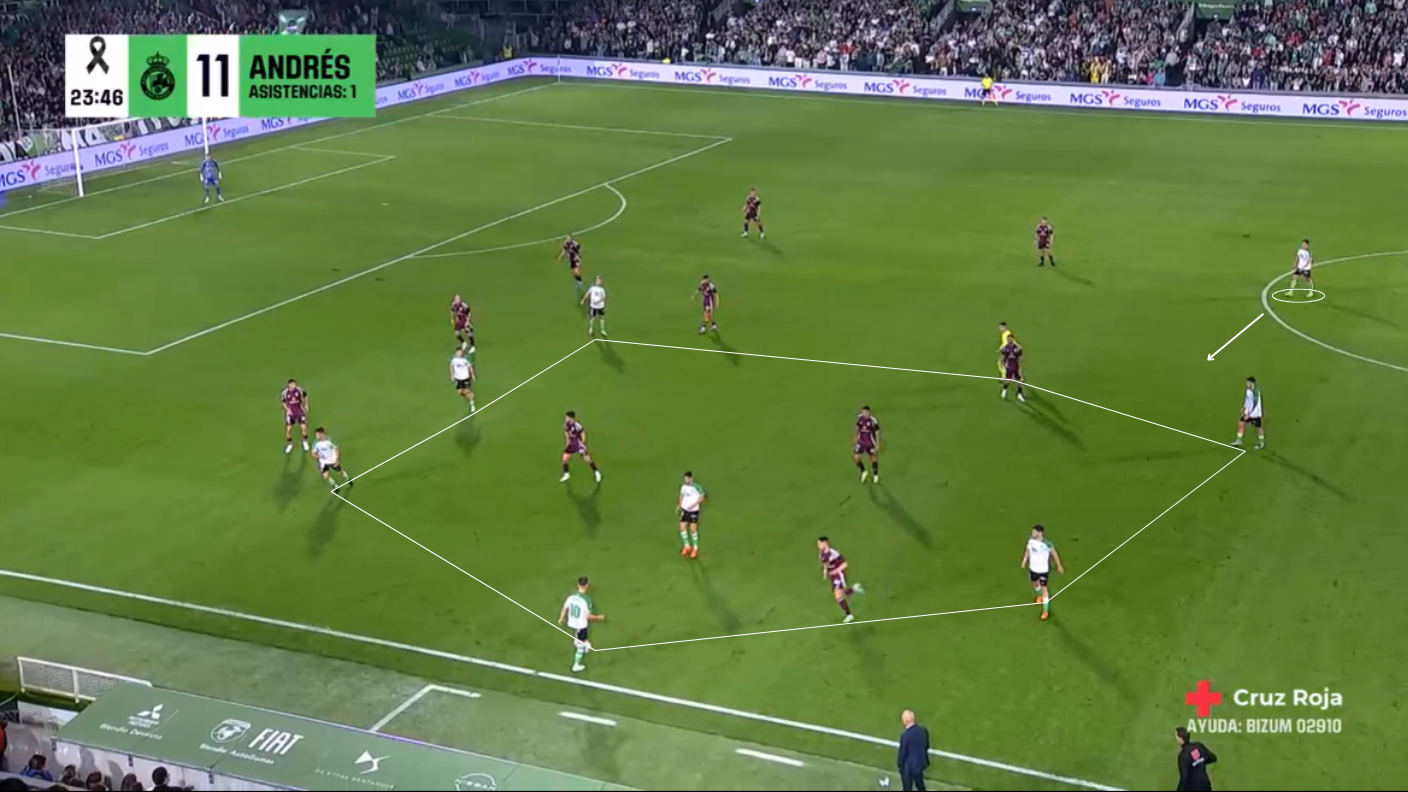
When in possession, Racing Santander’s players locate themselves as close as possible to exploit their relationships through short passes, quick off-the-ball movements, and individual quality.
The winger from the far side gets closer to the play, and one of the full-backs stays to do the rest defence in case of a turnover.
How Did Racing Santander’s Relationism Start?
The most interesting detail about this team is how José Alberto López’s Racing Santander started playing like this.
The coach did not wake up one day and say, ‘I want to play like this’.
All of this, as occurred with the origins of relationism, started organically and naturally.
“We have created this naturally.
I have been here for more than two years.
We have been developing our style of play progressively with time.
Time has allowed us to generate those relations between players to exploit our best potential and count on the best individual skills of every player.
If our left-winger can find the centre-forward, the attacking midfielder, and the right-winger at the same time—which is difficult because if you play from the positions, it is hard to see both wingers finding themselves—they can associate and enhance their strengths thanks to the instructions that we have built.
We have finishers, passers, associative players, and more individualists…. Because of these capacities, we looked for a way to locate them.
All of this has led to our game.
Then, we heard that Fernando Diniz at Fluminense was a coach who strongly emphasised relationism, but I wasn’t familiar with the philosophy.
This appeared spontaneously.
People told us, ‘You play like this’, and they were right.
Then, we started investigating to study which ideas we could take from other teams, like Rydtröm’s Malmö also, that had already played similarly, but we did not know this style.”
Racing Santander’s Ladders And Corta-Luz
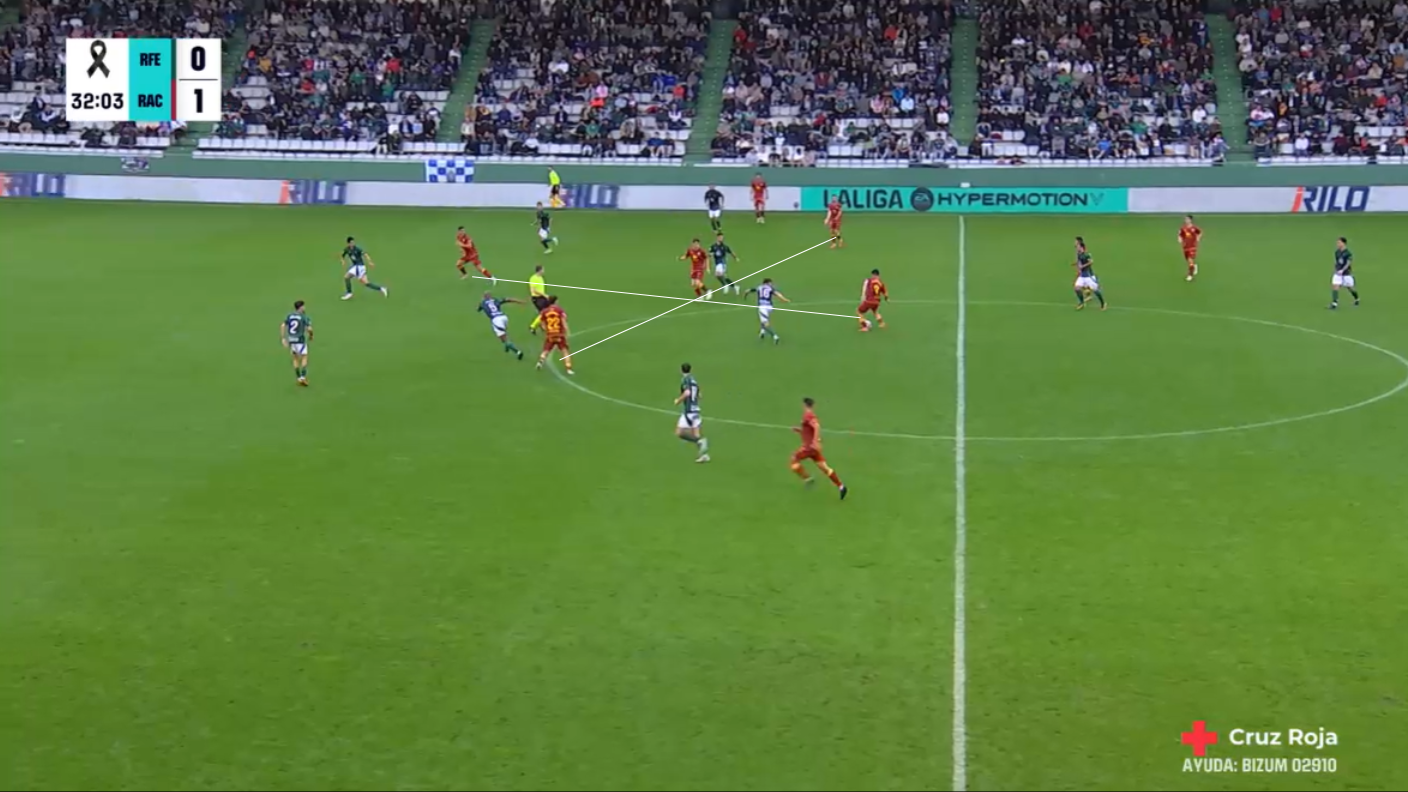
When a relationist team progresses, one of the most common patterns is the ladder.
Figure 2 shows that Racing makes two ladders with Íñigo Vicente as the axis.
Once this configuration happens, the tension of the first pass decides the tempo of the progress, sometimes causing a corta-luz—when a player lets the ball roll to the teammate forward and becomes an option in the next play.
Nevertheless, these types of automatisms are born naturally from the relationships of the players, and that is what happened here.
Insisting on the naturality of Real Racing Club de Santander’s development in possession, we asked José Alberto about how to train and become routine these patterns.
“Well… I did not even know before what was a ladder or a corta-luz.
We do not name those things.
In each phase of the game, we try to locate our players in the best possible way to progress, relate and generate as many clear goal opportunities as possible.
In the build-up, we have automatisms; progressing through the middle, we have other automatisms, and beating a low block, we have other ones — I’m still learning.”
Racing Santander’s Time Sequence
A relationist model is usually considered a dominant style of play.
We can affirm that Racing Santander is a dominant team.
Although they play with short passes and combinations, they do not dominate with long possessions.
Curiously, José Alberto López’s Racing Santander is the team with the fewest average time per offensive sequence.
Once they recover, they are aggressive and risky.
They do not want to maintain the ball, so we asked José Alberto about this.
“This has an explanation and you will understand easily.
In our style of play, short combinations are crucial, but the number of passes is not important to me.
If I ask my players to be different and they consistently attempt final passes, the likelihood of mistakes in those passes increases.
However, the outcome ultimately depends on the quality—and we have plenty of quality in the final third.
We accept that.
There is another metric—the majority of the goals are generated in possessions from four and eight passes; once we have made more than eight, the rivals are usually able to reorganise.
We want to attack fast.”
José Alberto López’s Racing Santander During The Defensive Phase
If we want to understand the why behind the rhythm of José Alberto López’s Racing Santander at the moment of attacking, we must deep-dive into the defensive phase.
As well as being the fastest team while attacking, they recover the ball faster than anyone—they are the team with the most counter-pressing recoveries in the opposition’s half from La Liga 2.
Racing Santander’s High Regains
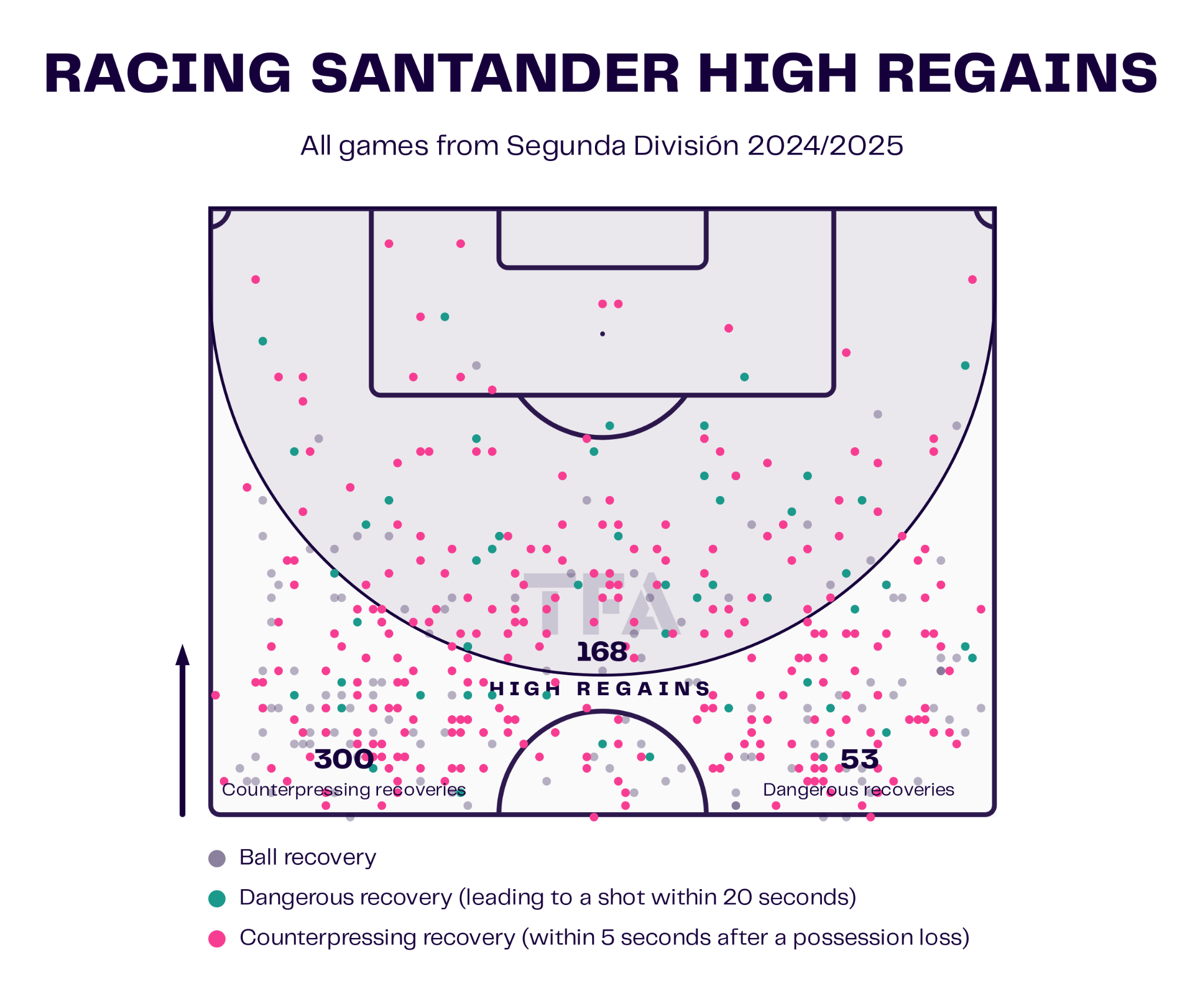
“There is another interesting metric—we are the team with the highest percentage of play in the opposition’s half, not only attacking but also defending.
We want to play in the opposition’s half and to do this, we must spend some defensive phases there.”
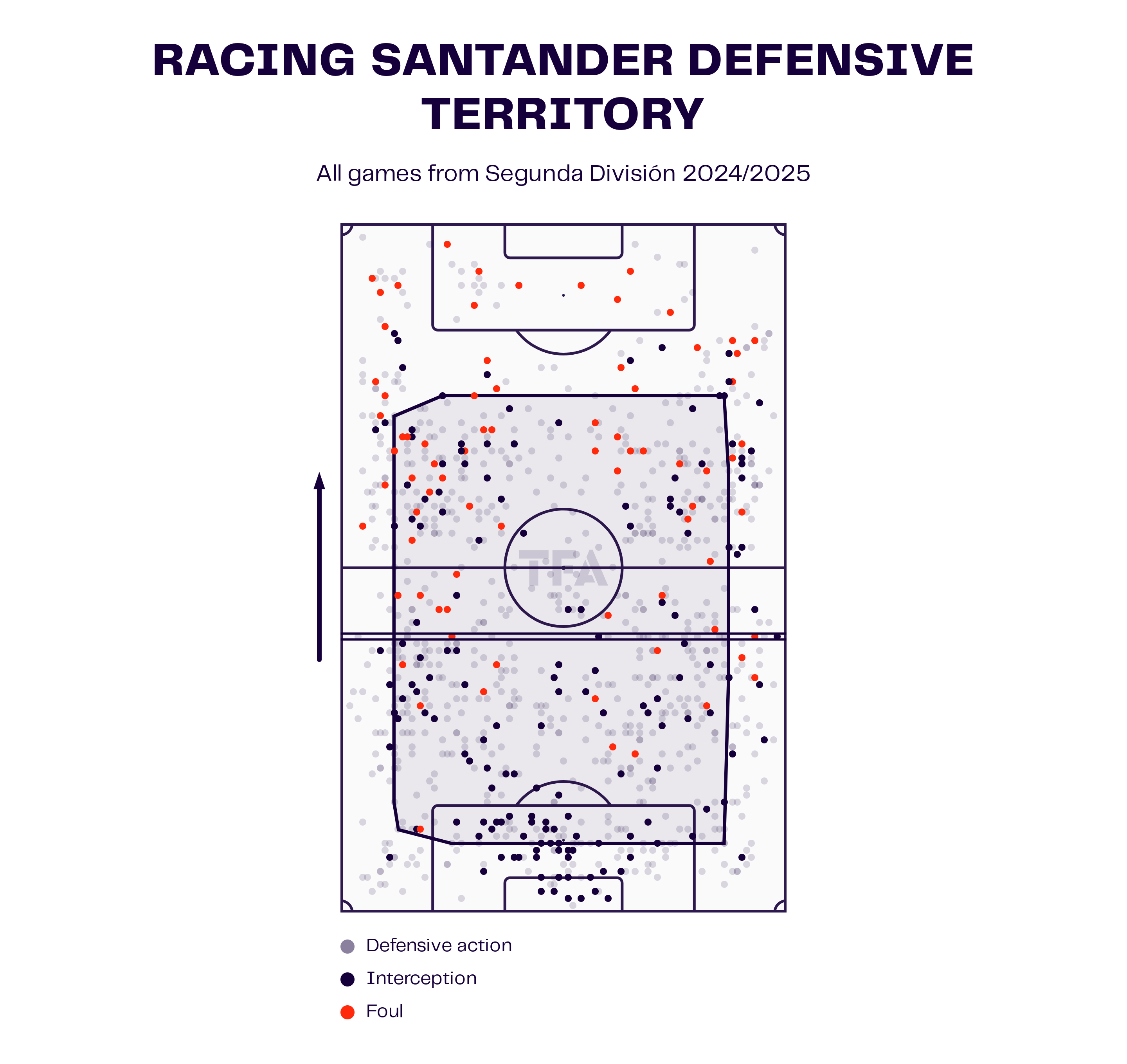
In this phase, José Alberto’s Racing Santander not only make aggressive and risky jumps in a man-oriented press, well they also position the defensive line high—the highest in the tournament—to be always close to their marks and use the offside trap as a tool.
José Alberto López Racing Santander Defensive Territory
Why the high line and the offside trap?
José Alberto explains:
“It’s about choosing how you want a team to attack you.
You can choose to let them attack you in a deep block, where you’ll mostly face box situations—defending crosses from wide areas, long-range shots, and dealing with second or third balls close to your goal.
Or you can choose to let them attack with fewer players involved.
Also, playing with a very high defensive line means there’s a lot of space behind your backline to recover, which buys you time.
So, many times, when we think defending with a high line is risky, it can actually be an advantage.
You have a lot of time to readjust.”
The offside trap has become almost a trend, too.
Hansi Flick’s Barcelona, for example, use it as a weapon to push themselves forward with the pressure.
They have good defenders in open-pitch actions and the work behind to perfect the height and synergy between the players to not break the line in specific sequences is heavy.
Something similar happens here.
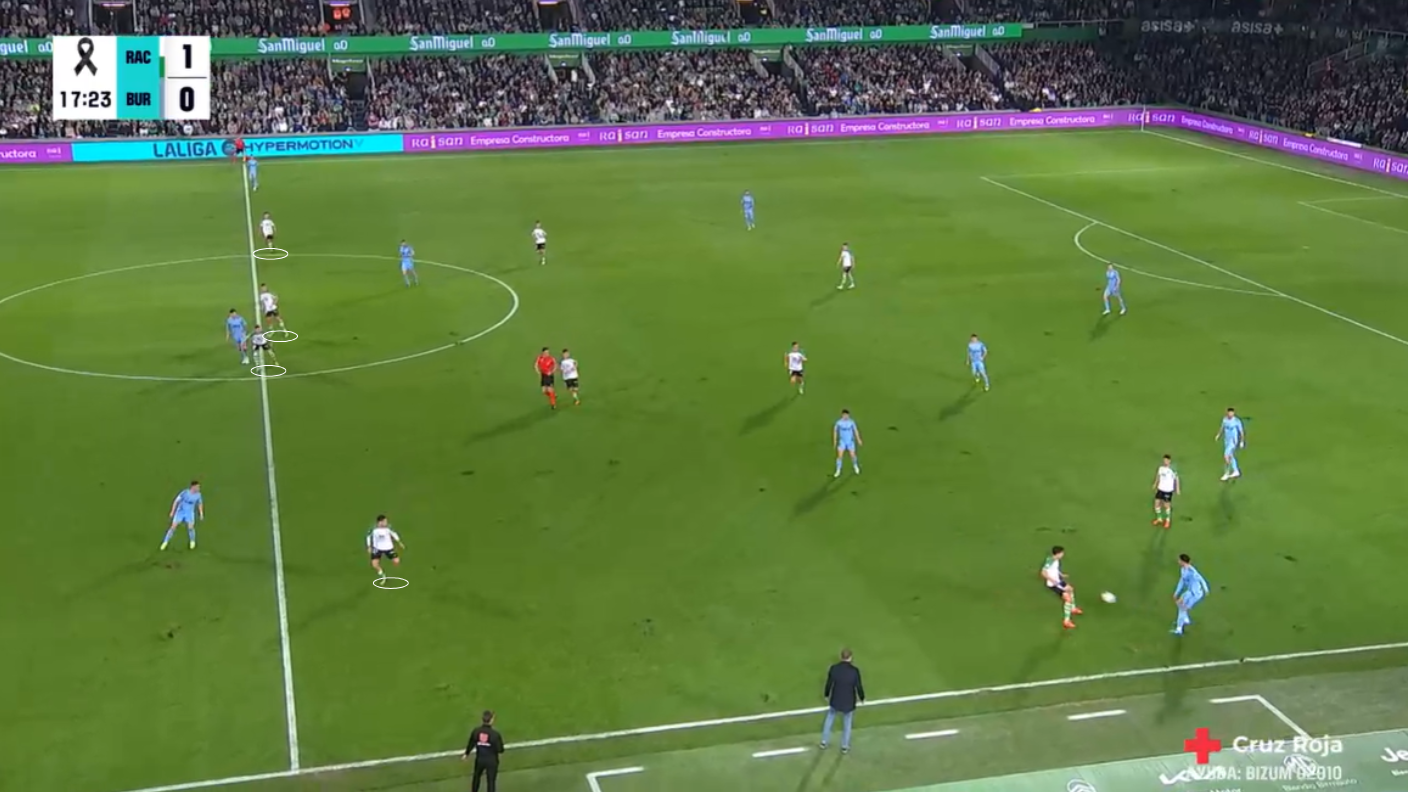
As Figure 5 shows, they tend to use the halfway line as the limit.
As we can see, both centre-backs are prepared to run back but are taking care of the coordination in the defensive line to avoid mismatches in crucial meters.
Specifically against Burgos, José Alberto deployed a braver defensive line, and his defenders were tested.
The Conviction
In possession, players from Spanish football are comfortable with positional models.
After losing the ball, many of them are used to running back to defend in mid/low-blocks.
So, maybe the most interesting collective detail in José Alberto López’s Racing Santander is the conviction and the bravery to make all of this ‘new’ model real.
“[On the high defensive line] It’s hard to convince the players to execute it.
There is a lot of training and video analysis work involved.
Not too long ago, we were winning 2-0 at home against Burgos, and three of the four defenders approached me and said, ‘We’re too exposed.’
We were not really that exposed; it’s just that playing with so much space behind you is challenging.
You have to convince them through hard work, through images and videos, that they can recognise situations like a covered or uncovered ball, a ball in the central channel, or a ball out wide.
There are a lot of different circumstances.
The key is to get the players fully convinced and able to identify those situations as quickly as possible to respond accordingly.
All of this, of course, while taking full responsibility as the coach.
For example, we conceded a goal away from home against Racing Ferrol due to the risks we took with the high line.
It’s the coach who has to assume responsibility for that—without blaming anyone.
The responsibility for playing with such an advanced line is mine, and the courage the players are showing in doing it deserves a lot of credit.
There is a lot of work behind it.
This is our style, our way of understanding the game, and it cannot change.”
Positional Play: The Determining Factor In Spanish Football
Offensively, in addition to the video and training, a way to convince the players is to emphasise the weaknesses of positional playing models.
“I have spent many years in the Segunda División and know well what opponents propose in this league.
Positional play, especially defensively, causes many opposing players to be pinned by their positions.
So, if you attack down the left flank, for example, the left-back and left-winger remain pinned on the opposite side [something we can see perfectly in Figure 1].
When you move your team to attack on the other side, there are already two players who will not defend.
That is where we’ve started to analyse, build, and establish relationships that allow us to attack and enhance combinations.
I think this is a general trait of Spanish football—all teams work based on positional play.
The players’ own positions determine and pin them down, and the same happens to us when we defend.
Because of these limitations within the positional play, you have to take risks and help the players see that it’s possible to attack differently—not just attacking into open spaces where the circulation becomes wider and easier to defend.”
Jokin Ezkieta Overperformance And The GK Training
Another curious detail about the team is that goalkeeper Jokin Ezkieta has been overperforming this season, according to xG metrics.
The 28-year-old has prevented 7.83 goals at the moment of writing.
However, we must consider that objective variables calculate the expected goals in a shoot—location of the shot/assist, foot or head, assist type, etc.
José Alberto also told us why he does not consider this metric to be alarming.
Jokin Ezkieta Shots Faced By GK
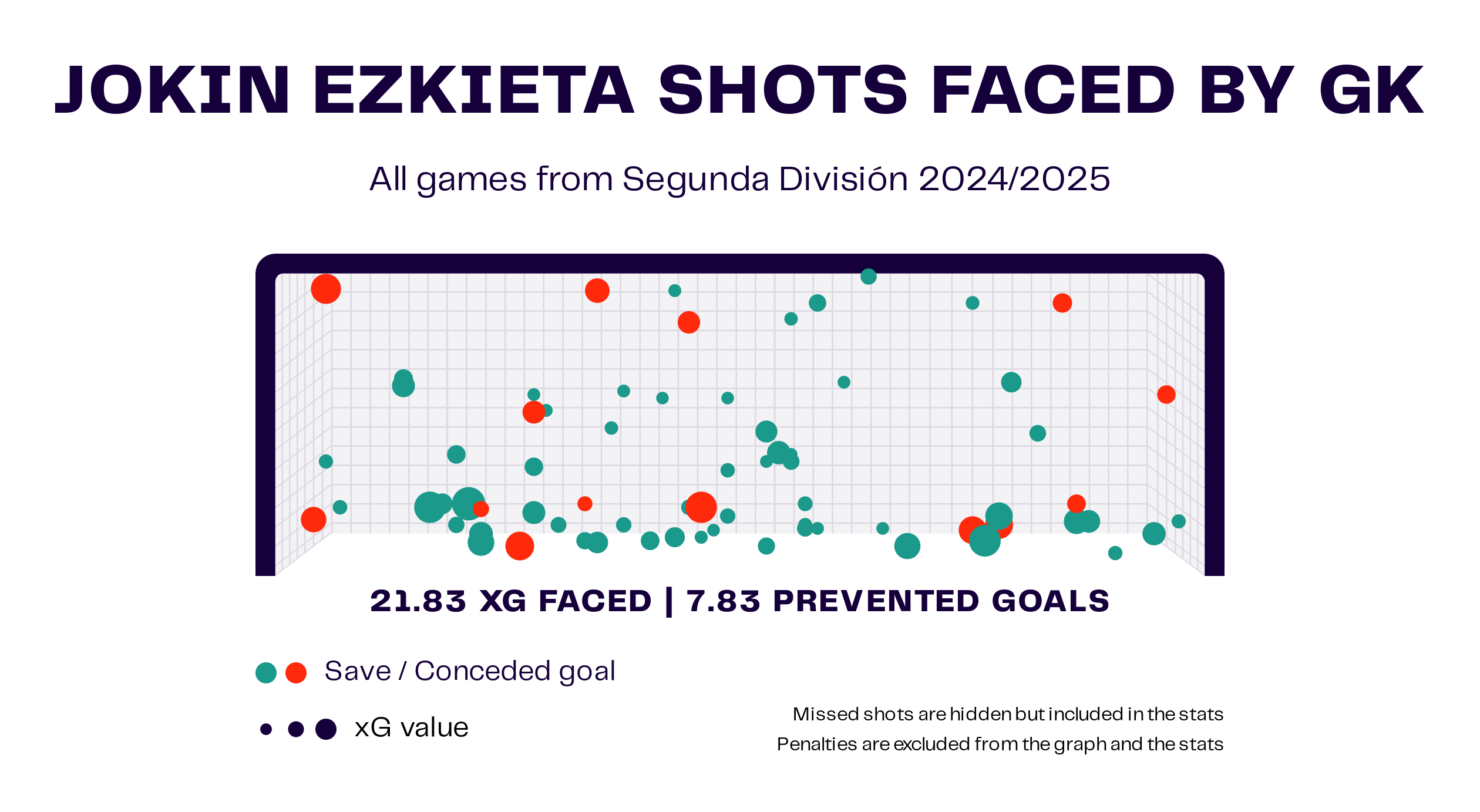
“I’m not overly concerned.
It’s about choosing how you want your opponents to finish their attacks.
We’ve chosen to let them finish in repetitive patterns, and our goalkeeper knows how we might concede goals.
Our goalkeeping coach prepares him specifically to try to prevent situations like 1v1s, shots from tight angles, and shots after low crosses are played to the near post in the space between the goalkeeper and the backline.”
Racing Santander’s Shots Against
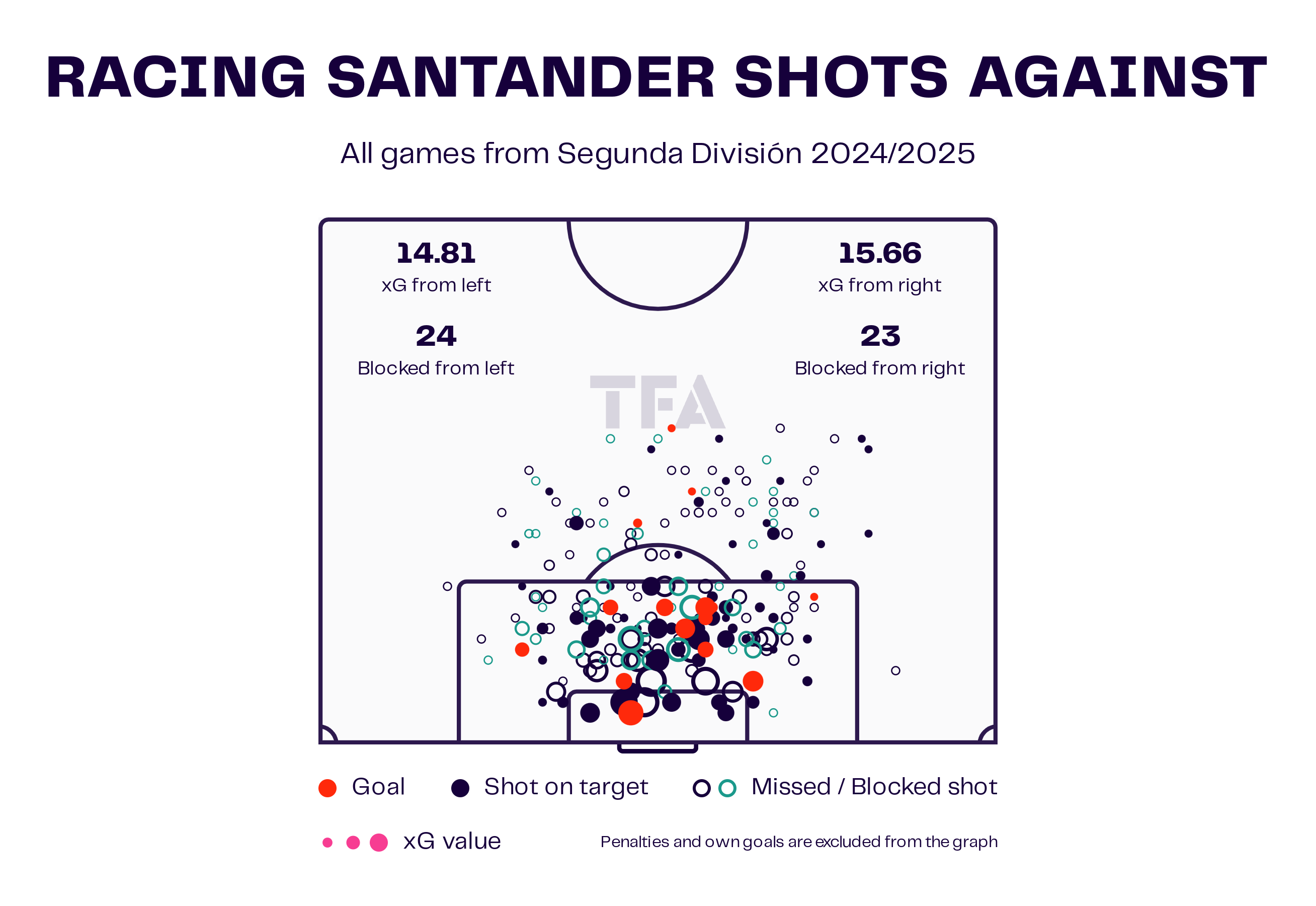
“Those types of actions can happen, and we work on them a lot.
By doing this, we accept that we will concede fewer goals than last season when we conceded far too many.
It was clear that we needed to change certain situations.
When deciding where to set your defensive line, understanding why you want to play that way is the most important thing.
Our defensive approach is proactive, defending forward so that when we recover the ball, we have enough players to find options quickly and transition effectively.
We’ve scored goals by recovering and playing.
After winning the ball back, finding an advanced teammate with the first touch is key.
When the opponent is spreading out and opening up, it often becomes much easier to score.”
José Alberto López, A Coach To Watch In 2025
What is happening at El Sardinero is a historical anomaly.
Although the results in the last two months were not the best, Racing are still favourites to be promoted to La Liga this year.
What is most important is how football reinvents itself in every part of the world.
Racing Santander keeps developing a unique style of play in the strangest place to do it.
Regarding the promotion, we recently asked José if he would maintain a similar model at La Liga, and his answer was blunt.
“100%, no doubts.”
Fernando Diniz at Cruzeiro, Henrik Rydström at Malmö, and Lionel Scaloni at Argentina are, more or less, a few examples of current-big-scenario coaches employing relationism in their squads.
José Alberto is another one, and he has the chance to be promoted to the first level in the country with the most UEFA Coach Licenses in the world with a counter-cultural methodology.
