
Raith Rovers FC have been home to one of the most interesting stories to come out of Scottish football this season.
The club haven’t been a part of the Scottish Premiership since the 1990s, having suffered their final relegation from the top tier in 1997 after shipping 73 goals and scoring just 29 in 36 league matches that season. Since then, they have shuffled between the Scottish First Division (now Scottish Championship) and Second Division (Scottish League One), coming close to getting back into the Premier League on only a couple of occasions. They notably finished third in the Championship in the 2020/21 season, qualifying for the playoffs. Rovers defeated Dunfermline Athletic 2-0 on aggregate in the quarterfinals but lost 3-1 to Dundee FC in the last four. This was followed by a fifth-placed finish in 2021/22, and last season; they finished a lowly seventh in Ian Murray‘s first campaign with the club.
Despite winning just 11 of their 36 league matches under Murray, which included no wins in their final seven games of the season, Rovers chose to keep Murray at the helm. A summer of change followed, with 15 players signed (10 free transfers and five loan deals), while ten players were sold. The result has been a massively improved campaign, with the team currently second in the Championship, having collected an excellent 58 points from 29 matches – already more than what they managed in five of their last seven completed seasons, with seven matches still to go. They are just one behind Dundee United, who have played a game more.
The key driver of this change has been a massively improved offence, which scored 49 goals, the third-highest mark in the league and more than what Rovers scored in their last three full seasons. What has led to this explosion upfront and where are the goals coming from? This tactical analysis will look at Murray’s impact and perform analysis of the key statistical changes and tactics used by this iteration of Raith Rovers FC.
Background
As mentioned earlier, Murray, 43, is a former footballer who spent his playing career largely across the Scottish football pyramid. He began his career with Dundee United, making it into their first team in 1998, before joining Hibernian on a free transfer the following year. After six seasons there, he spent two years with Rangers before moving to Norwich City in 2007. However, his spell there lasted just a year, and he returned to Hibernian in January 2008. After four-and-a-half years with the club, Murray joined Dumbarton in November 2012 after spending over four months without a club and eventually hung up his boots at the end of the 2013/14 season. He made 336 club appearances overall, with 289 of those coming in the Scottish Premiership (248 with Hibernian). Murray also played six times in the UEFA Champions League and won six caps for Scotland.
His management career notably began during his time with Dumbarton, as he was their player-manager from when he joined them until nearly a year after his retirement. In that time, he oversaw the team in 108 matches, winning 41 times before departing the club in May 2015. Murray then joined St. Mirren, but his spell lasted a mere seven months and 21 matches (five wins, six draws, 10 losses). He was then the assistant manager to Kevin Nicol between January 2017 and October 2018 after which he promptly joined Airdrieonians in the Scottish League One. Murray stayed with the club for nearly four years, leading them to 69 wins in 142 matches, twice falling at the final hurdle in their bid for promotion to the Championship. He left the club in May 2022 to join Raith Rovers.
What do the stats say about Raith Rovers FC’s improvements in 2023/24?
A quick look at the stats suggests that Murray’s men have simply gotten better at some of the things they were doing last season, as there aren’t too many standout improvements across fields.
Let’s start with their attacking output. Rovers are overperforming their expected goals (xG) tally for now but are still creating better chances than they did last season, resulting in the team scoring 49 league goals compared to 46 last season. A key reason for this is the team taking more shots from inside the box and getting more of those on target rather than firing away from the outside. Additionally, they have become marginally more proficient from corners. However, their ability to hit teams on the counter has dipped, and are recording more activity inside the penalty area as well.

As their shot-map for the 2023/24 Championship season (right) indicates, a large chunk of their shots has been from central areas around and ahead of the penalty spot, which usually gives them a better chance of finding the back of the net. Notice the difference in the volume of shots from outside the box and inside the six-yard area between last season and the ongoing campaign.

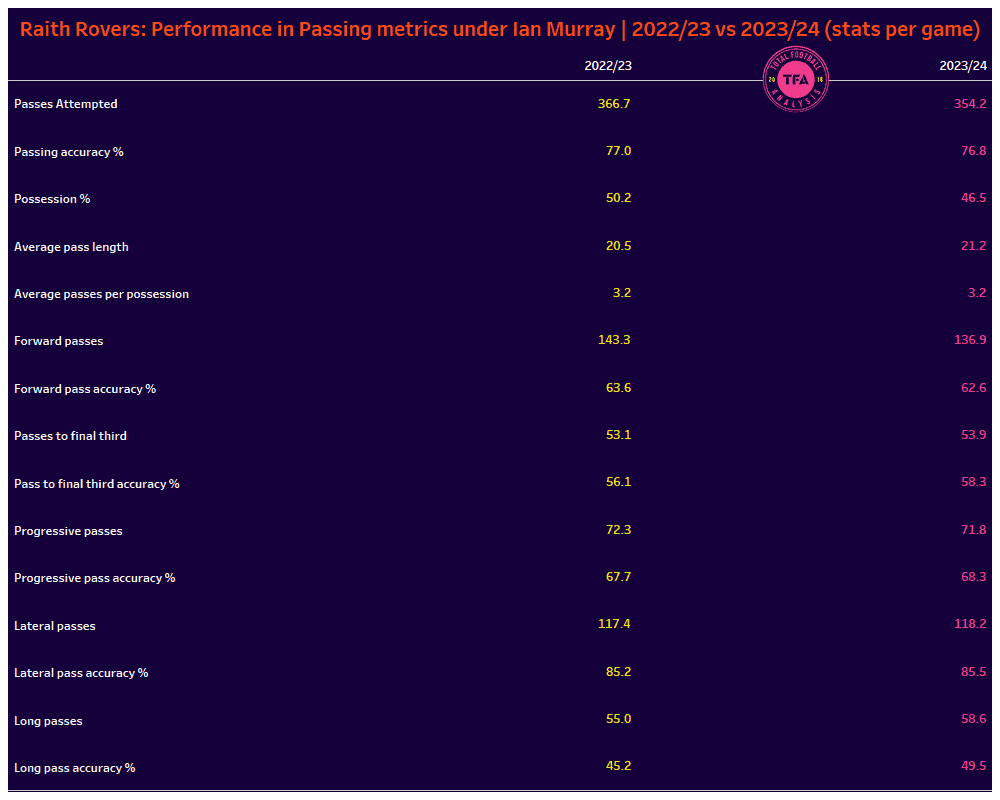
There are also differences in their passing stats when compared to last season. Murray’s men have enjoyed lesser possession this season, leading to fewer passes. As a result, they have been slightly more dependent on long passes, but they’ve adapted well to this as their long pass accuracy has gone up despite the increase in volume. Despite a drop in their volume of forward passes, interestingly, their passes to the final third per game have gone up, with improved accuracy as well, which once again hints at improved activity in and around the box. The combination of their long-ball exploits and final-third numbers suggests that Rovers can hurt opponents in various ways.
Formations and Personnel
This season, Rovers have largely utilised a four-man midfield and a four-man backline in a 4-1-3-2 or a 4-2-3-1 and have occasionally used a 4-4-2, 4-4-1-1 and 4-3-1-2 as well.
In goal, summer signing Maciej Debrowski has started 27 of their 29 Scottish Championship matches. Liam Dick has been a constant at left-back, while the right-back slot has been a toss-up between Ross Millen, Josh Mullin (who can also operate on the right wing and in midfield) and, more recently, James Brown. Another summer arrival in Euan Murray has played the most minutes at centre-back, with Scott Brown, Keith Watson and Daniel O’Reilly partnering him at various points during the season.
The holding and central midfield roles have also been a bit of a toss-up, with Shaun Byrne, Brown, Sam Stanton and Scott McGill receiving minutes there. At the same time, Dylan Easton and Aaron Connolly, in addition to operating as wingers when required, have also played as wide midfielders in certain formations. Stanton has often been deployed as a 10 as well, while centre-forward and top-scorer Lewis Vaughan, who has also played as a 10, has featured in all 29 league games for Rovers this season. Vaughan has had Jack Hamilton and Callum Smith for company in two-man frontlines.
Another forward, Jamie Gullan has been Murray’s most-used substitute, with 15 appearances off the bench. Easton and Connolly are behind him on 10, and Smith and Hamilton are next with nine apiece.
Thus, this season’s Raith Rovers have been defined by versatility, with numerous players capable of playing across positions.
Attacking Shape
As the heatmap below shows, much of Rovers’ activity is concentrated in half-spaces within their own half. When they move beyond the halfway line, they tend to move the ball out wide rather than look to attack teams through central areas.

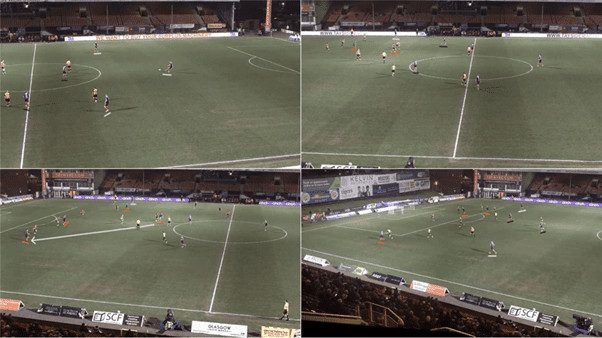
This comes through when we look at in-match footage as well. In terms of build-up, Murray has set up his team in a couple of different ways this season. One of those methods is to begin possessions from their own half with a three-man backline, with one of the full-backs pushing up high and wide. A holding midfielder drops back to help with getting the ball forward while the other looks for gaps within the opposition’s defensive lines.
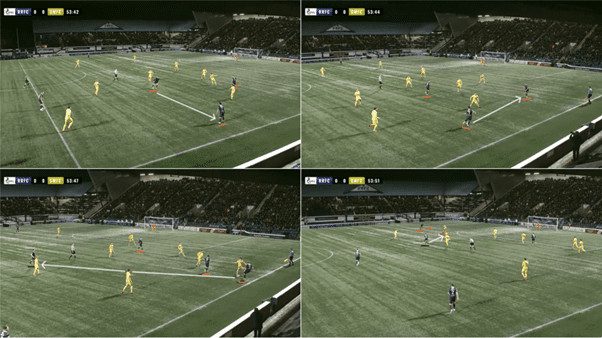
An example of this can be seen in this sequence from their 1-0 win over Partick Thistle. Notice how one of the forwards (marked in orange) also drops back to assist with the play, which initially involves passes between the defenders (white) and midfielders (black). This helps Rovers move the ball to the wing. There is no overlapping by the full-back on this occasion, with a larger emphasis on getting men into the box.
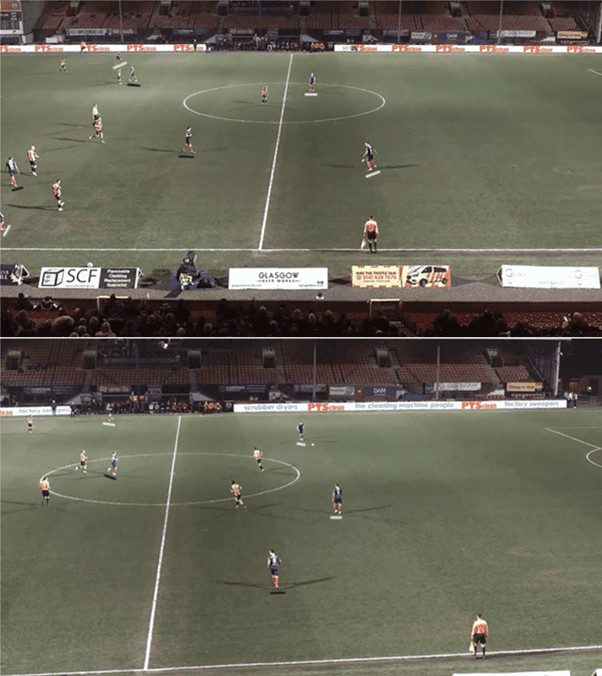
Just seconds later, we see another form of build-up. Raith kickstarts the move with just two central defenders, as both full-backs remain wider up the pitch. One of the midfielders drops back to assist with build-up play, with the team looking to engage their opponents out wide instead of centrally.
Let’s now see how they move the ball when they start from the goalkeeper.
In the sequence below from their 0-0 draw with Greenrock Morton, the goalkeeper rolls the ball to the centre-back, who passes it wide. One of the midfielders runs across to collect the ball on the half-turn before finding an attacker dropping back, as in the case above as well. From here, they move the ball back out to the right before finding the attacker furthest forward, dragging the defenders to a more central zone.
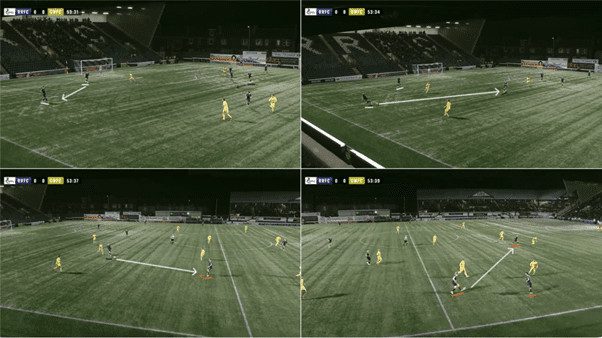
Raith then manage to find the open man on the right, who has time to pick a pass to an onrushing midfielder. He then tries to slip the left winger in, but his pass is underhit and intercepted.
As described in the previous section, Murray’s personnel are versatile. Many of them can play with their backs turned to the goal and then turn with the ball upon collecting it. Their wingers, in addition to crossing, are also good with their passes as they are able midfielders, which allows them to mix things up in the final third.
This section will also analyse a final sequence from the draw with Morton, where their off-the-ball movement stands out. Morton seems to have backed them into a corner on the left wing. Still, some smart movement and the creation of a passing triangle help Rovers move the defence around before switching it to the right after dragging the opposition out of position.
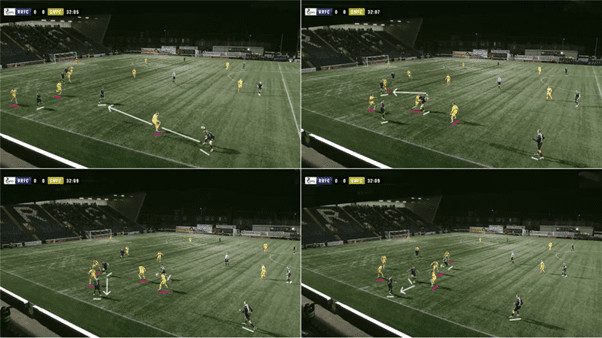

It’s worth noting how the move begins as a battle between three players from each team, and even when a fourth Rovers player drops back, he is followed by another Morton defender. However, the fourth man plays a pass and then runs back towards the box, pulling one defender with him and leaving another one confused. This, along with two other forwards dropping into the vacated space and calling for the ball, allows a 3v3 to eventually become a 3v1 thanks to the triangle, and the ball is easily shifted to the other side.
All three of these sequences highlight distinct features of Rovers’ attacking play under Murray this season. In addition to a preference for the wide areas, they know how to work the ball out of there and occasionally spring a pass to the middle. Their off-the-ball movement has been vital to initiating moves in the middle and final third, while their centre-backs play a pronounced role from close to the halfway line to get them on their way in the build-up.
Goals and Goalscorers
Vaughan is the Raith Rovers’ leading scorer this season with 12 strikes. The 28-year-old is a threat on multiple levels, scoring seven goals with his stronger right foot, two with his left and three with his head. He has been a clinical finisher, getting his goals from an xG of just 8.14 while getting 51.6% of his shots on target.
Consider his goal from Rovers’ 3-2 defeat to Inverness, which also displays some of the team’s best qualities. It begins from the left flank, with the left-back passing into the centre. Vaughan initially engages and drags a defender with him but then changes direction, with his off-the-ball movement causing some confusion. This allows the ball to go through to Zak Rudden, who flicks it on. The entire defence is caught off guard, and Vaughan latches onto the ball and dribbles forward before opening up his body and finishing with his right foot.
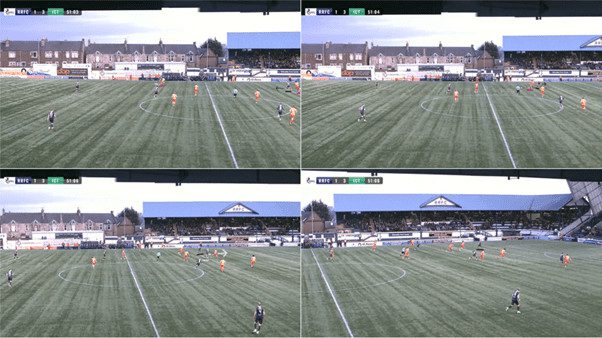
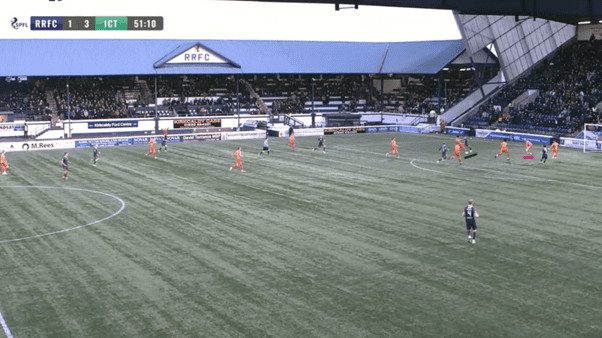
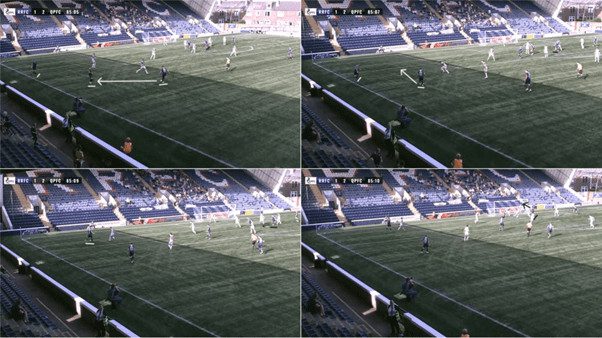
In this goal below against Queen’s Park, Vaughan shows brilliant movement to get between the centre-backs and ahead of his marker to nod the ball home after some excellent combination play on the wing. While the opposition failing to close down spaces is a crucial part of this move, the passing on the left is a feature of Rovers’ play, as explored earlier, and the cross from Connolly is brilliant.
Easton is Rovers’ next-highest scorer with seven goals. He, too, has massively overperformed his xG, which is only 3.14, while getting 40.9% of his shots on target. The 29-year-old provides a different dimension to his side’s attack as over half of his 44 shots in the league this season have been from outside the box (24); eight of those have been on target, and two have ended up in the back of the net.
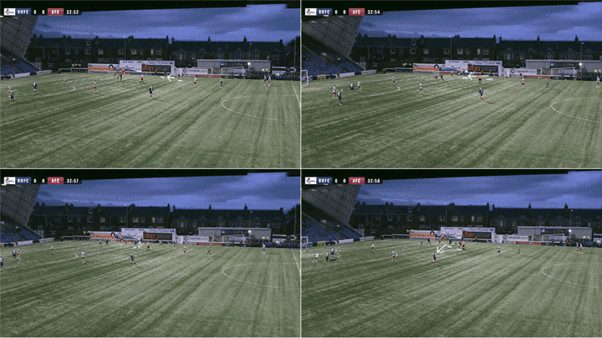
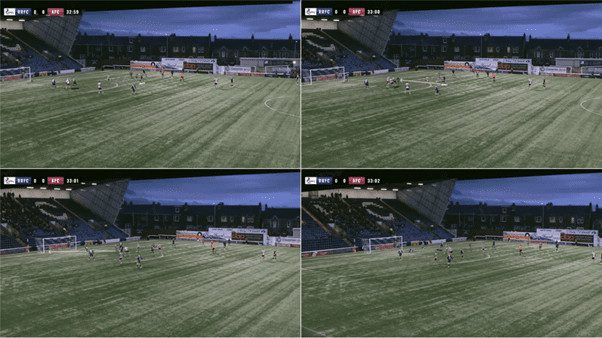
However, Easton can also burst into the box to finish moves, like in the sequence below, where he polishes off a superb team move that originates from the right wing with a precise right-footed shot into the bottom corner. His off-the-ball movement is fantastic here, while the intricate passing is once again indicative of Rovers’ style under Murray this season.
Conclusion
This season, Raith Rovers FC’s revival has been a joy to watch, with Murray taking their attack to a level few could have expected. Their new offence has been driven by intricate passing; wing plays with variety, and excellent off-the-ball movement. Rovers’ promotion push is evidently on its way, and their clash against league leaders Dundee United this weekend could potentially see them win the Championship themselves as they look to make it back into the Premiership.
However, regardless of whether they defeat Dundee or not, the club have given fans plenty of reasons for optimism and with Murray at the helm and this system in place, there is reason to believe that the future is bright.
