
Who Is Freyr Alexandersson?
Kortrijk are in the midst of a season that almost seems destined to end in relegation.
The club currently sit bottom of the Belgian Pro League, 11 points from safety.
They are also on their third permanent manager of the season, with former Iceland women’s national team and Lyngby Boldklub boss Freyr Alexandersson being appointed over the winter break.
The 41-year-old Icelander is now tasked with the seemingly impossible mission of saving the West Flanders side from relegation to the Challenger Pro League.
This tactical analysis will look at some of Alexandersson’s tactics from his previous managerial stop in Denmark with Lyngby, giving Kortrijk fans, as well as Belgian football fans, a good idea of what to expect from Kortrijk under the 41-year-old.
Freyr Alexandersson Preferred formations
When it comes to a preferred formation for Freyr Alexandersson during his time at Lyngby, the 41-year-old tended to play with either a back five or a back three.
In his first season (2021), Lyngby were among the strongest teams in the Danish second division.
This allowed Alexandersson to mainly play with a 3-5-2 system, allowing Lyngby to consistently be on the attack and not need to be as worried, leaving gaps in behind the defence, with this campaign resulting in promotion to the Superliga.
However, the last two seasons in the Superliga have forced the 41-year-old coach to adopt a more back-five approach, with Lyngby usually playing a 5-3-2 in this period.
However, a 3-5-2 was still utilised relatively often, while an occasional switch to a back four has also happened, though much rarer.
At Kortrijk, a switch to a 5-3-2 looks like the likely outcome, at least initially, with the Belgian side currently having the worst defensive record in the Belgian top flight.
However, goal scoring is also a major problem, with Kortrijk’s 12 goals through 20 matches this season far and away the worst in Belgium.
While scoring goals is a crucial part of the game, keeping them out at the other end is often more critical for a team struggling as bad as Kortrijk are.
The goals will come, but Freyr Alexandersson’s first order of business should be shoring up a defence statistically near the bottom in almost every major defensive category in Belgium.
Defending as a unit, looking to force the opposition long
As we mentioned briefly in the previous section, one of the first problems Kortrijk needs to address is its defensive ability.
At Lyngby, Alexandersson’s side also did not have the best defence, with the Danish club being near the bottom of the table in terms of goals conceded over the past two seasons in the top flight.
However, one key trait of Lyngby’s defense is its ability to defend as a unit.
This is something that has been lacking at Kortrijk, with poor communication and poor defensive positioning leading to poorly conceded goals.
While Lyngby still struggled defensively at times under Alexandersson, their constant communication and tendency to try and get into the correct defensive positions helped the side.
This season in the Danish Superliga, Lyngby have the fifth-highest shots against total, with 216.
However, their 65 shots blocked are the second most in the division, showing their willingness to get in the way of shots and throw their bodies in front of the ball to prevent shots on target.

The data viz graphic above shows Lyngby’s average defensive territory this season under Freyr Alexandersson.
As we can see, the Danish side have been active in all areas of the pitch from a defensive perspective.
They have looked to press high and defend from the front while also sitting back if they need to absorb pressure.
They have also looked to eliminate opposition sides from playing through the middle of the pitch, with his Lyngby side aiming to force the opposition to play the ball long into the back five.
His Lyngby side looked to engage the opposition in all areas of the pitch instead of sitting back and attempting to absorb opposition pressure, something that he will likely look to employ to fix Kortrijk’s defence.

We discussed Freyr Alexandersson’s Lyngby side earlier: their constant communication and constant tendency to shift and slide to get into more favourable defensive positions or to cover for a teammate.
This phase of play above against Silkeborg shows a good example of this in action.
Though the back five are not in the picture, we can easily see the 5-3-2 shape that the Icelander prefers to utilise.
One thing to notice is the compactness of the Lyngby midfield three and front two, with these five players able to block the passing lanes to the two Silkeborg players in the centre of the park.
Another thing this example shows is the communication and the ability of the side to shift to cover for players.
In this phase, the outside centre-back for Silkeborg is looking to dribble into midfield, with Tochi Chukwueni releasing to engage the player.
His two midfield partners do well to shift and cover this space, with the forwards also shifting to continue blocking the passing channels centrally.
This forces the Silkeborg defender to play a ball over the top as his only progressive passing option, something that the Lyngby defence does well to anticipate and defend against.
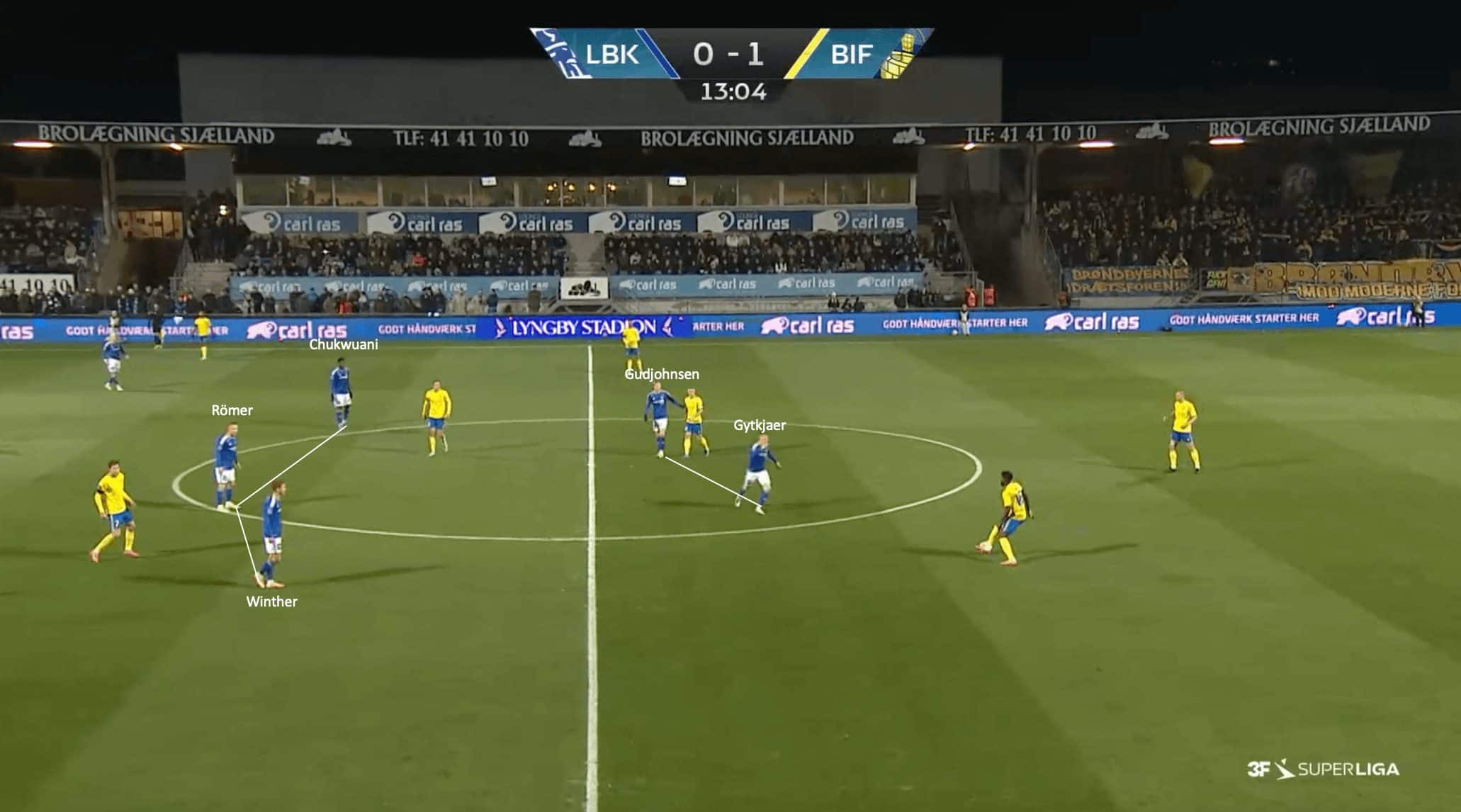
The figure above shows another example of this defensive shape and work rate as a unit, this time against one of the strongest teams in the Danish Superliga, Brøndby.
As we can see from the image, Lyngby are operating in the same 5-3-2 shape, with the midfield and forward lines staying tight and compact to block off any progressive passes into the central areas.
However, this frees up the wide spaces to be attacked, with Brøndby switching the point of attack to the outside central defender on the far side.
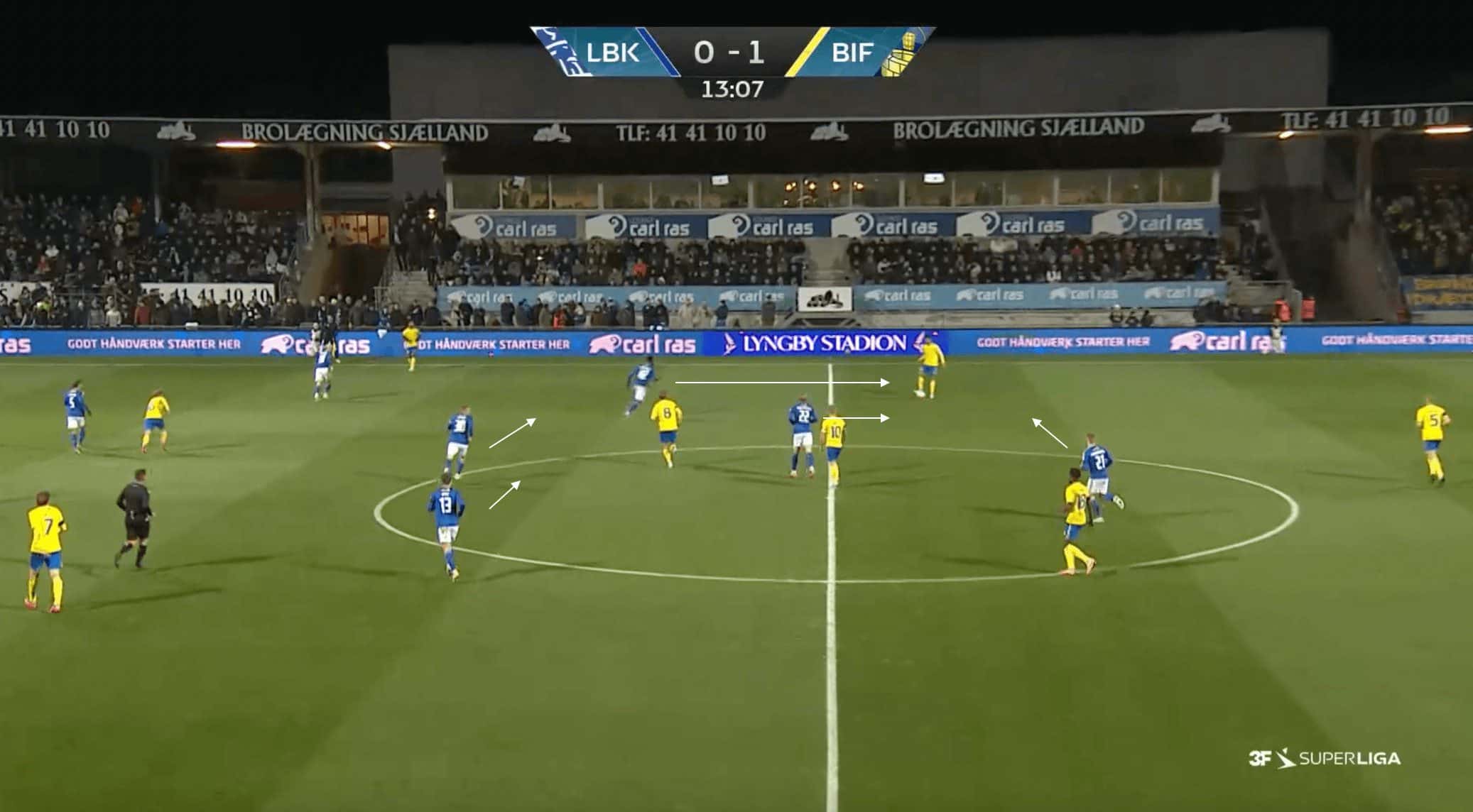
The figure above shows the movement of the Lyngby front five when the ball is rotated to this far side.
Chukwueni releases to engage the centre-back, with the other two central midfielders sliding to cover the space that he leaves, as well as eliminating the potential line-breaking pass to the Brøndby forward, who is looking to drop off the back line into the pocket of space.
This forces the centre-back to play backwards, allowing the Lyngby defence to get higher up the pitch and potentially win possession back in an advanced area.
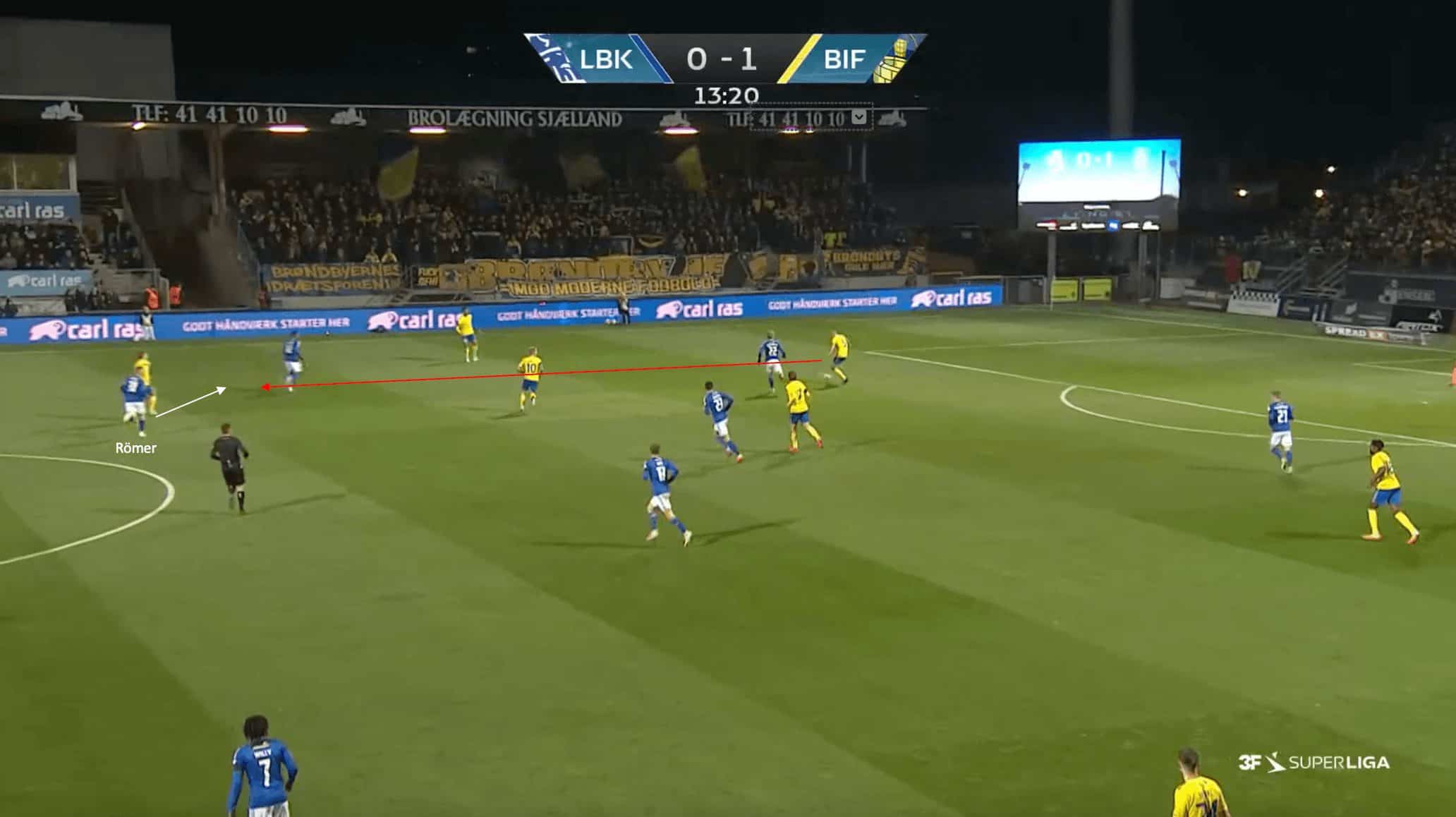
The end result is shown above, with Lyngby able to press higher and force Brøndby into a turnover inside their own defensive half.
With the centre-back put under pressure, he forces a pass into the central area towards a teammate, not noticing Lyngby captain Marcel Römer in a position to jump the passing lane and intercept the pass.
This is what happens: Lyngby can start an attack with a 6v5 advantage in the opposition half, all originating from their tight, compact defensive shape and positional intelligence.
As this section has illustrated, while Freyr Alexandersson did not possess one of the best defences in the league at Lyngby, he was able to find success with his squad on the defensive side.
A lot of this came down to the factors we discussed throughout this section: being tight and compact, constant communication, looking to force the opposition long, and positional rotations.
If Alexandersson can implement these tactical ideas at Kortrijk, there is a chance he could fix their leaky defence and give them a better chance of staying up.
Freyr Alexandersson Direct style of attack, emphasis on width
When it comes to how Freyr Alexandersson may want his Kortrijk side to attack, it likely won’t be a possession-oriented style.
During his season and a half in charge of Lyngby in the Superliga, Alexandersson’s side averaged 45.8% and 46.7%, respectively.
His Lyngby side tended to create most of its chances on counterattacks, with width playing a big part in how the Icelander creates them.
When it comes to crossing, Lyngby finished the 2022/23 campaign in the Superliga with the 4th most crosses.
However, they were not the most accurate, with Lyngby finishing second-lowest in crossing accuracy in the Superliga.
The same has been true in this campaign, with Lyngby currently playing the 4th-highest number of crosses in the league and also posting better accuracy.
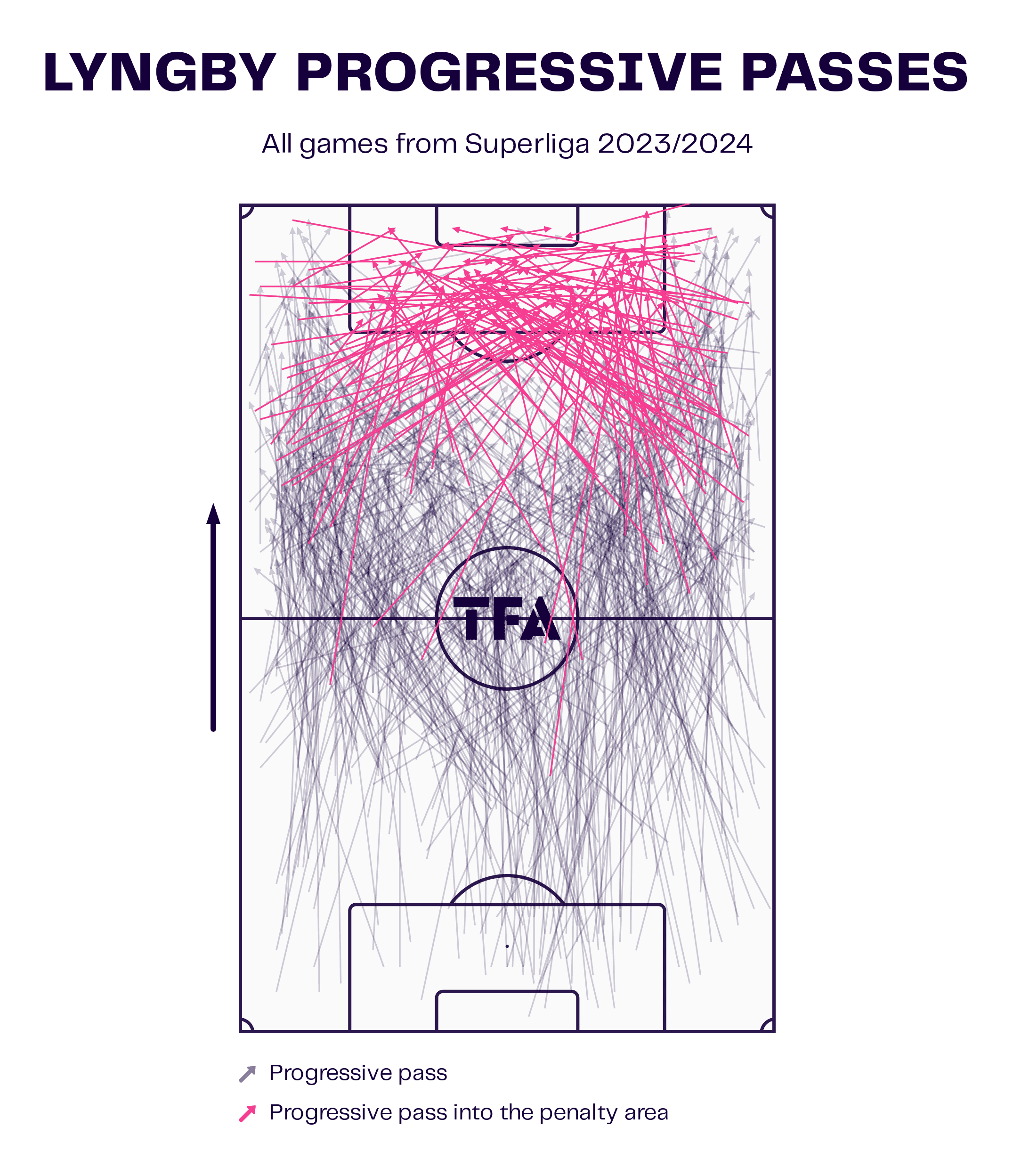
The data viz graphic above shows Lyngby’s progressive passes so far this season, highlighting their tendency to play direct under Alexandersson.
This graphic also shows Alexandersson’s emphasis on wide play, with a vast majority of their progressive passes into the penalty area this season coming from these wide areas.
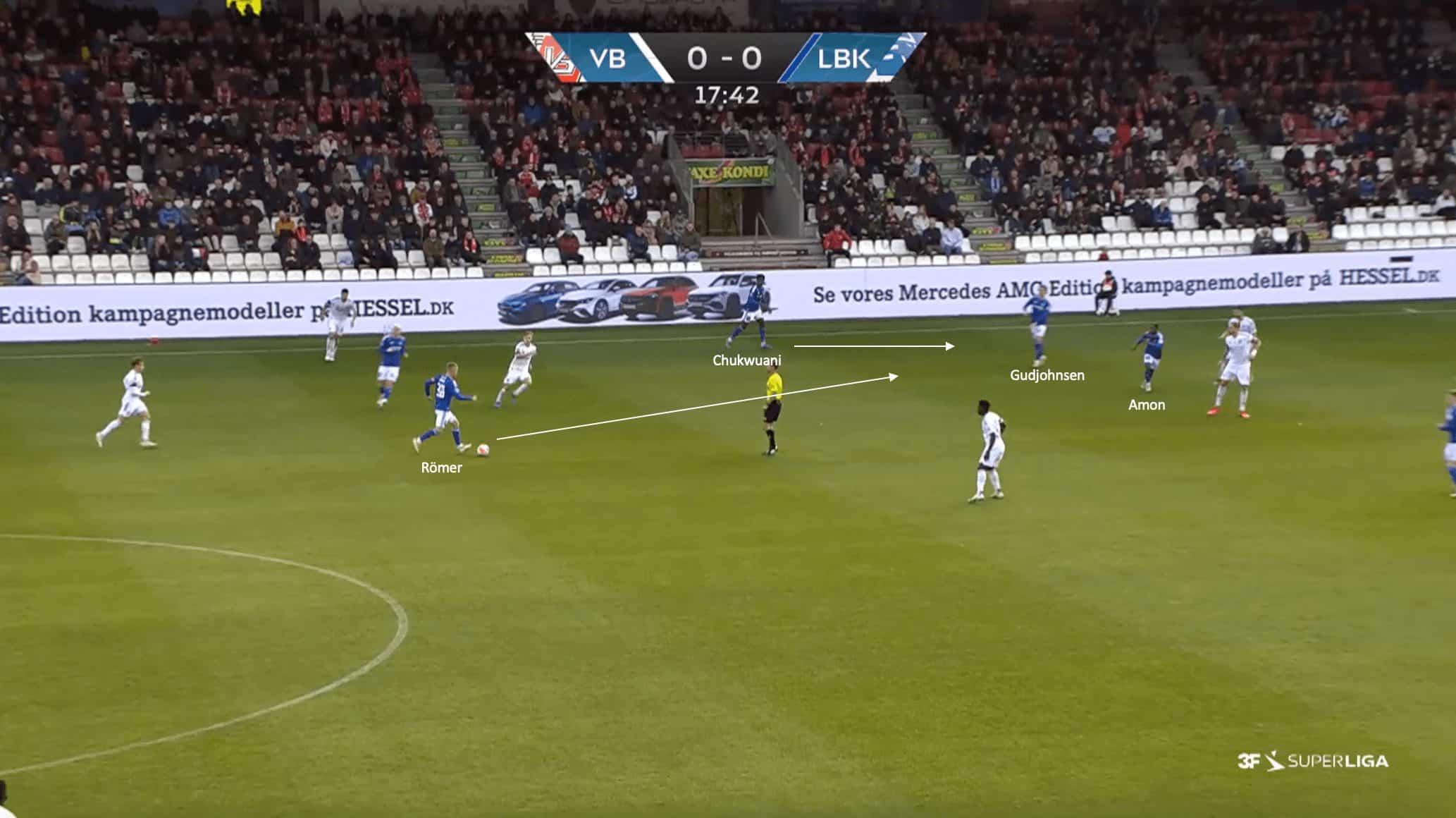
The image above shows an example of how Alexandersson looks for his side to exploit the wide channels when they are in possession.
In this phase of play against Velje, Lyngby regained possession in the middle third.
The ball is in possession of Römer, with the outside central midfielder, Chukwuani, advancing down the left touchline.
His movement creates an overload against the Velje defence, with the Lyngby captain able to play a ball into the path of the midfielder’s run.
Chukwuani is able to get onto the end of the pass, driving towards the byline before sending a cross into the penalty box.
Unfortunately, there are no end-product results for the Danish Superliga side.
However, this example gives a good idea of what Alexandersson may often utilise with his Kortrijk side.
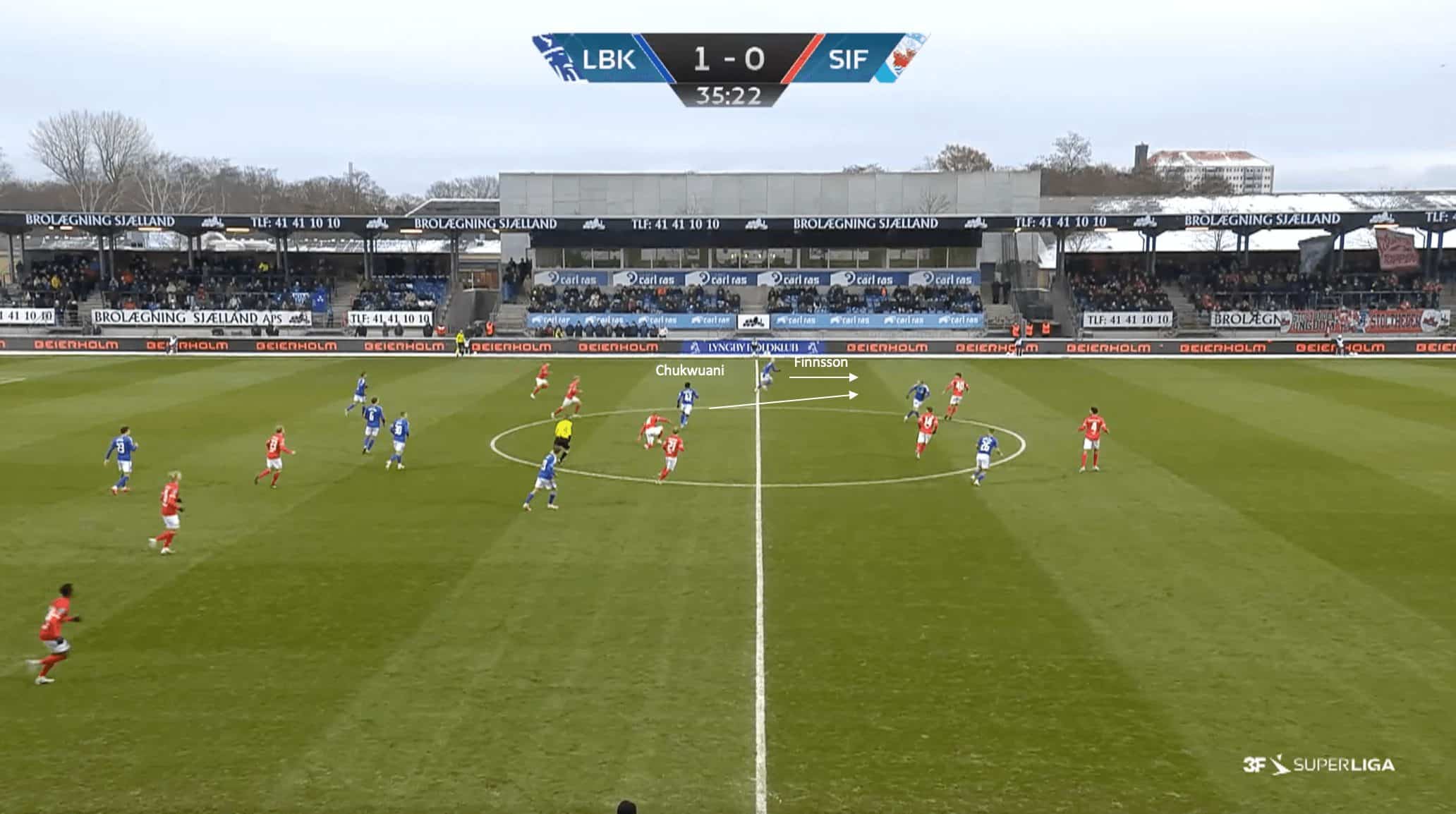
The image above actually shows a similar example to the previous figure.
In this phase of play against Silkeborg, Chukwuani regains possession in the middle third, with an advanced movement into the space wide by the left wingback, former Borussia Dortmund II player Kolbeinn Finnsson.
The midfielder plays a ball into the space out wide, with Finnsson able to run onto the through pass and drive towards the opposition penalty area.
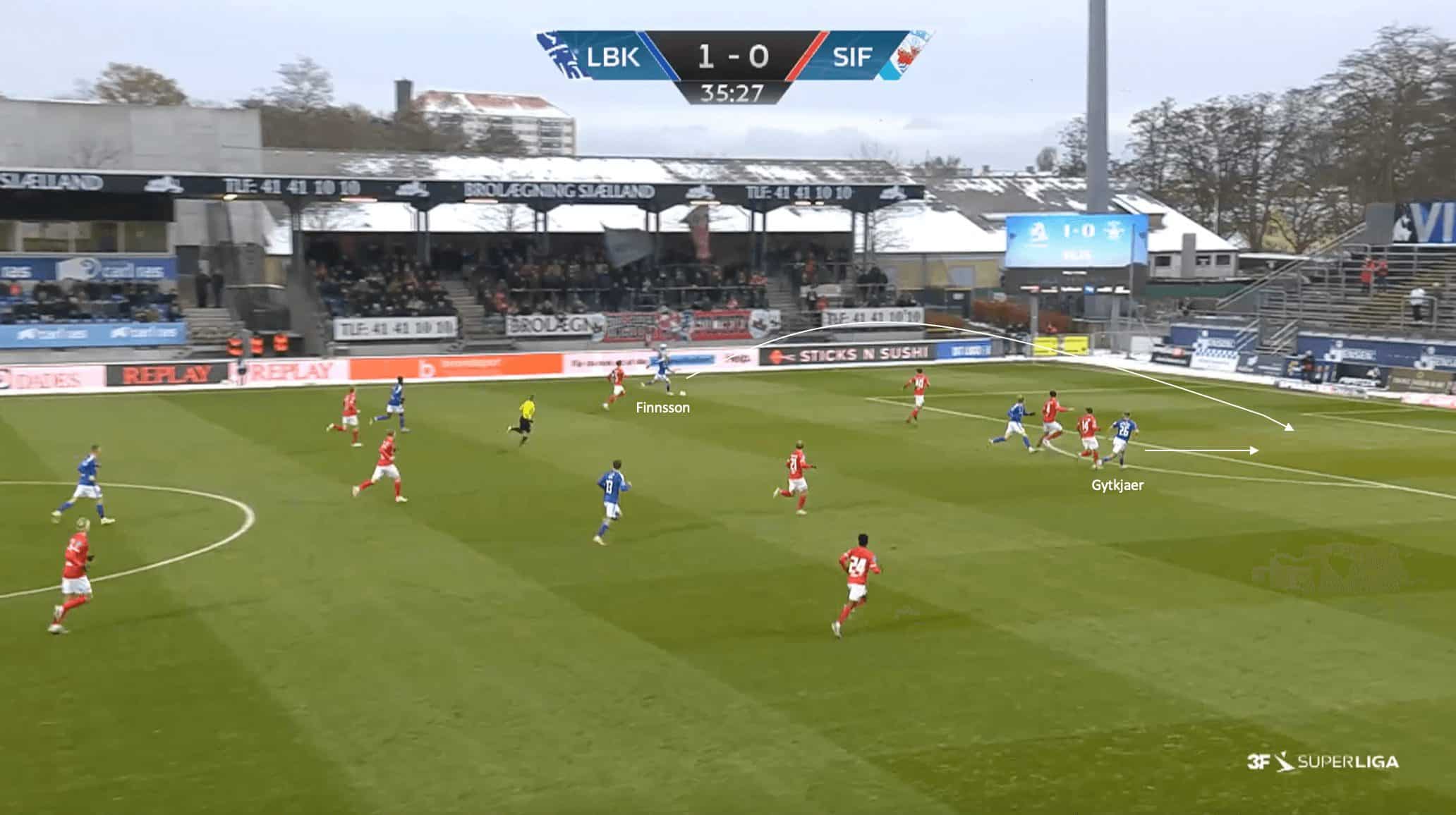
The next figure shows what happens as the Lyngby attacking phase develops.
As we can see, Finnsson could drive towards the edge of the Silkeborg penalty box before having to send an early cross into the box due to the defender approaching.
The ensuing cross is able to find Gytkjaer at the back post, but the striker’s touch lets him down, with the ball bouncing off him and out of play for a goal kick for Silkeborg.
Though nothing results, it again shows what Freyr Alexandersson is likely to want his Kortrijk side to do after winning possession in either the middle or the attacking third of the pitch.
Freyr Alexandersson Set Piece Analysis
Set pieces can be a game-changer, especially when a side is good at them.
Well, in the case of Lyngby under Freyr Alexandersson, they are very good.
In the last season and a half in the Danish Superliga, Lyngby have scored the most goals from corners, with 13.
This section will take a brief look at some of the goals scored off corners by Lyngby, examining similarities and where Alexandersson finds success.
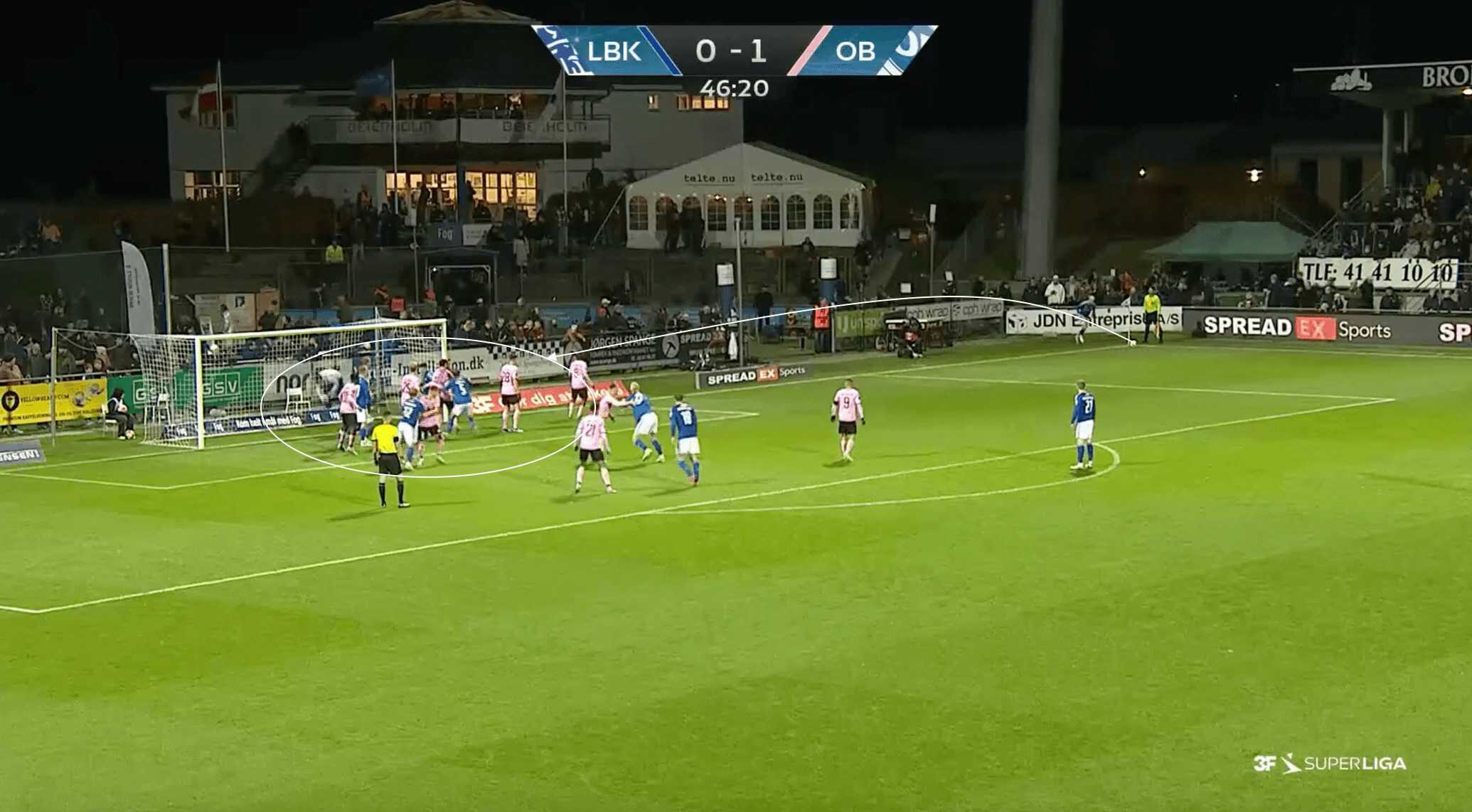
There are usually two variations that Freyr Alexandersson has used at Lyngby to great success.
The first variation is shown above, with Lyngby looking to crowd the goalkeeper.
In this specific example, the ball is whipped in towards the near post, resulting in an own goal as the opposition defender inadvertently heads into his own net.
Also, as the ball is played in, a couple of the players in the pack break off and back off the line, looking to play either the second ball or a mishit corner aimed more towards the penalty spot.
To summarise, this attacking corner setup looks to cause chaos inside the 6-yard box.
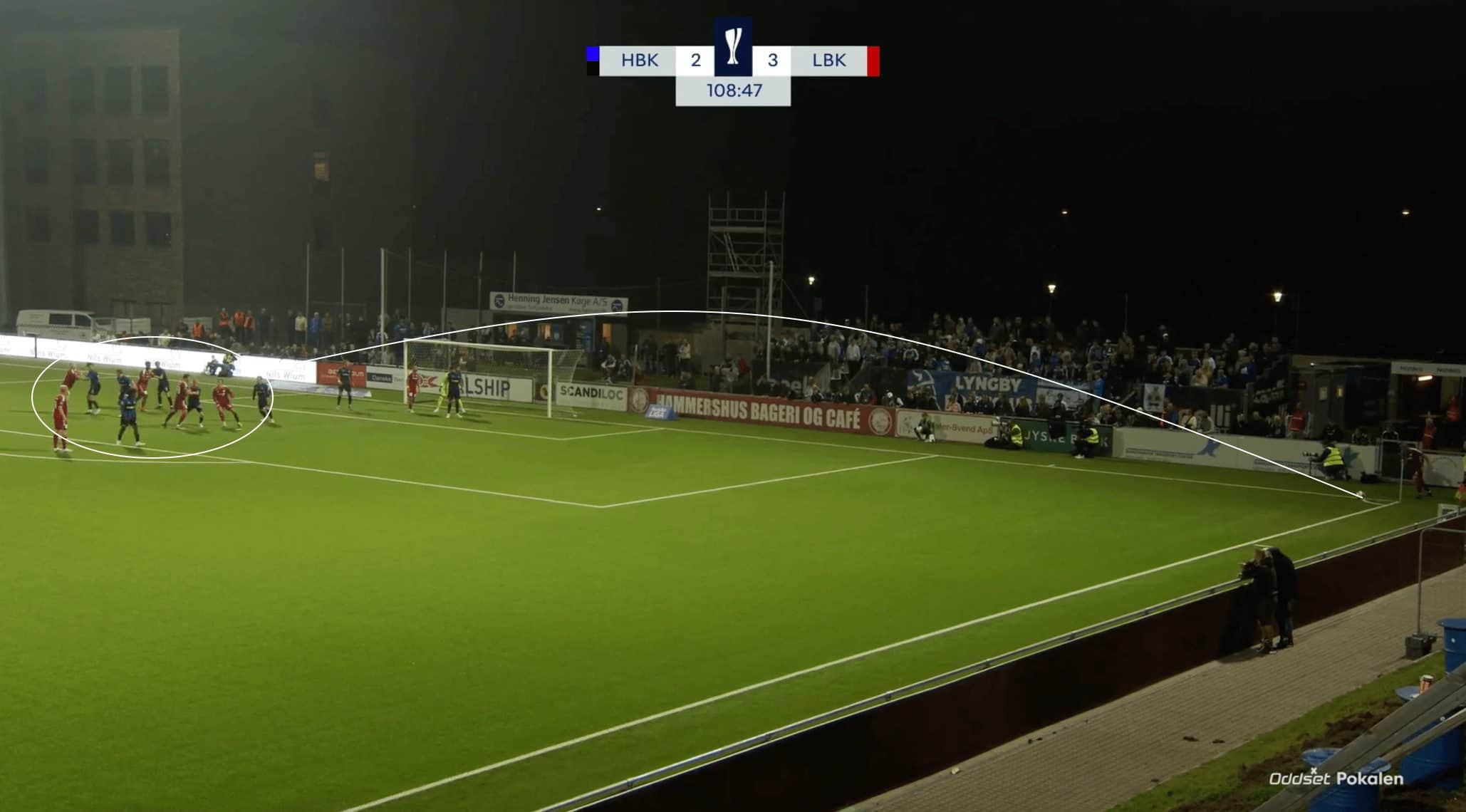
The image above shows another common attacking corner variation that Lyngby tends to have success with.
The Danish side would look to line up in a pack near the back post area, with the delivery aimed towards this area to be headed back centrally, to runners breaking off the pack and looking to stop near the penalty spot.
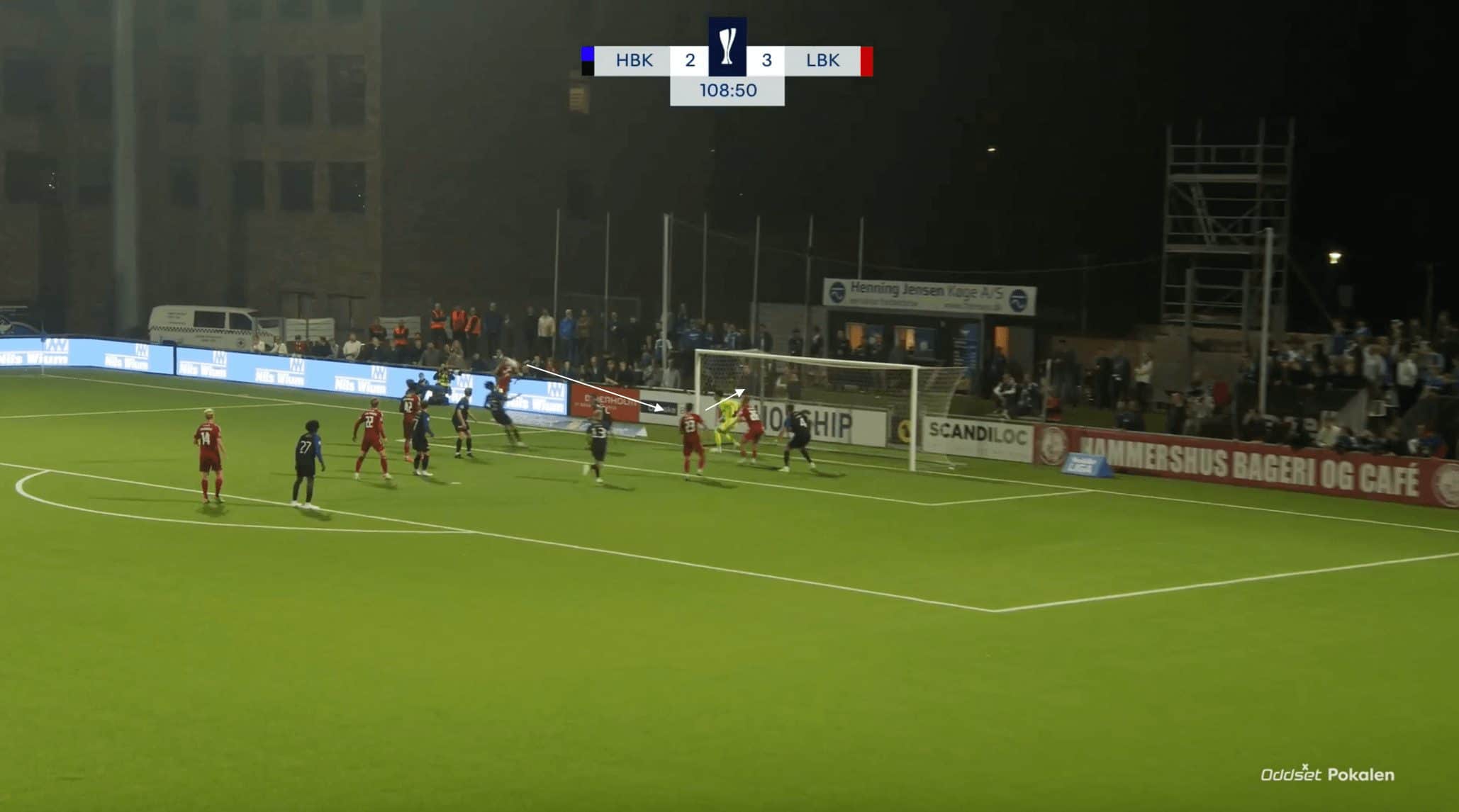
This second figure shows the corner that results after the ball is whipped into the back post area.
As we can see, the goal is to head the ball back centrally towards the penalty area.
In this phase, we can see the Lyngby striker unmarked on the edge of the six-yard box.
As the ball is headed back towards him, he has a free header and puts it into the back of the net.
As this shorter section has illustrated, set pieces are another considerable strength for Freyr Alexandersson’s side, and he would be able to make a huge difference if he can implement them successfully at Kortrijk.
Conclusion
As this tactical analysis and tactics piece has shown, Freyr Alexandersson was an outside-the-box pick by Kortrijk to help them avoid relegation.
While it may be considered an almost impossible task with the club sitting far adrift at the bottom of the table, it will be interesting to see how they get on in the second half of the campaign.
