
West Ham United have had a good season under David Moyes so far. After 17 games, the Hammers have 26 points, with the gap to the top four being just three points, although some teams such as Tottenham have played one game less. In the summer, they let good attacking players such as Felipe Anderson and Grady Diangana leave the team, doubting their ability to contribute consistently in the Premier League. However, they have scored one more goal than Arsenal and have the same number of goals as Manchester City, which shows that despite letting those players go, they have not really struggled too much from an attacking sense.
A key source of goals this season has been from set-pieces. To understand the secret behind their set-piece tactics, this set-piece analysis will introduce the main ideas in play at West Ham’s attacking corners.
Offensive corners
West Ham have a lot of players with physical advantages compared to the rest of the league. According to Transfermarkt, there are at least three players taller than 190cm in the first team – Issa Diop (194cm), Angelo Ogbonna (191cm) and Tomáš Souček (192cm). Along with them, the likes of Michail Antonio and Declan Rice are either muscular or not extremely short, which also gives them a huge advantage from offensive dead ball situations.
Overview and basic setups
Firstly, this analysis will give a brief overview of West Ham’s offensive corners. The image below shows all of their shots taken following a corner this season. There are some clear notable patterns:
- Deliveries from the left are usually out-swingers
- Deliveries from the right are usually in-swingers
- The edge of the six-yard box is a frequent target from both sides
- Most of West Ham’s attempts, and all their goals, have come from the shaded area
- Almost no shots have been generated around the penalty spot
- Almost no attempts from outside of the penalty box
- All goals were registered in the six-yard box

So, how did they achieve this? We have to understand the basic setup of West Ham from corners. One of their most frequently-used patterns is noted below:
- 1 player in the six-yard box to disrupt the keeper
- 1 player at the edge of the six-yard box/spaces outside of the zonal chains
- 2+ players starting at the penalty spot, standing in a vertical chain
The West Ham players overload central areas, allowing which creates space on either side to be attacked, or used as a running lane to get into the six-yard box. From this basic setup, the Hammers could also add players to serve specific tactical purposes. For example, adding a player on the right or left of the vertical chain to attack the front post or serve as a screener.

Below is their basic setup in a game situation. There is one player standing in the six-yard box to disrupt the keeper, while Rice stayed at the outside of the zonal chain. The vertical chain was formed by their best players in the air – Craig Dawson (188cm), Ogbonna, and Souček.
By beginning their runs from deep, they could generate power to head the ball and gained an advantage over static zonal defenders. This superiority was very clear especially in the highlighted shooting zone earlier. Also, it was easier to utilize the physicality of the centre-backs and Souček to create mismatches, given teams tend to place weaker players in those regions.
The variation we spoke about earlier can be seen below. The Hammers have one player standing on the left of the vertical chain, to either attack the near side or make decoy movements to open spaces or running lanes for deep runners, based on the delivery of the corner.

Split movements
On most occasions, the running routes were simply categorized according to direction. We named them as split movements as the players ran to two directions – front side and far side. If not performing as screeners, the first one or two players in the vertical chain, plus the player outside of the zonal chain would aim to attack the front post.
In the meantime, the deepest player in the vertical chain was tasked with running to the opposite direction – the far side. The simultaneous timing of these runs could distract defenders and potentially catch the man-markers unprepared. This deepest player was not always the same – Ogbonna and Souček are just two of the players used in that role this season.

Dynamic advantages and mismatches
Why did West Ham United need a player to attack the far post? It was because of the inevitable dynamic advantage. Not only could the likes of Souček and Ogbonna create a mismatch, but they could also see the ball while running towards the designated zone, allowing them to adjust their movement and time their jump properly.
When the man-markers kept their eyes on the deep runners, they could not watch the ball. In that case, they are likely to misjudge their timing to jump as they will not be able to read the flight and path of the ball correctly.
You could see Souček’s goal against Leeds United in the next image. Stuart Dallas was unable to compete with the Czech Republic international because he was looking at the target rather than the ball. When the ball was delivered, it was too late to position himself in the correct position. In addition, the physical qualities of Souček maximized the impact of this mismatch, as he jumped much higher than Dallas to score.

On the other hand, the man-marker were usually in trouble as well, since he needed to look at the ball, which allowed blindside runs to be made to the far post.
You can see Ogbonna heading the ball completely unmarked in this zone, with his marker nowhere near him since he was caught ball-watching.
In addition, Souček and Ogbonna have also been able to use feints and other techniques extremely well to get away from their markers during corners.

Late runs
The above analysis mentioned the simultaneous split movements that gave the defence a difficult task. However, this is not the only way that West Ham have attacked from corners. West Ham also use runs triggered at different times, although the split movements still occurred. This was likely to have been a strategic plan against specific teams, such as Brighton, who defended with a pure zonal system.
This was how the Souček goal was created. By moving in different timings, the running lane was opened for the deepest runner to attack.
The two images below show the impact of the early runners. Initially, the Hammers still used their three-man vertical chain at the penalty spot. The rest is very similar to our earlier explanations, except that Andriy Yarmolenko positioned himself at the left of the chain and stepped towards the first line.
The image on the right shows the early movement of Ogbonna, who moved diagonally towards the front post. Intentionally or not, the middle player of the three-man second layer has slightly moved towards that side, which enlarged the space between him and the last defender.
This created the running lane for Souček – the deepest player. He quickly advanced through the gap in front of the last defender of the outer zonal chain.
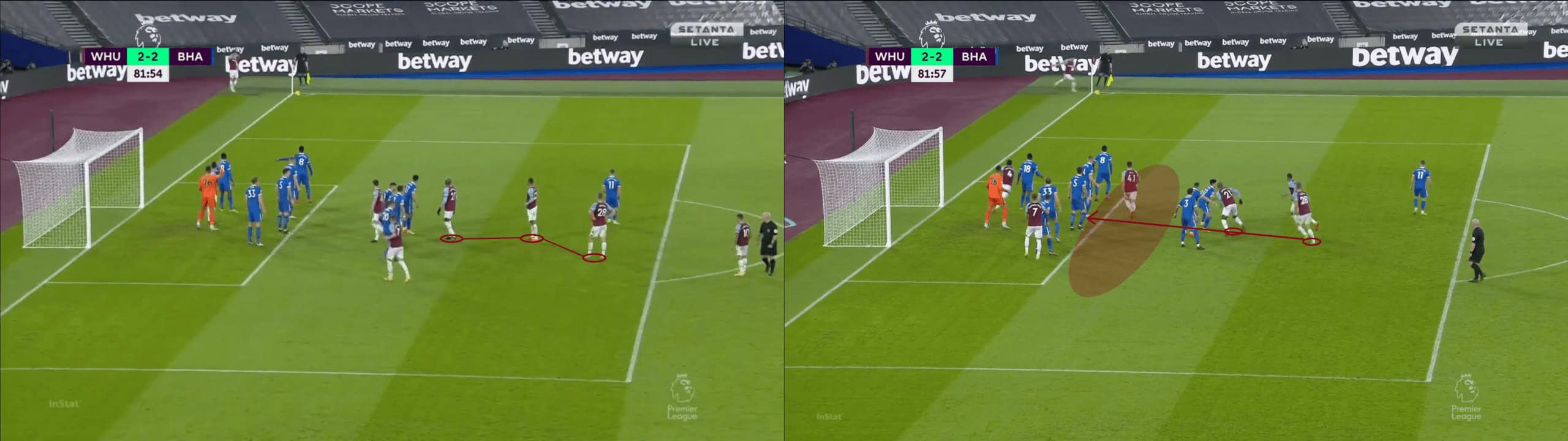
The highlighted region of the right image above is the zone from where West Ham have managed to get the most shots from their attacking corners. Whether against pure zonal defences, or teams using a mixed approach, the objective of West Ham’s movement in the box has been to attack the spaces between the lines, apart from being able to get away from man-markers.
Here, in the image below, because Ogbonna has opened the running route for Souček, the Czech Republic midfielder was able to run into that zone. You can see clearly how he got into the gap between the middle and last defender of the second layer (#9 and #3). As a result, he attacked the space which Lewis Dunk failed to protect, to score the goal.

Blockers/screeners/creating traffic
The last key feature we are showing is the use of blockers or screeners. Using blockers is an effective way to create running routes and block traffic, and it has helped West Ham attack from corners with a lot of dynamism. It is especially useful against man-markers, as those defenders must adjust their positions according to the offensive side.
The basic setup of West Ham allows them to use blockers in different parts of the attack, whenever needed. In the vertical chain, it was very easy to use the first player to shield the deepest runner. When the two (or three) players created a train, the opposition man-markers could not directly engage their respective targets, and they might not even perceive visual information clearly.
The below image is an example of using a train. When the runs begin, the player in the front could block the man-markers while the players behind run away from the crowd. César Azpilicueta (#28) was the deep runner’s marker but Ogbonna tried his best to create traffic. Only at the last moment was Azpilicueta was able to catch Souček.

This example contains the use of blockers in the split movement. On some occasions, that vertical chain did not attack the front post, but delayed their movement and crowded the central areas. This could effectively keep the defensive side at the same zone as well, while the first two players in the vertical chain trying to block the opposition like a net.
Here, the three-man train was used. You can see Souček was not the deep runner, instead, he served as the blocker to protect the running route. And because of these efforts, the deepest player could curve his run to arrive at the space in front of the zonal line to contest with Maguire. Again, the attacked zone is the shaded region seen in the Brighton example and in the first image.

Another example of using a blocker, this time was from an event attacking the front post. This was applied when the team was attacking the near side, where the initial player between the lines blocked everyone behind him to ensure that space was opened in front of him.
Here is the case – Rice was occupying space between the lines early, while Fabián Balbuena tried to get rid of the marker and attack the front side; he ran alongside the English international and let him block Trézéguet (#17). As a result, Balbuena was the free player to attack those spaces.

Final remarks
West Ham’s players have undoubtedly had some of the best physical traits in the league, due to which the likes of Souček and Ogbonna have been doing extremely well in this phase. Not only could they individually become threats to attack the goal, as analyzed in the last section, but they are also happy to serve the team by using their qualities to block the opposition, opening space for a teammate. This has meant that West Ham have been an extremely dangerous team from set-pieces this season – they have scored four goals from corners so far this season, which is the fifth-highest in the league, and they can be expected to be a threat from such situations all throughout this season
