
This year, Morocco Women will participate in the World Cup for the first time ever. This will represent a big opportunity for the country to showcase their abilities and aim at attaining the best possible results while putting on some convincing performances. They will be facing some tough opponents in the group stage since their group includes Germany, Colombia and South Korea.
Morocco were finalists of the latest Women’s African Cup of Nations and were beaten by South Africa after succeeding in passing a group stage made up of Senegal, Burkina Faso and Uganda, before knocking out Botswana in the quarter-finals and Nigeria in the semi-finals. This represented a big achievement for Morocco since it allowed them to not only become the runners-up of the African Cup of Nations but also earn a qualifying ticket to the World Cup — therefore getting more visibility, building confidence in their abilities and eventually raising their standards and developing higher targets following the end of this World Cup.
For this first-ever World Cup participation of Morocco, the aim will be to put on some convincing and competitive performances in the group stage while giving their best to reach the knockout stage. Although the group stage includes a giant European team like Germany, Morocco are capable of winning some points in the other two games against Colombia and South Korea, even though winning or getting a draw or two against these teams will not be a simple mission for Morocco. In this tactical analysis scout report, we will be exploring Morocco’s attacking and defensive tactics, their strengths and weaknesses as well as their predicted starting line-up. The analysis will also include parts on their key player and a prediction regarding their tournament journey.
Predicted Starting XI
Morocco and their two times UEFA Women’s Champions League-winning head coach, Reynald Pedros, will most likely be relying on the 4-2-3-1 formation since it suits the team more based on the available players’ abilities and capacities. Khadija Er-Rmichi will probably be the team’s goalkeeper during the tournament if no surprises take place since she is the most experienced option in the squad, while Assia Zouhair and Inès Arouaissa will represent backup options.
In defence, the most suitable choices based on talent, experience and consistency in terms of performance would be Zineb Redouani as a right-back, Maryame Atiq and Yasmin Mrabet as centre-backs while Sampdoria’s Sabah Seghir would be the team’s left back.
In the middle of the park, Morocco have been playing with two central midfielders lately and these two would be Servette’s Élodie Nakkach and Ghizlane Chebbak since the two players are among the best Moroccan midfielders and offer a combination of defensive and physical strength.
Upfront, Pedros will be needing Sakina Ouzraoui and Fatima Tagnaout’s services on the wings since both players are quick enough and have got what is needed to be dangerous either by cutting inside or using their crosses. And for the striker role, Pedros will definitely make use of Rosella Ayane, WSL and Tottenham striker — whose qualities will surely be fundamental for Morocco during their World Cup group stage journey and perhaps in the knockout phase as well.

In terms of age averages, we can say that Morocco’s squad is made up of a mixture of different ages including a majority of players below 24, some players during their peak (between 24 and 30) and six experienced players aged between 30 and 34. This means that Morocco’s squad can be considered a very balanced one in terms of composition since it combines youthful dynamism and raw talent with older players’ experience and guidance. This mixture will most probably help the Moroccan team perform very well especially if the coaching staff know how to monitor the experienced players’ playing time and make the right decisions when choosing the lineups for each match.

Attacking Phase

By looking at the following graphic, it is immediately obvious that the team often succeeds in creating numerous opportunities per match. While we must remember that the quality of opposition will be even stiffer than normal in the World Cup, playmaking hasn’t typically represented an issue for Morocco and the statistics highlight this fact since they have excellent averages in terms of final third passes per match, xG and shots on target. The latter means that the team’s attacking and finishing abilities are good enough and that one of the aspects that needs some improvements is passing.
In fact, the team’s passing accuracy and offensive duels won as well as possession require some work from the Moroccan players and coaching staff in order to have more control of games, reach the box with accurate passes and, therefore, in a more consistent way in order to score goals more often and be able to increase their number of goals per match.
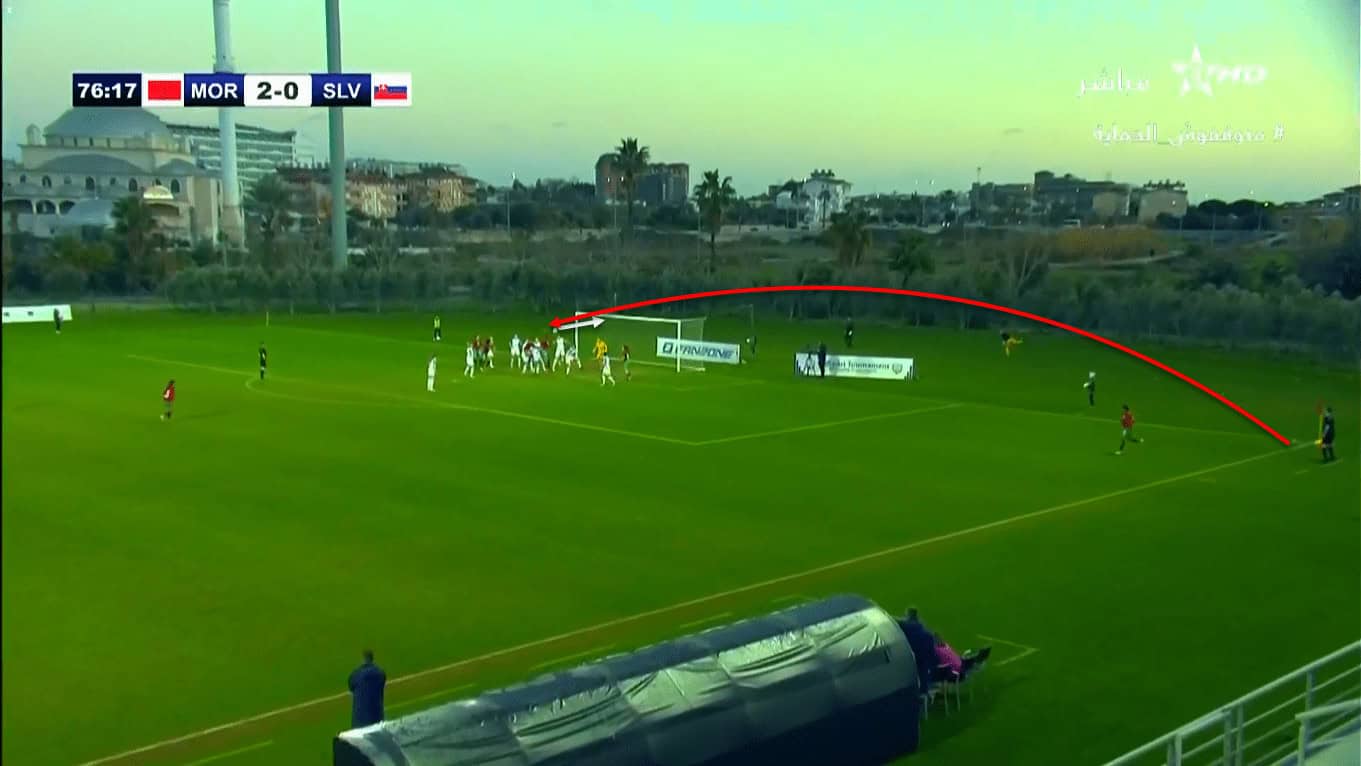
A tangible example of Morocco’s key passing abilities is highlighted in the next picture of a goal action against Slovakia in which Morocco rely on long passing from defence in order to serve Ayane at the back of the defensive line. Such quality passing from defenders like Mrabet represents a big asset to the team’s attacking options.

Another very important aspect of Morocco’s attacking organisation is the flexibility in movements and the constant change in positions between Ayane, Tagnaout and Ouzraoui which helps the team confuse defenders and vary their attacking solutions. This tactic often works for Morocco since Ayane’s ability to be efficient on both wings in addition to inside the box always benefits the team and especially both wingers. She leaves a lot of space inside the box to be occupied by Tagnaout and Ouazraoui while she acts like a winger and provides key passes towards the box. This method worked successfully against Nigeria in the latest African Cup of Nations where Ayane provided an assist to Tagnaout and the latter scored a very important goal thanks to this switch of positions.

Morocco’s attacking playing style is mainly based on short passing to Ayane and penetrations from both wingers. Moreover, the team are extremely dangerous in the execution of set-pieces and in finishing them as well. Making use of set-pieces would help Morocco a lot in the group stage because they will definitely need set-pieces to score goals especially when they face well-organised defences like Germany’s or Colombia’s and struggle to find alternative attacking solutions.
Furthermore, Pedros will need to prepare alternative solutions when Ayane will be marked tightly as this would represent an issue for the team in attack. Perhaps the most adequate solution for this situation would be to use attacking midfielders or add a second striker, transforming the formation into a 4-2-2-2 with two central midfielders, two wingers and two strikers as this would help Ayane get more space and put the opposing defence in trouble.
Defensive Phase

Concerning Morocco’s defensive system, it should be mentioned that the team have got some very good averages in certain aspects while having poor rates in other important aspects. This means that the team will have to work harder on the defensive organisation prior to the start of the tournament and on improving what is going wrong and reinforcing what is already good enough.
Morocco are performing well in areas like interceptions per match and aerial duels won. Working on maintaining these strengths, reinforcing them by playing the best possible defensive duo in each match and fixing the defensive block in a suitable line depending on the opponent and on the team’s strategy will determine Morocco’s defensive success or failure during the tournament.
Also, it will be crucial to enhance the players’ 1v1 defending since this would surely represent a big issue for the team if not addressed, especially against Germany. Being able to work on reducing the number of fouls committed in key areas would also help Morocco concede fewer goalscoring opportunities, knowing that committing numerous fouls per match can generate more opposing danger.
Atiq and Mrabet look like the team’s most powerful defensive duo at the moment and having the chemistry needed while working on each one’s duties and on covering for each other when needed will be fundamental in conceding fewer chances and in keeping clean sheets.
In this regard, avoiding mistakes like the one shown in the following picture will be necessary — especially in counterattacks. Morocco will need to keep their defence organised during counterattacks and avoid conceding too much space at the back. This conceded goal against Romania shows Morocco’s defenders’ bad positioning during Romania’s counterattacks, and their inability to disturb the striker or block the shot from distance. It would be important to not leave such gaps during the World Cup and to work on reducing the dangers of counterattacks by keeping a deep defensive block and not getting too high with the defensive line when in possession.

Moreover, leaving gaps between two defenders represents a recurring issue for Morocco that needs to be fixed as soon as possible in order to not concede goals due to this positioning problem. This conceded goal against Canada shows how damaging this positioning issue can be since it led to a goal here after the two defenders left way too much space between each other, helping Canada’s player to advance and shoot on target. Also, midfielders need to be more participatory in the defensive phase by forming a defensive line and trying to stop such penetrations in order to avoid such scenarios from happening.

Transitions
When it comes to transitions, Morocco tend to rely on quick passing usually from the wings while looking for a passing trajectory to Ayane who often knows how to create danger even when being marked. She usually provides passing options and doesn’t remain static inside the box but rather moves towards one of the wings depending on the situation.
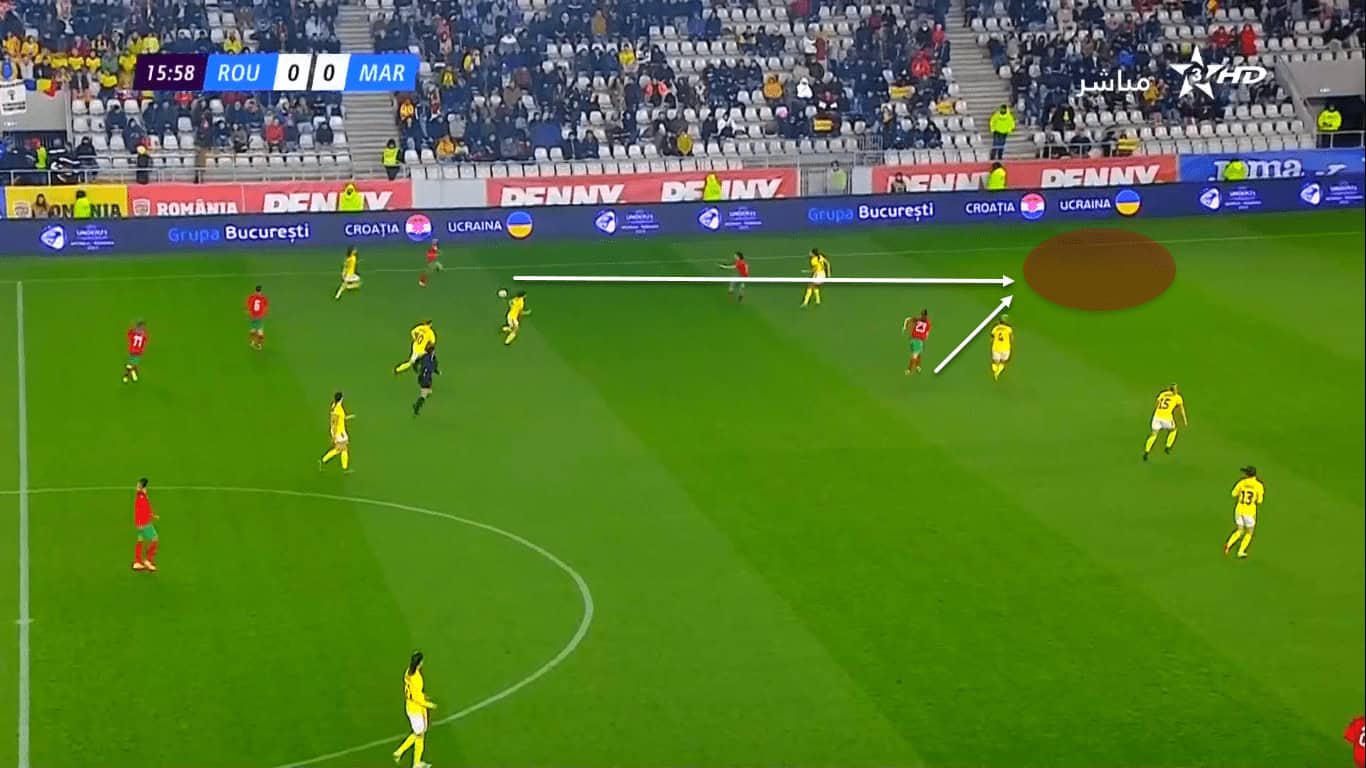
As soon as she receives the ball on one of the wings, she looks for a penetration possibility or waits for her teammates to join the attack and provide passing options. The chemistry between her and Tagnaout, in particular, always helps the team in creating danger upfront and in finding solutions. On this occasion, for instance, Tagnaout was the first who spotted Ayane’s complicated situation and asked for the ball while moving towards the box to provide a concrete passing option to Ayane.

Concerning defensive transitions, Morocco often tend to retreat quickly when losing the ball while trying to disturb the holder of the ball for as long as possible in order to ensure that the back-four are well-positioned. At the same time, one of the two wingers often retreats with the defensive line and the midfield line in order to help during the defensive phase while the striker and the other winger remain on the edge of their team’s own half to wait for a possible counter-attack. The following example shows how Morocco re-organise their defence quickly after losing the ball and try to intercept it as far as possible from goal, while both striker Ayane and the winger do not retreat in a complete way and remain at the edge of their own half.

Attackers
Morocco will be relying on a plethora of talented forwards during the World Cup and although the choice is not a very luxurious one compared to some of the participating teams, Morocco still have what it takes to play using a powerful front-three with Ayane as a striker, and Tagnaout and Ouzraoui as wingers.
In addition, players like Servette’s Imane Saoud, Sofia Bouftini or Sanaâ Mssoudy represent solid alternatives if called up. Saoud can play both on the right or the left wing with more mastery of the right-winger role, Bouftini can also be very useful on the right wing while Mssoudy would be a very suitable back-up player for the striker or the second-striker role.
Pedros will therefore need to find the right balance between these players’ playing time depending on the opponent and on the players’ readiness as well as on the team’s attacking plans for that specific match, knowing that apart from Ayane, the level between the players is quite similar. Yet, the list will include those who have better averages and who are accustomed to the team’s playing style.
Midfielders
For the midfield, Morocco will most likely use two central midfielders — likely to be Élodie Nakkach and Ghizlane Chebbak. These two midfielders have played alongside each other a lot and, therefore, the chemistry and complementarity will be guaranteed between the two while Pedros will have some valuable backup options capable of replacing the midfield duo.
We are talking mainly about Ibtissam Bouharat as an alternative since the 33-year-old’s experience can definitely help the team in complex moments.
As an advanced playmaker, Salma Amani is the player who has got the advantage over the rest to hold this key position and make use of her creativity, dribbling and passing skills to facilitate the front three’s mission.
Defenders
In defence, the Lionesses of Atlas will rely on the services of Mrabet and Atiq as centre-backs while Nouhaïla Benzina would be the backup alternative for this role, given Mrabet and Atiq’s experience and advantage over her in terms of chemistry and defensive duels won averages.
Morocco do not have numerous choices for the full-back roles since both Sabah Seghir and Zineb Redouani have been the regular right-back and left-back during this period while Ghizlane Chhiri might challenge Seghir for the left-back position depending on the opponent since Chhiri can be a more defensive option guaranteeing more security at the back, with an average of 61% in terms of challenges won.
Mazrouai can also challenge Redouani for a regular spot at right-back even though the latter has got more experience and can use both feet, which represents an advantage for Redouani over Mazraoui. But overall, no surprises will be expected for the defensive organisation or names and the defensive line will combine the experience of the centre-backs and the explosivity of both full-backs.
Key Player
Rosella Ayane is Morocco’s most impactful and key player at the moment and will most probably be crucial during the Women’s World Cup as Pedros relies on her completely for the striker role. Although she is often used as a right-winger or a left-winger at Tottenham, she has proven on several occasions that she is the best fit for such a key role involving excellent finishing and other duties. In fact, the experience acquired from playing against tough defences of teams like Chelsea, Manchester City, Arsenal and Manchester United helped Ayane become more dangerous inside the box and more mature and clinical in terms of finishing.
Ayane is not a poacher and does not only wait for the ball inside the box. She moves a lot per match and always tries to provide passing options when the team is in possession. Moreover, one of her most striking traits is her high average of dangerous passes per match which confirms the fact that Ayane is a team player and a very dynamic and modern striker who can be dangerous not only through her finishing but also thanks to her excellent passing and intelligent positioning when the team is in possession and especially when being marked tightly and trying to escape marking.
It is true that Ayane’s services will be indispensable for Morocco. Nevertheless, having the support of a creative advanced midfielder like Amani and two dynamic wingers like Tagnaout and Ouzraoui will help Ayane shine more and be more dangerous.

Tournament Prediction
Morocco will most likely battle against Colombia and South Korea for a qualification ticket since Germany will probably finish at the top of the group. However, anything can happen in the encounters involving the rest. It will be tough for Morocco to beat a very physical and compact team like Colombia who are more likely to finish at the second spot. Nevertheless, Morocco have the tools necessary to beat both Colombia and South Korea and qualify for the knockout stage especially if they fix some of their defensive issues prior to the start of the World Cup.
