
Saudi Arabia will participate in the World Cup for the sixth time this year following their deserved qualification at the top of group B of the third round of the qualifiers. Saudi Arabia have been preparing for a long period for this participation as they would like to make up for their failed 2018’s World Cup journey by surpassing the group stage during the upcoming World Cup.
Indeed, the mission will not be as easy as it sounds, but at the same time, the circumstances are not going against Saudi Arabia in terms of opponents. In other words, Saudi Arabia could have been drawn into a much more complicated group than Group C in which they’ll face Argentina, Mexico and Poland.
In fact, all of this group’s teams are hard to beat, especially Argentina. However, Saudi Arabia are capable of challenging both Mexico and Poland and they have almost equal chances with these two teams to fight for the second spot. Therefore, if Saudi Arabia prepare well and are at their best during the competition, they can threaten both Mexico and Poland and why not aim to take four or more points out of these two games?
What will also help Saudi Arabia in this competition is that their head coach, Hervé Renard, is known to be a very ambitious person who has had various successful international experiences, especially with African national teams, and he will certainly need to use all of that experience to aid his Saudi Arabian World Cup journey.
In this tactical analysis scout report, the focus will be directed towards the analysis of Saudi Arabia’s attacking and defensive tactics, their predicted starting line-up, their key player and a lot more information based on footage and data.
Predicted starting XI

Saudi Arabia have been alternating between the 4-3-3, 4-4-2 and 4-2-3-1 formations lately and they can play well according to these three types of formations. However, Renard is more likely going to opt for the 4-2-3-1 one and might change to the 4-3-3 during the game if needed.
He will start the tournament with Al Owais as a goalkeeper since he has been the starting goalkeeper for the last period and he is the most experienced current Saudi Arabian goalkeeper. At the same time, Fawaz Al-Qarni, Mohammed Al Rubaie and probably Nawaf Al-Aqidi will be the backup goalkeepers. The defensive line will be composed of Sultan Al-Ghanam as a right-back, Abdullah Madu and Abdulelah Al-Amri as centre-backs and Yasser Al-Shahrani as a left-back.
This defence is composed of experienced players who played with each other a lot and therefore it is expected that the defensive line will be solid during this tournament. In midfield, the team will most likely rely on Salman Al-Faraj and Mohamed Kanno as central midfielders while both Fahad Al-Muwallad and Salem Al-Dawsari would play on the wings, knowing that the two players can be very dangerous in these positions. On the same line, Hattan Bahebri will bring his experience to this attacking midfield line while playing as an advanced playmaker behind the striker Firas Al-Buraikan who can be challenged by Abdullah Al-Hamdan, Saleh Al-Shehri, Haroune Camara and Haitham Asiri.
The squad looks balanced on paper even though it lacks players with physical strength. Therefore, the team will have to prove on the field that they are capable of handling attacks like Argentina’s, Poland’s and Mexico’s, and that will certainly not be an easy task. These teams have some dangerous attacking players such PSG‘s Lionel Messi, Inter Milan‘s Lautaro Martínez, Barcelona‘s Robert Lewandowski, Serie A and Napoli’s Hirving Lozano, and many more key players.
To score goals, they will need to exploit set pieces very well and make sure to make use of counterattacks, knowing that they have got some quick and efficient attacking players like Salem Al-Dawsari and Hattan Bahebri. Also, midfielders will have to serve the ball accurately whenever they intercept the ball and make sure they provide key passes whenever possible in order to surprise opposing defences.
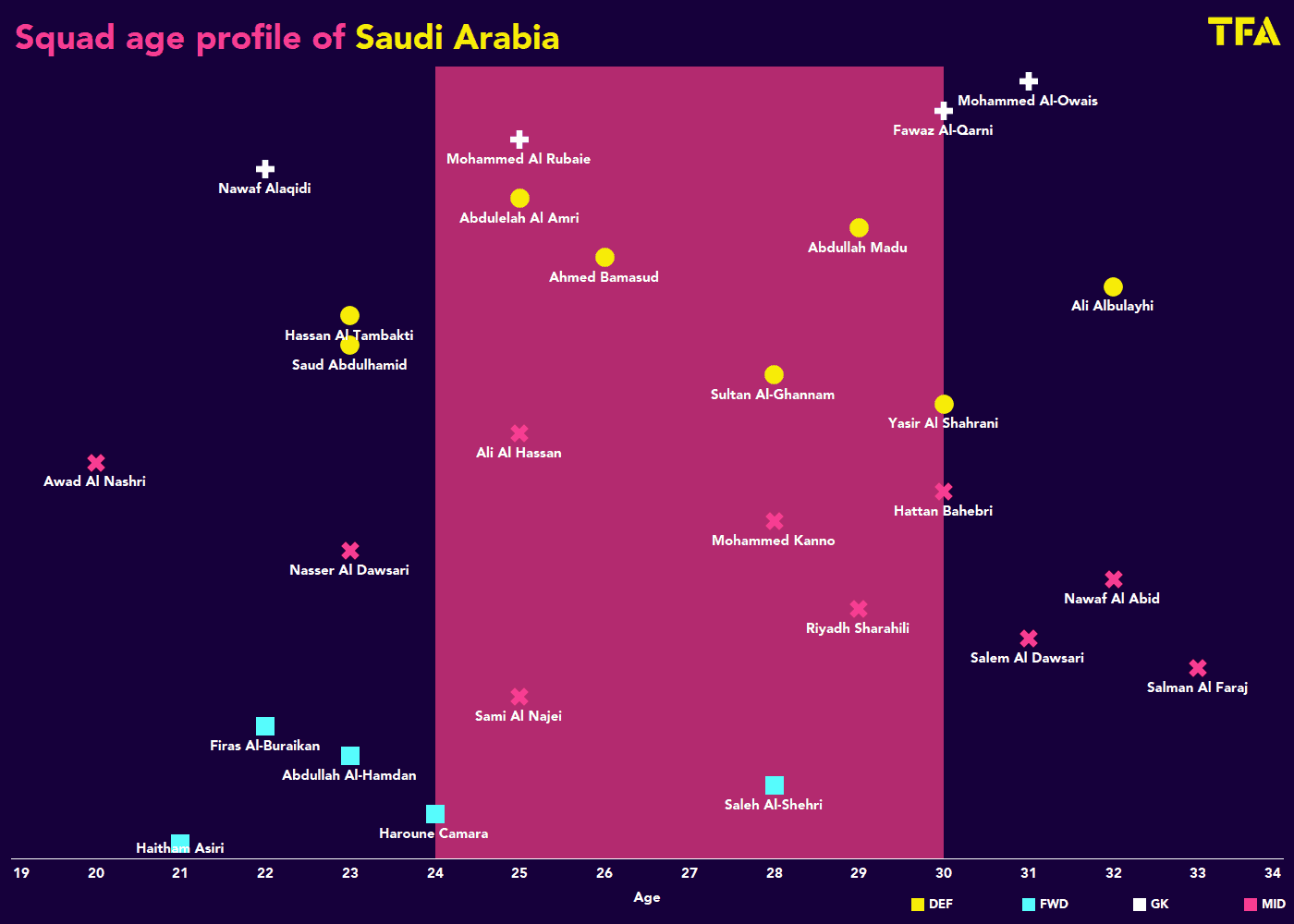
Having an attacking line of players below 25 years of age, except for Saleh Al-Shehri, can serve the team in terms of physical abilities and especially in terms of stamina. The team should exploit this strength and rely on these attacking players more often during their games and not just focus on defending or playing for a draw. Such players can represent a threat to defences that have some weaknesses such as the Argentinian defence, the Mexican defence and even Poland’s defence.
In reality, these teams are not known for having some of the best defences in the world and Saudi Arabia should exploit this fact in their favour without leaving spaces behind or attacking without reasoning. The age profile shown below also indicates that numerous players are actually at their peak and not many of them are past their peak years — knowing that for goalkeepers like Al-Owais the peak years can start at 30.
Attacking phase
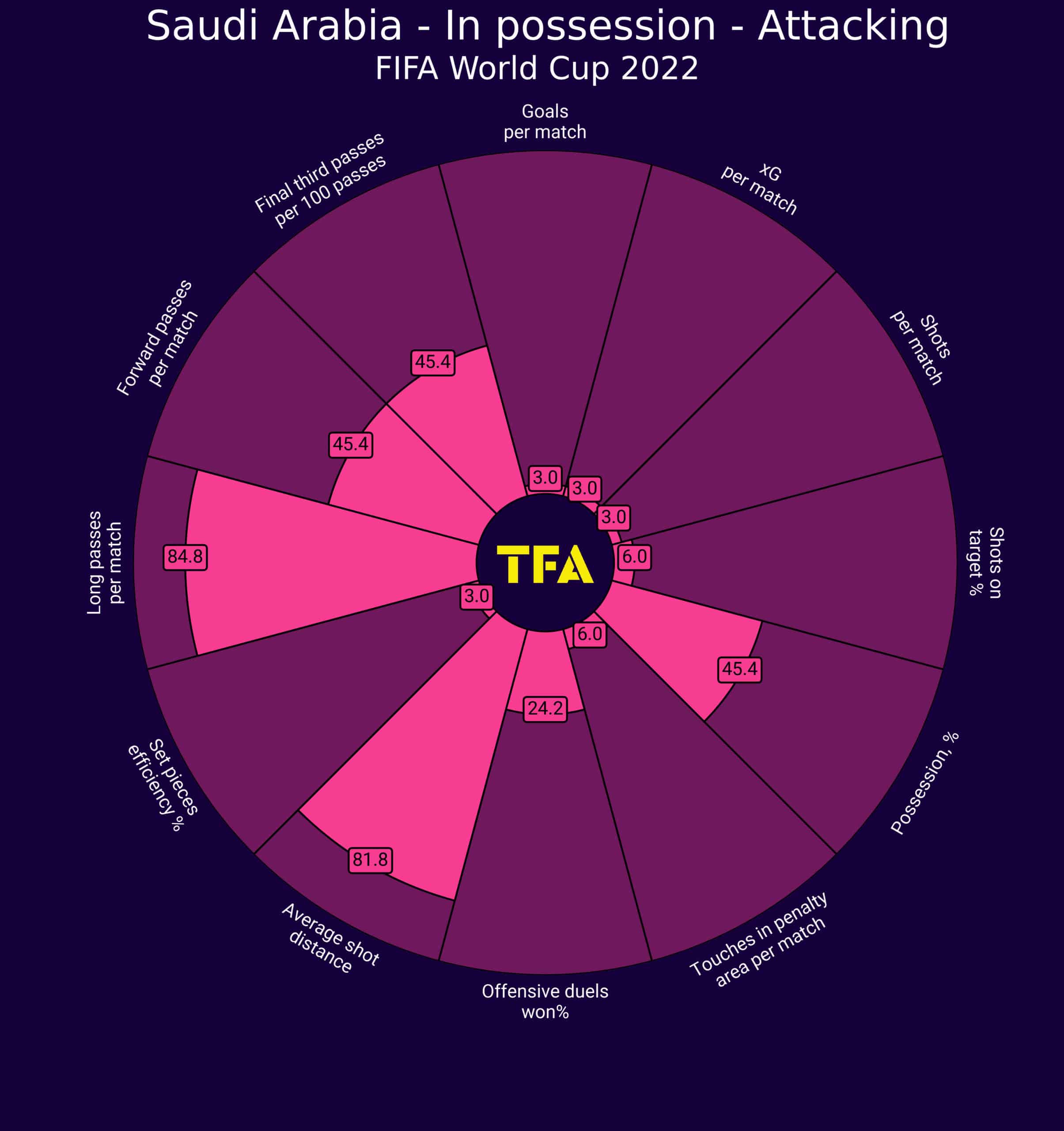
Saudi Arabia’s attacking statistics are not really encouraging. The team doesn’t win a lot of offensive duels, the players do not shoot on target a lot per match and more importantly, their goalscoring statistics are quite low.
If they play with the same attacking tactics and keep having the same statistics, it is unlikely that they will score goals during this group stage. To overcome this problem, Saudi Arabia will have to focus on assessing their opponents’ defensive weaknesses and try to work on exploiting them. For instance, they will have to work a lot on set-piece efficiency to use them against one of the teams that are weak in defending set-pieces. However, if the team fails to spot their opponents’ weaknesses, they will not be able to harm them or be dangerous.
Shooting from distance is one of the tools Saudi Arabia are good at and they should focus on using this in their favour, especially when playing against goalkeepers who are not excellent in saving shots from distance. Saudi Arabia have got numerous players who can shoot well from distance, such as Salman Al-Faraj.
At the same time, the attacking players will have to be focused 100% on scoring and there will be no excuse for missing chances like the one shown below. In this action, Hattan Bahebri preferred to provide a pass to his teammate when he could have scored a goal by himself. Instead, he gave a wrong pass to his teammate and the ball, therefore, was intercepted. Missing such chances in the World Cup will certainly be regrettable and the coaching staff will have to work with the players on finishing and decision-making inside the box.
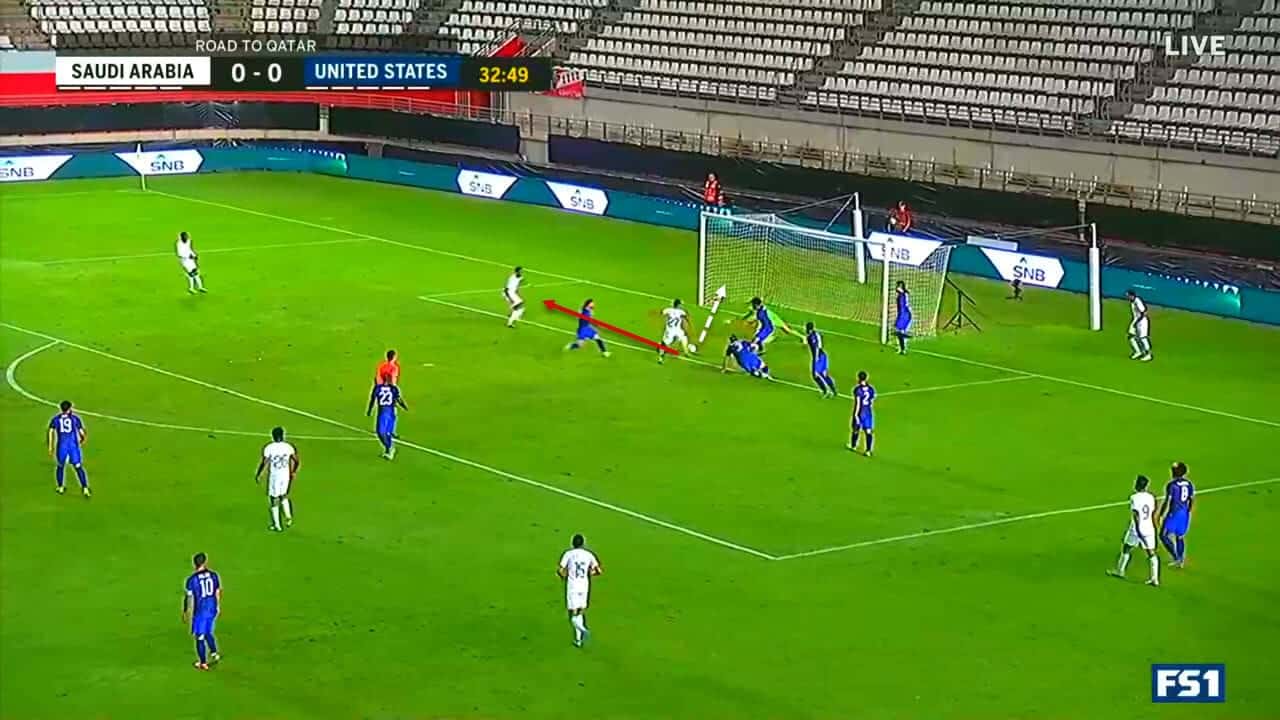
At the same time, the team will have to alternate between their attacking tactics and not rely solely on low-probability shooting from distance. Crossing from the wings can be effective and cutting inside from players like Salem Al-Dawsari can be extremely useful and the coaching staff can build movements and combinations on that. Relying on shooting from distance only would make the team’s moves predictable and defending against such actions will become easier for opponents.
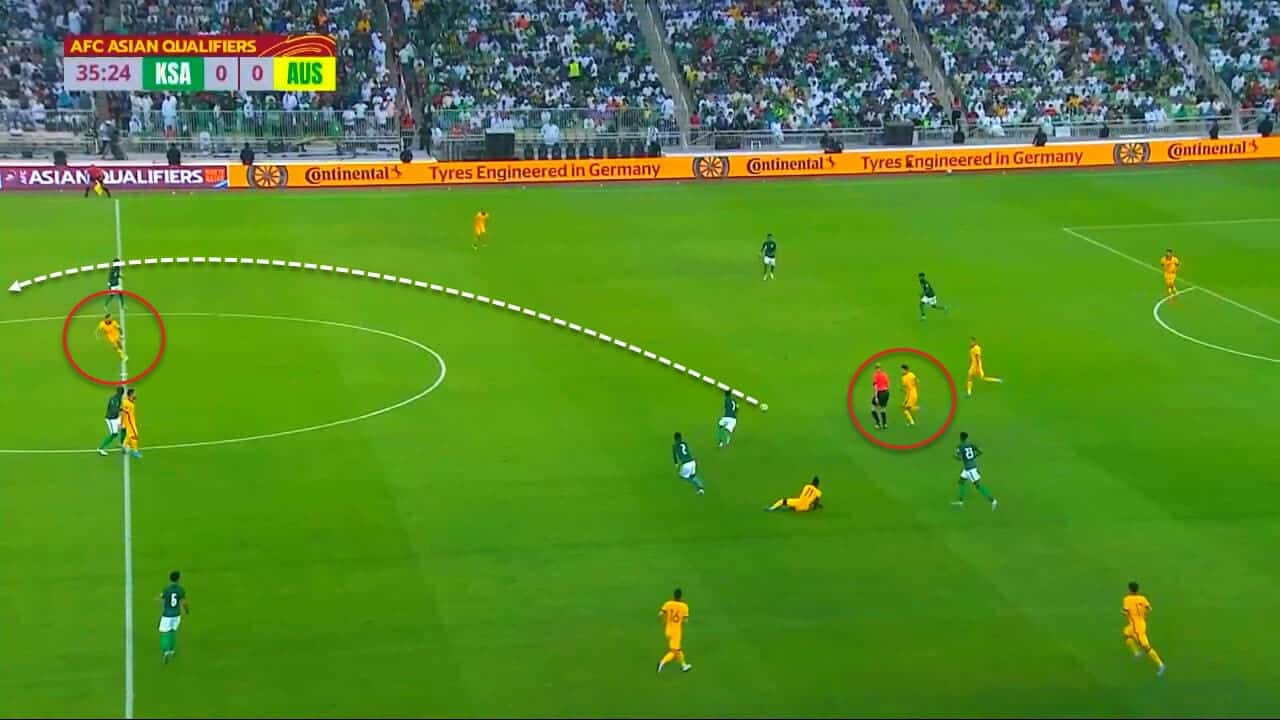
For example, the player intending to shoot in this action could have passed to his teammate who was asking for the ball as both of them could have opted for a passing combination to exclude the opposing defenders. Instead, he automatically went for the shot without even looking at what was surrounding him and who was asking for the ball.
Defensive phase
Saudi Arabia’s defensive phase will be crucial during the tournament as the level of endurance and resistance of this defence will play a big part in determining Saudi Arabia’s overall result. The team will have to be prudent throughout the three games as they will need to limit their errors to not concede numerous goals.
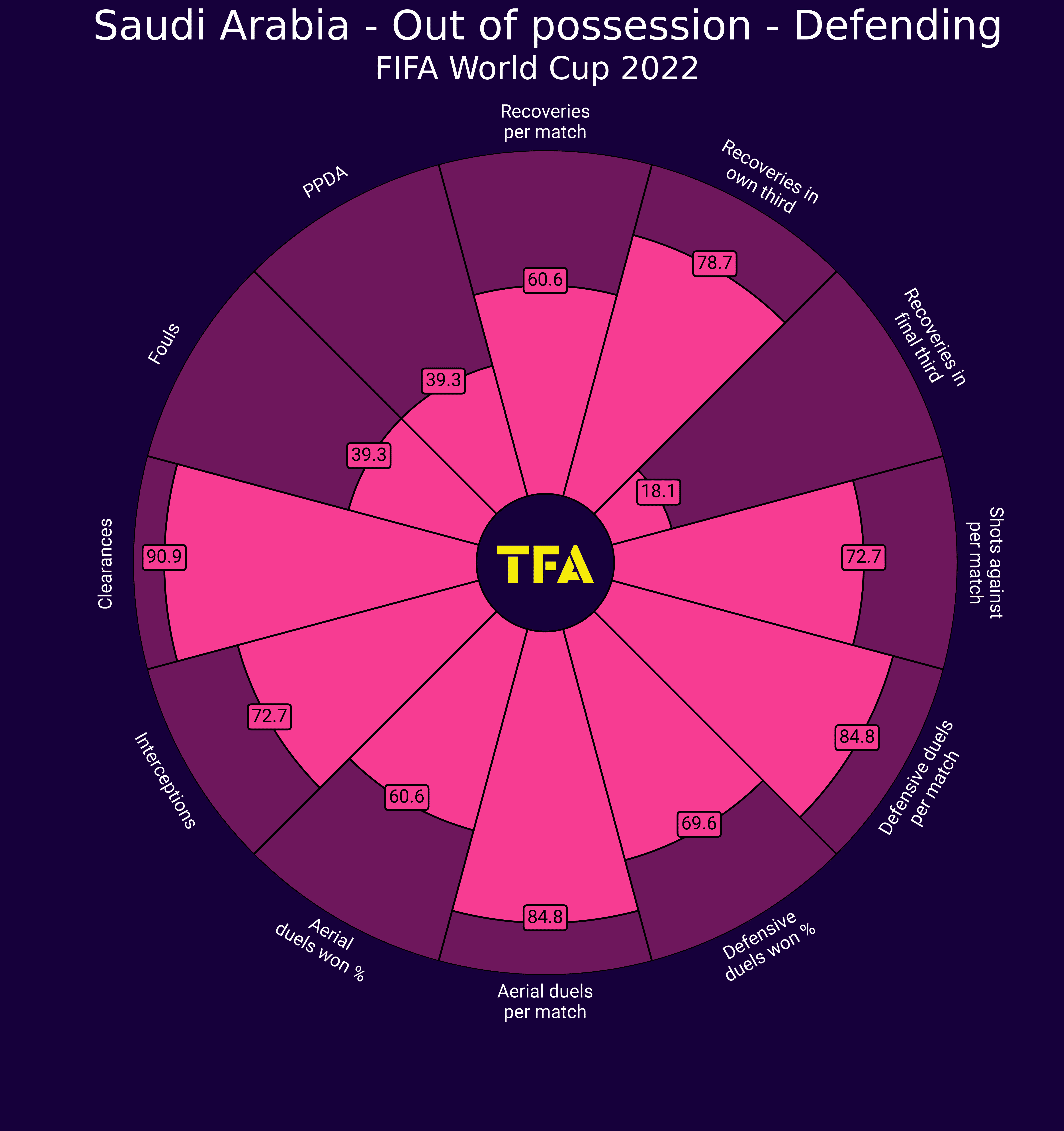
As opposed to their attacking statistics, Saudi Arabia’s defensive numbers are quite solid as they win a fairly good number of defensive duels and aerial duels. And at the same time, they intercept the ball a lot and make numerous clearances per match. This coincides with their tendency to spend most of their time without the ball.
The big issue concerns the high number of shots against they concede per match as this would cause a lot of trouble against players who have excellent finishing skills.
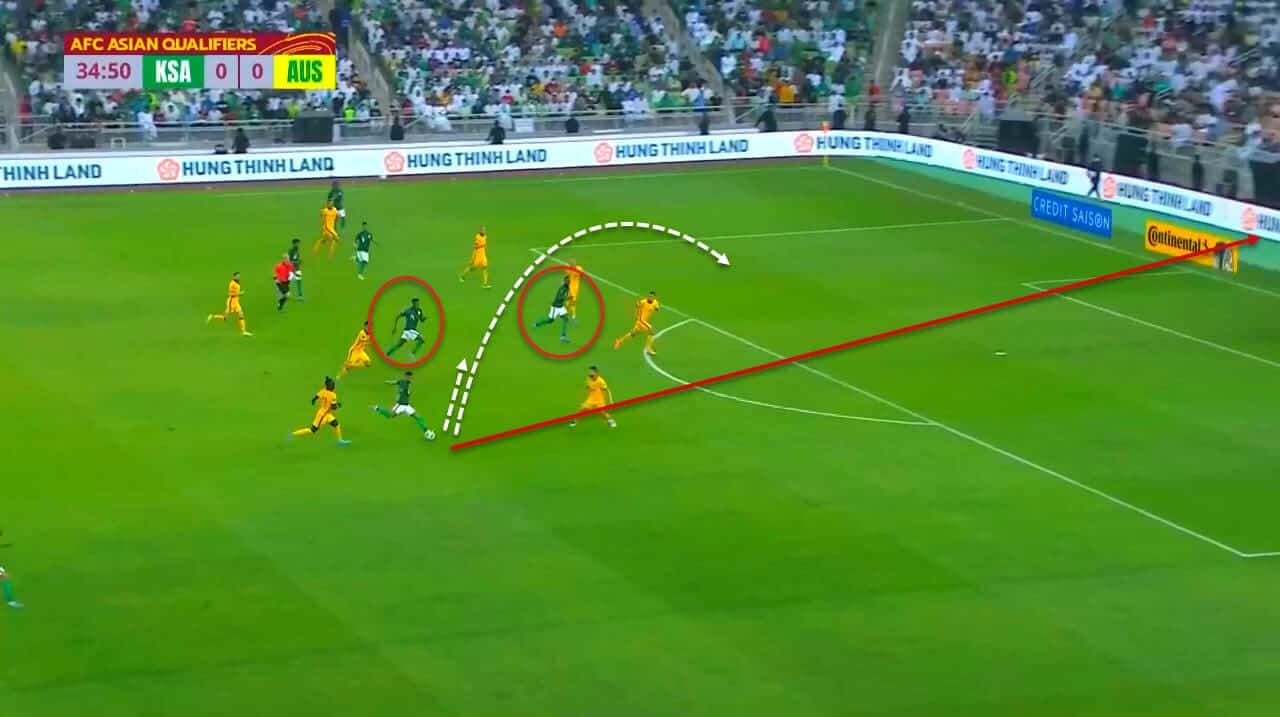
Saudi Arabia must be very organised and time their movements very well to not commit crucial mistakes. For instance, they will have to control when to play with a high defensive block and when to avoid using a high defensive block, knowing that a very advanced defensive block can lead to conceding goals by breaking the offside with a single pass and a well-timed movement from the striker.
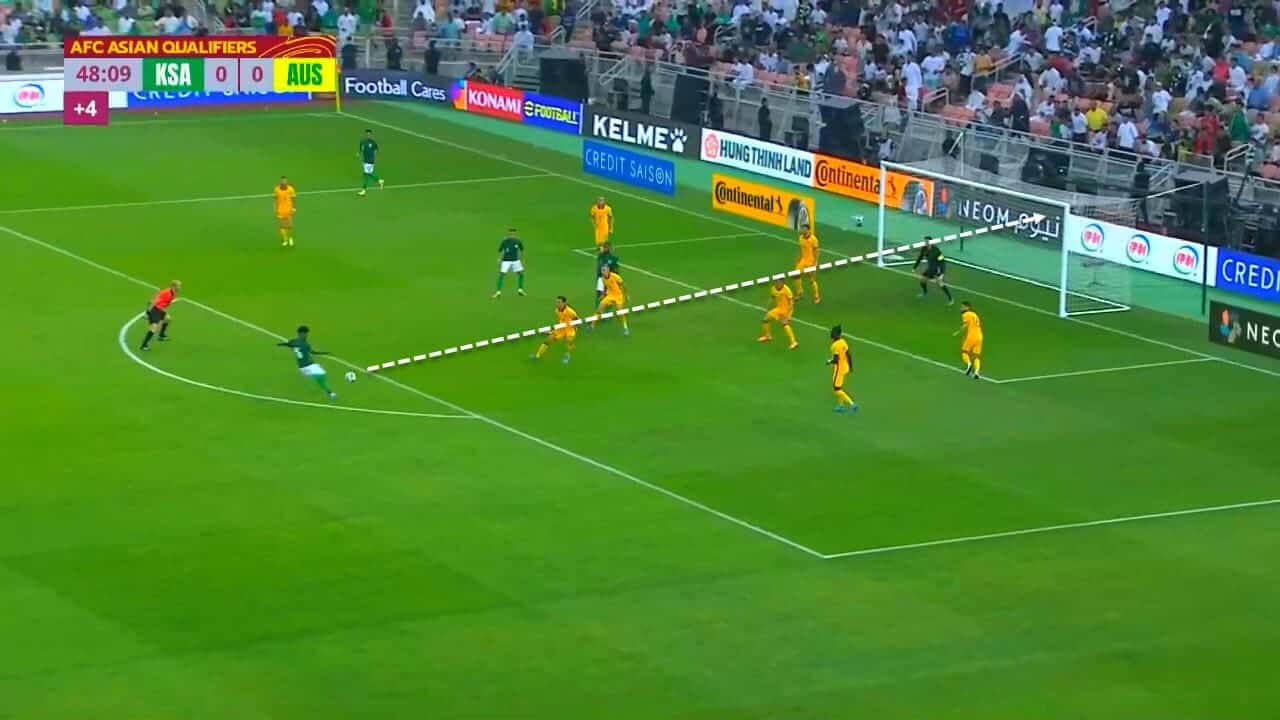
Saudi Arabia have already suffered from such errors and this example from the match against Australia shows how this high defensive block may lead to dangerous opportunities. In this action, Saudi Arabia were lucky because there was an offside position of the striker, but on other occasions, the team risks conceding goals, especially against teams with great passers and excellent strikers like Argentina.
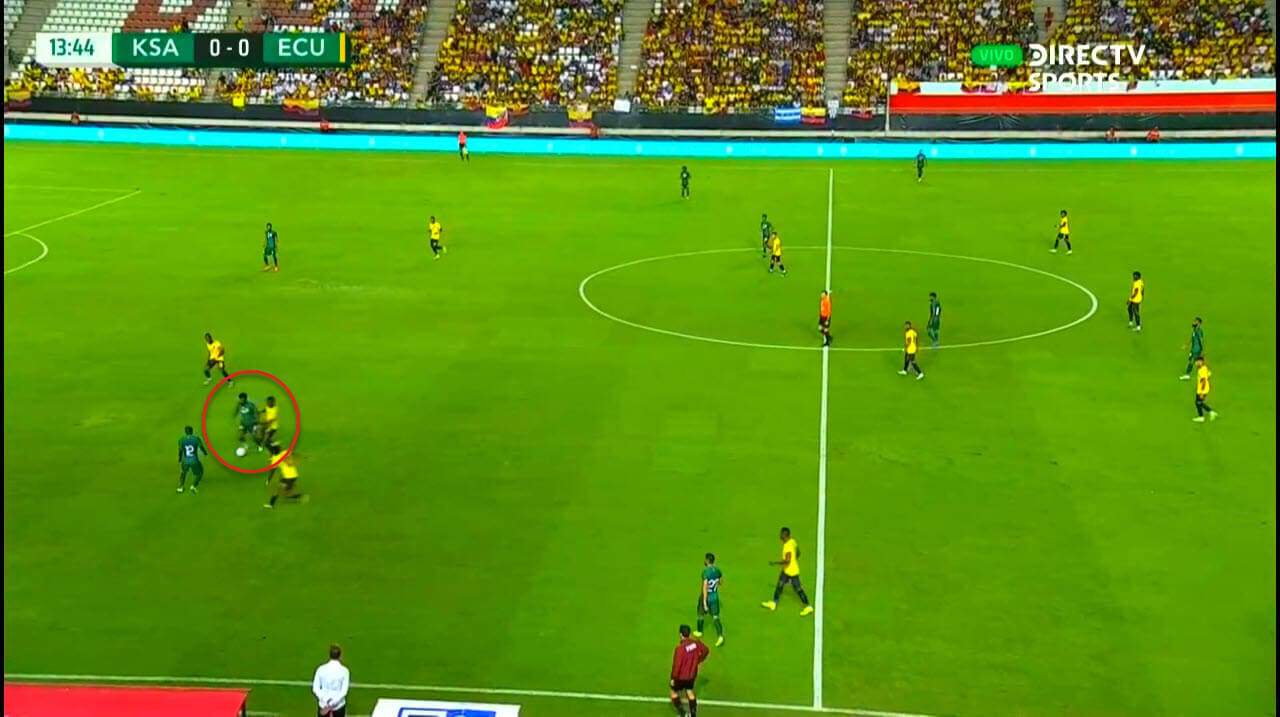
In addition, Saudi Arabia will have to avoid keeping the ball too much in dangerous areas and against quick players with high pressing abilities. In other words, midfielders and defenders will have to know exactly when they can keep the ball and when they have to pass it quickly to avoid the opposing pressing.
Saudi Arabia doesn’t seem to deal well with such pressing and they showed on some occasions that they might commit some individual mistakes and concede the ball to opponents. In this game against Ecuador, Saudi Arabia’s midfielder exceeds in keeping the ball and puts himself in trouble as he didn’t know when to get rid of the ball. The result was conceding a very dangerous counter-attack and a one-on-one situation with the goalkeeper. Such mistakes should not happen during the World Cup if Saudi Arabia want to get some points and aim at qualifying for the next round.
Transitions
In terms of transitions, Saudi Arabia usually start their actions with Al-Faraj, who is their key midfield player. He has a great vision and excellent passing technique and he is responsible for controlling the rhythm of midfield and dictating the play. He often provides short passes to one of the attacking players on the wings or near the wings to find space and advance better.
In the following picture, he passes towards the right and on other occasions, he provides passes to Al-Dawsari who is one of the best in Saudi Arabia in terms of dribbling skills and penetrations. Therefore, the team often rely on him for penetrations from the left wing, cutting inside or early crosses towards the striker.
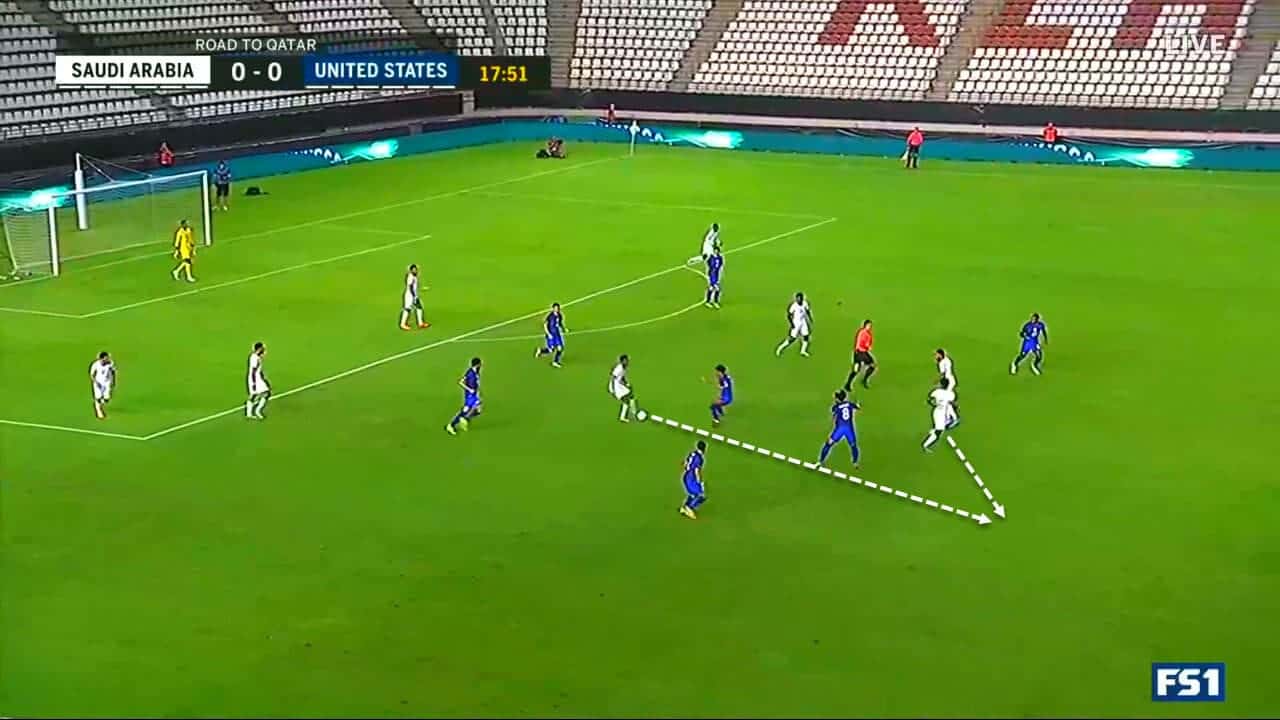
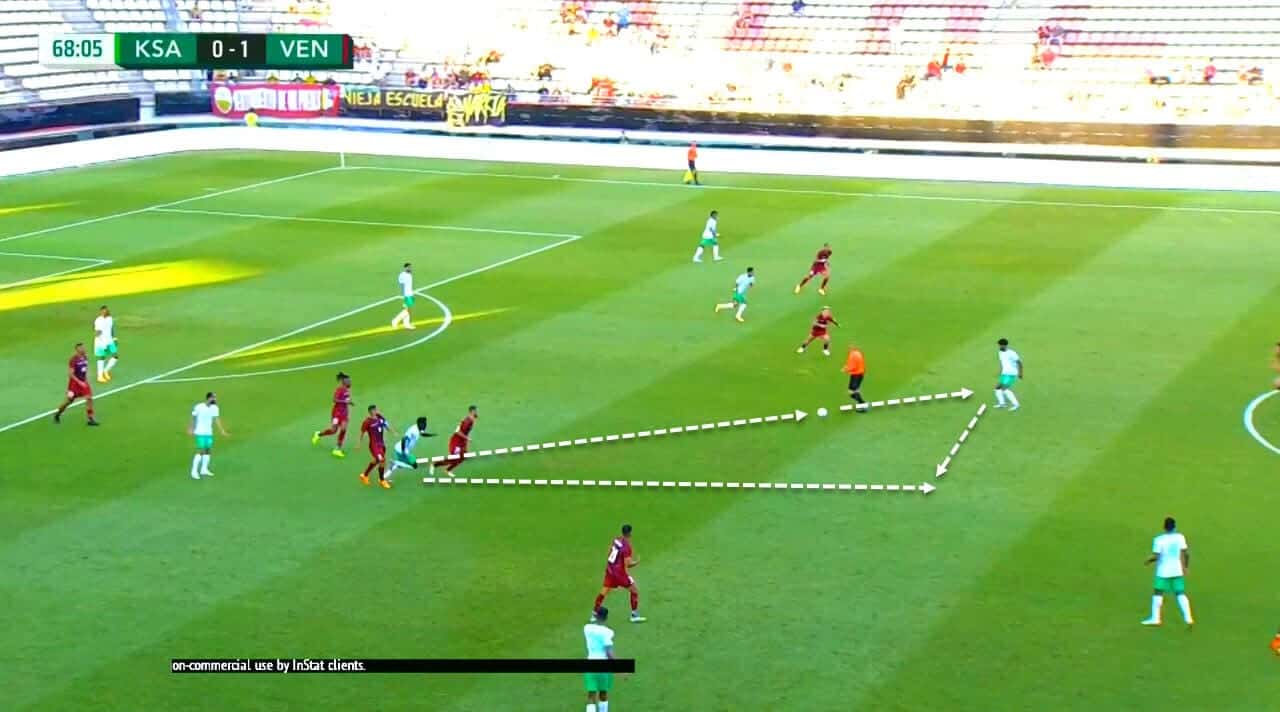
Whenever possible, Saudi Arabia rely on quick passing combinations to exclude the opposing players and start counter-attacks. And although this doesn’t always work well, Saudi Arabia often succeed in getting the ball in their opponent’s half using such passes and movements, especially from midfield players before passing to the more attacking players. Saudi Arabia tend to opt for short passes rather than long passes when it comes to transitions. And their tactics are often effective, concerning transitions.
Attackers
Saudi Arabia has got plenty of powerful attacking options to choose from and Renard will have to choose the best players for each match of the group stage. As wingers, Fahad Al-Muwallad and Salem Al-Dawsari represent great additions to the team, as they are responsible for both wings and especially for supporting the striker and creating opportunities for themselves and for the striker.
Therefore, their role is fundamental in the team. For the striker role, Renard will have to adapt his choice to the type of defence he is facing and to the tactics he would like to use in that specific game, which means that all of Firas Al-Buraikan, Abdullah Al-Hamdan, Saleh Al-Shehri, Haroune Camara and Haitham Asiri can be useful either as starters or as subs knowing that they don’t have the same abilities nor the same physicality.
Midfielders
The midfield will have to resist a lot during this competition and make sure to intercept passes regularly and help the defensive line continuously since it will be impossible for four players to defend against attacks with dangerous players like Argentina’s.
Therefore, Mohamed Kanno, Salem Al-Dawsari, Hattan Bahebri and perhaps Abdullah Otayf should give a lot of support to the defence in the non-possession phase to concede the minimum number of opportunities or goals. Midfielders will also be fundamental in transition as we explained above and players like Salem Al-Dawsari and Hattan Bahebri will have to advance whenever possible, pass accurately and why not attempt at shooting from distance as their support is needed in attack, knowing that both players are excellent in this regard. Hattan Bahebri will also be required to link between midfield and attack and between the wingers and the striker when needed as his position demands such roles.
Defenders
The defensive line will be the most crucial part of this team as the defensive performance of Saudi Arabia will determine if they will have a chance of progressing or not. The back four will have to remain organised throughout the three games and avoid making marking mistakes whether in set pieces or in open play to avoid conceding unnecessary goals.
At the same time, Renard will have a difficult task in finding a way to stop a team like Argentina without conceding spaces. Perhaps the best thing to do in such situations is to instruct players to double-mark dangerous players like Lionel Messi whenever they touch the ball to prevent them from finding spaces or playing finding solutions easily.
Key player
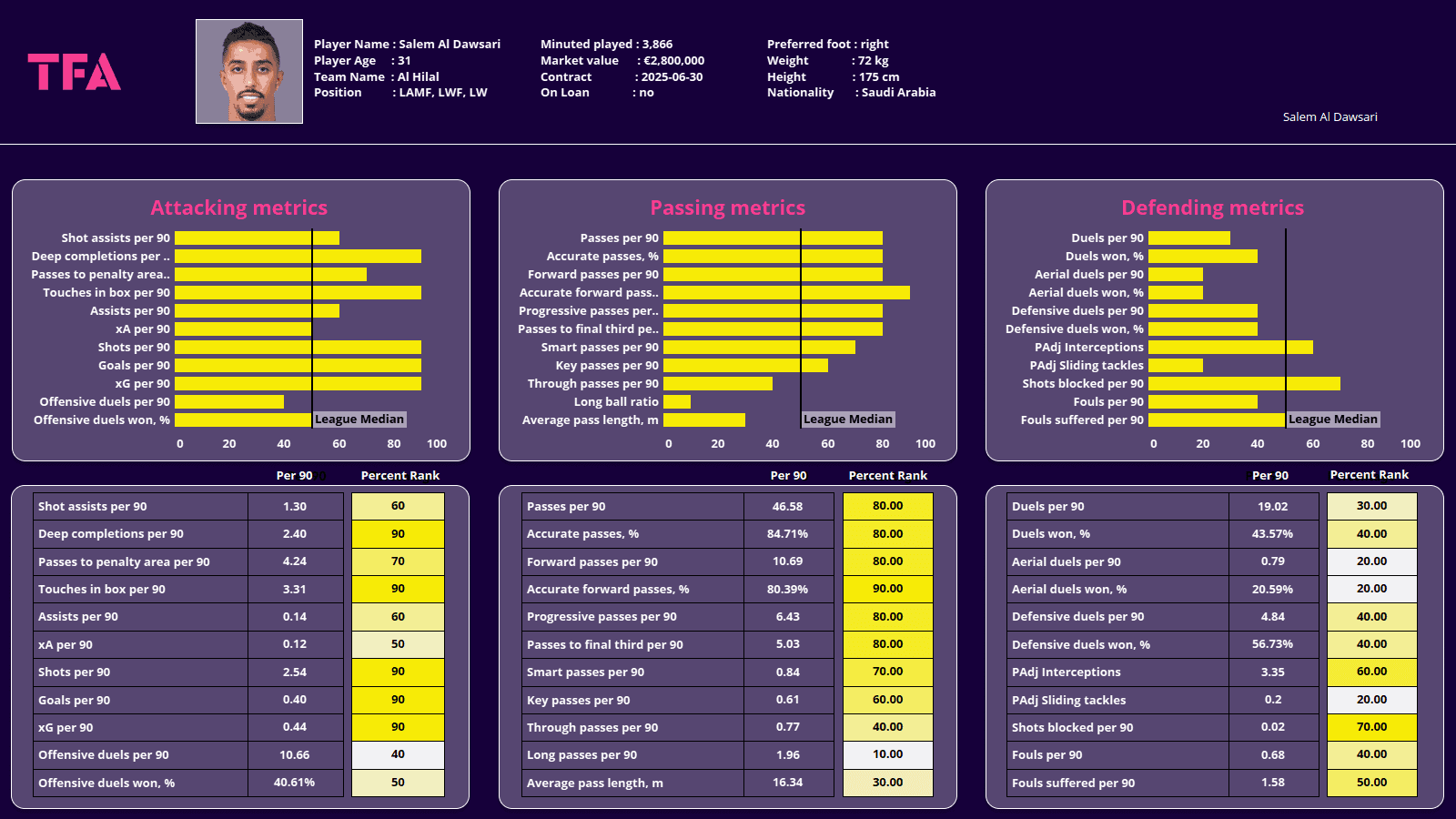
Salem Al-Dawsari is Saudi Arabia’s key player in this tournament as he is one of the most skilful Saudi Arabian players at the moment if not the best. He is mainly a left winger who plays at Al Hilal and this player can definitely solve Saudi Arabia’s attacking issues given his great individual skills.
He is a very agile player with excellent technique whether in terms of passing, shooting or dribbling. As you can see in the graphic, his numbers are generally very good and they reflect the importance of such a player in a team like Saudi Arabia.
Renard will have to exploit Al-Dawsari’s abilities in the best possible way to help the team score goals and make positive results. Indeed, defensively speaking, Al-Dawsari is not a player who can be helpful enough, but he makes up for that by being an excellent passer and a very good finisher.
Tournament prediction
Saudi Arabia have the chance to progress from the group stage, but this will depend essentially on how the team will approach the three group stage games. Saudi Arabia can win points in any of the three matches if they remain concentrated, defend well and do not make crucial errors.
However, if the team keeps performing at the same level seen in the previous friendlies and in the Asian qualifiers, Saudi Arabia are unlikely to finish second in the group and will most probably finish third or fourth.
