
Milan’s future was rather uncertain with the departure of their key player Hakan Calhanoglu to their city rivals Inter in the summer. While Stefano Pioli managed to build a solid team, who reached the second spot in Serie A last season, the fact that they relied on the midfielder so much, made people think that it will be difficult to find a replacement for him.
He was crucial in his attacking midfield position and not only supported the team’s ball progression, but he was also responsible for the team’s attacking set-pieces and contributed with assists and goals. The only possible replacement seemed to be the Real Madrid loanee Brahim Díaz.
The young player didn’t get a chance in the starting XI too often and would come on from the bench. It wasn’t until the end of the season, when Pioli started using him in the attacking midfield position, moving Çalhanoğlu on the left. He showed a glimpse of his potential and proved that he could be a great threat to the goal, which eventually led Milan to negotiate on extending the loan deal to two more seasons until the end of 2022/23.
In this campaign, Díaz is a regular starter for Milan and has been crucial for the team’s attacking actions, increasing their efficiency and providing versatility in the final third. Surprisingly, the Turkish international’s absence doesn’t seem to has affected the Rossoneri’s performance and they have been successful in Serie A, scoring 15 goals in their six victories and one draw since the start of the season.
The Spaniard also contributes to their performance in the Champions League, although the team didn’t manage to get a point in their first couple of games.
Playing in a 4-2-3-1 with a lone striker up front and being surrounded by two wingers seems suitable for Díaz. He has already scored four goals and assisted two more in nine games so far this season, sitting next to Rafael Leão as the leading goalscorers of the team.
In this scout report in the form of tactical analysis, we examine Díaz’s main traits and what makes him flourish in the attacking midfield position this season.
What does the data say?
Díaz’s contribution in the opposition half doesn’t differ much from Çalhanoğlu’s in terms of numbers. We compared the Spaniard’s 2021/22 numbers to their ex-player’s 2020/21 performance. While there is a difference in the playing minutes, it gives us a general idea of whether Díaz could be a sufficient replacement and if his actions in certain areas could increase Milan’s efficiency in attack.
Díaz is averaging 37.72 passes per 90, while Çalhanoğlu was contributing with 45.2 passes per 90. The area coverage is similar but Calhanoglu’s higher number is mainly a result of his tendency to drop deeper to pick up the ball. The Real Madrid player’s pass completion rate is higher though (87%) as his composure under pressure is better which is also reflected in the number of offensive duels that they jump in.
The Turk averaged 7.69 offensive duels last season, while Díaz is more adventurous with the ball and dives into 11.98 duels per 90. His success is also a result of his dribbling abilities, as he attempts 5.45 dribbles per 90, compared to Çalhanoğlu’s 3.18 last season and often takes on his markers. His 2.59 progressive runs are also proof that he is confident with the ball and which is beneficial for the team in their build-up-play.
Their contribution with passes to the final third and the box is similar, but Milan’s ex-player relied on more long balls per 90 (3.49) than his successor (1.5).
Çalhanoğlu added value to the team’s attacking actions with his shooting attempts. He averaged 2.86 shots per 90 last term, compared to Díaz’s 1.77 now. The main difference, though, is that the Turk had a rather low accuracy rate (28.4%), while the 22-year-old achieves an average of 53.8% of shots on target. This is a result of their shooting positions. While the majority of Çalhanoğlu’s shots came from outside the box, making it practically more difficult to be accurate, the Spaniard is more successful from close range and gets into better goalscoring positions so far.

Díaz is more efficient defensively too, with slightly better numbers than his predecessor in terms of ball recovery and defensive duels. He also suffers fewer ball losses compared to Çalhanoğlu, which helps the team to retain possession in the advanced areas and have better chances in attack.
Díaz’s ball progression and movement
The 22-year-old provides versatility to Milan’s squad. He impacts their build-up with his movement and positional sense. Díaz provides a passing option with no matter if the team have decided to build up through the central areas or through the flanks. He could be seen combining with the centre-backs, most frequently Simon Kjær, but would also often partner with Theo Hernández.
They would also switch positions due to Díaz’s left-oriented movement and the full-back’s tendency to cut inside. Their partnership is important as this way the team could attack through the central areas and use Díaz to spread out, but also, to play with width, advance the ball through the flanks and then cross it to the midfielder who can finish the attack.
Rafael Leão’s involvement in these actions is even more beneficial for the team as they would use short pass combinations to bypass the opposition press and to set up each other into quality goalscoring positions. He would also receive support from the right, as Alexis Saelemaekers constantly tries to deliver the ball to him, relying on his control and dribbling skills to advance it even further and shoot.
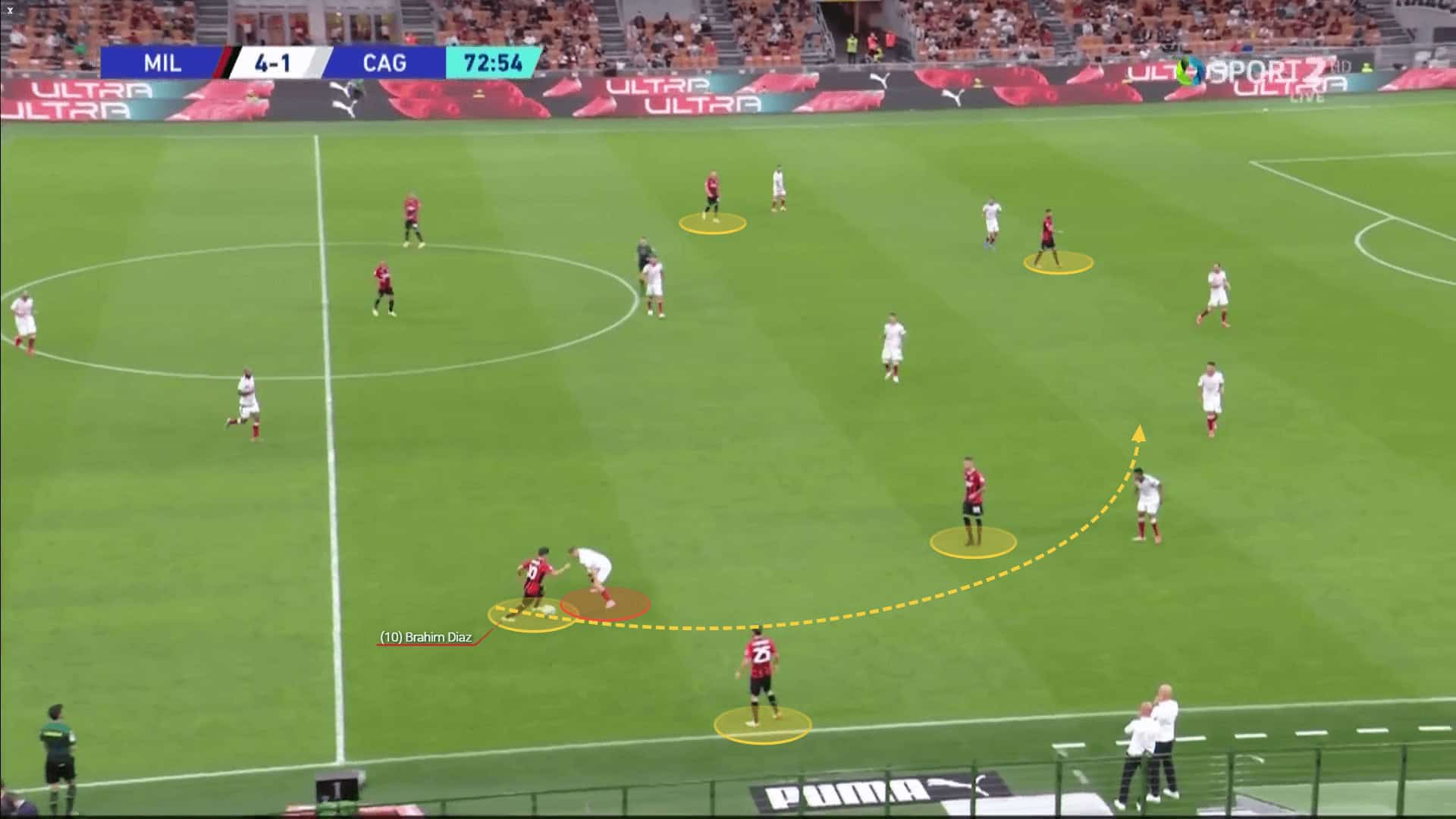
He is a creative player, and that’s the reason his presence between the central line and the box is important for the team, especially when it comes to creating goalscoring opportunities. His movement engages the opposing defenders and often leaves spaces for his teammates, but he is also able to exploit that space providing through balls.
Being a direct threat
Milan are deadly on a counter and Díaz contributes well to their movement. He is often positioned higher up the pitch and ready to pick up the ball. He would be used to advance it thanks to his composure and pace, but he would also make runs off the ball to provide an additional option in the box.
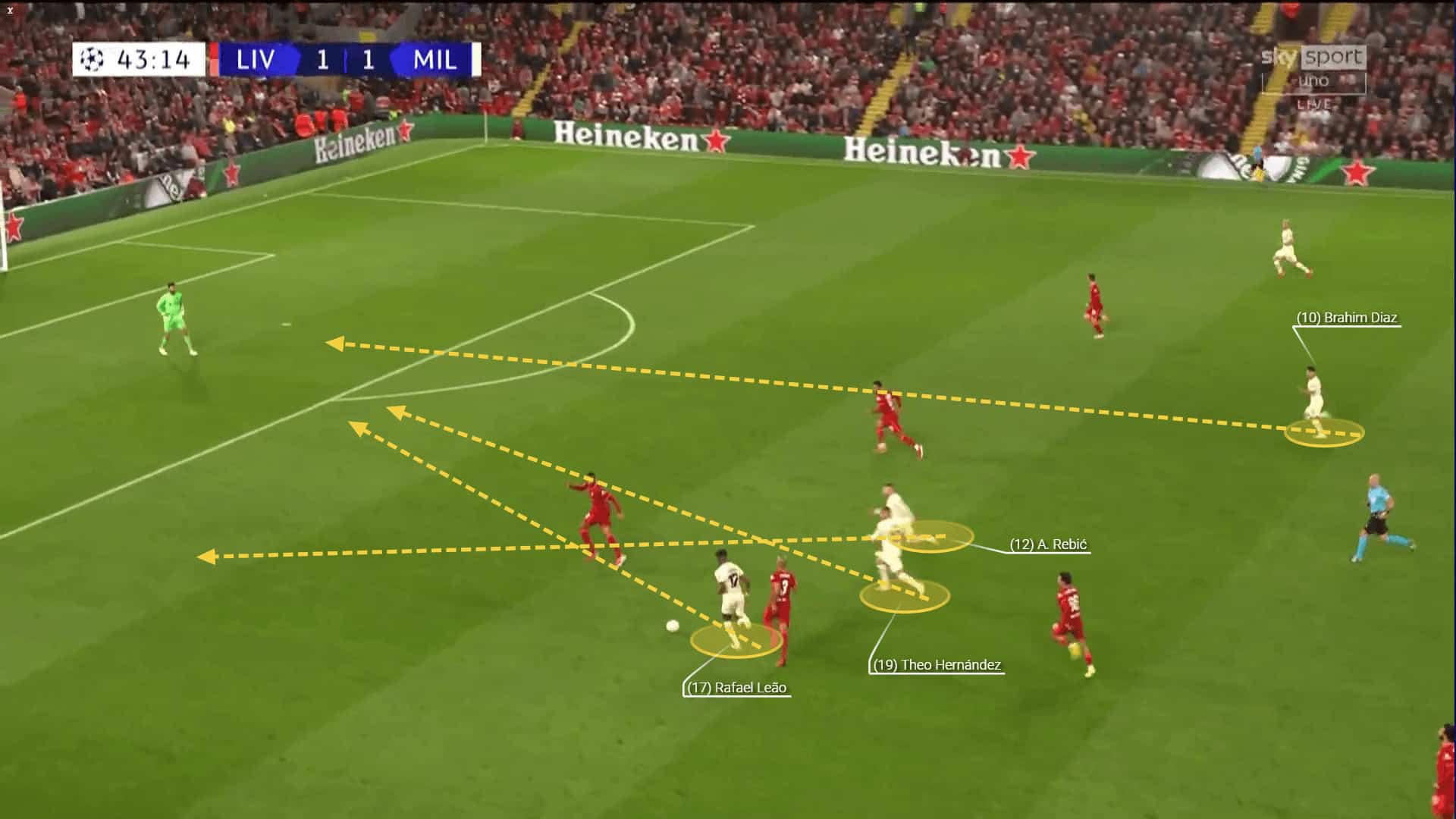
His runs are his speciality not only when the team counter-attack. He always tries to find the gaps and move into a goalscoring position, often on the defenders’ blindside, which is what makes him successful. With his late runs, he often catches the opposition off guard and manages to take advantage of their chaotic movement.
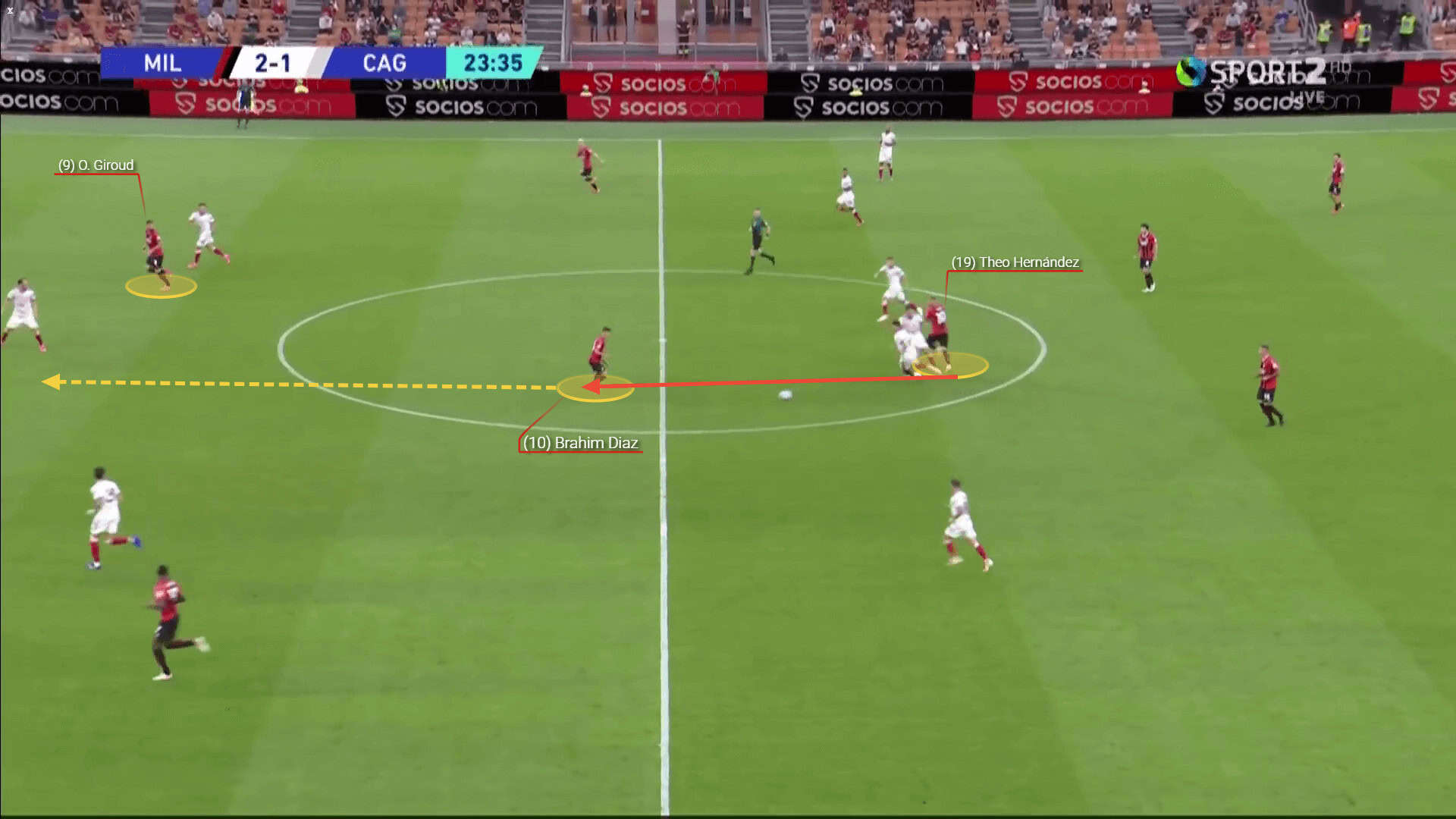

While he does provide a threat from outside the box, he is more dangerous in the box where all of his four goals have been scored from. His partnership with his teammates often results in great team movement where they rely on off the ball movement, positional interchanges and creativity.
Conclusion
As our analysis showed, Díaz successfully filled in the gaps left by Çalhanoğlu and made his absence unnoticeable. His control and attacking flair help the team in reaching the final third and in creating opportunities, while his concentration and decision-making result in him utilising such chances. His presence is beneficial for his teammates too, as their combinations and movement often result in successfully breaking through the opposing defences.
