


In English football, the academy pathway has long been seen as the most reliable conveyor belt to the professional game.
From as young as five, players are placed into highly structured environments.
They are drilled in technical repetition and prepared for the demands of the senior game.
However, some of the most interesting stories emerge not from this polished system, but from its margins.
Consider Michail Antonio, who once juggled part-time football at Tooting & Mitcham before becoming West Ham’s all-time Premier League top scorer.
Or Jamie Vardy, who spent four years at Stocksbridge Park Steels before firing Leicester City to a Premier League title and becoming a member of the ‘100 club’.
Their journeys remind us that football education can take many forms, some defined by academy polish and others by non-league.
It is within this latter narrative that Richard Koné now steps forward.
In fewer than six years, he has risen from the obscurity of non-league football to the EFL Championship, where he has signed for Queens Park Rangers.
His arrival is not just a story of perseverance but also raises tactical questions: How does a player made outside the academy system fit into the high-demand environment of the EFL?
More specifically, in this scouting report and player analysis, we will examine how Julien Stéphan might use his raw attributes and unconventional background within QPR’s game model.
Who Is Richard Koné?
Born in the Ivory Coast, Richard Koné’s path into English football couldn’t have been more unconventional.
His first experience of the UK game came in 2019, when he arrived to represent his country in the Homeless World Cup.
From there, a chance opportunity with Athletic Newham set him on a trajectory few could have predicted.
Within five years, he had not only shattered scoring records in the Essex Senior League but also forced scouts from higher divisions to take notice.
That rise led to a move to Wycombe Wanderers during the January window of 2024.
The step up to EFL League One, which can be a stumbling block for players without academy foundations, seemed like a seamless progression for Richard Koné.
By the end of the 2024/2025 campaign, he had scored 18 goals and registered three assists across 41 appearances.
This campaign earned him the League One Player of the Season award and confirmed his readiness for a bigger stage.
Unsurprisingly, the summer transfer window drew a crowd of many interested clubs.
Norwich City, Rangers, and Swansea City were all credited with interest, but Queens Park Rangers ultimately secured his signature.
For the Loftus Road faithful, the prospect of Richard Koné joining a forward line already boasting Ilias Chair, Kwame Poku, and Karamoko Dembélé adds an element of unpredictability and excitement.
The question now is not whether he belongs at the EFL Championship level, but how Julien Stéphan will integrate him into a side seeking both stability and attacking dynamism.
Richard Koné Style Of Play
Richard Koné’s playing style is less about mechanical polish and more about instinct, explosiveness, and directness.
Statistically, his 2024/2025 campaign in League One paints the picture of a striker who thrives on volume and persistence.
Across 30.5 full 90s, he averaged 3.28 shots per game, with 1.31 on target per 90, an output that placed him among the most active shooters in the league.
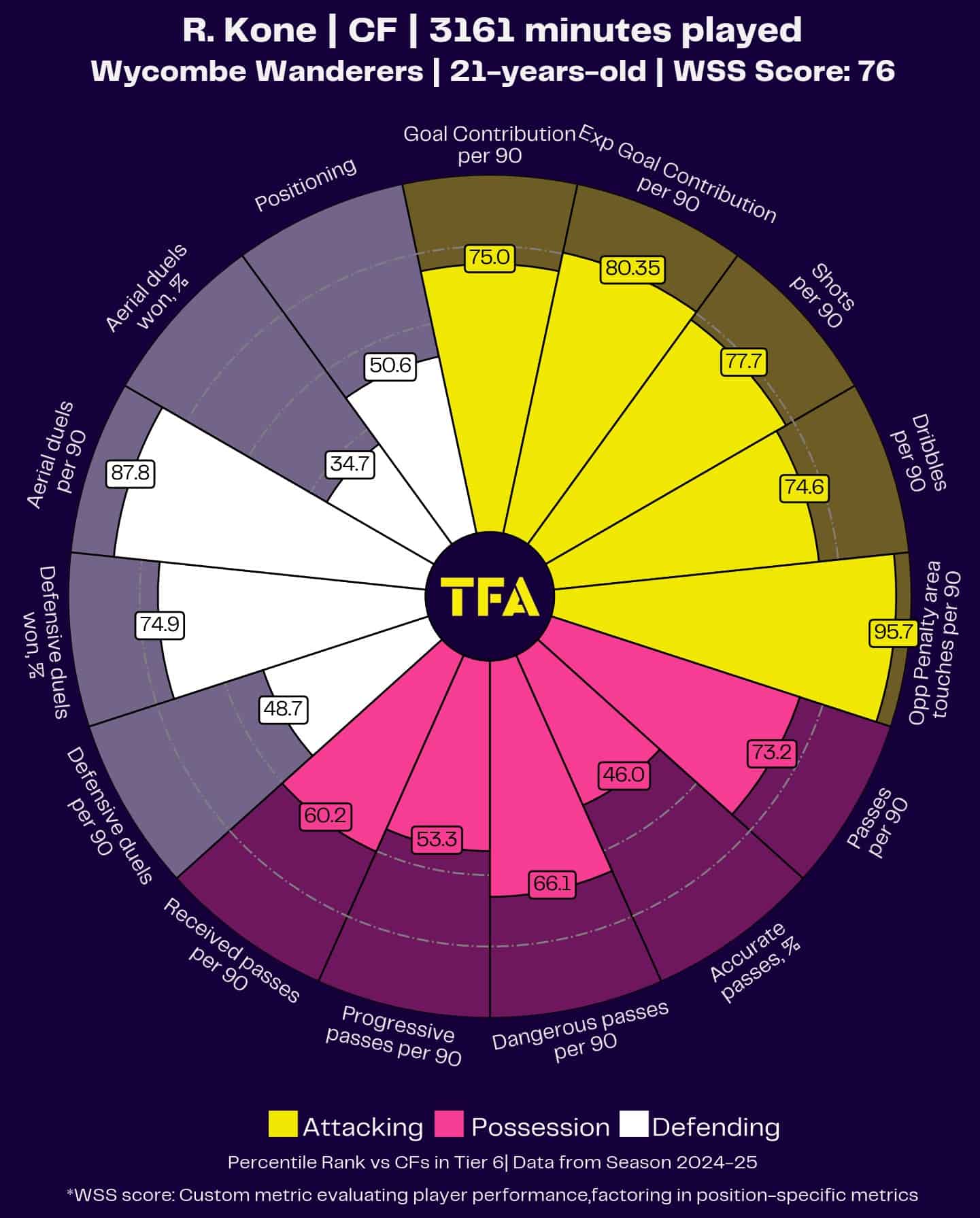
This pizza chart highlights Richard Koné’s shooting and attacking contributions for Wycombe Wanderers, benchmarking him against other League One forwards (median = 50).
His shots per 90 (77.7) and expected goal contribution per 90 (80.35) are standout metrics, placing him comfortably above the median of his position.
Additionally, his goal contribution per 90 (75) and penalty area touches per 90 (95.7) show his ability to find and exploit dangerous spaces in attack.
Although his possession metrics, like accurate passes (73.2%) and progressive passes (53.3%), show room for refinement, his attacking dominance illustrates a forward focused on getting into goalscoring positions rather than deep build-up involvement.
Furthermore, his 40% shots-on-target rate shows a striker who consistently works the goalkeeper rather than wasting possession with speculative shots.
What stands out technically is his movement into space before receiving.
Richard Koné positions himself on the blindside of centre-backs, timing diagonal runs into the half-spaces to exploit gaps between full-backs and central defenders.
His runs are sharp and begin with a subtle drop of the shoulder or a quick scan over his marker before accelerating into space.
He cleverly uses his body shape, angling his hips and shoulders so that he can open up on the half-turn and carry the ball forward in stride.
This allows him to either drive directly at defenders with his first touch or roll markers using his upper-body strength and low centre of gravity.
His finishing profile is similarly interesting.
While his 0.14 goals per shot (G/Sh) suggests he is not hyper-clinical, the 0.43 goals per shot on target (G/SoT) demonstrates that once he hits the target, he becomes a threat.
In the video below, versus Charlton Athletic, Richard Koné is able to create space for himself due to his holding up the ball well via shielding (as well as clever manipulation of the ball).
He is able to shoot across goal into the bottom right corner and score.
This points towards a striker whose shot selection may at times be rushed, but whose technique, particularly on low, driven finishes across the goalkeeper, is strong.
He generates surprising power from minimal backlift, a product of explosive leg strength and a compact striking motion, which makes it difficult for goalkeepers to set themselves.
Physically, Richard Koné brings attributes that translate well to the Championship.
He has explosive acceleration over short distances, allowing him to burst away from defenders in the first three strides.
Once in full flow, his stride pattern is long and elastic, giving him the ability to attack open grass quickly. However, he can also decelerate to create separation inside the box.
His pressing is aggressive and high-intensity, aided by his ability to spring laterally and cut off passing lanes.
When operating in wider zones, he uses his body well to shield the ball, planting his standing leg firmly while leaning into contact to roll full-backs.
As shown in a fixture versus Swansea City, Koné is able to shield the ball well and invite his teammate into play. He peels off and makes a run into the box to receive the pass and score with his left foot.
He is able to do this because he can withstand pressure from behind—if the centre back tries to win the ball back, the likely outcome is a free kick.
Against centre-backs, his willingness to initiate contact before spinning into space makes him difficult to track.
He likes to drift out to wide areas and has plenty of touches in the channels, suggesting he can operate as both a central striker and a wide forward in a front three.
This versatility will be valuable for Julien Stéphan, whose systems at Rennes relied on dynamic forwards capable of interchanging positions.
However, there are weaknesses to his game.
Richard Koné’s link play remains underdeveloped, and his first touch can be inconsistent under heavy pressure.
As shown in a fixture against Charlton Athletic, Koné does not have control of the ball despite being ahead of the recovering centre back.
His touches lead him into a duel, which he eventually loses.
He is not yet a natural back-to-goal forward who can consistently connect play between the lines.
He sometimes drifts out of the game against deep blocks, and his threat is muted when space to attack is limited.
These traits suggest that he may be better suited to a transitional system initially.
In this system, QPR can exploit his vertical running and aggressive pressing rather than relying on him to dictate slower-possession phases.
His impact on team outcomes at Wycombe highlights his value.
With him on the pitch, Wycombe averaged 1.86 points per match and conceded fewer goals (0.89 per 90) than without him.
That “on/off” impact (+0.63 PPM) indicates his scoring contribution and the territorial and pressing advantages he brings when leading the line.
In short, Richard Koné is excellent when it comes to directness, intensity, and vertical threat.
If Stéphan can refine his decision-making in the final third and improve his hold-up play, QPR may have acquired a system-shaping forward.
Richard Koné Tactical Fit For Julien Stéphan Tactics At QPR
Julien Stéphan inherits a squad with technical creators in Ilias Chair and dribbling wingers like Karamoko Dembélé and Kwame Poku.
Richard Koné’s arrival adds something different: a vertical runner who can stretch the backline, pin centre-backs, and provide direct penetration.
His role will vary depending on the system, but three shapes stand out as natural homes for him in this QPR squad.
Lone Striker In A 4-2-3-1
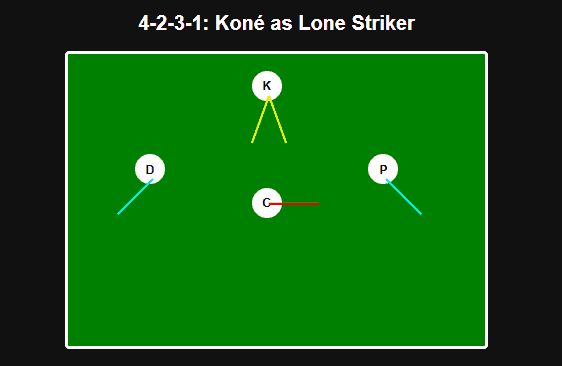
In a 4-2-3-1, Koné functions as the reference point at the top of the structure.
His primary value is holding the last line, forcing defenders to drop deeper.
By doing this, he opens space between the lines for Chair, who does well when receiving on the half-turn as a No. 10.
As shown in the image below:
- Koné (K) is positioned centrally at the top of the structure; the yellow arrows show him making diagonal runs into the spaces between the opposition centre-back and full-back.
- Chair (C) is just behind him, acting as the playmaker; the red arrow shows how Chair can pass vertically into Koné’s runs.
- Dembélé (D) on the left has a blue arrow diagonally inside, showing his tendency to cut in on his stronger foot and combine with Chair.
- Poku (P) on the right stretches the width, with a blue arrow forward, showing how he pushes up to hold the opposing full-back.
This shape uses Richard Koné to pin defenders while Chair and Dembélé exploit the pockets of space he creates.
Poku holds width to stop the defence from collapsing centrally.
Richard Koné’s diagonal runs into the half-spaces, creating constant dilemmas for centre-backs.
If they follow him wide, they leave gaps centrally.
If they hold the line, they risk being exposed in behind.
The forward line gains balance with Dembélé attacking inside from the left and Poku stretching the right channel.
One wide player comes short, another goes long, and Koné provides the vertical reference.
His explosiveness makes him particularly suited to this role. He can both contest aerial balls and immediately spin into space when service arrives early.
Strike Partnership In A 3-5-2
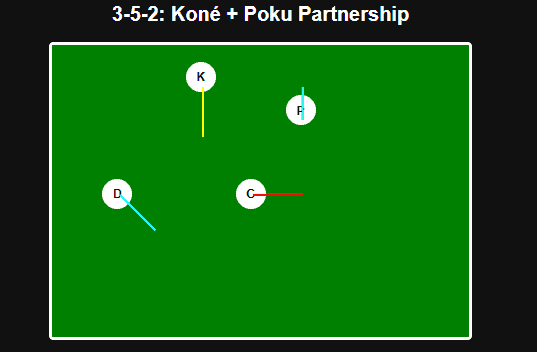
Stéphan has previously shown comfort in using back threes, and a 3-5-2 would allow Richard Koné to work in tandem with Poku.
In this setup, Poku can drop off as a second striker, linking with midfield and drawing defenders into pockets, while Koné stays high as the depth runner.
As shown in the image below:
- Koné (K) stays high and central, with a yellow arrow straight ahead, representing his role as the depth runner who constantly threatens the space behind the defence.
- Poku (P) has a blue arrow dropping back, showing how he comes short to link play or combine with Chair.
- Chair (C) sits just behind them, with a red arrow forward, and has the role of the feeder to both strikers.
- Dembélé (D) is wider left as a wing-back, shown by the blue arrow up the flank; he can provide width and carrying the ball.
This duality creates complementary movements.
Koné pins the line, occupying both centre-backs, while Poku drifts into the inside-right channel to combine with Chair, who would be the free No. 8.
Meanwhile, Dembélé could be used as a left wing-back, offering width and progression.
This system maximises Richard Koné’s strengths in transition.
He can attack space with fewer defensive crowds around him while also benefiting from a strike partner who can take responsibility for link play.
Wide Forward In A 4-3-3
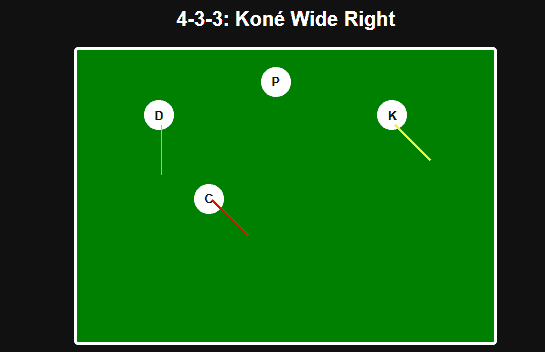
Another intriguing option is to deploy Koné wide on the right of a front three.
This unlocks his pace and directness in one-on-one duels with full-backs while still allowing him to make diagonal runs inside.
In this role, Poku could operate as the central striker, with Dembélé on the left.
The chair can drift forward from midfield and then become the secondary playmaker, feeding diagonal passes into both channels.
As shown in the image below:
Richard Koné (K) starts from the right wing.
The yellow diagonal arrow shows him cutting inside towards the half-space, attacking the gap between the centre-back and full-back.
Poku (P) plays as the central striker, occupying the centre-backs.
Dembélé (D) is wide on the left, with a blue arrow forward, showing his role in stretching the pitch and forcing the opposition to defend wide.
Chair (C) is deeper, with a red arrow forward, illustrating how he steps up from midfield to feed diagonal passes into Koné’s runs.
Richard Koné would not be asked to hold play with his back to goal, but rather to isolate defenders and use his explosive first steps to gain separation.
His body shape, with hips angled towards goal and shoulders positioned to cut inside, naturally suits him to attacking diagonally rather than hugging the touchline.
This role would also give QPR a more unpredictable attacking trio, as all three forwards would be comfortable rotating and interchanging positions.
Conclusion
Richard Koné gives QPR something their attack has been missing: pace and penetration.
He is not yet the finished product, but his movement, explosiveness, and ability to create space for teammates like Chair, Dembélé, and Poku make him a welcome addition.
Under Julien Stéphan style of play, his raw qualities can be refined, turning potential into consistent impact.
For the fans, this is a signing to be excited about because Koné brings unpredictability, energy, and the kind of direct threat that can change games on his own.
He offers a new dimension to the attack, the promise of goals, and the buzz of a player who plays on the edge of defenders.

