


Rangers left Celtic Park with a 3-2 victory on Sunday despite ending the game with just 28% of the ball possession.
This result was undoubtedly a feather in the cap of interim Rangers boss Barry Ferguson, who took over from ex-Gers manager Philippe Clement in late February.
Both sides had good moments and bad moments, both in and out of possession during Sunday’s game; it was far from a tactical masterclass on behalf of either side in this legendary rivalry.
However, the interplay and partnership between Rangers’ centre-forward pairing—initially Cyriel Dessers (left) and Václav Černý (right) before the latter was replaced by the game-winning striker Hamza Igamane in the final minutes of the game—proved vital to the victory for the blue half of Glasgow.
Our tactical analysis looks to highlight how Ferguson utilised his centre-forwards to such great effect in Sunday’s game and how those players influenced the match so heavily.
We’ll focus on how Rangers’ centre-forwards combined, moved and worked together to create against Celtic despite their team having such little ball possession over the 90 minutes.
Rangers’ Forwards Dropping In Between The Lines To Influence Play Vs Celtic
Firstly, let’s look at how Rangers’ forwards would drop in between the lines versus Celtic to impact the game.

Both Dessers and Černý performed this role at different times during the game, as indicated by the pair’s touch maps above.
However, Desserts was a bit more active in this regard, with Černý staying higher a little more often.
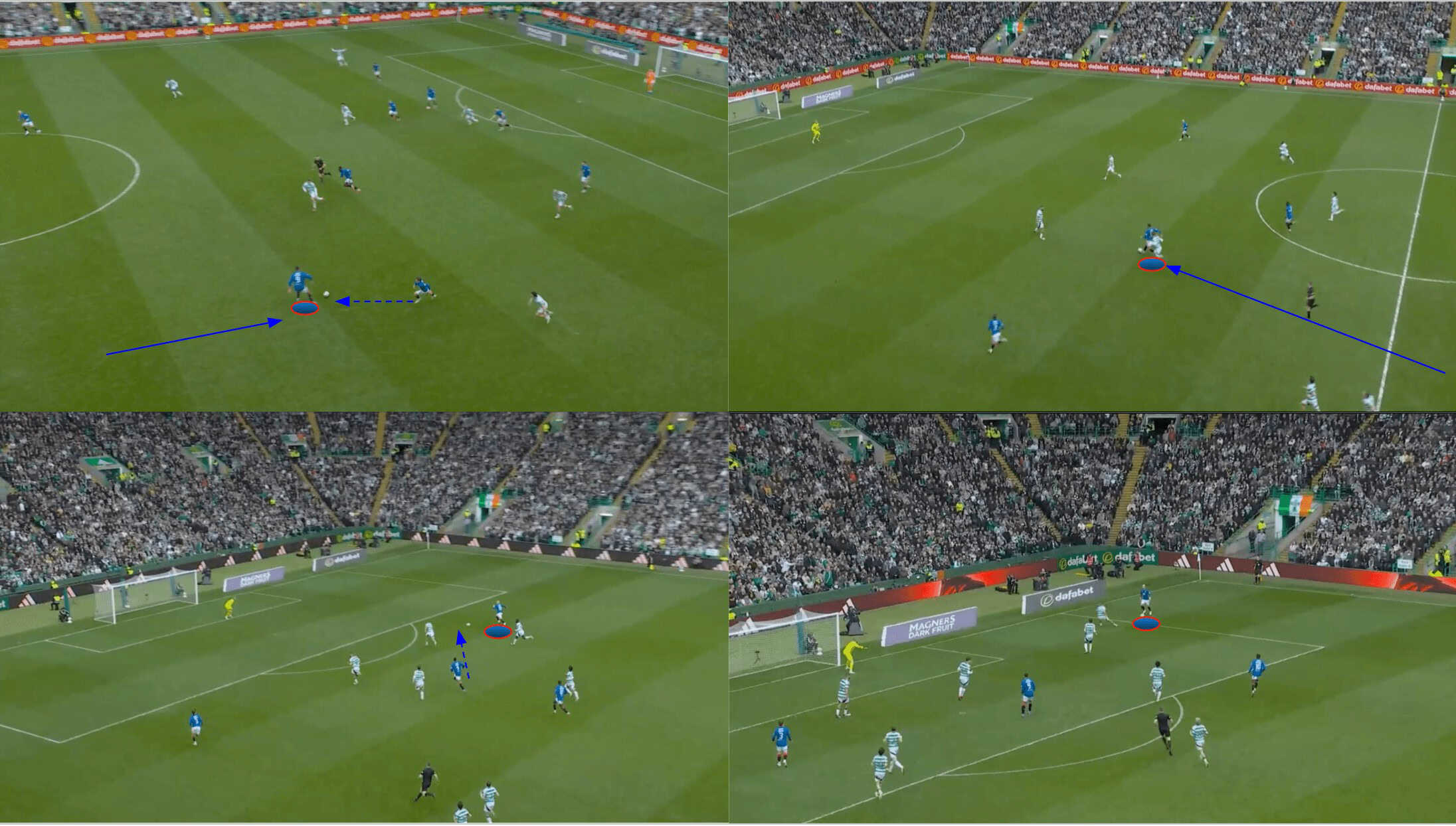
One example of Dessers dropping between the lines is shown in figure 2.
Here, we see that the left striker has picked up the ball quite a few yards inside his team’s half of the pitch.
Rangers have just regained possession of the ball and are now starting a counterattack.
The ball carrier drives into Celtic’s half with the ball at his feet, holding off pressure from the challenger on his back and progressing all the way to the edge of the area before playing his strike partner, Černý, into the box with a through ball.
Most instances where Rangers’ forwards were involved with the game were during transitional phases.
They had to find space and put themselves in inviting positions to receive the ball as their team looked to launch counterattacks, as Dessers did in figure 2 above.
Once they were on the ball, their strike partner would try to provide support by placing at least one passing option on the table—we can see an example of this with Černý in figure 2, with the right striker positioned on the edge of Celtic’s backline, threatening to break away in behind the defence from a slightly wide position—an option which Dessers ultimately takes up to progress Rangers into Celtic’s penalty area.
Movement, positioning, dribbling, vision and passing were all key skills on display by Rangers’ centre-forwards when they were involved in this game, as the strike partners display in figure 2.
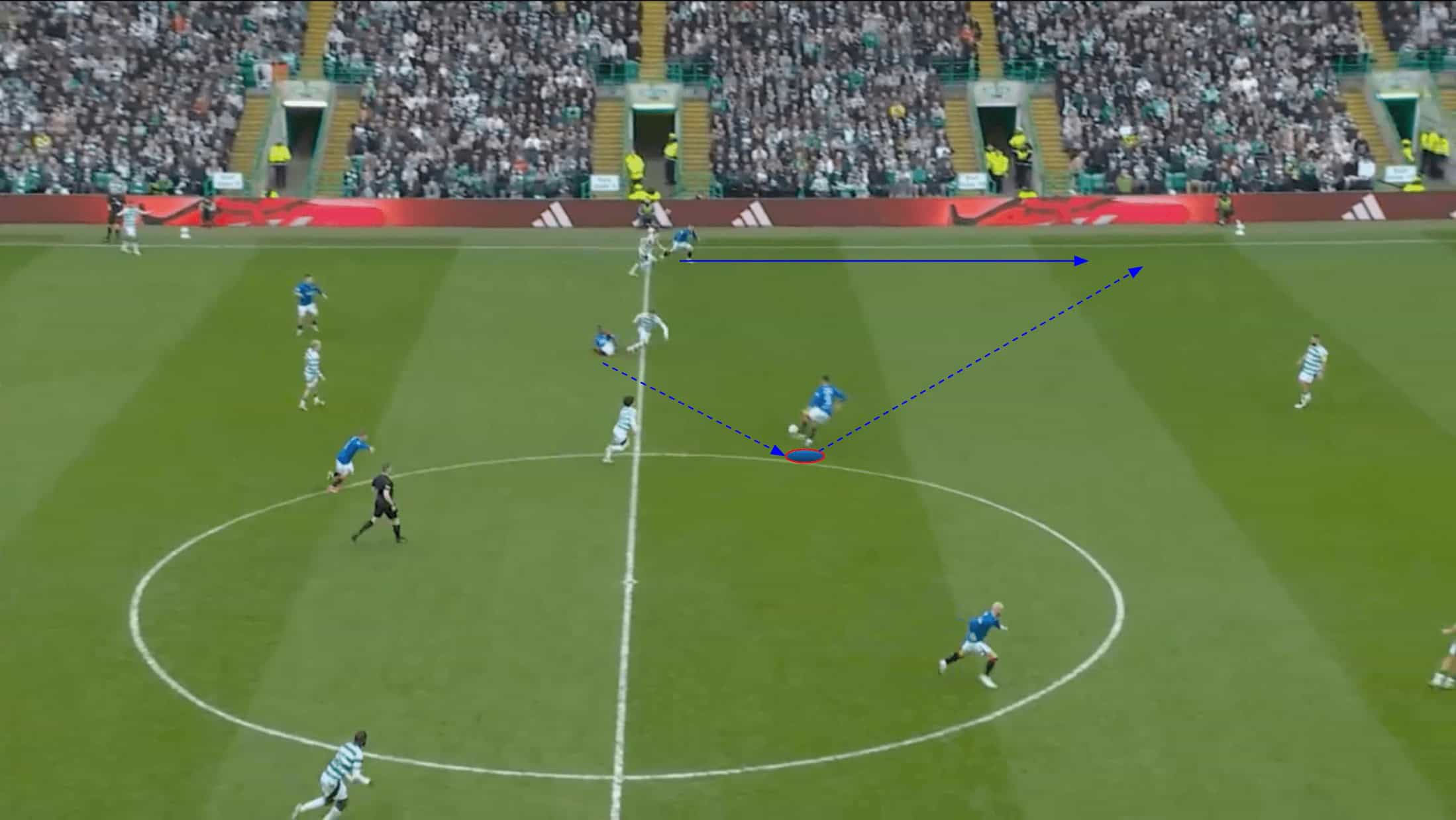
Here, Desserts receives the ball at the start of a Rangers counterattack once more.
On this occasion, the striker is able to pick up the ball and quickly relay it to the overlapping left wing-back outside him.
Again, he’s done well in positioning himself relatively close to where the favourable turnover occurred, in plenty of space to receive the ball and keep the play moving forward for his side.
In this instance, it’s crucial that teammates, such as his strike partner and the wing-back, quickly react to his reception of the ball and provide support via progressive passing options to keep the attack progressing smoothly.
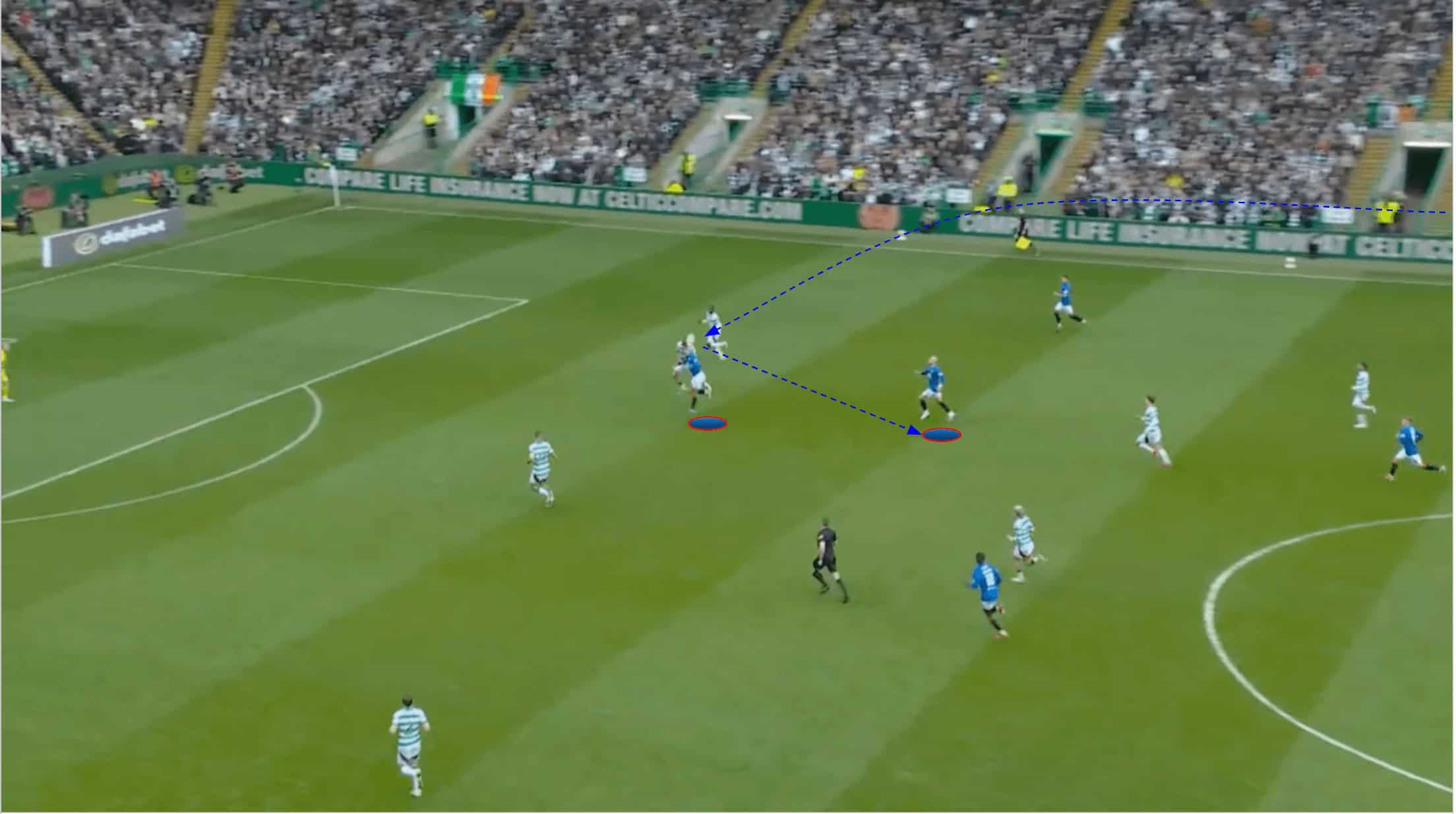
On this occasion, the ball is making its way forward in the air, with Dessers contesting the aerial duel with Celtic’s centre-back while Černý has dropped off in between the lines, preparing to challenge for the knockdown.
After he receives the ball, Černý is able to get a shot off from distance that challenges Celtic goalkeeper Kasper Schmeichel—further demonstrating how Rangers’ exploitation of space in between the lines versus Celtic proved helpful in their chance creation efforts against their rivals on Sunday.
How & Why Rangers’ Strikers Split Wide Vs Celtic
We caught a glimpse of how Rangers’ strikers moved away from the centre into slightly wider positions versus Celtic in figure 2 via Černý’s position as he receives the ball to progress into the opposition’s penalty area.
This was not a one-off; it was a regular feature of Rangers’ game on Sunday for both strikers—especially Černý, as the heatmap in figure 1 again displays.
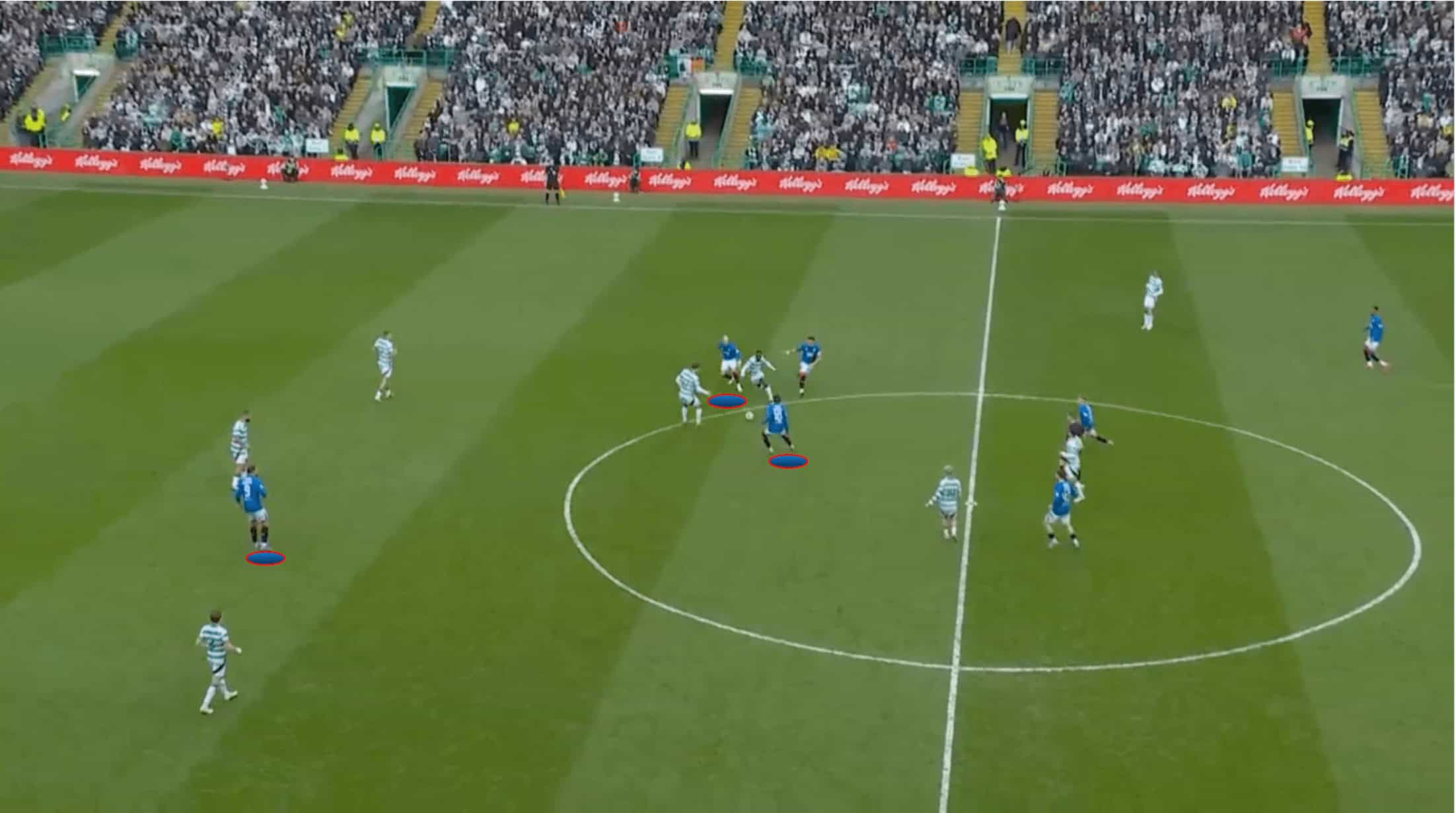
Here, we see Diomande picking the ball up in the middle of the park.
As he does so, Rangers’ strikers—immediately turn their attention to their respective runs and provide options for the attacking midfielder, leading us into figure 6, where we’ll find Dessers getting onto the receiving end of Diomande’s through ball.
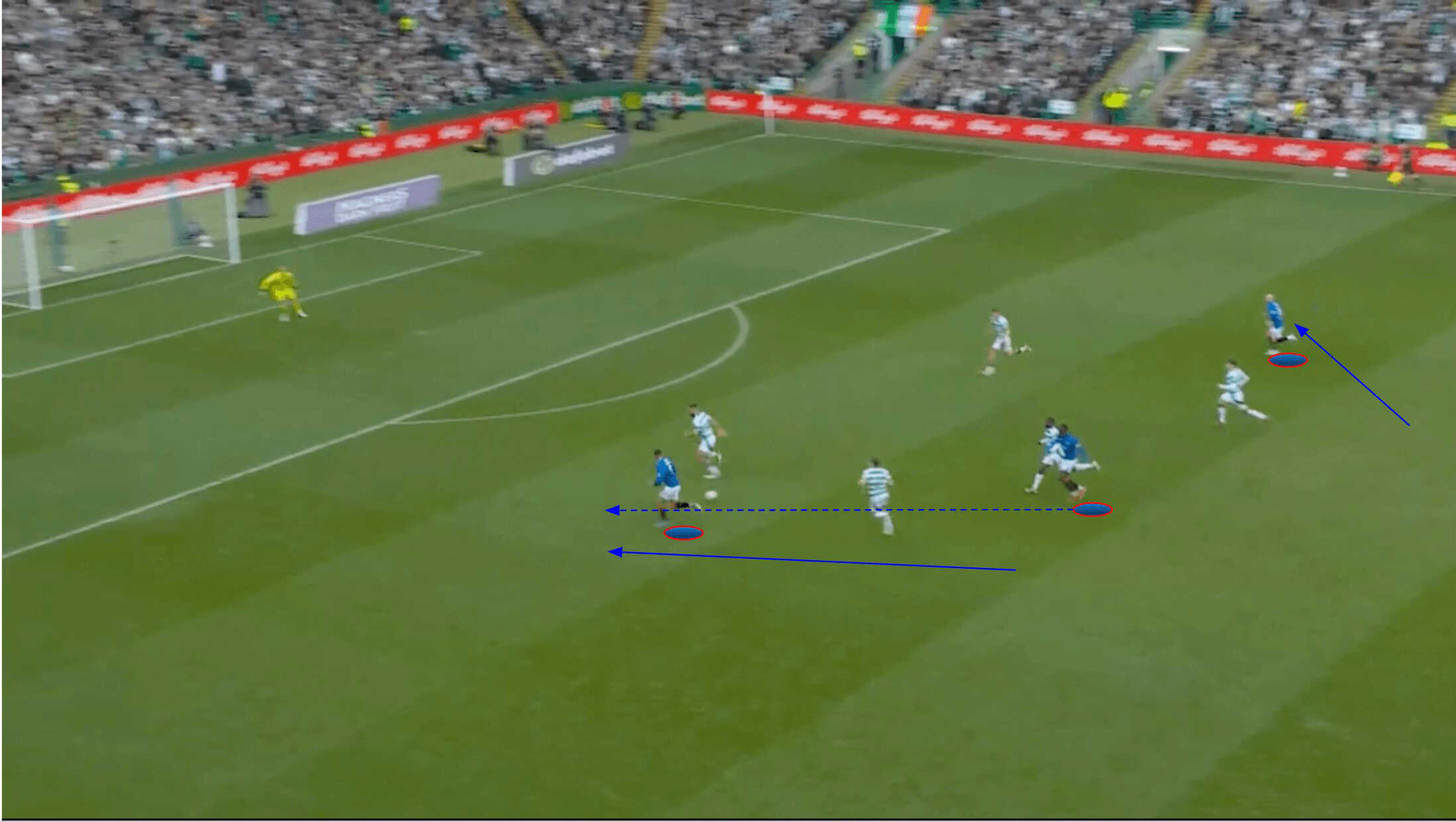
We pick up play with Diomande, who found Dessers with a through pass inside the final third.
At this point in time, we can observe how both Dessers and Černý have vacated the very centre of the attacking line, leaving that space empty in order to make their runs via slightly wider positions.
This puts them in a position to attack from outside the centre-halves and progress into a short crossing position if they wish to do so.
This kind of movement also served to create space for other teammates, as was observed when Rangers scored their second goal of the game on Sunday.
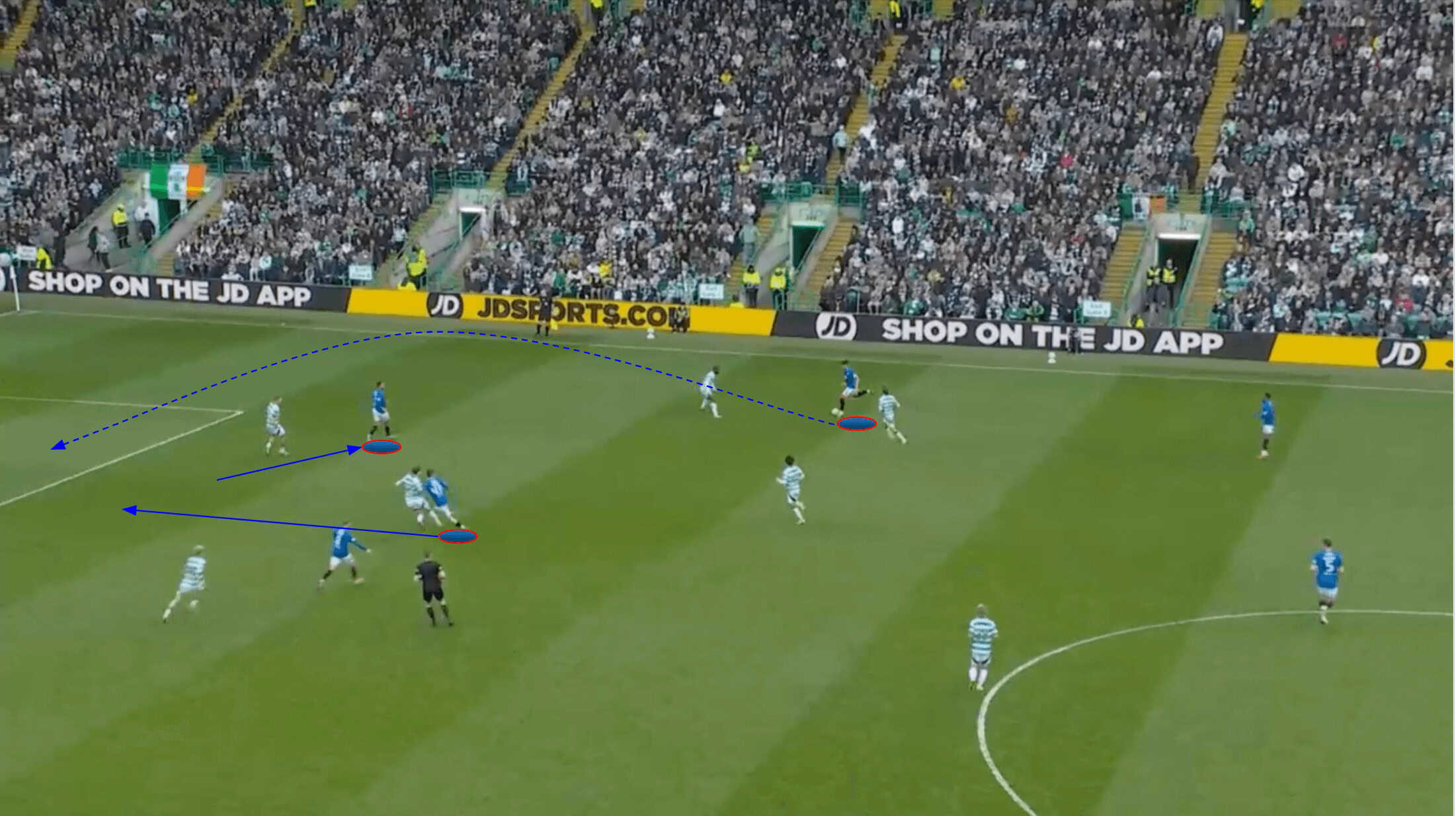
Here, we see how Dessers’ movement has dragged Celtic’s left centre-back out from the middle of the box to the edge.
At the same time, Černý is positioned fairly wide on the other side.
This positioning ultimately creates some space between the centre-backs caused by Rangers’ split strikers, which an advancing midfielder could exploit with an intelligent, well-timed run.
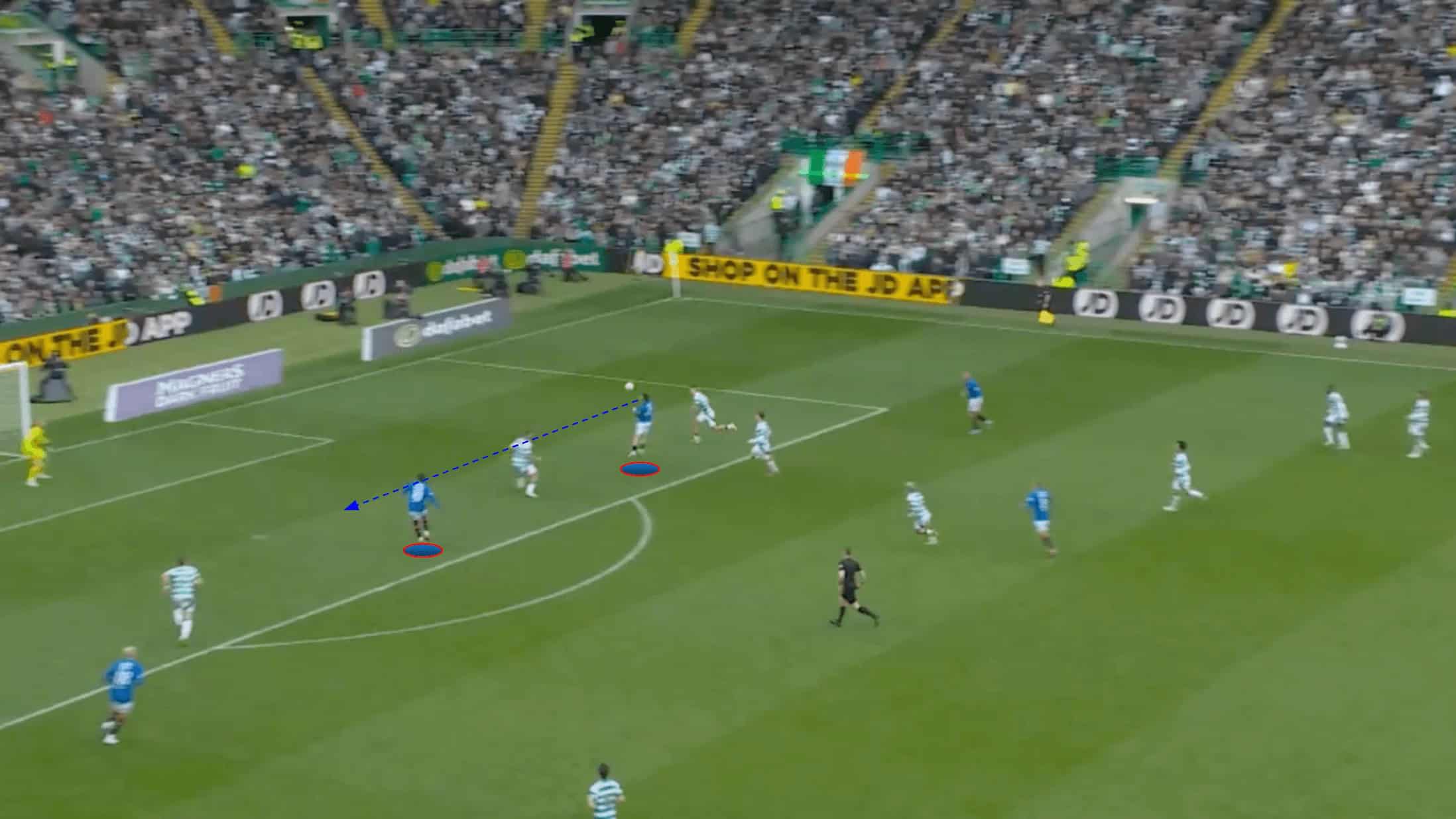
As the ball is played into the space between the centre-backs—especially left centre-back Maik Nawrocki, who was dragged quite wide by Dessers’ movement—central midfielder Nicolas Raskin, who we saw beginning his run into the box in figure 7, is in position to meet the ball.
Right centre-back Cameron Carter-Vickers is drawn towards Raskin, but the ball is knocked on to Diomande by the advanced midfielder, and all the Celtic defence can do now is watch as the ‘10’ tucks the ball away to double Rangers’ lead to two goals in the 37th-minute.
This move was largely created by the unselfish movement of Rangers’ centre-forwards, who split wide and drew Celtic’s defenders towards them.
This created the gap in the centre that ultimately led to Diomande’s goal.
Rangers’ forwards performed this kind of movement on several occasions throughout this game.
They could have benefited from more advanced runs from central midfield to exploit the resulting space that we saw in this example on other occasions, too.
Nevertheless, they were able to take advantage of the strikers’ movement and the resulting space on this occasion to put themselves up by two—a good result for that particular tactic.
How Rangers’ Forwards Used Aerial Knock-Ons To Defeat Celtic
Lastly, we’re going to take a look at a few more aerial duels, all of which featured knock-ons from one striker to another, and how they played their part in Celtic’s defeat on Sunday.
Long balls from the goalkeeper were not uncommon for Rangers in this game.
They launched their kick-outs fairly regularly, often targeting a centre-forward with those long passes.
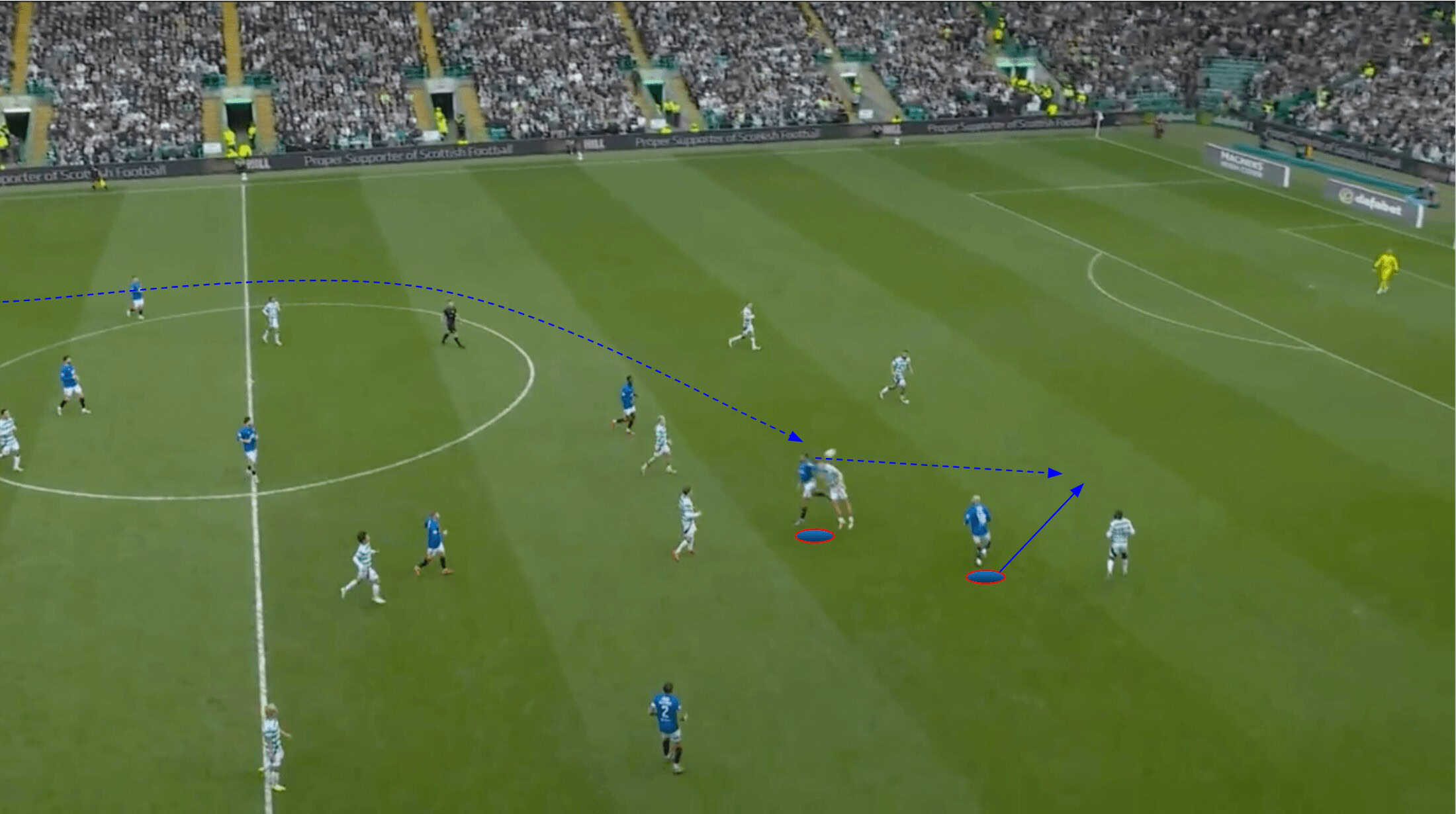
Here, the ball drops onto Dessers’ head, and the striker knocks the ball on for Černý, who’s ready to pounce on the ball as it progresses towards him.
This sets the striker up to run in behind Celtic’s backline and towards goal.
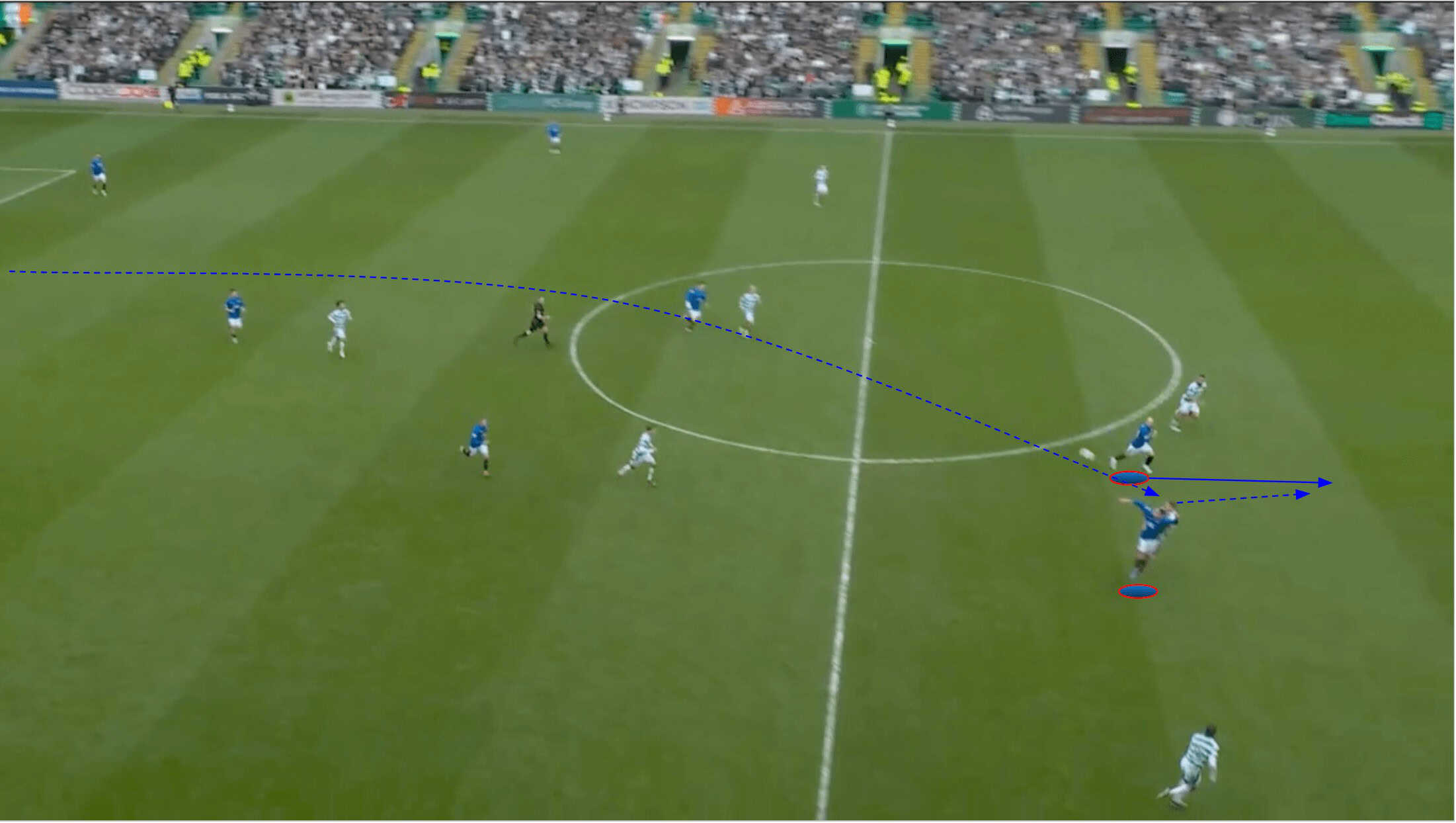
We saw this combination of Dessers contesting the aerial duel.
At the same time, Černý runs off his strike partner to provide an option in behind quite a bit—especially in the latter stages of the game, as both these examples display.
The game plan here was to utilise Černý’s pace and movement in combination with Dessers’ ability in the air to create via these long balls forward.
That tactic didn’t ultimately lead to a goal for Černý, but it did lead to a goal for his replacement, Hamza Igamane, shortly after the substitute striker was introduced to the game late on.
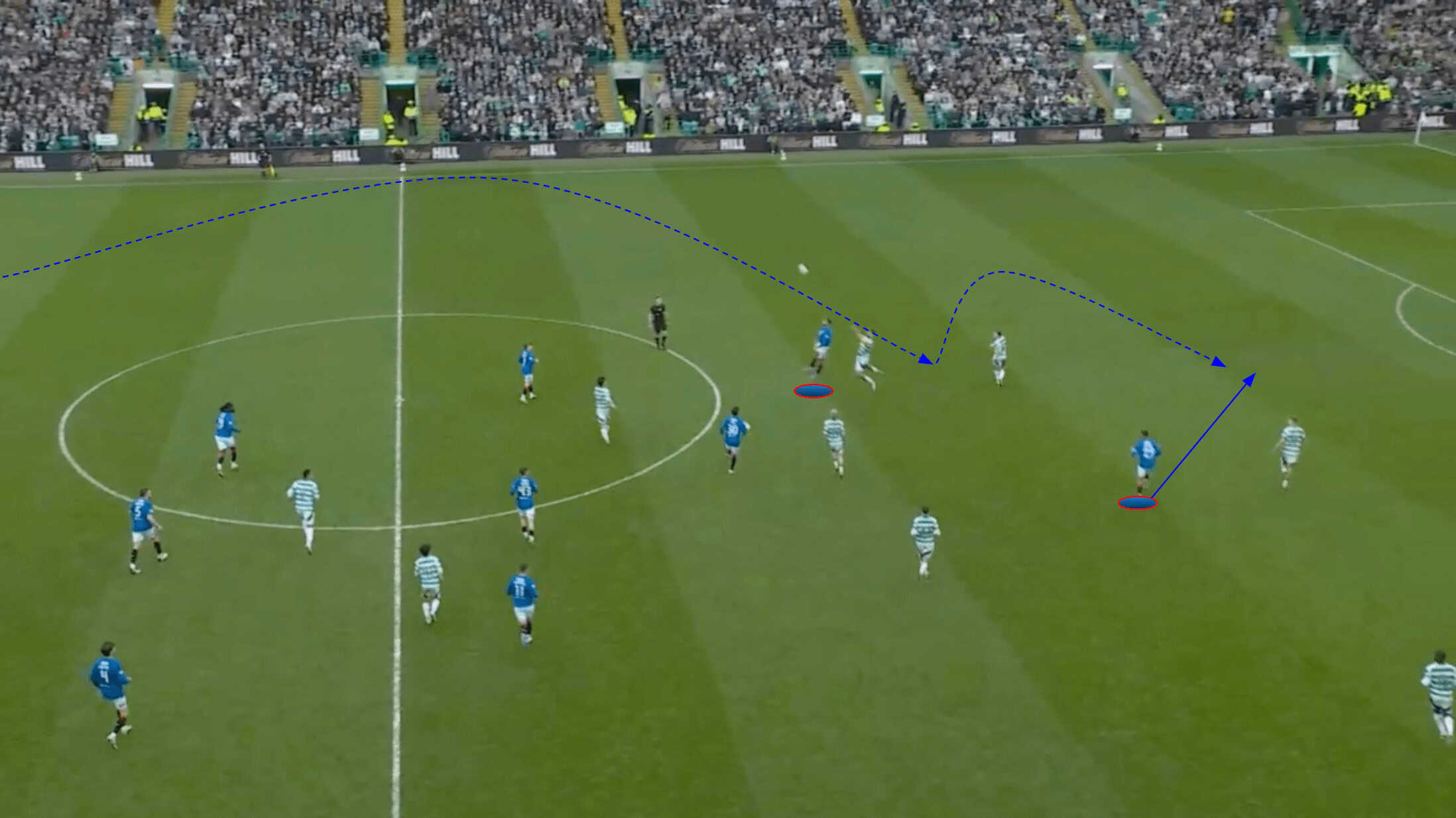
After the long ball was played towards Dessers, both the Rangers striker and the Celtic defender competing with him in the air missed the ball, allowing it to bounce just behind them.
Crucially, this bounce wrong-footed the Celtic defender waiting just behind, which allowed the ball to continue towards Igamane, who was able to pull off an exquisite finish to seal a 3-2 victory for Rangers at Celtic Park.
Conclusion
In conclusion, Rangers’ centre-forwards played a vital role in their side’s eventful away win.
They helped their team launch counterattacks, displayed intelligent movement and positioning in general, and provided options when the Gers opted to go long, especially late in the game.
As mentioned, this was not a tactical masterclass for either side, but the quality of Rangers’ centre-forward play helped the away side make the most of their chances, maximising their chances of securing three points.

