


Since Miron Muslić took over at Cercle Brugge in September of 2022, the Belgian side have been constantly improving.
Now, in 2024, the Belgian side started the post-winter break in Belgium with a dominant performance against last season’s league runners-up, Genk.
Muslić’s side were unlucky not to leave the Cegeka Arena with three points, with the match ending 1-1.
This tactical analysis will examine three key tactical trends from the match against Genk, while also utilising data and analysis from previous games this season to demonstrate that Cercle Brugge’s performance was essentially complete, with the scoreline being the only negative aspect.
We will examine the match against Genk in the context of Cercle Brugge’s season, highlighting the identity that Muslić aims for his side to possess and the tactics he intends to employ.
Pressing shape caused Genk problems
Before we delve into the analysis of Cercle Brugge’s pressing and their pressing shape from the match against Genk, it would be beneficial to start by examining their statistics in this metric this season.
Cercle Brugge’s PPDA of 6.78 is far and away the lowest in the division, highlighting the rate at which Muslić’s side press, as well as how successful they have been.
As the title of this section states, we are going to take a deeper dive into the pressing shape of Cercle Brugge against Genk, with Muslić’s goal to prevent Genk goalkeeper Maarten Vandevoort from using his back line to build from the back, as well as limiting the time the backs were on the ball if they did receive possession.

The image above shows a pressing phase from Cercle Brugge early in the match off of Genk’s goal kick.
Typically, Wouter Vrancken’s side look to play possession-based football, with it common for Genk’s back line to play between each other, looking to break opposition presses down before playing line breaking passes, either into the wide channels or centrally, with Genk’s defenders across the back line all very good in possession.
Muslić looked to eliminate this possibility for Genk playing out from the back, with the Austrian coach setting his side up in a 4-4-2 diamond shape in these phases of play.
This shape clogs the central zones, with Genk’s double pivot of Matías Galarza and Patrik Hrosovsky unable to find space to receive possession.
What it also does is force Genk through one avenue of attempting to build play from the back, with only the wide channels really accessible, with the only other option to play long.
As the play develops, we can see the trouble this diamond shape caused Genk throughout this match.
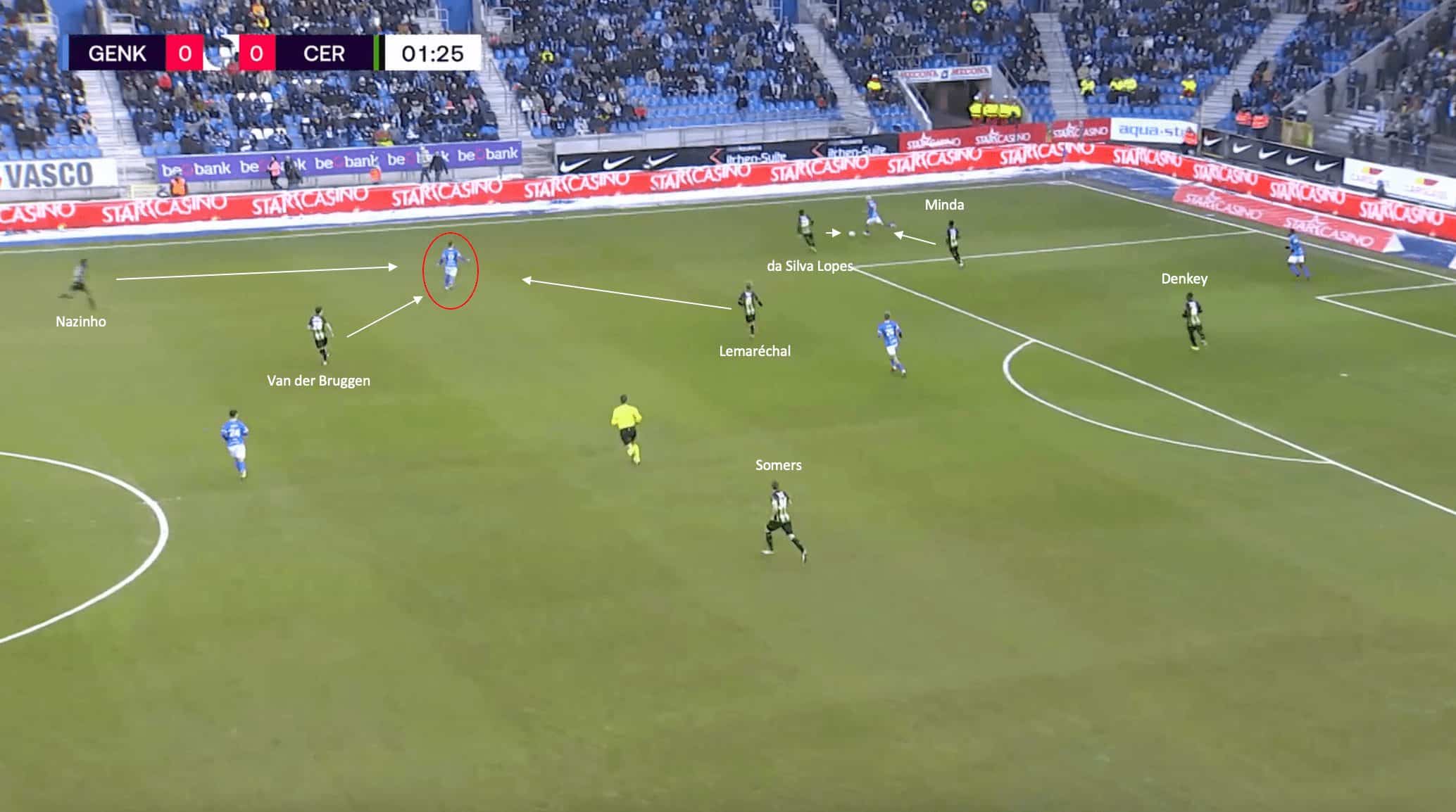
The image above shows what happens as the play develops.
The ball is able to reach the Genk fullback, Daniel Muñoz, with the Cercle Brugge shape able to quickly shift over, with Alan Minda and Leonardo da Silva Lopes able to close the Colombian defender down.
Instead of looking to relieve the pressure, Muñoz instead looks to play a pass into the midfield to Hrosovsky, looking to break the press.
Instead, it is what Miron Muslić’s side wanted Genk to do.
With the Slovakian international midfielder the only progressive option, three Cercle Brugge players, Felix Lemaréchal, Hannes Van der Bruggen, and Nazinho, all collapsed on the midfielder.
The key is the pressure from behind by Nazinho, as this forces the midfielder to drive back towards his own goal, inviting the pressure once again from Cercle Brugge.
This press leads to an eventual turnover, with Muslić’s side able to regain possession in an advanced area of the pitch and looking to put the Genk defence under immediate pressure.
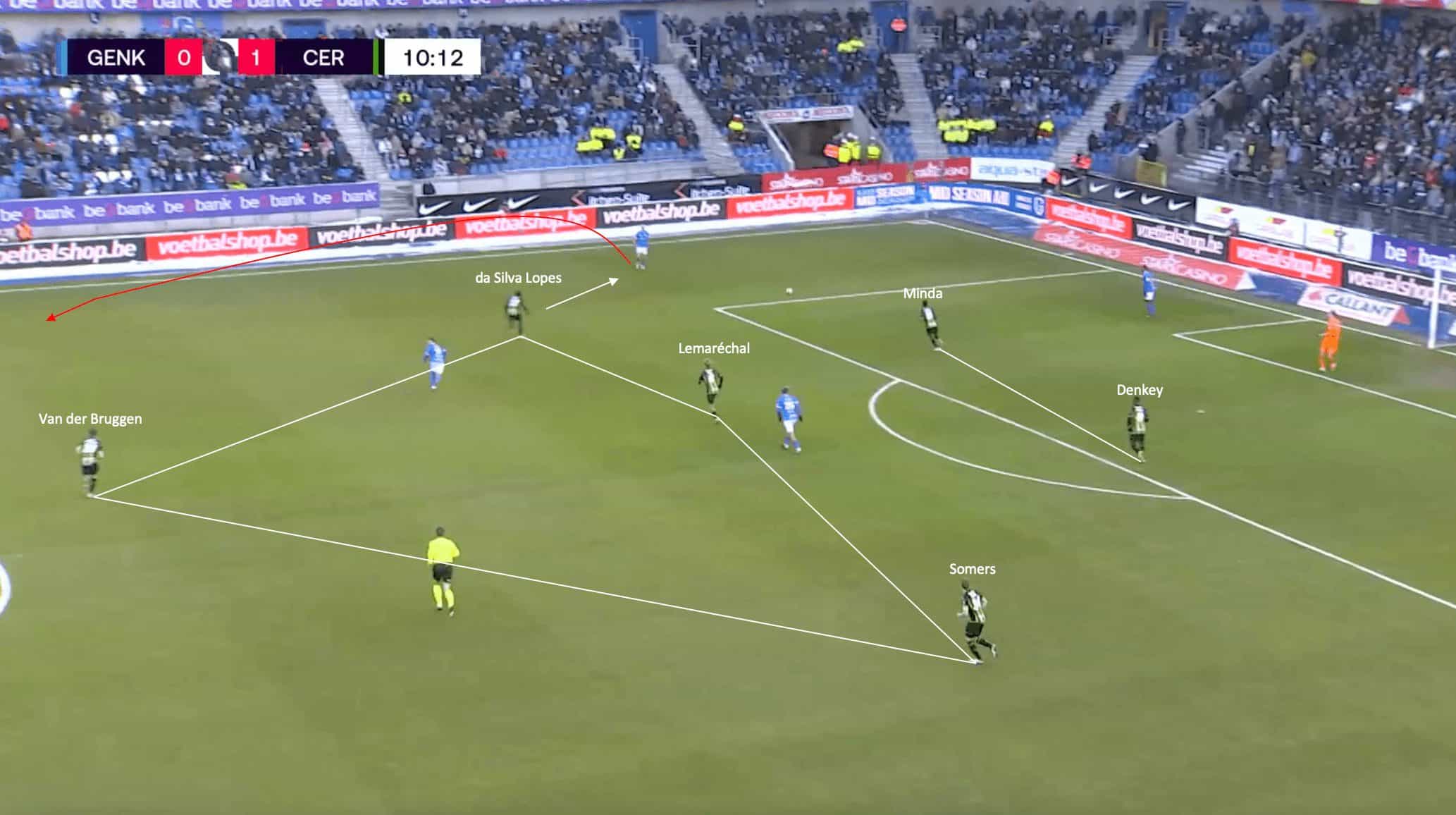
The figure above shows a similar pressing phase from Cercle Brugge in the match.
As we can see, the shape is still very similar to a 4-4-2 diamond, with Muslić’s side giving Genk the wide areas.
As the ball is played wide again from the goalkeeper to Muñoz, da Silva Lopes is already within striking distance.
As a result, this does not give the Genk fullback much time on the ball, forcing him to dump the ball long and towards the Cercle Brugge defence, again preventing Genk from playing out from the back.
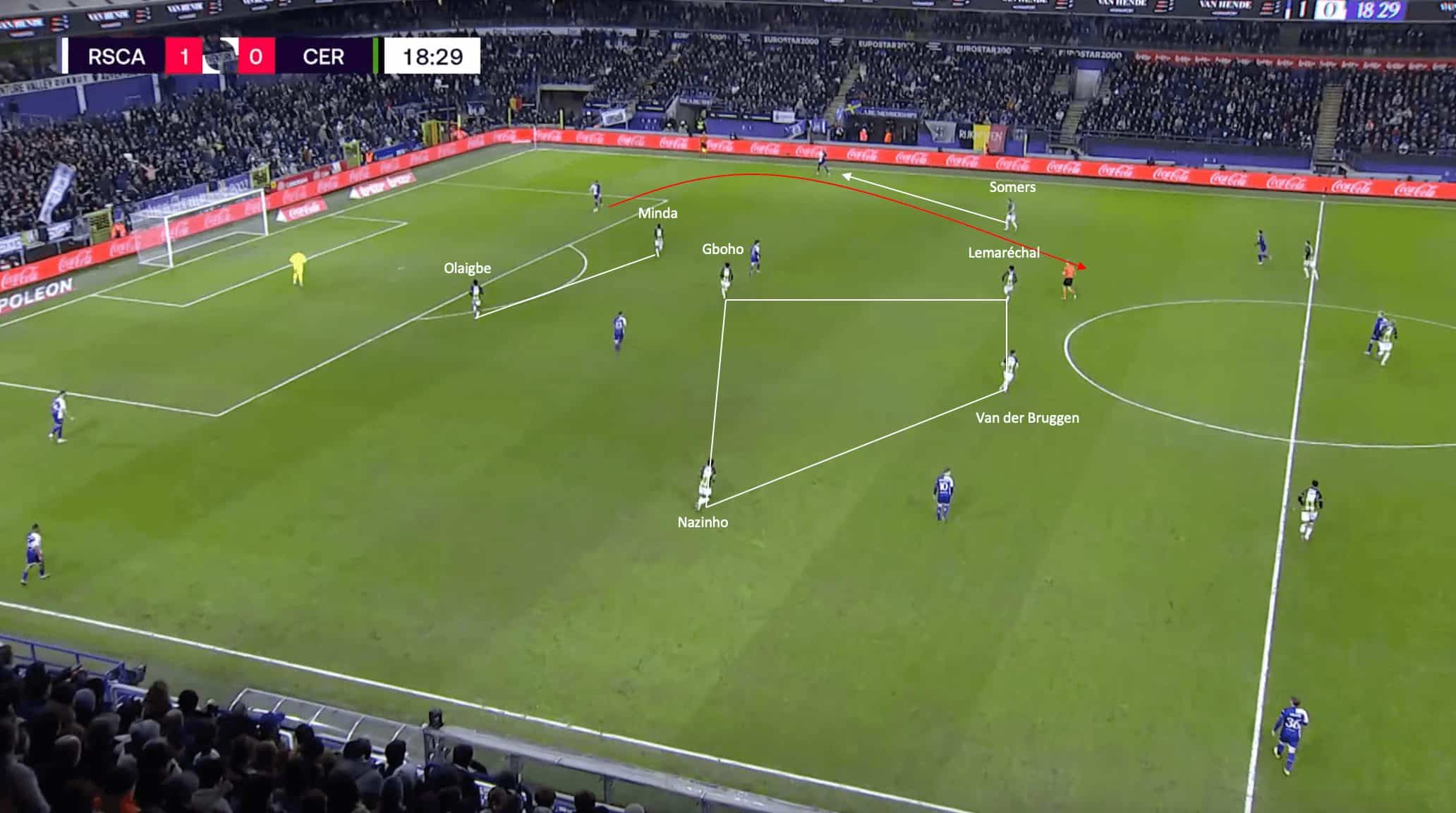
Looking away from the Genk match, this concept of pressing with either a diamond or box midfield has been present in other matches for Cercle Brugge this season.
This phase of play above is from Cercle Brugge’s match just before the winter break against Anderlecht.
As we can see, the formation resembles a 3-4-2-1 out-of-possession.
Still, as the ball rotates from former Premier League-winning goalkeeper Kasper Schmeichel, the midfield begins to take on a more box or diamond shape.
This, along with the positioning of the two forwards, eliminates any possibility of central progression from Anderlecht.
Additionally, Thibo Somers’ advanced movement to occupy the left back forces the centre-back to play the ball long, allowing Cercle Brugge to gather possession and initiate an attacking move.
As this section has shown, while the match against Genk could be considered a masterclass in pressing and positioning from Miron Muslić’s side, this has become a constant theme during his time in charge of the Belgian side, with continuous improvements and tweaks coming along the way.
Ability to show adaptability and flexibility in different phases of play
Another common trend from the match against Genk was Cercle Brugge’s ability to show their formational flexibility and adaptability in different phases of play.
We already had a good look at how the shape looked during pressing moments that originated with goal kicks.
However, Muslić’s side alternated between different shapes as the match progressed, depending on the ball’s location and the specific phase of play they were in, with formations such as 4-2-3-1 and 4-4-2 or 4-2-2-2 also being used.
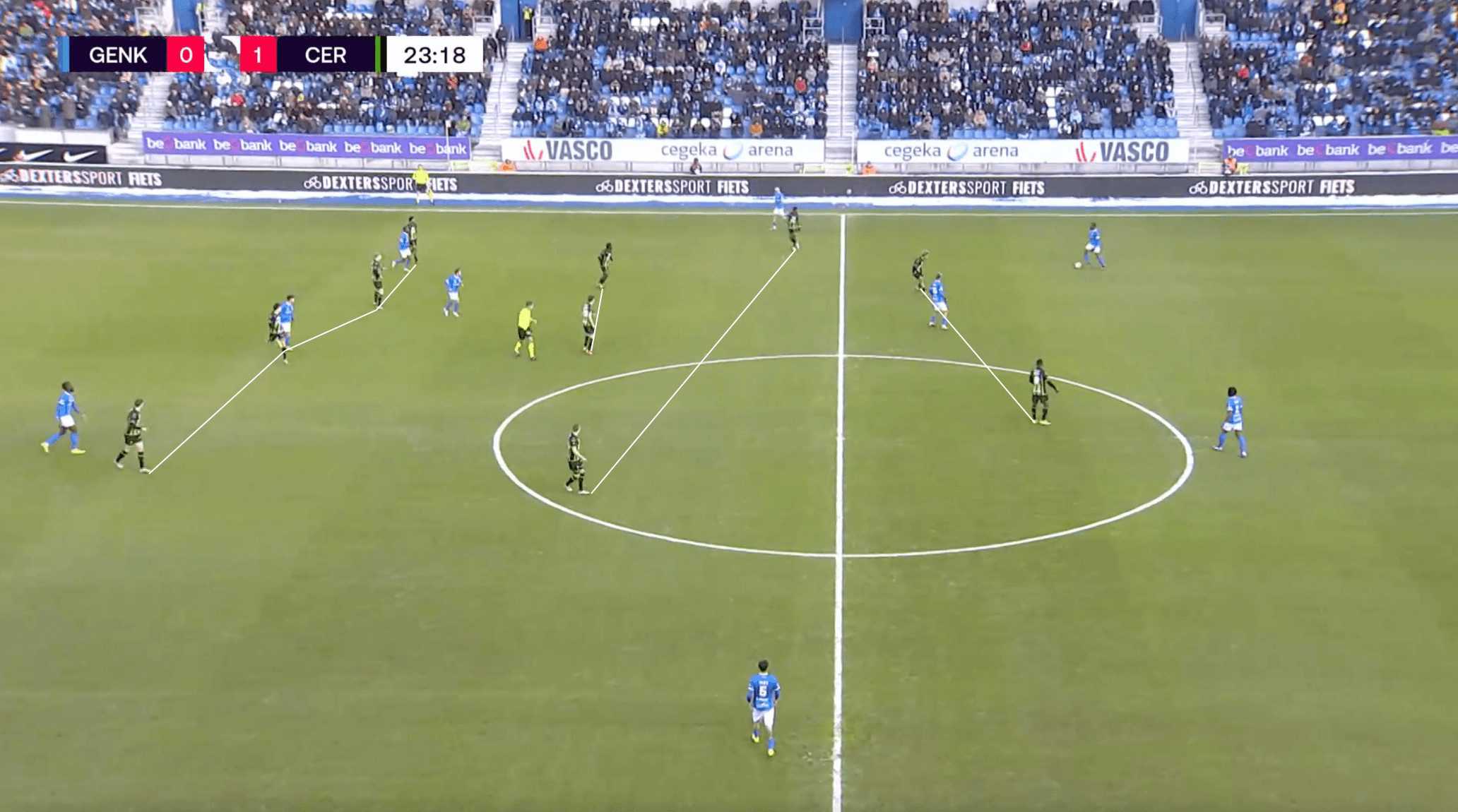
The image above shows an example of one of these formational switches that Miron Muslić tactics looked to utilise to try and gain an advantage against Wouter Vrancken’s side.
While Cercle Brugge looked to press in a 4-4-2 diamond shape during open phases of play, either defensively or on the attack, this shape tended to switch.
Usually, when Cercle Brugge were out of possession, it looked like a 4-2-2-2, as shown above.
This shape allowed Cercle Brugge to control the central zones again, not allowing Genk any opportunities to build through the middle due to their defensive numbers and ability to overload the central areas.
This usually forced Genk to attack down the flanks, much like they were forced to do against Cercle Brugge’s pressing shape.
This meant that Muslić’s side were able to dictate the play in the middle third of the pitch, allowing them the ability to have an advantage in this part of the pitch as well.
This defensive shape worked well against what is usually a very potent Genk attack.
Muslić’s side held Genk to only 11 total shots, with only three being on target.
They also held Vrancken’s side to a 0.92 xG and an average shot distance of 18.5 meters, showing their success at keeping Genk away from dangerous scoring areas.
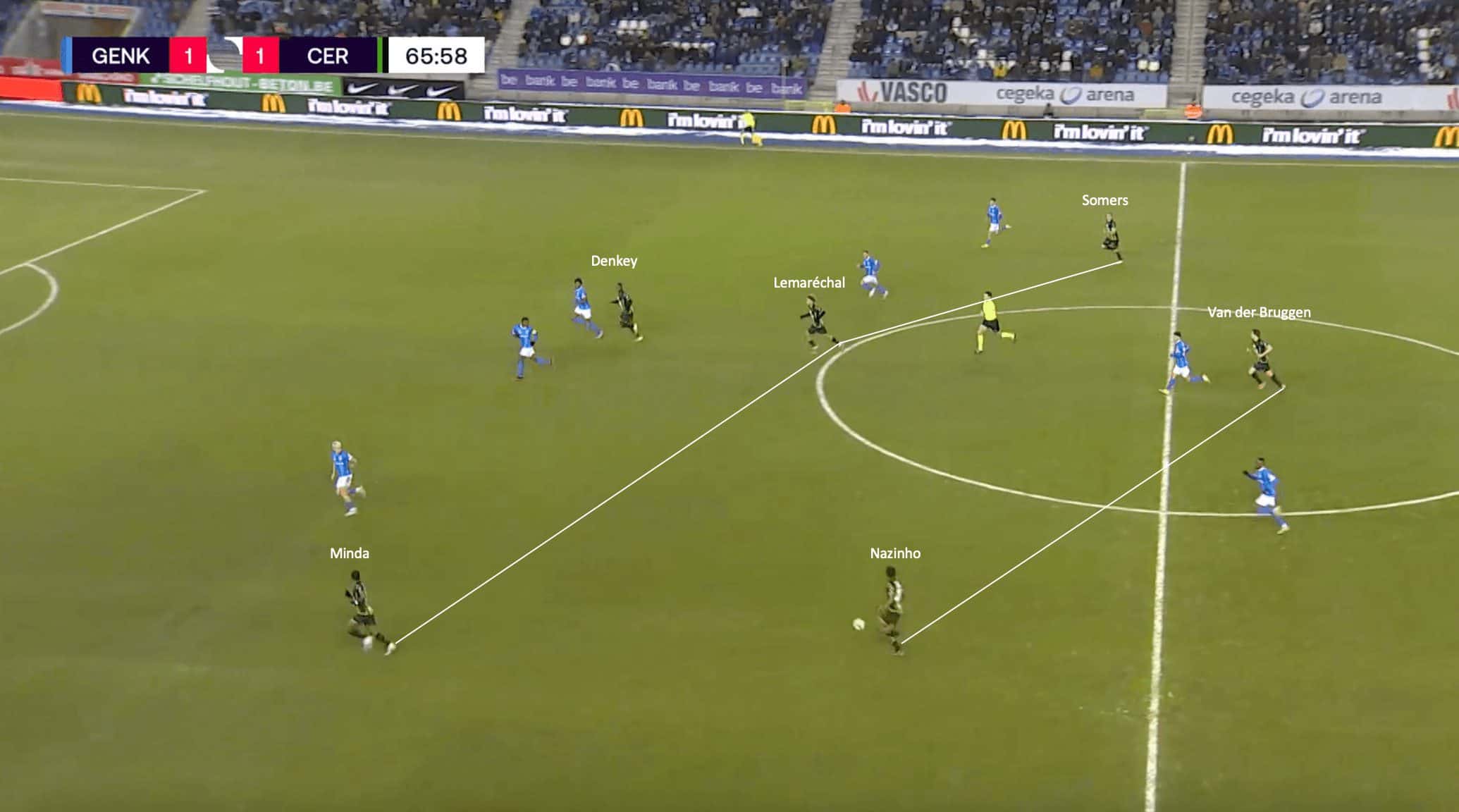
This following figure above is an excellent example of this adaptability and flexibility that Cercle Brugge showed throughout the match against Genk.
Miron Muslić’s side are currently in a transitional attacking phase, with Cercle Brugge winning back possession in their own defensive half.
As we can see, the shape has roughly turned into a 4-2-3-1, with the left fullback, Nazinho, driving towards goal in a slightly more inverted position next to Hannes Van der Bruggen.
The front four is well defined, with Minda drifting wide to the left, Thibo Somers to the right, and Felix Lemaréchal in a more defined #10 role.
In this match in particular, when Muslić’s side were in possession, it was common to see this shape utilised.
The 4-2-3-1 is a highly flexible formation, especially when it is solely used when a side is in possession.
It has the ability to be more narrow, allowing plenty of numbers in a central area to overload in these zones, or to become wider and stretched, sometimes resembling a 4-3-3 formation with the wide midfielders looking to get high and wide during attacking moves.
It was used with great success by Miron Muslić, with Cercle Brugge always looking dangerous when possession was turned over, and they were able to progress the ball in their 4-2-3-1 shape.
Lacking a clinical edge at times to kill off games
Though Cercle Brugge were the dominant side for most of their match against Genk, they lacked a clinical edge, unable to score a second goal early on to kill the game off.
This has been a recurring theme for Miron Muslić’s side this season, with the Belgian side heavily underperforming xG throughout this current season.
To start, let’s look at their xG total from the match against Genk.
According to Wyscout data, Cercle Brugge finished with an xG of 3.67, though only managed one goal.
In total, Miron Muslić’s side have managed 26 goals this season in the Belgian Pro League, yet they possess the 3rd highest expected goals total, with 44.68, showing this underperformance.
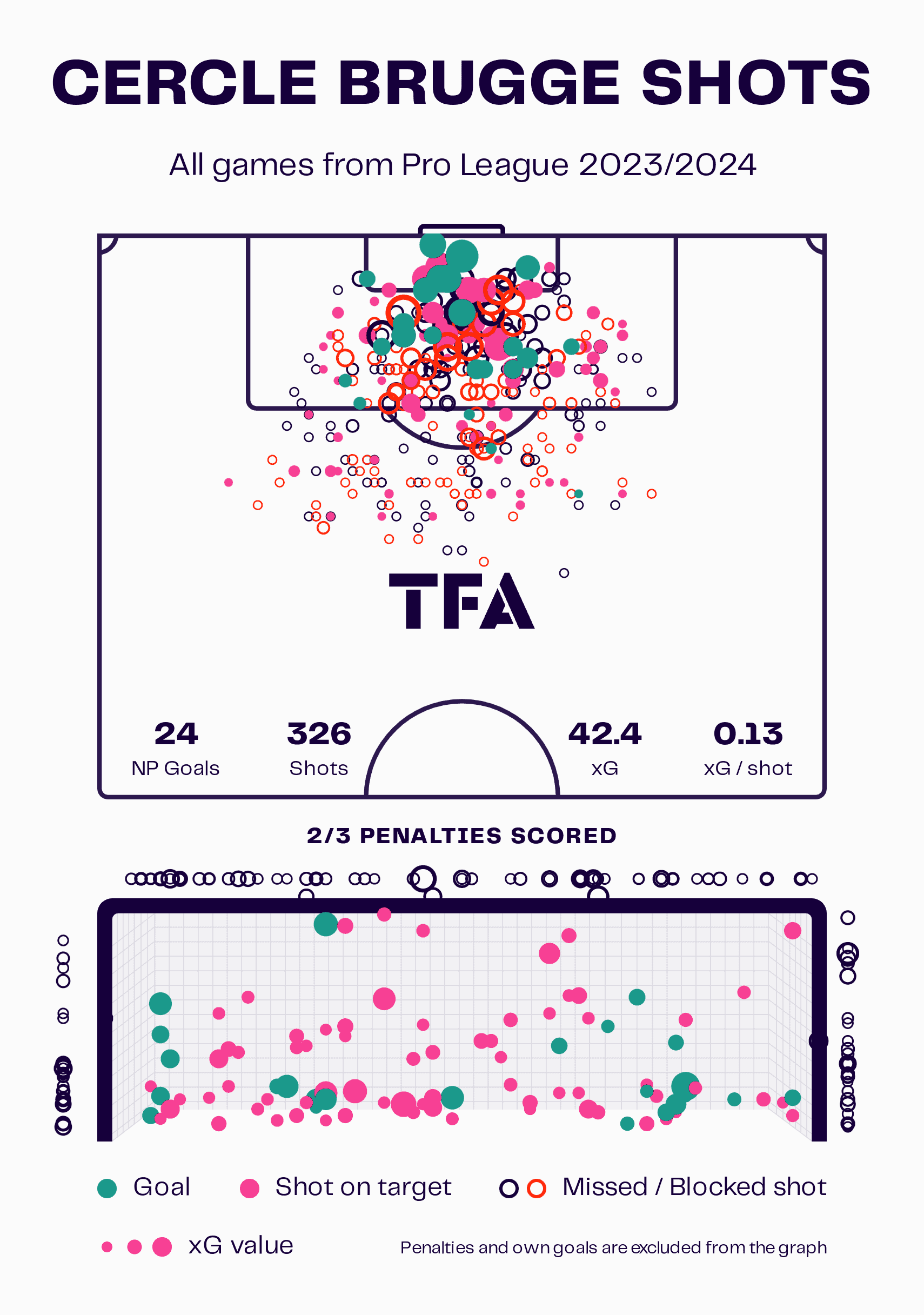
The data viz graphic is also able to illustrate this trouble that Cercle Brugge is having this season in front of goal.
As we can see from the graphic, the Belgian side have accumulated a very good total xG per shot of 0.13, but a lack of composure and decision making at times in front of goal has hurt them.
With that being said, Muslić’s side is still having a very good season and is likely to have a good shot at qualifying for European football next season.
However, with a more common tendency to kill off games, it could potentially push for a top two or three finish.
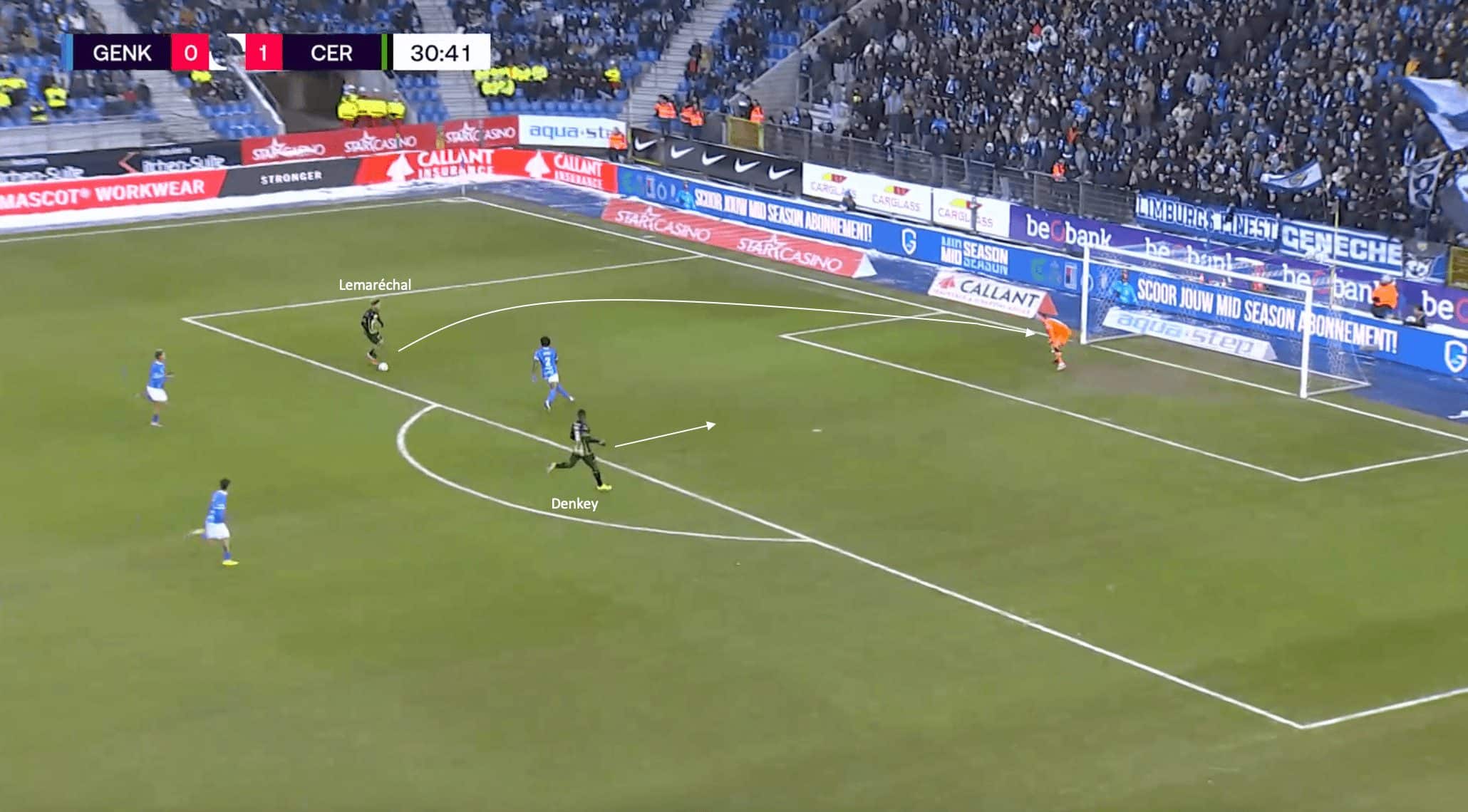
The image above shows one of these examples where Cercle Brugge should have killed the game off early on in the match but failed to do so.
Genk turned the ball over in the middle third, with Cercle Brugge able to gather possession and start on a rapid counterattack.
It gets to this point, with Felix Lemaréchal and Kévin Denkey 2v1 against the Genk centre-back.
The obvious choice for the young Frenchman is to play a ball across goal and into the path of Denkey, who likely would have had an easy tap-in.
Instead, Lemaréchal takes too many touches on the ball, allowing the Genk defender to begin to close him down and simultaneously eliminate the passing lane towards the Togo international striker, with Denkey forced to slow down, eliminating his momentum in the process.
As a result, the Monaco loanee is forced to attempt a shot himself, which completely misses the target and results in a goal kick for Genk.
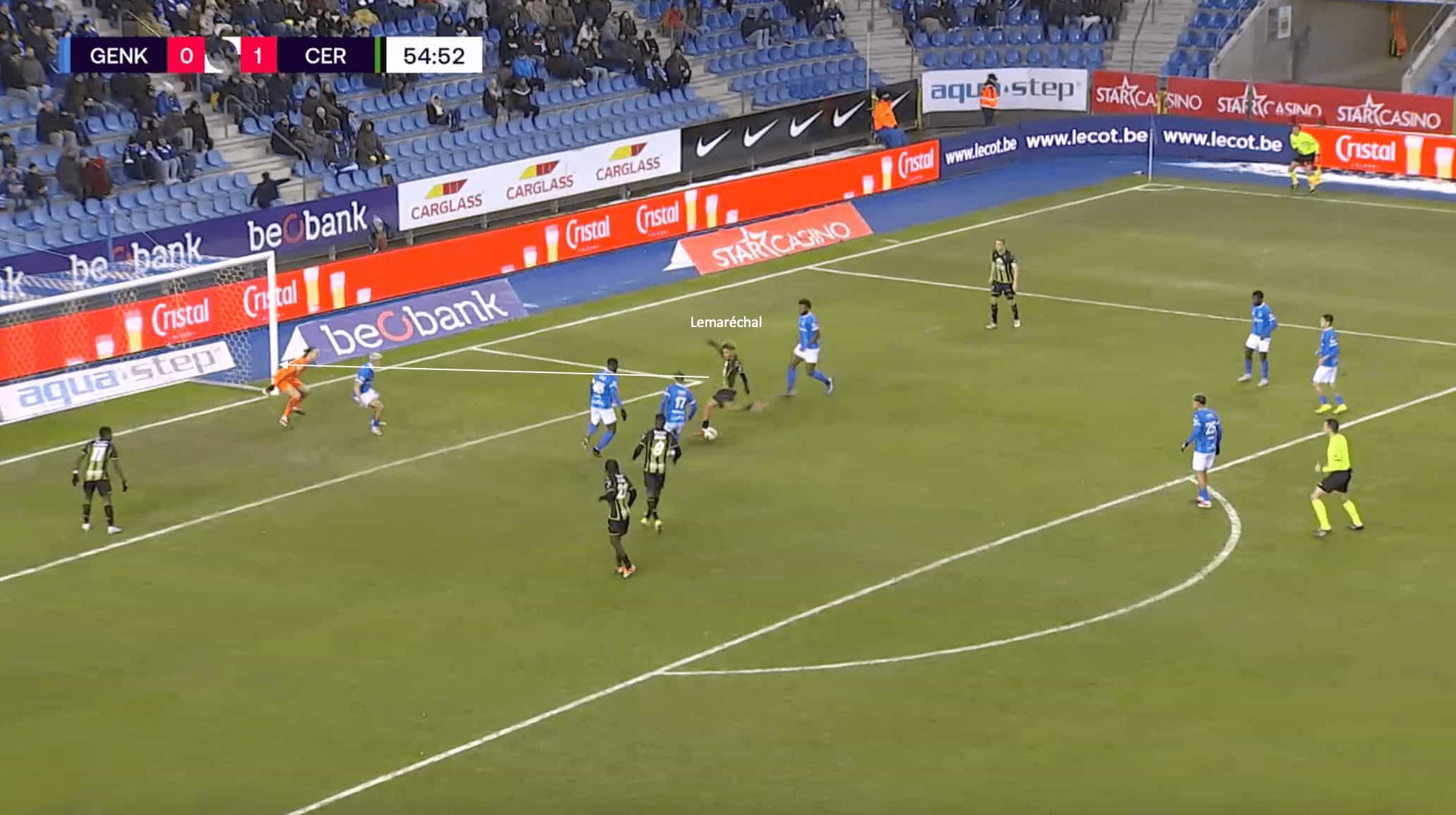
The image above shows another very good chance that Cercle Brugge had to get the all-important second goal in the match against Genk.
The chance again fell to Felix Lemaréchal, with the ball falling to him after a ball across the box from Thibo Somers was cleared by a defender into the young Frenchman.
The 20-year-old Monaco loanee does really well to get the hard-hit clearance under control, with his shot getting deflected behind for a corner by the Genk defender, who does well to position himself in front of the goalkeeper.
While Lemaréchal does really well, and it is a huge block by the defender, the young French attacker could still have potentially done slightly better in this situation.
What is not shown in the image, the 20-year-old could have taken the shot on the first bounce after he controlled it, but he waits for the ball to bounce a second time, which allows the defender the chance to get set and block the incoming shot.
This mainly comes down to composure and coolness under pressure, something that will definitely improve with this side as they gather more experience and continue to grow under Miron Muslić coaching style.
Conclusion
As this tactical analysis has shown, Cercle Brugge have been a side that not many in Belgium have wanted to play this season.
Their improvements under Miron Muslić, since he took over, have been extraordinary, with the Belgian side genuine contenders to qualify for Europe next season and even finish in the Championship playoffs.
This first match post-winter break against Genk was one that demonstrated very clearly what Muslić wants from his team.
His high intensity and high pressing principles of play have proven very successful, and with the youngest team in Belgian football, he has them punching well above where many would have expected them to be.
While they may still lack a clinical edge in front of goal that has cost them points at different times this season, this will likely improve with more experience, and it will be fun to watch this team for the rest of this season and into the future under Miron Muslić.

