


Laurent Blanc became manager of Olympique Lyonnais in October 2022, tasked with preventing their season from going into freefall following a disappointing start under former manager Peter Bosz.
To give Blanc his credit, he did manage to turn around the fortunes of the club; at the end of the 2022/23 campaign, OL finished in 7th place, just five points off the European places.
His decision to utilise Lyon’s famed youth academy saw the likes of Bradley Barcola and Saël Kumbedi nail down starting positions and become fan favourites.
For the most part, Blanc’s tactics revolved around fluidity and unselfish off-the-ball movement that defences struggled to deal with.
However, he could be conservative when required; the 1-0 smash-and-grab against PSG in April springs to mind when Barcola popped up in the right place at the right time to slot home the winner.
Fast forward to the 2023/24 season, and the landscape looks very different at OL.
The team find themselves struggling, having only picked up a single point from their first four games.
Where Blanc’s tactics once appeared progressive and fluid, they now seem to be quite stagnant and pedestrian.
This comes amid off-the-pitch drama involving the former owner, Jean-Michel Aulas, and the current owner, John Textor, which is being played out in the media.
Coupled with the departures of Barcola and Lukeba, the club appears to be in disarray, with no apparent signs of improvement on the horizon.
As rumours swirl that the 57-year-old French coach could be saying ‘au revoir’ to Lyon sooner rather than later, we are going to look into what is going on at the club.
In this tactical analysis, we will highlight the departure of Lyon’s key players and the impact it has had on the team, as well as examine Laurent Blanc’s tactics and why Les Gones are struggling to perform on the pitch.
Olympique Lyon Key Player Departures
To begin this analysis piece, we will look at some of the players who have departed OL during the summer window.
The three players we are going to look at are all academy graduates who have decided to move on to play in much stronger squads — perhaps an indictment of where this Lyon team currently are.
Bradley Barcola Radar Chart

Firstly, Bradley Barcola has joined PSG for a fee in the region of €45 million.
Lyon have done alright out of this deal in the sense that they have received a substantial figure that the club can potentially reinvest and improve other areas of the squad.
However, in losing Barcola, they have lost one of their most dynamic attacking outlets.
The youngster scored seven goals and contributed nine assists last season for Laurent Blanc’s team, and his performances made him stand out as one of the most promising French footballing talents.
His seven goals came from an xG of 5.28, suggesting that he is capable of scoring low-percentage chances.
We can see from the pizza chart above that Barcola ranked very highly in terms of the number of touches in the opposition penalty area, and he also ranked quite highly in terms of dribbles per 90.
Additionally, Barcola averaged 2.54 progressive runs per 90 minutes, as he was often the player the OL turned to when looking to transition quickly from defence to attack.
His ball-carrying abilities and his ability to carve out goal-scoring opportunities for himself and others will be a huge loss.
A replacement potentially comes in the form of new signing Ernest Nuamah.
The highly sought-after youngster will have to hit the ground running if he is going to be the one who Lyon turns to in order to change their fortunes this season.
Castello Lukeba Radar Chart
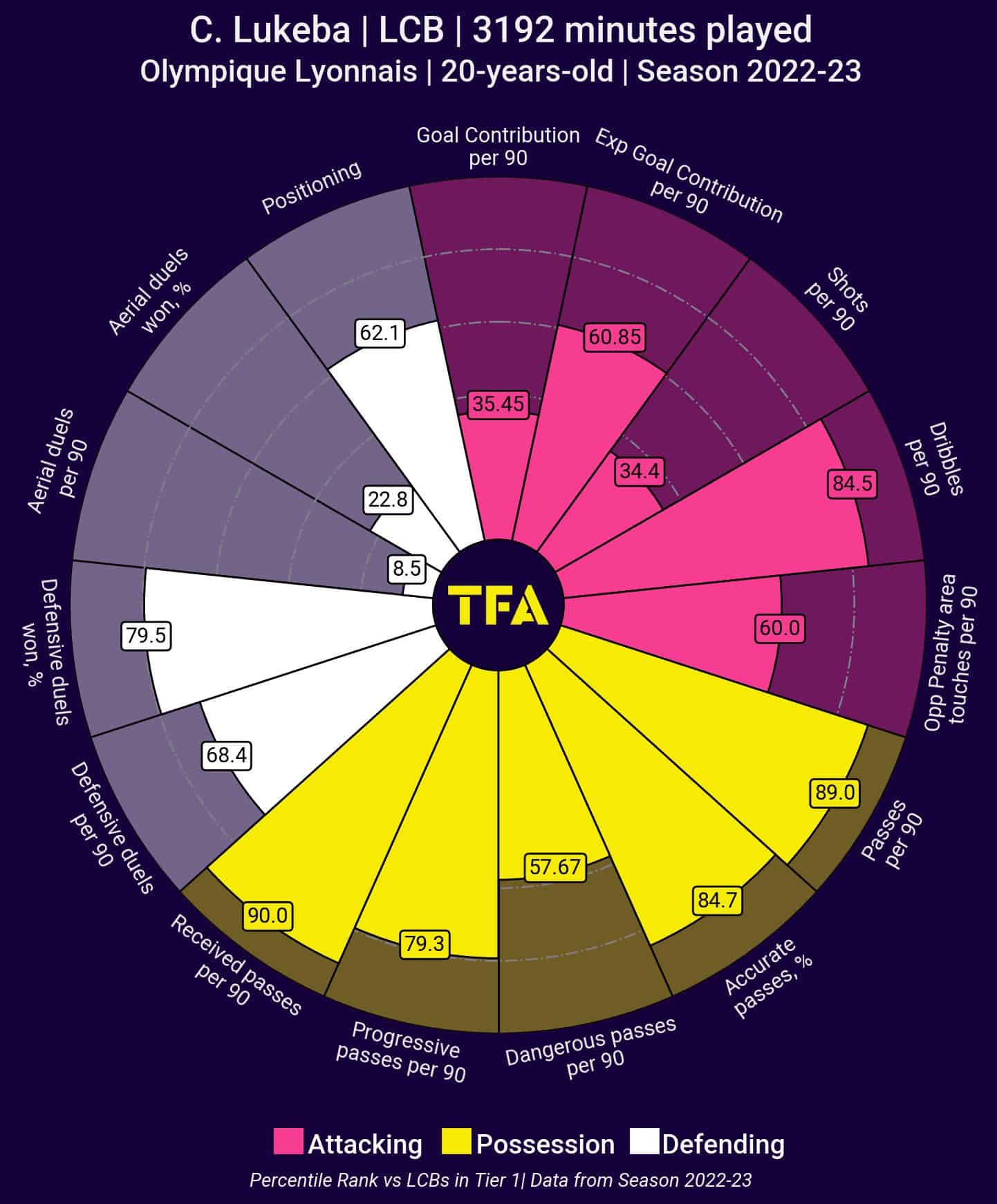 Another player who has moved on is centre-back Castello Lukeba.
The 20-year-old has joined RB Leipzig for a fee of around €30 million.
The left-footed defender was one of the standout performers for OL last season, and his departure certainly leaves a gap in Laurent Blanc’s defensive line.
As we can see from the pizza chart above, Lukeba was incredibly effective in his defensive duels for Lyon last season.
He averaged 6.27 per 90 and won 72.1% of them, which meant he was extremely reliable when battling for possession.
Furthermore, Lukeba contributed 4.87 interceptions per 90, meaning he was often in the right place at the right time to cut out passes as the opposition looked to attack.
Playing as a left-sided centre-back in Lyon’s back three allowed the young defender to show his on-the-ball abilities.
He averaged 1.12 progressive runs per 90 and was unafraid to carry the ball well into the opposition half.
Additionally, Lukeba made 6.52 passes to the final third per 90, which allowed Lyon to transition quickly into the attacking phase and best utilise the pace of the aforementioned Barcola.
Houssem Aouar Radar Chart
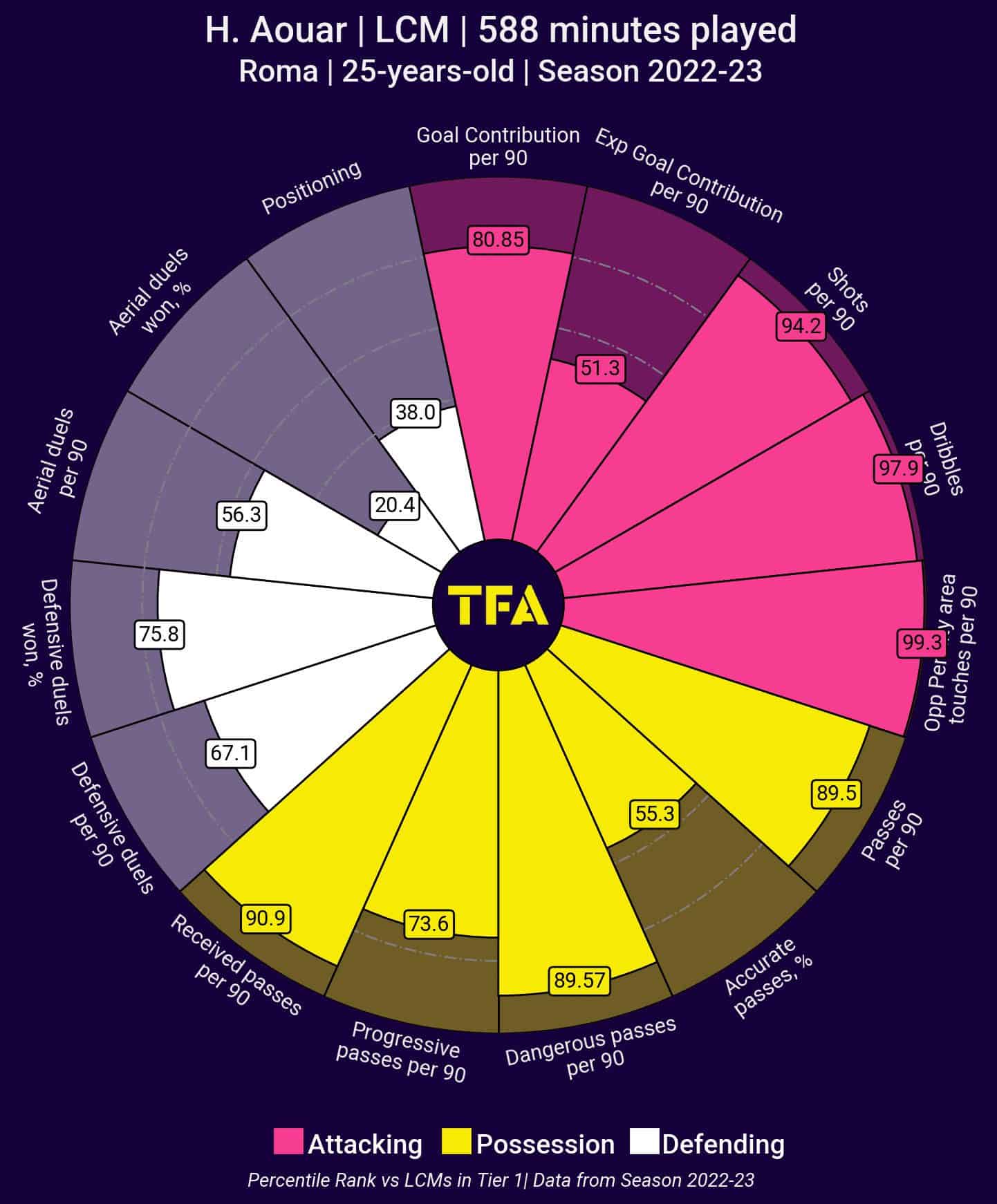
Houssem Aouar finally departed OL this summer after years of speculation.
Aouar has moved to Serie A and will turn out for José Mourinho’s Roma side as they look to challenge for the title.
Aouar left on a free transfer, which, with hindsight, may trouble OL a little as back in 2020, when links with Manchester City and Arsenal emerged, the versatile midfielder had a market value of €55 million, according to Transfermarkt.
Even in 2022, he was still valued at €30 million, and rumours linked him with a move to the likes of Nottingham Forest and Crystal Palace.
Despite most of his appearances being from the bench last season, Aouar averaged 1.81 progressive runs per 90 from his time on the pitch.
He also averaged 6.39 passes to the final third per 90, often showing how useful he is in the attacking phase of play.
Even in his limited game time, his quality often stood out.
Since Aouar has moved on to new pastures, it raises the question about the potential lack of creative players in the OL ranks, as we will discuss later in this analysis.
Olympique Lyon Defensive Vulnerabilities
We will now look at some defensive weaknesses that Lyon displayed, particularly in their recent game against OGC Nice, where they were fortunate to come away with a point.
Under Laurent Blanc, Lyon primarily employs a 4-2-3-1 formation, which transitions to a 4-4-2 in the defensive phase, as illustrated in the diagram above.
Blanc opts for the 4-4-2 in the defensive phase to limit the opposition’s attack by remaining compact and closing off passing lanes.
However, OL have looked remarkably disjointed so far this season, and Nice were able to find their way through on multiple occasions.
 Francesco Farioli’s side looked to exploit the wide areas, with the wingers staying as wide as possible and executing positional rotations with the midfielders to create space.
Meanwhile, the fullbacks stayed incredibly narrow, which meant there was a vast amount of space out wide, as shown in the image above.
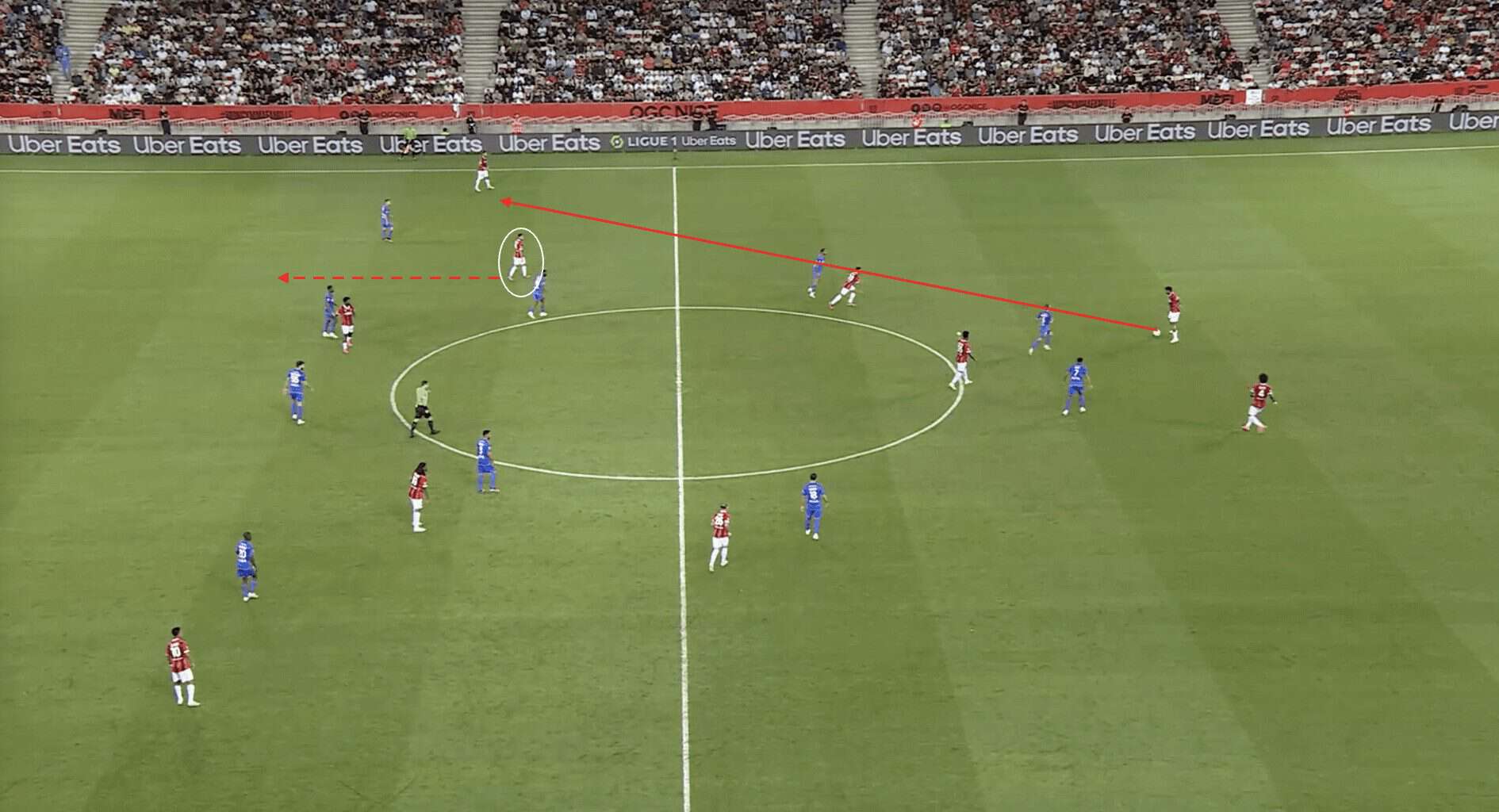
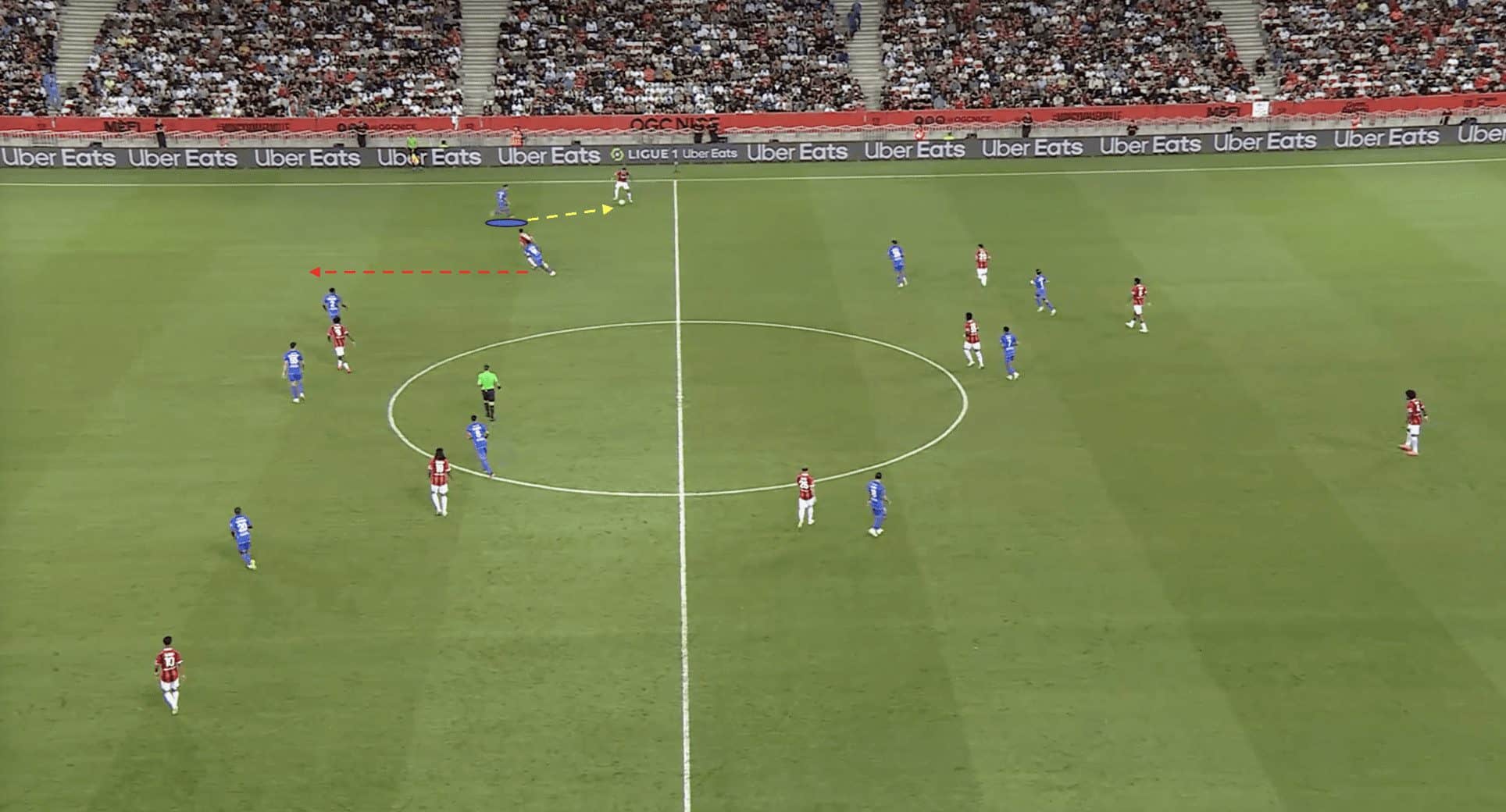
We can see here Nice works the ball out onto their right wing, and Nicolás Tagliafico moves out to press the player in possession.
As a consequence, Nice can get a runner into the space left open by the Lyon player and find themselves in behind the defensive line.
This dynamic movement from Les Aiglons disrupts the Lyon team’s ability to maintain a compact and well-organised defensive structure.
As a result, the defenders must constantly adjust their positioning and marking, which leads to gaps or spaces opening up in their defensive line.
Furthermore, Nice’s positional rotations often led to attackers converging in specific areas of the field.
OL struggled to deal with this effectively, which made it challenging for them to cover all potential threats effectively.
Francesco Farioli’s team enjoyed 57.62% possession during this game and generated an xG of 2.26; therefore, the only reason they didn’t pick up the three points was mainly due to their poor finishing, rather than a standout defensive display by Olympique Lyonnais.
To limit the effectiveness of Nice’s positional rotations, Lyon tried to maintain a disciplined and compact defensive shape.
However, players were too easily baited into stepping out individually.
They would then focus too heavily on tracking individual attackers rather than staying organised and defending as a unit.
Additionally, as we can see in the images above, OL chose to stand off the Nice players as they were looking to build out from the back.
Had Laurent Blanc instructed his team to put pressure on the opposition defence, it could have allowed them to limit opportunities to open up the passing lanes and execute their rotations and movements effectively.
This would also mean Lyon could prevent their opponents from comfortably switching the play out wide to the wingers, where they aim to stretch the pitch.
Olympique Lyon Caught Out In Transitions
Whilst Blanc decided to try and play it safe against Nice by sitting back and allowing them to keep the ball, it has been a different story against Montpellier and Strasbourg.
Whilst OL enjoyed over 60% possession in both of these games, their opponents were very astute and found other ways to win, mostly utilising quick transitions to catch Lyon off guard.
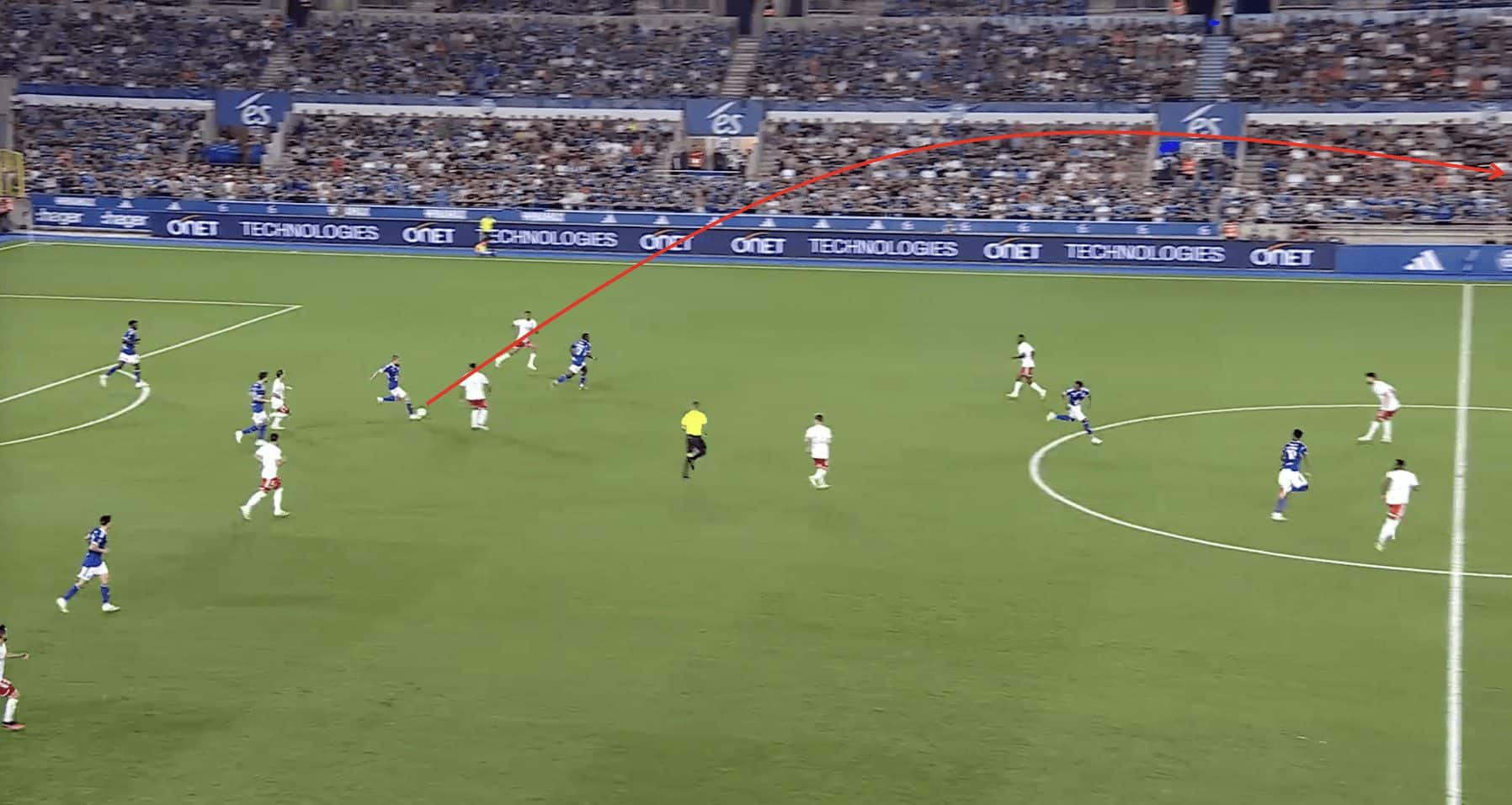
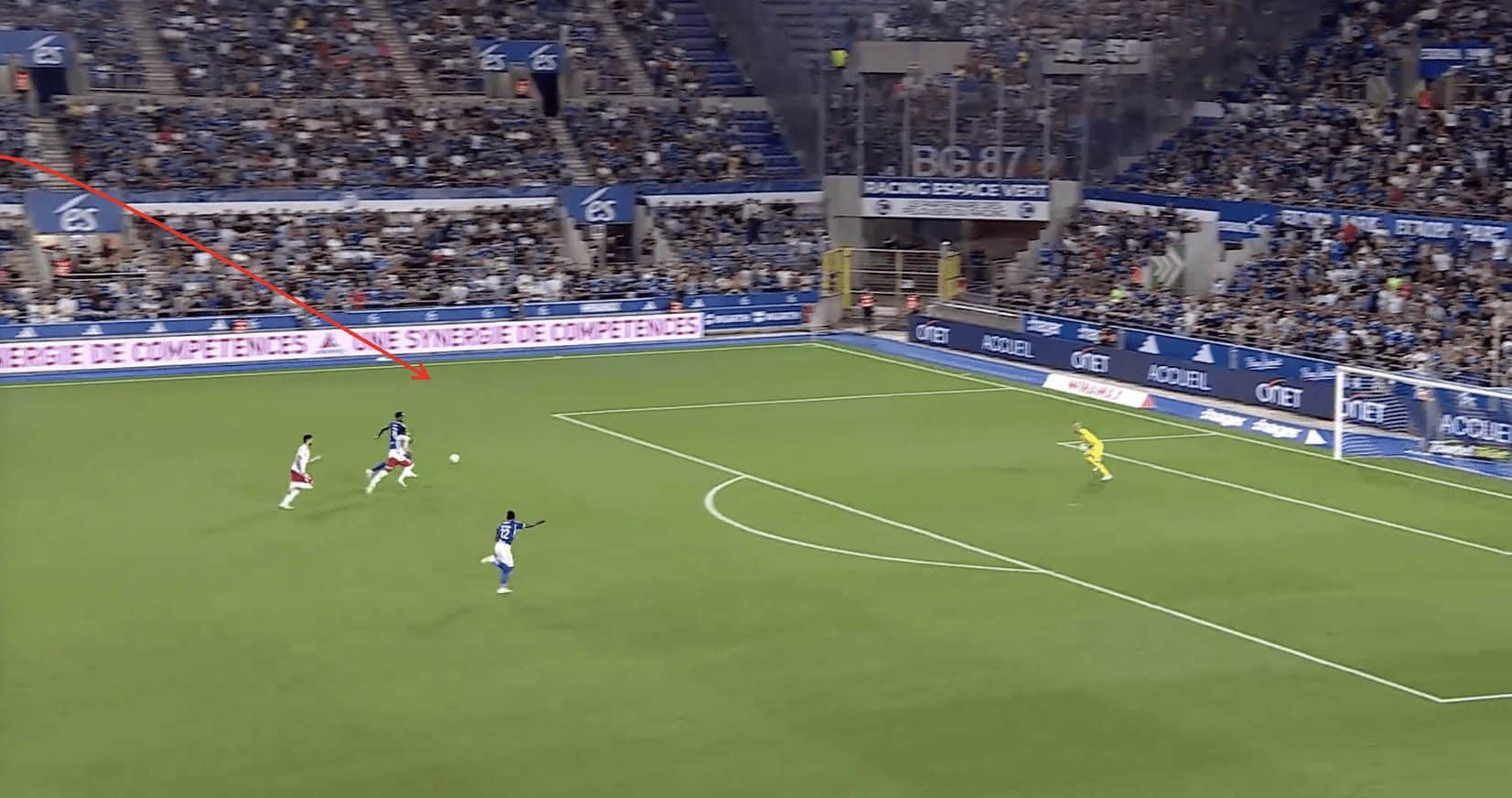
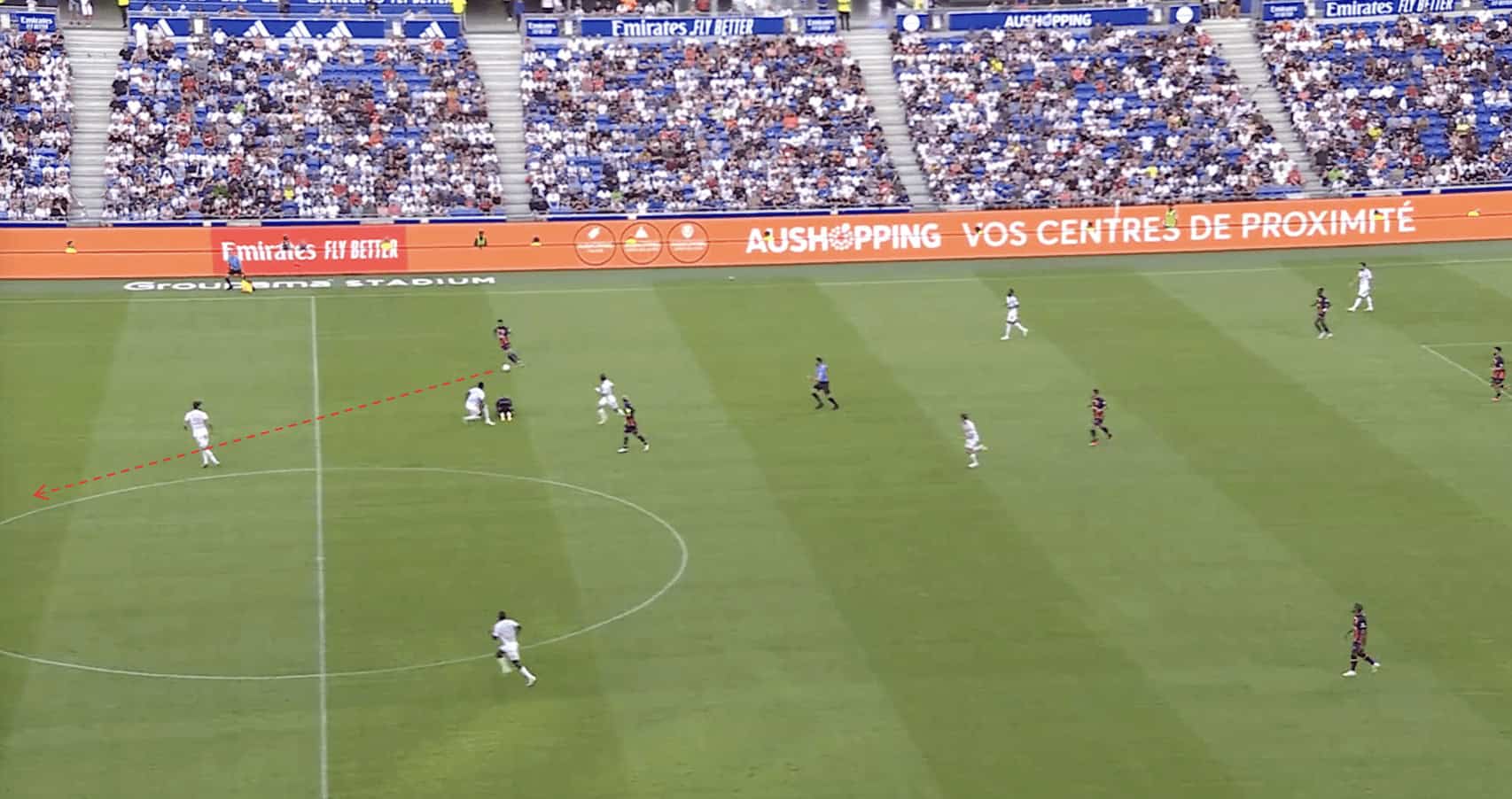
Here, for instance, we can see that once Olympique Lyonnais have lost possession, Strasbourg immediately look to launch it long.
When in the attacking phase, Lyon often looks to push their centre-backs higher in an attempt to pin their opponents back in their own half.
This makes it easier for them to recycle possession should they not be able to carve out a goalscoring opportunity at the first attempt.
Under the guidance of former Arsenal legend Patrick Vieira, Strasbourg sought to utilize the pace of their forwards, Emegha and Mothiba, to put significant pressure on the Lyon defense.
By playing it long, it often created 1v1 situations that the defence couldn’t deal with, as shown above.
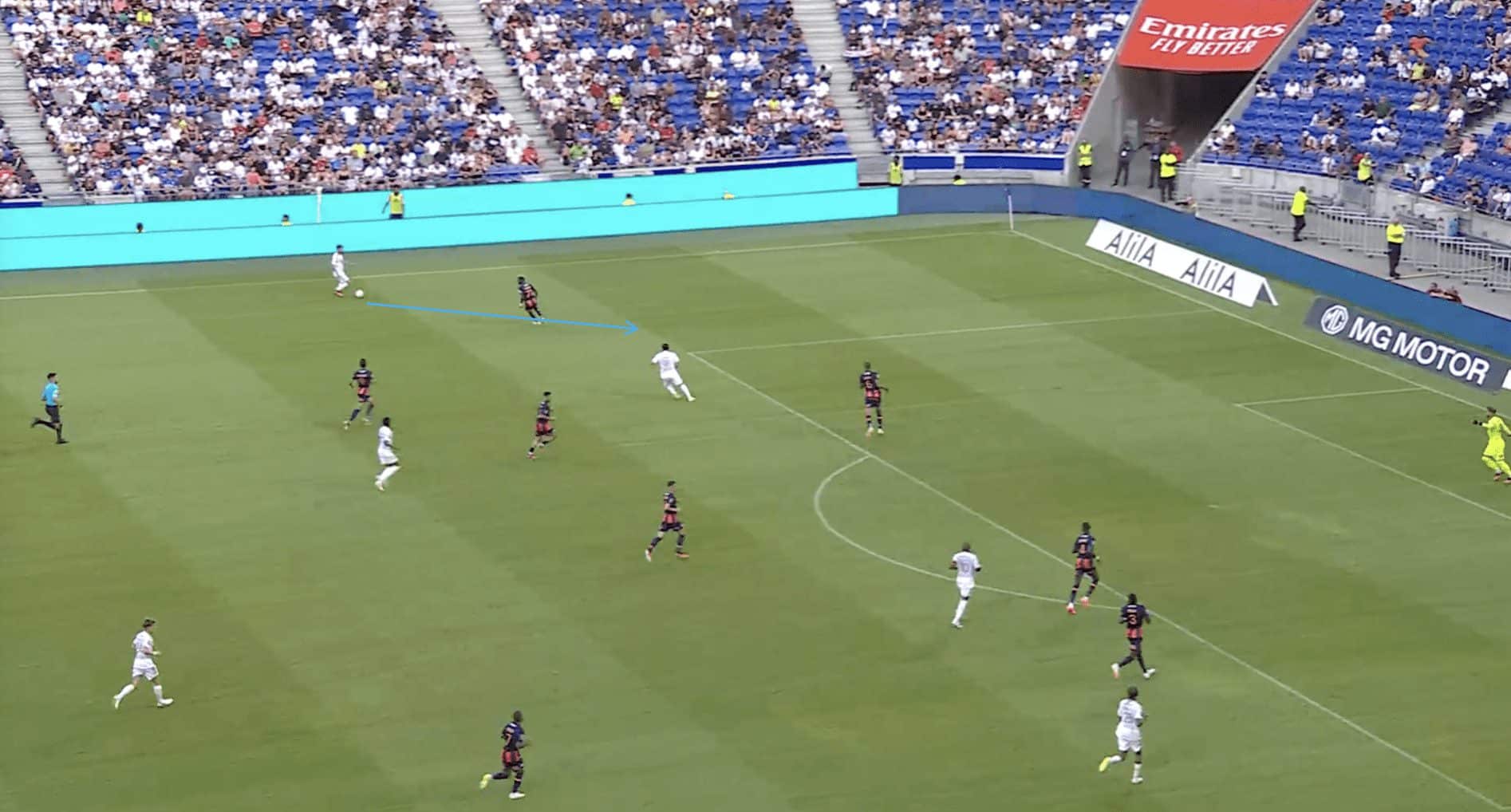
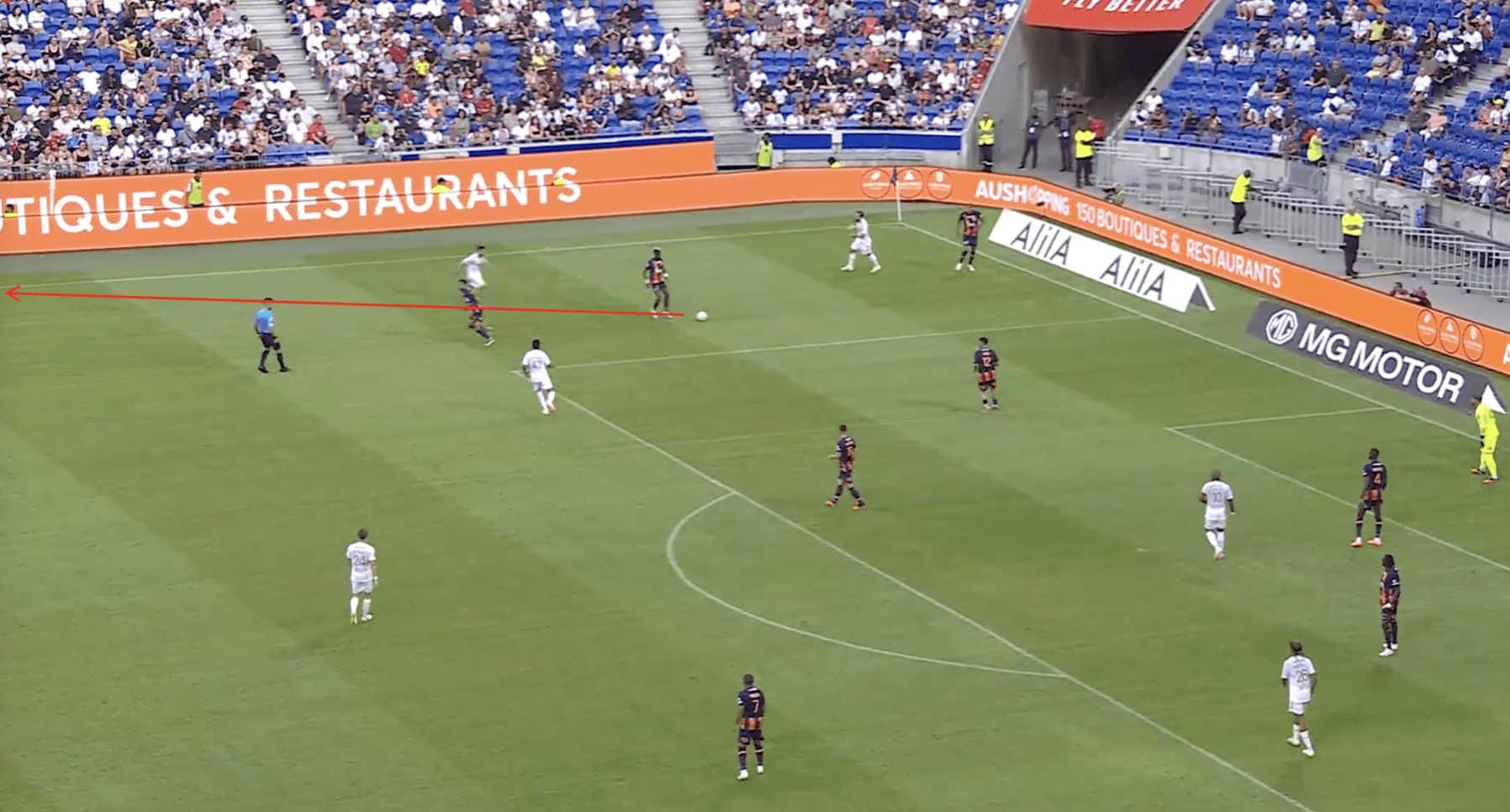
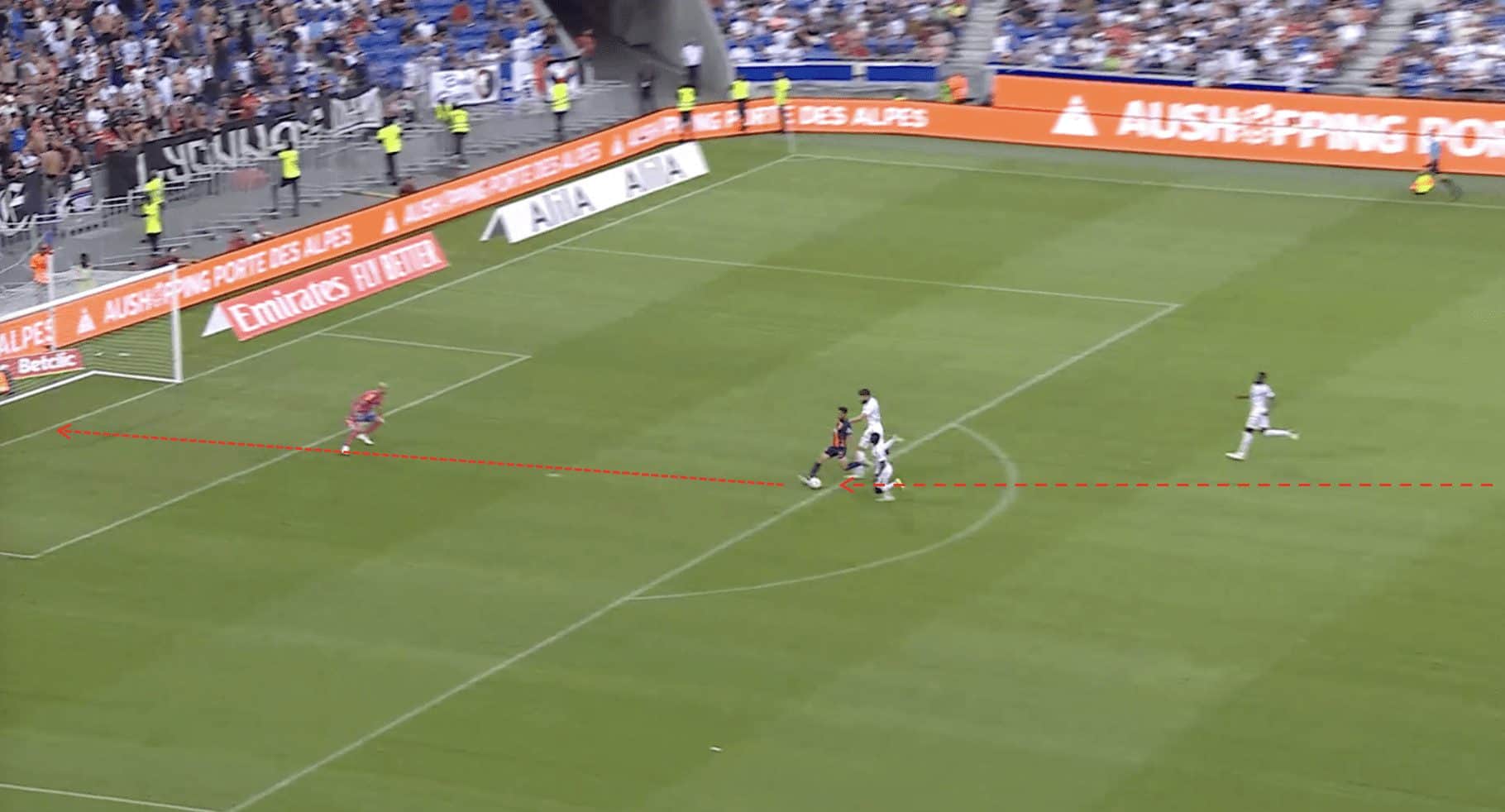
Furthermore, in the game against Montpellier, OL were once again caught off guard by their opponent’s decision to use long passes to transition from defense to attack.
When Lyon loses possession, La Paillade immediately plays it long.
Musa Al-Tamari picks up the second ball and, as we can see, can dribble unchallenged into the penalty area, where he places a shot beyond the goalkeeper.
Strasbourg and Montpelier both made over 40 long passes during their games against OL, which indicates that it was a specific tactical instruction as they had identified a weakness in Laurent Blanc’s side.
One noticeable thing is the lack of effort when tracking back from the Lyon players.
Perhaps we can link this to the rumours of discontent among players who want to leave the club. With the transfer window now closed, we may see a change.
Alternatively, it could be a sign that the players are not too happy with Laurent Blanc’s style of play, which doesn’t bode well for the future.
Poor Build-up Play And Lack Of Attacking Threat
As well as Lyon’s poor defensive displays, we have seen some equally bad performances in the attacking third.
OL have really struggled to resemble a cohesive unit so far this season, and that has certainly been evident in their attack.
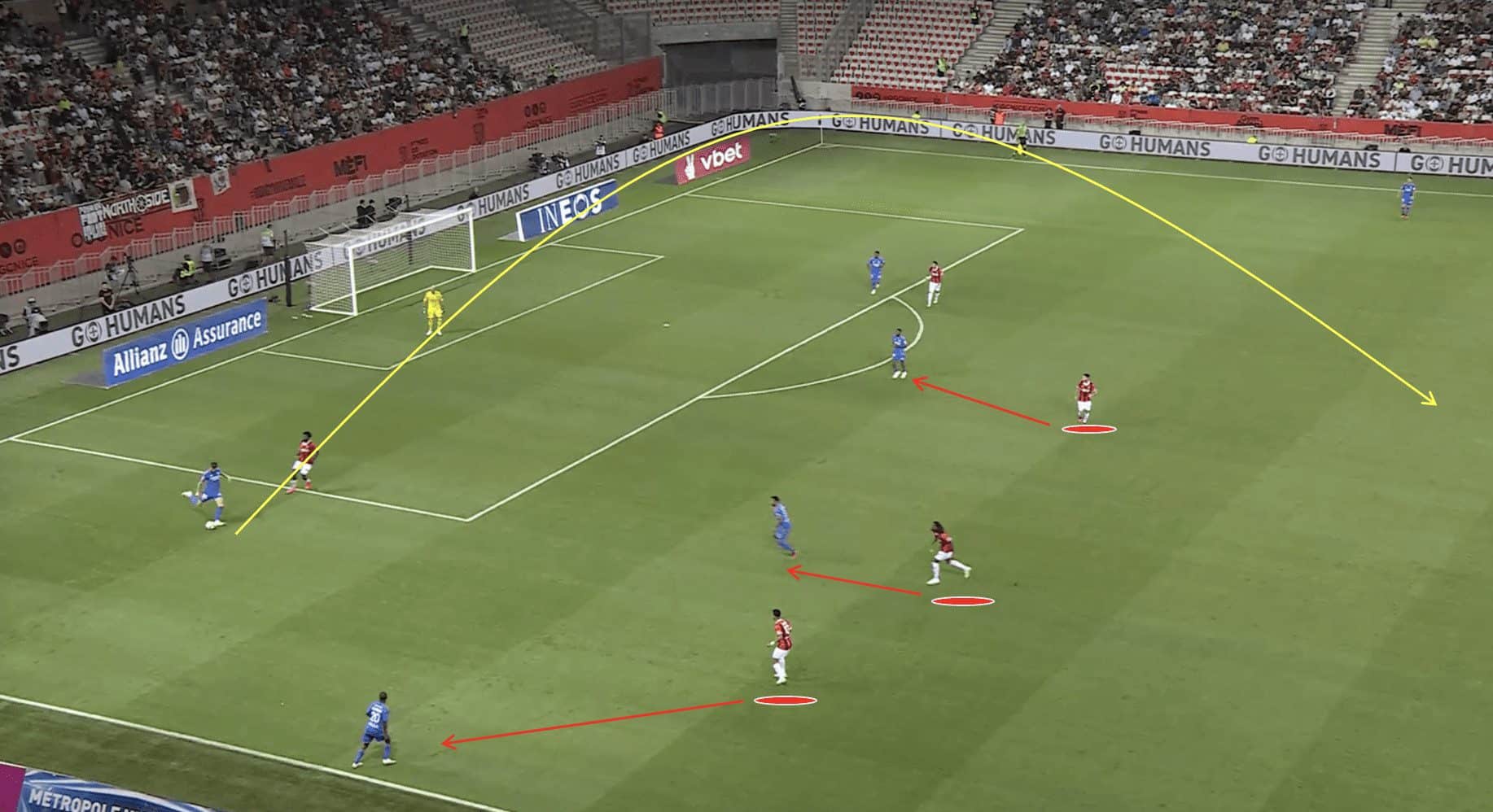 We can see here that as OL are looking to build an attack from the back, their opponents – Nice in this case, are pressing high and looking to close off passing lanes.
Duje Ćaleta-Car has no option but to play it long.
However, there is no one there to pick up the pass and OL turnover possession as a result.
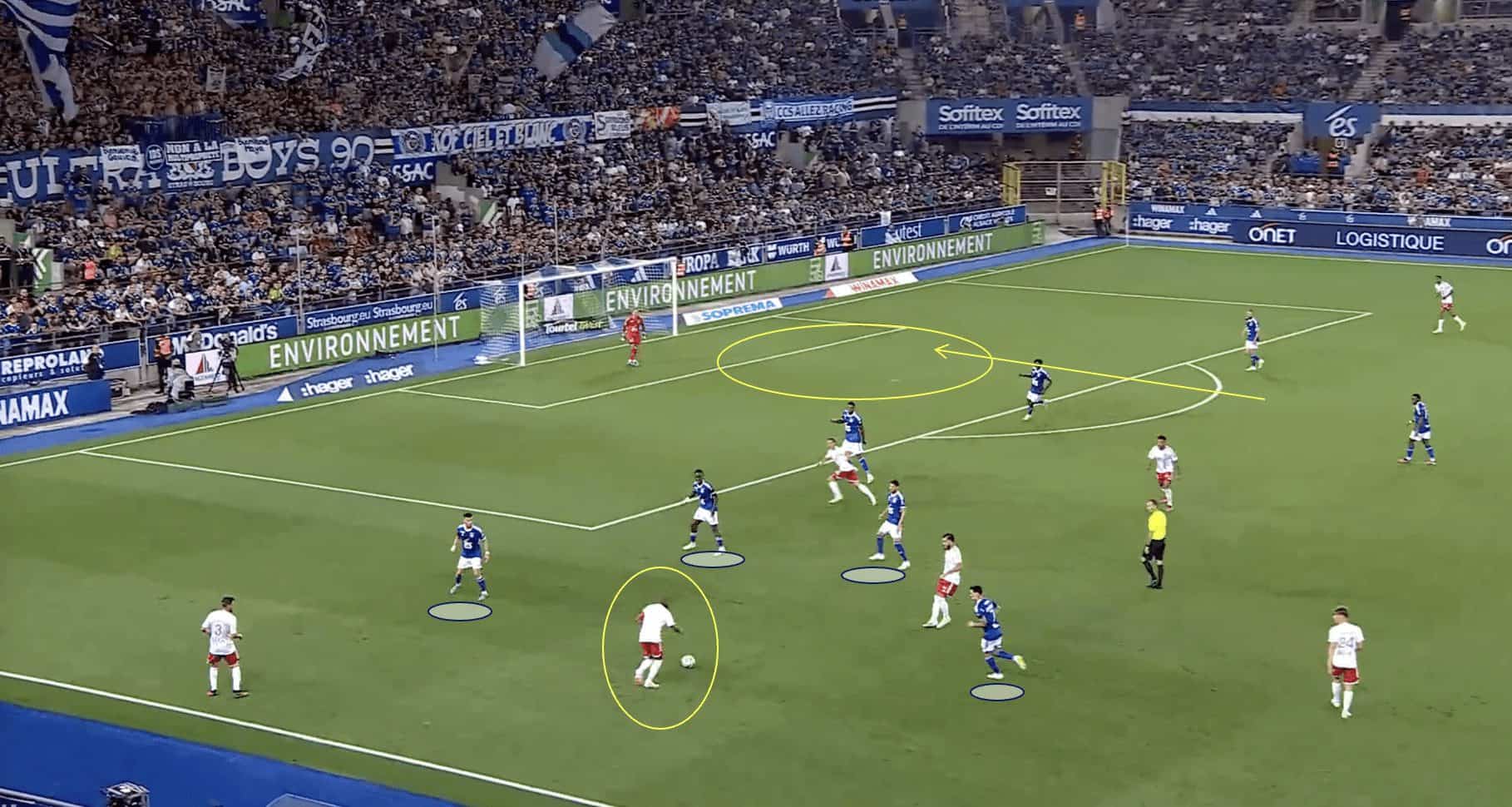
There appears to be a lack of dynamic movement in the attacking phase.
In the image above, we can see Alexandre Lacazette has dropped deeper to collect the ball, as he so often does.
In theory, this creates space for midfielders or wingers to make off-the-ball runs into the box.
As we can see, Lacazette is in a decent crossing position, but there is no one there to aim at.
Additionally, Strasbourg appears to be able to cut off most of the passing lanes, so Lacazette doesn’t have many options beyond playing backwards or playing a hopeful pass infield.
There is an absolute lack of dynamism and off-the-ball movement, which means the ball carrier often finds themselves with limited passing options.
As we can see in the example above, this often leads to stagnant possession, and consequently, it makes it easier for the Strasbourg team to defend, as they can more easily close down passing lanes when there are fewer options available.
Additionally, these off-the-ball runs are essential for opening up passing lanes and creating opportunities for through balls or quick combinations, as Lyon did so well last season.
By comparison, this season, they are finding it much more difficult to break down the opponent’s defence through intricate passing and movement, resulting in a lack of creative spark in the team’s play.
Defensively, opponents can take advantage of the situation, as Strasbourg demonstrated.
Without Lyon making dynamic off-the-ball movements, they were able to apply more effective defensive pressure.
They closed down the passing lanes, pressed the ball carrier more aggressively, and maintained a more compact defensive shape.
As we saw previously, when Lyon turned over possession, Strasbourg were able to counterattack rapidly.
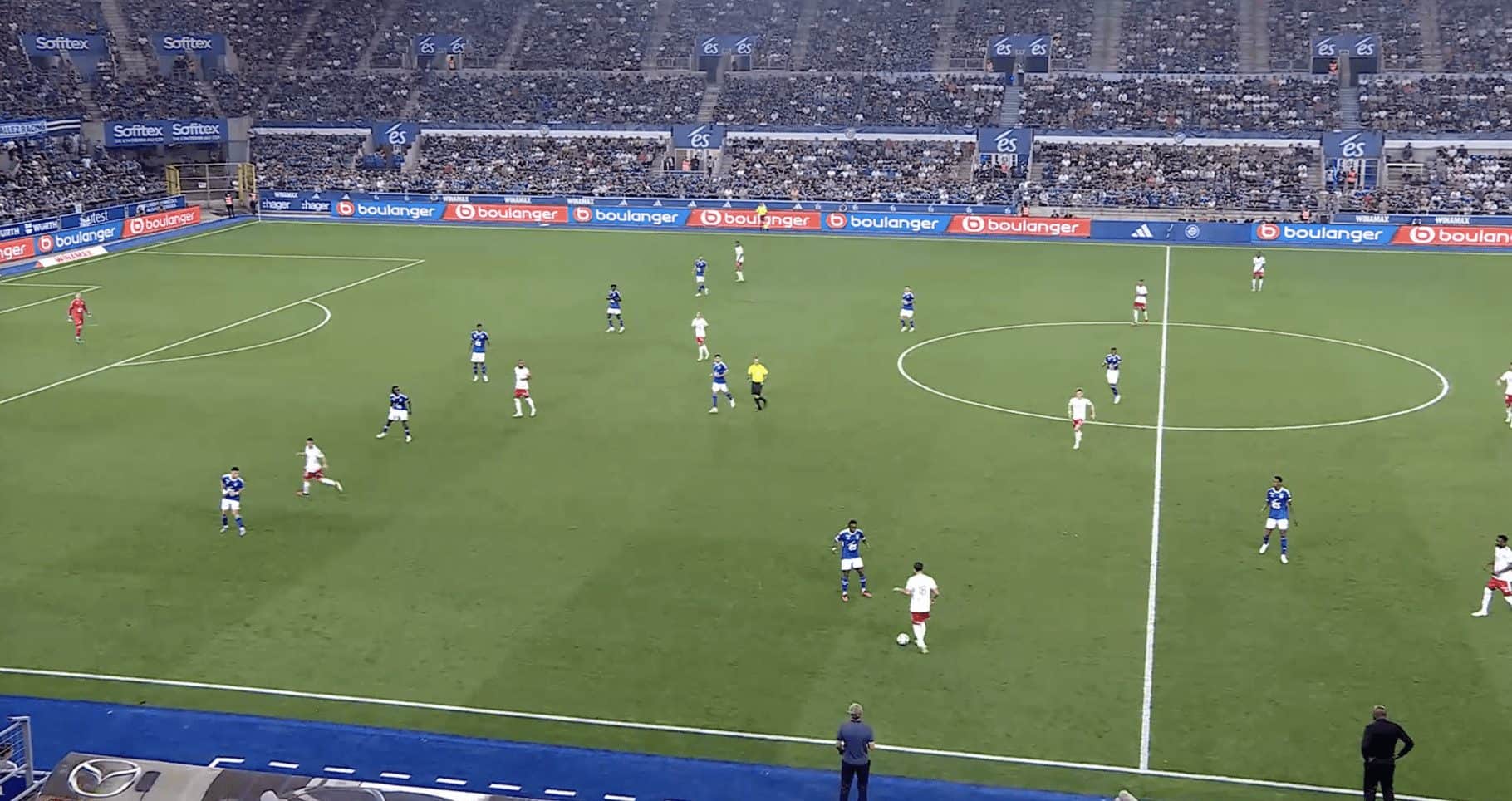
Here, we can see OL looking to build an attack, but there is no real movement, which limits their creativity and makes it so much easier for the opposition to defend.
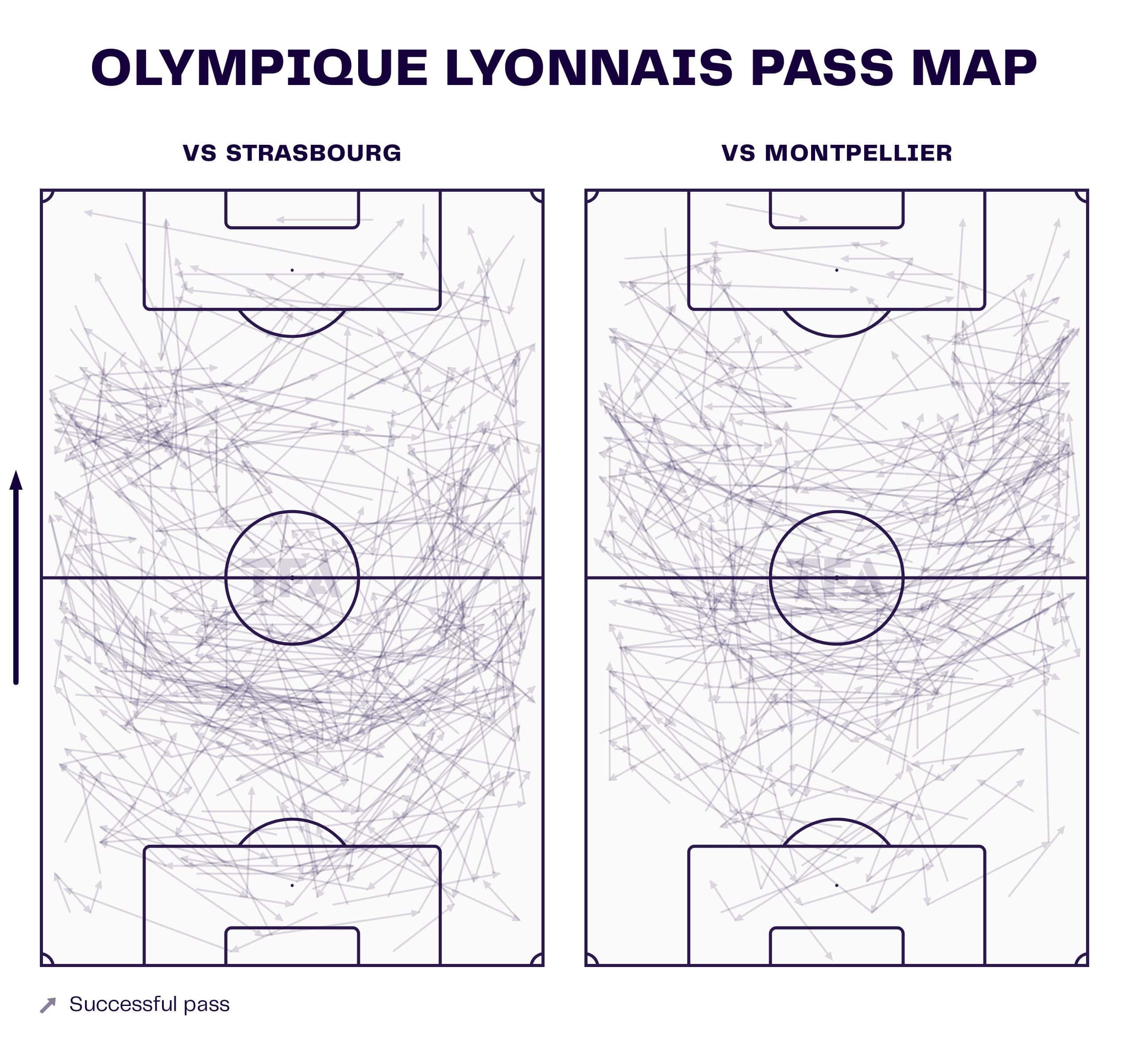
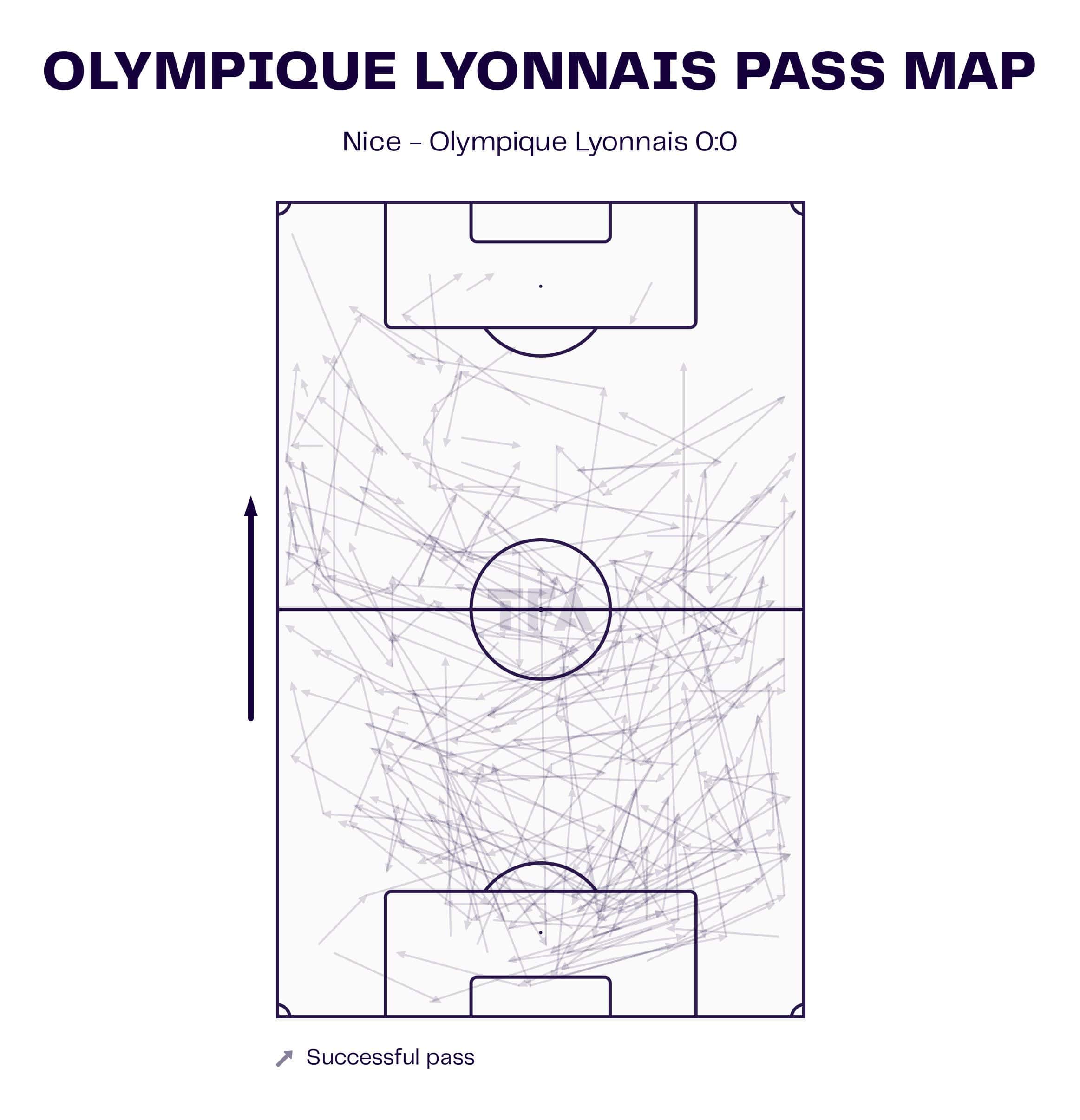
Moreover, we can see from the pass maps below that Lyon rarely made passes into the area, so short of relying on individuals to carry the ball in the opposition area, they really struggled to break through the defensive lines.
Olympique Lyonnais Passes Maps
Conclusion
Overall, it has been a terrible start to the season for Lyon.
Laurent Blanc’s tactics appear to have become very stagnant, and his players are not making the same dynamic movements that we saw last season.
Les Gones did incredibly well to finish just outside the European places last season, and many believed they would build on this success this season, but this has not been the case.
OL looks pedestrian, slow to react — and we have seen how easy it has been for the likes of Nice and Strasbourg to catch them out.
Should the current performances continue, the 57-year-old French coach will most likely find himself without a job, and the managerial merry-go-round will start again.
Olympique Lyonnais need to improve quickly; otherwise, they will be set for another season of decline.

