


At the end of the 2020/21 campaign, Christophe Galtier’s Lille were crowned French champions, overcoming the financial might of Paris Saint-Germain to finish top of the Ligue 1 table for the first time since the 2010/11 campaign when the likes of future Chelsea and Real Madrid playmaker Eden Hazard helped Rudi Garcia’s side to the title.
Fast forward to the beginning of the 2022/23 season, Lille were coming off the back of a reality check campaign in which they crashed down from first to 10th on the Ligue 1 table, while Galtier was getting ready to embark on a new journey as PSG boss following a season at Nice.
Another manager getting ready to start a new challenge at the beginning of the current season was Lille’s Paulo Fonseca. The 50-year-old Portuguese coach had sat out the 2021/22 season after departing from Roma in the summer of 2021 to make way for his compatriot José Mourinho’s Serie A return, undoubtedly refreshed and full of ideas of how he could get Lille back into Europe.
At present, Lille sit sixth in Ligue 1, five points off Monaco in fourth and a place in the UEFA Europa League group stage. Securing qualification for the Europa League, at least, would be an excellent way to cap off what’s been an exciting first season for Fonseca at Stade Pierre Mauroy and may well be on the cards.
Though only time will tell if Lille can pull it off. What’s for sure is that they’ve been quite entertaining to watch this term under Fonseca and this tactical analysis will delve into some aspects of their strategy and tactics that have made them entertaining for us to watch and far more effective on the pitch than they were last season. Our analysis won’t just be positive, however, as we’ll also look at some of the weaknesses evident in Fonseca’s side.
Build-up and ball progression
We’ll kick off our analysis by looking at Lille’s approach this term in the initial stages of possession: their build-up and ball progression phases.
Lille have kept the highest average amount of possession (59.6%) of any team in Ligue 1 this term and they’ve played the second-most passes (512.27 per 90) of any Ligue 1 side. As they try to control the game with the ball, they take a fairly methodical approach in the build-up and ball progression phases, with some clear patterns of play evident in these stages of their attack.

Figure 1 shows an example of Les Dogues’ shape in the build-up phase. There are a few fundamental principles of Fonseca’s in-possession approach evident in this image — firstly, he likes the goalkeeper to step out, be brave and contribute in possession.
Meanwhile, the centre-backs spread wider, as do the full-backs, both of whom place themselves high and wide on either sideline. This level of width is another fundamental aspect of Fonseca’s approach in possession.
The Portuguese boss also loves to see his team form this box in the centre of the pitch, with the ‘number 10’ and the left-winger combining with the holding midfield duo to create that box here, while the striker and the right-winger stay high, exploiting space where possible at the tip of this offensive shape.
Firstly, with the box midfield, we see Fonseca’s idea of how to ensure control of the centre in possession. Secondly, the positioning of the most advanced players in their system shows how they aren’t so much fixed to a specific position so much as they are to the idea that they need to find and exploit space where it presents itself at the tip of this shape to give the deeper players options.

The 21-year-old Lille academy product Chevalier has played a key role for his side in the build-up phase this season, being empowered on the ball and entrusted with playing an active role in helping his team beat the opposition’s first line of pressure. His touch map in figure 2 compared with that of Ivo Grbić from last season (with a similar number of minutes played) highlights the difference in Lille’s approach in possession this term under Fonseca as well as the very different role Chevalier has had to play for his team.
This empowerment of the goalkeeper in possession is a notable trend we’ve discussed in a recent article here at Total Football Analysis, titled: ‘Mamelodi Sundowns: Empowering the goalkeeper in build-up and ball progression – scout report’. We analysed a few examples of this concept in action along with its potential benefits if you’re interested in reading more about this type of approach. It’s clear that Lille and Chevalier under Fonseca are another solid example of this idea in action from 2022/23.

Lille trust their goalkeeper in the build-up — and it’s important that they do. Chevalier can help them get out of awkward positions successfully and help build their attack while maintaining clear control of the ball as they attempt to progress through the opposition’s defensive setup in their methodical manner.
Figure 3 shows how Chevalier helps his team to negate the opposition forward’s pressure, bypass the press and ultimately help his team break not just this first line of pressure but also the opposition’s second line of pressure.
After the right centre-back receives from the ‘keeper, he has time to get his head up and pick out a forward pass to the right-sided holding midfielder. Lille managed to make this pass an attractive one as their shape shifted to the right when the ball was played out to the right centre-back, allowing the right holding midfielder and the right-back to overload the opposition’s left-winger and create a forward passing opportunity through the middle of the pitch despite the opposition’s organised 4-2-3-1 being designed to congest central space.
The midfielder is able to turn and continue his team’s progress upfield after receiving here, helping Lille to continue moving through dangerous, high-value parts of the pitch that can be difficult to play through. The involvement of the ‘keeper in the build-up initially made this possible, while the organised structure and intelligent movement from the team when the ‘keeper played the ball out to the right centre-back set Lille up to effectively break the opposition’s press and cut through the centre of the pitch — an example of Fonseca’s approach at its apex.
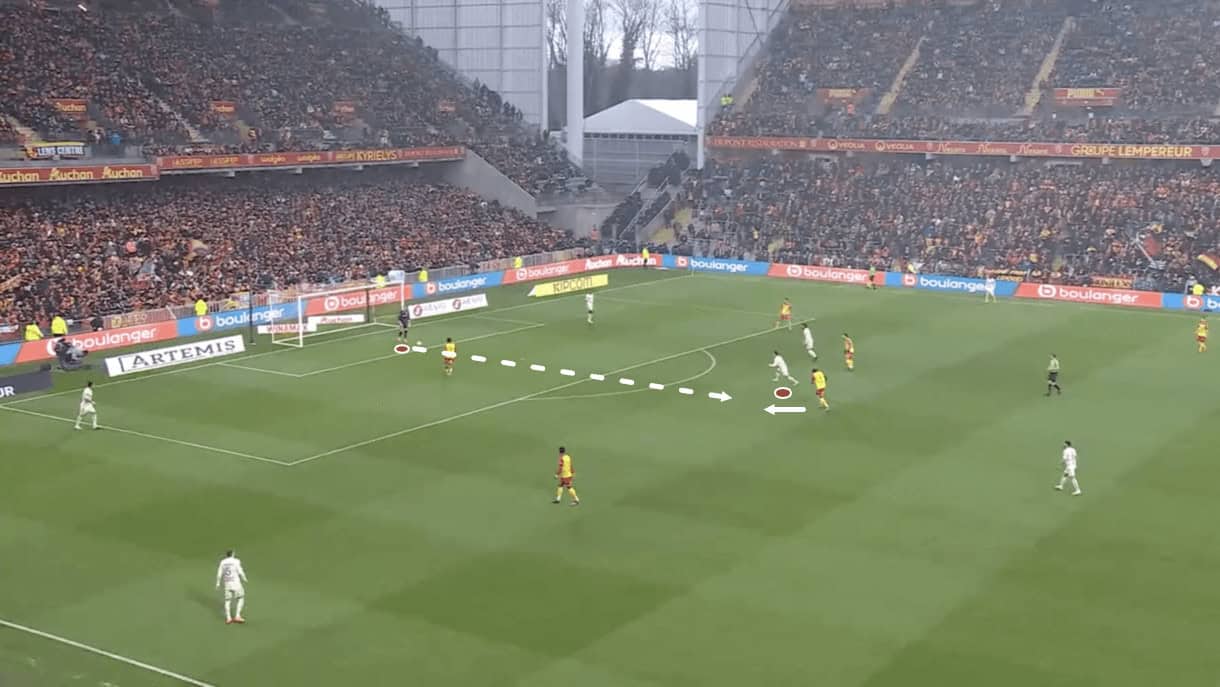
Chevalier is often found holding onto the ball and allowing some pressure to mount before releasing it to a teammate, again showing great self-belief and trust in his abilities. The ball may then be played to a centre-back before moving through midfield or the 21-year-old ‘keeper may play the ball into the centre himself. Nevertheless, Lille want to go through one of the holding midfielders in that central box before progressing forward, which we see an example of in figure 4.
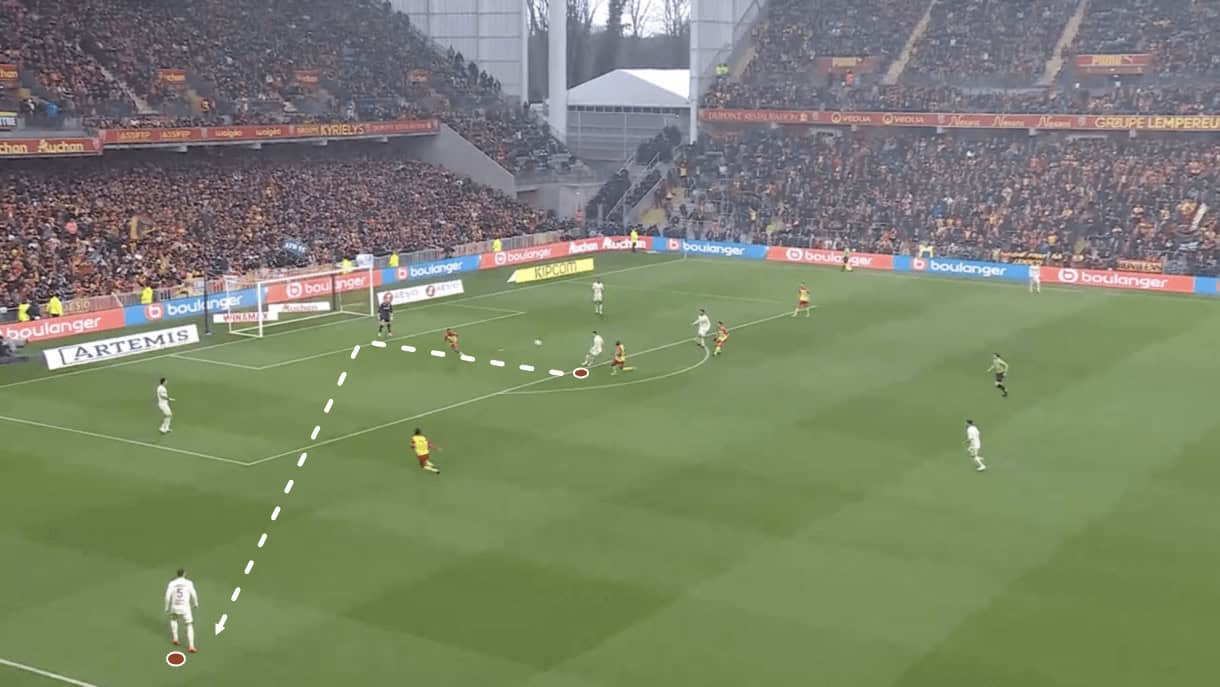
As we progress into figure 5, we see the holding midfielder managing to turn his body enough to launch the ball out to the right-back from here; the full-back has plenty of time and space to receive as the opposition’s press has been dragged into the centre by Lille’s possession play. This will help Lille to enter the next phase of their attack and probe into the opposition’s half via the wing-back, and this highlights just why Fonseca places such emphasis on width in his system — he wants these passing options available for his midfielders and wants the midfielders to know they always have these options too in order to speed up the decision-making process.
Fonseca’s side demonstrate some really interesting principles in the early phases of possession and while, of course, this comes with some risks as any strategy does but especially one that aims to ensure such control of the ball, in general, it has helped Les Dogues to progress the ball a lot and generate plenty of goalscoring opportunities.
Chance creation
Moving on into the chance creation phase at the business end of the pitch, Lille have been impressive here this season. They’re currently the fourth-highest goalscorers in France’s top flight with 49, while they’ve got the second-best xG (56.62) and third-best xG per shot (0.148).
Furthermore, they’ve taken the second-most shots of any Ligue 1 side this term (13.24 per 90), with all of this highlighting how they’re not just good at generating plenty of goalscoring chances, but they’ve been successful at generating plenty of high-quality goalscoring chances this season.
Lille have made the sixth-most dribbles of any Ligue 1 side this term, and we’ll start our analysis of Les Dogues in the chance creation phase by analysing their ball-carrying and how they’ve used it very effectively to progress through the final third and into the penalty box.

As figure 6 shows, the vast majority of Lille’s carries come in wider areas and mostly inside the final third, with some also coming in deeper areas, primarily as a result of the fact Lille often play the ball from the centre to the wing from where they can then drive forward as we saw in our previous section.
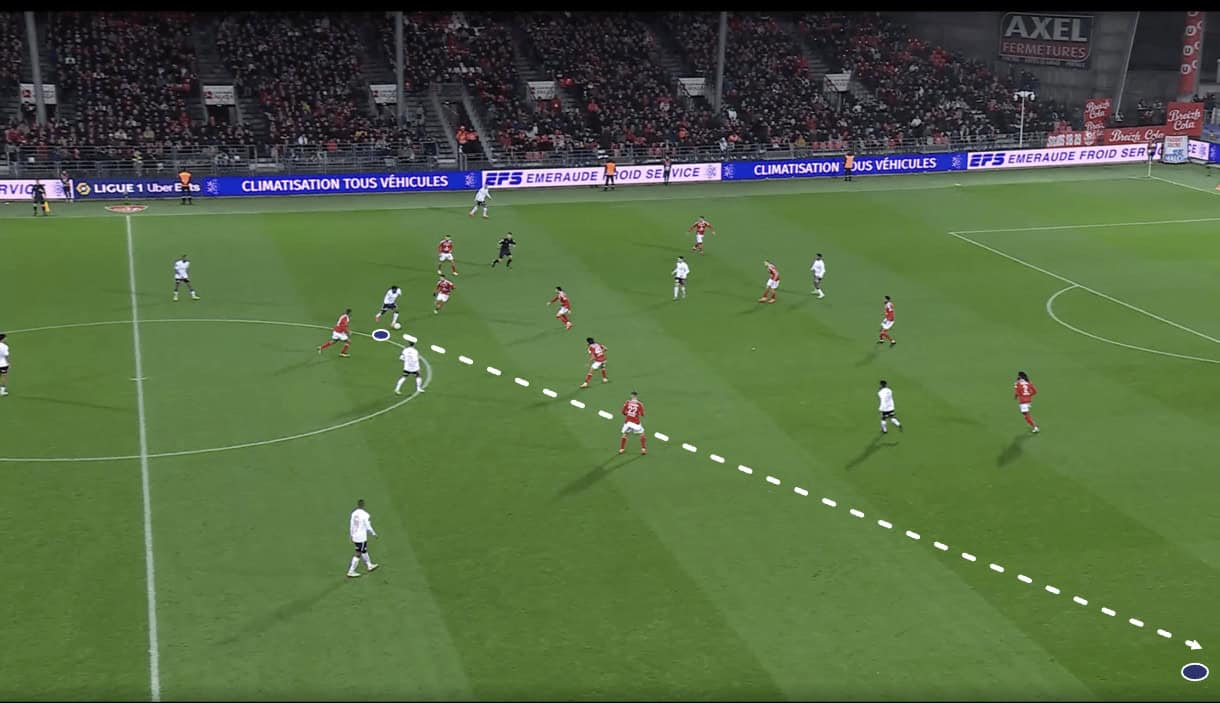
In the final third, Fonseca’s side prioritises maintaining width just as much as they prioritise this during the build-up and ball progression phases. They’ll always have a player getting chalk on their boots inside the final third, again giving those positioned centrally options to spread the play out wide.
This can be particularly effective when the opposition drop into a horizontally compact low-block to congest space centrally as a lot of teams will likely do when Lille progress into the chance creation phase and as we see an example of in figure 7 above.
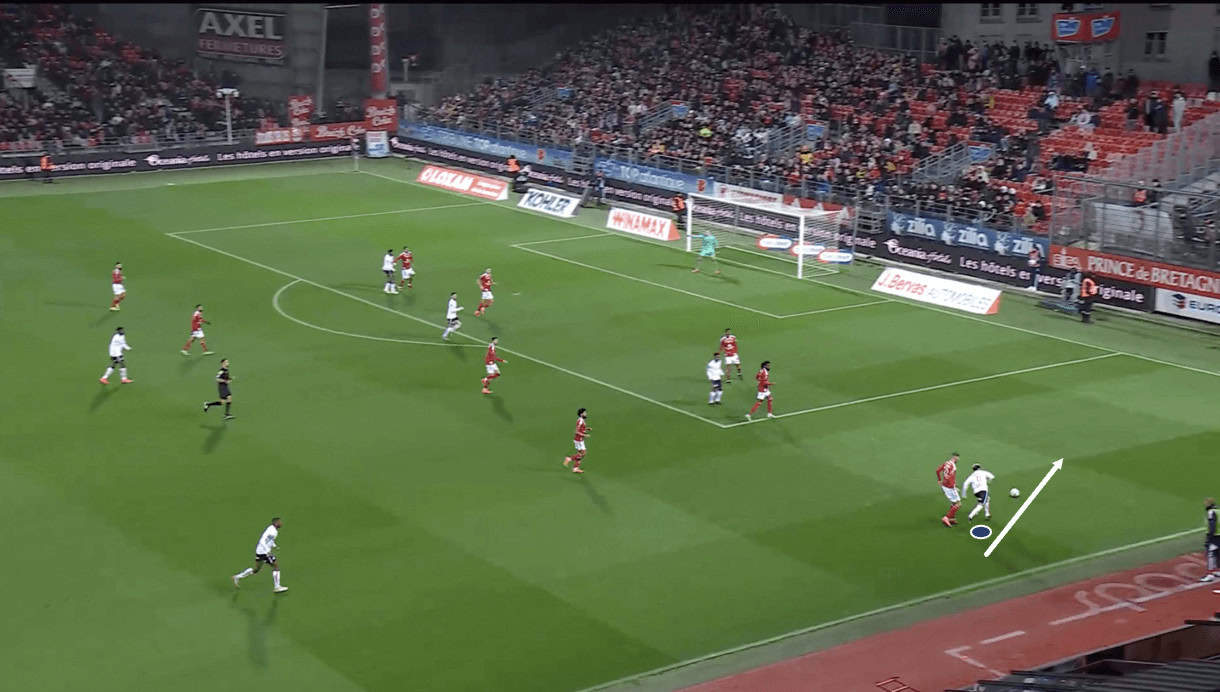
When we move on into figure 8, we see how the ball found right-winger Adam Ounas, who made the switch from Napoli to Lille back in September. Ounas has missed almost half the season through injury but has been a delight to watch when fit since making the switch to Northern France. He’s made 11.13 dribbles per 90 this term — the most of any Lille player — with a 66.36% dribble success rate.
Here, he received out wide with time and space to set himself, get his head up and make his first move beyond the approaching full-back before the defender reached him. Ounas skipped past the defender and ran down the line, setting up a good opportunity to cross — though as play moves on, we actually see the 26-year-old pull the ball back and continue his dribble.
This is just one example of how Lille like to isolate their wide men with the opposition full-backs inside the final third after building into the opposition’s half with their careful and calculated approach. Ounas has been a high-volume dribbler on the right, but players like Jonathan Bamba, Edon Zhegrova and Alan Virginius can also be lethal when deployed in this manner.

These wingers are also great assets for Lille in transition, which we see Ounas providing an example of in figure 9. After a quick one-two inside his own half, Ounas pulled away down the wing, hurdled an opponent’s sliding tackle and continued into the final third at pace, progressing into a valuable position for chance creation.
So, these wide men are not just useful in positional attacks via their wide positioning but are just as effective in counterattacks, making them a multifaceted weapon in Fonseca’s arsenal.

Chance creation doesn’t just consist of carrying, of course, passes are also an important aspect of this phase to analyse. Figure 10 shows Lille’s progressive pass map for the 2022/23 season up to this point and this map clearly illustrates a lot of key information regarding Les Dogues’ passing.
We know they initially like to play the ball into the centre to the holding midfielders — and we see some progressive passes from the centre in deeper positions on this map. However, just as with their dribbling, the majority of Lille’s progressive passes into the penalty area inside the final third come from slightly wider positions, especially the half-spaces.
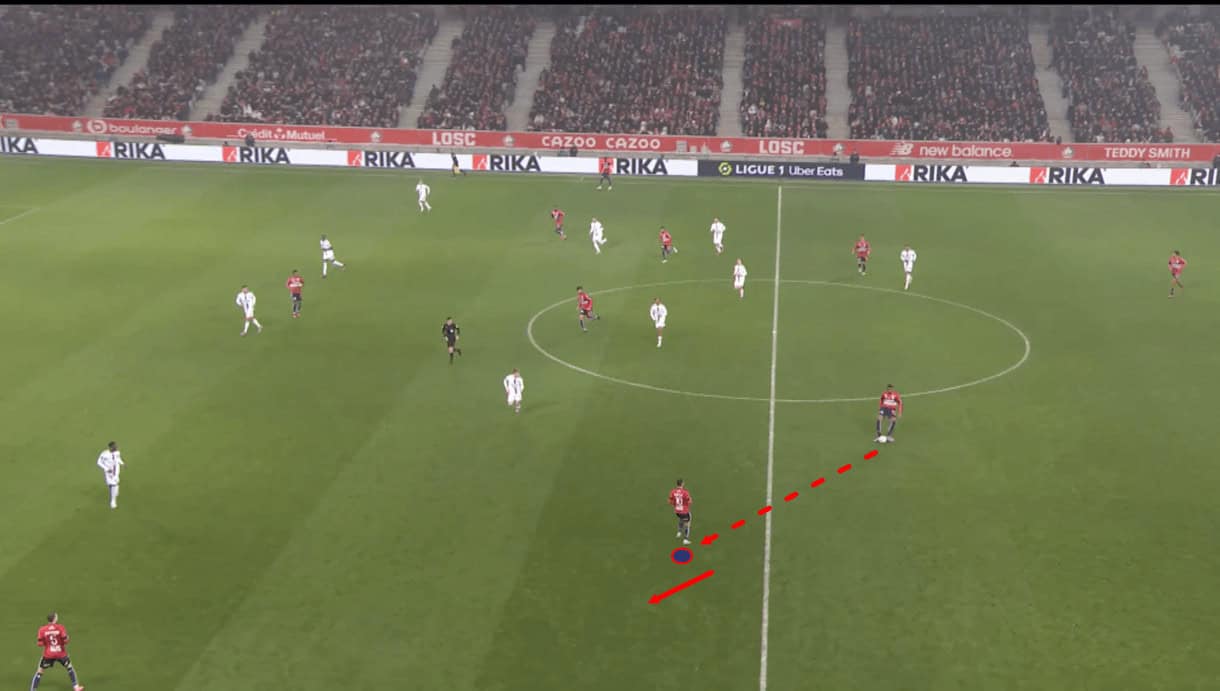
The more advanced duo in that central box will position themselves in the half-spaces in the progression phase and chance creation phase, looking to occupy space where they can receive and act as a catalyst for goalscoring.
Rémy Cabella has been a star man for Lille since making the move from Ligue 1 rivals Montpellier last summer and we see an example of him pulling off into a slightly wider position where space has opened up just inside the opposition’s half and receiving from a deeper teammate with an excellent body position in figure 11.
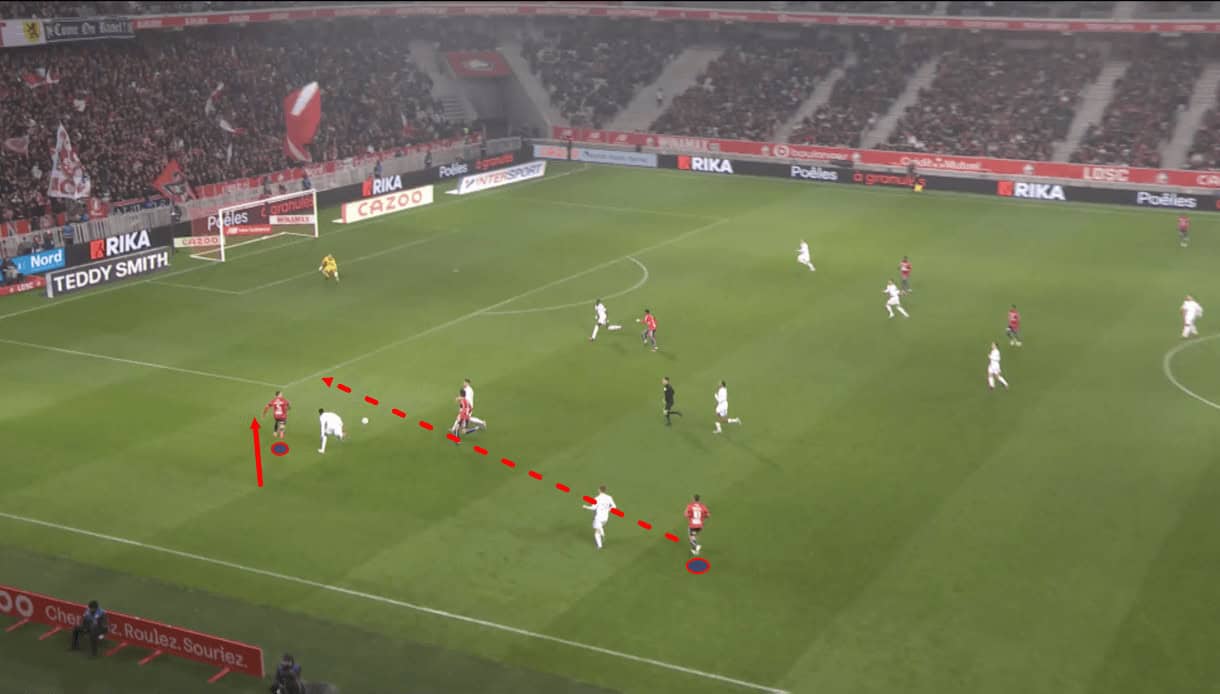
The 33-year-old receives, turns and plays the ball forward from this wider position he’s pulled out into, splitting the opposition’s backline with an incisive through ball for overlapping left-back Gabriel Gudmundsson to chase in behind, setting up a decent opportunity for Lille to create a goalscoring chance.
So, we can see from this example how Lille’s attacking midfielders have the license to roam about a little bit within their designated areas, react as they find space and exploit that space to create for their team. This world of Fonseca’s is one in which Cabella has thrived this season, with the 33-year-old proving a very astute bit of business following his free transfer last summer.
We hope this section shows exactly why Lille have generated so many high-value goalscoring opportunities this season; they’ve exhibited some very intelligent possession play at times in all areas of the pitch, helping them to become a very difficult team for their opponents to keep away from their goalmouth.
Their xG is highly impressive and their goals scored are nothing to turn one’s nose up at either. However, if they can get closer to matching their xG with their actual goals scored by the end of the campaign, they’ll give those currently occupying the European places a good run for their money.
Defensive phases
Our final section of analysis focuses on Lille’s approach without the ball, in defensive situations. This area is a mixed bag for Fonseca’s men. On one hand, they’ve conceded the fewest expected goals (29.91) of any Ligue 1 side — a positive indicator regarding their defensive performances.
However, on the other hand, they’ve conceded 36 actual goals — vastly exceeding their expected goals figure, and their expected goals per shot against sits at 0.138 — the eighth-highest in Ligue 1.
With all of that said, we feel this can at least partly be explained quite simply. Lille have faced the fewest shots of any Ligue 1 side this term, conceding just 7.52 shots per 90. However, as their expected goals per shot against figure indicates, when they do concede shots, they tend to be relatively high-quality chances for the opposition.

Firstly, let’s take a look at exactly how Les Dogues defend. They typically set up in a 4-2-3-1 shape without the ball, and utilise a fairly man-oriented approach during the high press phase.
This is demonstrated in figure 13, where we see Lille’s left-holding midfielder stepping up to mark the opposition’s right central midfielder in an attempt to ensure Lille deny the opposition a numerical advantage in the second line and all short passing options for the deep ball carriers are marked up tightly.
The left holding midfielder ends up getting quite aggressive with his press, even becoming Lille’s most advanced player at one point. In the end, he helps his team force the play out to the left wing, from where the ball then moves into central midfield, where Les Dogues can close in on the central receiver.
This is just one brief example of Lille’s man-oriented pressing approach, but it’s one that clearly shows how they set up to deal with the opposition’s build-up and stifle their progression.
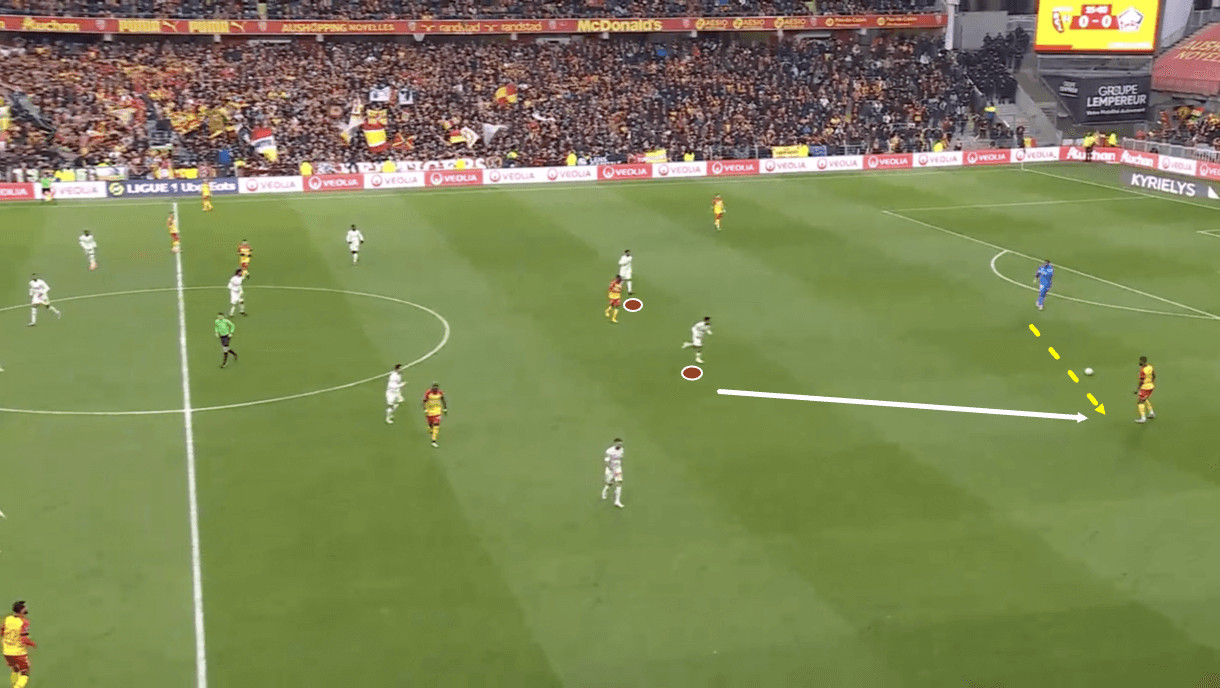
Their centre-forward and ‘10’ have a key role to play in the high-block and also the mid-block. We see Lille defending slightly deeper than in the previous example here in figure 14. Initially, as the ball is with the goalkeeper, both the ‘10’ and centre-forward sit on the holding midfielder, intending to just deny the opposition any angle into him.
As the ‘keeper plays the ball to the left centre-back, it’s the right-sided attacker’s job to close this player down while keeping the holding midfielder in his cover shadow, as the left-sided attacker shifts over and marks the holding midfielder tightly.
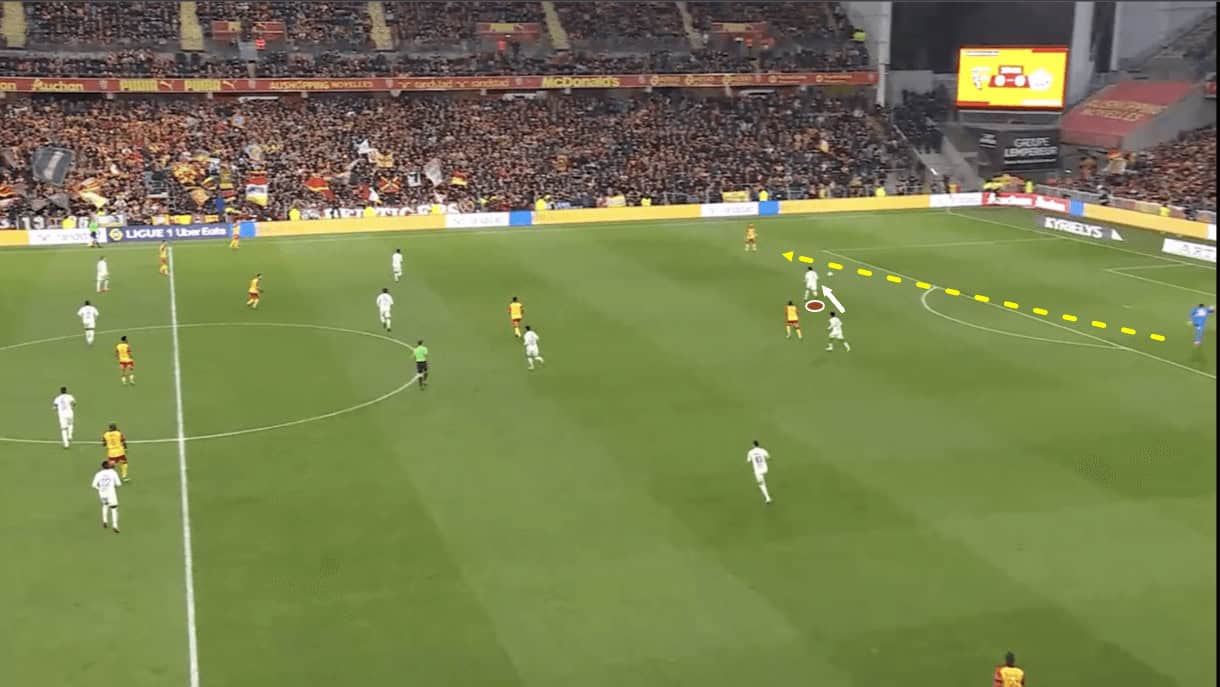
The opposition switch the play back over to the right centre-back, and then the two attackers switch roles; the left-sided one jumps to press the receiver while the right-sided one now takes up man-marking responsibility on the holding midfielder.
All this time, Lille’s midfielders stay fairly tight to the opposition’s midfielders and close off short passing lanes into them. They’re more focused on short passes to feet than long balls over the top or players dropping into the space behind them. This defensive shape isn’t too dissimilar to the 4-4-2 shape Lille primarily used under Galtier two seasons ago but the big difference is that this shape operates more aggressively and is more man-oriented, whereas Galtier’s Lille were more passive, focusing on organisation and position-orientation.
Under Fonseca, Lille undoubtedly win the ball back higher more often but it can come with risks, of course.

Figure 16 shows three chances Lille conceded in recent games. The top two show how Lille’s high line can be exploited in different ways. The top-left shows a period of settled possession from Lyon that leads to the ball being played into an attacker who drops into the right half-space, dragging Lille’s centre-back with him because, again, Lille’s midfielders are far more occupied with what’s going on in front of them than what’s going on behind them.
The Lille defender fails to win the ball, allowing Lyon to play a through pass in behind Les Dogues’ high backline. Meanwhile, Lille’s high line can be vulnerable in transition as well, as the top-right provides an example of. The Lens wide man received out wide and carried the ball forward on the left wing before sending a through ball into the striker’s path as he ran in behind Lille’s backline.
Lastly, the bottom two images are from Lille’s recent clash with Galtier’s PSG. Here, Neymar dropped into the space behind Lille’s midfield and was found by a teammate exploiting this space. The Brazilian managed to turn and run at the opposition’s defence before sending a through ball into his left-sided teammate’s path, setting up a 1v1 inside the final third for Les Parisiens.
These are just a few of many examples of how Lille have been put in dangerous positions far too often of late. It’s not the volume of chances they concede that’s the issue, it’s the quality of chances they give away when they do give away a chance and this could prove costly come the end of the season.
Conclusion
To conclude our tactical analysis, there’s a lot we like about Fonseca’s side both in and out of possession, and they’ve been a breath of fresh air at times both for Lille and for Ligue 1, though, like any side, they aren’t perfect!
Can they continue challenging Monaco, Rennes and perhaps even Lens for European places by the end of the campaign? At the moment, we’d say yes as there’s so much to like about their approach, they’re still proving very difficult to stop when attacking and they don’t give away too many chances but they need to cash in on that xG, be more clinical in front of goal and less generous with the quality of goalscoring opportunities they concede.

