Total Football Analysis
Once.Sport
  • Football Analysis
    • Data Analysis
    • Formations
      • 2-2-4 Formation
      • 2-3-5 Formation
      • 3-1-4-2 Formation
      • 3-2-2-3 Formation
      • 3-2-4-1 Formation
      • 3-1-6 Formation
      • 3-3-4 Formation
      • 3-4-1-2 Formation
      • 3-4-2-1 Formation
      • 3-4-3 Formation
      • 3-5-1-1 Formation
      • 3-5-2 Formation
      • 4-1-4-1 Formation
      • 4-2-2-2 Formation
      • 4-2-3-1 Formation
      • 4-2-4 Formation
      • 4-3-1-2 Formation
      • 4-3-3 Formation
      • 4-4-2 Formation
      • 4-5-1 Formation
      • 5-3-2 Formation
      • 5-4-1 Formation
      • 6-3-1 Formation
    • Head Coach Analysis
    • Match Analysis
    • Player Analysis
    • Recruitment Analysis
    • Set Piece Analysis
    • Tactical Theory
    • Tactical Preview
    • Team Analysis
    • Training Analysis
    • Tactical Analysis
    • Scouting Report
  • Competition
    • ALL Competitions
    • English Premier League
    • Champions League
    • La Liga
    • Bundesliga
    • Serie A
    • Ligue 1
    • Eredivisie
    • EFL Championship
    • FIFA World Cup 2022
    • WEURO 2022
    • Women’s Super League
    • NWSL
    • Belgian First Division A
    • A-League
    • Liga Profesional de Argentina
    • Austrian Bundesliga
    • Campeonato Brasileiro Série A
    • DFB Pokal
    • 1. HNL
    • Danish Superliga
    • EFL League One
    • EFL League Two
    • FA Cup
    • EFL Cup
    • Indian Super League
    • K-League
    • J1 League
    • Liga MX
    • Copa América 2021
    • Copa del Rey
    • MLS
    • Eliteserien
    • Euro 2020
    • Primeira Liga
    • Scottish Premiership
    • Allsvenskan
    • Europa League
    • UEFA Nations League
    • Liga AUF Uruguaya
  • Coaches
    • All Coaches
    • Alfred Schreuder
    • Ange Postecoglou
    • Antonio Conte
    • Arne Slot
    • Bo Svensson
    • Brendan Rodgers
    • Bruno Lage
    • Carlo Ancelotti
    • Christophe Galtier
    • Claude Puel
    • Claudio Ranieri
    • David Moyes
    • Dean Smith
    • Diego Simeone
    • Domenico Tedesco
    • Frank Lampard
    • Eddie Howe
    • Edin Terzić
    • Emma Hayes
    • Erik ten Hag
    • Ernesto Valverde
    • Gennaro Gattuso
    • Gerardo Seoane
    • Gian Piero Gasperini
    • Giovanni van Bronckhorst
    • Graham Potter
    • Igor Tudor
    • Imanol Alguacil
    • Jesse Marsch
    • Jonas Eidevall
    • Jorge Sampaoli
    • José Bordalás
    • José Mourinho
    • Julen Lopetegui
    • Julian Nagelsmann
    • Julien Stéphan
    • Jürgen Klopp
    • Luciano Spalletti
    • Lucien Favre
    • Manuel Pellegrini
    • Marcelo Bielsa
    • Marco Rose
    • Marco Silva
    • Massimiliano Allegri
    • Mauricio Pochettino
    • Maurizio Sarri
    • Mikel Arteta
    • Niko Kovač
    • Nuno Espírito Santo
    • Oliver Glasner
    • Patrick Vieira
    • Paulo Fonseca
    • Pep Guardiola
    • Peter Bosz
    • Rafa Benítez
    • Ralf Rangnick
    • Ralph Hasenhüttl
    • Roger Schmidt
    • Roy Hodgson
    • Sean Dyche
    • Sérgio Conceição
    • Simone Inzaghi
    • Sonia Bompastor
    • Stefano Pioli
    • Steffen Baumgart
    • Steven Gerrard
    • Thiago Motta
    • Thomas Frank
    • Thomas Tuchel
    • Unai Emery
    • Vincenzo Italiano
    • Xavi
  • Teams
    • ALL Teams
    • AC Milan
    • Ajax Amsterdam
    • Arsenal
    • AS Monaco FC
    • Atalanta
    • Atlético Madrid
    • FC Barcelona
    • FC Bayern Munich
    • Borussia Dortmund
    • Celtic FC
    • Chelsea FC
    • Everton F.C.
    • Inter Milan
    • Juventus F.C.
    • Leeds United F.C.
    • Liverpool FC
    • Manchester City
    • Manchester United FC
    • Paris Saint-Germain
    • Rangers FC
    • RB Leipzig
    • Real Madrid CF
    • Tottenham Hotspur
    • West Ham United
  • Players
    • ALL Players
    • Alisson Becker
    • Bukayo Saka
    • Erling Haaland
    • Harry Kane
    • Jack Grealish
    • John Stones
    • Julián Alvarez
    • Kalvin Phillips
    • Kevin De Bruyne
    • Kyle Walker
    • Kylian Mbappé
    • Lamine Yamal
    • Lionel Messi
    • Luis Díaz
    • Mohamed Salah
    • Phil Foden
    • Virgil Van Dijk
  • Contact
  • Write For TFA
No Result
View All Result
No Result
View All Result
Total Football Analysis
No Result
View All Result
Home Analysis

How Frank Lampard’s Tactics Guided Everton To Eventual Safety – Tactical Analysis

Owen Bullman by Owen Bullman
June 7, 2022
in Analysis, Dominic Calvert-Lewin, Everton F.C., Frank Lampard, Head Coach Analysis, Premier League, Richarlison
0
Frank Lampard at Everton 2021/22 - tactical analysis

Frank Lampard took the Everton job at the end of January, following a year out of work.

Since taking charge of the Toffees, he has managed them to Premier League safety and is looking to build on an eventful end to the season.

The former Chelsea boss has certainly struggled in Merseyside, averaging 1.11 points per game.

This tactical analysis will look at how Lampard has kept his Everton side in the Premier League for another season.

Within this analysis, the tactics and decisions made by the manager will be understood and explained.

Frank Lampard Tactics In Possession

When in possession, Lampard sets his side up in a 3-4-3 formation.

When in possession, Everton looks to progress the ball through the thirds quickly rather than slowly building up.

By utilising the aerial strength of Richarlison and Calvert-Lewin, they can comfortably play long to the forward players.

Everton’s aerial strength means that they look to play longer, but they are also regularly faced with difficulty when building up from deep.

Below is an example of how easily marked the Toffees are when looking to build up.

The lack of pivot in Lampard’s midfield means that the Blues are not comfortable in playing it short and building up.

To add to this, the centre backs do not split wide enough to create space.

This is something which Lampard is aware of and his tactic is to go long to his attacking players.

By doing this, Everton completely bypasses any type of press from the opposition and looks to maintain possession from higher up the pitch.

However, having said this when given time and space Everton are able to build up by receiving the ball from their goalkeeper.

This isn’t something that happens regularly, as teams tend to press high against Everton because of their ‘lack’ of ability on the ball in the defence.

Frank Lampard at Everton 2021/22 - tactical analysis

Lampard’s preferred formation heavily involves the wide channels, as there are almost two sets of wingers in action.

More recently, Vitaliy Mykolenko and former Arsenal player Alex Iwobi have been used as the side’s ‘wingbacks’.

Everton’s use of their wingbacks allows for their more attacking players to maintain a centralised position.

Below, Mykolenko is pictured overlapping attacker Demari Gray.

This move is a common theme in Everton’s possession style and way of attacking.

Both wingbacks provide lots of energy and width, giving the attackers freedom to express themselves centrally.

The attackers play centrally which creates space wide for the wingbacks.

By doing this, there are always options to pass the ball to.

The attacking players comfortably show for the ball into feet, and the wingbacks attack the space behind the defence.

Frank Lampard at Everton 2021/22 - tactical analysis

This season, in the final third of the pitch, Lampard’s side has struggled to convert chances, mainly because star striker Dominic Calvert-Lewin has missed the majority of the season through injury.

As mentioned earlier, Everton’s front players are particularly strong in the air.

Calvert-Lewin averages the league’s most aerial duels per 90.

2022 06 05 18 48 18

The former Chelsea boss looks to capitalize on this strength as his side regularly sets up to cross the ball from all areas, especially from deep.

Wingbacks usually pick the ball up in deeper areas, which triggers Everton to flood the box.

The Toffees have at least two attackers in the penalty area with a midfield runner arriving late, something the Everton manager was well known for in his playing days.

ab

Frank Lampard Tactics Out of possession

Frank Lampard sets his side up in two different ways depending on the scenario and where the ball is located on the pitch.

Both variations can be classed as a mid or low block.

Firstly, when defending high up the pitch, Everton remains solid in their 3-4-3 formation, with the front three stepping high and screening the opposition midfield.

Instead of pressing the opposition defence, Lampard wants his team to be conservative and remain in a structured shape.

This way, Everton can focus on winning the ball back in more important areas.

Whilst Everton teams of the past have dominated the opposition, this Everton side had to dig in and fight for survival.

Lampard’s out-of-possession approach ensured Everton was difficult to break down while also conserving energy by not pressing aggressively.

Frank Lampard at Everton 2021/22 - tactical analysis

Once play has progressed further, and Everton finds themselves deeper, they drop into a more defensive shape.

This shape, 5-4-1, enables the Blues to close any space down quickly, as their players are so close together.

To operate like this, Everton must remain disciplined and compact.

Lampard has used this tactical approach in his reign over the Toffees.

By doing this, it gives Everton the highest chance of nullifying any threat from the opposition.

Key to this low block and defensive style is former Watford midfielder Abdoulaye Doucouré.

His defensive discipline and ability to cover ground enable the defensive shape to remain solid.

He often drops deeper to the screen and blocks potential passes in between the back five and midfield four.

Moreover, the striker is left isolated as the highest player up the field for Everton.

This role is equally as important as the rest.

The striker tends to apply subsequent pressure when the opposition tries to progress the ball into dangerous areas.

The striker, usually Richarlison is comfortable in dropping deep and almost creating another bank of five.

The Brazilian’s work rate disrupts the opposition’s build-up, as he is quick to press any loose ball.
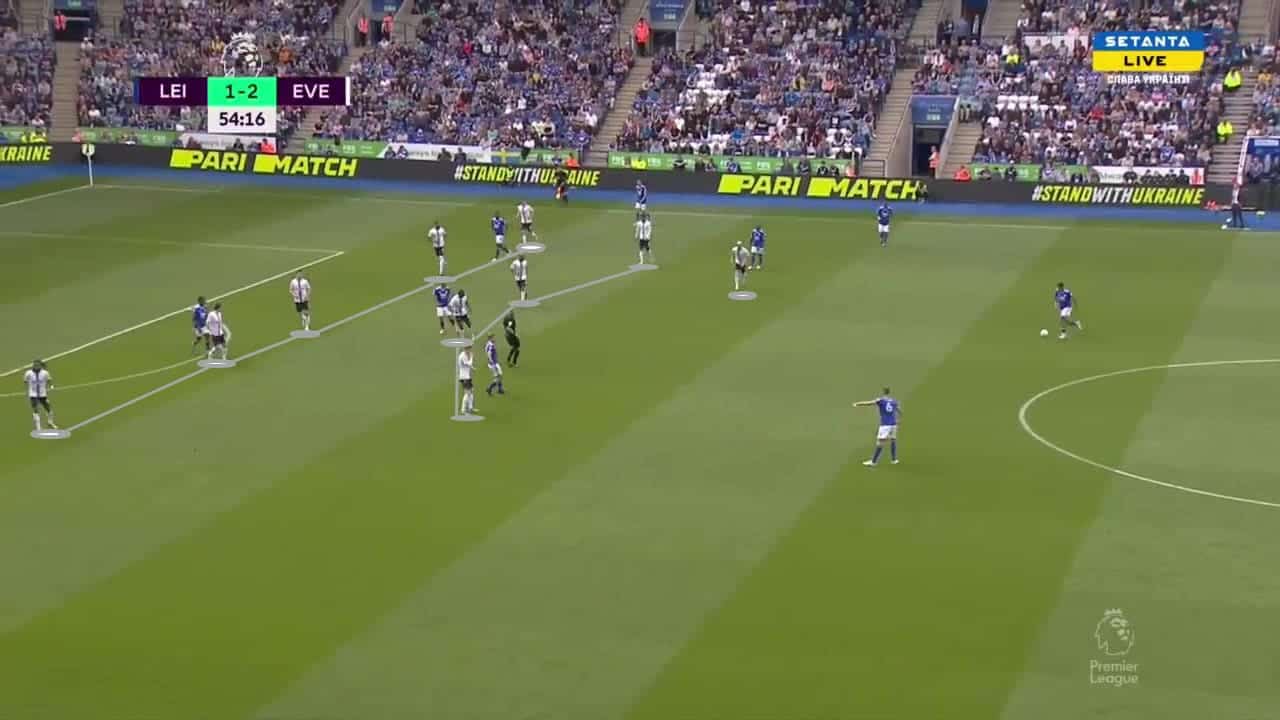
Frank Lampard sets his side up in two different ways depending on the scenario and where the ball is located on the pitch.Both variations can be classed as a mid or low block.Firstly, when defending high up the pitch Everton remains solid in their 3-4-3 formation with the front 3 stepping high and screening the opposition midfield.  Instead of pressing the opposition defence, Lampard wants his team to be conservative and remain in a structured shape.This way Everton can focus on winning the ball back in more important areas.Whilst Everton teams of the past have dominated opposition, this Everton side had to dig in and fight for survival.Lampard's out of possession approach ensured Everton were difficult to break down whilst also conserving energy by not pressing aggressively. 

The off the ball work rate from Everton is something very noticeable.

Lampard sets his side up to be aggressive when in close contact with the opposition.

Defenders are instructed to follow their men, even if it means stepping into the midfield.

This does leave the potential to be exposed as space will be left.

However, the aggressiveness of the Everton players usually wins them the ball or, worse, delays the opposition’s progression.

Once play has progressed further and Everton find themselves deeper, they drop into a more defensive shape.This shape, 5-4-1 enables the blues to close any space down quickly as their players are so close together.To operate this Everton must remain disciplined and compact.Lampard has used this tactical approach in his reign over the Toffees.By doing this it gives Everton the highest chance of nullifying any threat from the opposotion.Key to this low block and defensive style is former Watford midfielder Abdoulaye Doucouré.His defensive discipline and ability to cover ground enables the defensive shape to remain solid.He often drops deeper to screen and block potential passes in between the back 5 and midfield 4. 

Everton Attacking Transition

Lampard’s defensive structure leaves Everton limited with numbers up front.

Following a transition, Lampard’s men are usually heavily outnumbered due to the manager’s defensive style and tactics.

When transitioning, Everton looks to break quickly and directly.

Richarlison is usually the furthest player forward.

His first action is to drive the ball forward by dribbling very directly.

This is his only option, as support has not yet reached him.

When transitioning to attack, Everton is quite cautious in the number of bodies they send forward.

This could be due to Everton’s finding themselves in a position that wasn’t worth the risk of exposing themselves defensively.

Frank Lampard at Everton 2021/22 - tactical analysis

Rarely do Everton string a sequence of passes together when transitioning to attack.

As seen below, there are several options for the player with the ball.

However, the Everton player chose to dribble further and directly take opponents on.

By doing this, if the Everton player beats a man, then the numerical advantage changes in their favour.

Everton ranks second lowest in the league for the number of successful through balls this season, with 30.

The direct measure of dribbling is something tactical Lampard has implemented into his side.

Everton have amongst the highest 1v1 dribbling rates in the Premier League, averaging the fourth-highest with 26.84 per 90 minutes.Frank Lampard at Everton 2021/22 - tactical analysis

Everton Defensive Transition

Everton’s defensive transition can sometimes cause them to be outnumbered and caught out.

As mentioned earlier, Lampard wants his side to be aggressive, which sometimes leads to them overcommitting men and then being at risk of a threat.

As pictured below, Everton’s midfield has overcommitted and are now out of the game leaving the back three completely exposed to the attack.

Lampard wants his side to be proactive, and if they lose possession in their half, he clearly plans to counter-press.

However, this is risky as sometimes there is not enough time, space, or men to back this press, leading to a situation like the one below.

Frank Lampard at Everton 2021/22 - tactical analysis

Conclusion

Overall, Frank Lampard tactics have made Everton more organised out of possession.

His out-of-possession tactics are perfect for the players he has at his disposal.

The shift of Alex Iwobi to wingback has proved a master stroke as the Nigerian has hit some form recently.

The structure of the midfield and defence means Everton are no longer a pushover.

Every player knows his role and job, and the fight and desire shown during the run-in proved vital for Everton’s survival.

Leading onto the 2022/23 season, Everton fans should be optimistic.

With the addition of a few new players and the retention of strikers Richarlison and Calvert-Lewin, the Toffees should be challenging for a European spot.

Frank Lampard has found his style in Merseyside and is looking to build on his philosophy.

Previous Post

Walid Regragui Tactics At Wydad Casablanca 2021/2022: How The Monumental Moroccans Were Crowned The Champions Of Africa – Tactical Analysis

Next Post

Corinthians 2022: Why Vitor Pereira’s positional play is failing in Brazil – scout report

Next Post
Corinthians 2022: Vitor Pereira's failed positional play - scout report - tactical analysis tactics

Corinthians 2022: Why Vitor Pereira's positional play is failing in Brazil - scout report

  • About Total Football Analysis
  • Contact Total Football Analysis
  • Write For Total Football Analysis
  • Advertise
  • Privacy Policy
  • Cancellation / Refund Policy
  • Resources
  • Terms Of Service

© 2026 Total Football Analysis

No Result
View All Result
  • Football Analysis
    • Data Analysis
    • Formations
      • 2-2-4 Formation
      • 2-3-5 Formation
      • 3-1-4-2 Formation
      • 3-2-2-3 Formation
      • 3-2-4-1 Formation
      • 3-1-6 Formation
      • 3-3-4 Formation
      • 3-4-1-2 Formation
      • 3-4-2-1 Formation
      • 3-4-3 Formation
      • 3-5-1-1 Formation
      • 3-5-2 Formation
      • 4-1-4-1 Formation
      • 4-2-2-2 Formation
      • 4-2-3-1 Formation
      • 4-2-4 Formation
      • 4-3-1-2 Formation
      • 4-3-3 Formation
      • 4-4-2 Formation
      • 4-5-1 Formation
      • 5-3-2 Formation
      • 5-4-1 Formation
      • 6-3-1 Formation
    • Head Coach Analysis
    • Match Analysis
    • Player Analysis
    • Recruitment Analysis
    • Set Piece Analysis
    • Tactical Theory
    • Tactical Preview
    • Team Analysis
    • Training Analysis
    • Tactical Analysis
    • Scouting Report
  • Competition
    • ALL Competitions
    • English Premier League
    • Champions League
    • La Liga
    • Bundesliga
    • Serie A
    • Ligue 1
    • Eredivisie
    • EFL Championship
    • FIFA World Cup 2022
    • WEURO 2022
    • Women’s Super League
    • NWSL
    • Belgian First Division A
    • A-League
    • Liga Profesional de Argentina
    • Austrian Bundesliga
    • Campeonato Brasileiro Série A
    • DFB Pokal
    • 1. HNL
    • Danish Superliga
    • EFL League One
    • EFL League Two
    • FA Cup
    • EFL Cup
    • Indian Super League
    • K-League
    • J1 League
    • Liga MX
    • Copa América 2021
    • Copa del Rey
    • MLS
    • Eliteserien
    • Euro 2020
    • Primeira Liga
    • Scottish Premiership
    • Allsvenskan
    • Europa League
    • UEFA Nations League
    • Liga AUF Uruguaya
  • Coaches
    • All Coaches
    • Alfred Schreuder
    • Ange Postecoglou
    • Antonio Conte
    • Arne Slot
    • Bo Svensson
    • Brendan Rodgers
    • Bruno Lage
    • Carlo Ancelotti
    • Christophe Galtier
    • Claude Puel
    • Claudio Ranieri
    • David Moyes
    • Dean Smith
    • Diego Simeone
    • Domenico Tedesco
    • Frank Lampard
    • Eddie Howe
    • Edin Terzić
    • Emma Hayes
    • Erik ten Hag
    • Ernesto Valverde
    • Gennaro Gattuso
    • Gerardo Seoane
    • Gian Piero Gasperini
    • Giovanni van Bronckhorst
    • Graham Potter
    • Igor Tudor
    • Imanol Alguacil
    • Jesse Marsch
    • Jonas Eidevall
    • Jorge Sampaoli
    • José Bordalás
    • José Mourinho
    • Julen Lopetegui
    • Julian Nagelsmann
    • Julien Stéphan
    • Jürgen Klopp
    • Luciano Spalletti
    • Lucien Favre
    • Manuel Pellegrini
    • Marcelo Bielsa
    • Marco Rose
    • Marco Silva
    • Massimiliano Allegri
    • Mauricio Pochettino
    • Maurizio Sarri
    • Mikel Arteta
    • Niko Kovač
    • Nuno Espírito Santo
    • Oliver Glasner
    • Patrick Vieira
    • Paulo Fonseca
    • Pep Guardiola
    • Peter Bosz
    • Rafa Benítez
    • Ralf Rangnick
    • Ralph Hasenhüttl
    • Roger Schmidt
    • Roy Hodgson
    • Sean Dyche
    • Sérgio Conceição
    • Simone Inzaghi
    • Sonia Bompastor
    • Stefano Pioli
    • Steffen Baumgart
    • Steven Gerrard
    • Thiago Motta
    • Thomas Frank
    • Thomas Tuchel
    • Unai Emery
    • Vincenzo Italiano
    • Xavi
  • Teams
    • ALL Teams
    • AC Milan
    • Ajax Amsterdam
    • Arsenal
    • AS Monaco FC
    • Atalanta
    • Atlético Madrid
    • FC Barcelona
    • FC Bayern Munich
    • Borussia Dortmund
    • Celtic FC
    • Chelsea FC
    • Everton F.C.
    • Inter Milan
    • Juventus F.C.
    • Leeds United F.C.
    • Liverpool FC
    • Manchester City
    • Manchester United FC
    • Paris Saint-Germain
    • Rangers FC
    • RB Leipzig
    • Real Madrid CF
    • Tottenham Hotspur
    • West Ham United
  • Players
    • ALL Players
    • Alisson Becker
    • Bukayo Saka
    • Erling Haaland
    • Harry Kane
    • Jack Grealish
    • John Stones
    • Julián Alvarez
    • Kalvin Phillips
    • Kevin De Bruyne
    • Kyle Walker
    • Kylian Mbappé
    • Lamine Yamal
    • Lionel Messi
    • Luis Díaz
    • Mohamed Salah
    • Phil Foden
    • Virgil Van Dijk
  • Contact
  • Write For TFA
  • Login

© 2026 Total Football Analysis