
Shamrock Rovers are one of the most historic clubs in the League of Ireland and have also won more top-flight titles than any other team in the Republic with 18 in total.
In 2020, the Hoops were crowned league champions for the first time since 2011 under the guidance of Stephen Bradley, a former Arsenal academy product, who was just 35 years old at the time.
The young manager has been commended for his team’s attractive and possession-based style of play. Since last season’s title victory, Rovers managed to go on a 33-game unbeaten run in the league, which carried on until the twelfth game-week when they were beaten by the 2019 champions Dundalk, 2-1 at Oriel Park. This is currently the longest unbeaten streak in the league’s history, an incredible collective feat by the players and the coaching staff.
Again this season, Rovers have started really well, winning eight of their opening twelve matches and they are now top of the league. Bradley’s side have shown that there is so much more to the League of Ireland than long balls and physicality, and they are arguably the best side to watch in the division from a neutral perspective.
This article will be a tactical analysis of Shamrock Rovers in the form of a team scout report. It will be an analysis of the tactics that Bradley has implemented so far in the 2021 campaign with a particular focus on how they set up in possession.
It must be noted that this team analysis was completed prior to Rovers’ game against Sligo Rovers on 24 May and so the stats may be slightly outdated.
Lineups and formations
Bradley has preferred to use a back three variation so far this season. The 3-4-2-1 has been the formation deployed the most by the Hoops and has been used 46 percent of the time, whilst the similar 3-4-1-2 formation has been used in 32 percent of their matches.
The third most-utilised structure has been the 4-3-2-1 and Rovers have been set up in this formation in 8 percent of their games. The other 14 percent is made up of formations where Bradley’s side have been a man down due to a sending-off such as the 4-2-1-2 or the 4-4-1.
The manager has chopped and changed his side quite a lot in the current campaign and has used his squad to its fullest extent for the most part.

It is difficult to explicitly rhyme off Rovers’ best eleven due to the constant rotation of the starting lineup from game to game, but the image above shows their starting lineup from one of their recent matches against Derry City which ended in a draw at home. It can be argued that this is as close to their best starting eleven as possible, give or take one or two players.
Alan Mannus has been a main-stay in the Shamrock Rovers net, protected for the most part by a back three. This three-man defensive line typically comprises Lee Grace, Cape Verde international Roberto Lopes, and Sean Hoare, although at times, left wingback Liam Scales has been used as a left centre-back, a position he is very comfortable playing. Former West Ham United man Joey O’Brien has also been utilised as a right centre-back in place of Hoare on several occasions.
The double-pivot has consisted mainly of Dylan Watts and Gary O’Neill, although Ronan Finn has doubled as a wingback and a central midfielder this season whilst Chris McCann has also played his part. Danny Mandroiu played in the double-pivot recently against Dundalk in the game that the Hoops lost their immaculate unbeaten record, but he did still play very well in possession.
The wingback roles have been rotated quite a bit. Both Scales and Finn have mainly played there but Sean Kavanagh, Sean Gannon, and Max Murphy are just as capable of filling these roles should an injury or suspension occur.
The front three have rotated between Graham Burke, Mandroiu, top goalscorer Rory Gaffney, and Aaron Greene. The three-man forward line is responsible for Rovers’ fluidity in their team shape and the three starting players rotate constantly, so the shape at times resembles a 3-4-3, a 3-4-2-1, or a 3-4-1-2.

Interesting build-up structure
Shamrock Rovers are very much a possession-based side under Bradley and this alone they have averaged 60.32 percent possession in each of their games compared to their opponent’s 39.68 percent. They have all the attributes and intricacies of a positional play side and so in the build-up phase of play, Bradley wants his side to play out from the back and build their way through the thirds of the pitch.
As stated numerous times already, Rovers use a three at the back in and out of possession, but when they are in the build-up phase of attack, the team’s shape changes to a back four with the right centre-back pushing wide as a temporary fullback. The other two central defenders move to the edge of the six-yard box with Mannus in between them.
Generally, the left wingback then drops to complete the temporary four-man backline with the goalkeeper. The right wingback pushes high and wide on the right flank, keeping the width to stretch the opposition’s defensive block.
One of the pivot players, generally O’Neill due to his tidiness and intelligence in possession, sits at the edge of the 18-yard box in front of the opposition’s first line of pressure while the other pivot player moves into the space behind the first line of pressure. This is a common theme that is noticeable when watching Shamrock Rovers under Bradley with a double-pivot, one stays in front of the opposition’s forward line when in possession, and one stays behind or pushes wide into space.

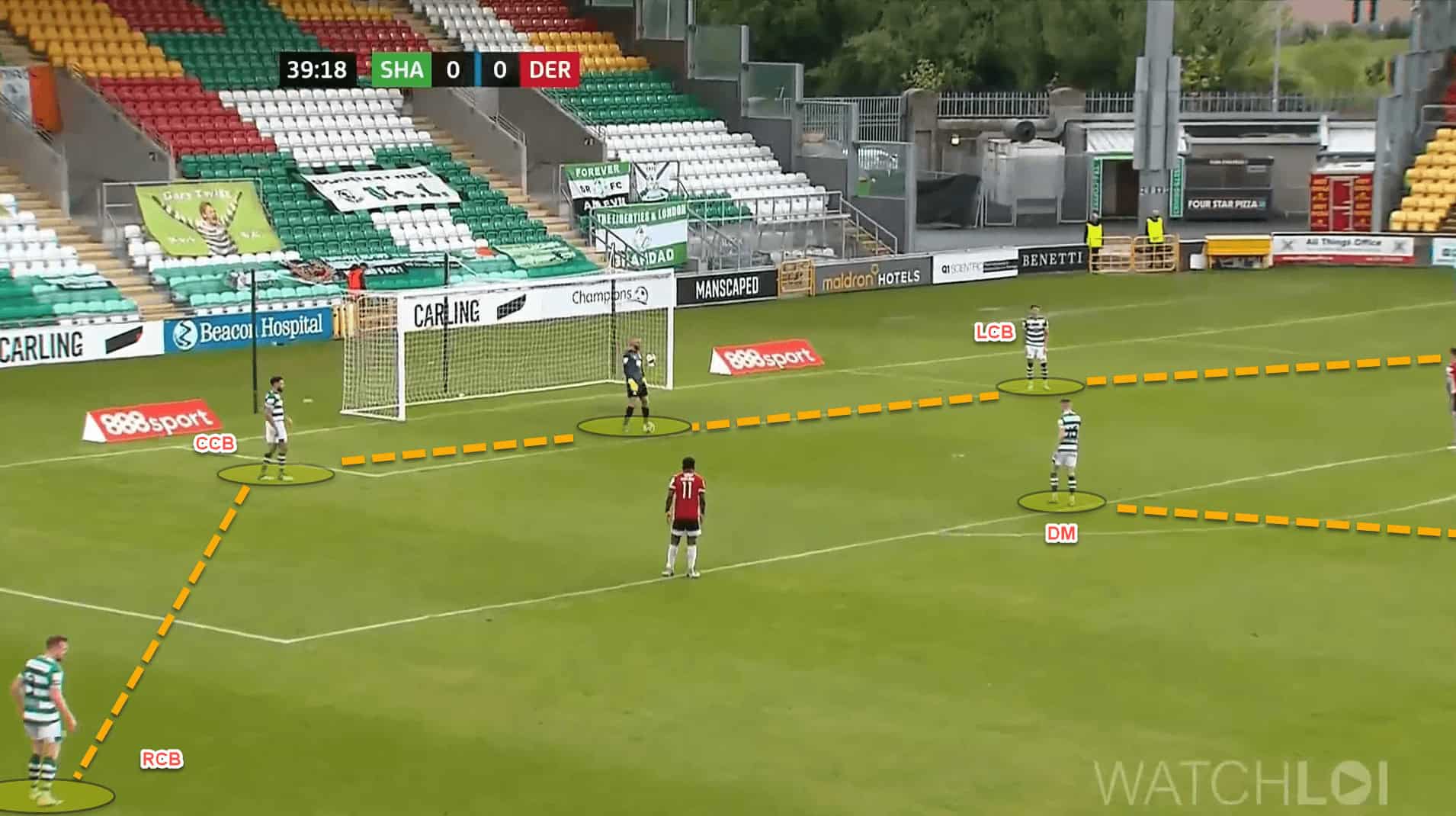
The centre-forward is tasked with positioning himself and to constantly make runs into the channel between the fullback and one of the centre-backs. By doing this, he is providing an option for Rovers to play long in behind if they are struggling to play out from the back.
The two wingers are used very similar to that of Lucien Favre’s inverted wingers at Borussia Dortmund. They drop deep during the build-up play if necessary and provide progressive passing options between the lines.

Here is an example of how Bradley set Shamrock Rovers up in the build-up phase in a recent match against Dundalk in the League of Ireland in full view. Rovers managed to progress from the build-up phase into the consolidation phase – the phase where the team has established possession in the middle third of the pitch – rather easily.
In this match, they managed to play 97 progressive passes, with a lot of these passes being from the build-up phase. 72 percent were accurate which is a success rate of 74.23 percent in total. The reason they found progression from the first third to the middle third rather seamlessly was that they almost always had numerical or qualitative superiority throughout the pitch against Dundalk’s 4-4-2 high press.
Numerical superiority means having more players in one area of the field than the other team whilst qualitative superiority is having a 1v1 situation where one player is better in terms of quality than the other.
Consolidation phase and breaking down the first line of pressure
When Shamrock Rovers bring the ball from the build-up phase into the consolidation phase of their attacks, their shape changes again. The last line switches from a back four into a back three with the right centre-back pushing across to join the other two central defenders. The three centre-backs space themselves out to cover the width of the pitch though with the wide centre-backs generally sitting in the halfspaces in possession.
The double-pivot maintains a similar principle to how they position themselves in higher areas of the pitch to where they are positioned in the build-up phase. As already mentioned, one tends to drop in front of the opposition’s first line of pressure whilst the other sits behind it.
This gives the centre-backs an option to use the player in front as a wall pass to circulate the ball and then eventually use the player behind the first line to break through the defensive team’s block.
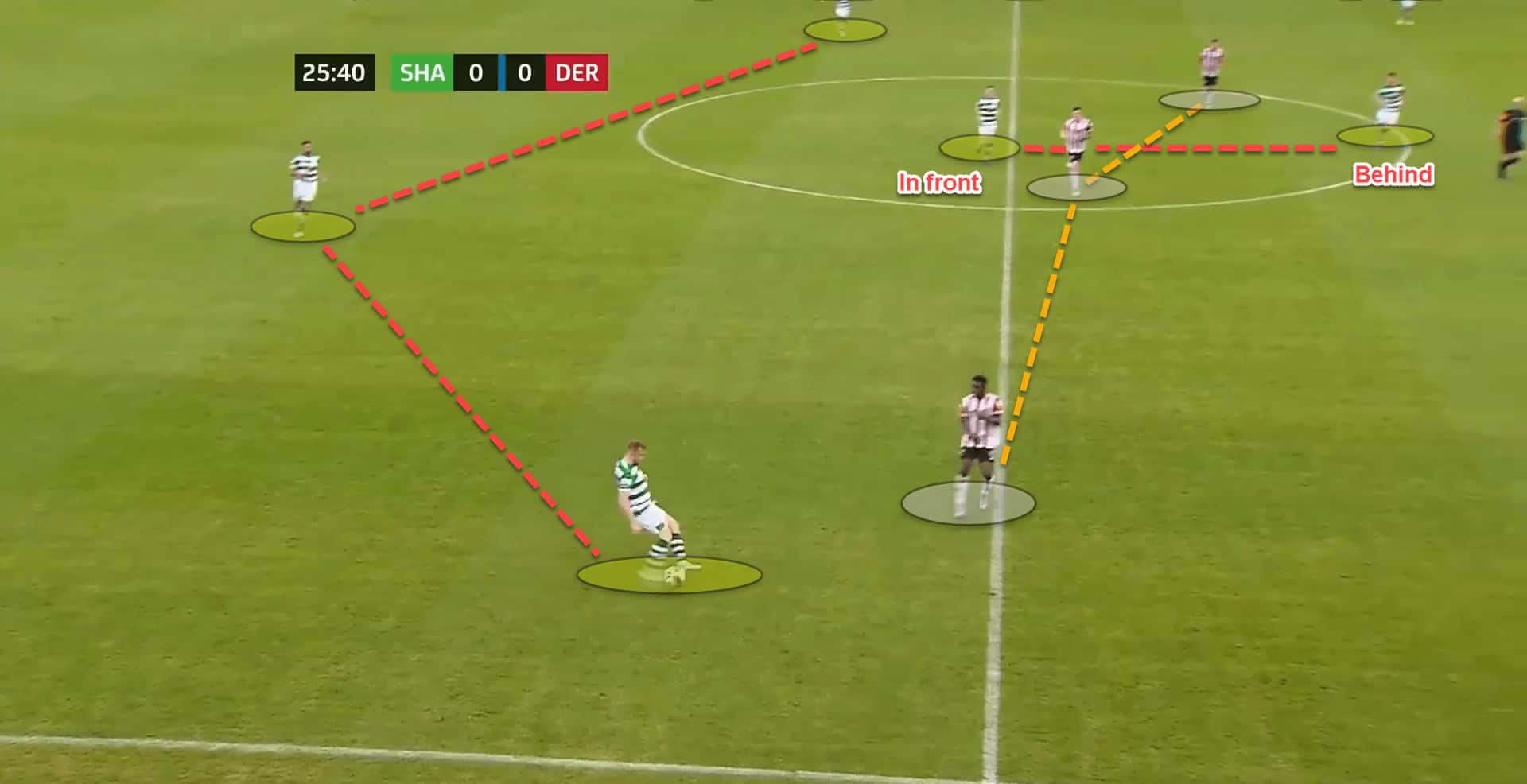
Having this set-up allows for clean progression in the central corridors. The reason for this is because when the ball is played to the player in front of the first line of opposition pressure, the ball-near defensive player will jump to press him. Rovers can then use the player in front as a bounce pass back to the centre-backs who then plays a pass to the free third man who is the pivot player sitting behind the first line.

This is an example of how Bradley set his side up in a recent game against Derry City when they had established possession in the middle third of the pitch against the away side’s deep defensive block. Having the double-pivot set up this way allows for clean progression to higher areas of the pitch providing the passing is done smoothly and with the correct weight and direction.
When the ball is played into the area behind the opposition’s forward line, it forces the midfield and forward line to squeeze to try and press the pivot player on the ball, preventing him from turning on it and playing forward. This can give Rovers an advantage too though if the player in this area can play a lateral pass to the players out wide quickly.

This allows the wingback to receive freely in space and Rovers can look to take the next step which would be to break down the opposition’s last line in order to create goalscoring opportunities.
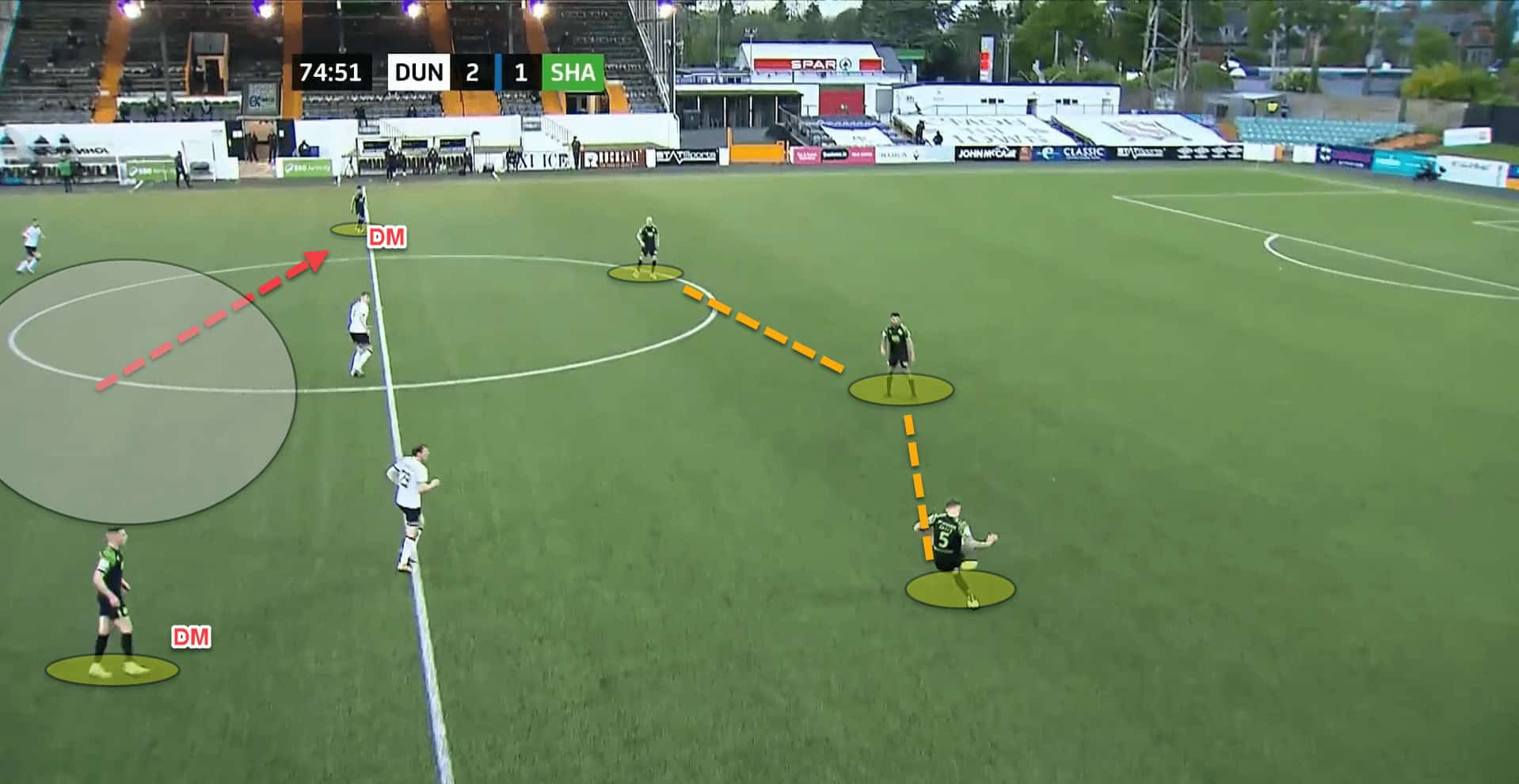
This is not the only way that Shamrock Rovers can play to these areas though. If they are struggling to break through the opposition’s first line of pressure, either wingback will drop to receive the ball off the backline, or else the pivot player behind the first line will vacate this space and move out wide to receive, almost as a brief auxiliary fullback.
Manchester City do this very well with players like Bernardo Silva, Ilkay Gundogan, and Kevin de Bruyne if they are struggling to get through the first line of pressure centrally and so instead of playing through, they play around.
Creating wide overloads and leaving a man over
When they do manage to get the ball into the wide areas, Shamrock Rovers like to create overloads with plenty of counter-movements. They use almost all of their ball-near players to do so in an attempt to drag across the opposition’s defensive block to one side of the pitch to defend against the overloads.
These wide overloads require a lot of positional rotations between the players, something that Rovers do quite well, in order to be unpredictable and difficult to defend against in possession. It also disorientates the defensive team’s block and creates space to pass into providing the players are not stagnant and are constantly moving.
Players occupy positions in the halfspaces and the flanks, trying to ensure that there is not more than two players on a vertical line which would end up being pointless.

Here, we can see an example of Shamrock Rovers overloading the flank with five players. Two players, the centre-forward and the pivot player sitting behind the ball-carrier are occupying positions in the halfspace whilst the Scales (left wingback), Finn (other pivot player), and Mandroiu (attacking midfielder) are positioned in the wide channel.
There are no more than two players per vertical line and one of the players is attacking the depth in behind to stretch the Derry backline vertically.
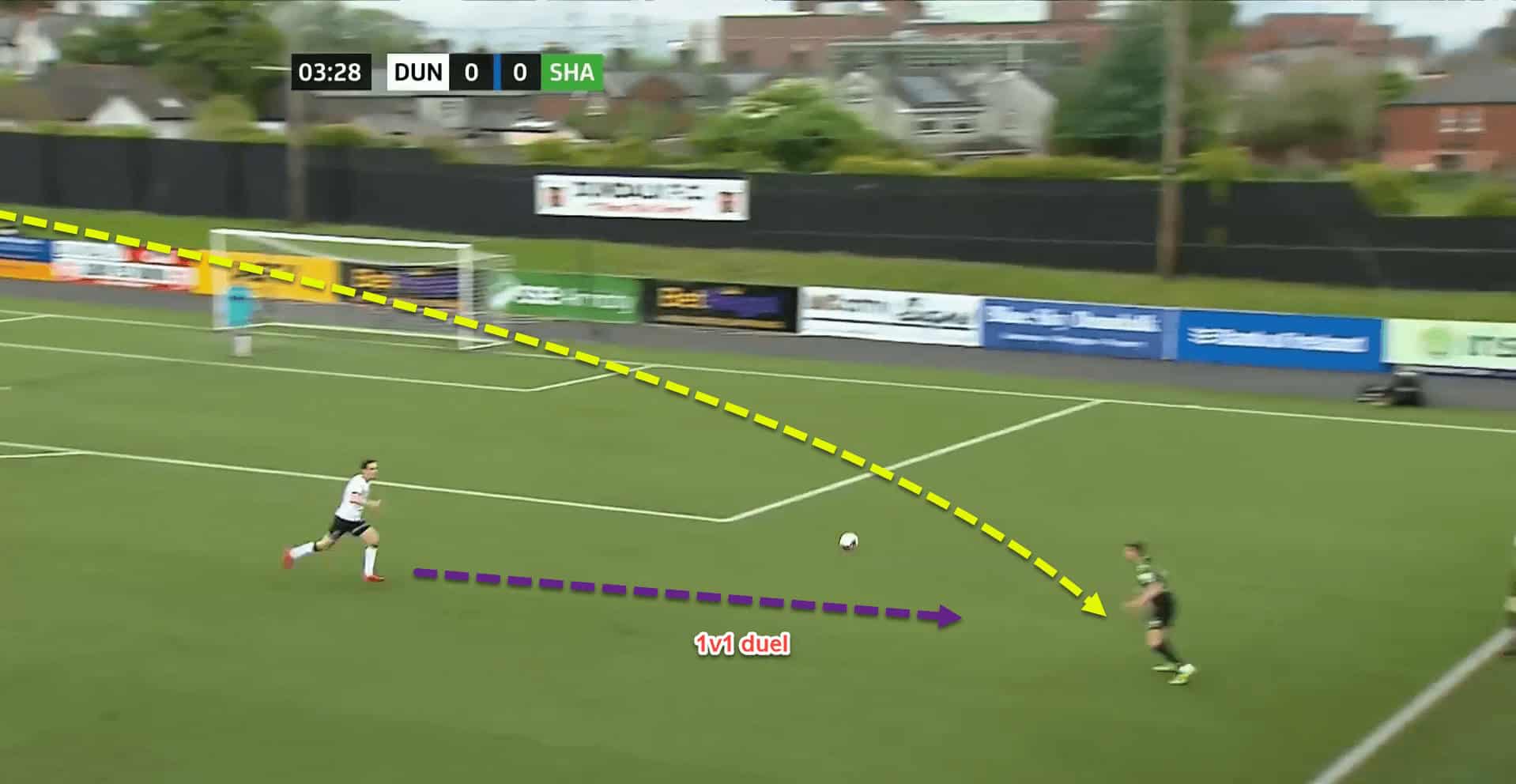
Creating wide overloads as such allows a team in possession to have numerical superiority and to penetrate the opposition’s backline, mainly using a free-man in possession. However, it also allows for a free-man to be open to receive on the far side of the pitch providing the ball-carrier can switch the play quickly. This process is called ‘Overloading to isolate.’
This means the team in possession overloads the flank to isolate the free-man on the far side in a 1v1 duel. Again, the aim here is to have qualitative superiority, as referenced earlier, meaning the player in possession in the 1v1 duel is better than his opponent.
Rovers mainly like to create wide overloads down the left flank.

Here is a data visual detailing the areas of the pitch Rovers played into during their 39 positional attacks during a recent game against Derry at Tallaght Stadium. 19 of these attacks came from the preferred left flank whilst 13 came from the right. Only 9 of the 39 positional attacks were through the centre.
What is interesting though about this data vis is that their most dangerous attacks came down the right by quite some margin. On the right side, they had an expected goals (xG) of 0.34 compared to the 0.08 on the left. The reason for this is because they overloaded the left flank constantly, quickly switched play to the right to the free-man who looked to use the qualitative superiority to put good crosses into the box before the opposition’s defensive block could shift across.

Now we can take a look at this in a real-time example from Rovers’ game against Dundalk. They created a wide overload to drag Dundalk’s defensive block across before quickly switching it to the free right wingback, Gannon, on the far side. It is always the wingbacks who are free due to the nature of the 3-4-2-1 and 3-4-1-2 formations.
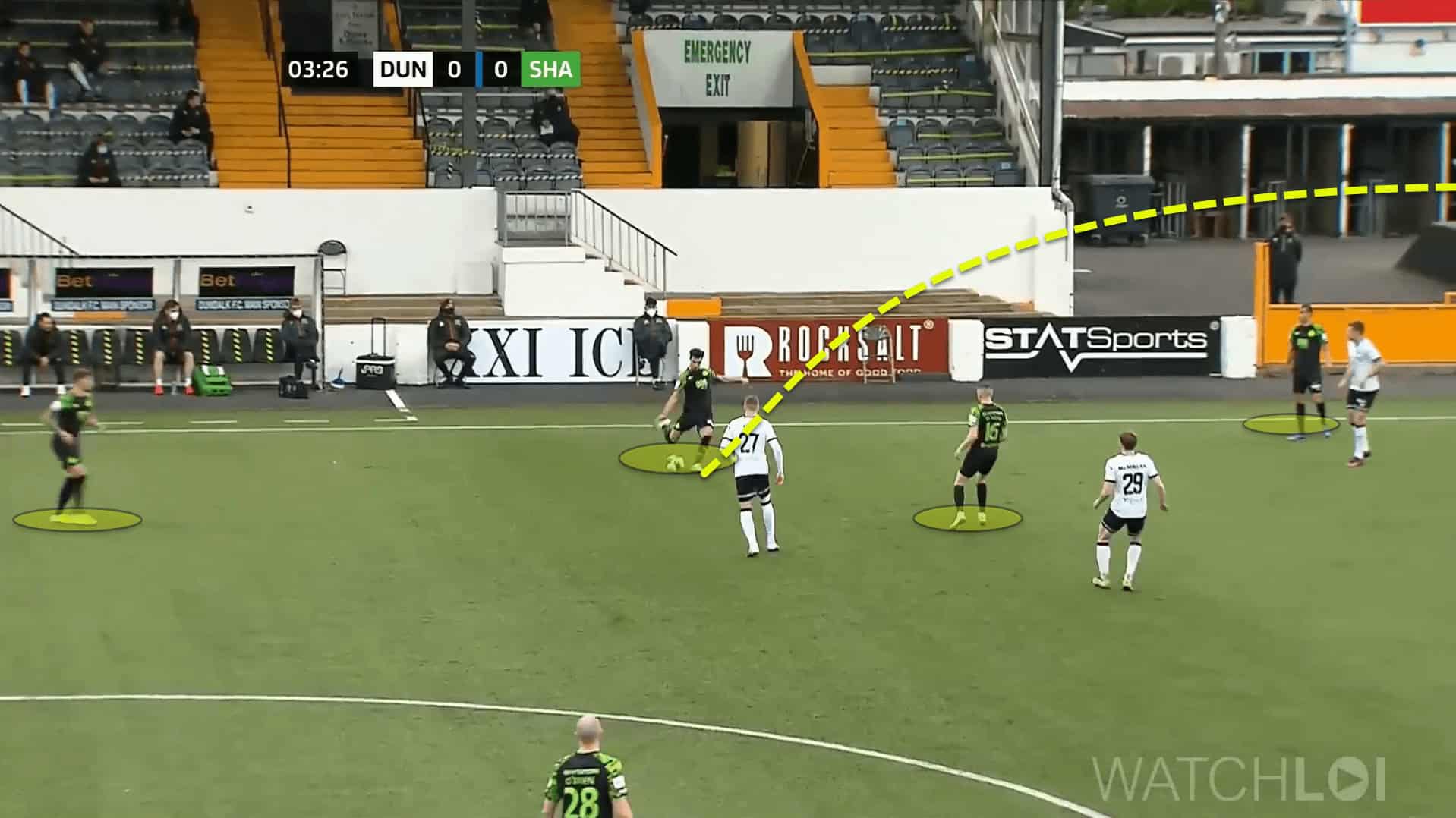
It must be noted also that Rovers are excellent at creating these overloads and qualitative superiorities but one of the main reasons why wide overloads are so efficient is because when they lose possession, they have plenty of bodies to counterpress and regain the ball high up the pitch.
Where are the goals coming from?
Rovers are the second-highest goalscoring side in the League of Ireland currently behind a revitalised Drogheda United. Most of their goals have come from inside the box, but they are not afraid to shoot from outside the area and have even scored 25 percent of their goals from outside the 18-yard box, the most in the division with 6.
The average goals scored outside the box in the league this season is 2.4 per team so Rovers are scoring 3.6 goals above the average from this area. One of these six goals was scored from the half-way line earlier in the season by Graham Burke and had an xG of just 0.01.

As can be seen from all of their shots taken this season, quite a high volume has been from outside the box. Their five goals outside the area have a combined xG of 0.17 according to InStat, an overperformance of 4.83 xG.
The issue with this is that these types of goals cannot be relied upon to score and they are taken in very low-value areas. Rovers have managed to score just four goals this season with an xG of over 0.2, meaning that 16 of their goals have had a value of 0.19 or below.
Also, they have taken just 19 shots in total this season which had an xG value of 0.2 or more.
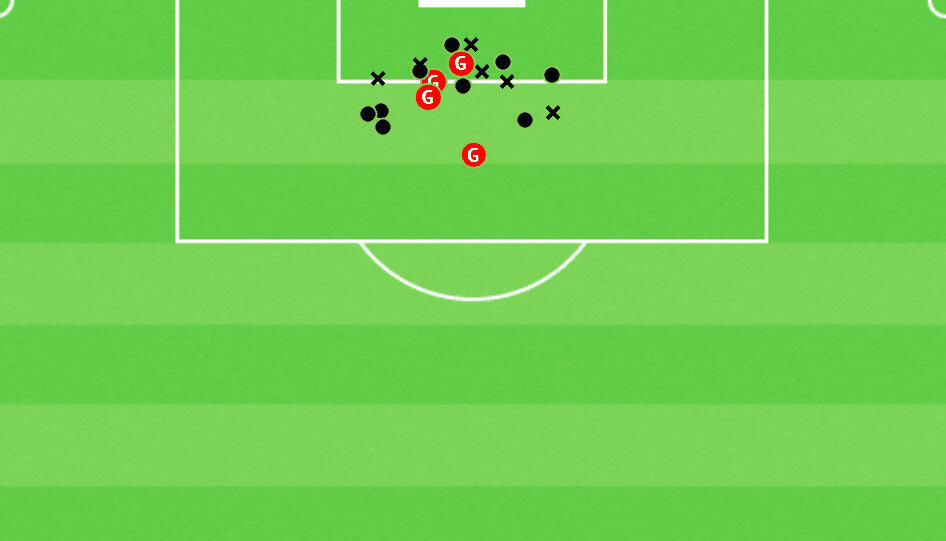
This has been quite sustainable for Rovers in the first trimester of the league season, but the worrying issue would be whether or not this is sustainable long-term. Bradley’s men need to try and create more opportunities in and around the six-yard box in high-value areas in order to give themselves the best possible opportunity to score.
Conclusion
The League of Ireland has often been degraded by the press and neutral watchers who claim that it is a league with little quality and teams don’t even try to play ‘modern’ and entertaining football.
However, Shamrock Rovers have hushed all these critics, showing the detractors that you can play a fantastic, possession-based style of football in the Republic of Ireland’s top-flight division, using adaptations from some of the world’s most influential coaches such as Manchester City boss Pep Guardiola.
The main issue for them is that they currently have the oldest squad in the league with an average age of 28.2 within the first-team squad so a major overhaul may be needed in the near future, similar to the type of transitional phase Dundalk are going through currently.
Nonetheless, everyone should enjoy them while they are still on top and it looks likely that, unless they suffer a drastic shortfall of form, Stephen Bradley’s Shamrock Rovers are well on their way to secure the League of Ireland title against this season.
