
Portland Timbers entered the recent international break off the back of three consecutive defeats, leaving them languishing in 12th place in the Western Conference. After a 7-2 victory at home against Sporting KC, hopes were raised for a turnaround to get the Timbers back on track for a play-offs finish. But this win was followed by unimpressive defeats against Philadelphia Union, San Jose Earthquakes and Inter Miami, with the latter two rivalling the Timbers towards the bottom of the overall MLS table.
This season’s performances are a far cry from the results that took the Timbers to a penalty shootout win away from being MLS Cup winners. Since joining in 2017, head coach Giovanni Savarese has secured their position in the top six of the Western Conference to qualify for the playoffs in each season of his tenure so far. However, alongside injuries and departures, this season’s form looks to have hindered the Timbers’ hopes of battling for success again.
In this tactical analysis in the form of a team scout report, we will discuss Savarese’s tactics that have led to a drop from MLS Cup finalists to 24th in the 28-team MLS league table.
In possession
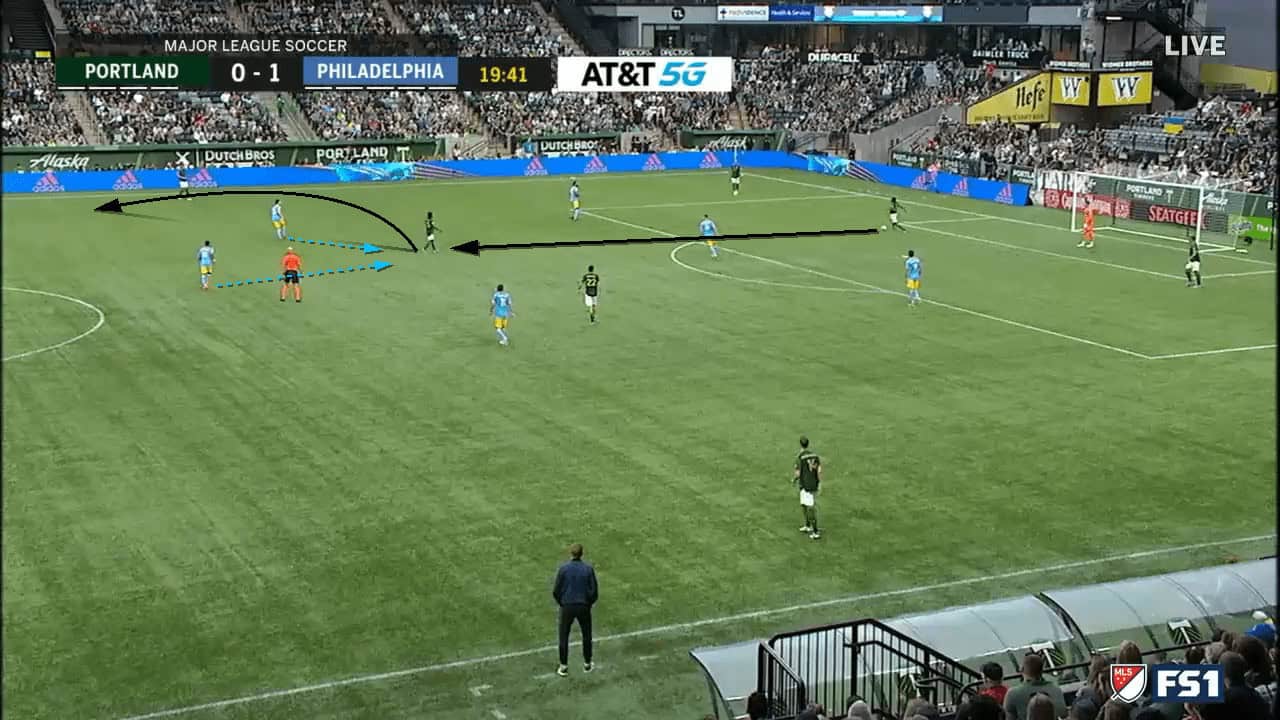
From goal-kicks, Portland Timbers’ build-up is usually short. The two centre-backs will consistently be short passing options inside the box, but the Timbers pivot player will also occasionally drop to the six-yard box to receive off the goalkeeper. This is shown in the figure below, with holding midfielder Diego Chará dropping alongside the centre-backs and goalkeeper to create a 4vs3 against Philadelphia Union’s pressing front three.
Diego Chará’s movement consequently pushes the full-backs besides the two central midfielders, forming another 4vs3 overload in midfield. With the Timbers full-backs holding width, their front three can remain narrower, positioned closer to combine to retain possession or collect second balls to regain possession.

One of their biggest departures in the transfer window was last season’s starting goalkeeper Steve Clark, who joined Houston Dynamo. Clark’s replacement has been Slovenian Aljaž Ivačič. This is Ivačič’s first season as the starting goalkeeper, since joining from Olimpija Ljubljana three seasons ago. Out of the 31 goalkeepers to have played over 500 minutes in the MLS so far this season, Ivačič ranks 25th for average pass length, showing his tendency to play short. His 5.63 forward passes per 90 are the lowest in the league, as well as his below-average passing accuracy, indicating his minimal influence on the Timbers’ ball progression in the build-up phase.
In the example below, the Timbers are able to exploit Philadelphia Union’s midfield with the use of their overload. As Diego Chará receives the short goal kick, right centre-back Dario Župarić, formerly of Pescara in Serie A, widens his positioning to stretch the Union front three. This enlarges the space between the left-sided and central player in the front three, creating the passing lane into Yimmi Chará. Yimmi Chará’s movement to receive has drawn out two Philadelphia Union midfielders, leaving right back Josecarlos van Rankin as the free man able to receive Y.Chará’s pass. The Timbers’ full-backs are heavily involved in attacking play, looking to access the forwards and offering movement into the final third.
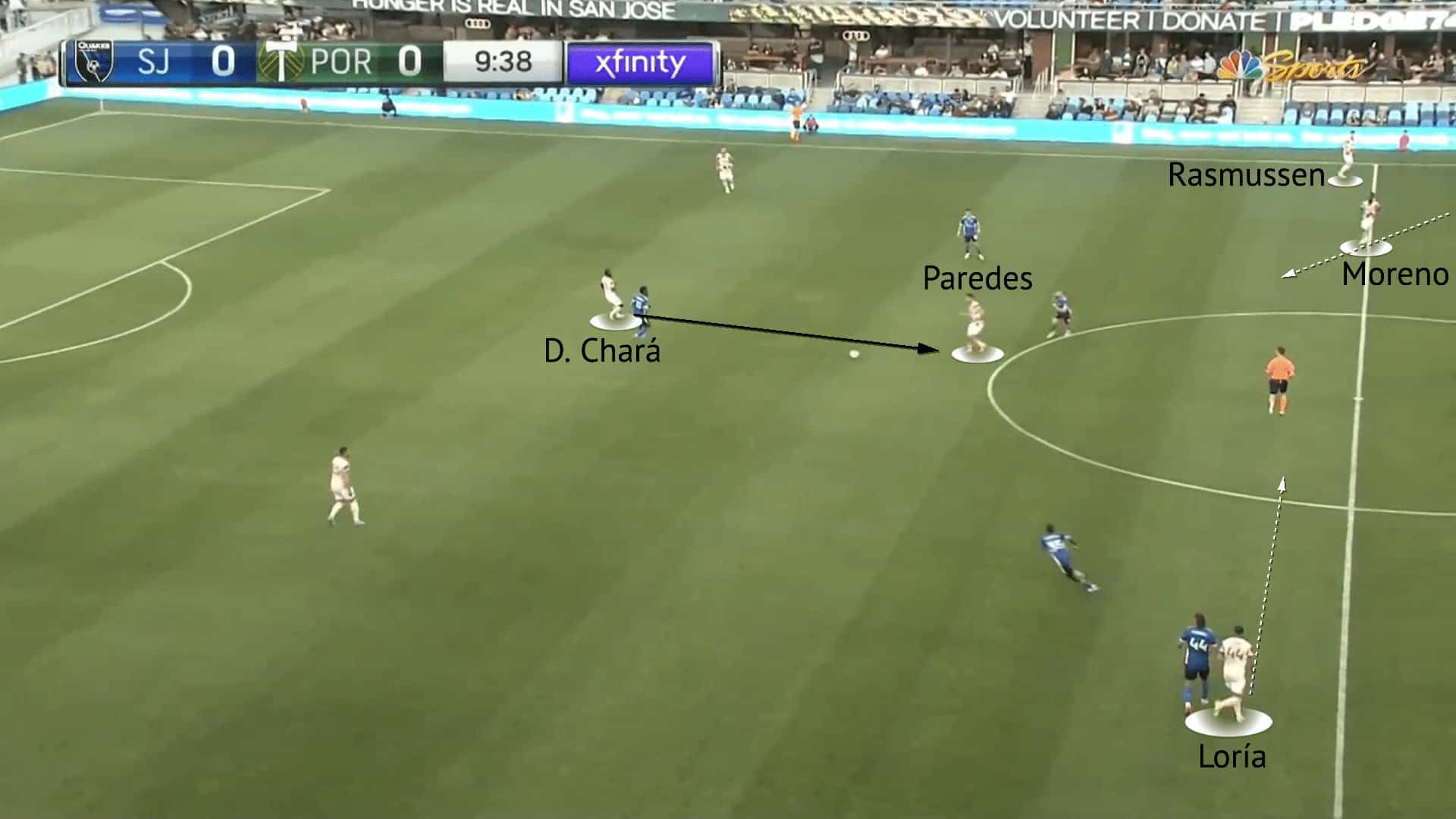
However, Savarese’s side don’t just create a makeshift back three from goal kicks, they also create the shape higher up the pitch. In the image below, we can see Diego Chará splitting the two centre-backs to make a back three as the Timbers look to progress the ball out of the build-up phase. This is a strategy Savarese regularly uses to aid progression, with Chará sometimes making a three as the left centre-back rather than central. With Diego Chará positioned in the defence, central midfielder Christian Paredes has moved back to occupy the pivot space. This movement has congested the space for the Timbers to progress, curtailing D.Chará’s passing. The experienced Colombian ranks 30th out of 98 MLS central midfielders to play 500 minutes for progressive passes per 90, but ranks very well for the accuracy of his progressive passes and passes into the final third. The image also shows the full-backs width facilitating inverting movements from the Timbers wingers.
Despite the comments above on Paredes’ movement, the occupancy of the pivot space is crucial for progression. The movement can draw out opposition to disrupt their shape and the player in the space can circulate possession, or play forwards after receiving on the half-turn.
Youngster David Ayala, a new signing from Argentina’s Estudiantes, similarly splits the two centre-backs when deployed as the holding midfielder in Savarese’s 4-3-3. Ayala has struggled for minutes since arriving but was one of Portland Timbers’ strongest performers in their recent game against Inter Miami before his substitution. This comes after his first full 90 minutes for the Timbers, against LAFC in the US Open Cup defeat. Ayala played a bit more of an advanced role as a central midfielder, rather than the holding midfielder, and displayed excellent weight of pass with the tenacity required for a player of his small stature. Ayala will only get better with game time, and alongside the potential improvements in ball retention and progression with him being trusted to start, his time in Portland becoming a success will definitely bring some interest from Europe.
Although the holding midfielder does sometimes drop into the defence, the Portland Timbers centre-backs are also capable of progressing possession. Bill Poni Tuiloma ranks 9th out of 88 centre-backs to play 500 minutes for average pass length, with the New Zealander looking to play more direct. The former PSG and Plymouth Argyle defender Larrys Mabiala was regularly seen at centre-back for the Timbers last season but has struggled with fitness this season and is progressive in possession, another potential factor to this season’s results. Župarić is comparatively safer in possession, attempting fewer progressive passes but ranking 2nd out of 88 centre-backs for forward passing accuracy.
The figures above and below show the advanced positioning of the full-backs. As mentioned earlier in the analysis, the movement of the full-backs is regularly used in the Timbers attacks. The full-backs are rarely depended on under pressure in the defensive third, as shown earlier with them receiving as the spare man in the overload. This is another area where Savarese’s side has been hit with injuries.
Argentine left-back Claudio Bravo was a standout performer for the Timbers last season, playing every minute in their MLS Cup play-offs, and has played every minute when available this season. However, he hadn’t featured for the Timbers since April, due to injury, until Saturday’s 1-1 draw at LA Galaxy. Bravo is a very good MLS full-back, ranking 12th for passes into the final third per 90 out of 110 full-backs to play over 500 minutes in the MLS last season.
His replacement this season has been Justin Rasmussen. At 23 years old, Rasmussen is playing his first season of senior professional football, joining the Timbers in the 2022 MLS SuperDraft after playing four seasons of college soccer with the Grand Canyon Antelopes. Out of 74 MLS full-backs to play 500 minutes this season, Rasmussen ranks 72nd for forward passing accuracy. This drop-off from Bravo is significantly affecting the Timbers’ ability to progress possession into threatening positions and has resulted in the lack of reliance on the full-backs on the ball in their own half.
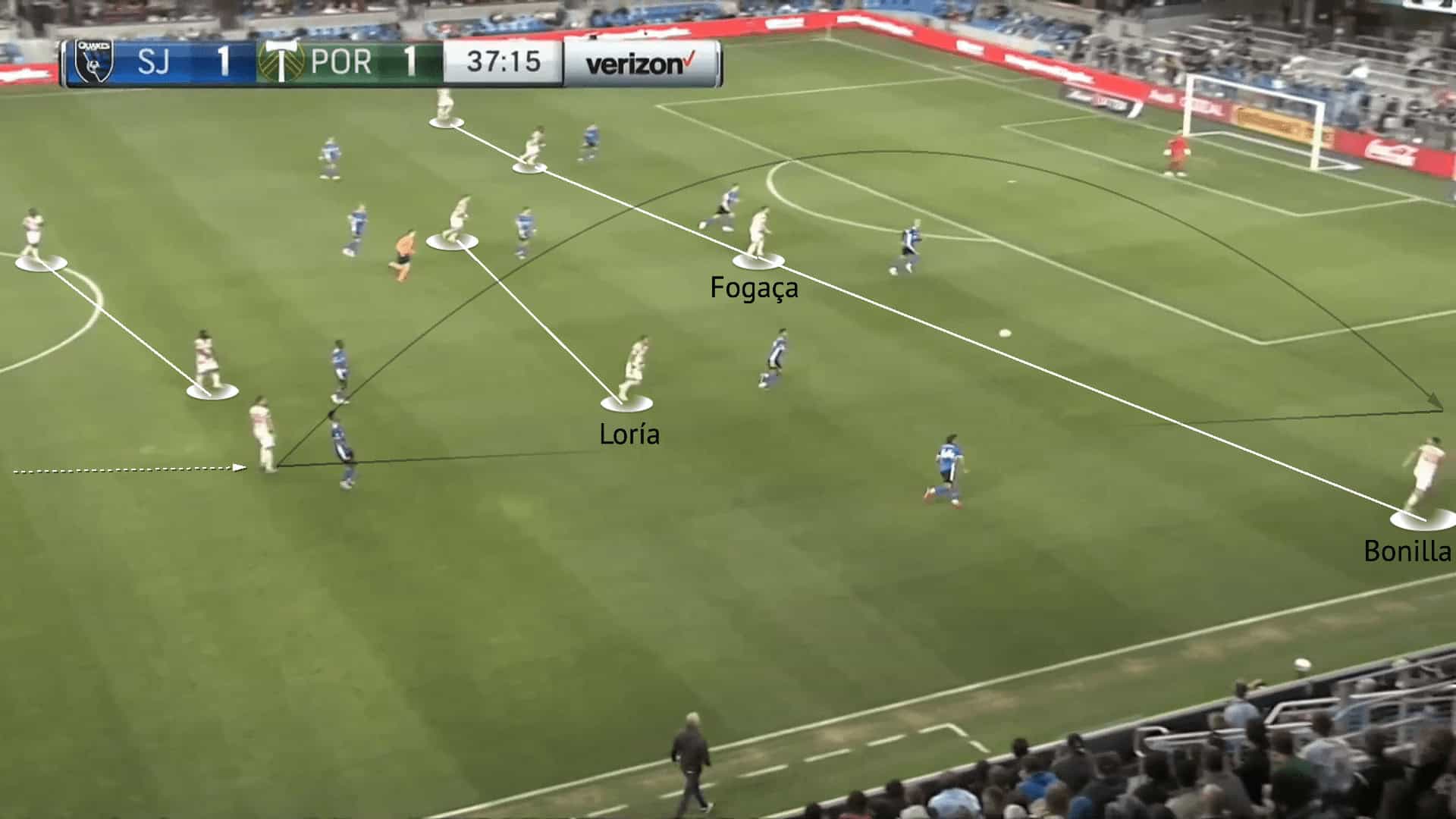
The image above shows Portland Timbers in a 2-2-2-4 shape, with Tuiloma stepping out of the defence and playing a lofted pass for right-back Pablo Bonilla, after winger Marvin Loría inverted. On the opposite wing, Rasmussen is also in the front line with winger Santiago Moreno inside.
The Timbers have really struggled this season due to injuries to attacking players, alongside the departure of club legend attacking midfielder Diego Váleri. Last season’s top scorer Felipe Mora has only recently returned to training, coming on for the last five minutes at LA Galaxy. Designated player Jarosław Niezgoda has struggled since his transfer and is recovering from injury, with Jeremy Ebobisse now the MLS top scorer at San Jose Earthquakes after leaving Portland Timbers and being misused as a left-winger. But one of their biggest misses this season is Sebastián Blanco.
The Argentine attacking midfielder has only started 33% of the Timbers matches this season, battling fitness issues. So far this season, out of 115 attackers to play over 400 MLS minutes this season, Blanco ranks 2nd for passes into the penalty area per 90 with 6.26 whilst ranking 5th for progressive passes per 90. Blanco also ranks 2nd in the entire MLS for crosses per 90, just behind New England Revolution’s Brandon Bye. When Blanco is available, he is at the heart of all attacks for Portland Timbers. However, this may not be good news for the Timbers. Despite ranking highly, Blanco’s accuracy for passes into the penalty area and crossing accuracy of 20% is significantly below league average.

Recently, Portland Timbers have looked most threatening from open-play has been when attacking play has been shared with quick combinations. Due to injuries, striker Nathan Fogaça wouldn’t have been expecting to start so much, but the Brazilian is effective at facilitating these combinations. In the figure above, receiving the forward pass from van Rankin with his back to goal, Nathan Fogaça executes a first-time back-heel flick into the path of Yimmi Chará, giving the Colombian dynamic superiority as he runs at the Inter Miami defence. Nathan has completed 100% of his backwards passes so far this season, displaying his ability to retain possession and find teammates, which is crucial when often receiving with little support and his back to goal.
Colombian winger Santiago Moreno has also shown promise this season, ranking 5th out of 119 wingers for completed dribbles per 90, whilst also offering end product. With Felipe Mora soon to be fit, Moreno’s output is set to improve further, giving Savarese more and better options to improve the Timbers attack for the rest of the season.
Attacking set-pieces
Portland Timbers normally deliver outswinging corners into the front zone. Predominantly, their corner takers are left-footed Marvin Loría, right-footed Eryk Williamson, and right-footed Sebastián Blanco. It is common for the Timbers to have four players (at least three) around the penalty spot, who then disperse into different areas. With most corners being delivered into the front zone, usually, two of the four players will dart towards the front zone and near post. The other two look to move into the middle zone or towards the back post, depending on where other attackers are positioned.
In the example below, the Timbers have the four players near the penalty spot, with Blanco in the middle zone and Nathan Fogaça and Moreno in the front zone. Mabiala and Tuiloma attacked the front zone, with Ayala moving more towards the uncovered back post. The main targets from corners are the players who start their run near the penalty spot, running onto deliveries that just beat the first man. These are usually the centre-backs, with Tuiloma currently the Timbers’ top scorer this season.
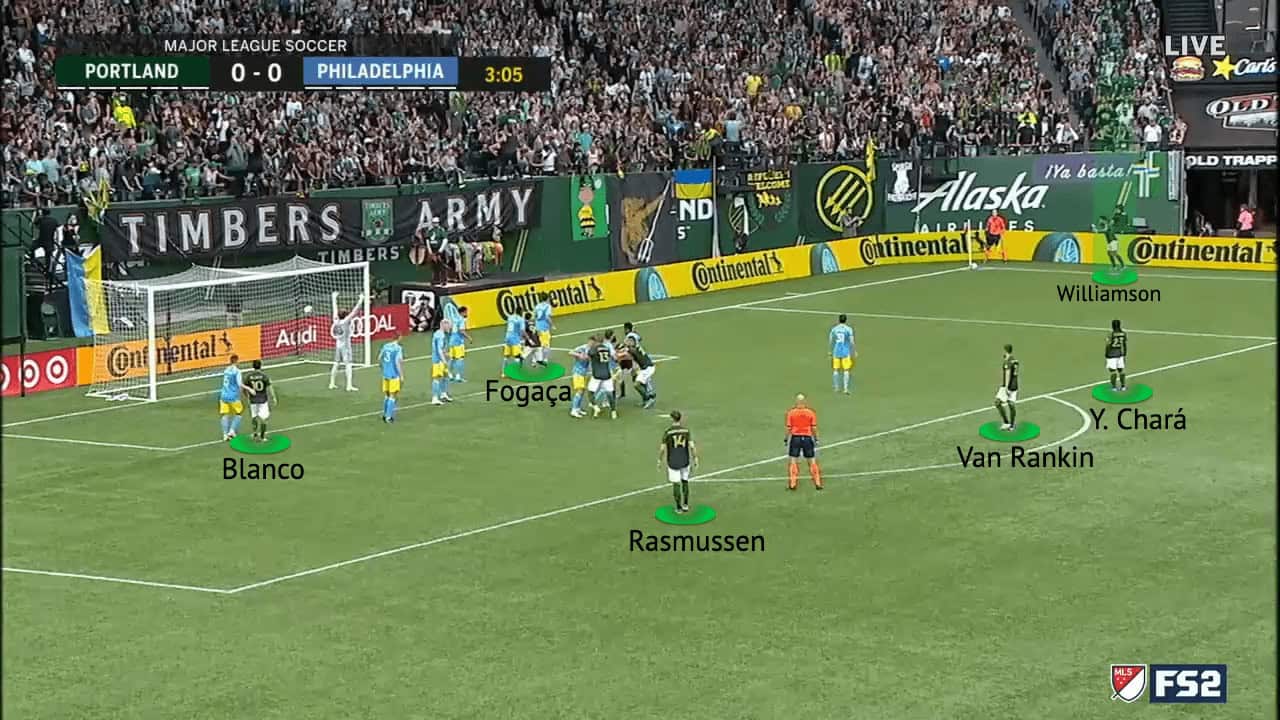
The example below is the Timbers’ most common corner set-up, used when games are level and tighter. With Williamson taking the outswinging corner, the Timbers have players occupy both the dangerous front zone and the back post in Nathan Fogaça and Blanco. Savarese has set up with three players near the penalty spot with another three on the edge of the box. The three on the edge of the box will look to defensively recover clearances and prevent counterattacks, while offensively attempting to shoot on goal in the second phase.
Out of possession
Savarese’s Portland Timbers have never been the type of team to have lots of possession. Every season under the Venezuelan head coach the team has averaged less than 50% of possession, with the Timbers ranking bottom in the MLS last season with an average of 45.5% possession. With the Timbers rarely having the share of possession, they require an organised and effective defensive structure, something they don’t have recently.
The Timbers have conceded the 5th most shots in the MLS, a statistic that should not be paired with a team that was MLS Cup finalists last season. As a result, the new starting goalkeeper Aljaž Ivačič has faced the 4th most xG against per 90 out of the 31 MLS goalkeepers to have played over 500 minutes. Ivačič’s season so far has been decent when considering his lack of game time over the last few years. Out of the 31 goalkeepers, he ranks 6th for goals prevented but his save rate of 66.2% ranks him 19th.
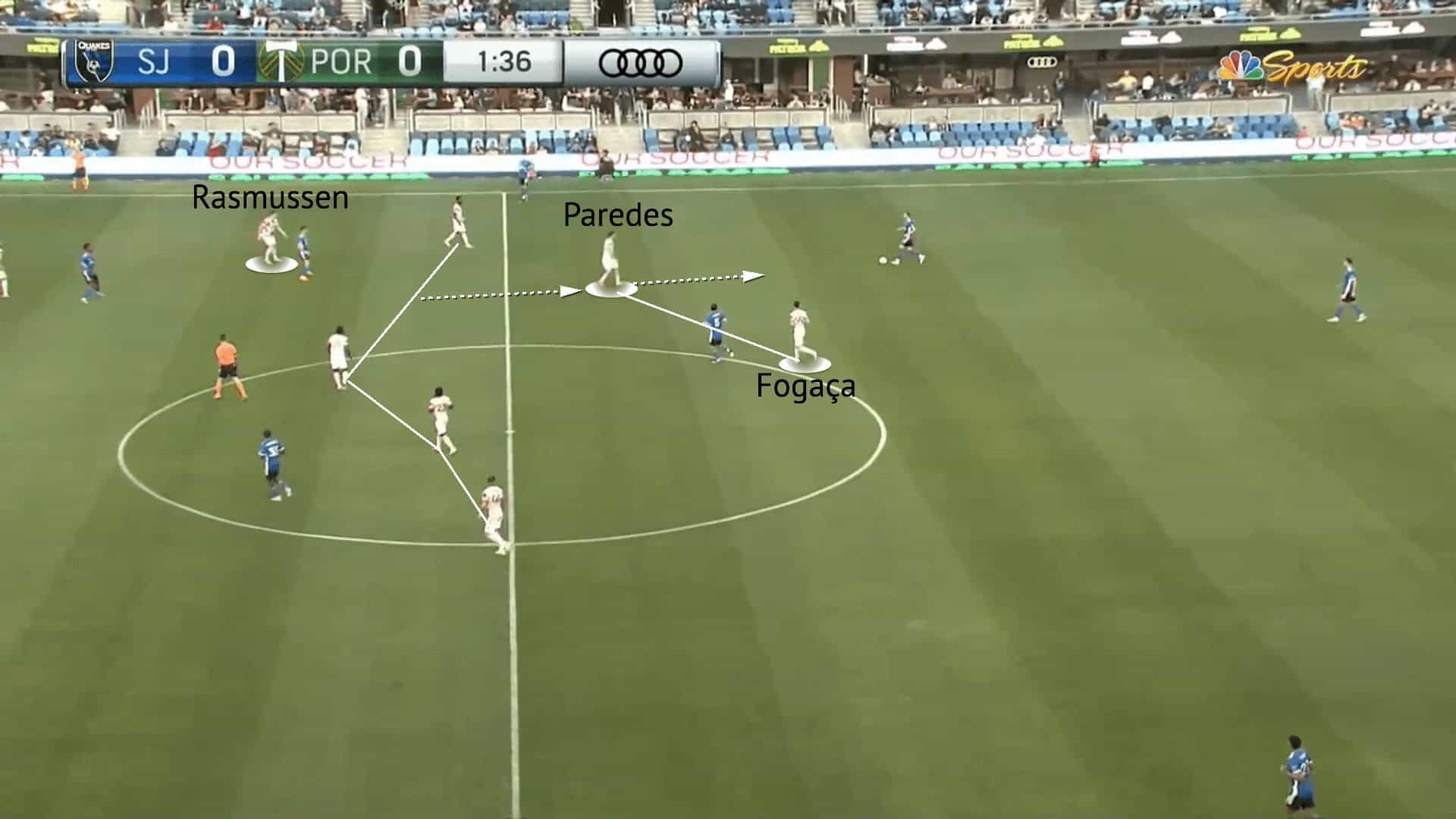
Out of possession, the Timbers usually shape in a 4-5-1, with one of the central midfielders occasionally going out to press alongside the striker to make a 4-4-2. The central midfielders press is more reactive, closing down the opponent after they have turned with possession to face forwards. In the figure above, Paredes doesn’t follow the San Jose Earthquakes midfielder that has dropped to receive but moves out to press once the midfielder has received possession. With San Jose’s winger drifting inside into Paredes’ cover shadow and being followed by Rasmussen, whilst Moreno is close to the full-back, the play has been forced backwards and circulated to the other wing.
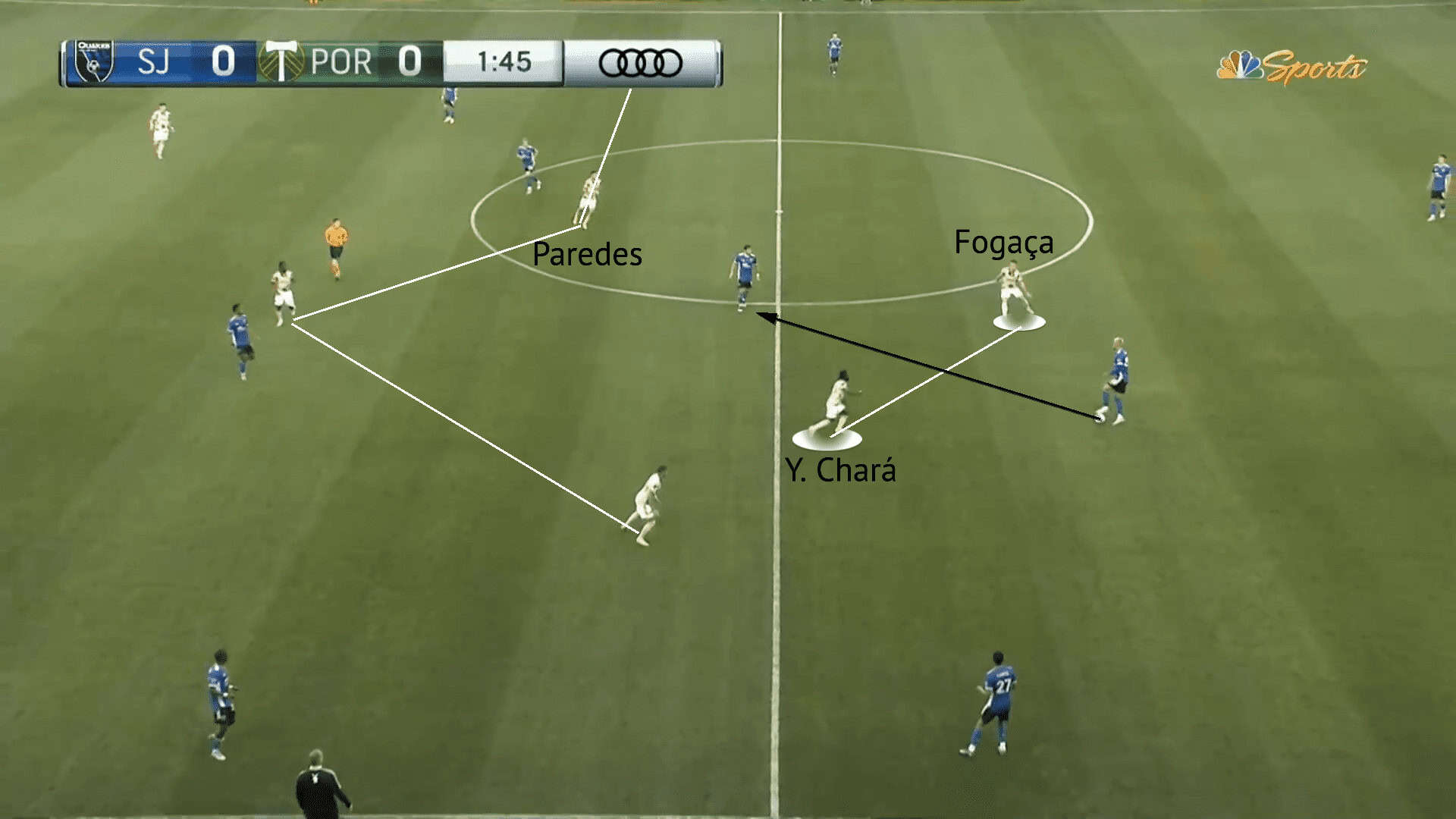
As play switches to the left centre-back, Yimmi Chará presses out with Paredes dropping back into the double pivot alongside Diego Chará to keep the shape. However, Y.Chará and Nathan Fogaça allow left centre-back, Francisco Calvo, to play a simple pass into pivot player Eric Remedi, due to a combination of poor pressing angles and intensity. In the recent 1-1 draw against LA Galaxy, Savarese lined his team up in a 4-2-3-1 with Paredes and D.Chará in the double pivot. This formation allowed the Timbers to consistently have a clear 4-4-2 shape out of possession, with the wingers dropping back and attacking midfielder Blanco positioned around striker Niezgoda.
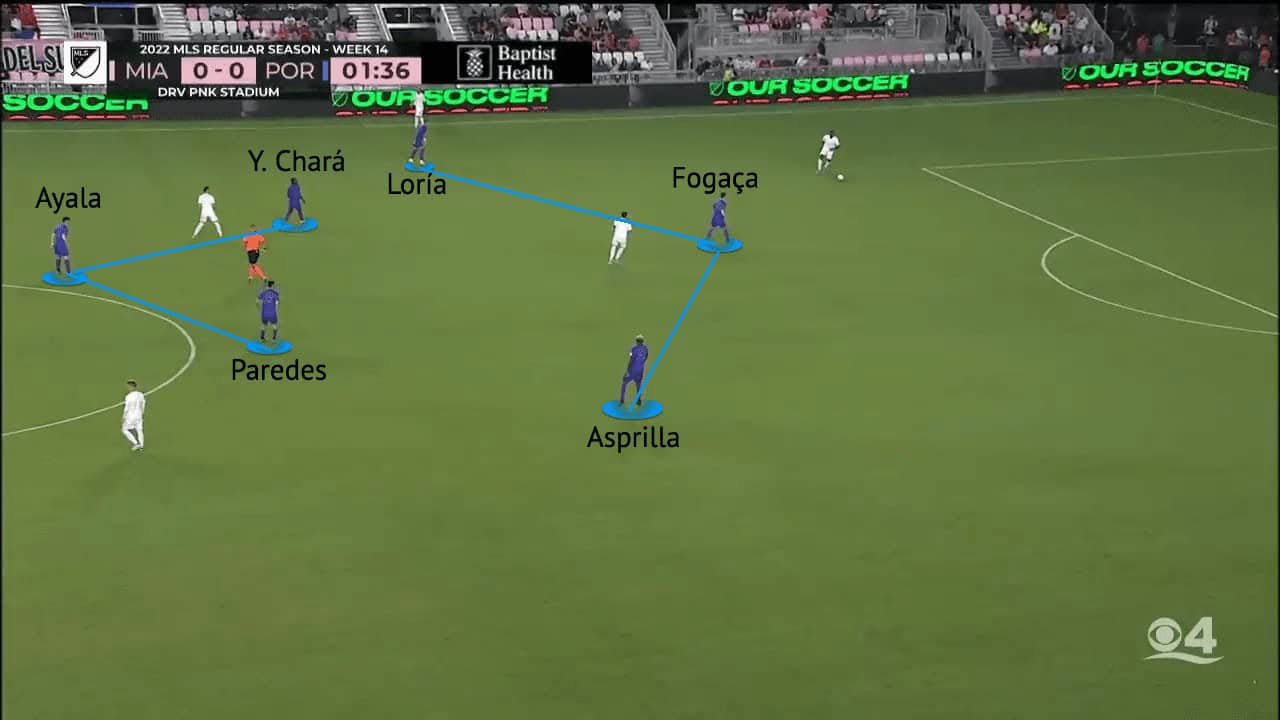
The figure above shows a peculiar strategy that Savarese can employ when the opposition are in the widest channel during the build-up phase. As shown in the example against Inter Miami, the Timbers midfield and attack are all positioned in the left half of the Inter Miami half, as right winger Dairon Asprilla has come into a central area. This compact shape prevents Inter Miami central progression, forcing either a long ball forwards or a lateral/backwards pass to then build out the other wing. This is a brave strategy from Savarese, leaving the opposite wing exposed and giving the opposition a high-risk, high-reward opportunity if they look to play a direct switch of play.
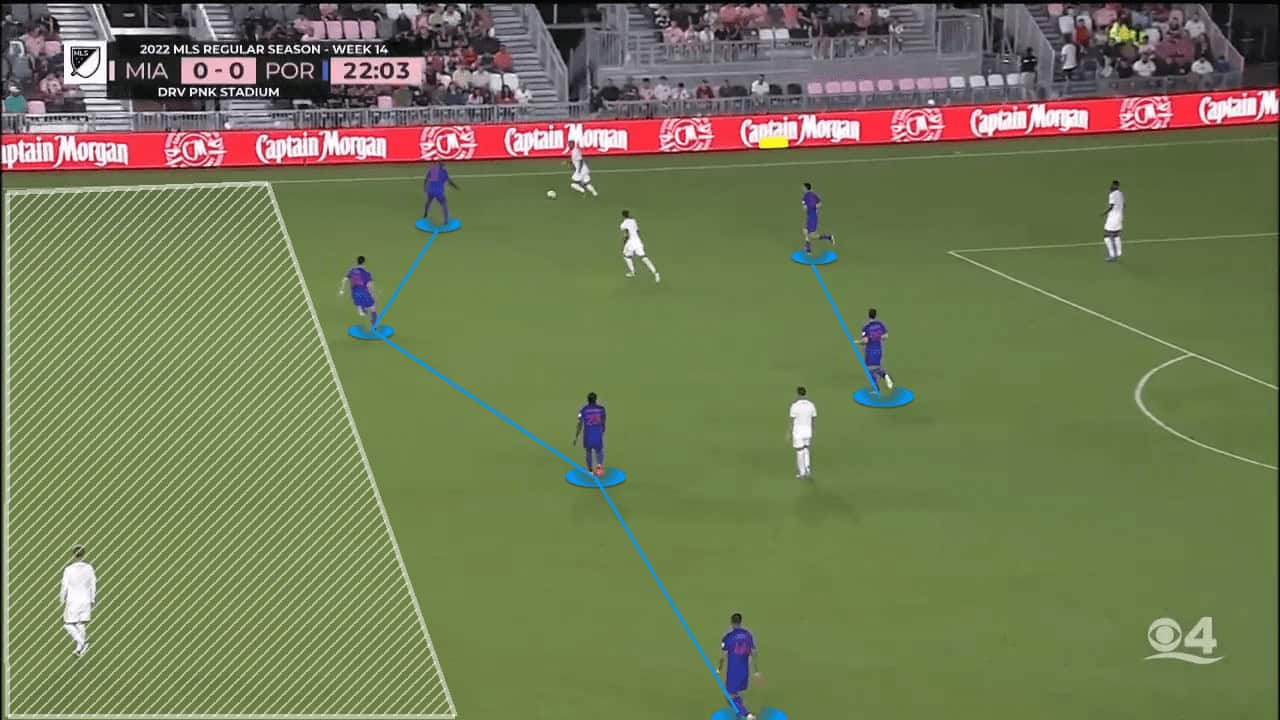
This more ball-oriented out-of-possession approach to opposition build-up can also leave areas exposed and spaces unoccupied elsewhere. In the example above, the Timbers’ two most advanced players prevent the Inter Miami right centre-back from passing into his teammates in their double pivot. With Paredes joining Nathan Fogaça in the front line, pivot player Ayala decides to vacate his position to join Yimmi Chará in the 4-4-2. This has significantly increased the space between the lines, exposing the Timbers defensive unit, as Asprilla allows the right back to receive and play forwards with ease. The Timbers often over-commit when attempting to regain possession in the opposition’s defensive third.
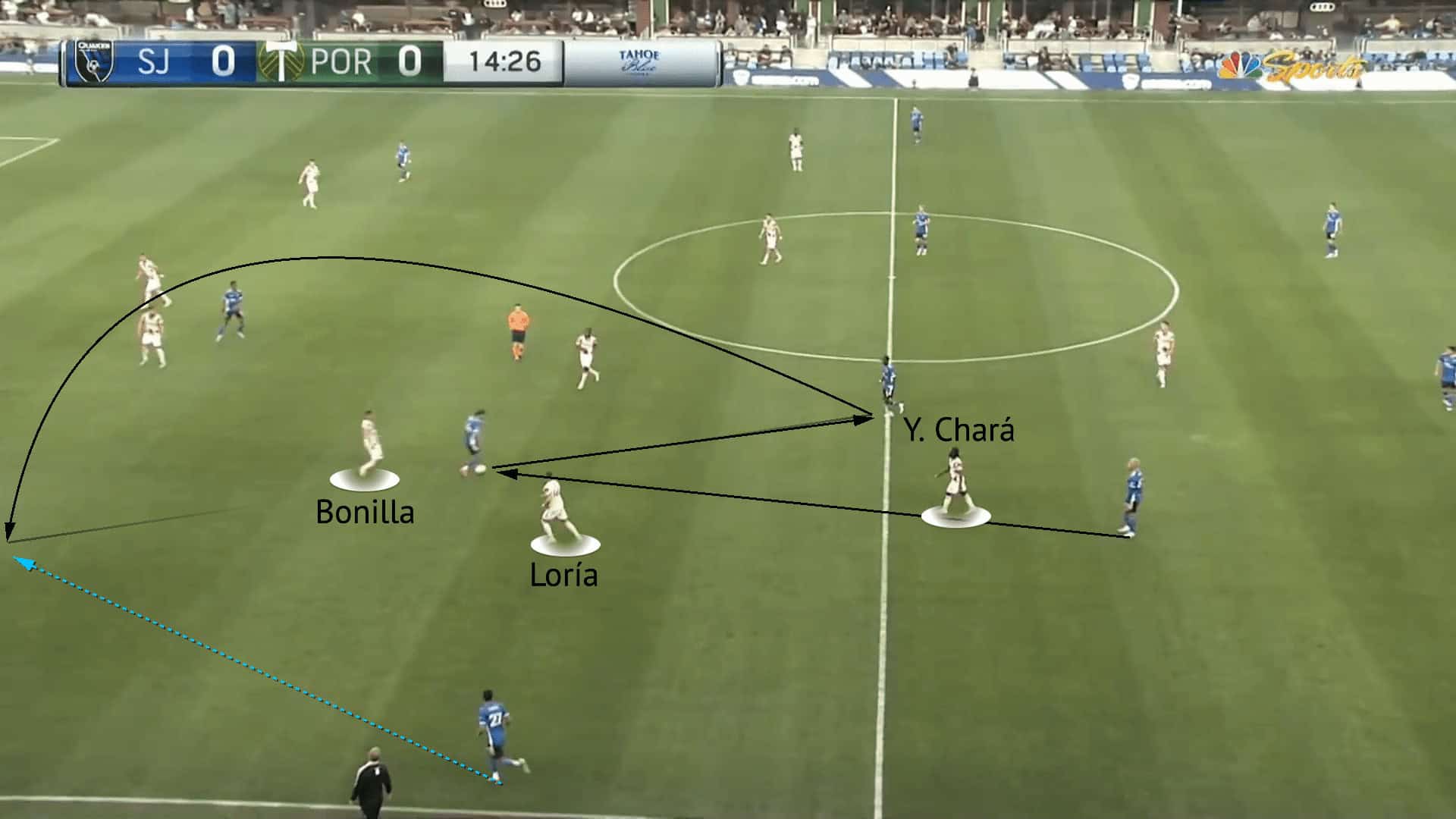
Portland Timbers are most threatened by opposition off the ball movement. The Timbers midfield consistently has lapses of concentration, with a lack of scanning and unsettled shape out of possession contributing to the effectiveness of the off-the-ball movement. This allows the opposition to run off the back of Timbers midfielders to receive between the lines. Diego Chará, often at the base of the midfield with play ahead of him, ranks 13th out of 98 central midfielders for PAdj interceptions and is really the only Timbers midfielder with strong defensive numbers.
This movement can also perturb the Timbers’ defensive line due to the man-marking approach, as shown above. Yimmi Chará has left the 4-5-1 to press San Jose’s Calvo, but his poor attempt allows the centre-back to pass up to winger Cade Cowell. Bonilla allows Cowell to receive and take multiple touches without engaging, despite man-marking him, before laying the ball off to Jamiro Monteiro. Monteiro executes a lofted pass in behind Bonilla for Marcos Lopez, after the left-back ghosted behind the unaware Loría, to complete the up-back-through combination.

The figure above is another example of Portland Timbers’ poor defensive work. Loría doesn’t engage with the Inter Miami player or cut the passing lane into attacking midfielder Bryce Duke. After the pass is made, Loría leaves his man, allowing him to run off his back with van Rankin still marking the winger. Yimmi Chará and Mabiala also leave Duke unpressured, with the midfielder able to turn and loft a ball in behind the defence. These defensive errors collectively bring more fouls, with the Timbers ranked 4th in the league for fouls, and first for red cards and yellow cards.
Defending set-pieces
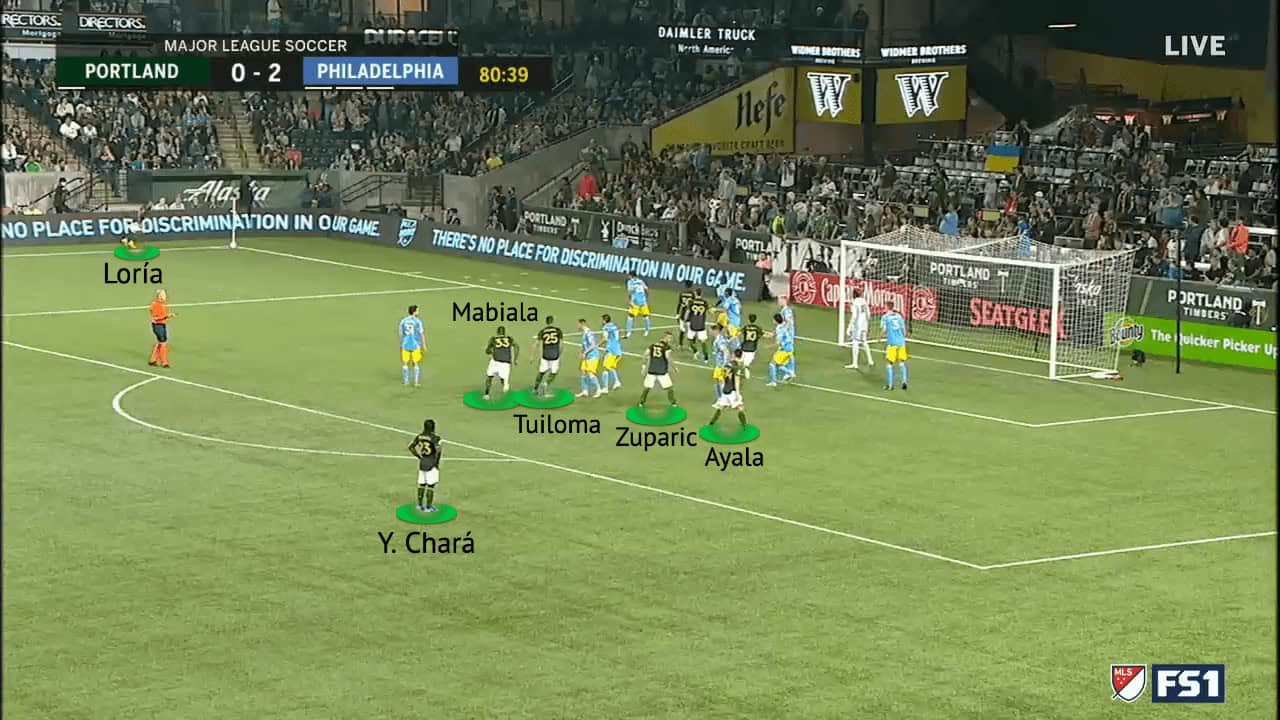
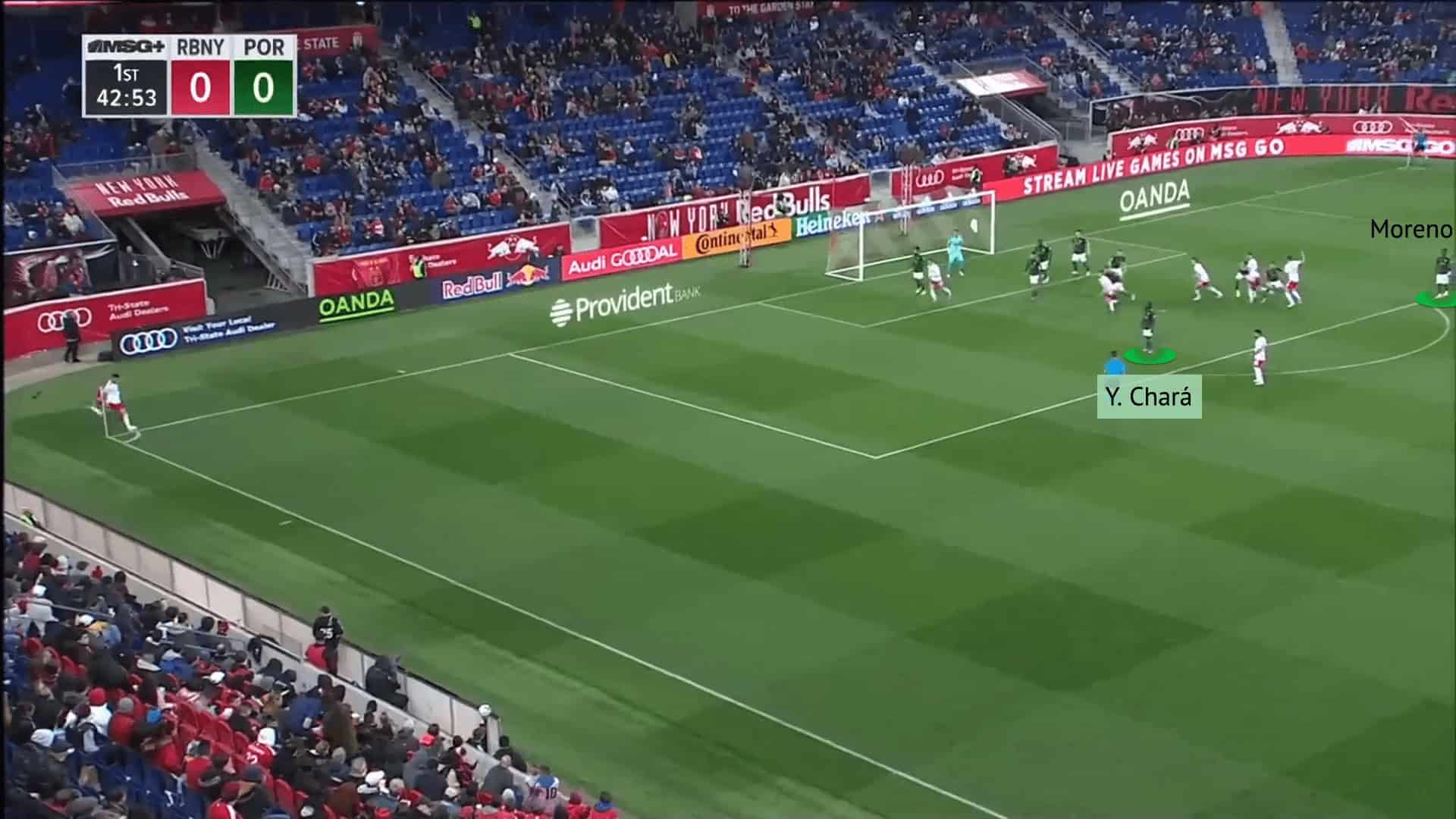
The image below is Portland Timbers’ usual defensive corner set-up. With one player occupying the front zone, two players in the middle zone, and one player towards the back post, the Timbers have covered the immediate areas in front of the goal. They have also given their goalkeeper Ivačič space to come and collect crosses. Elsewhere in the box, the Timbers defenders will man-mark the opposition, following their runs to prevent them from getting first contact. On the edge of the box will sit pacey attacking players, in this example Y.Chará and Moreno, who can start counters and bring the Timbers up the pitch with their energy and dribbling ability.
Conclusion
With just three wins from their opening sixteen matches, this is arguably Portland Timbers’ worst season in their MLS era. However, the season is not over yet for the Timbers, with key players in the defence and attack returning from injuries. With more than half of the season remaining, Giovanni Savarese has opportunities to recover the team back on track to chase the playoffs, where he excels most.
This team analysis and scout report has discussed Savarese’s tactics that have not been quite as effective this season, seeing the Timbers struggle to compete. Nevertheless, the 1-1 draw at LA Galaxy could be a turning point. The Timbers 4-2-3-1 gave Diego Chará support in a double pivot whilst having numbers in attack, with the returns of Claudio Bravo, Jarosław Niezgoda and Felipe Mora a further boost to Portland Timbers ambitions for the rest of the season.
