
The UEFA Women’s Champions League is finally wrapped up after an elongated season due to the coronavirus pandemic struck the world and stopped football in March. After seeing the last few games of the UEFA Champions League being played out in the last 10 days, the 2019/20 season finally crowned their champion. Champions of Division 1 Feminine Olympique Lyon Feminin and Frauen-Bundesliga Wolfsburg contested the latest final in what was predicted to be such an enthralling and exhilarating final.
This tactical analysis will detail the tactics and methods used by Olympique Lyon Feminin to win the tournament and peg back their German rivals Wolfsburg.
Lineups

Jean Luc Vasseur only had two selections to consider with his team playing brilliantly in the runup to the final. Amandine Henry and Nikita Parris were both unavailable for different reasons. Henry fell to a calf injury that kept her out of the semi-final against Paris Saint-Germain and 45 minutes against Bayern Munich. Her natural replacement in Sara Gunnardottir was more than able to step in. Parris, though, was suspended after being sent off in the semi-final, which forced him to make a decision between Jodie Taylor or Eugenie Le Sommer. The French forward lacked sufficient match fitness after recovering from injury but was chosen ahead of the English striker and proved to be a masterstroke.
Wolfsburg made two changes, both in defence: Anna Blässe and Lena Goessling replaced Kathrin-Julia Hendrich and Joelle Wedemeyer.
Lyon: Positional interchanges during build-up
Lyon’s build-up was similar to their previous games in the knockout stages where they focused on progressing the ball through the middle into the wide areas. Kumagai and Gunnarsdottir were both tasked with carrying the ball out from defence to draw in Wolfsburg’s double-pivot and spray the ball wide towards the wingers. On paper, they were a 4-2-3-1 but in reality, they attacked in a sort of 4-3-1-2 formation where Le Sommer and Cascarino would drive through the channels depending on the side the ball progressed through and Dzsenifer Marozsán would be a passing option to link play. Amel Majri started at left-wing but quickly moved into a left-central midfield role and switched between both positions. Similarly, Cascarino did the same by playing as a right-winger and centre-forward alongside Le Sommer.
A lot of Lyon’s build-up includes the full-backs and this game was no different. Though there were a few adjustments made due to the nature of Wolfsburg’s wingers and how dangerous they are, Lyon continued to push up one full-back whilst the other stayed relatively deep. In this case, Lucy Bronze played more aggressively and became a deeper threat for Lyon and the combination work between Cascarino, Gunnarsdottir, and Bronze caused Wolfsburg issues. Not to mention, Marozsán occupied pockets of space as the team’s trequartista, roaming between the lines to influence play. What helped Lyon maintain numbers across the thirds, was the positional rotations of the central midfielders. Majri would cover Karchaoui, Kumagai would slot in between the centre backs and Gunnarsdottir would cover Bronze. The movement of these central midfielders and in this case, specifically Gunnarsdottir, allowed Bronze to push up without worrying about leaving space in behind.
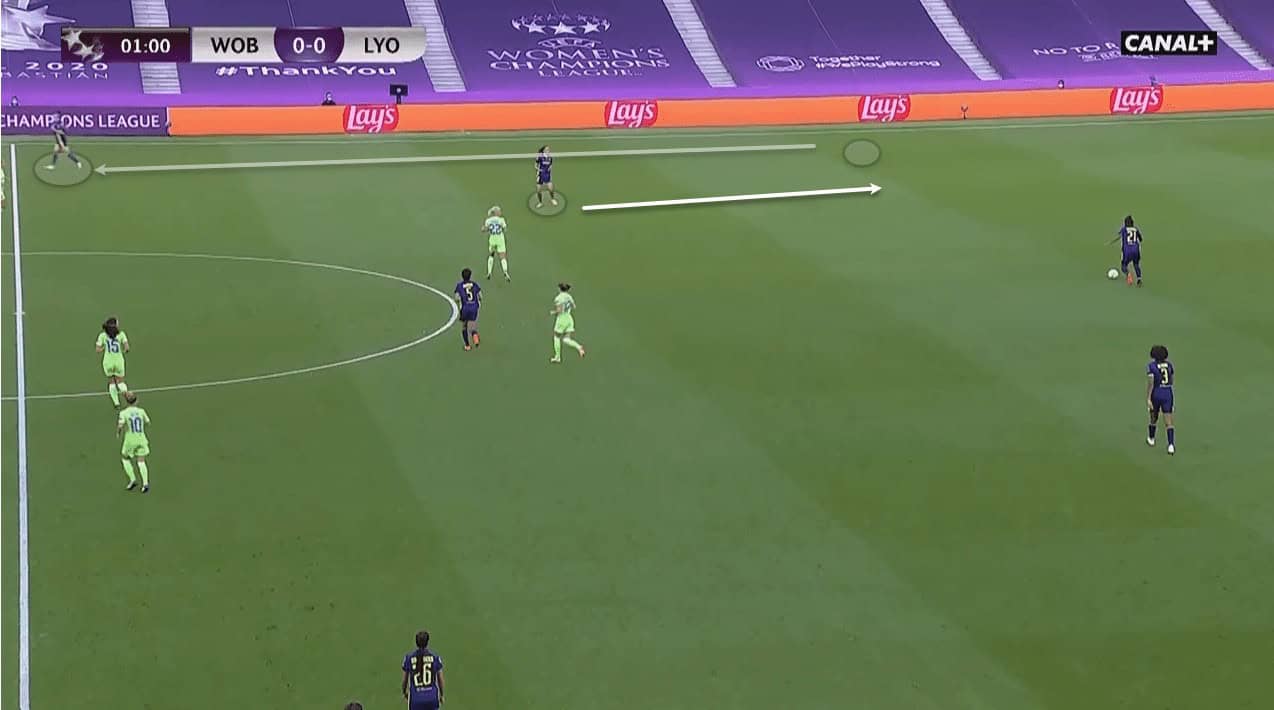
When a full-back did push up (mainly Bronze), Gunnarsdottir would slot into the right-back area to cover. These positional rotations are common amongst Lyon’s midfielders and are what keeps Lyon sufficiently covered in all areas of the pitch. Henry would carry out the same tasks and Gunnarsdottir didn’t look out of place. The image above shows Gunnarsdottir dropping in to replace Bronze at right-back as she pushes forward. These full-back movements provided an extra body in the wide area to open up the half-spaces. Gunnarsdottir and Marozsán would then take advantage of the space created and drive into the box to get on the end of a Bronze/Cascarino cross.
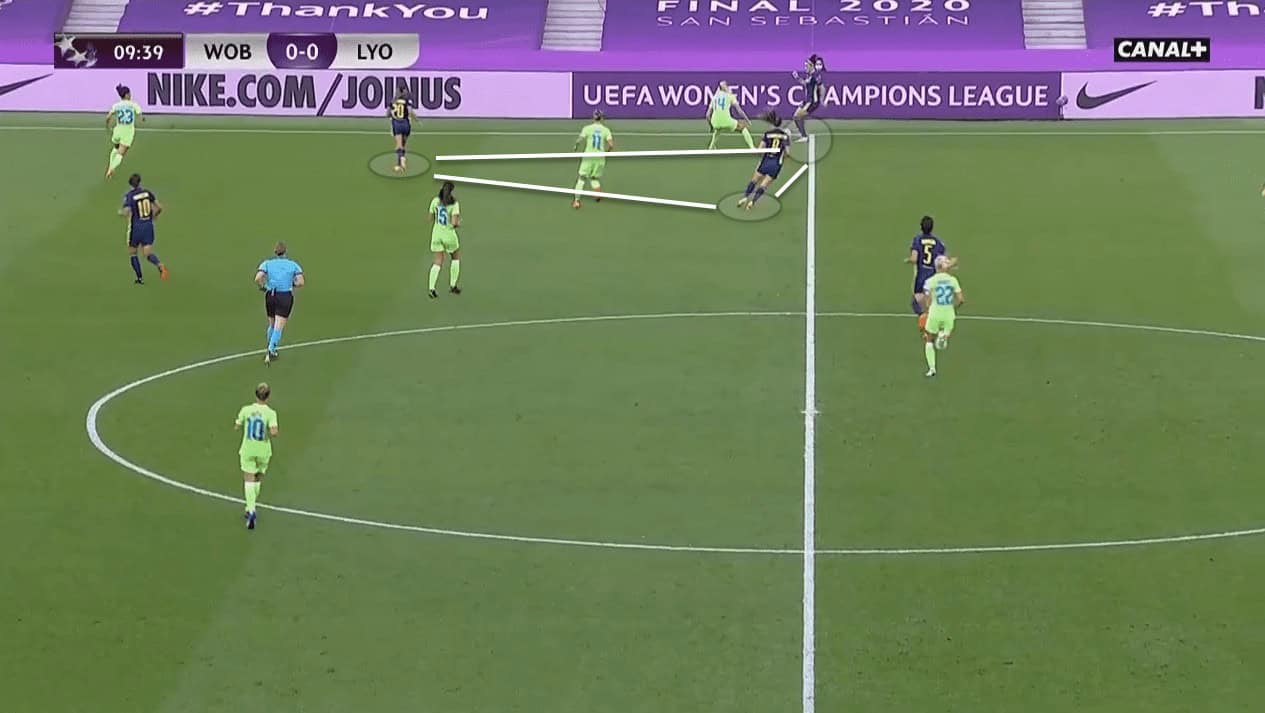
The above image shows the combination play between Gunnarsdottir, Bronze, and Cascarino which leaves Marozsán in space to receive a pass and drive forward. There are no Wolfsburg players in sight to press her, which means Lyon are able to take advantage in the central areas with their diamond midfield. Kumagai, Marozsán, and Majri can all overload Wolfsburg’s midfield.
When it came to penetrating in the final third, Lyon had specific tactics with Le Sommer leading the line. The wide forward is much more direct and dynamic than the nimble, fleet-footed Parris, and Vasseur wanted to use this to their advantage. The front three would often change positions and were almost given the freedom to play across the pitch when they approached the 18-yard box.
Out of possession, Cascarino would start centrally next to Le Sommer with Marozsán in behind which formed part of the 4-3-1-2 but when attacking, Cascarino would act as a right-winger and run in behind their full-back and cut inside to cross from the byline. Wolfsburg had to commit two players to stop Cascarino’s driving runs which meant two fewer players for Lyon to deal with in the middle.
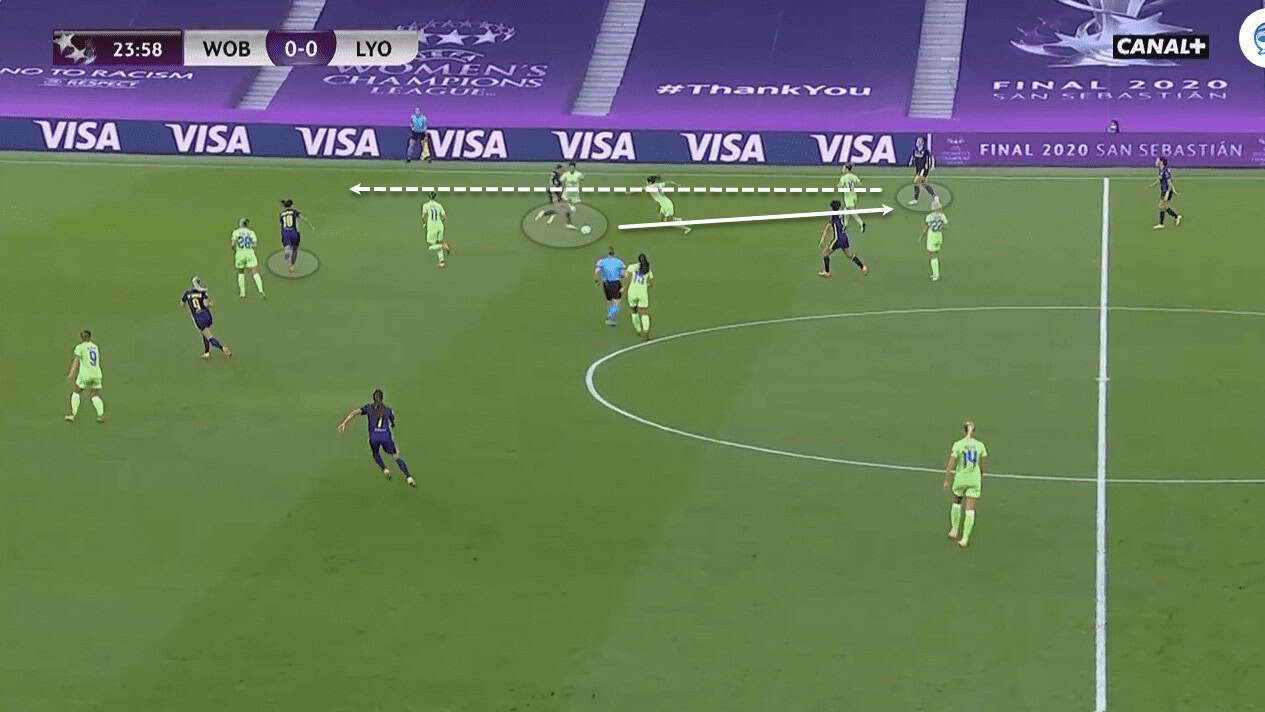
Lyon’s first goal was a prime example of this where they were able to use this build-up strategy to find space behind Wolfsburg’s defence. The first image shows us Cascarino dropping to collect possession, while Marozsán moved up next to Le Sommer. Cascarino would pass to Bronze who would play Marozsán down the flank.
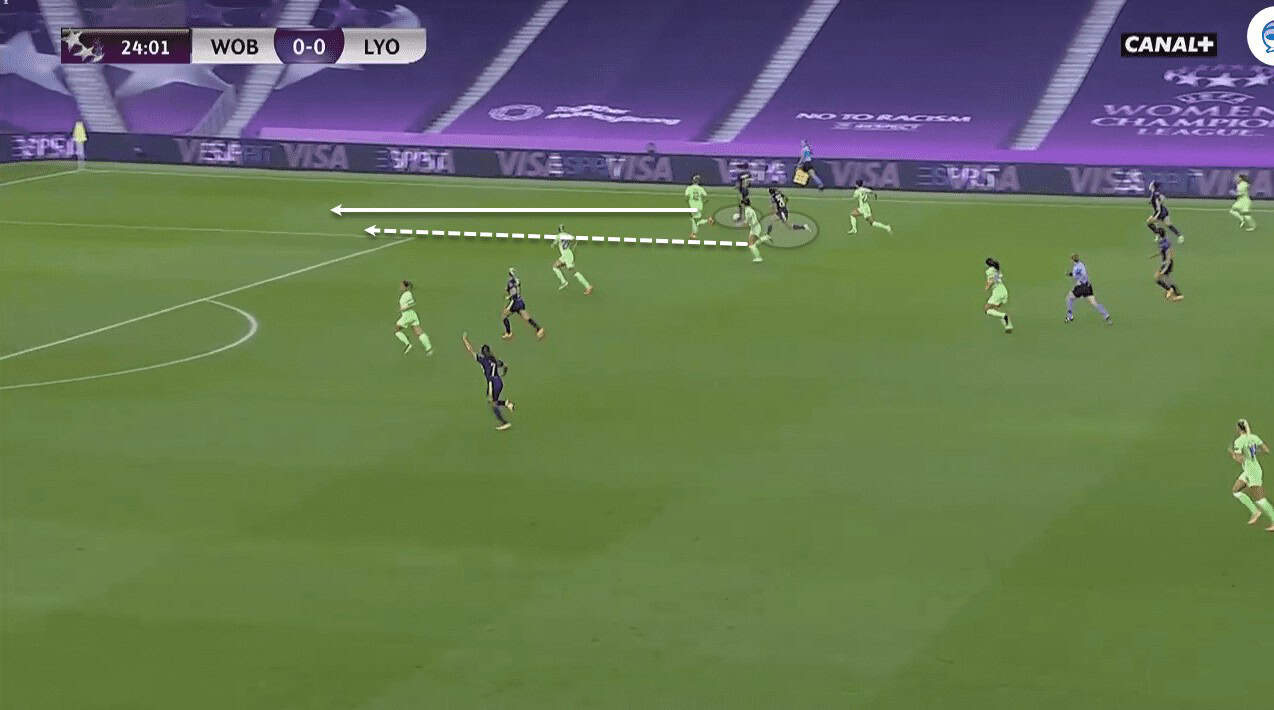
Here, Cascarino will make a late run beyond Marozsán and the two Wolfsburg defenders to take advantage of the highlighted space. Now Majri and Le Sommer are in a 2 v 2 or even a 2 v 1 situation.
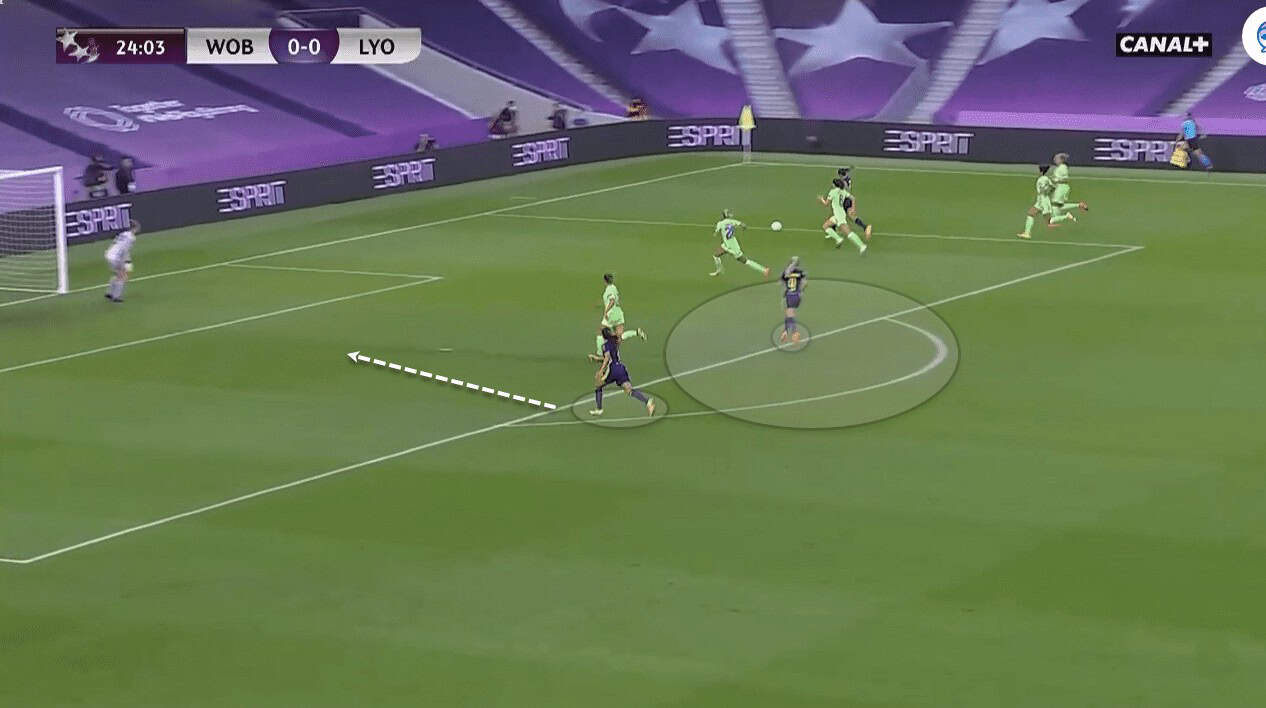
As Cascarino takes up a crossing position, four Wolfsburg players have committed to stopping the French winger which they are unsuccessful in doing so. Majri and Le Sommer have enough time or space to find a place in the box to take on the rebound which results in a goal.
Lyon: Out of possession
The game was always going to be predicated on how Lyon were going to impose their style on a resolute Wolfsburg team who have been so dominant in this season’s tournament. Their off the ball work was going to be arguably more important than what they did on the ball because of Wolfsburg’s world-class attacking players. Lining up in a 4-4-2 meant Wolfsburg were able to commit almost four players to their attacking moves and Lyon needed a way to nullify their supply from the midfield duo of Ingrid Engen and Alexandra Popp.
Their main idea was to ensure they had overloads in the central areas through their out of possession shape which rotated between a 4-4-2 diamond and 4-3-1-2 system. Up against Wolfsburg’s 4-4-2, Lyon tucked in Amel Majri into a central role to create a 3 v 2 against Ingrid Engen and Alexandra Popp. Majri and Gunnarsdottir shifted to either side to assist the full-backs to stop them advancing there. This allowed Lyon to manipulate Wolfsburg’s build-up and again created another 3 v 2 situation where opposition full-back and winger were dispossessed or forced back.
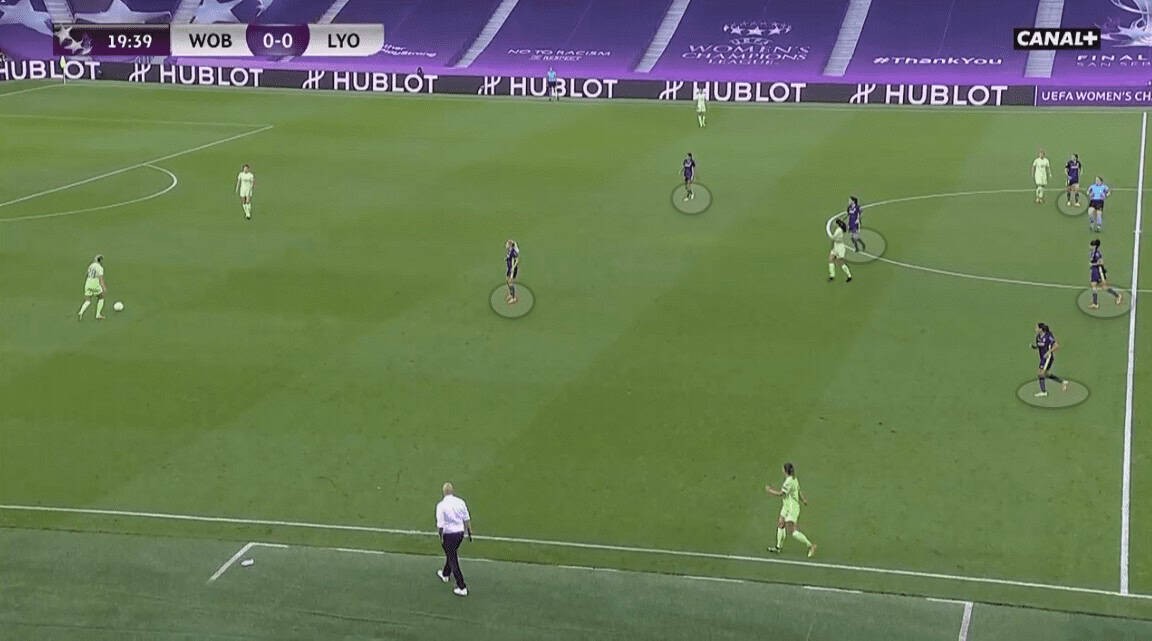
Both full-backs are usually integral to Lyon’s progression and tactics in the final third. However, while they were able to peg back Wolfsburg’s wingers in the first half, they were wary of the threat they still posed. The full-backs were not as advanced as they usually have been with one always staying back when the other pushed forward. Karchaoui was tasked with keeping Blässe and Svenja Huth quiet whilst Lucy Bronze did make forays forward to combine with Delphine Cascarino but not very high.
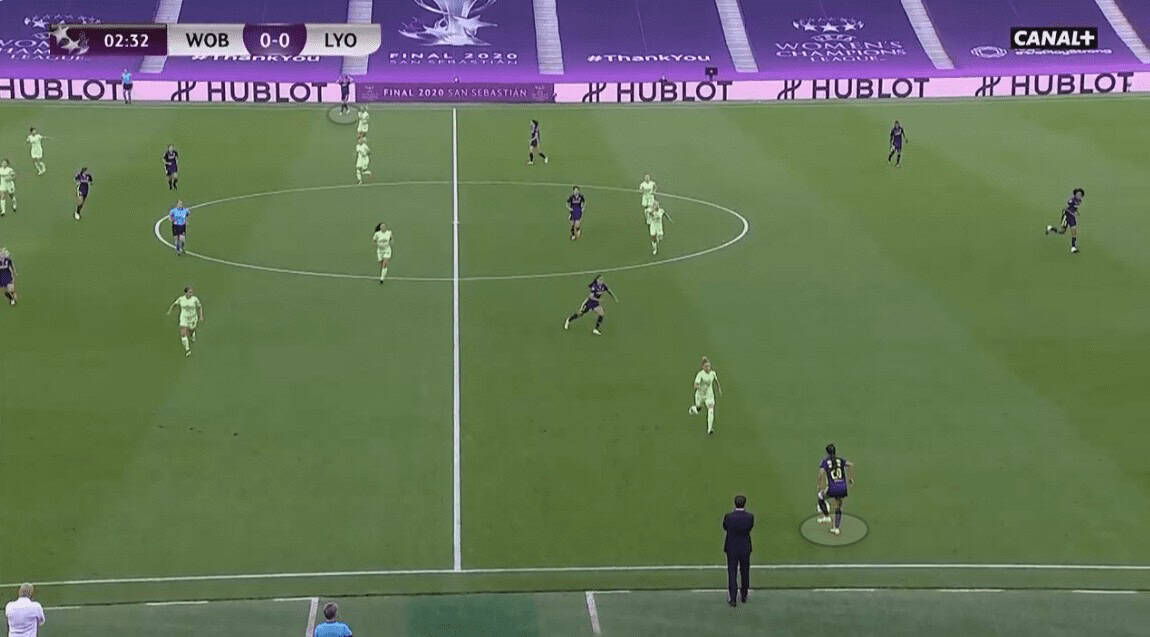
When Wolfsburg entered the middle or final third, Marozsán dropped into midfield to create the 4-4-2 diamond shape. The real difference being the ability to press Wolfsburg higher up the pitch with Cascarino and Le Sommer pressing the centre-backs. This sort of shape enabled Lyon to move from a zonal pressing system into a man-oriented pressing system in an instant, always giving Lyon an extra player to improve their chances of retention. This works best in tandem with their high-energy play style. It was the seamless switch in systems that didn’t allow Wolfsburg to maintain possessional efficiency which showed in their performance in the first 45 minutes. Wolfsburg were hardly given a real chance in the middle portion of the half.
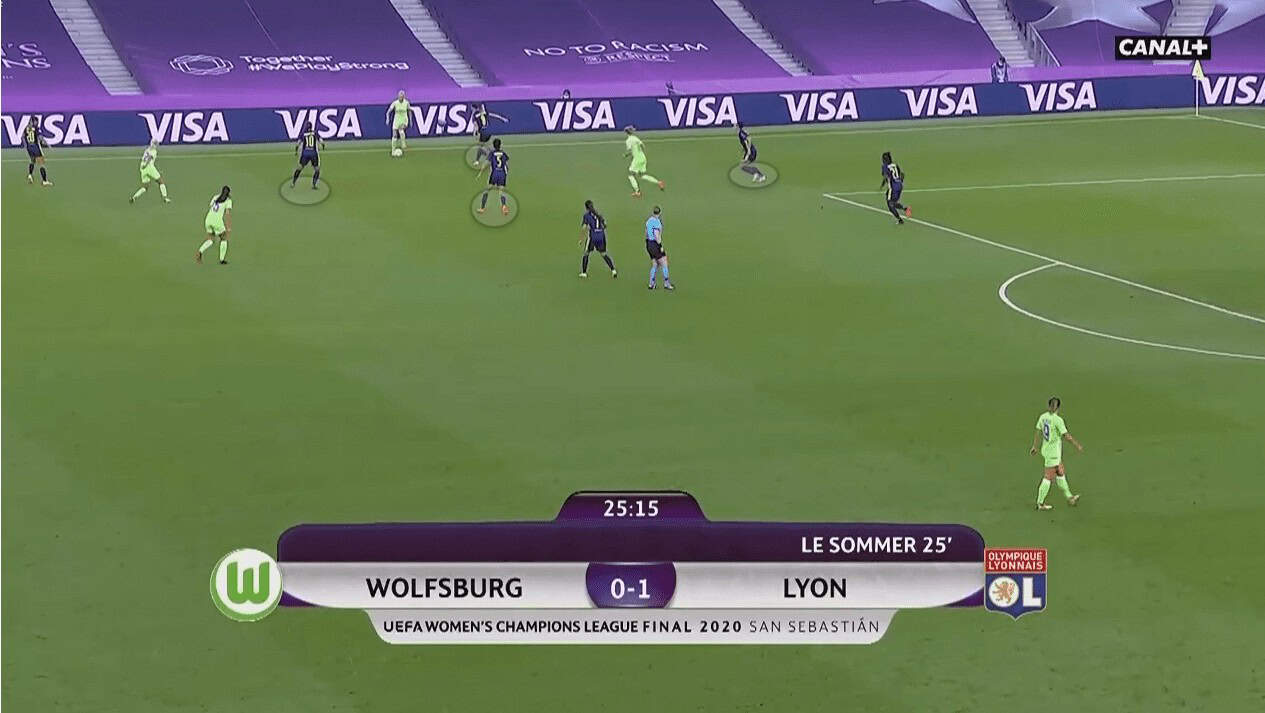
Here is an example of Lyon’s wide pressing where you can see Wolfburg’s two wide players are outnumbered by Lyon’s four. Lyon’s switch in marking and pressing systems was to trap Wolfsburg into pockets of space in the wide areas and bring in more players to crowd them out.

Here we can see Kumagai, Karchaoui, Majri, and Renard all covering the two wide players with Wolfsburg’s only option to go back. We’ll cover Lyon’s attacking exploits from this in a later section. It’s important to understand what issues the attacking moves caused Wolfsburg first and where their tactics faltered initially.
Wolfsburg: Pressing
One of the biggest problems for Wolfsburg was their lack of coordination in their press and support when it came to winning back possession high up the pitch. Wolfsburg pressed in a 4-4-2 mid-block which would give them the advantage of covering the width of the pitch with the four midfielders and suffocate the space between the lines. However, they adopted a man-oriented reactionary press without any sufficient cover from nearby players. This meant they only applied pressure on the opposing player when they received the ball. This affected them both in their defensive and final third of the pitch. This coupled with Lyon’s energetic and quick movement meant Wolfsburg were left chasing shadows and gave Lyon space to find a teammate.
We saw multiple examples of this throughout the first half and was one of the reasons for Lyon’s ability to constantly play through the channels and take advantage of the spaces in the pockets. From a defensive standpoint, the two forwards in Pernille Harder and Ewa Pajor did not apply enough pressure on Renard and Kadiesha Buchanan which meant they were able to play out from the back. Taking a look at this example in the 16th minute, we can see Harder not getting tight enough to Renard who is able to find Karchaoui to her left. The next frame would see Huth attempt to press Karchaoui but the left-back was able to pass it back to the goalkeeper.
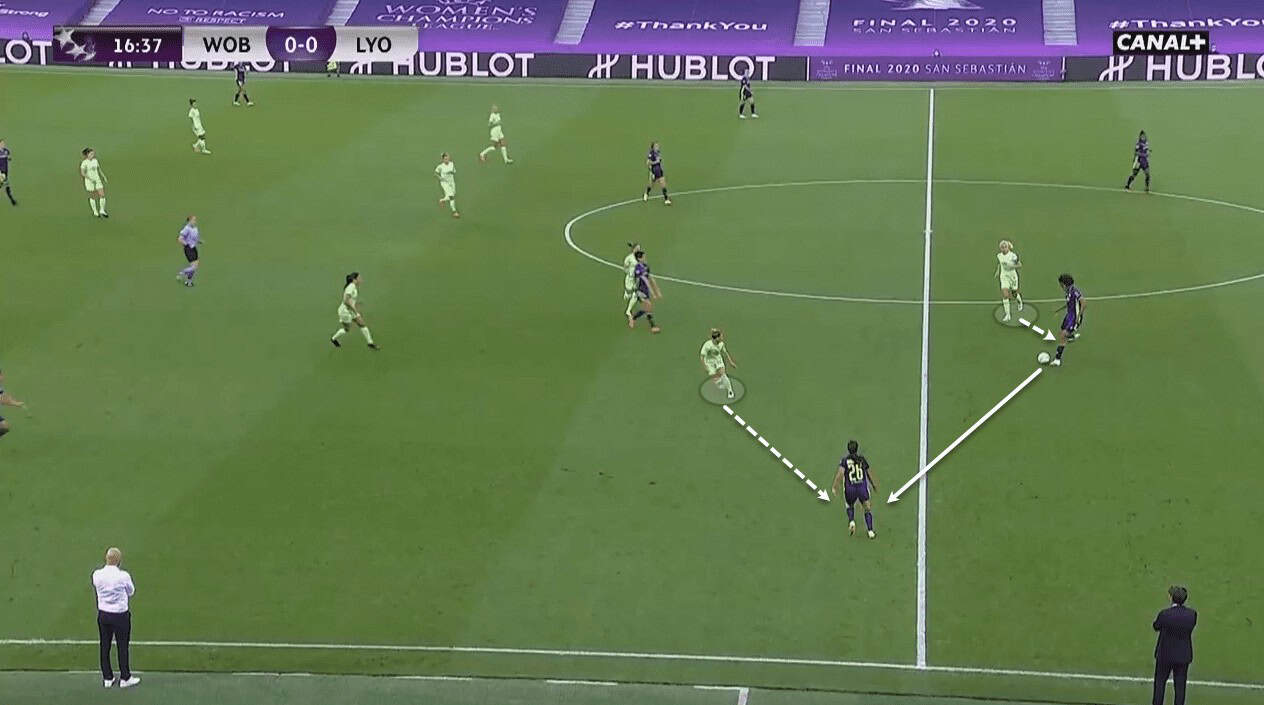
The first half saw them outnumbered time and time again and were restricted by Lyon’s high-energy pressing and movement. Blässe had some success down Wolfsburg’s right side but was shackled by Karchaoui. This duel, in particular, was one that Wolfsburg constantly tried but were not able to get through.
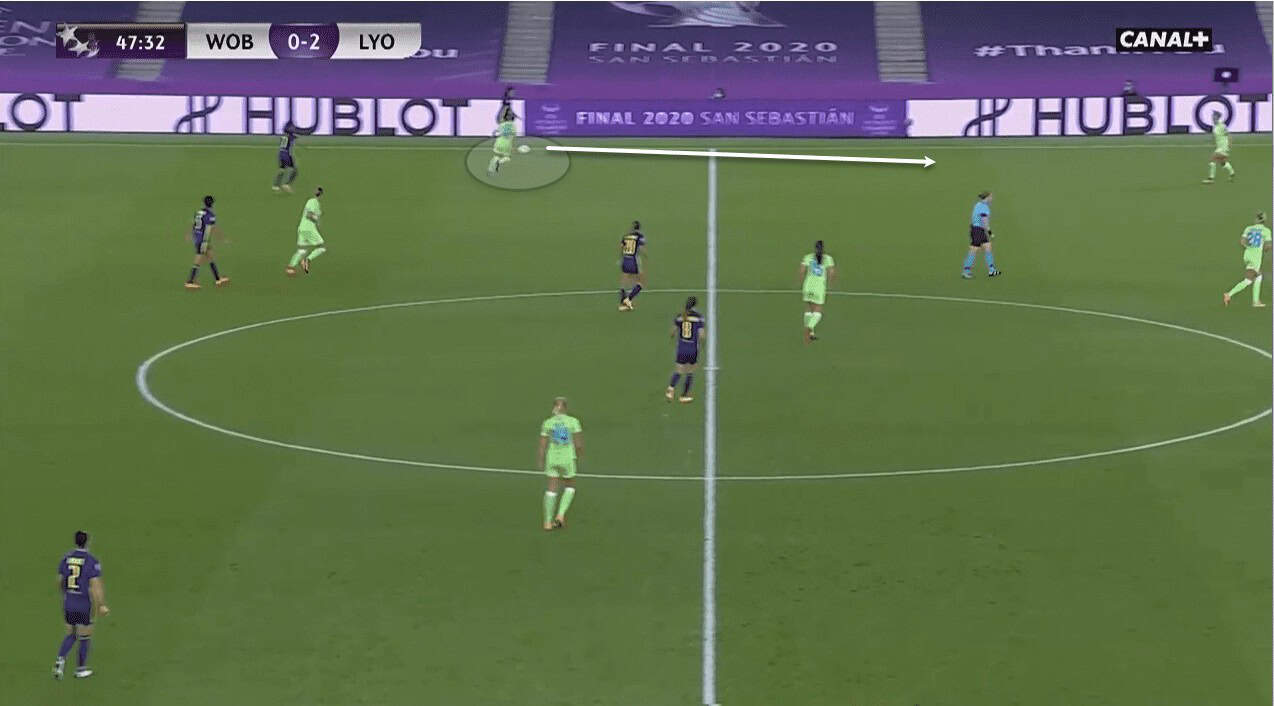
This example shows Karchaoui on the ball down Lyon’s left and while Huth was looking to close the left-back down, there was a lack of support from nearby players. Here we can see neither the full-back nor the central midfielder makes an attempt to help Huth and exert pressure on Lyon’s full-backs.
Their initial pressing strategy left them vulnerable at the back as the full-backs and wingers were not in sync with each other. As a result, Wolfsburg left too much space for Lyon’s midfielders to play through which saw them give away chances, especially Cascarino who found space and used her speed to push back Sara Doorsoun-Khajeh at left-back.

Their main progressors and creators were the two wide players in Fridolina Rolfö and Huth but both players were often left to take on multiple Lyon defenders. Neither full-back ventured far forward because they were afraid of the pace Lyon posed, especially down the right-hand side. Their main struggle was to generate enough attacks down the flanks and get the ball towards Rolfö and Huth. On Bronze’s side there were three-person pressing traps whilst Karchaoui managed to hold her own when it came to 1 v 1s against Blässe. Majri did come across to support the press and worked ever so hard to provide the balance. Wolfsburg’s inability to get beyond Bronze and Karchaoui meant Wolfsburg lacked a cutting edge and the Lyon overloads in midfield meant they were forced to walk into Lyon’s traps.
Wolfsburg: Tactical tweaks to the system
After the break, Wolfsburg made a significant turnaround after going two goals down. Wolfsburg looked much better in possession and were able to efficiently and effectively progress the ball and get it into their playmakers. The first major point to note was their pressing intensity picked up dramatically and while their press was still man-oriented, they were much more proactive and were able to apply more pressure on the Lyon defenders. This coupled with Lyon’s drop in intensity meant Wolfsburg were able to capitalise on the half-spaces and get the ball into wide players.
Pushing up both full-backs and instructing Engen and Popp to be more dynamic by hovering around the half-spaces meant Wolfsburg were able to get more players against Lyon’s defenders which meant Lyon had to stay more narrow in the second half to counteract the numbers.
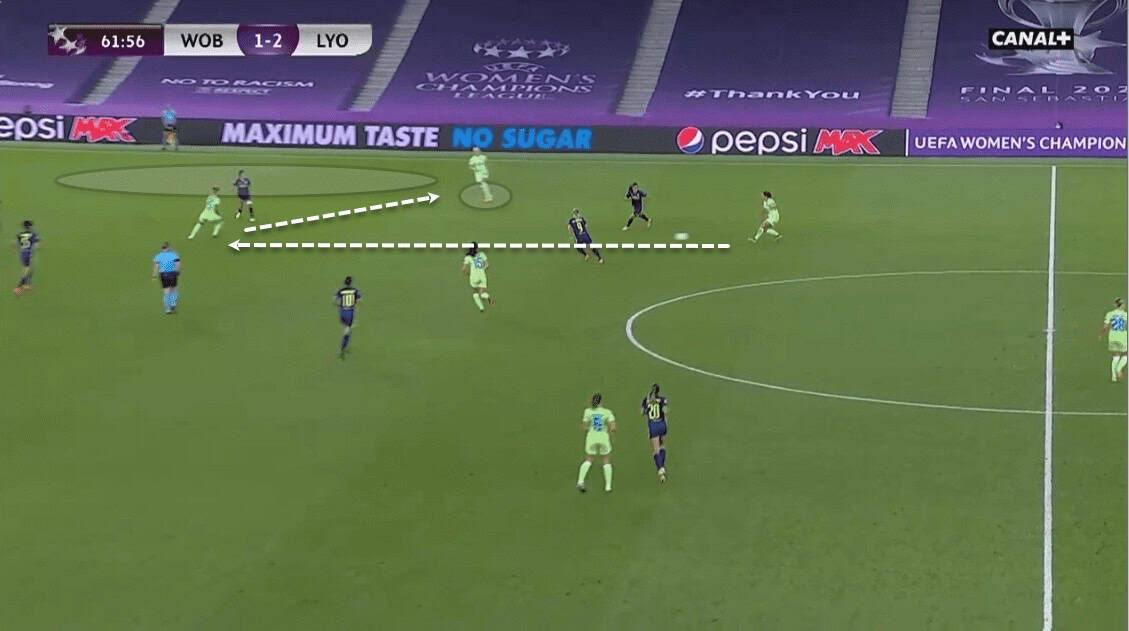
The most significant change was Harder dropping into midfield to pick up possession and not be left isolated between Kumagai and the centre-backs. Dropping deep meant Harder was able to pick up possession from midfield and become a link player between midfield and attack and release the players and give them a favourable battle against the full-back.
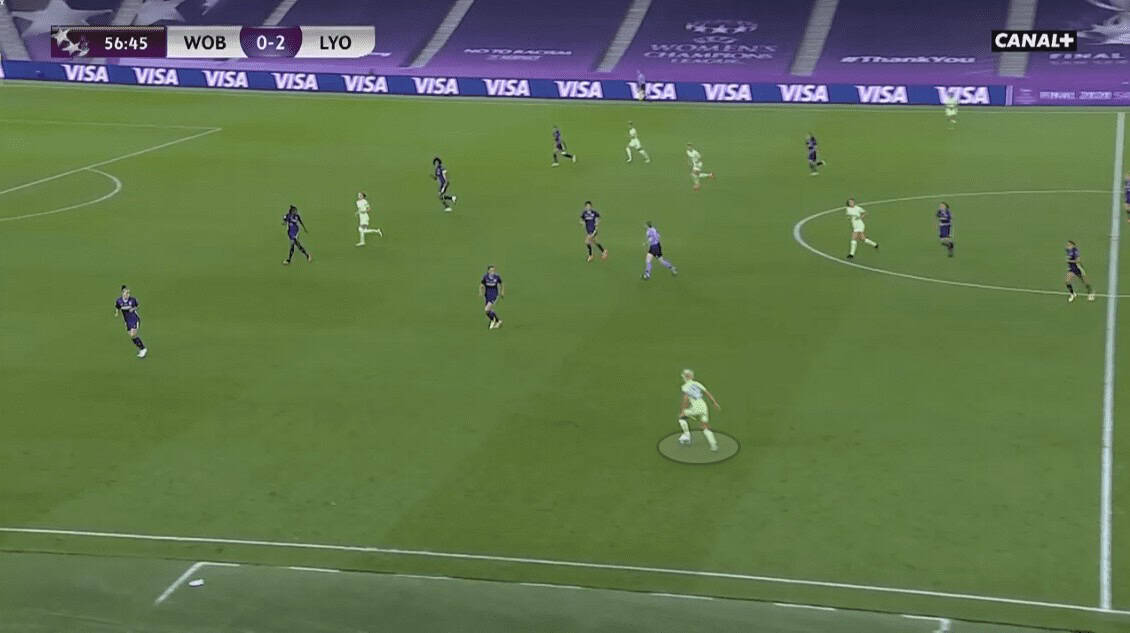
Harder’s runs meant the central midfielder that would come across had to commit to the runner, with the full-back tracking her movements whilst having the wide player on the overlap. This, in turn, enabled the wide players to stay wide whilst matching Lyon in midfield as three which can be seen in the image above. Wolfsburg now enter Lyon’s half in a 3 v 3 situation and forces Gunnarsdottir to move towards her.
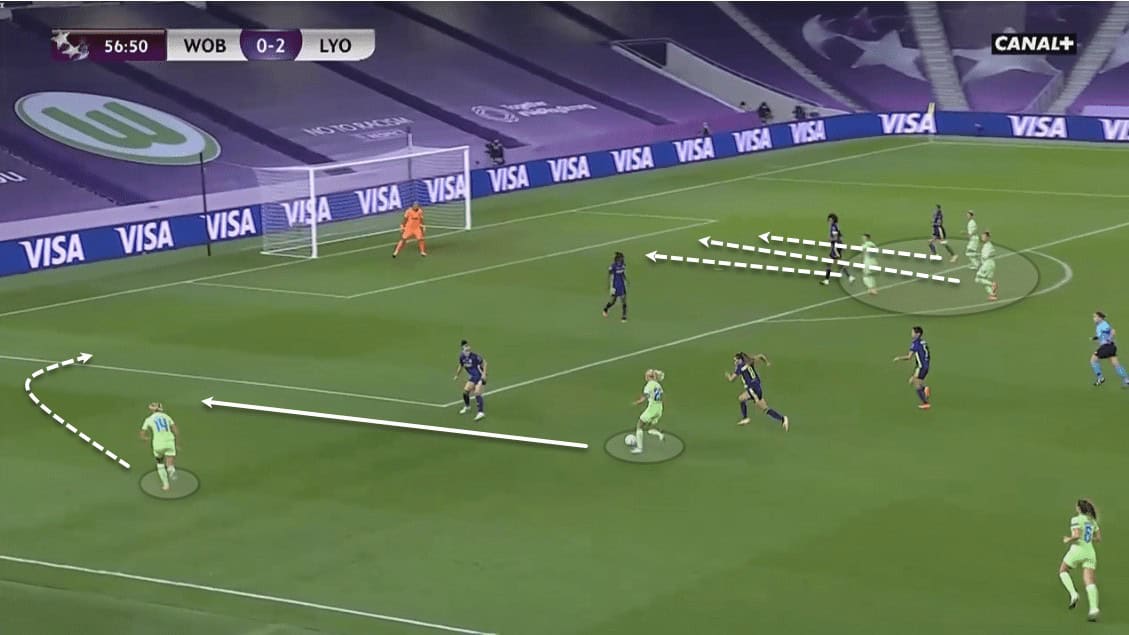
Here, Kumagai waits nearby to cover the gap but this leads Wolfsburg’s other attacker’s space in behind and overrun the Lyon defenders in their own 3 v 2. Harder’s direct run pulls in two-three players and allows Rolfö space to run in behind Bronze. The resulting cross ended up in Popp’s goal. The constant threat from the Wolfsburg wide players meant Lyon were pegged back for much of the second half.
Final Remarks
The analysis was quite interesting and Wolfsburg did improve as the game wore on but it was a back and forth contest with both teams having periods of dominance that produced some chances. Lyon were just more clinical and showed their big game experience. Throughout the knockout stages the French Champions showed their ability to grind out results. Securing their 5th Champions League title in a row is a massive feat and they will continue their quest towards a 6th straight title next year. It will take some doing and other teams such as Chelsea and Manchester City have strengthened heavily, and the likes of Wolfsburg and Paris Saint-Germain will always be in contention. Next season’s tournament seems to be the most enticing one we’ve had yet.
