
On the second matchday of Group H, South Korea and Ghana met at the Education City Stadium.
Both teams failed to win their opening match and are still waiting for their first victory.
Three points today could have been important in their bid to book a place in the last 16.
In their opening match, the South Koreans sold themselves dearly but lacked the final consistency.
With Uruguay’s only chance coming from the aluminium twice, the final result was a draw.
Ghana‘s first match was against the Group H favourites.
Interim coach Otto Addo’s team narrowly lost 3-2 against Portugal, with the team’s comeback in injury time coming too late.
At the end of this match, Ghana are left with three points, which they earned through efficient attacking play in the first half.
South Korea could rarely overcome Ghana’s well-organised defence.
In this tactical analysis article, we will focus on Ghana’s defence and tactics, especially from the first half.
But we will also look at South Korea’s mistakes and the methods they used to make the comeback.
But first, we will start the analysis by introducing the two lineups.
Lineups
Paulo Bento sent his team out in a 4-3-3/4-2-3-1 system.
Seung-Gyu Kim played in goal, and Moon-Hwan Kim, Min-Jae Kim, Young-Gwon Kim and Jin-Su Kim formed the back four in front of him.
South Korea’s two defensive midfielders were In-Beom Hwang and Woo-Young Jung.
Woo-Yeong Jeong was the attacking midfielder and Chang-Hoon Kwon and top star and captain Heung-Min Son started on the two flanks.
The nominal lone striker for South Korea was Gue-Sung Cho.
Addo lined up his team in a 4-2-3-1/ 4-4-2 system.
Lawrence Ati Zigi played in goal, and the back line consisted of Gideon Mensah, Mohammed Salisu, Daniel Amartey and Tariq Lamptey.
The defensive midfield line was formed by Salis Abdul Samed and Thomas Partey from Arsenal.
The attacking back three behind Athletic Club striker Inaki Williams consisted of Jordan Ayew, his brother André Ayew and Mohammed Kudus.

Ghana’s defensive performance
Ghana were particularly convincing in the first half with a united defensive performance and hardly allowed any chances for their opponents from South Korea.
Against the ball, they mostly formed a 4-4-2 system in which the distances between the two chains were kept very small.
With three of their four defenders coming from the English Premier League, they brought tangible experience in defence.
In addition, all of Ghana’s players brought a high tempo, which made it easier for them to defend the deep balls and runs.
Problems in Ghana’s backline mostly occurred only after stand-off situations, as well as crosses.
These game situations will be examined further in the remainder of this analysis.
Ghana clearly focused on a compact defence in order to stay without conceding a goal for as long as possible.
This was already evident in the last match against Portugal, where they only conceded the first goal in the 65th minute.
They let South Korea have the ball as much as possible and hoped for switching moments to be able to use their high tempo.
With a fairly deep defensive chain, they were optimally prepared for long balls.
If they played with a deep defensive chain, you might think that there would be big spaces between each line.
Yes, but they knew how to prevent the ball from being played into those spaces.
By running high, they prevented South Korea from playing a controlled build-up game, putting pressure on the players in the three-man build-up.
Often, there was then no other option for the South Koreans except the long ball.
With the help of the deep standing and high tempo of the Ghanaian players, these balls could be won or cleared either in a header duel or a running duel.
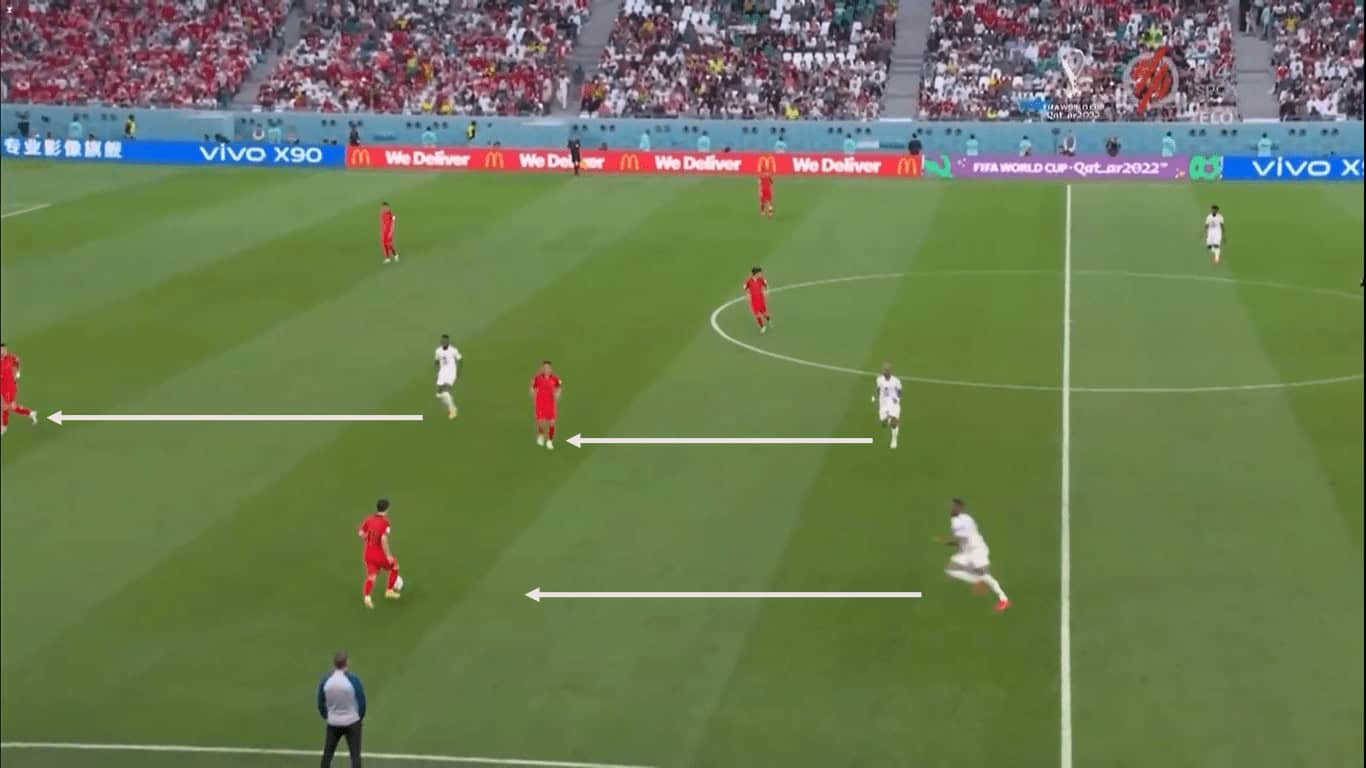 In this example scene, you can see South Korea trying to build up play in a controlled manner via the full-back in the back four.
They are outnumbered in their own half and are forced by Ghana onto their own right side.
In this scene of play, South Korea were able to break up through the goalkeeper.
However, the goalkeeper was also put under pressure and could not hit the ball forward in a targeted manner.
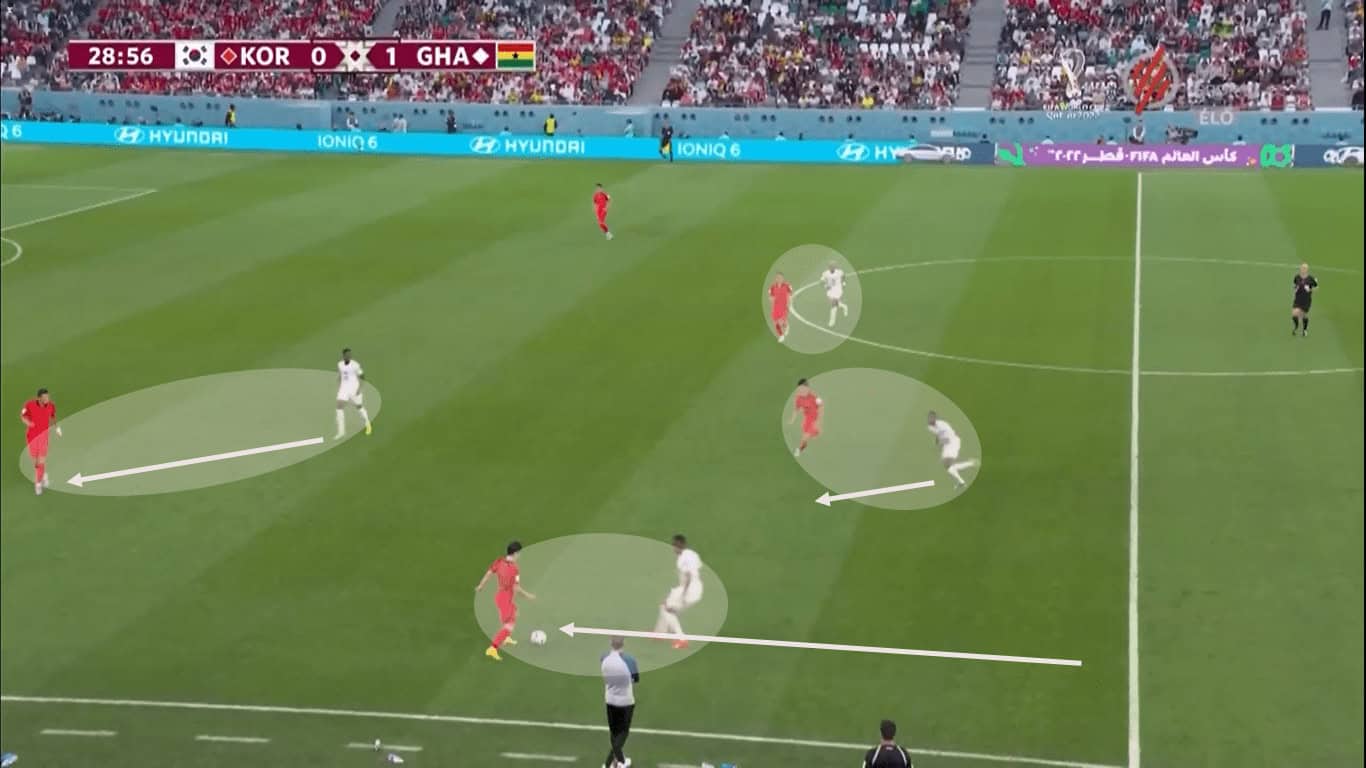 In the following picture, you can see a scene that resembles the previous one almost exactly.
Only this time South Korea is not building with a four-man but with a three-man chain.
The superior number in their own half is therefore only +1 from South Korea’s point of view.
You can see how Ghana is running in a man-to-man defence.
You can also see how the free players are run off the ball, thus taking away the options of the player with the ball.
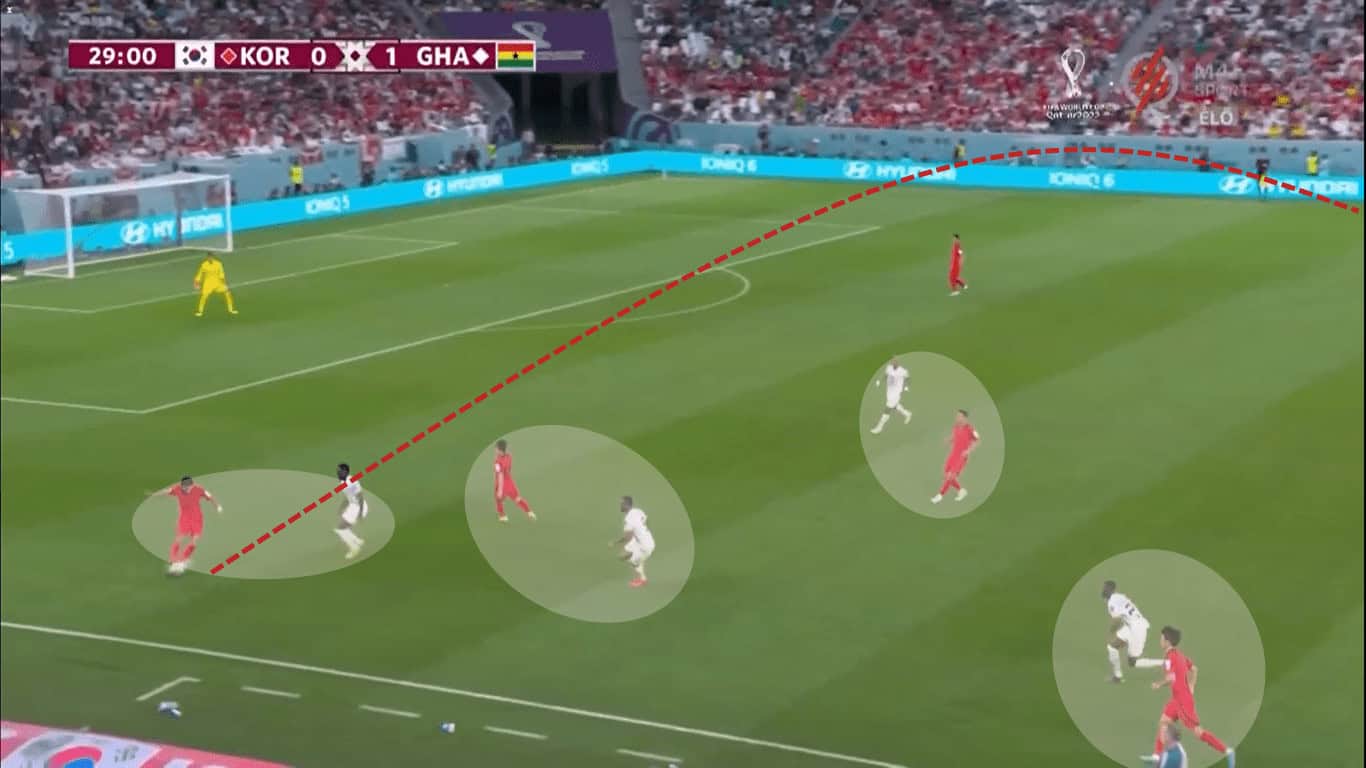 Here, you can see how the South Korean centre-back has actually broken away well in order to be playable.
However, he continues his run and also only has the option of knocking the ball long.
The gaps mentioned earlier, which are created by the deep defence and the high running, can hardly be played in this situation, if at all.
Thus, the Ghanaians were able to keep the ball away from their own goal but were also unable to control it.
This running of the forwards to disrupt the build-up of play and to put pressure on the centre-backs could be observed throughout the game and posed problems for South Korea, which they were nevertheless able to solve and score two goals.
This will be discussed further in the following part of the analysis.
South Korea mistakes in defence
South Korea played a 4-4-2 system against the ball, similar to Ghana.
At times, however, they played it variably in either a 4-3-3 or 4-3-2-1 system.
In doing so, they allowed just a few chances.
But in the course of the first half, they were sometimes too passive and were punished by Ghana.
Ghana rarely had the ball to build up their game in a controlled manner because, as already described in the previous part, they focused more on defence.
Nevertheless, from around the 30th minute, the South Koreans offered them more space and so they were able to run the ball through their own ranks and wait for an opportunity to present itself.
South Korea did not find a grip in this phase of the game and were always too far away from their opponents.
The entire Ghana team was wide open in the opponent’s half.
The reason for the lack of access was also due to the towering striker of South Korea.
He had little to no access to the game in this phase and could not decisively disrupt the opponent’s build-up play.
It was in this important sequence of the game that South Korea conceded the goal.
This scene in front of the goal describes well the mistakes of the South Koreans in the defence.
It was not only the defenders who made the corresponding mistakes, but also the first line of defence in the forward line.
Ghana were able to move the ball from one side to the other without being disturbed, as they did shortly before the goal was conceded.
Using the goal against, we now look at the various mistakes made by South Korea.
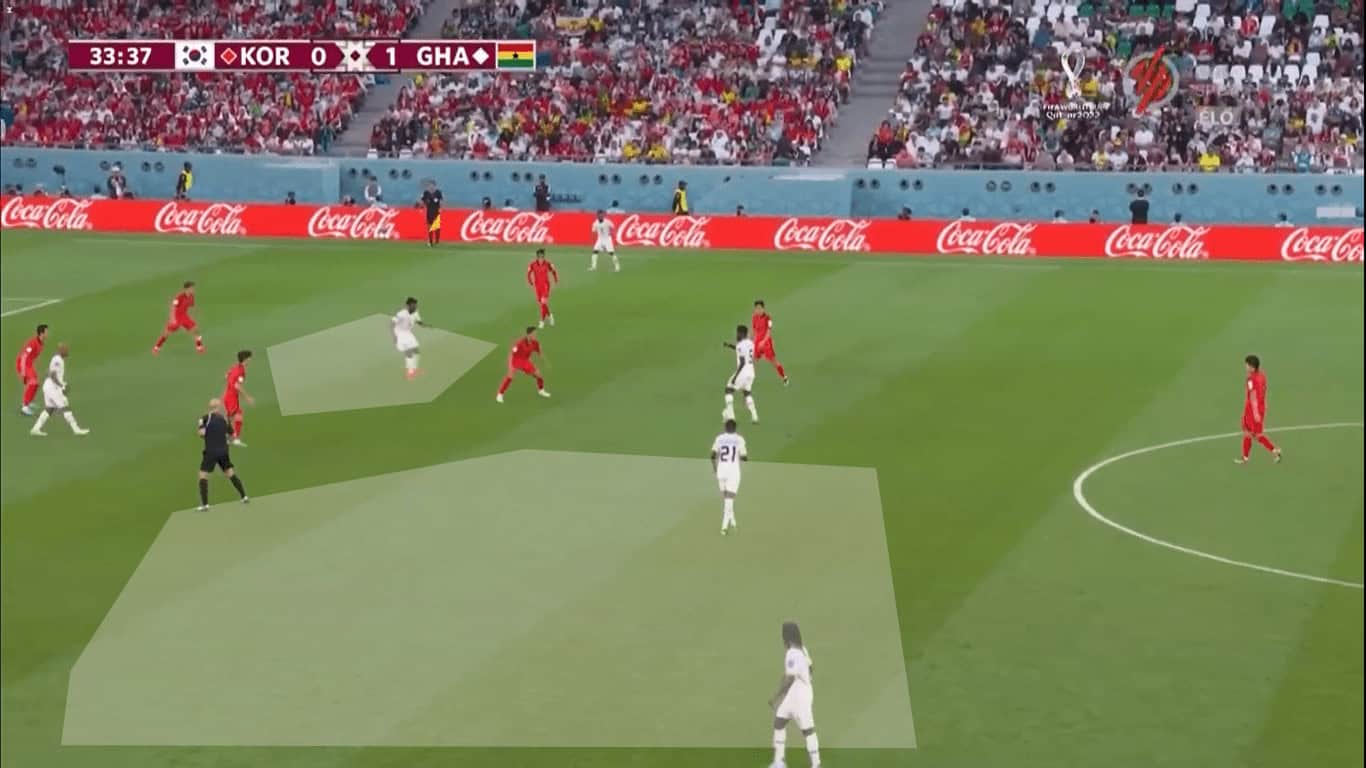
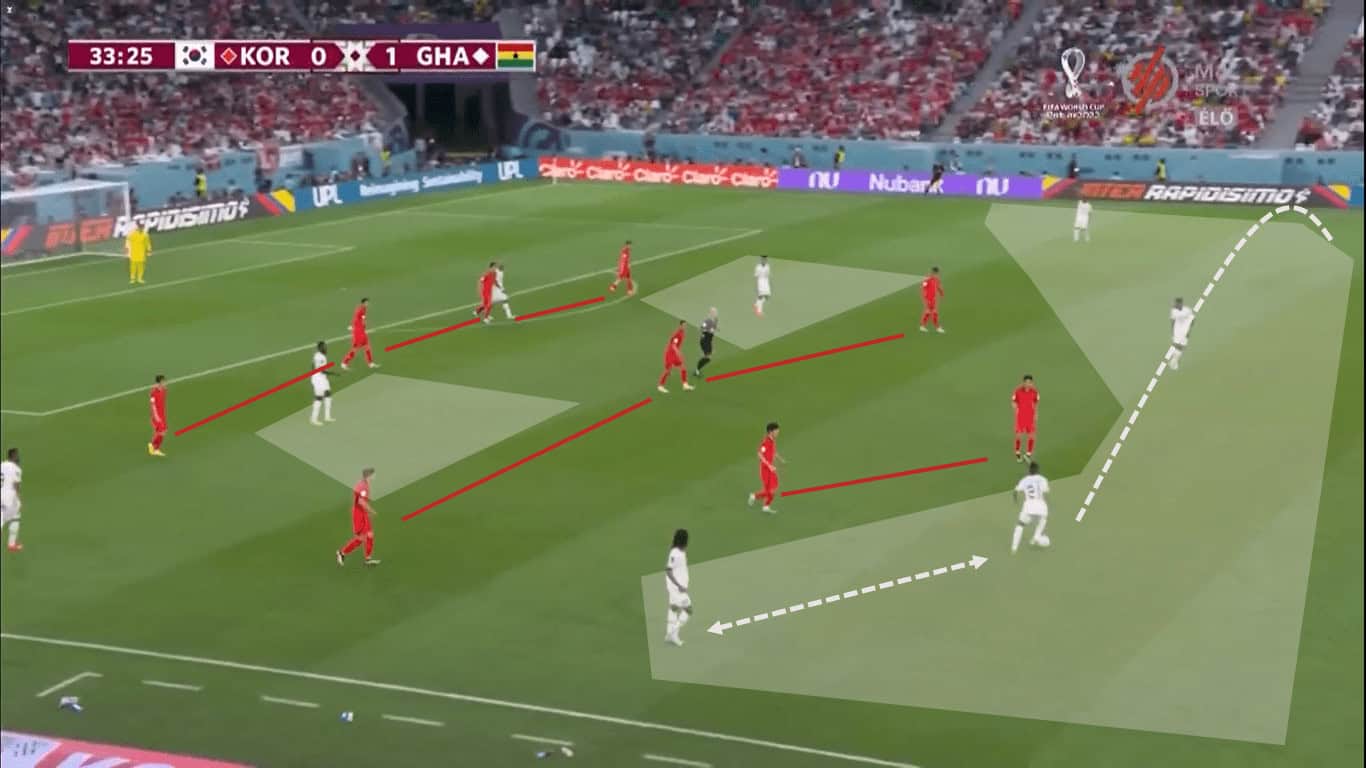 Here you can clearly see the passive defending of the South Koreans.
The striker mentioned cannot be seen here on the ball, as he is too far away from his own defensive lines.
The ball was already on the left side of Ghana in the final third.
As they did not find any possibility to become dangerous there, they first shifted to the back and then changed sides.
Ghana played it quietly here, as a pass into the two spaces marked out would also have been possible.
The front line with the two South Korean players is too far away from the player with the ball and thus cannot exert any pressure.
The latter has the necessary time to be able to shift sides.
 In the following diagram, you can again see the free spaces drawn in South Korea’s half.
They have moved far to their own left side, and there are spaces on the other side of the midfield.
In addition, you can see that the Ghanaian player in possession of the ball again feels no pressure and is free to switch sides.
Furthermore, the South Korean striker has no access to the game and cannot attack from above.
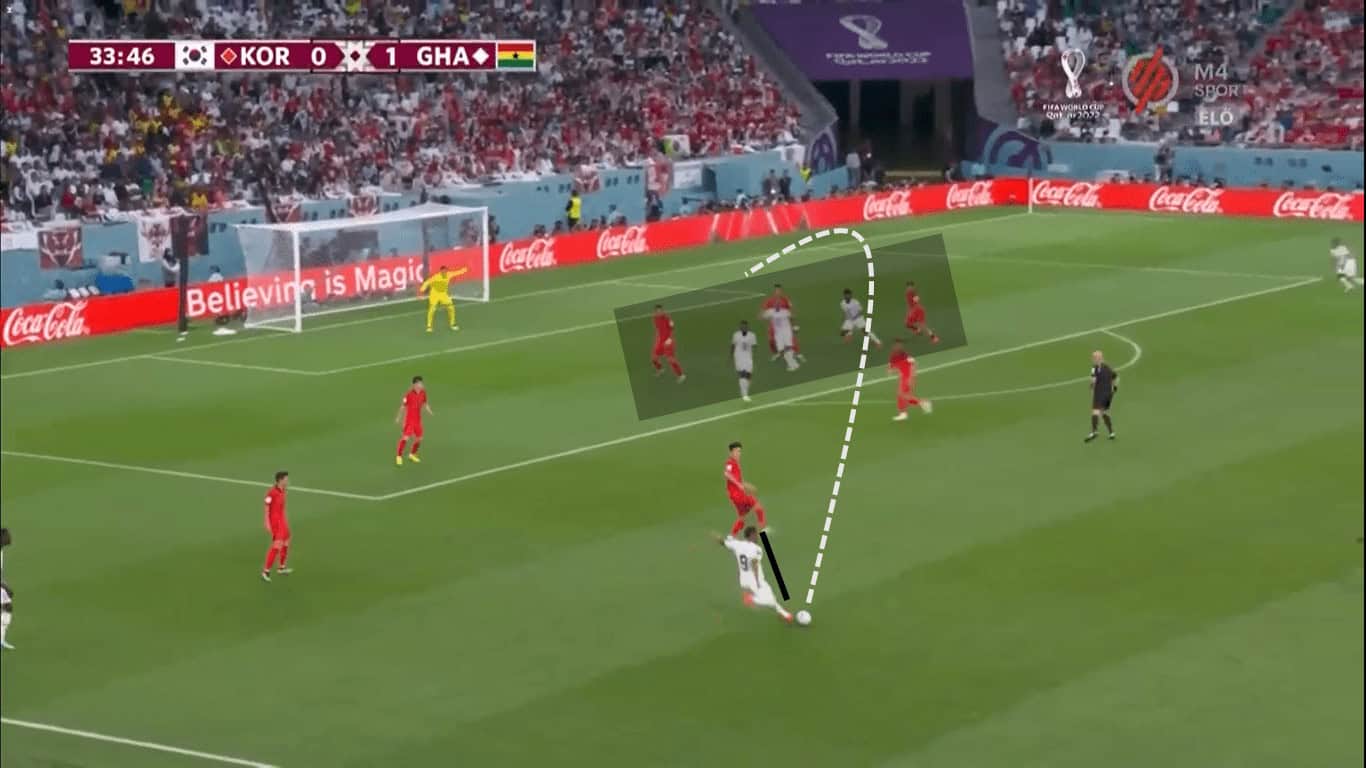 In this picture, the ball was moved to the Ghanaian left side, and South Korea again had no access and were too far away from their opponents.
The flanker has too much time and can bring the cross into the second post undisturbed.
There, you notice that it is a 1vs1 defence.
You can also see another player on the right edge of the picture who can attack the sixteen.
South Korea could have pulled the player positioned in front of the penalty area into the box here for reinforcement.
Nevertheless, Ghana’s cross is very well-timed, as is the header, which allows them to go 2-0 up.
South Korea were too passive in this phase and were unable to exert enough pressure on their respective opponents in every situation.
South Korea attacking style
South Korea managed to change their attacking style in the second half and create more danger.
This is how they managed to score two goals in just three minutes and temporarily equalise.
They improved their build-up play against the opposing strikers and shifted the play more to the two outer lanes.
The aim here was to break up Ghana’s midfield line and thus be able to play around the block via the free spaces on the outer lanes.
As already mentioned, Ghana stood deep with their defensive line in order to be prepared for possible long balls.
They were also very tight, and this created spaces for South Korea behind the outside midfielders.
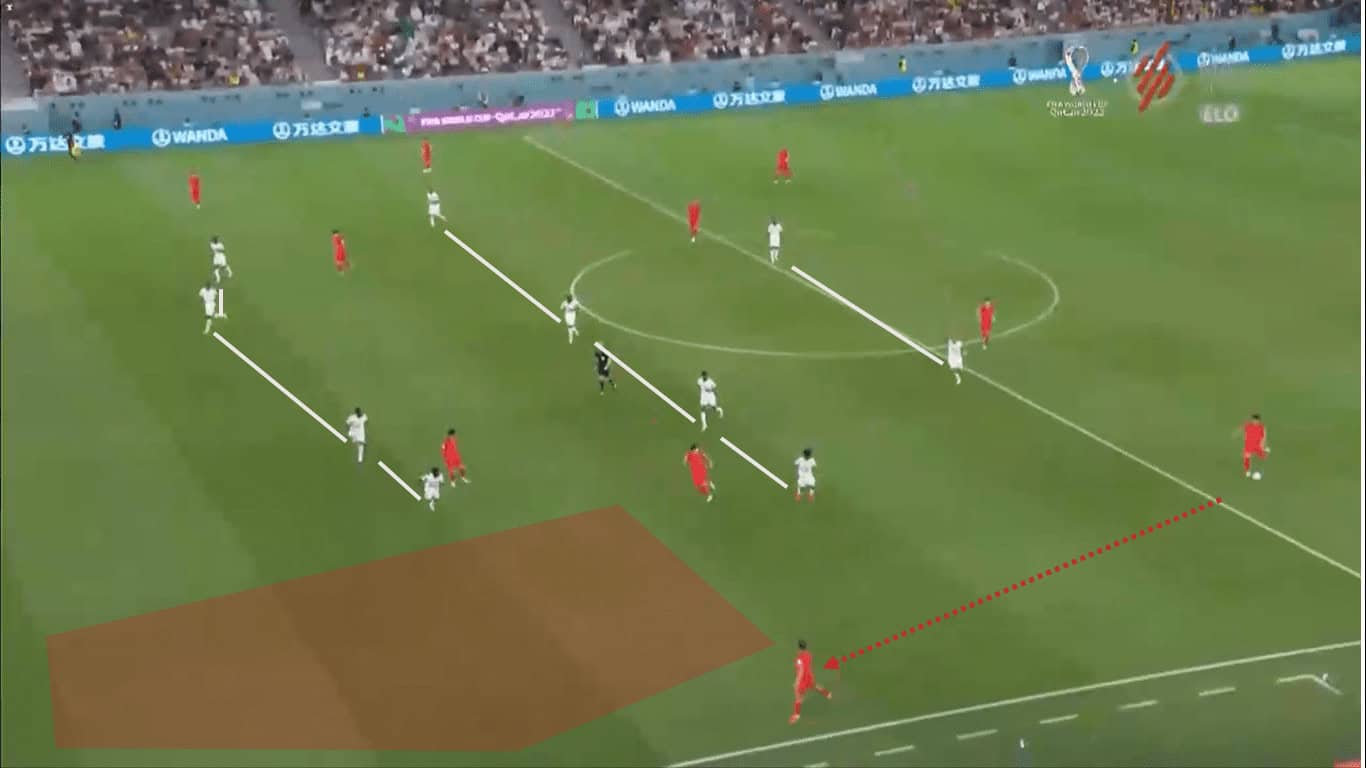 Here you can see the mentioned free spaces on the wing positions.
By shifting to the side, South Korea were able to play over the oncoming strikers and also spread out the midfield line.
The ball is now played from the defender to the wing and this goes over Ghana’s first two lines.
Two more South Korean players have already oriented themselves to their own left side during the shift to the flank, in order to be able to create a possible superiority on the wing.
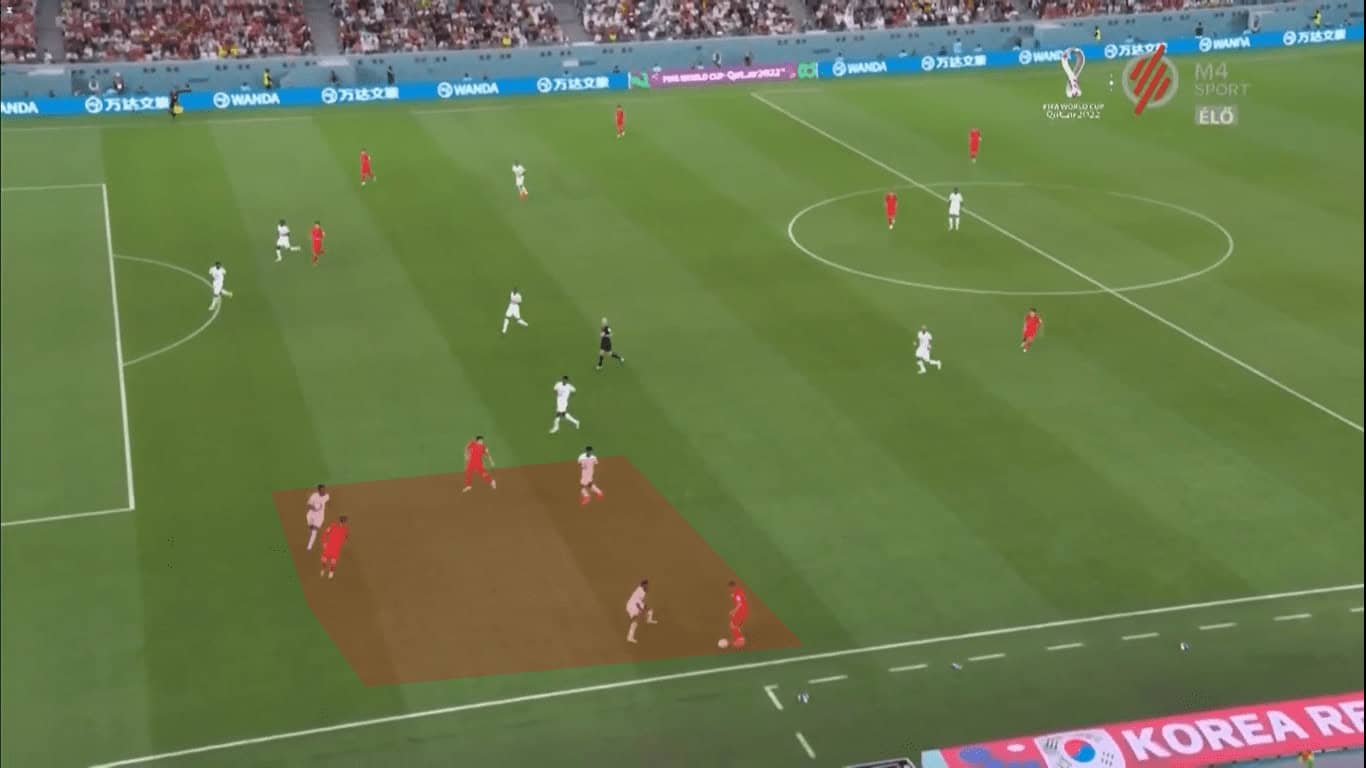 However, this overcrowding does not occur because the Ghanaian players follow up well.
Nevertheless, they have been able to get the ball into a promising position in the opposing third.
South Korea initially lose the ball in this situation but are able to win it back through strong counter-pressing deep in the opponent’s half.
Since they are in the flank zone here, it is quite dangerous for Ghana to lose the ball here.
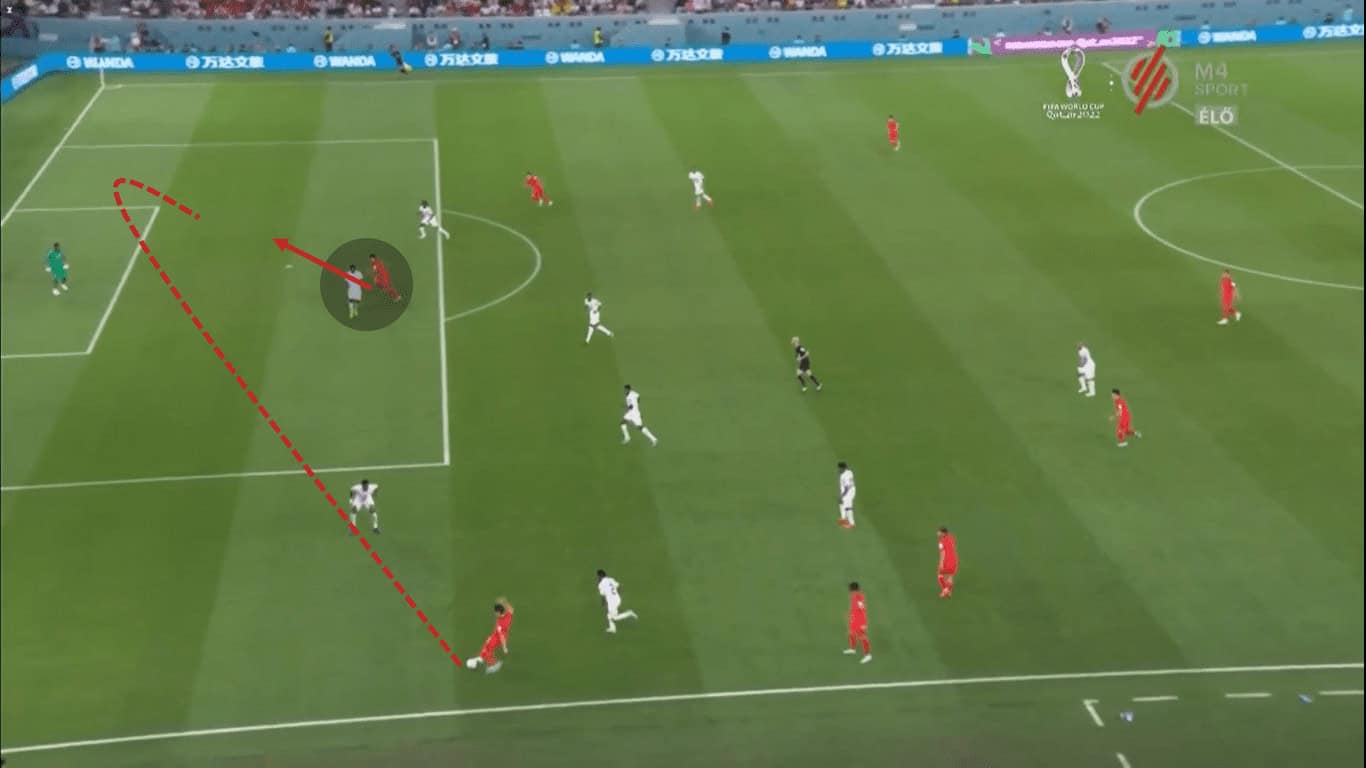 As you can see here, the South Korean player has a lot of space to get a good cross in.
The striker, who was criticised earlier, offers a good running path and makes it difficult for the defender to defend against him.
Similar to this goal, Japan subsequently tried to come down the wing and avoid the Ghanaians’ run-up.
It is therefore not surprising that the other goal, as well as several chances, were created via the two outer positions.
Conclusion
Finally, we will summarise the most important tactical points that have just been analysed:
Ghana limited themselves to defending their own goal and had little interest in shaping the game themselves.
They were looking for counter-attacking situations in order to exploit their high-quality speed.
In addition, Ghana’s tactic was to force the South Koreans into long balls early on in the build-up to the game.
They were then able to clear these without too many problems, but were also unable to bring them under control.
They then surprisingly took the lead through a free-kick situation, and the game changed somewhat.
South Korea let Ghana have more of the ball and lost more and more control.
The climax of this phase was reflected in Ghana’s second goal after a long passing sequence.
After the half-time break, the South Koreans shifted their play more to the two outer lanes and were able to cross from these positions again and again and score goals.
As already mentioned, both goals for South Korea were scored in this way.
When South Korea was on the verge of taking the lead, they felt the speed of the Ghanaians and conceded the third.
This goal also meant that Ghana could celebrate their first victory in this World Cup.
It was an open and tactical game after the equaliser, with both teams having the opportunity to score the winning goal.
