
KMSK Deinze are just two years shy of reaching their 100th year of existence, but so far, there is no available record of the team playing in the Jupiler Pro League, Belgium’s top flight.
As per Transfermarkt, Deinze spent most of the 1990s and 2000s in the second tier before being relegated in 2009. They returned to the Challenger Pro League in 2015 but were relegated once again that season, with the next four seasons spent in the third tier again. After achieving promotion in 2020, they finished fifth, fourth and eighth across the next three campaigns.
However, the ongoing season has seen them take a leap. Deinze currently sit second in the Challenger Pro League with 46 points from 25 matches, just one behind leaders K. Beerschot V.A. With three matches to go, they could very well end up in the Jupiler Pro League next season for the first time in their recorded history.
The man guiding their charge is former footballer Hans Somers, who has led them to eight wins in his 13 league matches in charge, taking them up from fourth to second. He has done so by improving their attack, with 24 goals scored, while keeping their defence at a decent level as well. The decision to bring in Somers was surprising to some, given that former manager Marc Grosjean, who had been in charge since October 2022, had led them to 20 points in their opening 12 games. However, the upturn in form suggests it was the right call.
This tactical analysis report will dive into how Somers has improved Deinze, his tactics, and an analysis of their best performers under him.
Background
Somers notably enjoyed a two-decade-long professional career before transitioning into management. He began his career with Lierse SK, moving from their academy to the first team in 1996. Five years, 120 appearances, a Belgian Cup and a top-flight title later, the former midfielder moved to Trabzonspor, where he netted 11 goals in 84 appearances and won two Turkish cups before joining FC Utrecht in the Netherlands in 2004.
It was here that he spent the bulk of his career, making 133 appearances in six years and winning the Dutch Super Cup before departing in 2010. Somers spent a year without a club before joining KSV Schriek in his home nation of Belgium, where he stayed for four years before joining Tielt-W. 3000 in 2015. He announced his retirement after the 2015/16 season.
In 2017, the Belgian joined Sport. Hasselt as their manager but departed six months later to take on the same role with KRC Genk’s U18 side. Two years on, Somers was appointed as the manager of Genk’s U21 side and held that role from 2020 to 2023 before becoming assistant manager to Marc Brys at OH Leuven. However, both were released from their roles after just nine matches.
In November last year, just a month after Somers was let go of by Leuven, Deinze appointed him as their manager.
Deinze’s improvement since Somers’ arrival: what do the stats say?
At the surface level, Deinze have marginally improved since changing their manager. Over the 13 league matches of Somers’ reign, they have collected 26 points, averaging 2.00 per game, compared to 1.83 in their first 12 games (20 points). They are scoring marginally more goals per game and are conceding at the same rate, which has evidently assisted in their excellent form. The fact that it has lasted for over a dozen games suggests it isn’t a flash in the pan.
However, the three stat-packs below, which compare their per-game stats from their matches under Somers with their season average, show that Deinze’s form does not come without a few concerns.
Let’s start with their attack. While the goals per game tally has improved, their expected goals (xG) figure has dropped. They are averaging fewer shots per game with marginally more accuracy, partly due to a reduced volume of attempts from outside the box (notably with much more accuracy). However, their penalty area entries and touches have dropped, while their potency from both corners and counterattacks has also fallen. Their improvement in converting positional attacks to shots is also fairly minimal.

Next up are the changes in their passing and creativity. Their possession per game has marginally dropped, resulting in fewer forward and lateral passes. More concerningly, their forward passing accuracy has also dropped, as have their passes into the final third and progressive passes, as well as the accuracy of both. Deinze has improved from crosses, but the rest of their statistics below suggest that they may be overperforming expectations and could return to the norm soon.

Lastly, their defensive numbers under Somers have mainly remained similar to their season average. Deinze is facing marginally more shots, but their opponents’ shot-on-target percentage has dropped a bit. They are also contesting far more duels and making more interceptions.
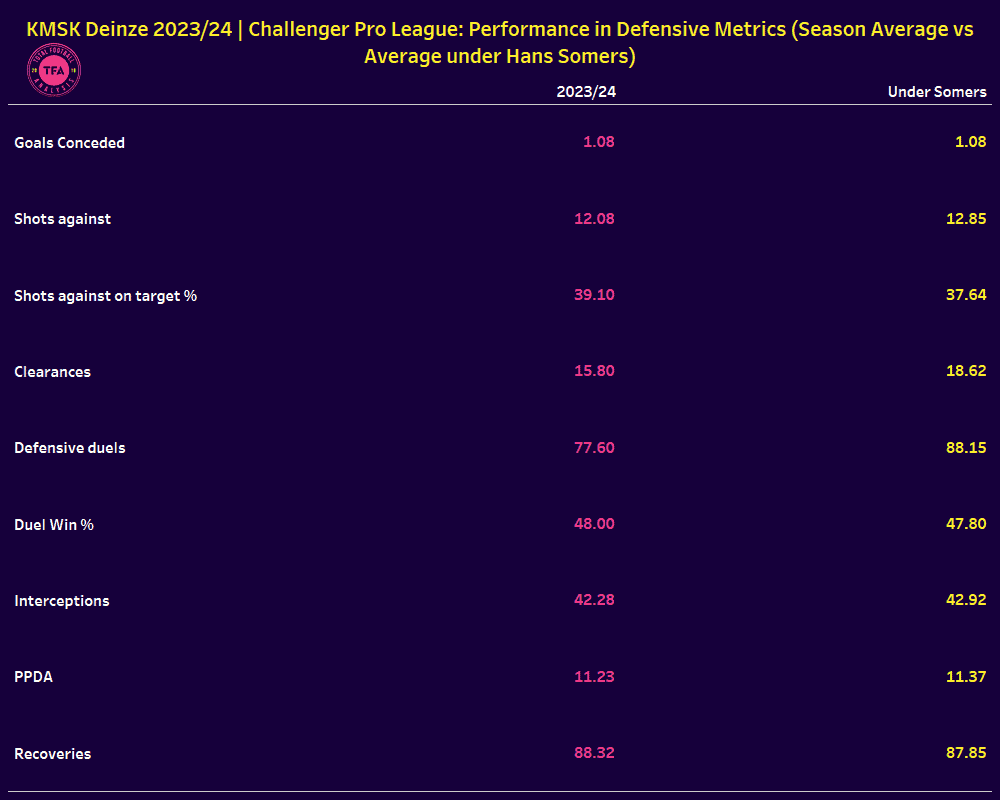
These stats suggest that Somers’ project is still taking shape, which makes the job he has done so far extremely commendable. Deinze’s individual stats from certain games indicate the same, with their passes per defensive action (PPDA) varying from 5.00 in their most recent game to 25.07 in the game before that. Seven of his 13 matches in charge have seen Deinze record a PPDA lower than 10.
Similarly, their possession figure has ranged from 32.62 to 59.33, while their shots conceded has ranged from four to 22. This is a trend that can be viewed across metrics, which suggests that a critical aspect of Somers’ reign at Deinze so far has been the team’s ability to adapt to their opponents.
Formations and Personnel
Somers’ preferred formation has been a 4-4-2 (used in nine of his 13 matches in charge), though he has also occasionally used a 4-1-4-1, a 4-2-3-1 and a 5-3-2.
Nacho Miras has been his first choice in goal, with the Spaniard starting all of Deinze’s matches under their current boss. Christophe Janssens has operated mainly at left-back, though Teo Quinteiro has also chipped in there and on the left side of a back three, despite those not being his preferred positions. Gonzalo Alemenara operates on the other flank. Kenneth Schuermans has been the preferred left centre-back option, with Denis Prychynenko and Andreas Spegelaere receiving minutes alongside him.
Gaëtan Hendrickx has been a constant presence in holding midfield, with Quinteiro for company, though Jaime Sierra has started their most recent matches with Quinteiro at left-back. Dylan De Belder and Jellert Van Landschoot have alternated on the left wing, with De Belder also featuring up top, while Van Landschoot has manned the right wing as well. Upfront, Lennart Mertens has featured in all but one of their 13 matches under Somers so far, with Guillaume De Schryver or Souleymane Anne for company.
Emilio Kehrer, De Belder, Mamadou Koné, Sven Braken (all centre-forwards), defensive midfielder Jur Schryvers and left-winger Nicolas Mercier have been Somers’ most-used substitutes.
Attack: Build-up patterns
A glance at Deinze’s heatmaps before and after bringing in Somers shows that they have spent more time in and around their box, while their attacking outlets have been more concentrated on the right under Somers compared to a more even split earlier in the season. This brings up some interesting wrinkles within their build-up patterns.

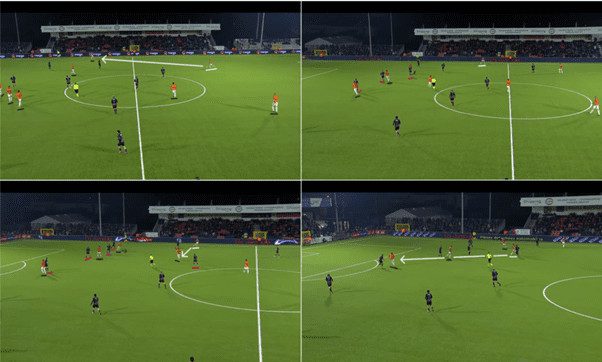
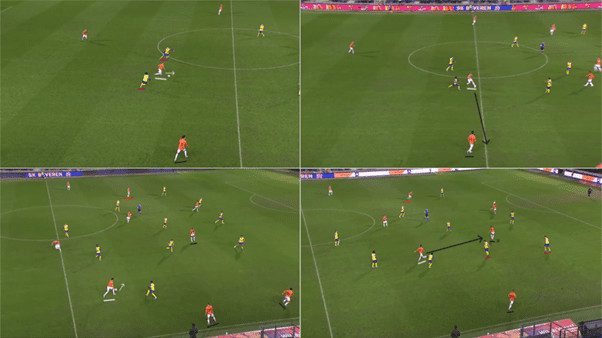
While the heatmap and stats suggest they have done more defending than earlier, they have also been more open to passing out from the back than before. Consider the sequence below from their most recent match, a 1-0 defeat to RFC Liège. With their opponents not pressing high, Deinsk send both their full-backs high and wide, with one of the central midfielders dropping back to help move the ball out from the back.
The right centre-back plays the ball to the right-back, with both strikers and the right-sided forward operating almost in a single-slanted line to keep the opposing defence on their toes. The right-back then plays the ball into the other central midfielder, and two of the forwards drop short – one out wide and one centrally – opening up space for the midfielder to slide a pass into the third attacker. While the move doesn’t amount to anything in the end, the movement and build-up patterns are interesting as they take away their numerical advantage in the box.
Against a team that presses better, like in this clip against Beveren, where the opponents commit four men to the area near the box. Deinsk play out from the back brilliantly to move forward. In the final clip, which is from a few seconds after the initial move, we see two of the forwards in acres of space, and while the move doesn’t come to fruition, it shows the composure of Somers’ men and the kind of openings they can create.
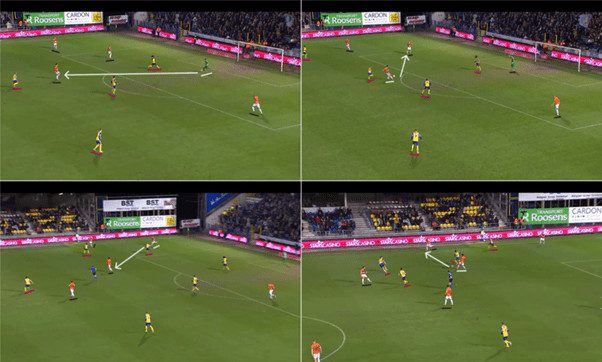
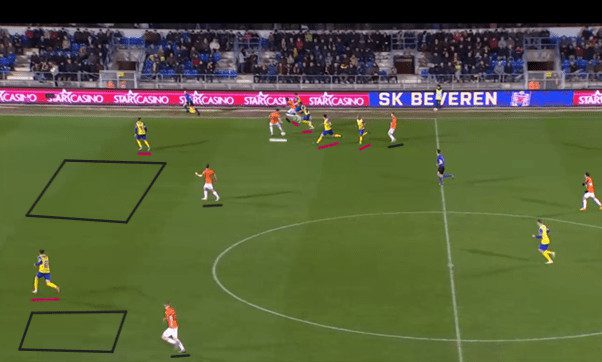
As mentioned earlier, an essential aspect of Deinze under Somers has been their flexibility, which the two examples above show as they use different passing patterns to get through different pressing methods and defensive set-ups. Both moves also show their preference for moving the ball through the right rather than the left.
Goals: Key performers
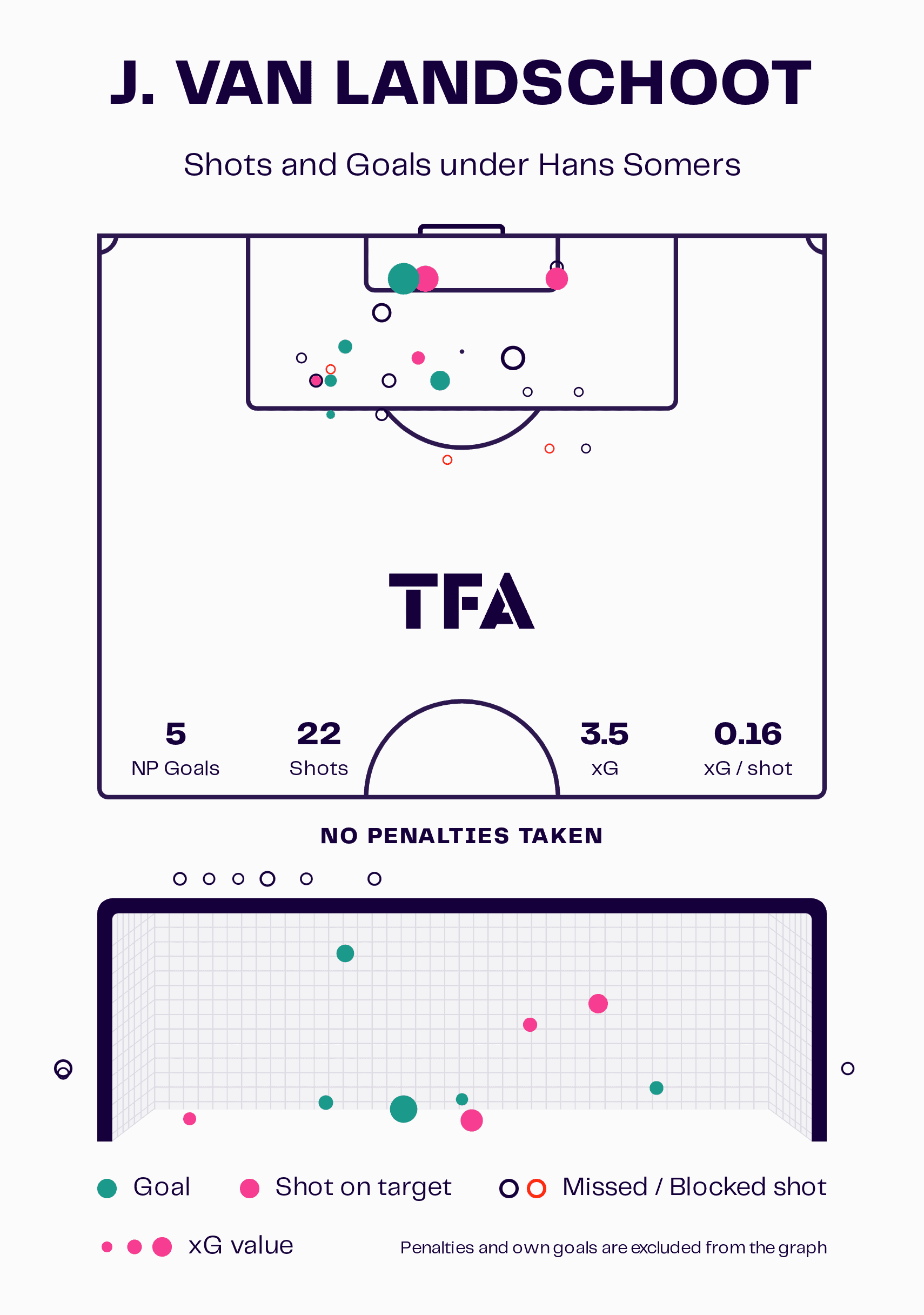
Van Landschoot has led Deinze in scoring since Somers’ arrival, racking up five goals in 13 matches. Quite a few of these goals have been the result of him arriving late in the left side of the box, from where most of his shots have come, as the map below shows.
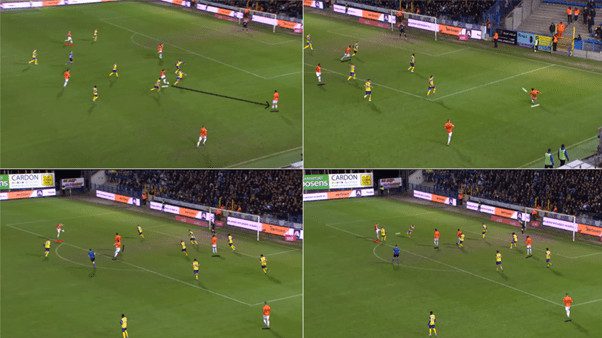
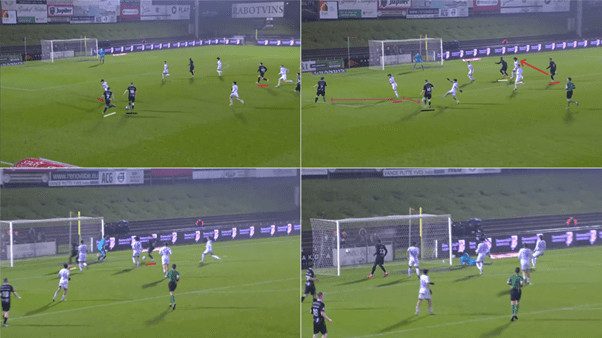
His goal against Beveren is an excellent illustration of both his goalscoring and offers a look at Deinze’s build-up play as well. The centre-back first breaks the first defensive line before sliding a pass to his teammate, who also moves forward. Deinze notably draw the opposing defense to the left, leaving the right open. However, acknowledging that a defender is in his way, the man on the ball plays a central pass. Notice how Van Landschoot (marked in red) is making a late run in the bottom two panels.
From there, the move shifts to the right and a first-time cross comes in. Van Landschoot controls the ball before lacing it into the back of the net via a minor deflection.
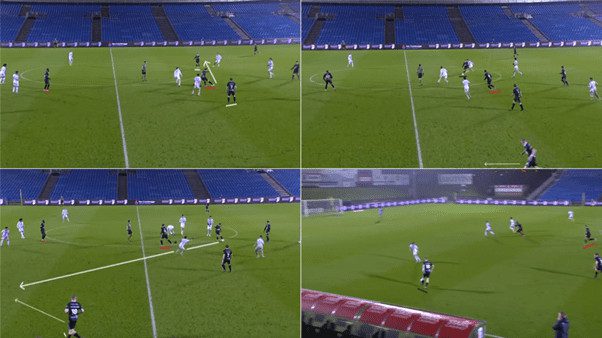
Mertens has been the other top-scorer for Deinze under Somers, also amassing five goals. The veteran centre-forward brings experience and an eye for goal, which has shone through in the last dozen games. His movement, in particular, has been excellent, as illustrated in the goal below against Anderlecht II, where he starts the move in his own half, makes his way forward and times his run perfectly to get in behind the defence and guide the ball home at the far post.
The goal also provides a look at how good Deinze is at moving the ball in transition, adding another weapon to their attacking arsenal. As the man with the ball moves forward, an excellent overlapping run takes the defender away from the ball, and in the end, the defender is caught in no man’s land, allowing a delivery to the far post.
Apart from these two, Hendrickx and Anne have chipped in with three goals each, while Quintero has netted twice. Schuermans, Kehrer, Kone, Mercier and Laurent Lemoine have scored one goal apiece, indicating that Deinze have rather effectively spread the scoring load amongst each other.
On the creativity side, Hendrickx has been key, notching up five assists since Somers’ arrival, most of those coming from set-pieces or crosses, in contrast to Deinze’s largely pedestrian set-piece numbers, as discussed previously. Alessio Staelens has recorded three assists, while Van Landschoot and Kehrer have two each. Alemenara, De Belder, and Anne have also provided an assist apiece.
Conclusion
Hans Somers’ project at Deinze is still in its initial stages, but the signs so far are extremely promising. The team has progressed in a few statistical areas while regressing in some others, but he has managed to keep their defence at a similar level to before while improving their attack.
What stands out about Deinze now is the variety of ways in which they have been able to score against opponents. With more matches under Somers, maybe they will develop a more consistent style of play, but for now, the diversity of their methods will keep opponents guessing. With only five league games left, a first-ever recorded promotion to the Pro League beckons.
