
Arne Slot Coaching Philosophy
As Liverpool FC embarks on a new chapter under Arne Slot, the club’s tactical setup has become a focal point for fans and analysts alike.
This tactical analysis report examines the distinct phases of play that define Slot’s strategic blueprint at Liverpool thus far, providing insights into the build-up, transition, and attack phases, as well as the team’s pressing and defensive strategies.
These elements collectively outline how Liverpool have been orchestrating play and adapting under pressure, emphasising Slot’s philosophy of integrating high work rate with tactical sophistication.
These insights into Arne Slot tactics at Liverpool showcase a blend of tactical intelligence and physical readiness, aiming for a balanced approach that adapts to the evolving dynamics of modern football.
This detailed exploration serves as the basis for further tactical analysis, utilising specific game footage from the most recent Premier League match against Manchester United.
Arne Slot Tactics And Formations
Arne Slot’s coaching philosophy at Liverpool has thus far been deeply rooted in a calculated approach to possession.
Patient build-up play and high-intensity pressing aim to establish control through technical and tactical superiority.
Unlike his predecessor, Slot’s strategy prioritises technical finesse over sheer physicality, creating a distinct shift in the team’s approach.
He has been employing a fluid 4-2-4 formation during the build-up phases to invite the opposition’s press, deliberately creating spaces for Liverpool’s attackers to exploit defensively.
This formation transitions seamlessly into a high-intensity pressing system when out of possession.
It focuses on tactical traps rather than relentless physical pressing, showcasing a blend of strategic foresight and adaptability.
Slot’s teams are designed to dominate possession, subtly luring opponents into traps through precise ball handling and movement, often leading to rapid transitions into attack.
His strategy integrates maintaining high fitness levels among players to meet the physical demands of his system while also instilling psychological resilience to complement the tactical framework.
Full-backs are pivotal in this setup; they often invert or move dynamically rather than adhering to fixed positions, which enables fluid attacking movements and creates numerical advantages in key areas of the pitch.
Phase #1 – Build-Up
The foundation of Liverpool’s play under Slot begins with a meticulously structured build-up from the back.
The team uses a flexible backline, often shifting between three and four defenders to adapt to their opponents’ pressing patterns.
Key to this phase is the goalkeeper’s distribution and the central defenders’ ability to play line-breaking passes, setting the stage for transitions into midfield.
Phase #2 – Midfield Transition
In the midfield transition, Liverpool under Slot’s style of play emphasises quick, vertical passing.
The goal is to exploit spaces between the lines through dynamic movement from the midfielders, with the wingers tucking in.
This phase is crucial for destabilising opponent structures and creating opportunities for attack.
Phase #3 – Attacking Phase
The attacking third focuses on high-intensity and rapid exchanges, emphasising the width provided by the full-backs and intricate interplays within the box.
Slot encourages overlapping runs and midfield support to increase numbers in attack, aiming to maximise shot opportunities through calculated risk-taking.
Phase #4 – Pressing The Opponent’s Third
Liverpool employs an aggressive high press designed to force turnovers in advantageous positions.
This press is initiated by the forwards and attacking midfielders, who set traps and apply pressure based on cues such as the opponent’s body orientation and pass direction.
Phase #5 – Defensive Structure
When out of possession and under pressure, Liverpool adopt a shape around compactness, focusing on restricting passing lanes and central areas.
Depending on the situation, the team shifts into a mid or low block, emphasising collective movement and spatial awareness to minimise vulnerabilities.
Liverpool Build-Up Vs Manchester United
In Arne Slot’s tactical setup at Liverpool, the team employ a flexible 4-2-4 formation during the build-up phase to distribute the opponent’s defensive structure, as seen in the image below.

Slot uses this shape to exploit space by dynamically moving his players, particularly within the double pivot and winger roles.
When facing intense man-marking, one of Liverpool’s double-pivot midfielders pushes higher up the pitch.
This movement pulls the marking opponent out of position, effectively creating space behind the midfield line.
In the scenario below, Luis Díaz drops into this newly created space, transitioning from his traditional winger role to a more central position where he can receive the ball with greater freedom.
From this position, Liverpool can target the ‘free man’—in this case, the full-back on the right side—allowing Díaz to switch the ball across and break the press.
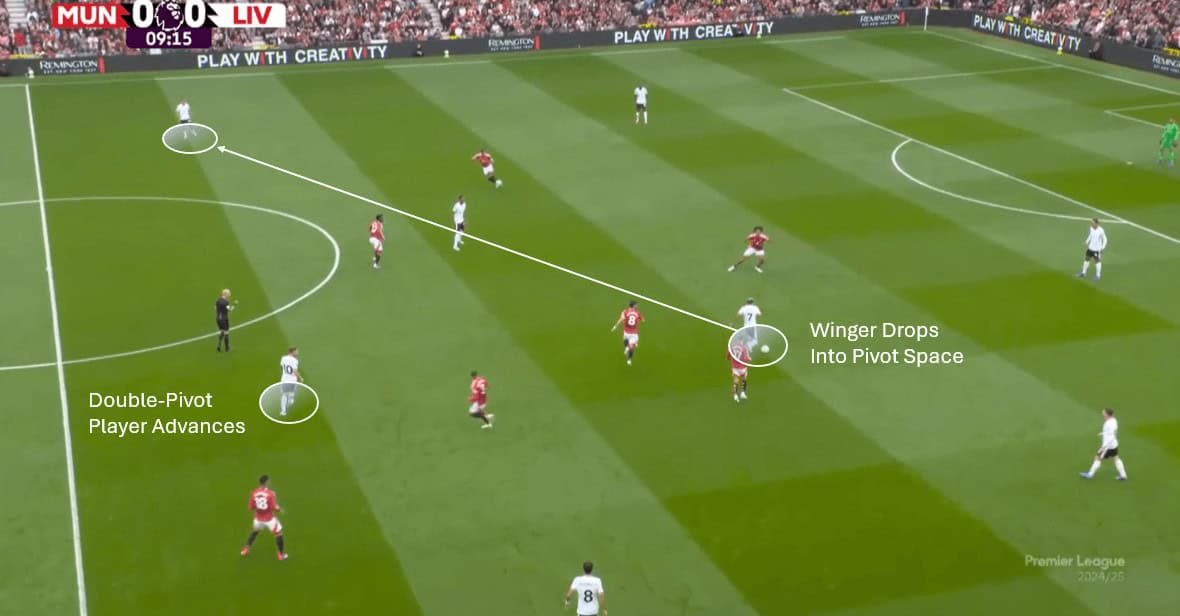
This movement plays a crucial role in disrupting the opponent’s defensive structure by pulling defenders out of position and breaking their press.
Díaz’s ability to drop back and exploit the newly created space allows him to either drive forward with the ball or redistribute it, taking advantage of the disorganisation in the opponent’s setup.
This tactical manoeuvre not only helps maintain possession under pressure but also progresses the play into more dangerous areas.
Slot’s approach showcases a blend of tactical intelligence and player fluidity.
Slot turns defensive pressure into offensive opportunities by outmanoeuvring the opponent’s man-marking schemes.
This strategy highlights his emphasis on control, space exploitation, and tactical flexibility, which are crucial for navigating high-pressure situations and advancing the team’s attacking objectives.
Liverpool Midfield Transition Vs Manchester United
As highlighted in the series of images provided, a key element in the strategic execution of Liverpool’s midfield transition under Arne Slot’s coaching style is how the team has been manipulating the opposing press to their advantage.
Liverpool’s setup focuses on spreading their backline wide, which stretches Manchester United’s press and opens up central gaps.

This spatial setup forces United’s players to choose between staying compact in the middle and extending their press out wide.
When a United player opts to press a Liverpool player positioned on the flank, it triggers a well-coordinated response from Liverpool.
With a simple horizontal pass along the backline, the wide player can easily bypass the press.

This sequence is illustrated in both images above, where Liverpool’s defenders effortlessly pass the ball horizontally across the back, effectively breaking through United’s pressing attempts.
The space generated by this manoeuvre enables Liverpool to advance the ball forward easily.
The success of Liverpool’s strategy is further emphasised by the positioning and roles of United’s forwards during the press.
For example, Zirkzee’s hesitation to close down Virgil van Dijk and Rashford’s inability to effectively invert and pressure Konaté give Liverpool the advantage.
As United’s players find themselves torn between pressing and blocking spaces, Liverpool’s backline capitalises on these hesitations, maintaining possession and pinning United into a passive mid-block devoid of adequate pressure.
This tactical nuance not only allows Liverpool to maintain control over the game’s tempo but also highlights their skill in manipulating and dismantling structured defensive setups.
Liverpool Attacking Phase Vs Manchester United
In Arne Slot’s tactical design at Liverpool, the attacking phase highlights a sophisticated manipulation of space and player movement, particularly between the wingers and central midfielders.
This dynamic becomes clear as Liverpool moves into the final third, where a strategic interchange between the wingers and the number 8s plays a crucial role in disrupting the opposition’s defensive structure.

Luis Díaz, playing as a winger, intelligently drops a few yards back towards the midfield rather than maintaining a higher, fixed position on the flank.
This movement is strategic; it creates space in the area he vacates, which is quickly exploited by one of Liverpool’s central midfielders—Mac Allister, in this instance—who pushes forward into the winger’s zone.
This fluid interchange between Díaz and Mac Allister creates a dilemma for Manchester United’s defence.
The space now occupied by Alexis Mac Allister forces United to decide whether to track him with a defender or midfielder.
If United fails to cover him adequately, Mac Allister gains the freedom to drive into the box, posing a significant threat close to goal.
Should a United player shift to mark Mac Allister, this adjustment potentially weakens their central defensive structure, exposing them to further attacks.
Such tactical rotations are characteristic of Slot’s approach to the attacking phase, where Liverpool uses structured yet fluid player movements to stretch the defence both vertically and horizontally.
This not only tests opponents’ defensive discipline but also maximises the effectiveness of the space created by these tactical shifts.
Liverpool can maintain pressure in the attacking third through these manoeuvres, constantly challenging the opposition’s ability to adapt and reorganise defensively.
A similar tactic unfolds on the opposite wing, as seen with Mohamed Salah and Ryan Gravenberch.
Salah, like Díaz, drops back slightly, pulling a defender with him and opening space behind.

Gravenberch moves into this space, mirroring Mac Allister’s earlier movement.
This off-the-ball movement is crucial in advancing the team’s attacking movements forward.
Notably, Zirkzee is seen directing a teammate to cover this new threat, underscoring the challenges opponents face in adapting to Liverpool’s fluid attacking movements.
This consistent strategy of position swapping and space creation exemplifies how Liverpool under Slot effectively manipulates defensive structures, making it difficult for opponents to maintain a cohesive defensive line.
Liverpool Pressing Vs Manchester United
In the pressing phase within the opponent’s third, Liverpool FC, under Arne Slot tactics, have been demonstrating a structured yet aggressive approach to disrupt the opponent’s build-up and force errors.
This strategy is exemplified in the scenario captured in the image you provided, where Liverpool adopt a 4-2-4 formation during their press.

This setup positions players strategically across the field, facilitating targeted pressing actions from key players.
Mohamed Salah, typically known for his attacking prowess, inverts onto Manchester United’s Martínez, effectively cutting off central defensive options.
This inversion is crucial as it forces United to consider less optimal passing lanes.
Dominik Szoboszlai, demonstrating Liverpool’s tactical flexibility, drops deeper to engage United’s #6, disrupting their pivot and further limiting their ability to play through the midfield.
Meanwhile, Ryan Gravenberch aggressively advances to press, highlighting Liverpool’s intent to compress the play and restrict the opposition’s space and time on the ball.
This coordinated press is designed to funnel United into playing the ball towards a specific side—usually where Liverpool can exploit numerical or positional advantages.
Once the ball is played to a United full-back, Liverpool’s nearby players quickly converge to apply pressure.
Consider this other example below.

As United’s Diogo Dalot receives the ball on the wing, Liverpool’s setup has already funnelled play towards this side.
By narrowing United’s operational space, Liverpool creates a tactical trap.
Once Dalot is in possession, a Liverpool central midfielder swiftly advances to apply pressure.
This assertive move forces Dalot into making a quick decision with limited options; he can either attempt a risky forward pass under pressure or, more likely, opt for a safer choice by passing the ball backwards to his goalkeeper or a central defender.
This pressing action is a crucial aspect of Liverpool’s game plan, aiming to limit the opponent’s ability to progress the ball effectively and force them into areas where Liverpool holds numerical or positional superiority.
By confining United to one side and then aggressively closing down on the ball carrier, Liverpool not only disrupts United’s intended play but also keeps them contained in a part of the field where they can apply intense pressure, potentially leading to a turnover or a mistake.
This tactical manoeuvre exemplifies Slot’s sophisticated approach to pressing, combining strategic positioning with proactive defending to dominate space and control the flow of the game.
This tactic not only reduces the opponent’s available options but also increases the likelihood of winning the ball back in a dangerous area, allowing Liverpool to transition rapidly from defence to attack.
This pressing strategy is a hallmark of Slot’s philosophy, emphasising high energy, strategic positioning, and collective effort to regain possession and keep the opponent under constant duress.
Liverpool Defensive Structure Under Pressure Vs Manchester United
The first image illustrates that Liverpool initiate their defensive actions in a 4-2-4 formation when pressing high up the field.

This setup enables Liverpool to apply pressure across the width of the pitch, aiming to disrupt the opponent’s buildup and force turnovers in advantageous positions.
However, when the opponent successfully advances past the halfway line, Liverpool’s strategy shifts significantly to counter the new threat.
As they transition into their own half, Liverpool quickly reorganises into a 4-4-2 formation.
Notably, this isn’t a typical flat 4-4-2; instead, it features a staggered arrangement of the two central midfielders, forming a vertical rather than horizontal double pivot.

With one midfielder positioned deeper behind the other, this vertical alignment allows Liverpool to cover more depth, offering enhanced protection against through balls and effectively managing the space between the midfield and defensive lines.
This vertical pivot system enables Liverpool to control both the depth and width of play defensively.
The deeper midfielder acts as a shield in front of the defensive line, intercepting any penetrating moves.
In contrast, the more advanced midfielder presses opponents who receive the ball in midfield, limiting their time and space to turn and create.
This structured yet adaptable defensive setup exemplifies Slot’s tactical acumen.
It strikes a balance between aggression and strategic caution, tailored to the game’s flow and the opposition’s movements.
Conclusion
Throughout this tactical exploration of Liverpool’s strategies under Arne Slot tactics, we’ve delved deeply into the methodologies that have distinguished Liverpool in today’s football landscape.
The comprehensive analysis highlights how Liverpool’s innovative use of space, pressing tactics, and strategic midfield transitions contribute to their dominant performances.
Insights from key matches demonstrate Arne Slot style of play and Liverpool’s ability to manipulate game dynamics, forcing opponents into unfavourable positions and exploiting tactical mismatches.
In conclusion, Arne Slot’s tactical acumen clearly strengthens Liverpool’s competitive edge and deepens our understanding of evolving game strategies in modern football.
This examination of Liverpool’s tactical approach highlights a broader shift in the sport, where cerebral and adaptive tactics are continually redefining the game’s boundaries.
