
In 2015, Andoni Iraola decided to leave Athletic Club Bilbao after a 15-year stay.
Commonly a right back, he was an outstanding player for his dedication, maturity, effort in each match, and passion for his shirt.
Under the guidance of various coaches, including Marcelo Bielsa and Ernesto Valverde, Iraola decided to become a manager in the final stage of his career.
However, he still did not know what would become of him after retirement.
The decision was made in New York City, thanks to Patrick Vieira.
After giving up his playing career, the former Arsenal player was sarcastically guilty of the Spaniard’s decision to become a coach.
Under a positional football concept, Iraola felt drawn to his conversations with the former legendary midfielder of the Premier League.
He wanted to understand things that weren’t in his mind as a player, and Patrick was happy to teach him.
It was in 2017 that he decided to hang up his boots and later lead AEK Larnaca in Cyprus.
It was an experience that he liked a lot because, according to him, it tested what he thought and whether that would work in football.
Then, with Mirandés, he reached the semi-finals of the Copa del Rey with such a good and fun football idea that gave him the right to be now the fashionable coach in La Liga with his Rayo Vallecano at only 40 years of age.
This article will be based on a tactical analysis of Iraola’s tactics at Rayo Vallecano, together with an analysis of the team in both phases of the game.
Andoni Iraola Intensity off-the-ball
Andoni varies between a compact system that is usually a defensive 4-4-2 or 4-5-1, which awaits the rivals in the mid-block.
However, ideas have fluctuated, and Rayo Vallecano has become a team that presses very high, with great and positive aggressiveness and certain interesting positions within the defensive ideas of the former right-back.
First, we can discuss the statistical aspect of Rayo’s defensive game, as it is here where we can see the sign that they are an extremely proactive team when defending, registering a PPDA of 7.62, which is the third-lowest among teams that allow fewer passes before taking defensive action.
The positionings vary depending on the opponent, the opposition’s setup in the build-up, and their intentions.
They have adopted the same approach, playing face-to-face against teams like Valencia, Sevilla, or Real Madrid, which they could potentially win 3-2 at home, for example.
There are clear ideas of how they want to defend their rival beyond the fact that certain things vary.
In principle, one of the wingers, mostly the left, closes his position to defend the central defenders and the centre-forward.
Behind, the rival #6 is nullified by the #10 of the Vallecas team.
Further back, the double pivot midfielders also seek to block the opposition’s options in that area.
However, many of the turnovers they force occur in the central channel, thanks to their clever triggers, which avoid taking their marking too close or too far.
Meanwhile, the right-winger tries to press the rival full-back.
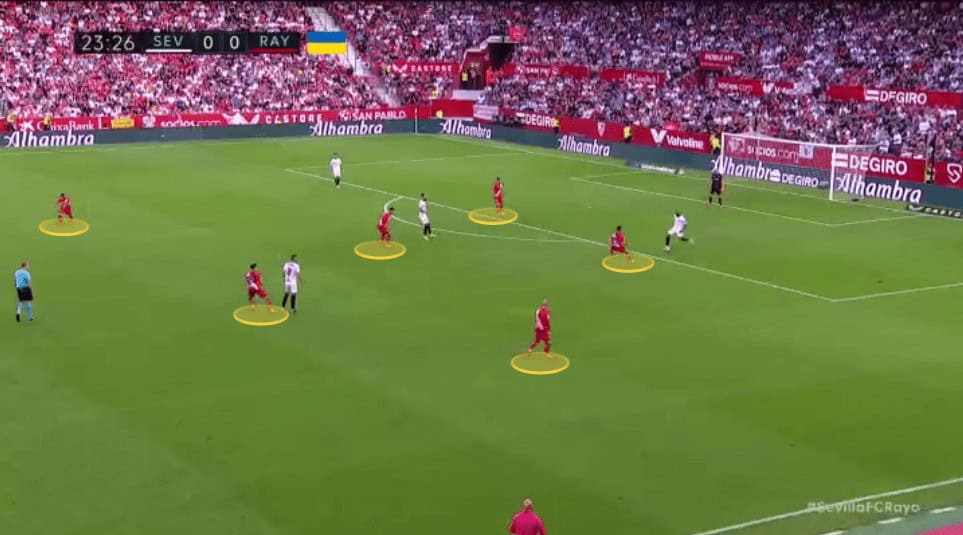
But as we mentioned, things vary due to the situations that the rival team wants to create with the ball.
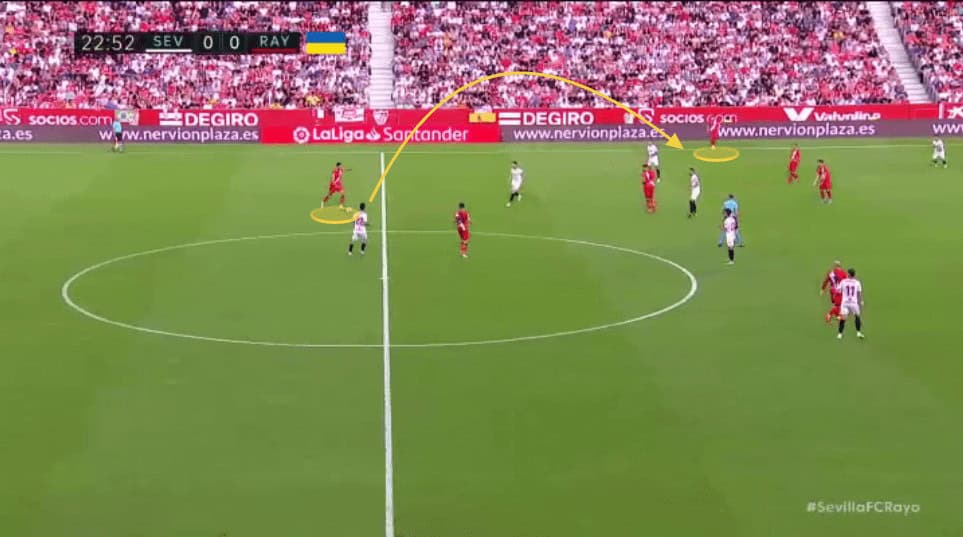
For example, in the first figure that we show, Sevilla sends their full-back relatively high; therefore, Rayo Vallecano’s left-back remains low with his line, in the same position as his opponent, who looks to threaten him.
Nevertheless, Fran García is the usual LB.
It is common to see him higher doing a very good pressing job since he is a highly dynamic and aggressive player, as well as having a tremendous physique and effort that allows him to advance meters on the field to defend as a winger and the teams have all their low options to escape the pressure blocked.
The collective work has done a great job in this sense to not only win possessions but how dynamic and fast they are after stealing and counter-attacking, which is something quite integrated that many have, in addition to having footballers with a solid technical level such as Óscar Trejo or Isi Palazón in this last third of the pitch, where normally Rayo wants to create their game.
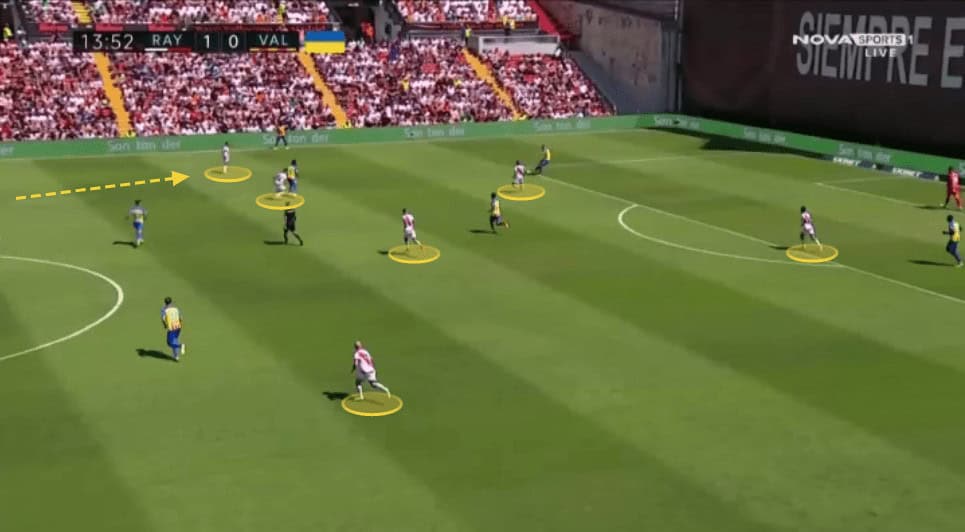
However, when forced by teams that manage long and high possessions up the field, they have a compact block in which they still try to be aggressive and proactive in pressing.
It is something usual to see how Rayo can jump out to steal with one of their forwards to the central defenders with the ball in a high block.
The midfielders set the tone, as does one of the forwards if defending in 4-4-2.
They seek to force the ball holder to play to one side, and the triggers are activated by one or two players on the other side of the pitch.
It is quite an intelligent facet of the team that always tries to get the rivals out of their third and keep them away from the box.
The more they let them progress, the more chances of doing damage there will exist, so this intensity is handled in each third.
The triggers to steal the ball aggressively are constant in many areas, no matter in which zones the opponent wants to create progression.
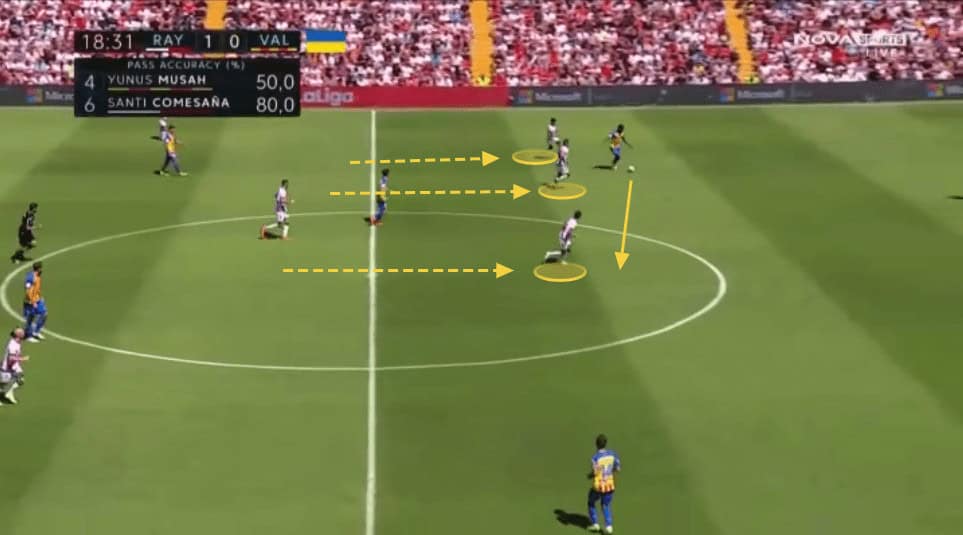
Andoni Iraola has worked with coaches who have developed extremely innovative defensive ideas over the years.
Bielsa and Valverde are two characters in this area that have been characterised, one for being the king of intensity and high pressing, and the other for being compact but chameleonic to adapt to high, mid pressing or solid blocks such as Valverde.
He has been inspired by ideas such as man-marking or those aggressive jumps in a 4-4-2 block.
Despite certain errors in defending the penalty box and, on certain occasions, his team can be exposed in counter-attacks, Iraola is forming a really interesting defensive system in La Liga.
Positional football
Ernesto Valverde and Patrick Vieira seem to have had a significant influence on him in this regard.
Andoni Iraola is a fan of positional play.
He wants his players to take charge of specific zones, look for width, and turn the side of the game constantly, especially with a rather high emphasis on finding the free man.
He comments that this idea of a free man was one of the things that most attracted him to Vieira’s 4-3-3, which motivated him much more to understand football in a different way and dedicate himself to being a coach to continue living within football.
One of the things that he was most delighted with was how he understood how to play as #6, something that Patrick knew perfectly, and it is something that we will see later that he took from him.
Within a 4-2-3-1, Rayo Vallecano is a team that quickly finds itself in a high block, their players take charge of the position for which they are responsible and occupy all the channels on the field.
They are capable of managing quite long possessions with ball movements from side to side or inside and back in a repetitive cycle in order to open up spaces in the opposing block.
This side-by-side and inside-back search is one of the clearest ideas of his team.
Within their shape, both full-backs go high and attack deep the last line of the pitch.
The left-winger is more open and drives inside looking to create 1-2 with his LB.
The #10 is mobile depending on where the ball moves, the striker is more fixed with one-touch supports, and the right-winger, Isi Palazón, plays inverted in a role that has suited him perfectly.

At Rayo Vallecano, several things become clearer when they have the ball.
They seek to fill the last defensive line.
Óscar Valentín from the double pivot is the player who stays the most, and that is where Patrick’s teaching comes in, to hand over the responsibility ahead of the defenders purely to one player, the #6.
His defensive and offensive movements say a lot about this, in addition to being the one who dictates when to change the side of the game, together with his centre-backs.
The movement to pin rival players is something that occurs with complete consistency and normality within the team.
The wingers look to fully open the channels to their full-backs, but even though the LW plays closer to the LB, these moves are always to find the free man pinning rivals.
The idea will always be to touch and touch, until the free man appears thanks to the direction of the ball, which, by going from side to side and out to in, moves the rival block completely.
The right moment will arrive, patiently, but it will.
As Guardiola has said many times, within his positional football, everything revolves around the ball, and if the ball moves quickly, spaces are created to progress.
Something interesting about Iraola is that much of his attacking threat comes from the speed and inventiveness of his wing players.
The LW, LB or the RB.
The RW, in this case, Palazón, is a player who relies more on holding and pausing than on dynamism and dribbling.
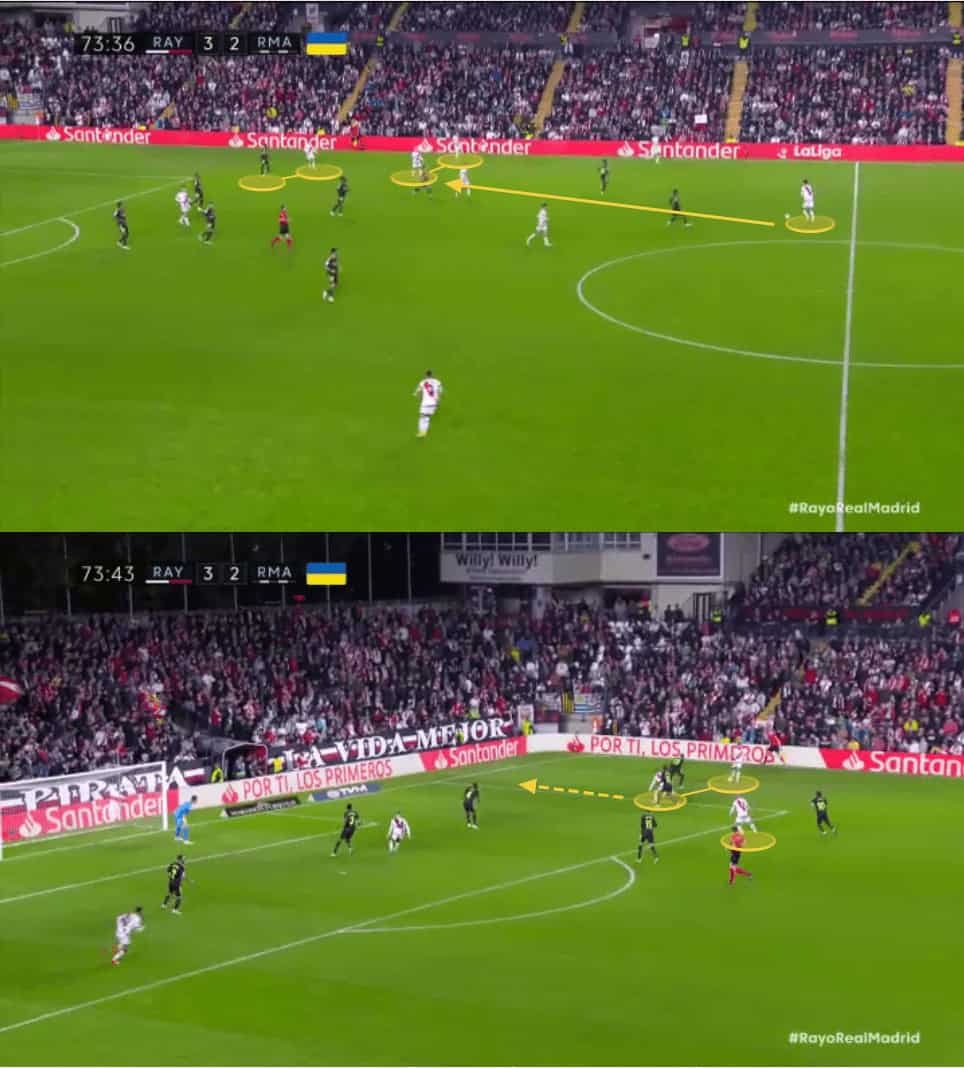
The figure above is important because we can appreciate several things.
How important is the #10, Trejo, moving through different channels, in this case, almost wide open?
Plus, where Palazón’s receptions are located and the width of his full-backs, in this case, the RB.
But beyond that, in general terms, it is their positioning that generates multiple pinnings to be able to progress and find the free man, which was Isi Palazón in the half-space, an area quite used by him and Trejo.
Another thing that draws a lot of attention within Iraola’s team is how well the central defenders progress and play with the ball at their feet.
With few complications, they move from side to side, but when they execute a pass between the lines, they do it well.
They have a good long ball if the opportunity arises, and they look within the idea of the former Basque player, to find the free man who they normally look for on the outside.
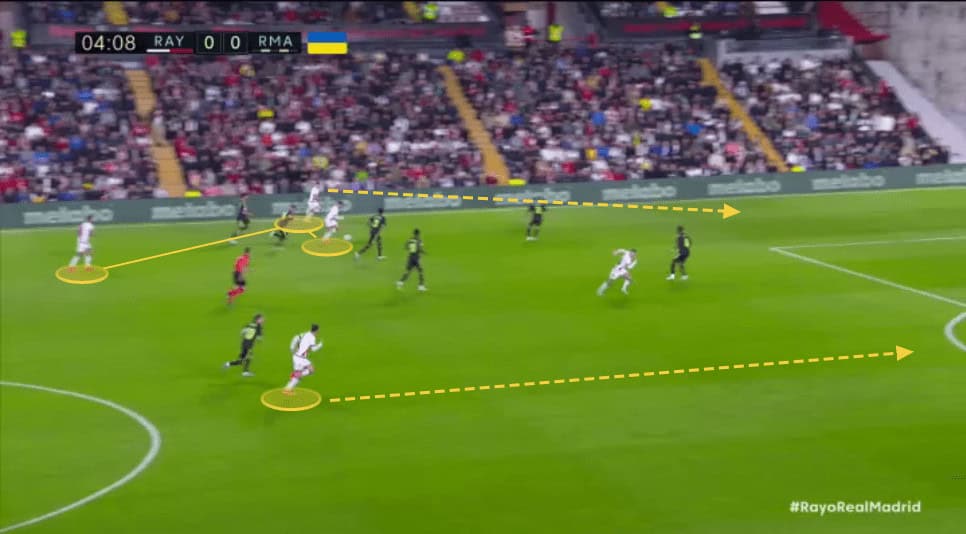
The dragging movements are also a constant, in order to generate third-man runs that have been made showy and regular by Santi Comesaña, one of the members of Vallecano’s double-pivot, who has become a key player in attacking the penalty area and providing progression as well as being one more attacker for the team.
The movements in the last third, especially from the striker, the attacking midfielder and Palazón, are extremely constant, which allows markings to be dragged, rivals pinned, and the pass appears for one of the players to create diagonal runs or movements into space.
If it is not possible and it is very risky, they will continue to play passes side-to-side until the block is broken.
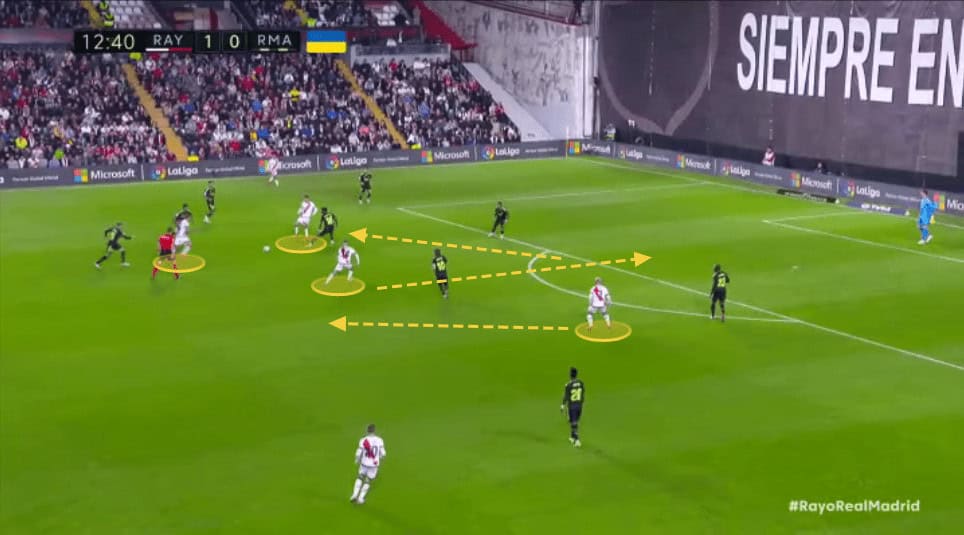
There is a clear emphasis on generating threat on the outside, which is activated thanks to the approaches of at least two players to form the 3v2 out wide with the FB.
This is something that has been done many times in Iraola’s team, seeking to load one zone to release the other or, in such a case, to progress through it if the pass appears.
Trejo and the LW, Alvaro Garcia, are players who have perfectly understood this.
They are changing channels, waiting to touch, moving the rivals, dragging them until one player draws the run, which is normally always created thanks to the teammates for the full-back to be mainly the one who runs into space to then send crosses into the box with time to decide.
This will always be accompanied by the mentioned movements by Comesaña, who was able to score against Real Madrid thanks to his intelligence, along with what his striker did off-the-ball, moving one of the defenders to create free space for him to take the shot.
Again, the idea is integrated into the player’s mind: We move and drag to create the free man.
Andoni Iraola’s team has become fashionable in Spain and little by little throughout the world.
His modern approach to the game, which incorporates various tones thanks to the coaches he worked with in different phases, makes it particularly interesting as he explores how to play football within his mind.
As soon as you see a build-up, you find meaning in many movements and positioning of their players, as well as passes, even if they seem boring or repetitive, but then can make their team one of the best in the country.
You can also see it in players who are quite passionate and have fun when playing inside the ‘Rayo’.
Conclusion
Rayo Vallecano values width, long possession, standing up to giant rivals from La Liga, and possessing a very courageous personality on the pitch.
In addition, they are brave enough to steal the ball from you.
Andoni Iraola has integrated a game model and an identity into the Madrid team, which is experiencing a dream moment thanks to his coach and the quality of footballers at its disposal.
