
In the upcoming edition of FIFA Women’s World Cup 2023, China will participate in Group D with England, Haiti, and Denmark. Unfortunately, China, who won the 2022 AFC Women’s Asian Cup, failed to win a single match in 2023. They lost against Spain and Sweden and played to a draw against Switzerland and the Republic Of Ireland
They are not considered a frontrunner in the tournament, but the Chinese have participated in the FIFA Women’s World Cup eight times (including 2023). Only in 2011 did the nation fail to qualify. China made their debut in 1991. Up until 2019, their best performance has been runners-up in 1999. China have hosted the Women’s World Cup twice — in 1991 and 2007.
Wang Shuang is considered their key player, offering good pace and the ability to play as a striker or a winger. Zhang Linyan is a promising player who is good at dribbling which helps the team in progression. Wang Shanshan, their captain, is one of those rare players who can play at both ends of the pitch with aplomb. In the 2022 AFC Asian Cup, she was fielded as a centre-back in the semi-final and final, yet passed the test with flying colours.
This scout report in the form of a tactical analysis will provide a detailed analysis into China’s tactics under Shui Qingxia.
Predicted starting XI
China has predominantly relied on the 4-4-2 formation as their foundation. Coach Shui Qingxia depends on this narrow formation which greatly helps them in defence where they defend in a mid or low block depending on the transitions to the wingers using the two strikers as targets to hold up play.
In goalkeeping, the choice ranges between Xu Huan, Zhu Yu and Zhao Lina. However, Xu Huan is the undisputed number one for China between the sticks. The 24-year-old keeper of Jiangsu LFC is the most-trusted lieutenant of Qingxia between the sticks and should have the gloves in the World Cup. Meanwhile, Zhu Yu should be the second-choice keeper. She was given an opportunity to impress against Sweden and claim the No. 1 spot but conceded four goals in that match which saw Xu brought back against Ireland.
Qinxia depends on a four-player backline. They usually play deep to keep things tight at the back. Li Mengwen should be the first choice as the right-back, but, if she is unfit, then Gao Chen can slot in her place. Wang Xiaoxue and Li Jiayue are the two first-choice centre-backs. Chen Qiaozhu is the first choice for the left-back position. The 23-year-old plies her trade with Meizhou Hakka in the Chinese league.
It is mainly a four-woman midfield with Yao Lingwei contingent with the responsibility to be the holding midfielder who stays at back. She is supported by Zhang Rui, who has to go forward and join the attack.
On the flanks, Wang Shuang and Zhang Linyan are preferred for the right and left-wing positions, respectively.
Wang Shanshan is likely to be partnered with Li Ying up front. Their coach depends on them in long balls to act as targets to hold up play and then pass to the wingers. Sometimes, Qinxia turns to Wang Shuang, or one of the wingers, to be a second striker to exploit her pace in transitions.

Shui Qingxia’s possible choices’ age profile is shown below.
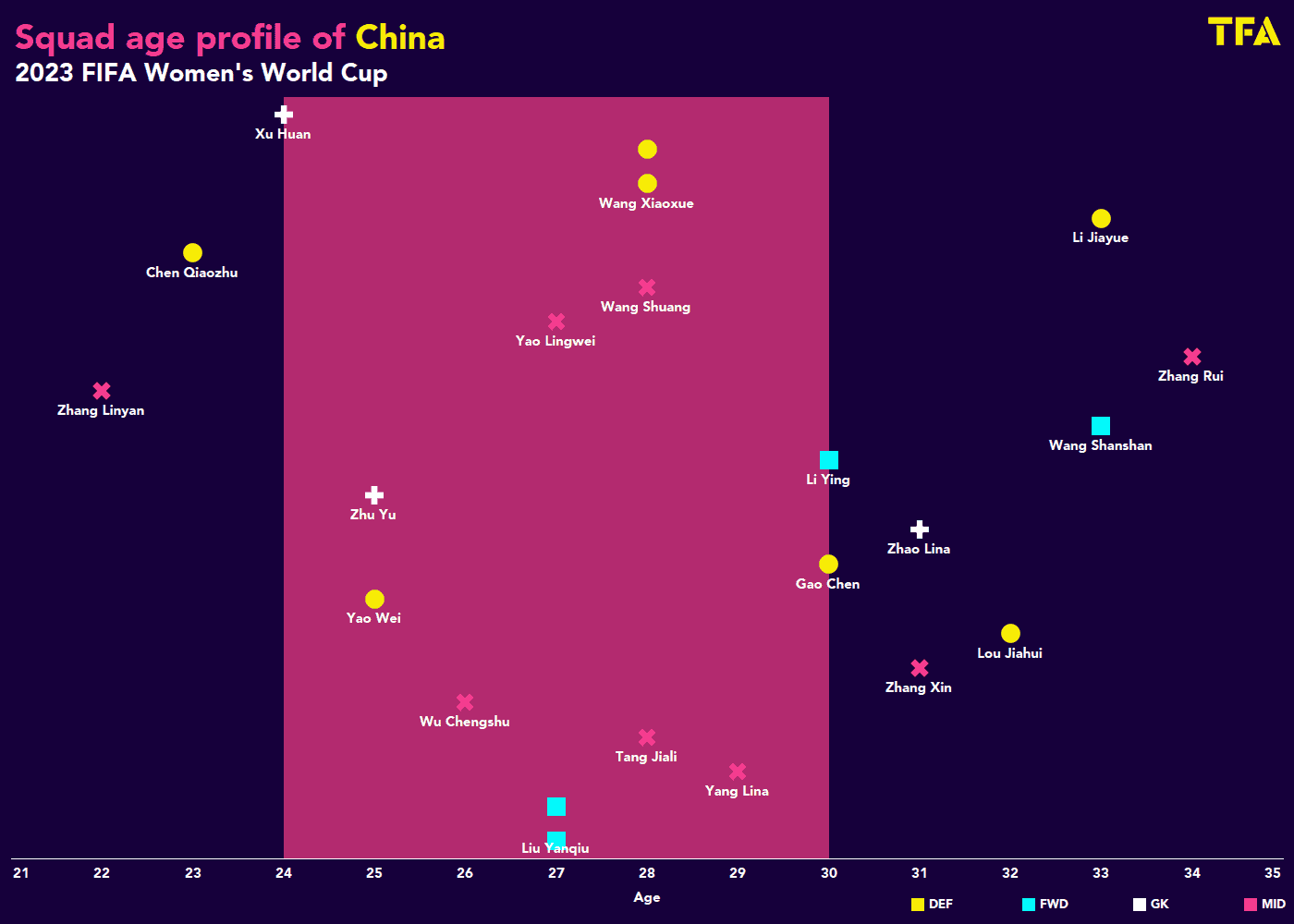
The coach’s choices are a mix of experience and youth. The experience represented by Wang Shanshan and Zhang Rui to withstand the pressure and help the rest of the players and the youth like Zhang Linyan and Chen Qiaozhu to make quick transitions on which they depend.
Attacking phase

The statistical data presented offers valuable insights into the team’s playing style. With a possession ranking in the 5th percentile, it becomes evident that they prioritise other aspects of the game over maintaining extended periods of ball control and how they depend on direct transitions.
All the rankings show that they don’t depend on short passes and don’t spend time in the in-possession phase. They also need to improve in attacking as shown in goals per match and even xG per shot rank.
The great set-pieces efficiency is further reflected in their 75th percentile ranking which shows how they put plenty of eggs in the set-piece basket; we can now say that they mainly depend on direct transitions and set-pieces.
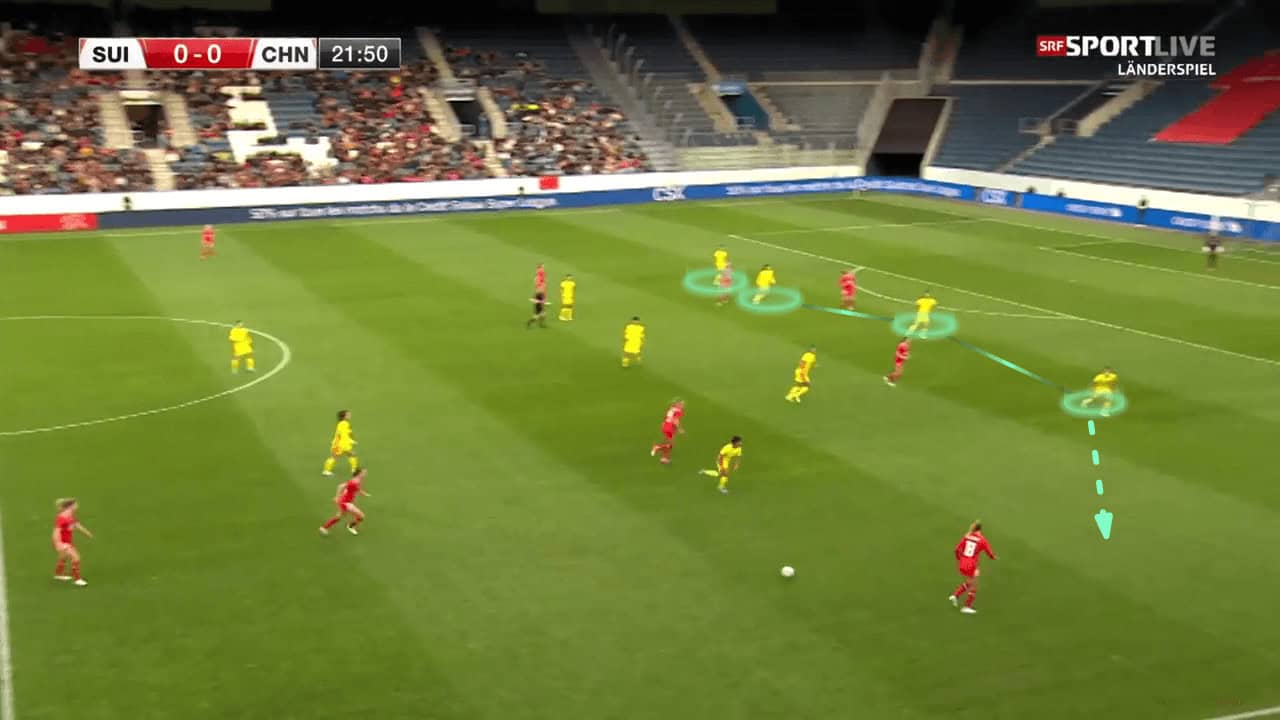
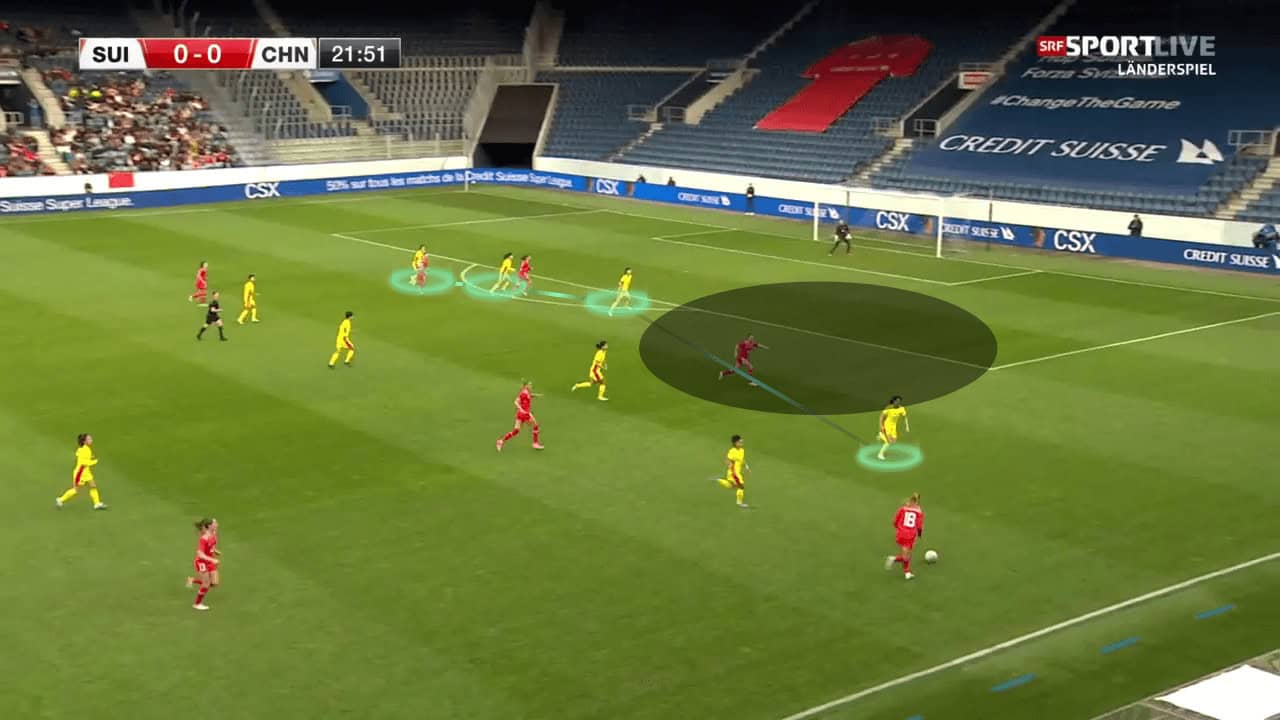
Here below, against Japan, it is shown that they don’t prefer short passes, rather they like long goal-kicks in their 4-4-2 formation using Wang Shanshan as a target. She flicks the ball to the second striker, highlighted in black.

The second striker passes the ball back to the right winger who will pass the ball to the narrow left winger.

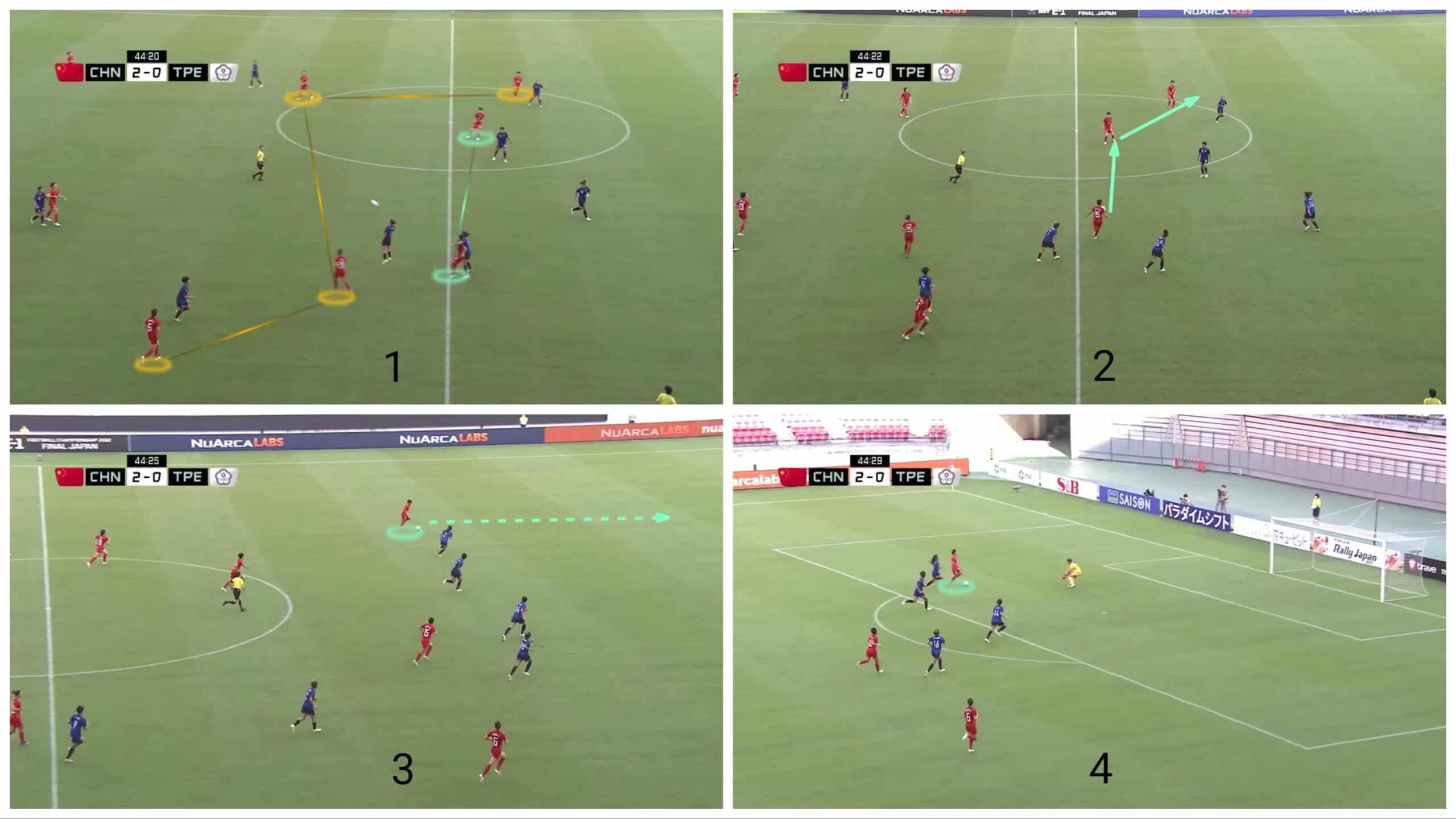
They also use another strategy in long goal-kicks which depends on the striker’s ability to receive the ball and hold up play, as shown in the first picture, to pass it to the second striker who will change the side quickly as shown in the second picture. Zhang Linyan, who is the left winger, carries the ball using her ability in dribbling and pace. The result is a good opportunity to score a goal as shown in the third and fourth pictures.
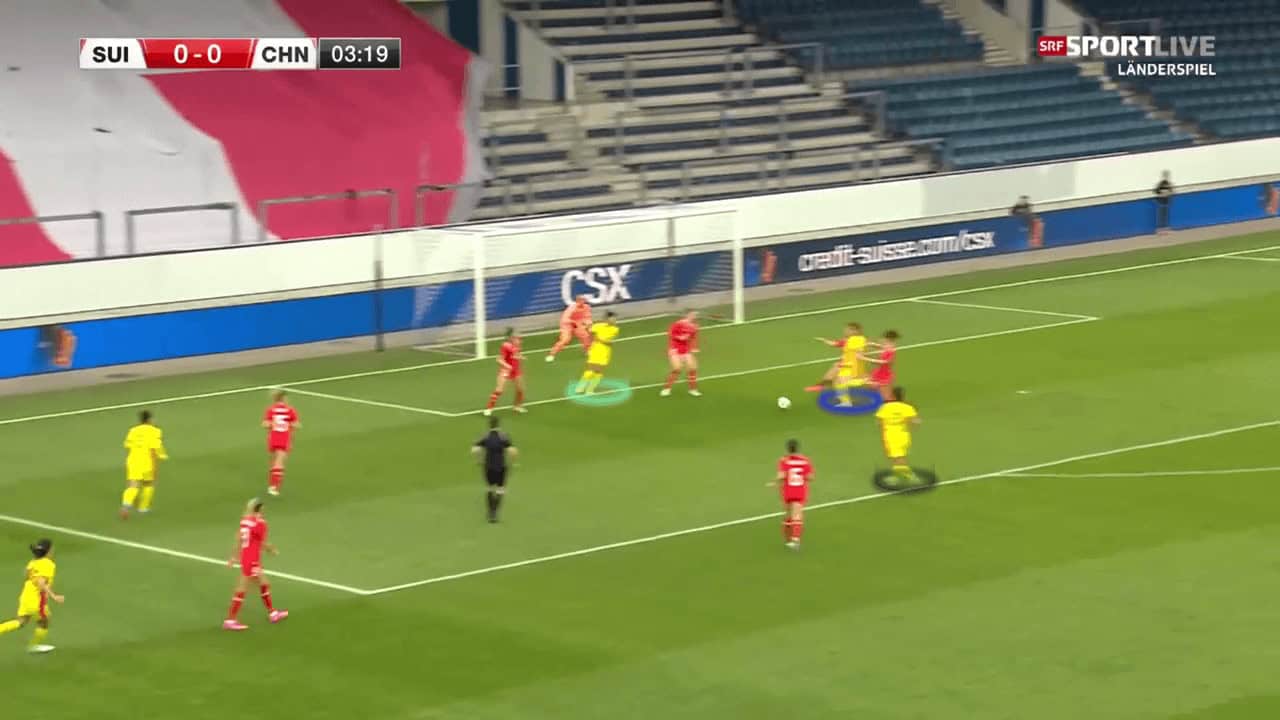
China also depends on wide rotations on the flanks, with the help of their 4-4-2 formation, as shown below. The trio of the full-back, the winger and the striker near the ball makes them carry out a double pass between the striker and the winger who can play the cross.

In the box, the second striker, in green, attacks the near post while the opposite winger, in blue, goes to the far post and the midfielder, in black, waits for the rebound.
Sometimes, they depend on a 4-3-3 formation as shown in the first picture depending on the principle of overload to isolate. As shown below in the first and second pictures, the right winger has the ball on the right flank. She passes the ball back to the centre-back who passes it quickly to the midfielder, in green arrows, while the left-back, with a yellow arrow, runs on the opposite flank using the narrow position of the left winger in black. In the third picture, the midfielder passes the through ball to the left back which forces the opponent, in the fourth picture, to go to him leaving the space behind her to the winger.

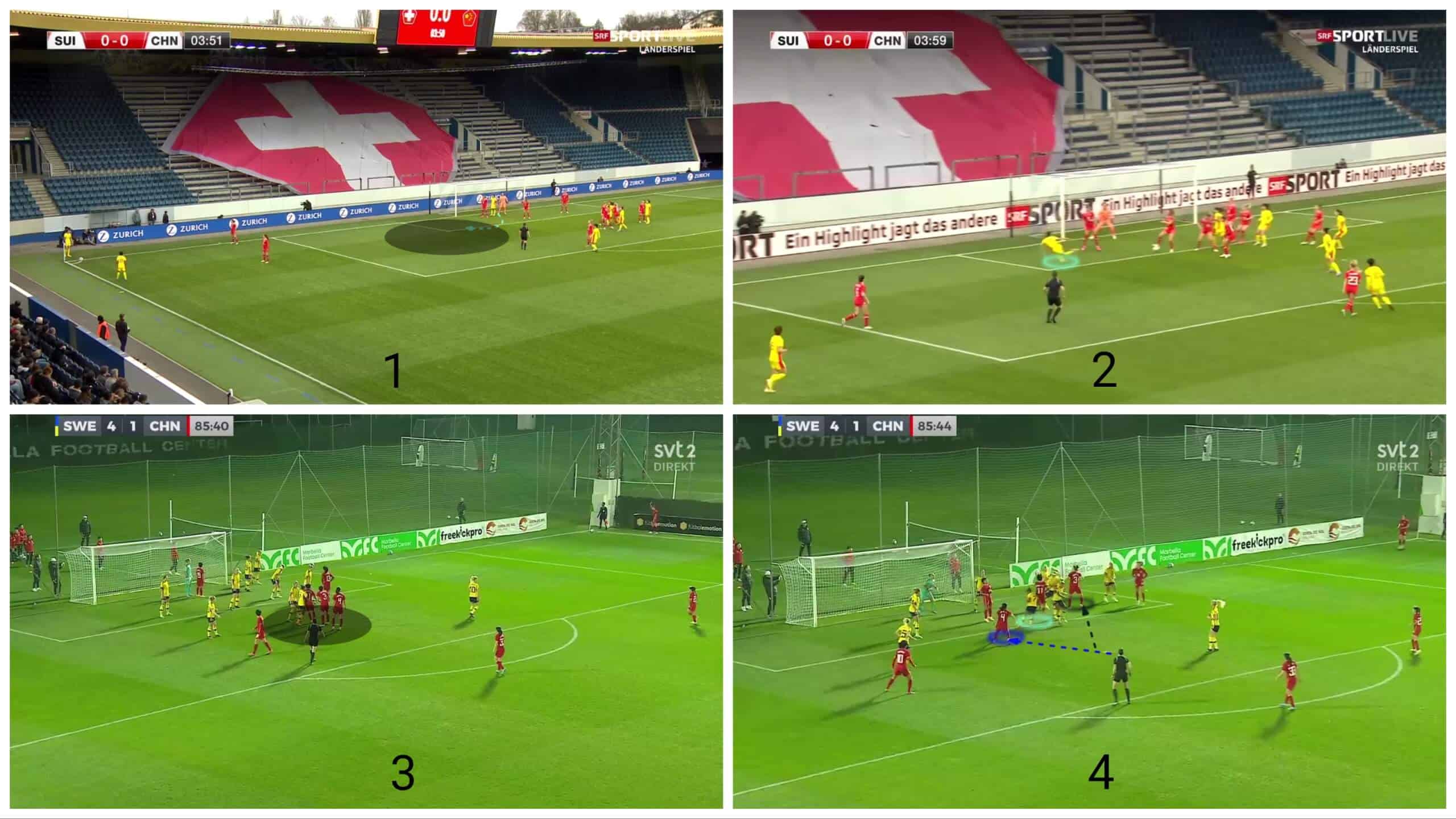
As we mentioned, set pieces are the strengths of the team using two repeated corner routines.
The first one, shown in the first and the second pictures, is to target the area before the near post by a player who stands initially with the goalkeeper without markers. The second one, shown in the third picture, is to target Wang Shanshan trying to make him in a 1v1 situation using a stack, in black. After playing the corner, the two players, in black and blue, move in two directions dragging their markers leaving Shanshan in a 1v1 situation in green.
Defensive phase
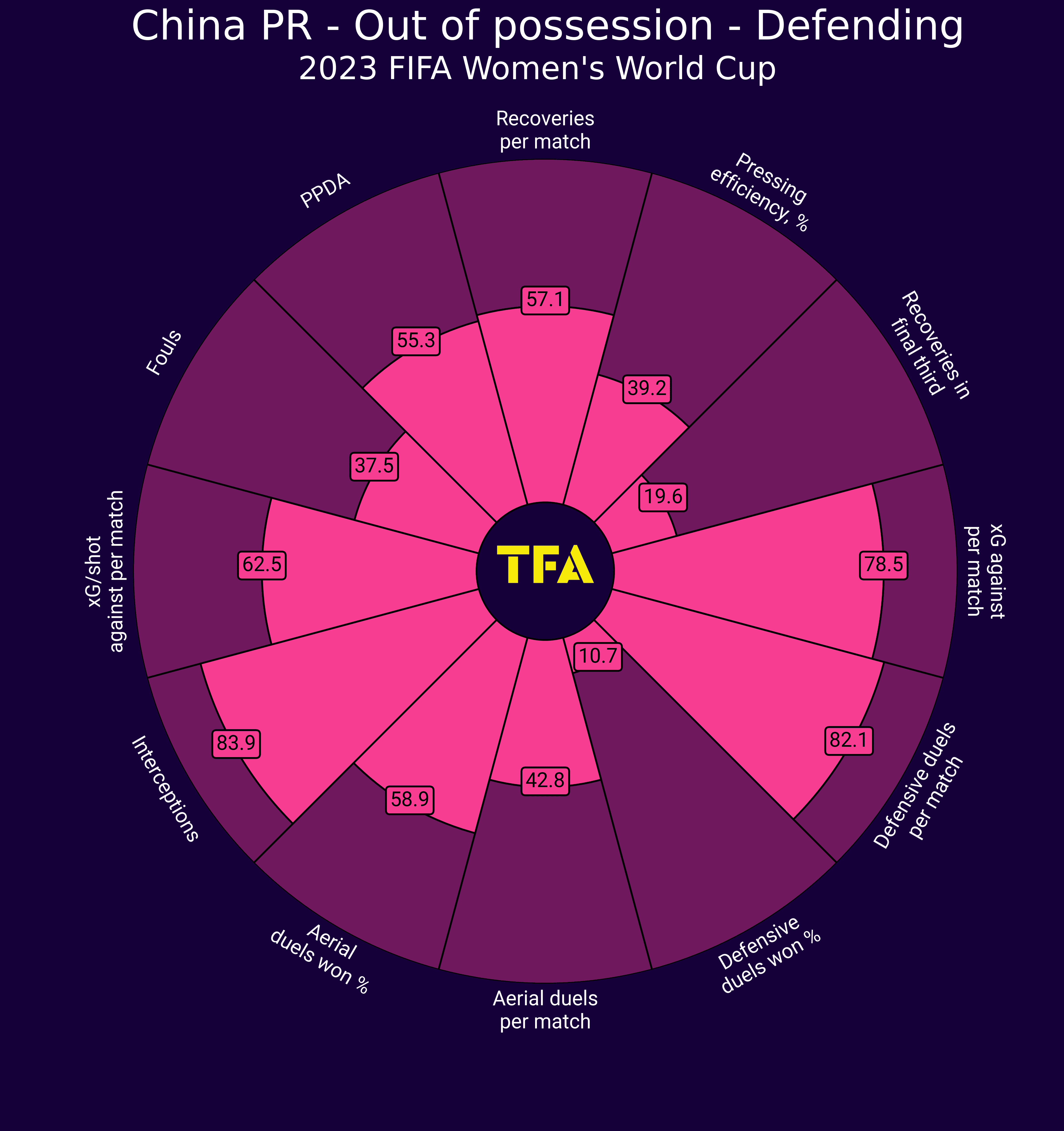
In terms of defensive statistics, the team’s interceptions rank in the 83.9 percentile, indicating their ability to disrupt the opponent’s passing and regain possession, but it happens at the back because their PPDA (Passes Per Defensive Action) percentile rank stands at 55.3, suggesting a moderate level of pressing intensity in relation to their competitors, with a lower number indicating a more aggressive approach. Moreover, they engage in a fairly average number of aerial duals per game. Their recoveries in the final third stand at the 19th percentile, highlighting that they prefer a low-mid press.
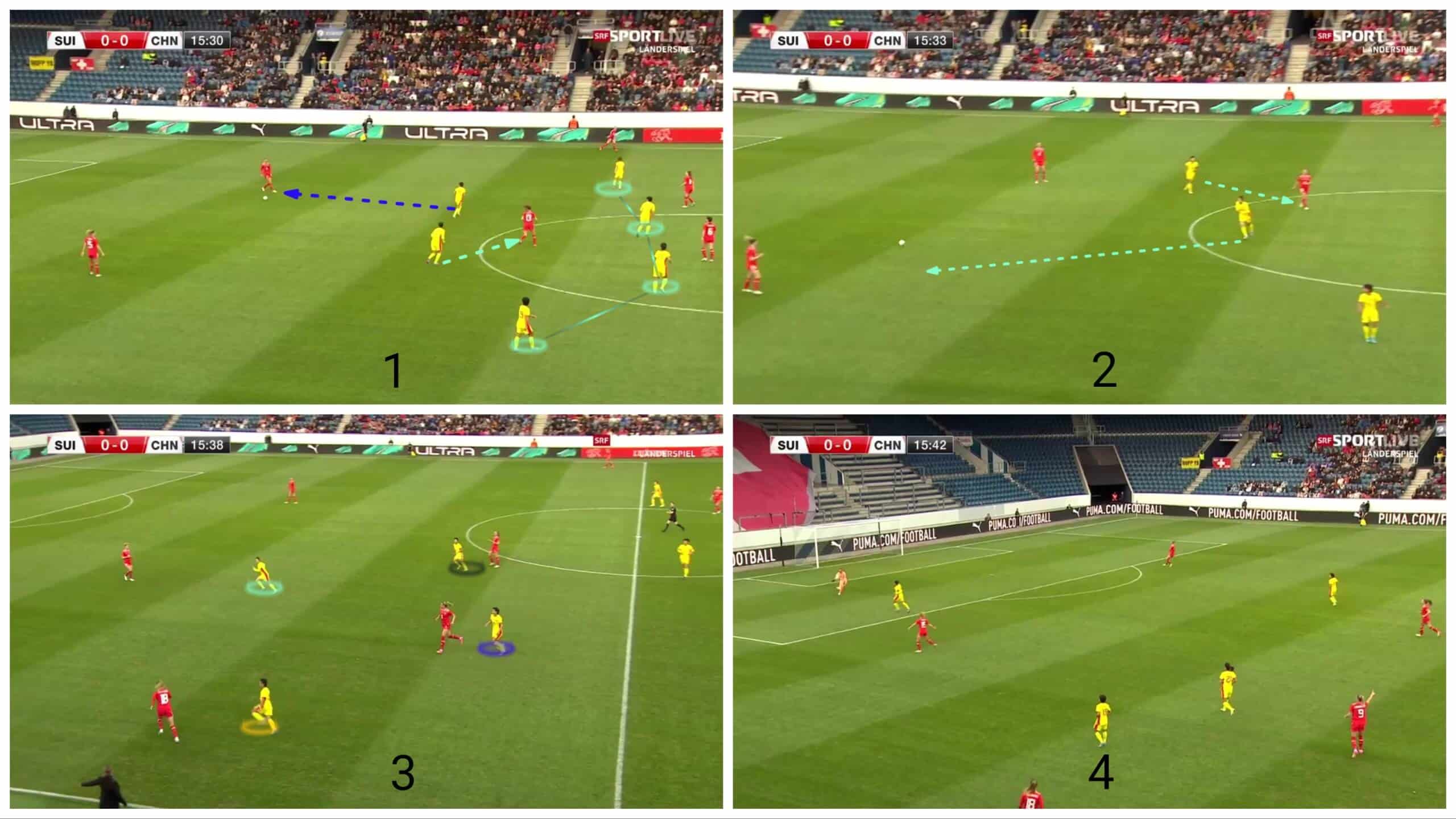
Defensively, China defend in a mid or low block in a 4-4-2 formation with four narrow midfielders. The striker near the ball, with a blue arrow, presses the defender while the other striker, with a green arrow, marks the opponent’s holding midfielder as shown in the first picture. When the defender passes the ball to the second defender, the strikers switch rules, as shown in the second picture. They aim to set a trap on the flank using the four narrow midfielders, forcing the opponent to pass to the full-back.
Here, in the third picture, the winger, in yellow, presses the full-back while the green-circled striker presses the defender near the ball, the black-circled striker marks the holding midfielder and the blue-circled midfielder presses the opponent’s midfielder. The goalkeeper is forced to play a long ball as shown in the fourth picture.
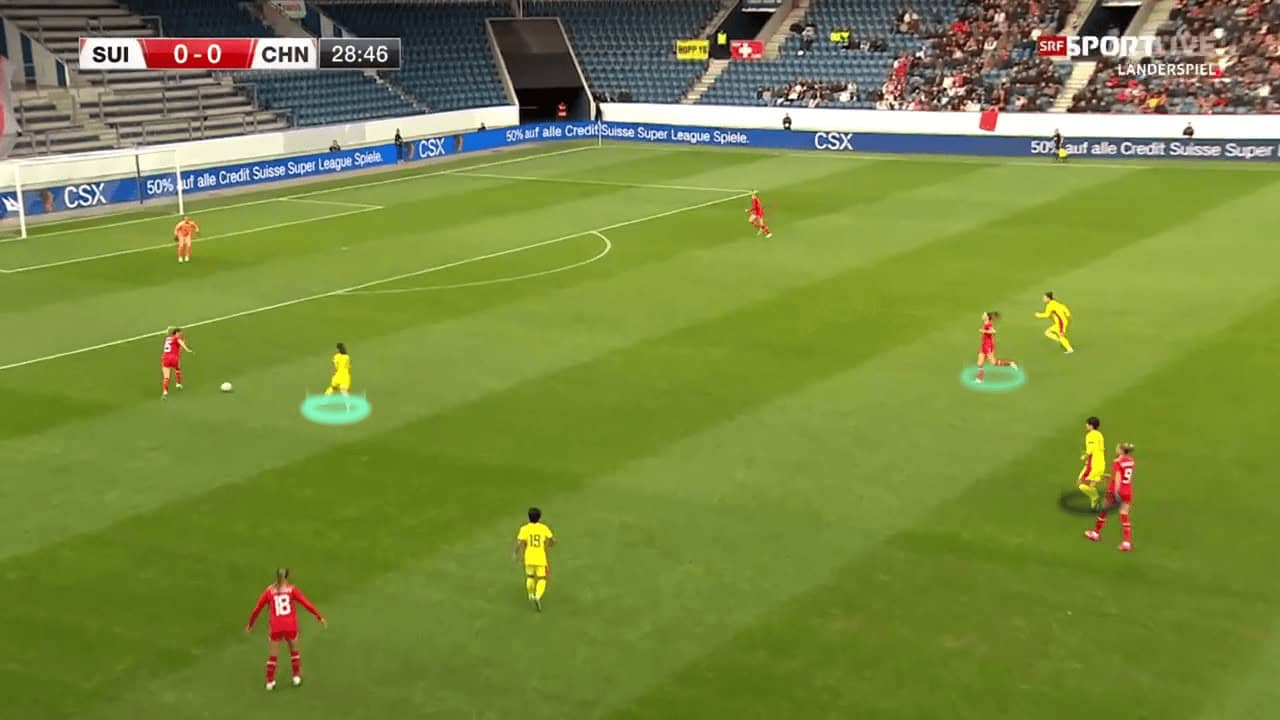
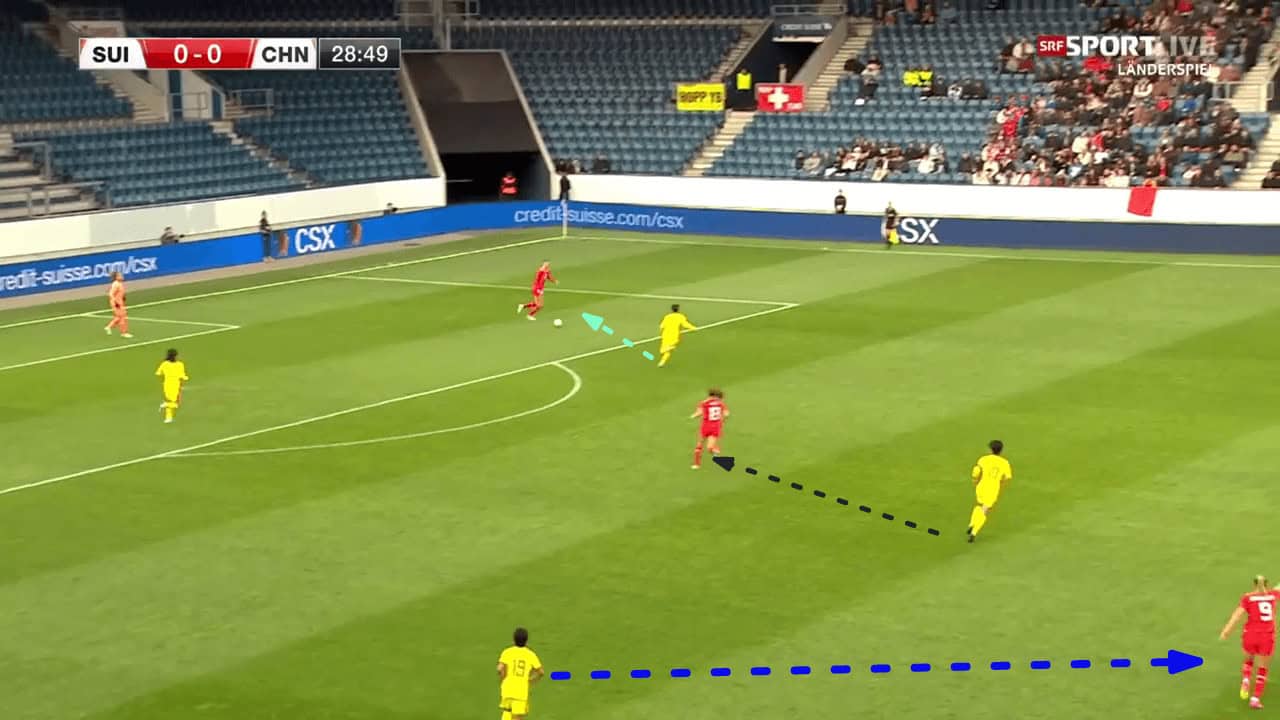
When the opponent’s defenders get wide, switching becomes more difficult, so they use the midfielder, in black, to press the opponent’s holding midfielder to allow the striker presses the defender, leaving number six. The winger, with a blue arrow, goes to cover that midfielder marking the opponent’s midfielder, as shown in the second picture.
Sweden had an idea to overcome this type of pressure. In the first picture, the right full-back drops with the two defenders to be in a 3v2 situation as shown in the second picture. This gives her the time and space to go forward carrying the ball because of the narrow position of the awaiting Chinese winger.
In the third picture, the winger is forced to go to press, leaving the opponent’s wide winger, in black, behind her because the Chinese left-back is committed to the narrow late position. Sweden’s right-back passes the ball to the midfielder who relays it to the free winger, as shown in the fourth picture.

In wide defending, they have a problem with switching as shown in the next two pictures. When the right-back goes higher to defend, the defensive line doesn’t switch, sticking to the striker, which causes a large space behind the right-back.
They have another problem in switching against the long ball. The defender goes up with the opponent’s striker as shown in the first picture. The defenders keep the same distances between them which leaves a large space between them as shown in the second picture. This space is exploited by the opponent’s midfielder as shown in the third and fourth pictures.

Transitions
Transitions play a crucial role in China’s playing style, particularly due to the strengths of their attacking players, who possess pace and agility. The team prioritise a rapid counterattacking approach, aiming to swiftly advance towards the opponent’s goal once they regain possession.
Players like Wang Shuang, Zhang Linyan and Lou Jiahui are key contributors during these transitional phases. Their individual skills and attributes make them essential assets for China in quickly transitioning from defence to attack. Their speed, technical ability, and ability to find spaces enable the team to depend on transitions.
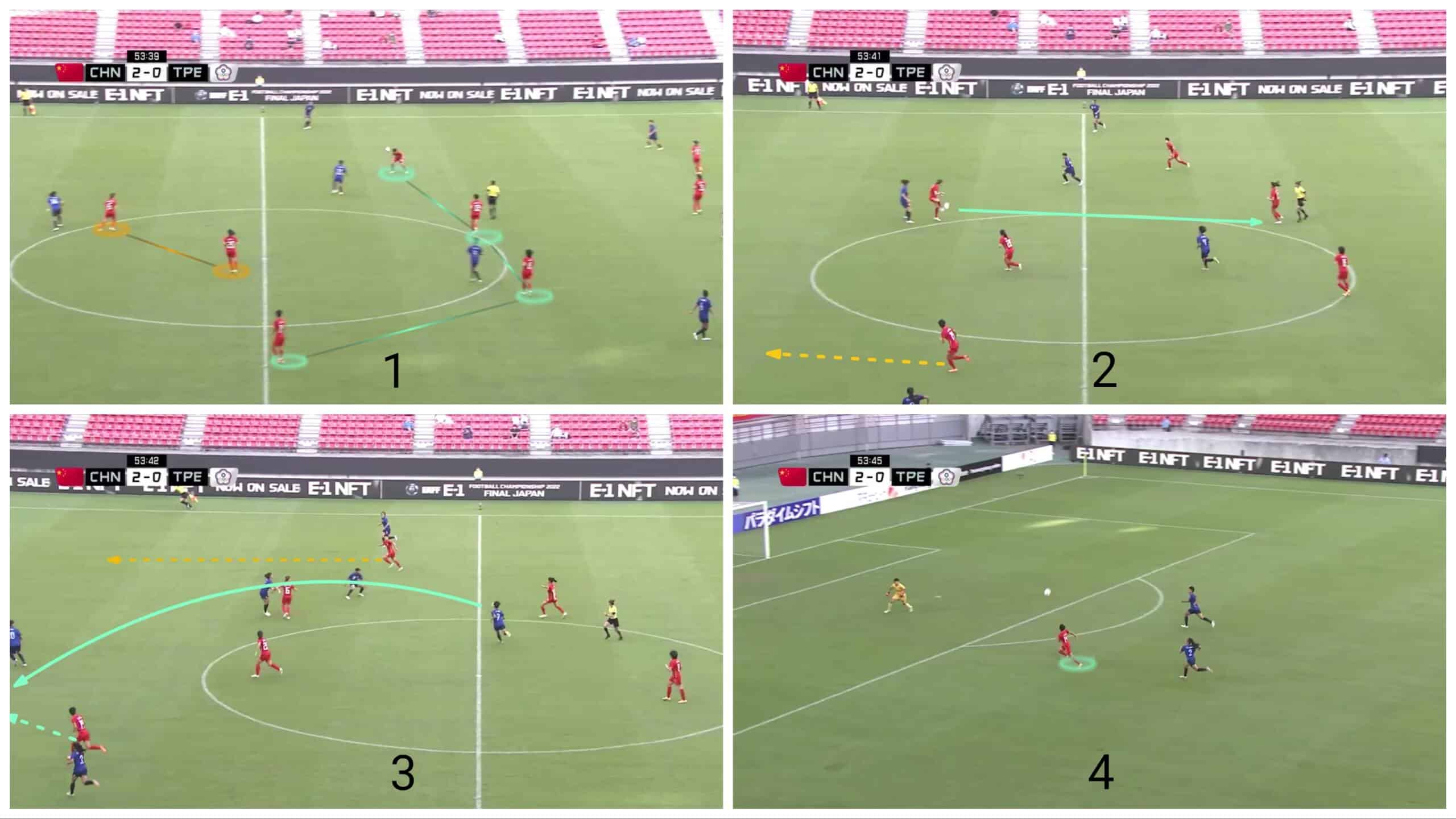
They mainly depend on the two strikers in transitions as shown below in the first picture. The striker gets the ball and passes it back to the closest midfielder as shown in the second picture. Meanwhile, the two wingers run quickly in half-spaces behind the defence to receive the long ball as shown in the third and fourth pictures.
Regarding defensive transitions, they don’t need to do a clear action like counterpressing because they prefer to drop back, reshape in a mid or low block, as mentioned above, waiting for the attacking transitions depending on their wingers’ pace.
They don’t prefer to counterpress to get the ball in the opponent’s half, the current trend in modern football, but they drop back in their 4-4-2 formation.
The only clear action they do as a counter-pressing action is to make one of their strikers mark the opponent’s holding midfielder while China’s four midfielders reshape as narrowly as they can to force the opponent to pass on the flanks where they have a numerical superiority because of their 4-4-2 formation.
Defenders
The defensive line plays a crucial role in China’s team because Chia usually stays at the back which makes the defenders receive many long balls. Players such as Li Mengwen, Wang Xiaoxue, Li Jiayue and Chen Qiaozhu are vital components of this defensive setup. They possess the strength, vision and pace necessary to initiate rapid transitions.
Additionally, Gao Chen is an important player who provides depth and serves as a key difference-maker from the bench.
Midfielders
The midfield in China’s system plays a dynamic and significant role due to its fluidity and awareness. It is primarily a four-woman midfield with Yao Lingwei entrusted with the responsibility to break down attacks and act as a defensive screener. She is supported by Zhang Rui, who is allowed to go forward and join the attack.
Yang Lina is another option that can sit back and absorb the pressure. She will be useful against offensive teams like England. Meanwhile, wingers Zhang Linyan and Wang Shuang are the most important players in the team because of their pace in transitions. Wang Shuang has another advantage which is her amazing progressive passes and her ability to play as a second striker.
Attackers
Shui Qingxia depends on Wang Shanshan as a target player to get the long ball and flick it to the second striker or hold up play, then passes the ball back to a midfielder who played a long ball to one of the wingers or the second striker.
The second striker is usually Li Ying or one of the fast wingers like Wang Shuang and Tang Jiali. Lou Jiahui can also play this role depending on her pace.
In set plays, they depend on one of their strikers, usually Wang Shanshan, and their strength in aerial duels.
Key player
Wang Shuang, who plays for Racing Louisville FC in the National Women’s Soccer League (NWSL), is the key player. The upcoming tournament presents a significant opportunity for her to showcase her abilities, particularly because the team’s playing style aligns perfectly with her strengths.
With the team’s playing method being well-suited to her skills, Wang Shuang has the chance to display her full potential on the international stage. She is good at defending because she is brilliant in defensive duels and has a high work rate. In the attacking phase, she is good at dribbling and progressive passes.
In defensive duels, Shuang stands out with a percentile ranking of 83.3 in defensive duel success %, highlighting her prowess in engaging in physical battles and her ability to come out on top. Additionally, her dangerous passes statistic ranks at the 66.63 percentile, indicating her ability, regarding her teammates, to execute passes that pose a significant threat to the opposing defence, potentially creating goalscoring opportunities for her team.
Regarding her teammates, Shuang’s individual statistics showcase her contributions to various aspects of the game. She averages a good number of progressive passes per 90 minutes, indicating her ability to play forward passes that advance her team up the field effectively. With a good average of dribbles per 90 minutes, her teammates try to find her to get through the pressure.

Tournament prediction
China enter the tournament with a diligent team, although they may not be considered among the top teams. They find themselves in Group D with England who are the European Champions, Denmark and Haiti.
Considering their results in 2023, making it far in the tournament would be seen as a notable achievement. It would demonstrate the progress and potential of the team, as well as the ability to compete against strong opponents. The winner and runner-up of Group B will face the runner-up and winner of Group D which means there is a chance of a face-off with the host, Australia, in the knockout round; then they would face Germany or France depending on the pathway, so it’s difficult to see China going further than the quarter-finals.
Success for China in this context would involve surpassing expectations, showcasing their capabilities, and potentially making a deep run in the competition. It would be a positive step forward for the team and a source of pride for the Chinese fans, regardless of the ultimate outcome.
