
Football fans love a good comparison of players. Over the years, there have been some classics — Gerrard vs Lampard vs Scholes, John Terry vs Rio Ferdinand, Cristiano Ronaldo vs Lionel Messi: there are many more.
Recent Premier League seasons have been dominated by Liverpool and Manchester City, which has been the catalyst for a new debate – who is the better defensive midfielder, Liverpool’s Fabinho or Manchester City’s Rodri?
Both players have been nothing short of vital for their respective clubs since their arrivals, and both have been sorely missed in midfield when absent. This data analysis will provide an insight into the key strengths of each player in several areas of the game, as we look to provide an analysis of and compare the contributions of each player when it comes to defending and various traits in possession i.e., passing and dribbling.
As the purpose of this report is to establish each player’s effectiveness as a defensive midfielder, we will be avoiding an analysis of pure attacking elements like shots, goals, activity inside the box etc. The data in question will be taken from each player’s contributions from the 2021/22 Premier League campaign only.
Player Profiles
28-year-old Fabinho joined Liverpool from Ligue 1 club AS Monaco for a reported fee of £40.5m in July of 2018. Since then, he’s established himself as a firm and essential cog of Klopp’s Liverpool machine.
His defensive awareness and ability allow him to provide great protection for Liverpool’s central defenders when the full-backs go flying forward. However, Fabinho has also been presented with the task of filling several other roles for the reds during their injury crisis of the 2020/21 campaign, filling in at right back and centre back.
The Brazilian’s primary and most effective role, though, remains as the defensive component of the engine room. The Brazil international has 27 caps to his name, at present.
Rodri arrived in England a little over a year after Fabinho, joining from Atlético Madrid for a reported fee of £56.43m and has settled into Pep Guardiola’s team fantastically well. With his role demanding slightly less of a defensive focus than that of Fabinho’s, Rodri can lend his talents to City when they have possession, getting involved with build-up play phases.
At just 26 years of age, he is almost certain to continue developing and giving the blues a strong defensive presence in the middle of the park. He also has strong international experience, with 33 caps to his name for Spain. Below is a summary pack of base information about the two during the 2021/22 season.

Defensive dominance
Both players have proven their worth when it comes to fulfilling defensive duties in midfield for their respective clubs; both are likely one of the first names on their respective team sheets when matchday arrives. This segment will provide an analysis of their defensive contributions where we will discuss several defensive metrics.

The first discussion of this data analysis focuses on their total number of successful defensive actions — their average per 90 minutes. The term ‘successful defensive actions’ includes all things defending — slide tackling, intercepting, duels etc., making it a good starting point to provide a foundation for how effective each player is, defensively.
As you can see from the bar graph above, Fabinho has the higher average by a margin of 1.17, thanks to his personal total of 9.51, compared to that of Rodri – 8.34. In reality, this is not a huge gap, especially for two players who belong to teams who like to dominate matches. It may simply reflect the fact that Fabinho’s role requires him to get stuck in slightly more than Rodri: the following graphs and analysis will hopefully paint a clearer picture of who is more effective in a defensive capacity.

This next graph lets us dig a little deeper into the defensive data of Rodri and Fabinho, giving us a view of how often they engage in defensive duels, along with a win %. As you can see, Fabinho is superior in this area thanks to his average of 7.4 defensive duels per 90 — of which he wins 60.78%. Both of these numbers surpass Rodri’s 6.6 per 90 with a win rate of 58.77%.
While Rodri’s numbers here are lower than Fabinho’s, this does not mean that the Spaniard is defensively weak — far from it. He rarely has a poor outing for City and his defensive contributions in the middle are vital to Guardiola’s tactics. Fabinho’s higher numbers tell us that he regularly involves himself in defensive situations and has the ability to win the ball back more often than not.

Aerial dominance is an important defensive factor when it comes to the defensive midfielder. With Fabinho standing near 6ft2 and Rodri near 6ft3, both players are fairly tall and well equipped to engage in aerial battle.
According to the data, Rodri is the better player in the air thanks to his average of 3.65 aerial duels per 90, winning 69.05%; this is considerably higher than Fabinho’s win rate of 58.46% from his average of 2.36 aerial duels per 90. For both players, though, aerial talent isn’t the primary function of their respective roles.

One vital part of any position is the ability to read the game and intercept passes. Interceptions present the opportunity to regain possession and launch an attack. Individually, it is a vital skill for a defensive midfielder as it involves them breaking up an opposition attack.
Both of these players have consistently displayed a talent for this, with Rodri averaging 4.37 interceptions per 90 — slightly more than Fabinho, who offers 4.32. Making at least four interceptions per game equals each player giving their team over four opportunities to regain possession and when you consider how dangerous Liverpool are on the break and how City can dominate the ball, this is an important feature of their roles.

Similar to the importance of interceptions, recoveries are key in a midfielder’s data as it highlights an ability to stop opposition possession and regain the ball for their own side. It combines the anticipation aspect of making an interception with the defensive technique to stop the opposition’s possession.
While Rodri (11.09 per 90) makes slightly more recoveries on average than Fabinho (10.52 per 90), Fabinho makes more recoveries in the opposition half, with 51.7% of his recoveries occurring there.
Rodri, meanwhile, makes 48.8% of his recoveries in the opponent’s half. This highlights a strength of both players to win the ball back, with Fabinho, in particular, showing that he can do it further up the pitch. This may be a result of a tactical facet of his role.
Midfield influence
Both Manchester City and Liverpool expect to dominate most of their games. This, combined with their tactics, means the midfield unit is extremely involved in most of their attacking moves. In this segment, we will cover a range of areas related to passing and dribbling.

Starting off with an overall perspective of their passing ability, we can see that Rodri is a very talented player in this area. He averages 78.36 passes per 90 — considerably more than Fabinho’s average of 53.06. This difference does not indicate strength or weakness, though.
What it does do, is further highlight the tactical aspect of Manchester City being more a possession-based team with a slow build-up play system deployed and Rodri’s central role within that system.
Rodri’s superiority lies in his technical proficiency and passing accuracy. With an accuracy of 93.39%, there could be a claim that he is more consistent and reliable with his passing than Fabinho (88.9%). The data analysis that follows will discuss their passing with more precision.

Measuring and analysing their performance in forward passing allows us to gauge their ability to move the ball with purpose rather than for the sake of keeping possession. Again, Rodri shows his sheer excellence on the ball thanks to his accuracy of 83.24% from 16.07 forward passes per 90. Fabinho also shows a talent for this with an accuracy of 77.66% from his 14.3 forward passes per 90.
Rodri may possible just the more accurate passer in this instance, but it is important to bear in mind the types of forward passes that each player will be making. For instance, due to Manchester City’s tactical approach, Rodri is likely to play a higher portion of shorter passes going forward under little pressure, whereas Fabinho may play more direct forward passes – possibly under more pressure if this occurs in a transition.
It is also important to consider the previous graph that highlights the average number of total passes made per 90. Rodri’s average leaves him making 16.07 forward passes out of 78.36 total passes per 90, whereas Fabinho’s average leaves him at 14.3/53.06 – essentially, Fabinho is playing a higher portion of forward passes per 90.

This next graph is something of an extension of the previous one, as it shows us their ability to move the ball into the attacking third. It’s no surprise that Rodri excels once again — 10.57 passes into the final third per 90 showing confidence and attacking intent, while 87.67% of those passes being accurate shows skill and consistency.
Fabinho also shows reliability in this area, with 82.35% of his 8.02 per 90 being accurate. Both players have highly talented and creative midfielders in front of them but this set of data shows us that they too possess creativity and the ability to contribute to an attacking move.

Short passes are often the easiest form of passing, especially when there is no/low pressure being applied. Any good midfielder should have a strong and varied passing range so they can contribute in more than just one way.
As you’ll see from the data, neither of these two plays for a club that heavily features long passing, but it is still something they use from time to time, either in the case of a counterattack or to play the ball out to the flank.
Fabinho again seemingly struggles to match the technical ability of Rodri, as the Liverpool man averages 4.06 long passes per 90 with an accuracy of 54.46%. Meanwhile, Rodri averages 6.54 per 90, with an impressive accuracy of 73.01%. The Spaniard shows the ability to switch things up more often and with positive results consistently. Again, the types of long passes and each club’s tactics will have played a part in the statistical outcome here. Due to City often dominating the ball in the opposition half, Rodri is more likely to play more comfortable long passes to switch play to another flank – Liverpool’s attraction to a counterattack may lead to Fabinhp having to execute long passes with a higher risk: long passes that break lines or have a genuine attacking intent behind them.
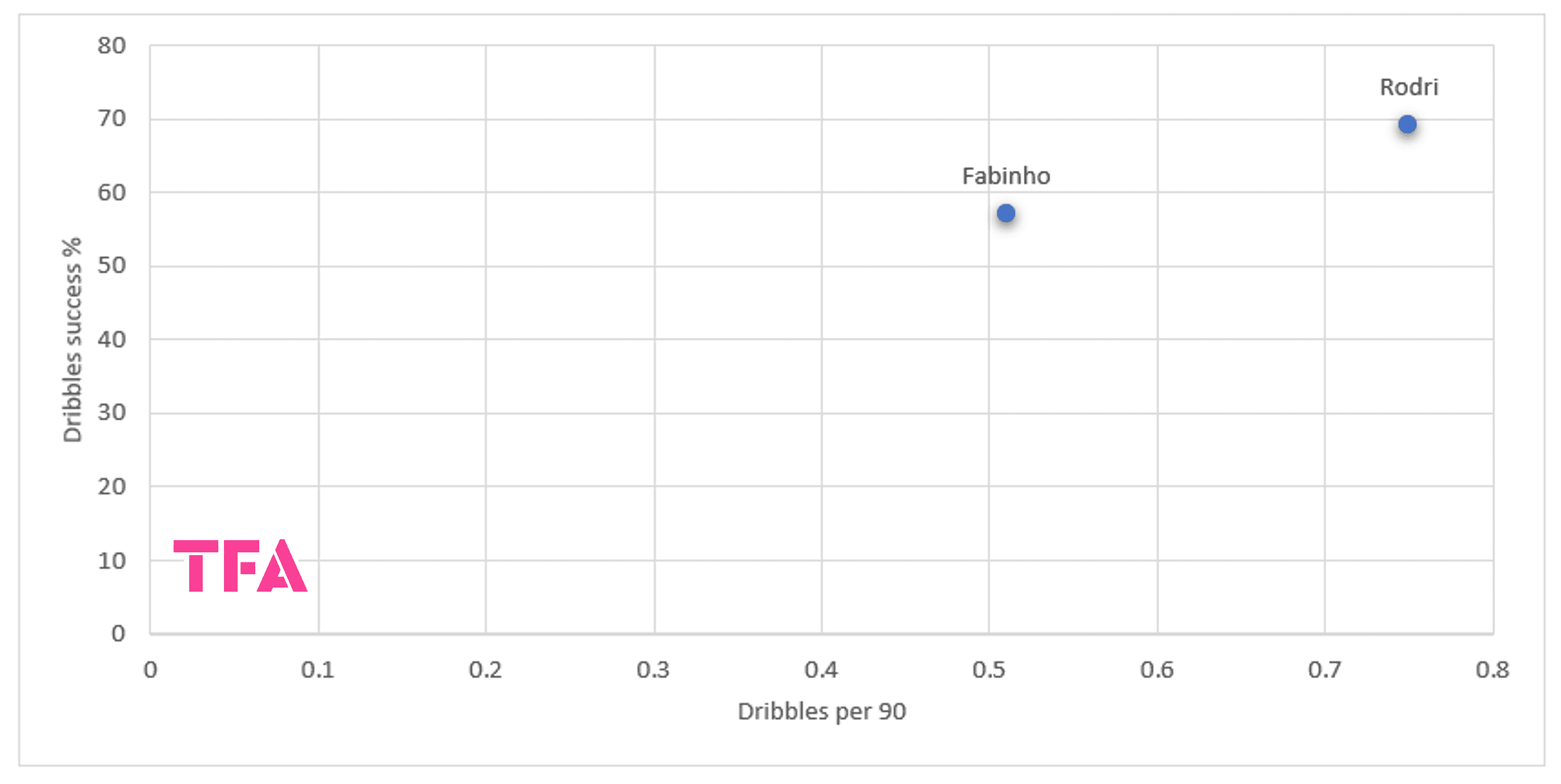
The final two graphs of this data analysis will analyse the performance of both players on the ball. First comes a look at their dribbling efficiency. You’ll notice straight away that neither player dribbles often. In fact, they both average less than one dribble per 90. But when they are required to do so, Rodri edges it in terms of success with 69.23% compared to Fabinho’s rate of 57.14%. When in possession of the ball, the job of both players is to move the ball onto a teammate rather than drive forward themselves.

This graph provides a more helpful insight into their efficiency on the ball as it measures their offensive duels. Wyscout defines an offensive duel as a player who is in possession of the ball keeping it despite a challenge from an opponent. It shows a good technique to keep the ball away from the opponent as well as good strength to fend off challenges.
Rodri (3.62) averages slightly more than Fabinho (3.16), but Fabinho is more reliable in an offensive duel thanks to his win rate of 44.83%. Rodri holds a win rate of 37.6%. This suggests that Fabinho possesses slightly more strength than Rodri, especially when you consider some of the defensive data presented earlier in this report.
Conclusion
One thing we all knew before diving into this report is that both Rodri and Fabinho are exceptional defensive midfielders. This data analysis aimed to shed some light on the areas in which they shine and see if it led to the possibility of being able to say that one player is outright better than the other.
It’s safe to say we can not pick a definitive player as the “better” defensive midfielder, but we can clearly see that Rodri outshines Fabinho in some areas and vice versa. Rodri’s data suggests a superiority when it comes to passing and dribbling, while Fabinho often shows higher reliability in defensive situations.
