
Sparta Praha are the current champions of the Czech First League, having achieved success under manager Brian Priske tactics in his first season with the club, securing their first league title since 2014.
In his second season in charge, Sparta is just one point behind Slavia Praha and is in its third consecutive cup final.
Their recent success even stems from Europe, where they dropped out of the UEFA Europa League at the round of 16 stages to favour Liverpool.
Praha has scored 14 goals from set pieces this season so far, and has clearly shown signs of a team that pays attention to set play preparation with their corner routines.
However, although they have scored many set plays, their dominance suggests they could be performing to an even higher standard.
From 225 corner kicks, only 3% have resulted in goals, indicating that there is room for improvement in one aspect or another.
In this tactical analysis, we will examine the tactics behind Sparta Praha’s corner kicks, providing an in-depth analysis of how they utilise screens to create danger from corners.
This set-piece analysis will also examine the details behind why their structure has allowed them to sustain pressure from corner kicks and the potential areas for improvement to increase their 3% conversion rate.
Sparta Praha Attacking Structure
One thing that immediately stands out when you lay your eyes on Sparta Praha’s set plays is their dominance in the penalty area after the initial duel.
Loose balls and the second phase of corners are eaten up by Sparta, allowing them to sustain pressure on their opponents through long-range shots and crosses back into the penalty area while the defensive side is still recovering from the initial delivery.
This is only possible because of Sparta’s bravery and ambition in their high and aggressive starting positions of the entire outfield unit.
In recent games, the setup has resembled the example below.
Two players attempt to create space around the six-yard line, whilst two attackers attempt to arrive in the space created.
We then see one attacker arriving at the back post, which enables him to attack rebounds and flicks while also being able to revive attacks if the cross is overhit by heading the ball back across.
One attacker is used to prevent the goalkeeper from claiming the ball, while three players are positioned around the box.

We will delve into this further later, but Sparta’s chances arise during the second phase rather than from the work done around the penalty spot.
With one player blocking the goalie, one on the far side of the penalty area, and three players around the box, Sparta have five players encompassing the defending side, whose primary responsibility is to keep the ball alive rather than attacking the ball and scoring.
The goalkeeper being blocked means that there is little threat of the opposition initiating quick counter-attacks, which allows them to throw all 10 outfield players within 25 yards of the goal.
Another common way teams can start counter-attacks is through a volleyed clearance at the near post. However, with the Czech champions opting for more floated crossing techniques, the likelihood of a cross being severely underhit is minimised.
As a result, there is no direct threat of a counter being sprung.
With that in mind, Sparta can use six players to attack the penalty area, which gives them the chance to have real estate in many different parts of the penalty area.
Consequently, there is a high chance that, regardless of where a loose ball lands after the initial aerial duel, it will likely be in close proximity to a Sparta attacker, who can keep the attack alive and help sustain pressure on the opposition.
Sparta Praha Using Screens to Create Space for Crosses
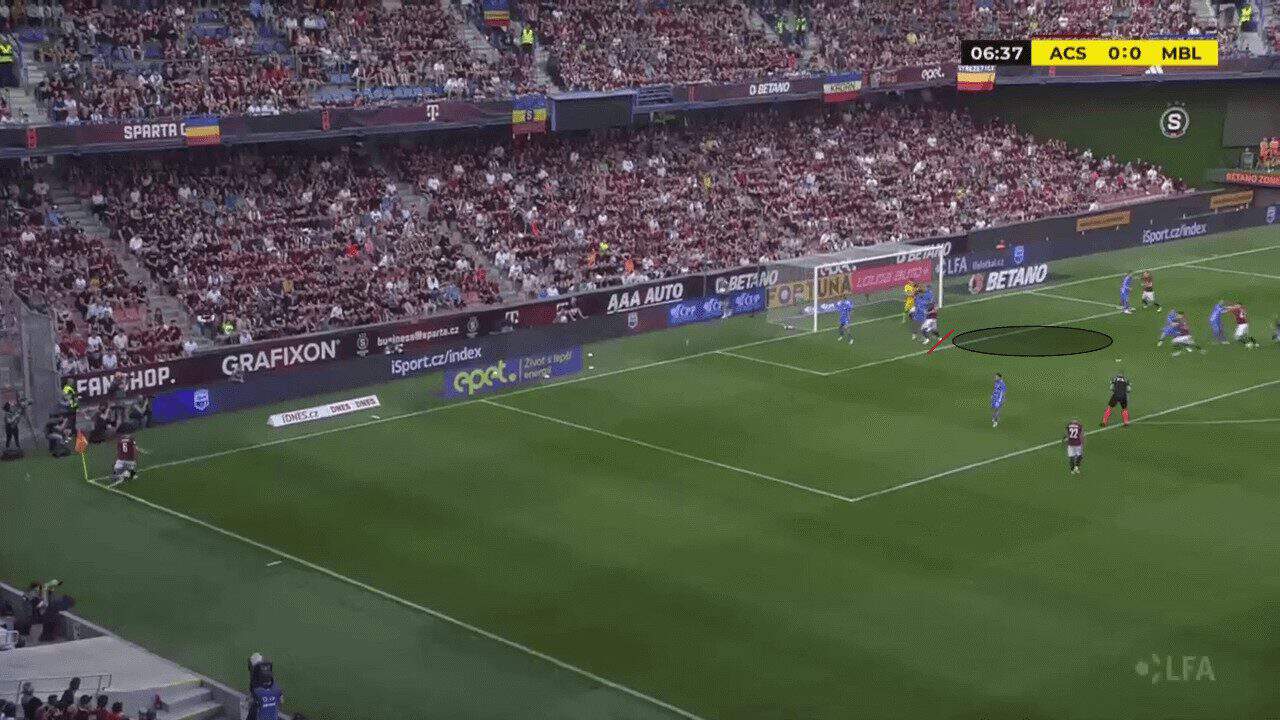
As mentioned earlier, the direct success achieved by Sparta has come from their ability to immobilise zonal defenders, allowing the ball easy access to the six-yard line.
The image below illustrates how a screen on the zonal defender leaves the six-yard box open, allowing an attacker from deep to arrive in the space and receive the golden opportunity.
With the deep attackers having so much space to attack and the advantage of their body facing the goal, at least one attacker should be able to take advantage of the space, although this has not always been the case.
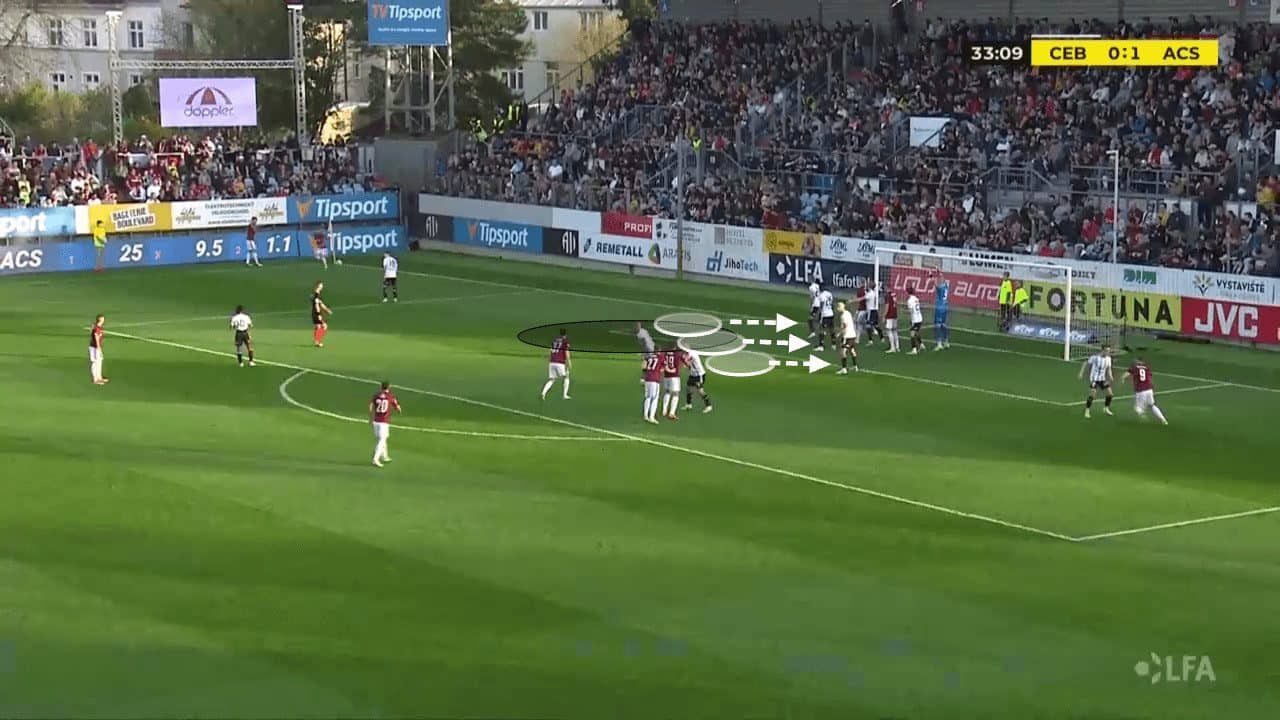
One alternative method that Sparta Prague has used to create space around the six-yard box is through the use of a decoy corner taker.
In the image below, an inswinging and outswinging delivery is possible before the corner is taken, with two players lining up to take it.
The opposition zonal unit must drop deeper to prevent the inswinger from being able to exploit the space, which is usually left open when facing an outswinging delivery.
As they drop deep, it creates space around the near side of the six-yard box, which would usually be protected by zonal defenders.
Through the simple addition of a decoy, space further from the goal becomes more easily accessible.
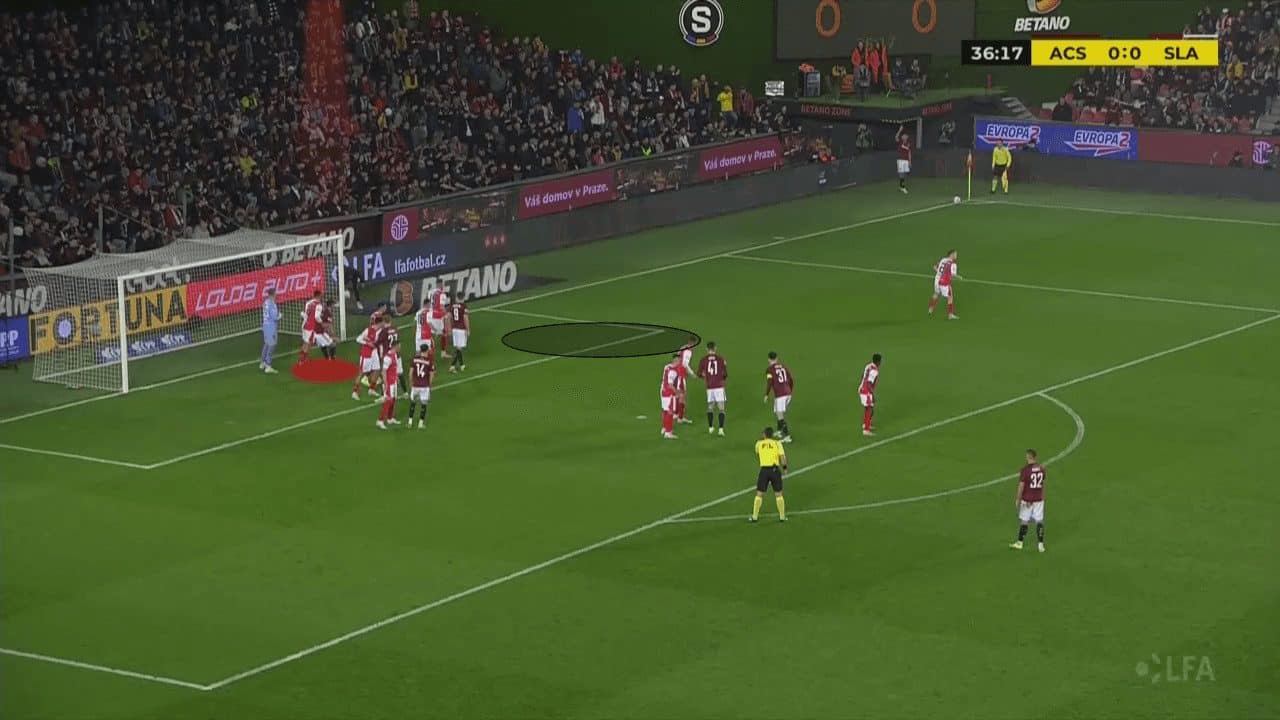
One issue that has arisen when watching Sparta Praha’s corners is the unnecessary use of blocks on goalkeepers when the delivery is aimed towards the near edge of the six-yard box.
The setup of a corner kick should always depend on the available space that will be targeted.
When the delivery is going to be flat and towards someone closer to the ball than the front post, it is improbable that the goalkeeper will have the time and opportunity to step out and claim the cross.
This could suggest a lack of clarity within the squad about which routine is used and where the ball is headed.
The block on the goalkeeper probably doesn’t change his or anyone’s approach, making it almost irrelevant.
The only benefit is the attacker’s ability to block the goalkeeper’s view and be closer to the goal for loose balls and rebounds.
However, suppose the highlighted defender steps up after the cross.
In that case, the attacker will be left offside, meaning their role has no value, and that body could be used elsewhere to cause problems for other defenders.
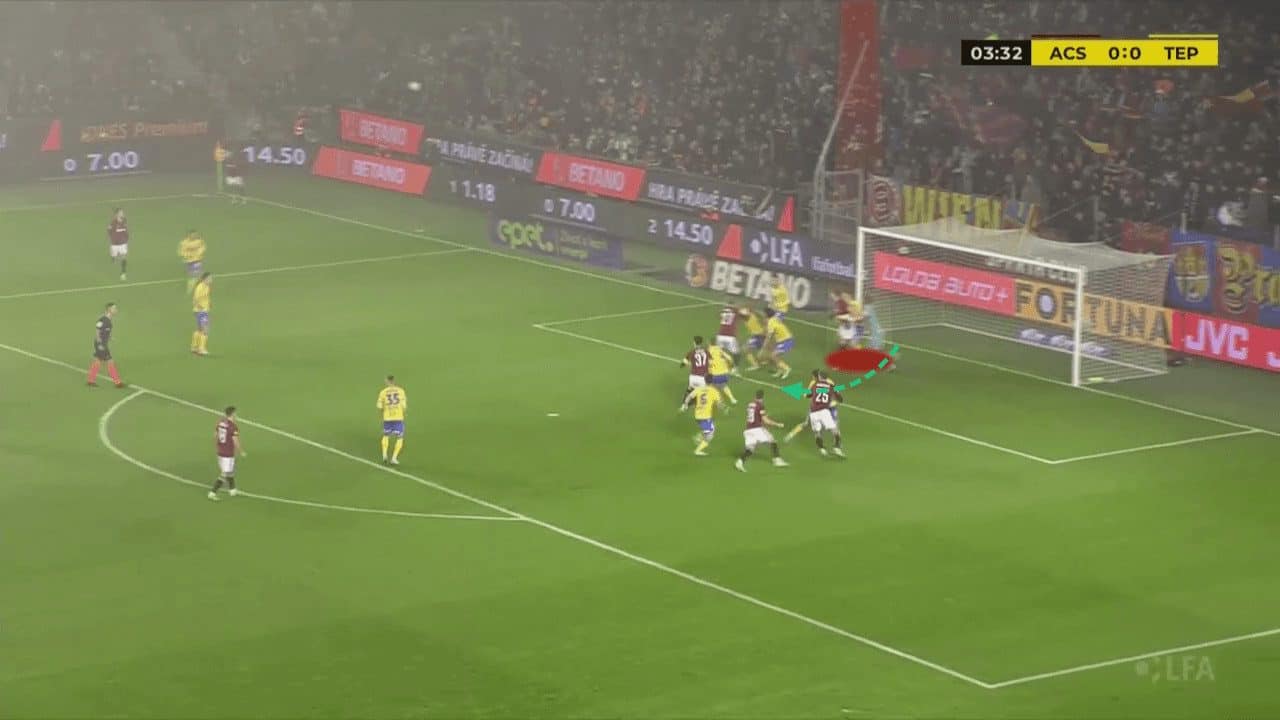
Another issue has been the early and predictable attempts to set screens on the goalkeeper.
As opposition sides come to expect this action to occur, defenders can spot the attempts earlier and extinguish the fires more quickly.
In the example below, the defender has enough time between the screen being set and the ball being delivered to shift the opponent out of the goalkeeper’s path, allowing him to claim the ball easily.
In the Premier League, Arsenal have consistently used Ben White to set screens on goalkeepers, allowing them to deliver the ball into the six-yard box, much like Sparta aims to do.
However, once the screen became predictable, White made sure to change his movements before the corner being taken, allowing him to block the keeper as the cross came in.
Just like players attempt to do around the penalty spot when attacking corners, the player blocking the keeper needs to create separation to set the screen effectively.
This could be possible by starting on the goalkeeper’s blind side, where he can arrive and set the screen just as the cross is taken, not giving the defender any time to shift him out of the way.
Sparta Praha Struggles With Creating Separation Consistently
The consistent theme in this article has been around the issues with separation.
Sparta Praha consistently provide the ball easy access into high-value areas through setting screens on zonal defenders, but they have failed to provide their players with the same luxuries.
This means that when there is a space that can be attacked, the attacking players are unable to lose their markers and have to compete in 50/50 aerial duels.
Of course, this depends on the individual’s aerial prowess, and in a couple of instances, it has led to goals; however, if this problem could be fixed, Sparta’s efficiency from corners could skyrocket.
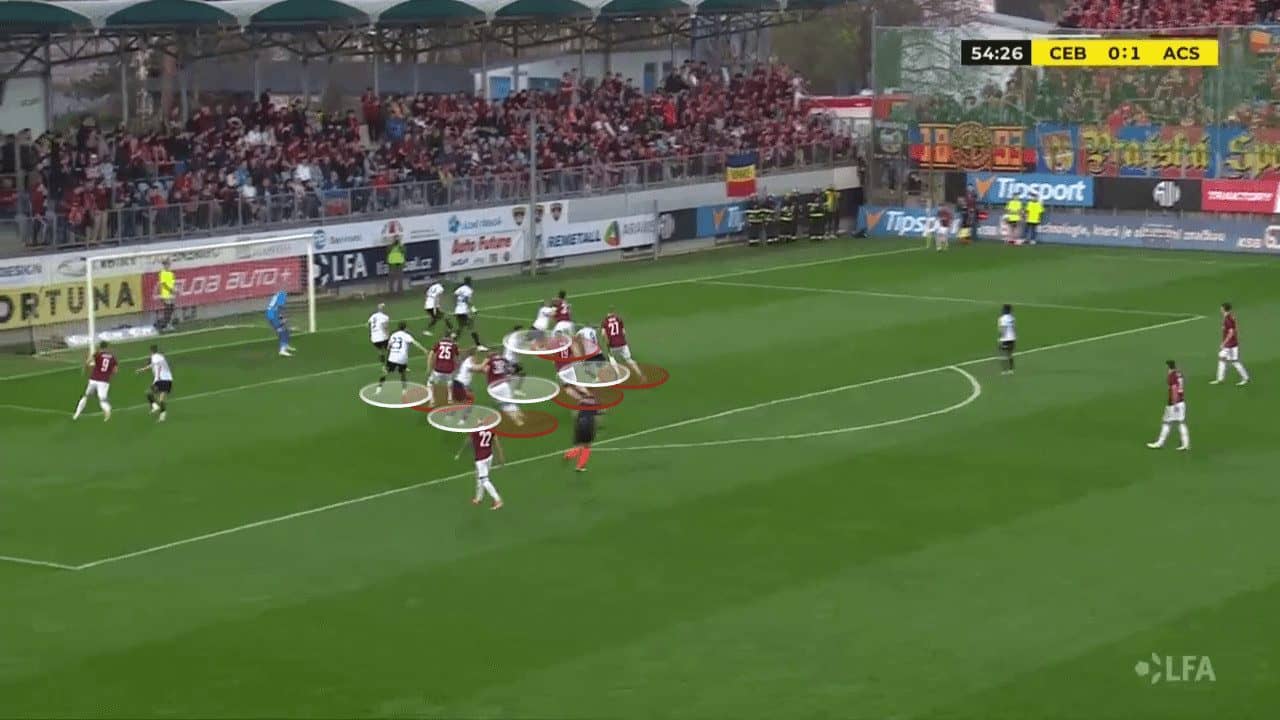
In the image below, we can see five attackers, each with an individual 1v1 battle.
In each instance, the defender is already in close proximity, allowing them to get physical and prevent attackers from building up momentum.
Attackers have no advantage in speed and must rely on their sharp movements to create separation from their markers, which is challenging to do when the box is so congested, as attackers might unintentionally block each other’s paths to the goal.
One way attackers can gain an advantage in 1v1 duels is by using a deeper starting position.
When the ball is going straight to a static defender, attackers moving from a deeper position can use the momentum they’ve created to generate additional power in the jump for the header, giving them the advantage in the aerial duel.
On the occasional occasion, this has happened for Sparta and been successful, highlighting the need for this move to be added to their set-piece toolkit.
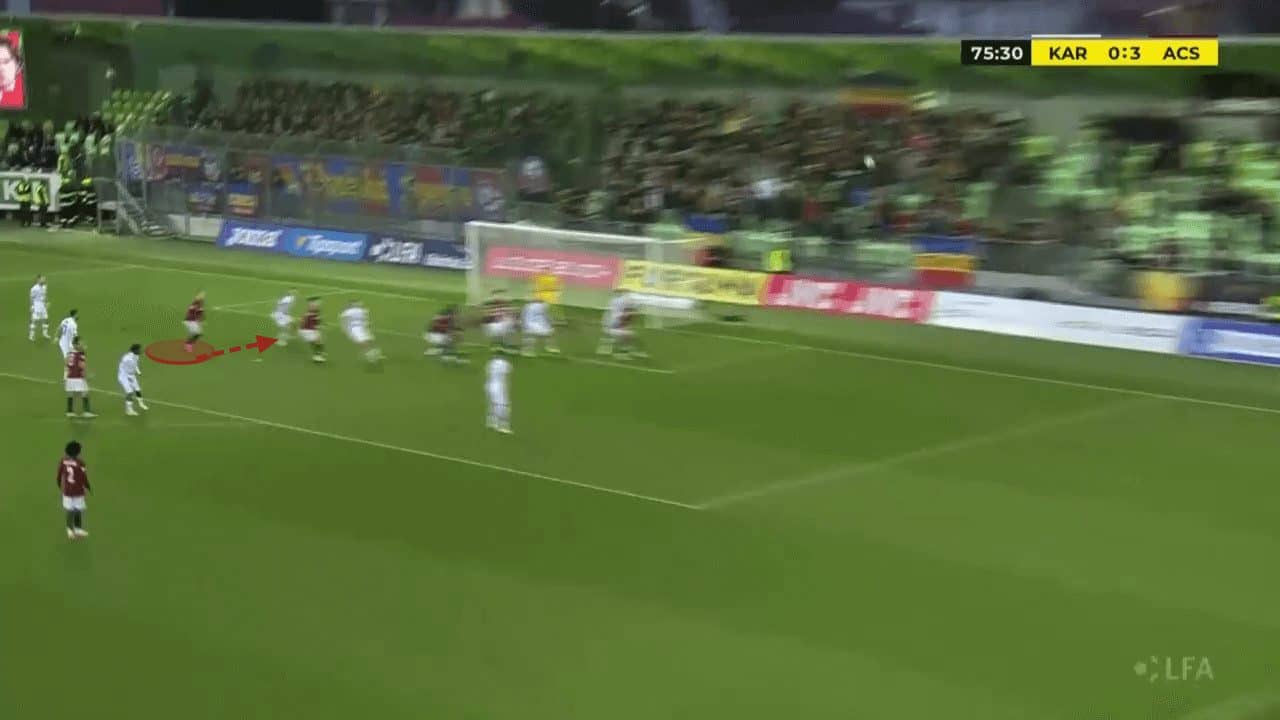
While the vertical runs have been easier to track for defending players, Sparta have been able to create separation through horizontal movements made across the six-yard box.
The simple tweak of moving players into the defender’s blindside has been effective in giving individual attackers the separation they need to arrive in space unmarked.
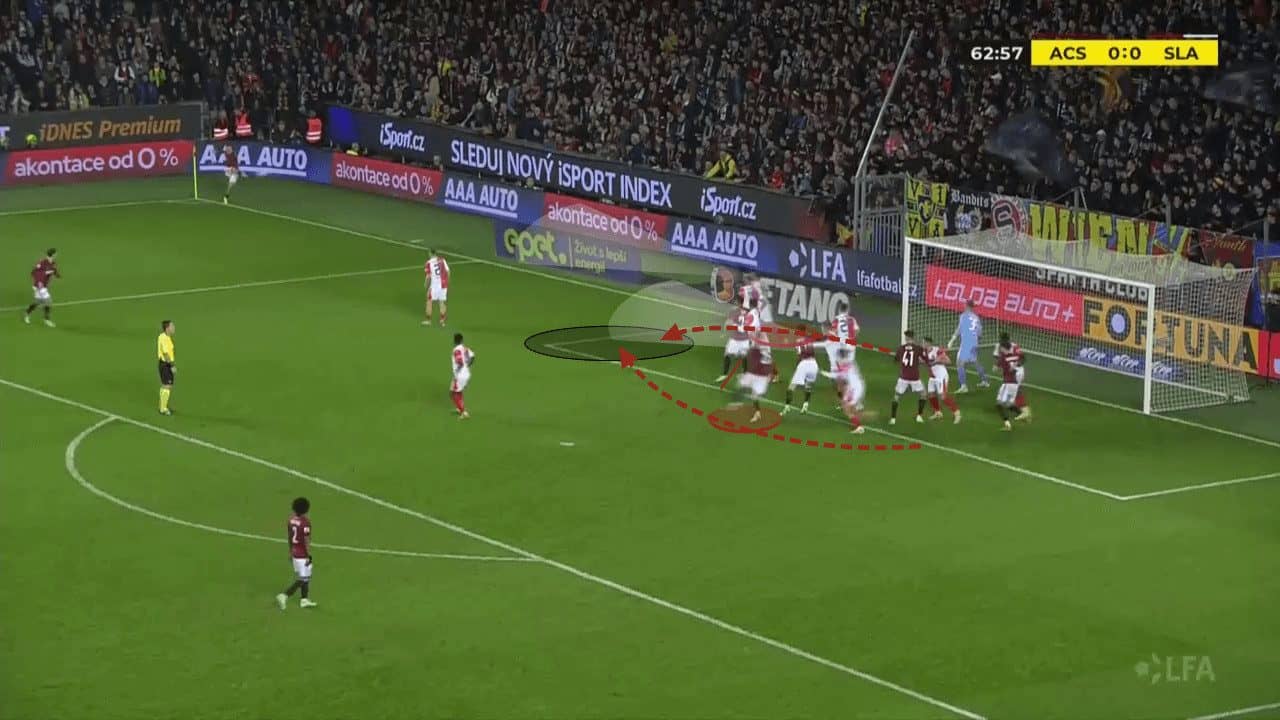
Timing issues have been consistently inconsistent throughout the season.
In instances where goals were scored, it is clear to see the attacker arriving in space at the same time as the ball.
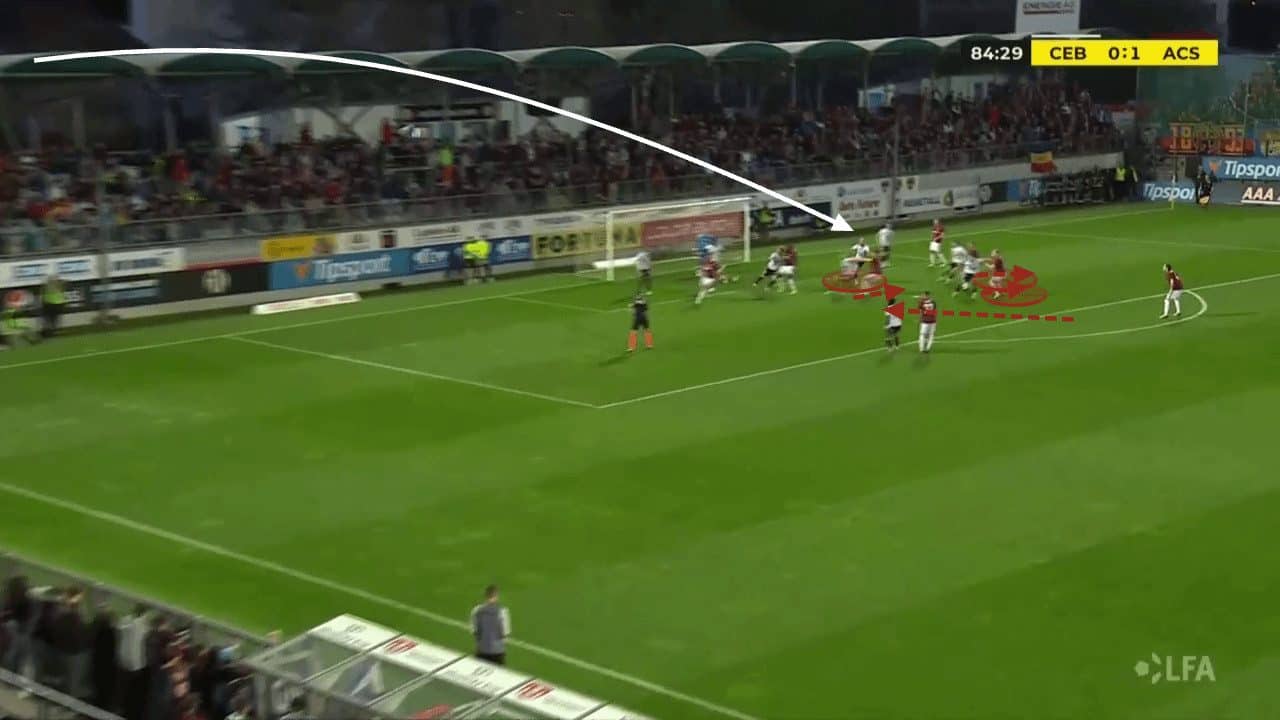
However, in many corner kicks, the runs were made too early, leading to situations like the one pictured below.
The attackers would arrive in the box while the ball was still coming, which meant they had to backtrack to make contact with the ball, as their momentum carried them past where the ball was going.
Ideally, the attacker arrives in space at a quick pace, which enables him to generate more power on the headed effort.
However, when that run is mistimed, the players are forced to backtrack, and the headed effort of a player who is reversing, moving away from the goal, is much weaker than if the player was moving towards the goal.
Conclusion
This tactical analysis has detailed the positive aspects of Sparta Praha’s set play design and highlighted some areas that could be improved.
Their use of screens has carved open significant gaps in the opposition’s defences, and they have been able to control the second phase of most corner kicks.
However, the infrequent ability to create separation for attackers arriving in space has meant that players are always focused on battling defenders to make the first contact, rather than being able to focus on executing their headed efforts.
The timing issues have also meant that attackers rarely can attack the ball with speed, resulting in many attacking efforts being less threatening than they could have been.
These slight improvements to Sparta Praha’s corner kick routines could be the difference between retaining the league title or just missing out, as Sparta trail rivals Slavia Praha by a single point, going into the final stretch of the season.
