


Two Premier League games were postponed because of the first English major trophy final in 2020: Aston Villa vs Manchester City. After 90 minutes, Pep Guardiola’s men retained the English League Cup at Wembley.
Manchester City had a good start, as Phil Foden set up Sergio Agüero’s goal at 20th minute; Rodrigo Hernández extended the lead from a corner 10 minutes later. However, Dean Smith’s team clawed one back by Mbwana Samatta’s goal, keeping the game on. Thanks to Claudio Bravo’s save in the second half, City won the game by two goals to one.
In this tactical analysis, we will show you how City beat Aston Villa. It is an analysis that focuses on tactics.
Lineups
Villa started in a 4-4-1-1 formation instead of a back three they used last game. Ørjan Nyland started ahead of Pepe Reina; Kortney Hause was not included in the squad and Ezri Konsa was on the bench, Björn Engels was the partner of Tyrone Mings.
Guardiola made huge changes regarding his selections from the midweek game. Bravo, the cup goalkeeper started the game; at the backline, Manchester City had Stones, Fernandinho and Oleksandr Zinchenko returned to the starting team; David Silva, Agüero and Raheem Sterling were the attacking players; a slightly out of expectation choice was Foden. They played in a 4-2-3-1.

Villa defensive style of play
Smith planned to set their team to defend and deny City’s attack, instead of looking to press and win the ball high. Their PPDA: 18.53 was higher than their season average 13.51. Also, in the last 15 minutes in the first half, this figure raised to 63. It hinted that they allowed City to keep the ball comfortably in the first phase of the attack.
In general, their defensive shapes was a 4-5-1 or a 4-3-3, depending on different situations. Their main idea was to remain compact and protect the central areas. Villa’s lone striker, Samatta was tasked to man-mark Rodri to eliminate City’s sole pivot in the build-up.
In the following image, you can see the pressing shape of Villa was like a 4-3-1-2. Samatta’s was behind Jack Grealish and Ahmed Elmohamdy as he was man-marking Rodri. Fernandinho was forced to pass under pressure.
Although Villa pressed in a triangle, they failed to set the pressing trap as Rodri was being marked tightly. Also, since their right-winger, Elmohamady. stepped out to press Fernandinho, City’s left-back was free to receive the ball.
Villa did slightly better when defending deeper with a low block. The key was to keep compact in the first half, especially the defenders. In this stage, it was usually a 4-5-1 formation, with the wingers guarding the half-spaces. Therefore, we seldom see City’s trademark half-space runs which generated crosses successfully in the first half.
You can see in this image, the block was compact horizontally and vertically. They tried to deny the City players between the lines. As a result, City defenders tended to move the ball wide without good options at the centre. In this case, Stones played wide to the left flank, given the long-distance for a pass, Villa had time to adjust the position of the players to defend at flank.
Among the defenders, Tyrone Mings did a tremendous job to keep the Villans in the game. Statistics show that he made 11 interceptions (10 in his own box); seven recoveries; six clearances; won all four defensive duels (100%).
City did not overload the wide areas in this match, hence, they only had, at most, three players at flanks. Therefore, Villa could deny the progression when they defended at flanks. Despite the defensive midfielders joint the press on occasions, Smith’s team at least had a full-back, a winger and a centre-back to protect the wide areas.
In this case, Foden and Kevin De Bruyne were suffering from a numerical deficit from three Villa players. Therefore, the attack could not develop, City had to try it again.
Since Villa were a goal down, they could not sit deep and allowed City to dominate the game liked the first half. After the break, they pushed the midfield line higher to pressure the City build-up players. However, this gave City the chances to play between the lines as the defenders did not follow.
In this scene, Sterling and D. Silva positioned themselves between the lines. Vertical distances between Villa lines increased, and, since Douglas Luiz stepped out to pressure Fernandinho, he could not cover spaces behind. City progressed the ball by a vertical pass, finding Sterling.
Inverted full-backs
For City, they attacked fluidly as their players were given the freedom to roam their positions. To sum up, the main theme of their attack was to maintain the width by all means. The first type of attack was tucking the full-backs inside.
The following image briefly illustrated the offensive shape of City, though the players continued to exchange their positions. The first phase of the attack was a 2-3 shape. Rodri, Zinchenko and İlkay Gündoğan provided the second layer of the build-up. The importance of the left-back’s position was to manipulate the opposition winger, which opened a passing lane to the left-winger.
In this phase, City tried to keep front players high, as, once they switched the ball wide, they had enough numbers in the box. For example, if Sterling received the ball out wide as reflected in this image, City already had three players (D. Silva, Agüero and Foden) to attack in the box. This gave targets in the box for the crosses.
Below is the heat map of D. Silva throughout the game. The Spaniard seldom dropped to the central third. As he stayed high as City progressed the ball through the flanks. D. Silva was active in the final third, precisely, the left half-spaces.

This was the approach that helped City to create the first goal. Sometimes, City even positioned both Kyle Walker and Zinchenko at the centre, Foden and Sterling stayed wide. This on occasions drew the defensive shape of Villa to a 4-3-3 and reduced the horizontal coverage of the block. Since Zinchenko pinned Elmohamady in as shown in the following image, Fernandinho had a wide passing angle to Sterling.
Also, since Villa’s defenders stayed narrow initially, so their right-back, Frédéric Guilbert was far from Sterling. The 25-year-old enjoyed rooms to carry the ball forward and entered the final third without obstacles.
Attack with the full-backs
As a ball-playing defender, Fernandinho had exceptional passing vision and skills. Therefore, despite Rodri was man-marked by Samatta, City still had another player to provide some quality out balls. The Brazilian was good at carrying the ball forward to open the passing lanes.
On other occasions, City used the full-backs to provide the width. The following image showed the attacking of Guardiola’s team. Their shape was wonderful as they successfully controlled five vertical corridors in the attacking third. Therefore, it was difficult for Villa to anticipate the forward passes.
In this case, Fernandinho carried the ball forward, attracted Villa players at the centre, created more rooms for Sterling. This strength of the Brazilian helped City to start an attack more efficiently.
Below was another example, on this occasion, City had Zinchenko to provide the width on the left channel. This allowed the left-winger, Sterling, to position himself at the centre. Again, Fernandinho carried the ball forward and looked for a progressive pass. In this case, he forced Luiz to step out, which opened the passing lane to Sterling. City penetrated through the centre thanks to the close distance from Sterling and D. Silva.
Fernandinho completed 69 of his 74 passes in the game (93%). Among those passes, 16 of them were progressive passes, no other City player had a higher figure. Also, he had 36 forward passes, at least 10 more than any other player on the pitch.

The full-backs of City were pleased to provide supporting runs at flanks as well. Since both City wingers tended to cut inside at flanks, this increased the unpredictability of City’s wide attacks.
In this image, you can see Foden’s body orientation gave Villa defenders a signal that he was cutting inside. The Stockport Iniesta drew the attention of the oppositions. As a result, Walker became the free player made an underlapping run to zone 18, and he was released by Foden.
Offensive transitions
City also looked dangerous in the offensive transitions. They capitalized on the positionings of Villa defensive midfielders. The distance between Luiz and Nakamba were too large. When possession turnover occurred, City got behind the Villa defensive midfielders quicky. Instead of keeping the ball and organize the attack, City tried to pass vertically and start an attack as quickly as possible.
For example, City bypassed the pressure and reached Sterling quickly in this transition. Nakamba was forced to pressure the 25-year-old, and he was under a 1-v-2 situation. Since Luiz pushed too high, he was far from Zimbabwean, Villa lacked protection at the centre. They could not cover D. Silva on many occasions.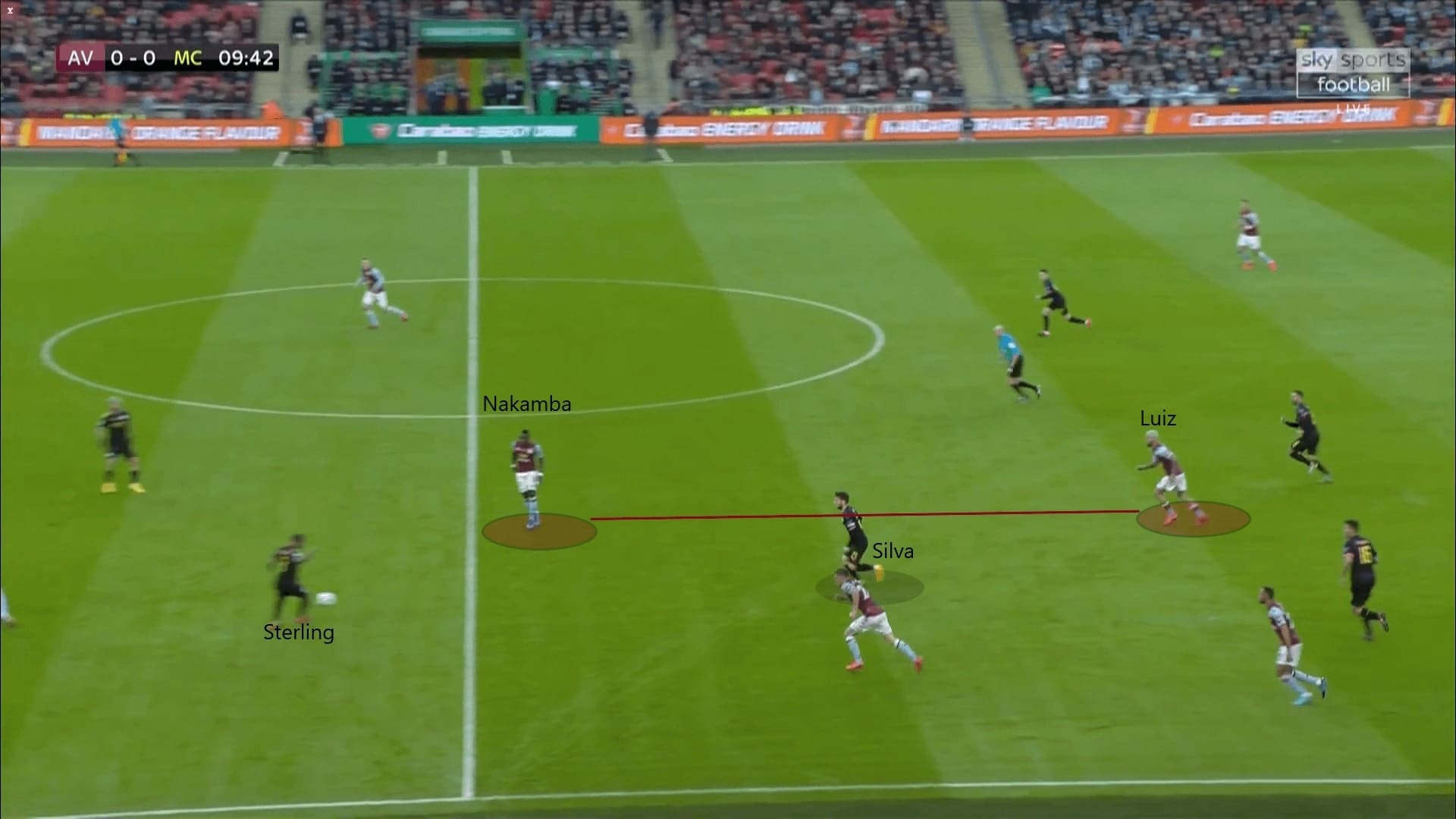
City’s Press
For City, they pressed Villa to win the ball back. The task was not too difficult as Villa were reluctant to play out from the back. Therefore, the objective of the press was to force a predictable long ball and let the defenders do the rest. Their PPDA was 8.80 in the game, and the lowest point was 4.20.
In general, City’s pressing shape was liked a 4-4-2. As shown in this image, D. Silva jointed the Agüero at the frontline. Once the Villans moved the ball wide, they shut the short passing lane around the ball. In this case, Agüero covered the pivot; D. Silva pressured the ball; Sterling stepped up to close the supporting player, under these circumstances, the Lions were likely to play long.
Villa wished to use Samatta or Elmohamady as the target men and attacked City’s left zone. Villa kept throwing long balls to that area, but they did not dominate the aerial duels. As the left centre-back, Fernandinho did a remarkable job to protect that zone. He had five interceptions; four clearances; 13 recoveries; three and two successful aerial duels (67%) and defensive duels (100%).
Below are the interception graph and recovery graph of Fernandinho. We framed the area between zone 4 to zone 10. You can see that the Brazilian made an impact by intercepting four balls and recovering six in those areas. He was a reliable defender to deal with the long ball of Villa.

To further elaborate, the key was to lock the second layer of the Villa attack to prevent the build-up. When Smith’s team felt the easy short options around the ball was unavailable, they tended to play long instead of taking the risks to penetrate at the centre. In this example, you can see Rodri stepped out to press the Villans. They tried to pressure the opponents in this phase and force a long ball.
As you can see in this image, Elmohamdy was at the central third. In other words, Samatta was isolated against two centre-backs and unable to win the ball on many occasions.
Indirect freekicks
Given the ineffective positional attacks (18 with two shots only), Villa tried to create their chances through the set-pieces. In hopes of exploiting the high defensive line of City, they prepared corresponding tactics to deal with it.
Below was an example which illustrated the general setup of their indirect freekicks, though the contexts were different. The main idea was to attack the far post, also, commit numbers to that area and pick the second balls.
As shown in the following image, you could see Villa placed two players at the far side, Mings and Anwar El Ghazi. The Dutchman was even behind Walker. City placed four players at the front post, but only two Villa players in that area.
Here comes the intriguing part. When the entire City defensive line retreated deeper, two players stopped the run: El Ghazi and Samatta. If the delivery was a pinpoint one, of course, the player(s) at the far post could head the ball. If not, the clearances of City players were likely to enter the area as highlighted around. With the positionings of the players, Villa could quickly pick the second balls around the box.
This was a good idea, though their execution let them down.
Conclusion
City won three straight Carabao Cups! In general, they were the better side of the game. The tactics were different from the Real Madrid game, they utilized the widths to attack, dominated the game. Defensively, they were still suffering from individual errors, if not for Stones’ error, City could have won the game more comfortably.
For Villa, they already improved a lot, compared to the last clash. Their block was unable to stop City from creating the chances. Offensively, they lacked pacey players to challenge the high defensive line of City. From xG (0.68–2.29), they were outplayed in the game. However, they could have levelled the game if Villa were more fortunate.

