


When the news broke that Bayern Munich Frauen midfielder Lena Oberdorf had sustained an anterior cruciate ligament injury in the run-up to the 2024 Paris Olympics, fans of the German national team could have been forgiven for harbouring concerns about whether her absence would hamper their ability to challenge for the gold medal.
However, as the group stages have progressed, those fears have rapidly dissipated due to Janina Minge‘s impressive performance levels.
She was drafted into the squad to replace Oberdorf (and who, ironically, was also signed by Wolfsburg Frauen to replace her in their ranks next season) and who has proved as the matches have gone on just why Germany’s interim head coach Horst Hrubesch saw her as the right fit to fill the hole that the injured midfielder had vacated.
There is no doubt that she is one to watch in the German women’s game at this moment in time and is only going from strength to strength.
This Janina Minge tactical analysis will take a closer look at her game to see where Germany has benefited from her presence and where she can help them to seal victory against Zambia in the final group game, with them needing a result in that match to be sure of a place in the knockout rounds.
Janina Minge Defensive Traits
When watching Janina Minge’s displays in France, it is hard not to be impressed.
Less than a week before their opening match against Australia, she was confirmed as a full member of the team.
However, it was apparent from that outing that she would be a key player for her nation as their time at the Olympics went on, with her qualities helping to fill the void that Oberdorf had left open.

One thing that Germany have really come to rely on is her ability to anticipate what will happen and to make moves accordingly to break up attempts by opponents to connect with each other around the field.
However, what has been noticeable is the variety that she has shown when intercepting the ball.
There are moments when she has simply positioned herself between two opposing players, forcing them to take an elongated route around her, which slows down the speed of their build-up play. At other times, she has looked to time her runs and regain the ball mid-transit.
This situation was one of the latter, with Australia’s West Ham United Women midfielder Katrina Gorry looking to send the ball towards Arsenal Women forward Caitlin Foord, but seeing it intercepted before it could reach her.
What has made Minge so effective at winning the ball back is that she often runs towards it from areas where she is not as easily noticed.
In this case, she didn’t appear to be in a position to make an interception due to the distance she needed to cover.
Still, she succeeded in doing so, thanks to her exceptional timing, which allowed her side to prevent Australia from gaining too much territory.
When considering that she has made 10 interceptions in total so far, this is certainly something that Germany have come to rely on her for and it is an aspect of her play that they will need to hope retains its effectiveness if they are to maintain their hopes of Olympic glory.
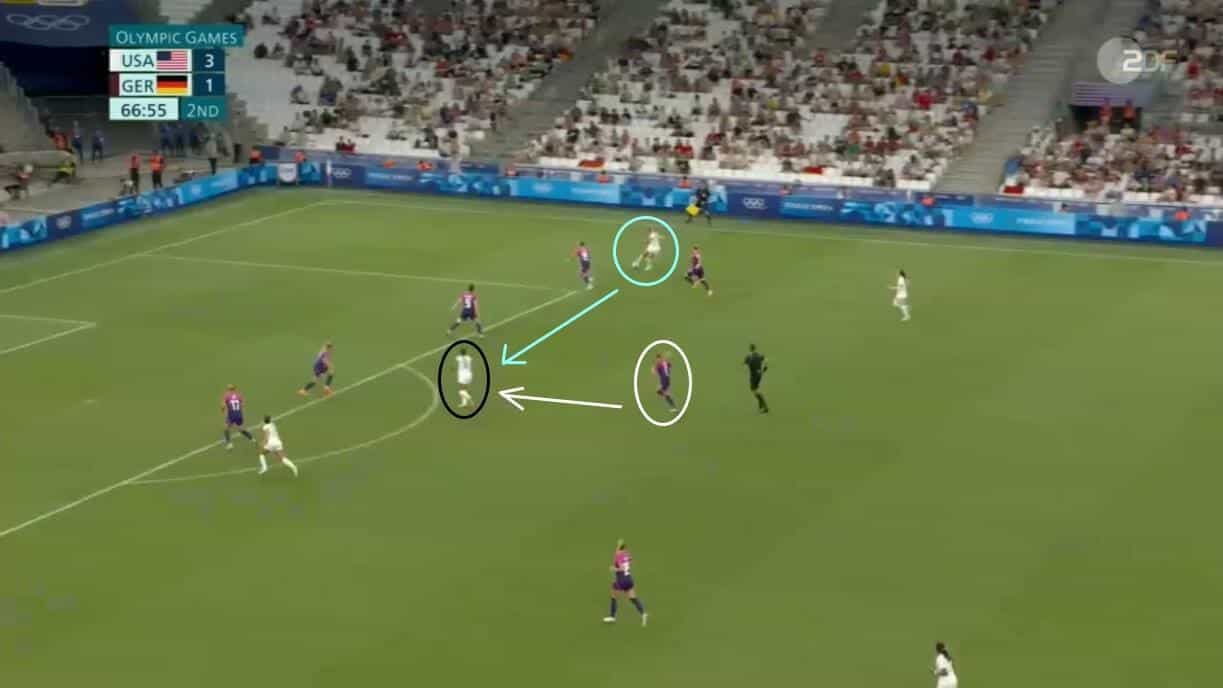
Having that raw anticipation and ability to read the game so well has helped Minge to have an effect in other areas of the field, too, such as here when the USA had made it into Germany’s third and were looking to fashion a shot on goal.
As this game evolved, it became clear that the USA tactics were based on spreading the play wide in an expansive manner before shifting the ball back inside and into the gaps they hoped had been created.
On the whole, it was a game plan that worked out well for them, which ultimately led to a comfortable win.
However, there were times when they were left frustrated, and the presence of Minge certainly contributed to this.
This was one of those moments when their attack broke down prematurely, with Portland Thorns forward Sophia Smith in the right position to send the ball towards Germany’s goal and Washington Spirit’s Trinity Rodman trying to find her from the far side wing.
However, the ball was once again met by Minge before it could reach Smith, and the USA were, therefore, unable to pull the trigger on this occasion.
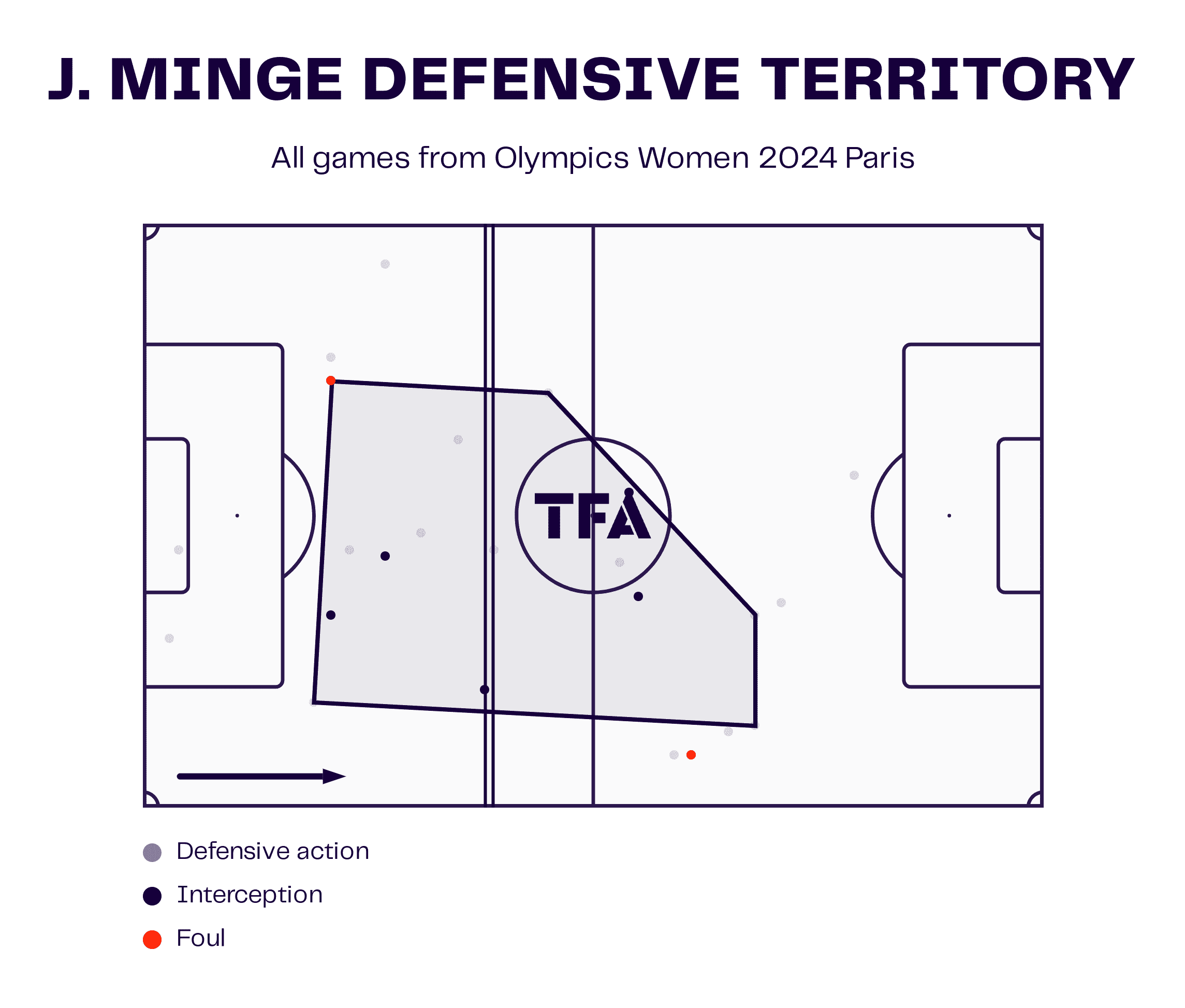
When examining the frequency of Minge’s contributions to Germany’s defensive play in their opening two matches, it is difficult not to conclude that she has been a vital component in their overall system.
She is one of the reasons they still have a chance of finishing in the top two of a group that was tough on paper.
It has also been vital in giving her team balance around the pitch.
They tend to rely on her to patrol the central and defensive thirds while pushing the rest of their midfield and forward players into offensive spaces, committing to attacks, and giving themselves the best possible chance of taking the opportunities that come their way.
When looking at how they put Australia to the sword with some fluid and elegant passing sequences, there is no doubt that they have been a threat when advancing up the field.
The presence of Minge behind has facilitated that, which is another reason that Germany would not have been able to play the same way without her.
Janina Minge Attacking Threat
What has become apparent in this scout report so far is that Germany have predominantly relied on Janina Minge’s defensive characteristics during their time in France, which is understandable as she was brought in to fill the defensive midfield role in their system.
However, Minge is not only someone who can have an effect without the ball, but she also offers a significant attacking threat, too, which could be of use to Germany if they were to alter their formation at all and look for a different approach.
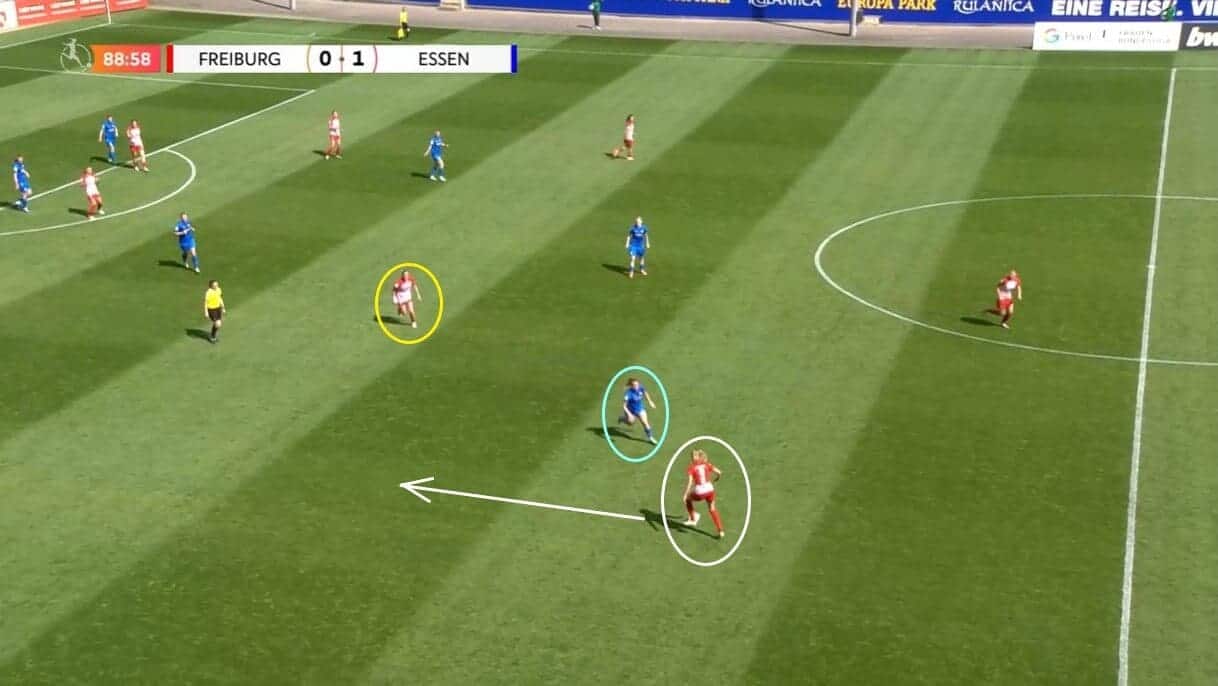
The fact that she can pass the ball out from deeper positions could be of particular interest to them, and she demonstrated this on numerous occasions for her now-former club, Freiburg Frauen, last time out.
It was partly for this reason that they tended to use her as a centre-back, which allowed them to be progressive once they had the ball and to involve the whole team in their build-up play.
It is not simply passing, though, that Minge can offer in these moments, as she is also capable of dribbling and waiting until the right moment to find a teammate.
In this case, she has seen the ball arrive at her feet and has recognised the attempt made by Essen Frauen striker Ramona Maier to close her down.
However, that doesn’t faze her.
Instead, she simply dribbles the ball forward to remove Maier from the equation before instigating a one-two passing sequence with teammate Annie Karich, who is positioned inside her.
On this occasion, the move didn’t lead to a goal, as Freiburg instead gained a free kick.
However, the key point to take from it is that Minge is not only someone who makes interceptions but can also play a part in converting those regains into precise transitions when needed.
With her having an 84.2% passing accuracy for the second half of last season in Germany, this is certainly something that Hrubesch could use to his advantage if he ever did need to tweak his team’s strategy to help them retain the ball for longer periods of play.
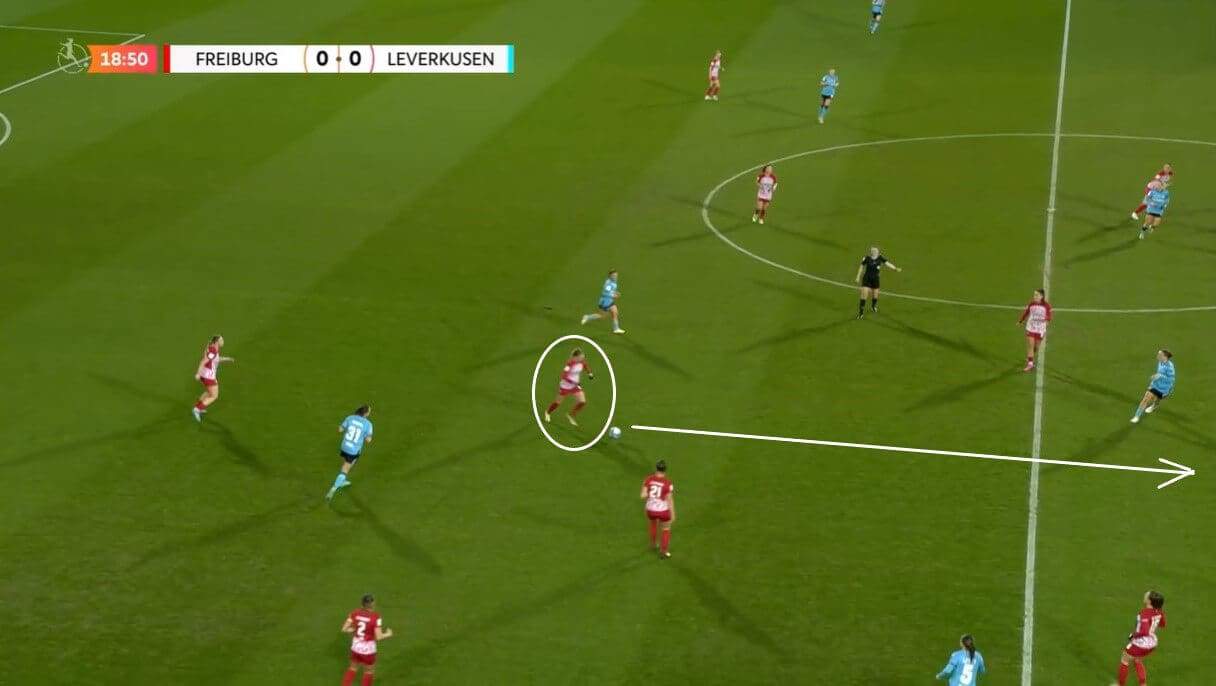
What is also apparent whenever Minge does have the ball is that she demonstrates the same anticipation and ability to plan ahead as in her defensive play.
That, too, allows her to find teammates in different ways and always gives her side the best possible chance of breaking down their opponents.
In this case, she assessed that a more direct approach was the best option, with her making another successful interception once Bayer Leverkusen Frauen’s Hungary defender Lilla Turányi had sent the ball up the field (something that she did 6.03 times per game in the second half of the season).
Still, it is what came next that really stood out.
With no signs of hesitation, she realised that there was space in advanced positions for her teammates to exploit and so moved the ball back towards where it had just come from, allowing her to find Austria striker Eileen Campbell and enabling her to run towards the Leverkusen goal.
With Germany averaging 42.51% possession per game so far, this is something they are more likely to rely on as their time at the Olympics progresses.
It will be of comfort to them to know that they have a player in their ranks who is adept at operating in that way and who can ensure that it leads to success for them.
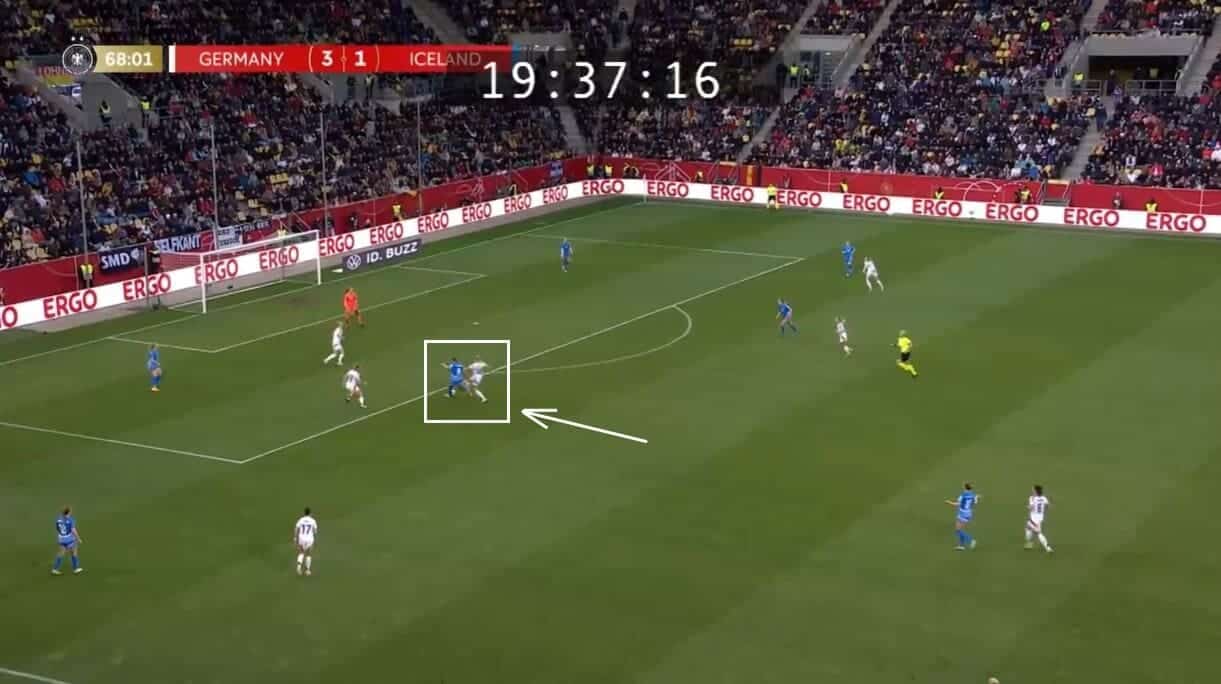
It is not only what Minge does with the ball that has led to her building a reputation as an effective attacker, though there have also been times when she has demonstrated other aspects of her offensive threat.
When Germany hosted Iceland in a Euro 2025 qualifying match earlier in the year, it was her ability to press that entered the spotlight, with her coming on to replace Sjoeke Nüsken and slotting into the attacking midfield position that the Chelsea Women player had vacated.
As a result, her role was very different from the one that she had been known for before then, with her tasked with getting tight to opponents and trying to take advantage of their desire to play out from the back.
This was one occasion when she demonstrated this as another strength in her play, with her successfully dislodging the ball from Fiorentina Femminile’s Alexandra Jóhannsdóttir’s feet before seizing upon it to get a shot away at goal.
It might not be something that Germany considers turning to at this moment in time, with it clear that they want her to be a defensive player first and foremost in order to retain the team balance mentioned previously in the analysis.
Still, it does again give them options, and that is the key point to take from this.
Possible Role Against Zambia
With a clear picture now laid out in this scout report concerning what Janina Minge offers in both defensive and offensive situations, attention can now turn towards Germany’s upcoming match against Zambia.
The African nation might not be the most secure defensively, with them known for conceding goals too easily at times, but their famed attacking threat has undone many teams, and Germany will have to work hard to prevent themselves from coming under the same pressure.
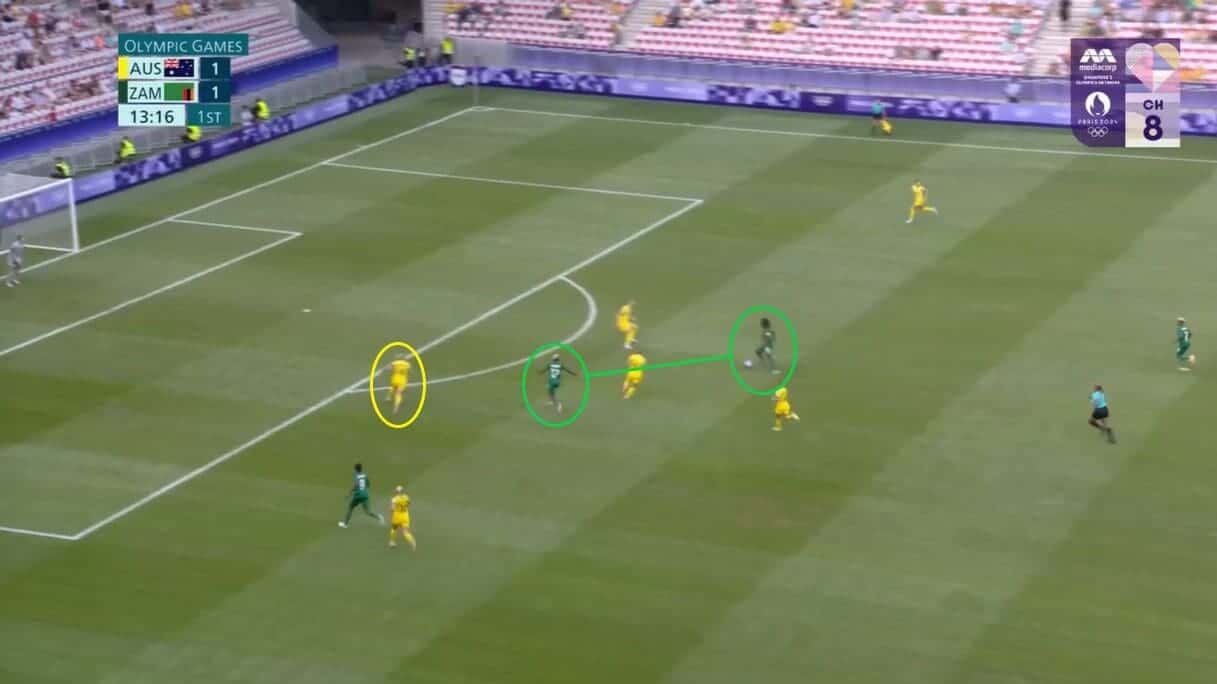
It is for this reason that having a player like Minge becomes vital, with her ability to position herself between opponents likely to come in handy as Germany seeks to break the link between Barbara Banda and Rachel Kundananji.
Doing so will not be easy, with them tending to float around each other as they have done here against Australia and trying to drag opposing defenders out of position, but what Australia didn’t have that Germany does is someone who can disrupt opposing attacks in the manner that Minge can.
Therefore, while Australia were only rescued by Manchester City Women defender Alanna Kennedy getting across and preventing Kundananji’s inverted run from leading to anything, Germany will be hopeful of avoiding Zambia’s attacks from developing this far, and Minge will almost certainly be charged with making that a reality.

Minge’s pace and ability to get tight to opponents could also come into their own if Zambia revert to the long ball tactics that they have adopted in a number of games.
They are looking to absorb pressure before feeding the ball aerially towards Banda and giving the Orlando Pride striker chances to run through opposing lines at will.
They had to adopt this approach at times against the USA, with Emma Hayes’ team dominating the game through the same expansive tactics they used against Germany.
It is possible that they may look to do the same if Hrubesch’s outfit seeks to build attacks in a similar manner.
With Minge already showing at times that she can get back and can prevent counterattacks from leading to anything, she could likely be charged with staying in areas from which she can turn and run towards her own goal if Germany were to be tested by an aerial pass.
She could also be tasked with staying as tight to Banda as San Diego Wave’s Naomi Girma managed to here, with Germany likely to have taken some inspiration from how the USA managed to nullify Banda’s threat and were, therefore, able to open their Olympic campaign in the best possible way.
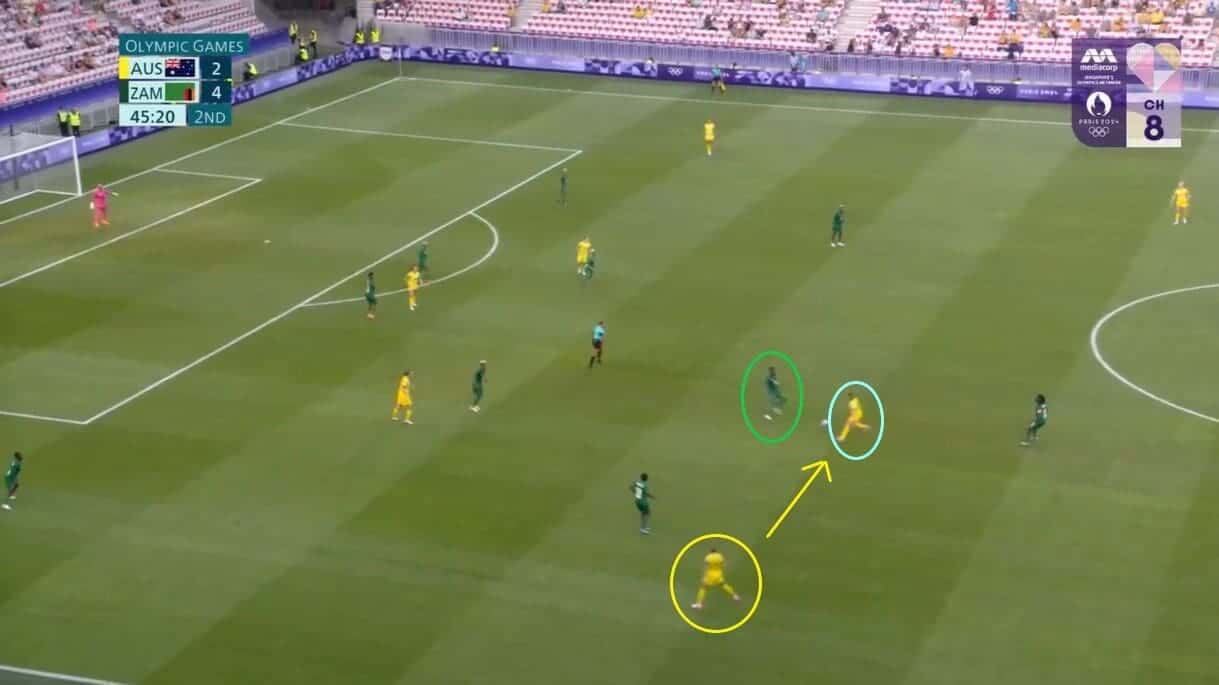
It is not only without the ball that Minge could have an effect on Germany’s play in this game, though; they also need to be efficient whenever they are in possession to make the most of their chances.
With them registering an 80.3% passing accuracy across their two matches so far, this is not something that has troubled them as of yet, but they will know that any momentary lapses in concentration could allow Zambia to get on the front foot, and that is when they are at their most dangerous.
Again, this was something that Australia struggled to get right, and the high volume of loose touches in their play proved costly in terms of the territory they ceded to their opponents.
In this case, Arsenal left-back Steph Catley sent the ball towards her clubmate Kyra Cooney-Cross, but the midfielder failed to control the ball, inviting Kabange Mupopo to break forward and enter the Australian third before her attack was brought to an end.
With Minge being a generally composed player when in these situations and capable of controlling the ball when it does arrive at her feet, Germany will be hopeful that they can avoid making the same mistakes, and they will know that having a positive outcome in the match could well come down to fine margins such as this.
Conclusion
In conclusion, this Janina Minge tactical analysis has taken a closer look at the German midfielder, highlighting different aspects of her style of play and showing both the role that she currently has in her national team’s performances and what other qualities she could offer if there was ever a need for Germany to change things around.
Whilst the injury suffered by Oberdorf was always going to be a difficult one for Germany to manage, the way Minge has stepped into the fray and filled the role means that she deserves a lot of credit, especially considering the tight timescale she had to prepare for action.
Her ability to break up play whenever opponents try to construct attacks has certainly been paramount to Germany’s ability to defend resolutely at times, as well as proving crucial in enabling attacking displays like the one witnessed against Australia to come about.
Germany now faces a tough test against Zambia as they look to maintain their hopes of achieving a gold medal, and it will not be an easy contest for them to navigate.
However, suppose they can keep the African nation’s dynamic attacking threat to a minimum and can, therefore, prevent them from getting into their usual rhythm. In that case, they will certainly have a good chance of gaining a positive result.
All eyes will be on Minge to see if she can deliver when the match gets underway, and she could well be one to keep an eye on for that reason.

