


At the time of writing, Greuther Fürth occupy second place in 2. Bundesliga with 35 points after 19 matches behind FC St. Pauli on 39 points. Despite that, they are not among the top 10 attacking lines in the league, where they occupy the 11th place as the best attacking line, scoring 30 goals with a difference of 10 goals from the best attack, Fortuna Düsseldorf.
As for the defensive level, Greuther Fürth’s team does better as it occupies the second place as the best defence in the league, conceding 21 goals after FC St. Pauli, the first-place holder, who conceded only 16 goals.
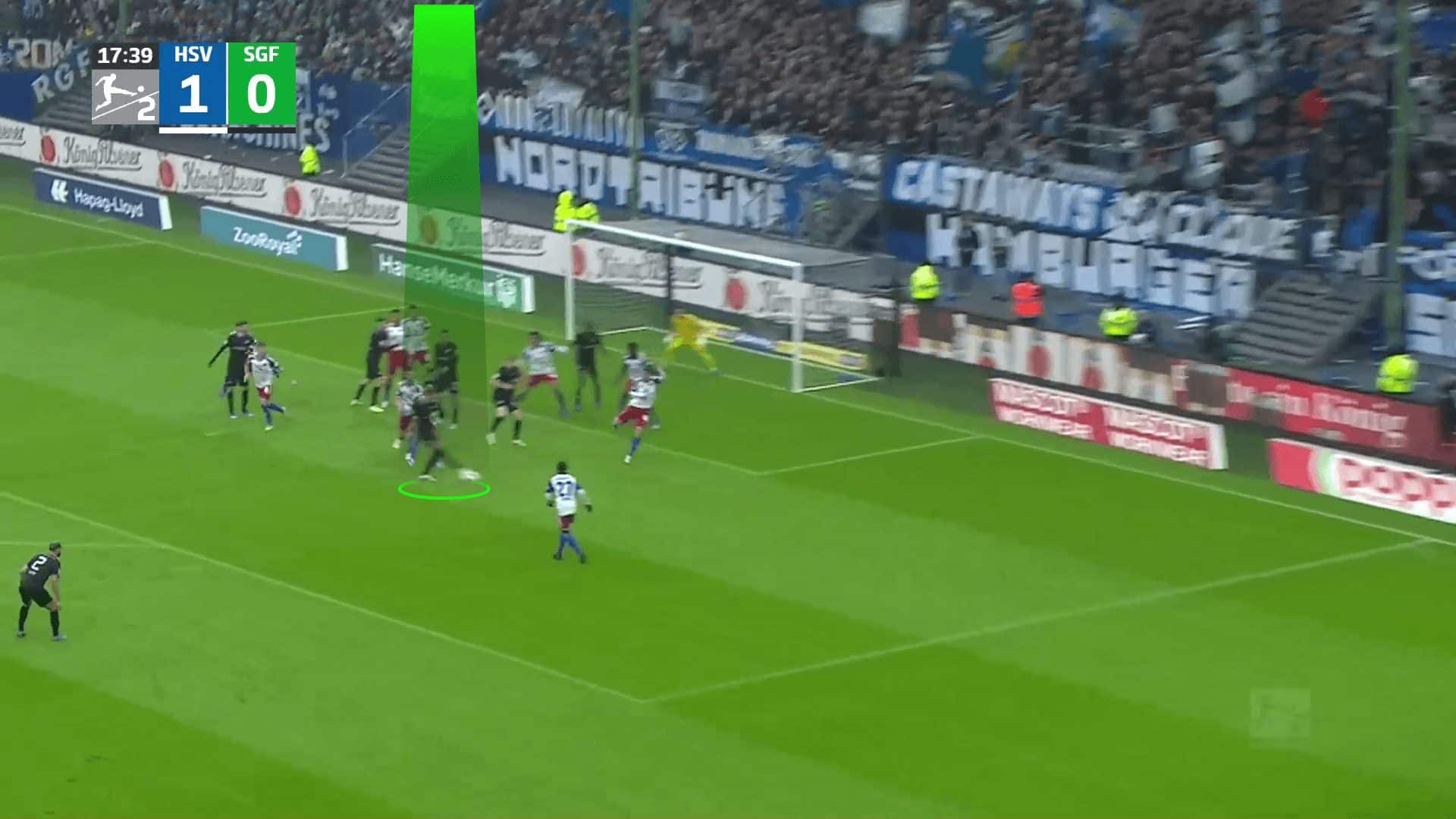
Returning to the offensive level, when we examined the matter well, we found that they also rely heavily on the offensive set pieces, especially the corners, where they are the top scorers from corners in the league with seven goals, where their goals from corners constitute about 23.3% of their total.
In this tactical analysis, we will explain their diverse tactics at attacking corners and how they use many easy methods to make their best players in aerial duels escape from their markers or get a little positional superiority over them to win the aerial duel.
Using stacks
The first idea we will talk about is using stacks to distract man markers, so the first thing we should explain is the meaning of stack. A stack is a group of players who stand vertically, sticking to each other, and that confuses defenders who can’t determine the attacker’s future run directions. In contrast, they can’t stick to their attackers that everyone should mark or be in physical contact with them, which gives the attacker a little dynamic superiority over the defenders.
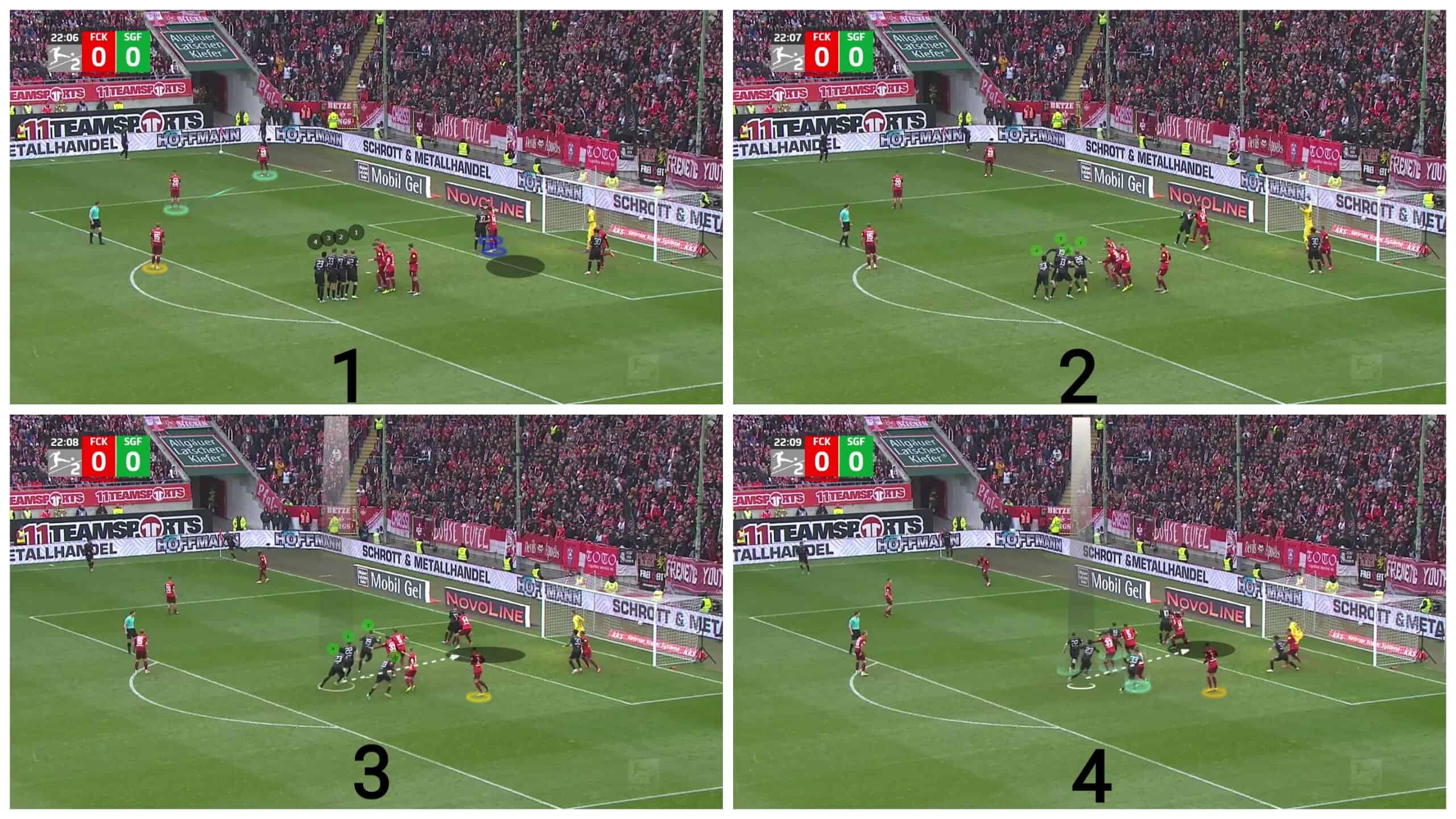
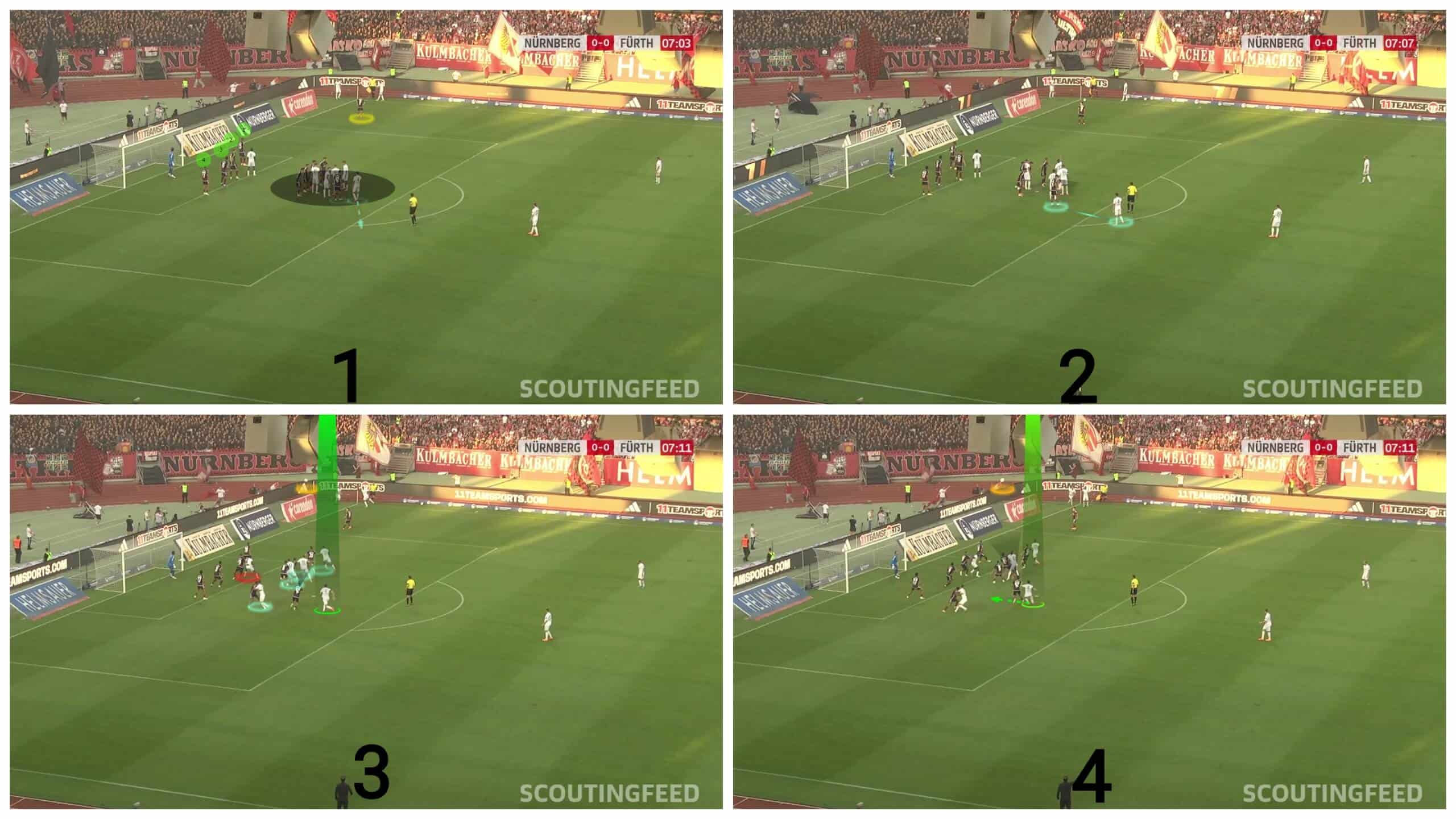
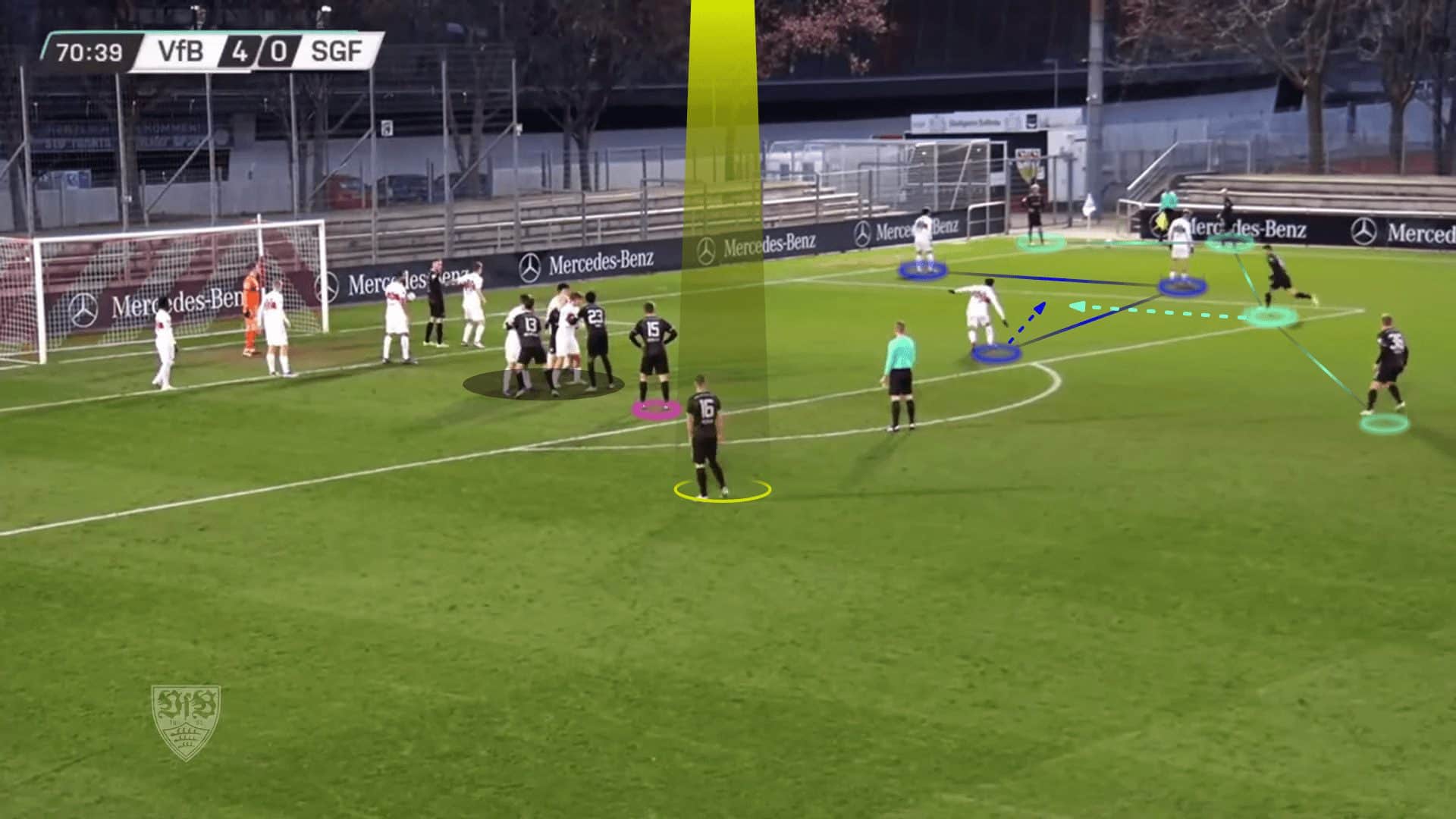
Going to an example to make the issue clear, the opponent defends with a man marking defending system with only two zonal players, two short-option defenders due to Greuther Fürth’s two takers and a rebound defender. In comparison, Greuther Fürth put a player on the near post to drag the two zonal players, a player on the far post, and four players in a stack, while the last one targeted the black area shown in the first photo.
In the second photo, the first and the second players in the stack start to move to the left direction as the taker moves, dragging the first two defenders, then the third attacker moves to the right, dragging the third defender, and after that, the fourth attacker moves to the left. These movements divide the defenders equally in the two directions. Still, the three attackers move to the left, achieving numerical superiority there. In contrast, only one attacker moves to the right against two defenders, so you can simply see the fourth defender in the third photo, in yellow, out of the game.
The fourth attacker finds his way easily to the left, targeting the black area with the help of the attacker, who stands initially with the two zonal players to drag their attention, preventing them from coming back, as shown in the third and fourth photos.
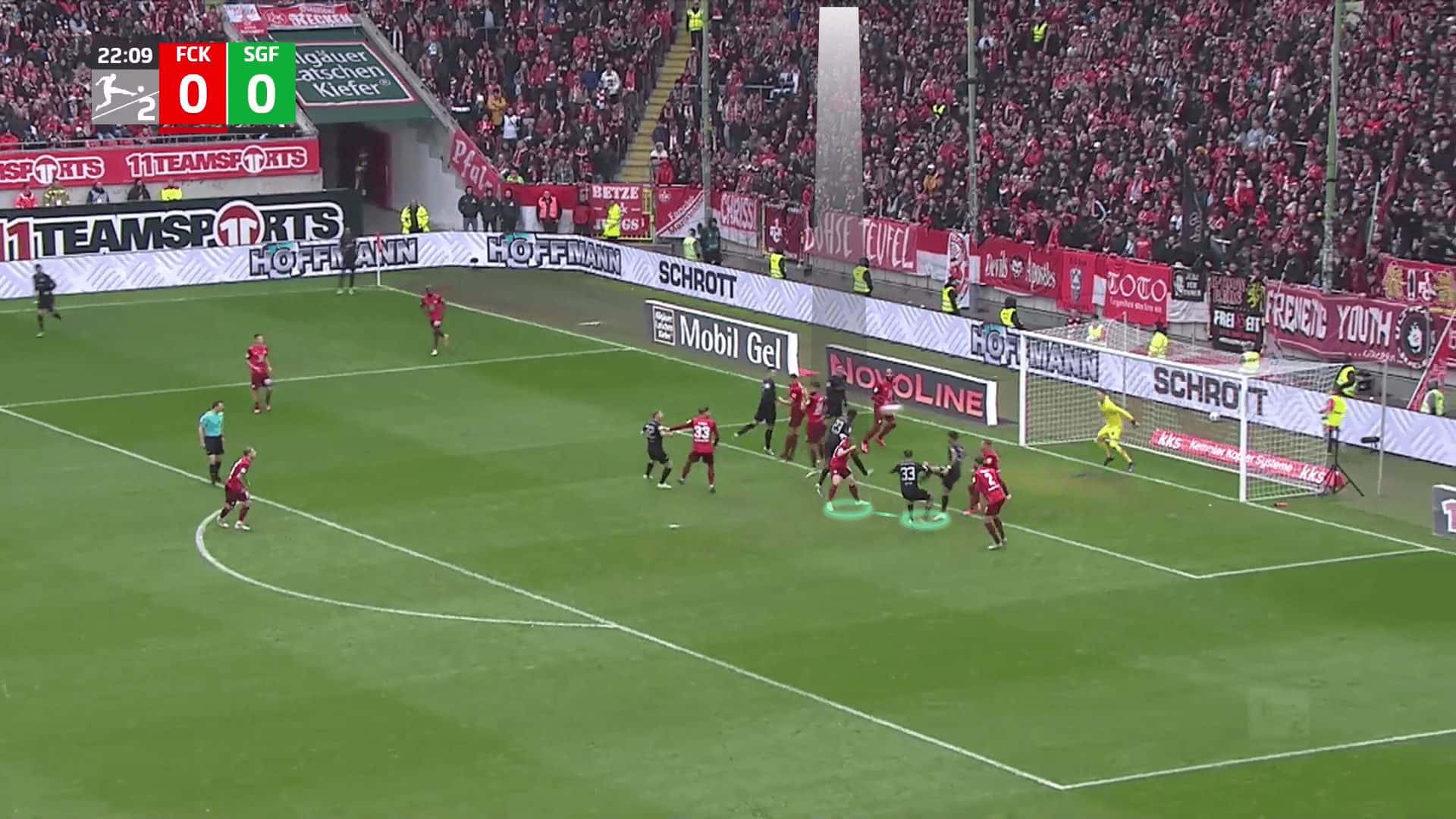
The plan works, as shown below, and the result is a goal.
Flat passing lane
The second routine they used, and we want to explain it, is creating a direct flat passing lane inside the box because this way is too simple to implement, but we do not watch many teams using it enough.
Going to the example, you can find below the defending team defending with a hybrid system, which is a mixture of zonal marking and man marking defending systems, so you can see five players in the first zonal line, which is declined to the outside because the waited out-swinging cross, but they don’t put a defender on the edge of the six-yard who may obstacle this direct ground pass. In front of them, they use four man markers while a player stands to defend the short corner who is dragged away from this passing and because of the short attacker who stands nearly on the corner of the box.
Greuther Fürth put four attackers close to each other, while the last attacker is the targeted player who stands behind two attackers to block the last two defenders. In contrast, an attacker blocks the first defender, preventing him from going to the pass, as shown in the two following photos below.
The plan works, but the player can’t control the ball well, as shown below.
Starting in far positions
They have many good and simple ideas to make it easy for their best players, especially Damian Michalski, in aerial duels to have an advantage over the markers using a combination of many methods to make it difficult for the markers to keep tracking the ball and the attackers at the same time.
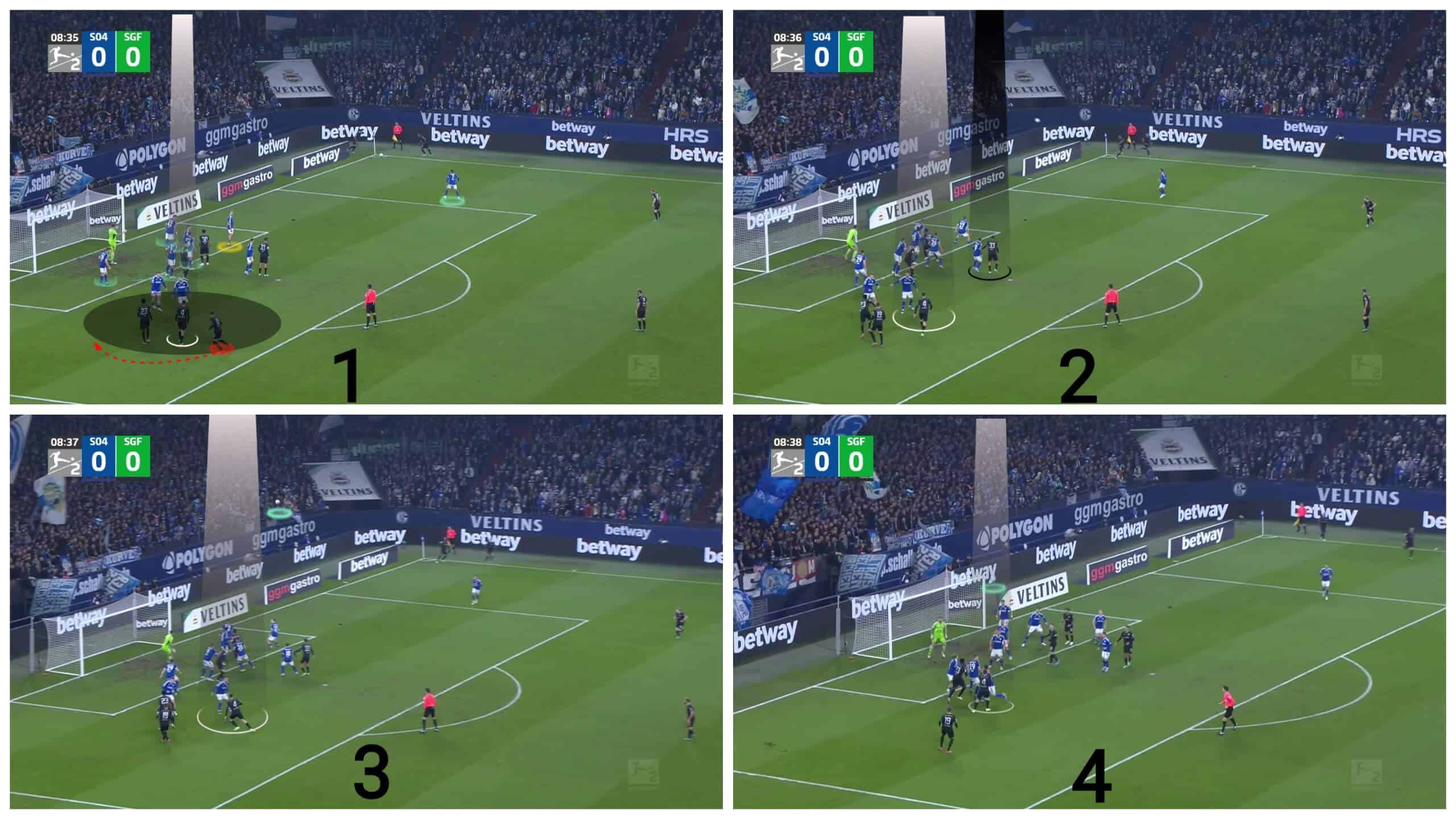
The first method is to stand in a pack near the edge of the box, as shown in the case below. This creates a big space between man markers and the zonal line, which is composed of four players, as shown in the first photo below, where our targeted player, Damian Michalski, drops back to the edge of the box to leave a space between him and his marker, as shown in the second photo.
In the third photo, the four players in the pack move in two directions, leaving the middle to our targeted player, who comes late with his momentum without the annoyance of his marker. This trick also helps him to make the marker between the ball and him, and that is an essential thing for any attacker because this puts him on the blind side of the defender, causing an orientation problem for him and also to have the choice to attack in the two directions depending on the landing position of the ball.
Using a floated cross with a significant height is also helpful to give the attacker the time to run and measure the ball without the annoyance of the defender, who is busy raising his neck to track the ball in the air so you can see the attacker changes his direction in the defender’s back in the fourth photo.
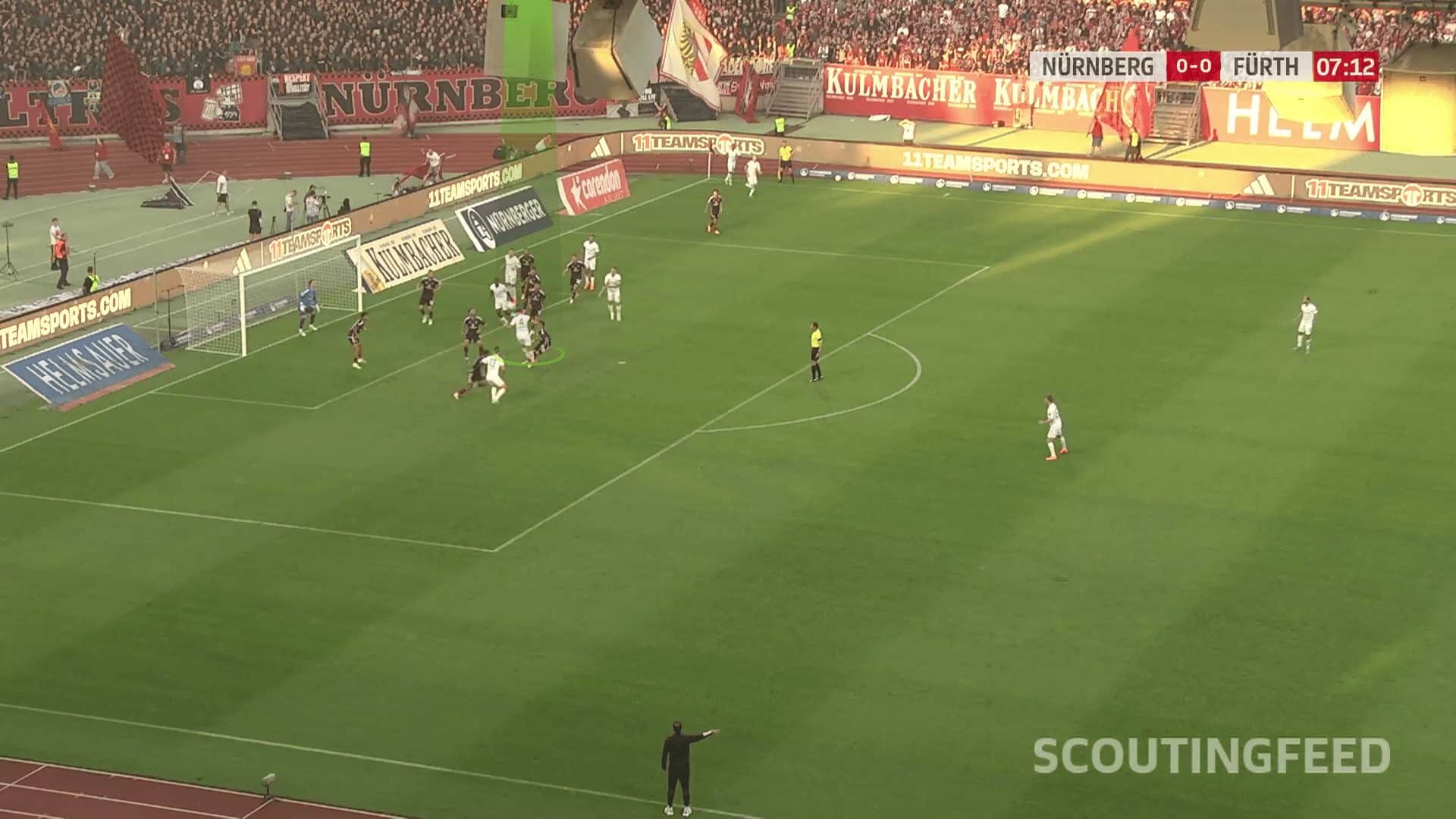
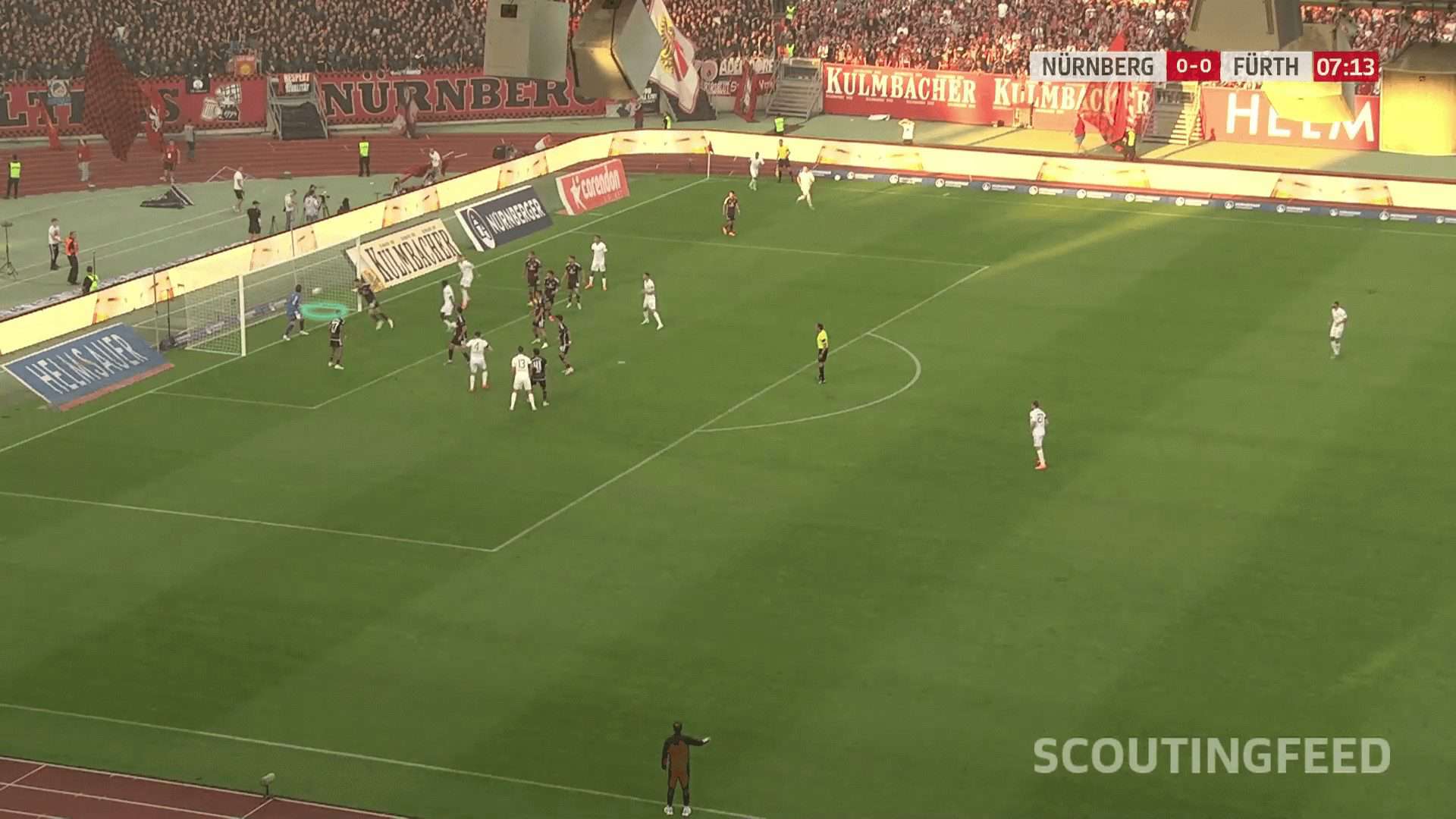
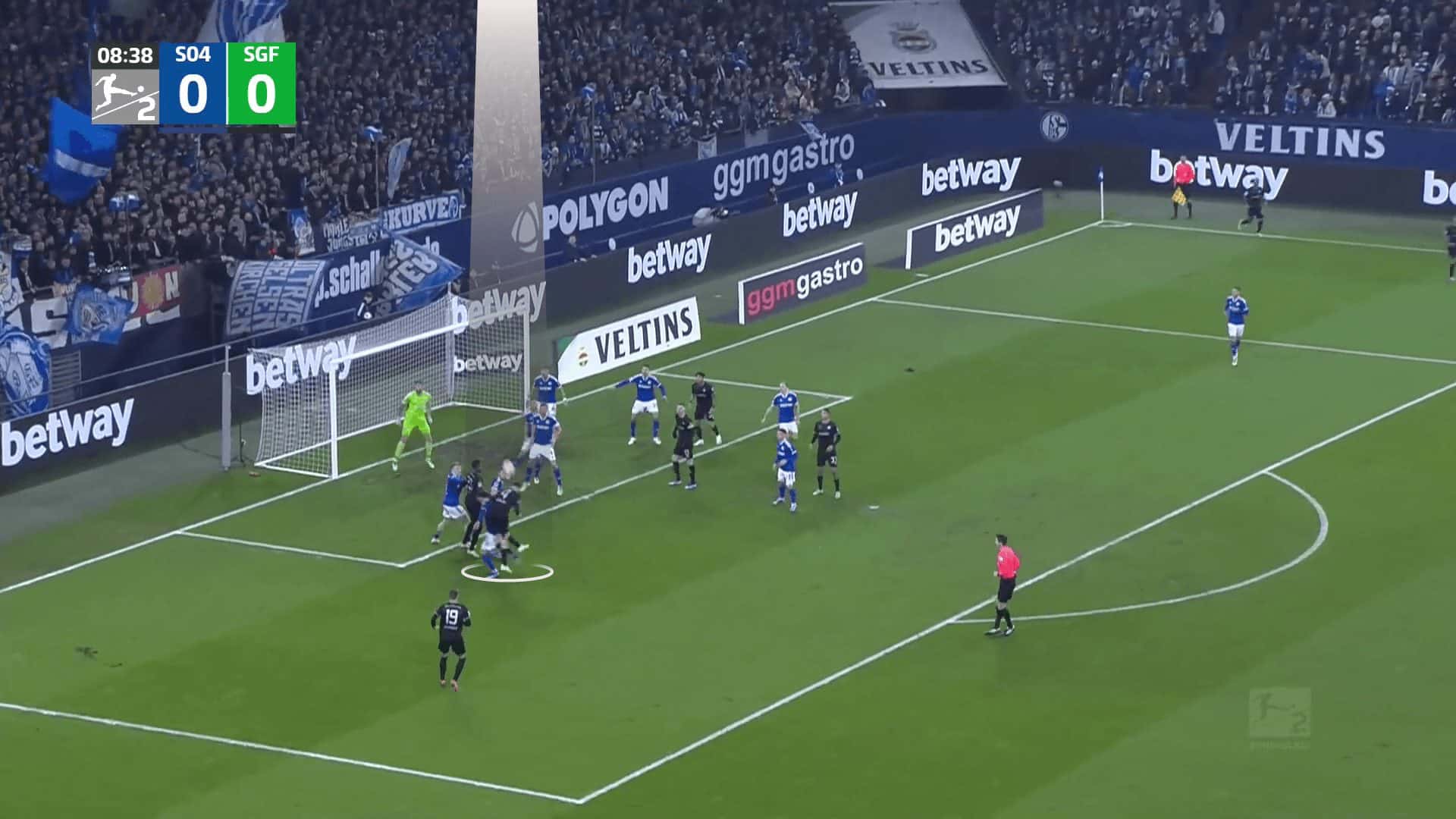
All of the previous details mentioned above make it easy for Damian Michalski to jump from the defender’s back, scoring a goal, as shown in the two following photos.
They have an alternative plan for the previous one: putting a player behind the targeted player in case the ball passes him and sometimes asking the first one to run a decoy run to target the second one. Let’s clarify that with an example.
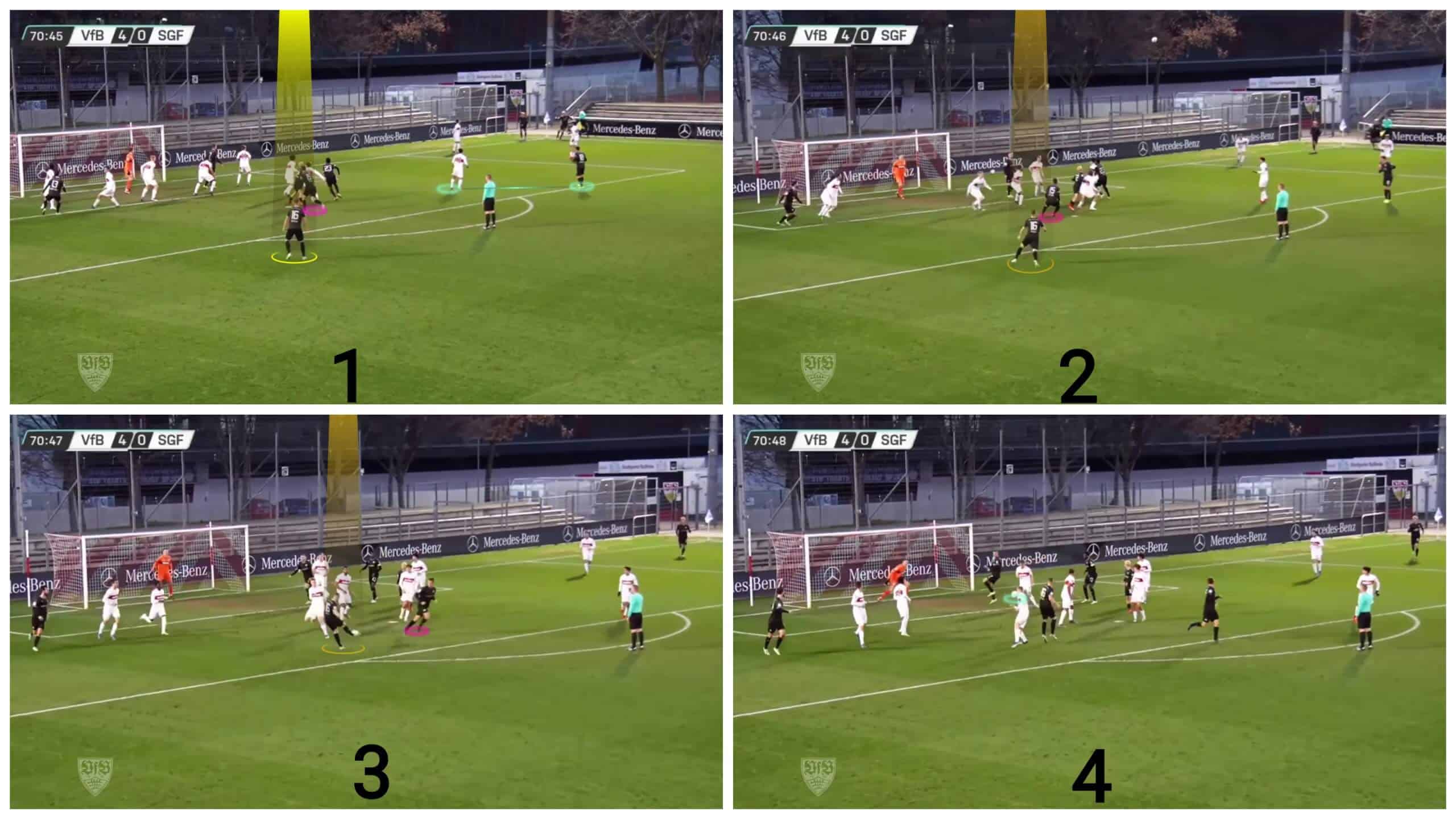
In the photo below, they overload the short area to make sure that the rebound area is empty, and to be more sure, one of the short attackers runs behind the two short defenders to drag the rebound defender. You can also find three attackers against three man markers, leaving two players behind them in pink and yellow.
In the first photo, when the taker touches the ball, the three attackers drag their markers in many directions. At the same time, the pink player behind them goes into the box, dragging the attention of the zonal players who try to get out, as shown in the second photo. So the yellow player gets the ball kicking it, but it hits a defender, as demonstrated in the third and fourth photos.
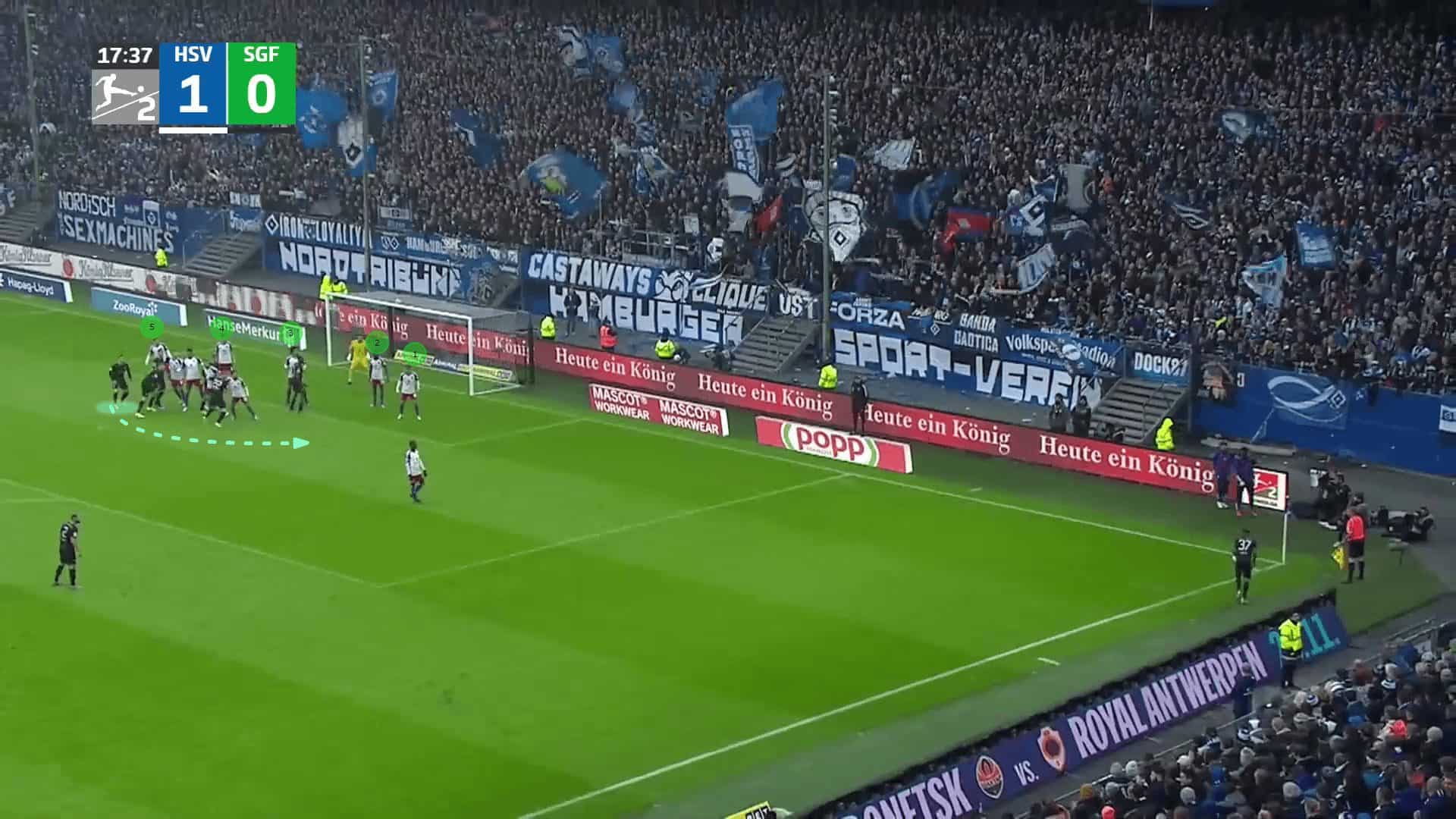
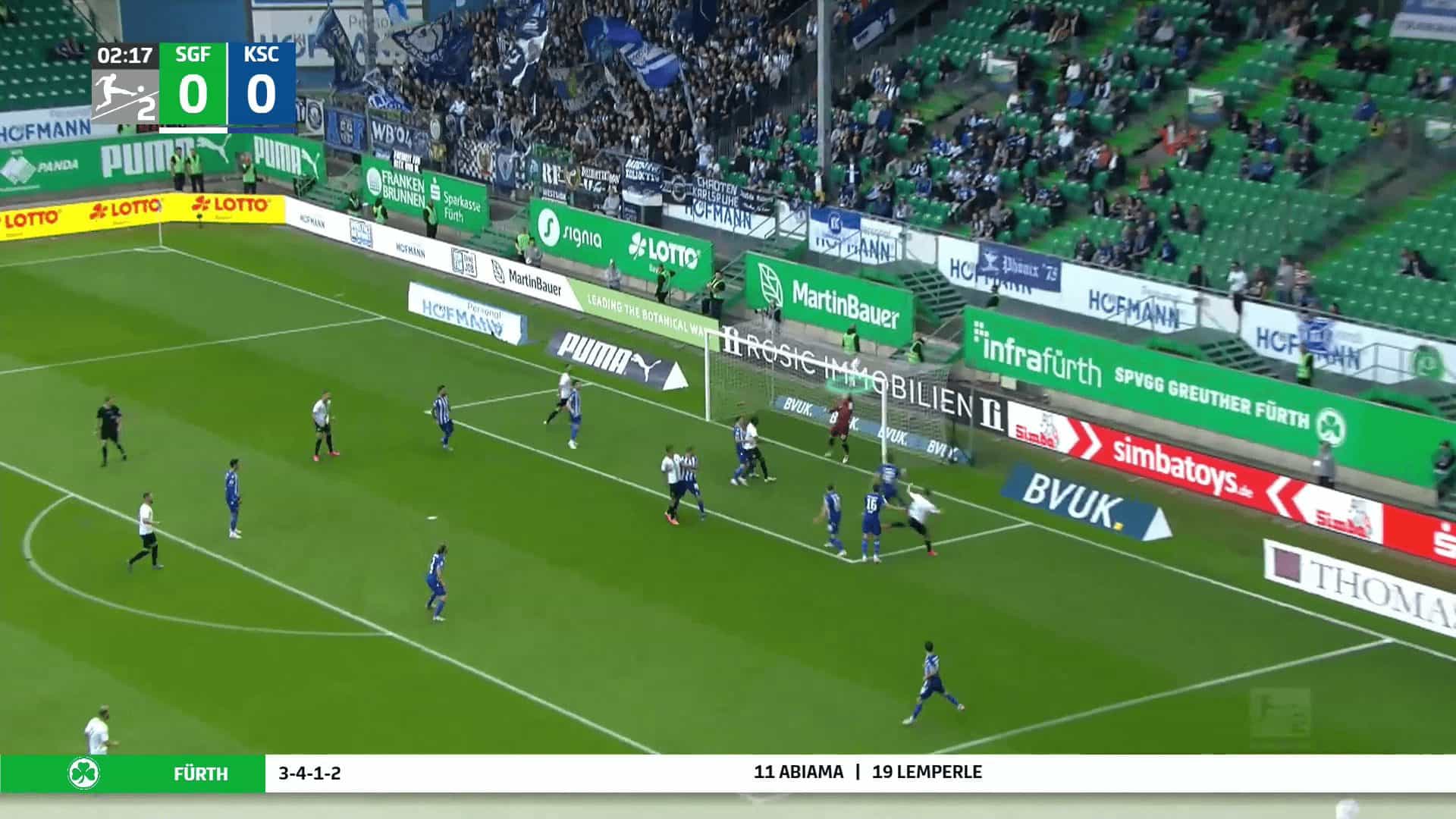
They have another similar method to cause orientation problems to the markers, which is asking some attackers to stand in far areas after the far post, as shown in the first photo, where you can see the opponent defend with five defenders in the first zonal line, a zonal defender in front of them, short-option defender and three man markers. One of the markers goes to mark an attacker on the penalty spot, which is considered more dangerous, leaving the targeted area in a 3-v-2 situation.
In the second photo, we want to focus on the main difference between the body shapes of the marker in the middle and the marker at the targeted area. You will find that the first one is optimum for tracking the attacker and the ball simultaneously, giving his chest to the attacker and his back to the goal, standing inclined to keep tracking the ball and the attacker. In contrast, you can find the opposite thing at the targeted area where the marker gives his back to the ball, so he can’t track the ball and the attacker at the same time and can’t stand inclined leaving the attacker can run inside easily toward the goalmouth.
This orientation problem helps the white targeted player to jump to get the ball while the defender wraps to see the ball losing contact with the attacker, as shown in the fourth photo.
The plan works, but the goalkeeper saves the ball, as shown in the two following photos.
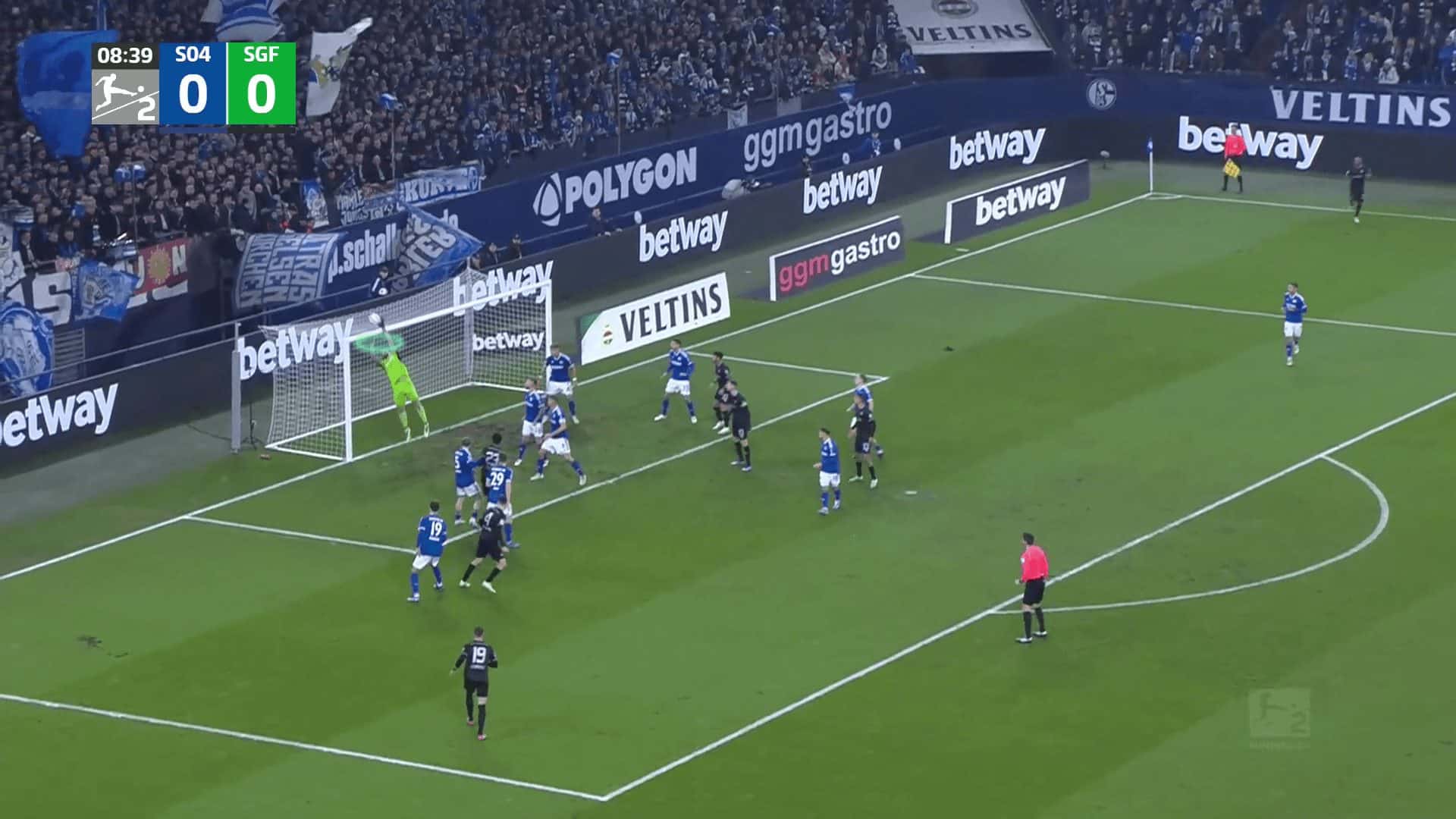
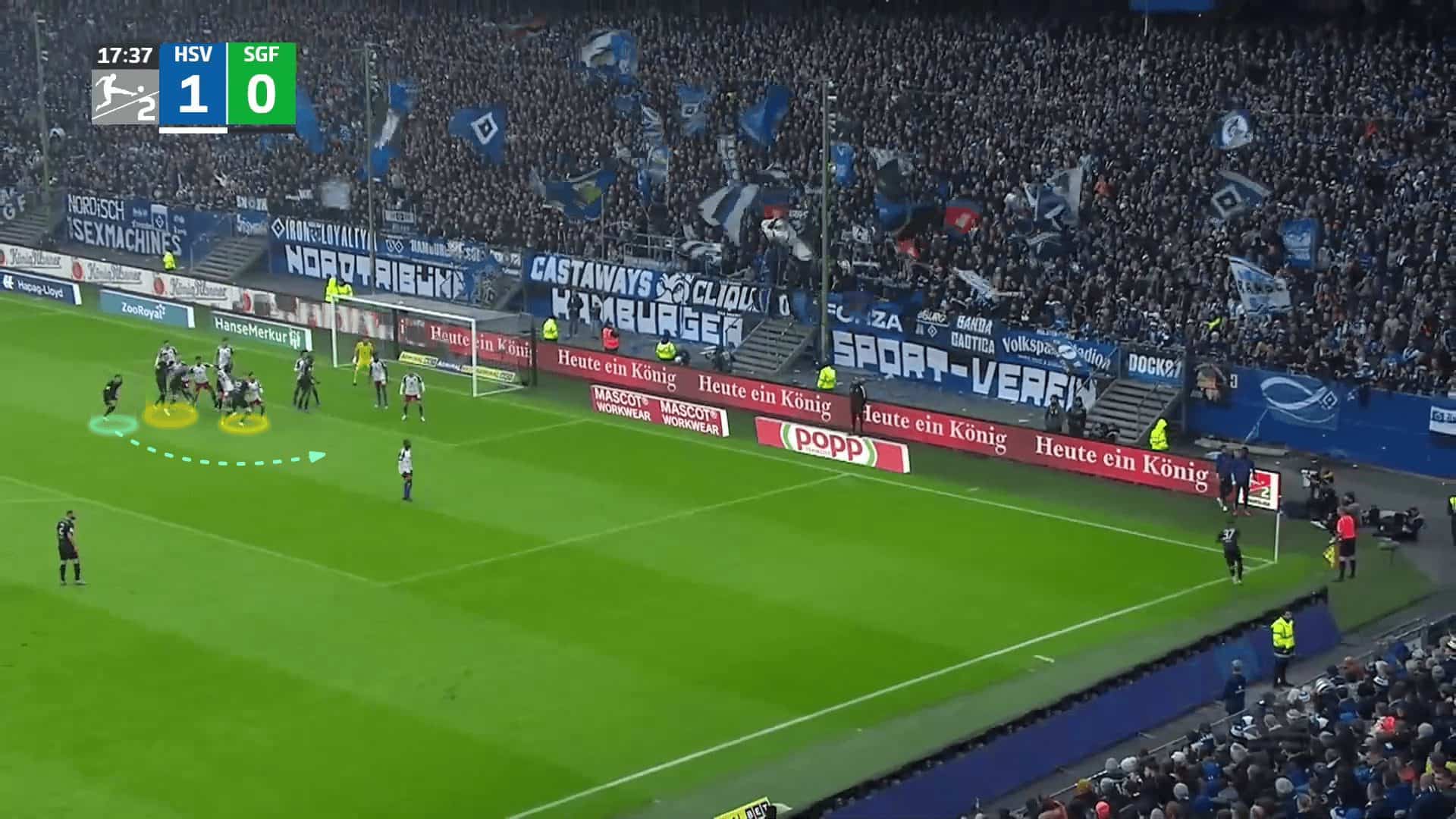
To understand more how dangerous it is for the marker to track the attacker with the right open body shape from far distances, you need to watch the corner below where the attacker pushes the marker’s hand and gets into a race to the targeted area with the help of the first attacker who blocks his marker, as shown in the two following photos.
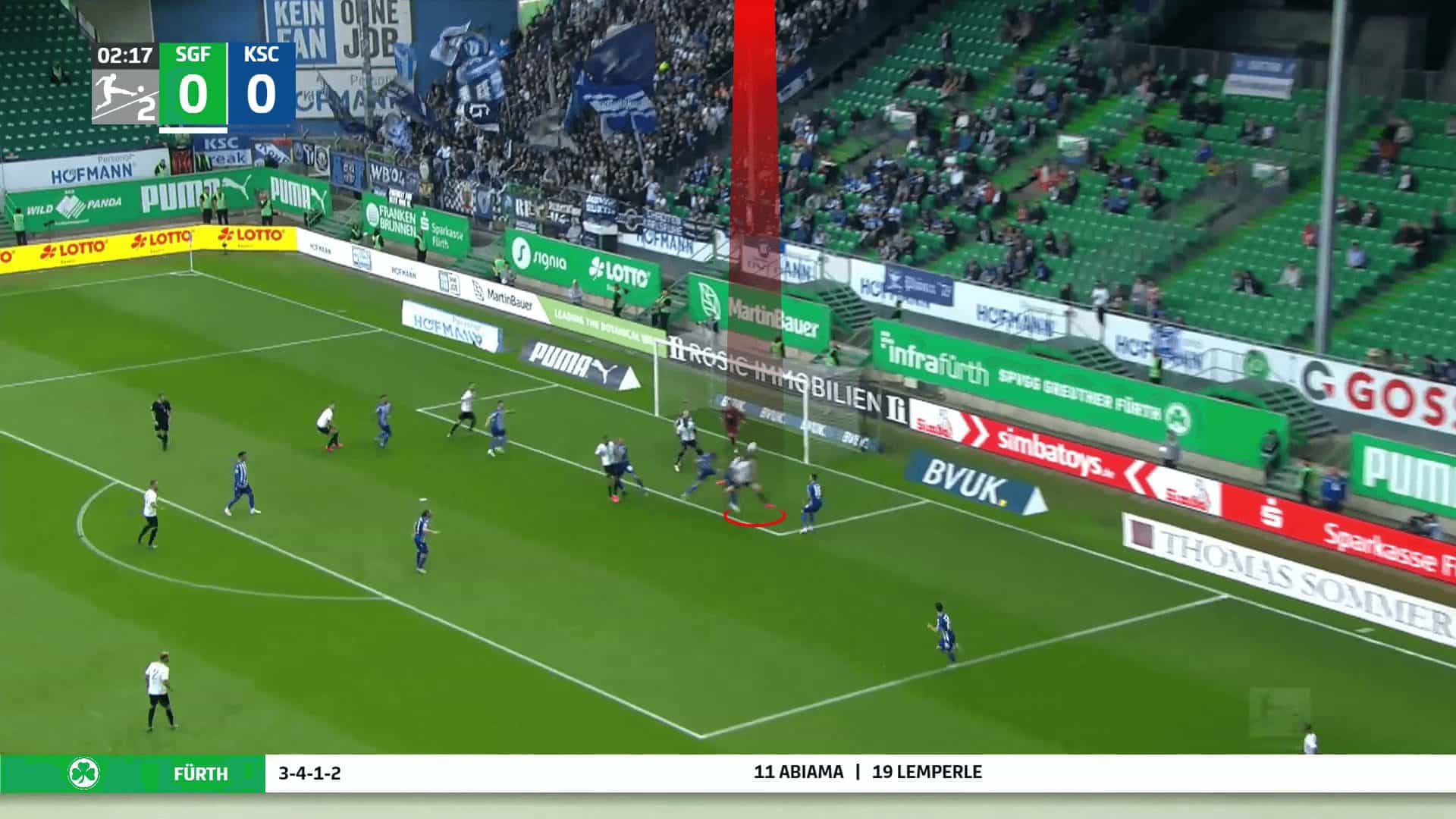
Here, we should refer to an important thing: how difficult it is for the defender to keep tracking the attacker in certain situations. From here, the zonal and hybrid systems exist to put zonal players in the most vital area to avoid that problem.
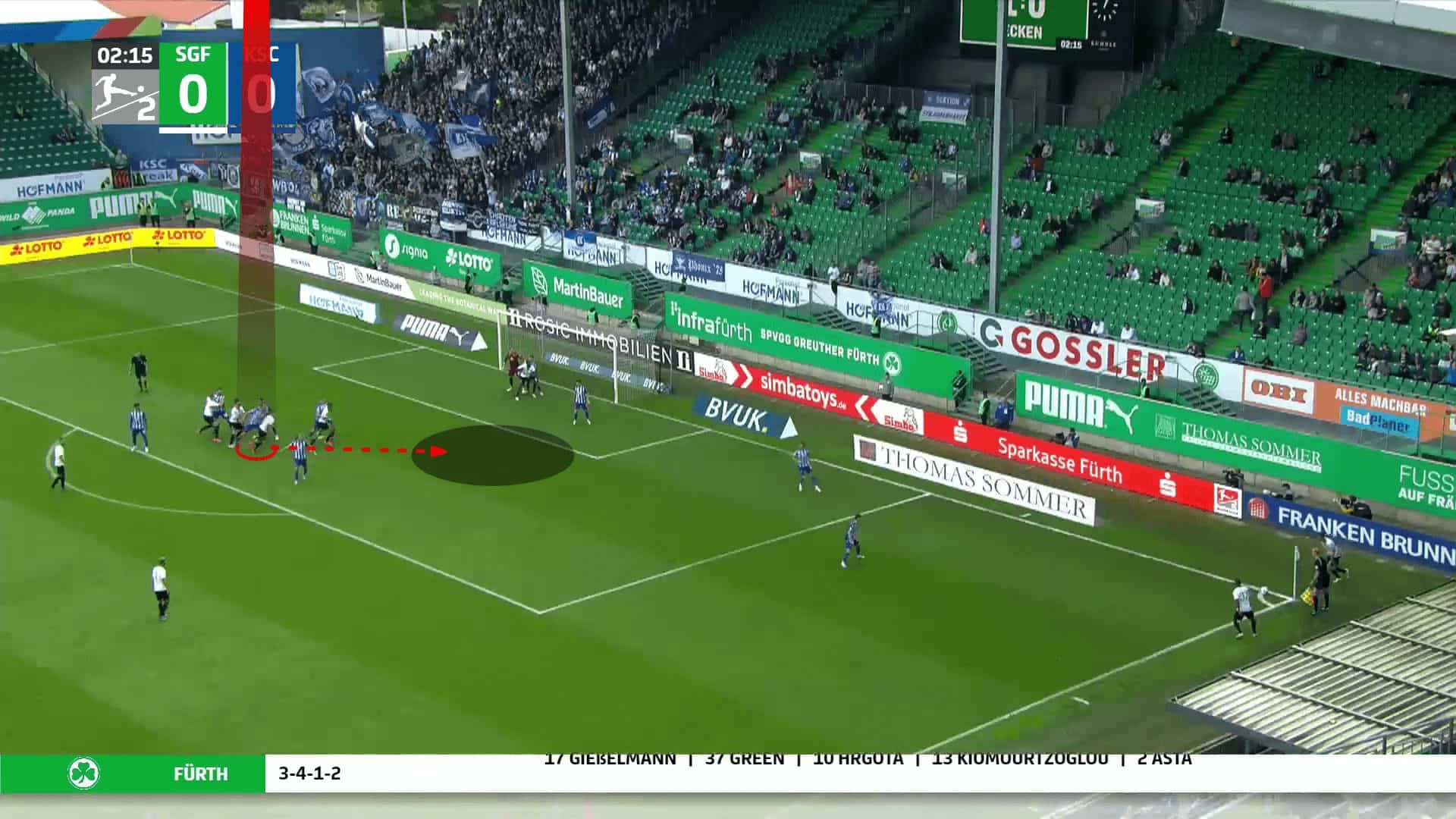
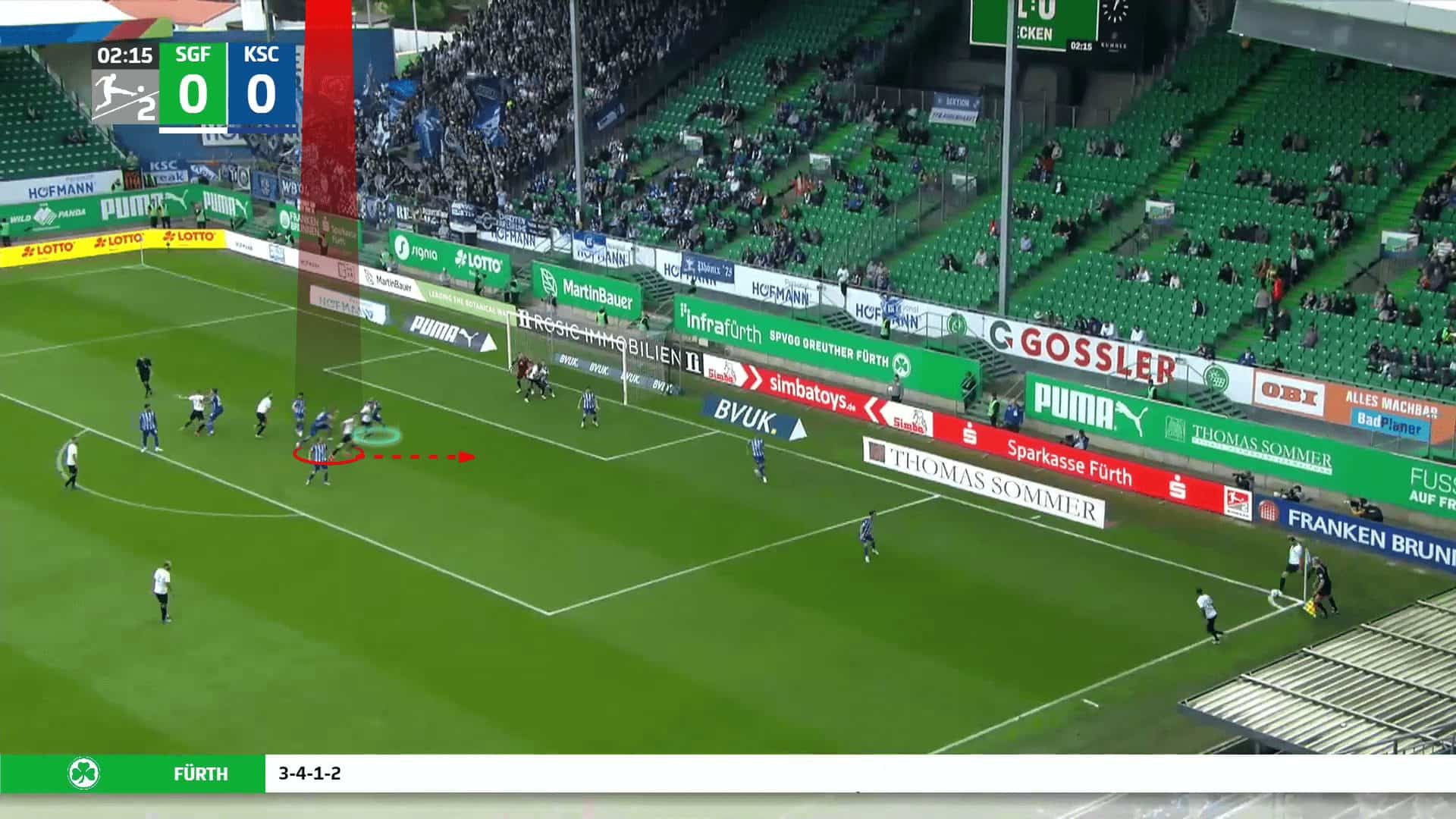
The attacker gets the ball before the zonal player who tries to go, but he is late naturally, but the goalkeeper saves the ball, as shown in the two photos below.
Conclusion
This analysis has shown how Greuther Fürth’s team excelled in 2. Bundesliga by using diverse and innovative strategies to maximise the chances of scoring from offensive corner kicks.
This set-piece analysis demonstrated how they employed various ingenious strategies, such as using stacks and creating a flat passing lane. It also revealed how they deceived their opponent by attracting the markers in far positions to give their exceptional player, Damian Michalski, an edge over the marker.

