


Tim Walter arrives at VFB Stuttgart with a strong reputation despite failing to gain promotion with Holstein Kiel last year.
In contrast, Walter arrives at a club hoping to bounce straight back up to the Bundesliga following their disappointing campaign last year.
Walter faces a difficult task in boosting the confidence of his side again, particularly when his style of play requires such a high level of confidence and can lead to individual errors at times.
In this tactical analysis, I’ll examine how Walter’s VfB Stuttgart might approach the season and utilise recent friendlies to identify and address the initial teething problems for Stuttgart.
Tim Walter build-up Play
The main feature of Tim Walter‘s Holstein Kiel side was their expansive, brave and fluent build-up play, which sees many different strategies for breaking through the opposition lines.
There are various patterns that we saw at Kiel, which are now being used in Walter’s early games at Stuttgart.
One common pattern is the use of asymmetrical full-backs in order to create space out wide.
In the below image, the right full back moves into the centre and receives the ball at a good angle.
The space conventionally occupied by the right full-back is now empty, allowing the winger to drop in and receive the ball.
Kiel can then overload the full-back, forcing the opposition to occupy Kiel’s central players.

We can see an almost identical situation again below, with the only difference being the defensive midfielder now dropping in to assist the centre backs in the build up.
We see the same space be created out wide again for the winger to drop into.
Another common feature in the build up is the movement of players to receive the ball.
In football, a fundamental principle is passing and moving, but when centre-backs pass the ball, they rarely move far and usually just drop deeper to receive the ball.
Walter’s defenders appear to have been coached to move up and look to break the lines immediately when they pass the ball, rather than dropping deeper to receive.
We can see an example of this below at Kiel, where the centre-back plays the ball back to the goalkeeper and immediately makes a run between the two pressing attackers.
This results in a much better shape than two flat centre-backs, bringing the goalkeeper into the game and effectively creating a 3v2.

We can see the same principle being implemented at Stuttgart below.
The fluency of Walter’s side is demonstrated well in this image, as this time, it is the left back (Insua) who passes the ball back and then makes a run in behind the pressing players.
The other centre back then moves back into the more conventional left back position.
An excellent reverse pass then finds Insua, who is in a central space and, therefore, has numerous passing options.

One final example is provided below, where the ball is played off to the goalkeeper.
Rather than performing the conventional movement of dropping deep and wide to receive the ball again or stretch the opposition (marked in red), Kempf moves up and between the two pressing strikers again, allowing him to receive the ball again or create space for wider players to receive the ball should the opposition mark him.

In fact, it is quite rare for players in Tim Walter’s sides to play backwards passes, due to the excellent positioning of his players.
We can see this in all the examples above, as well as in this subtle example below.
Kempf moves from behind the full-back to just past him, which creates a much better passing angle for the left-back.
Many centre-backs in this situation may not recognise this as quickly, and I would suspect this is something Walter has worked on with the team to help the build-up.

Initial problems
With such a change in style of play, Stuttgart are still getting used to Walter’s ideas, and preseason is of course an opportunity for the side to practice the ideas Walter wants.
Therefore, Stuttgart’s preseason has been particularly wild, with them scoring 13 goals in their last four games and conceding 10.
A high proportion of these goals conceded have came from poor defensive transitions, which is to be expected with such an aggressive, risky style of build up.
The situation below illustrates Stuttgart’s initial issues with the system.
After making a pass, the centre-back makes that same run again outwards between the two pressing players, but because the ball is given wide, this option is cut off.

The centre back continues his movement wide, but is still unable to receive the ball, so the central area is overloaded in a press and the ball is lost.
The pass into the player who loses the ball is a poor one, whereas had it been accurate, the centre-back in the wide area may have been able to be picked out.

Therefore because both the full back and centre back are committed so high when the ball is lost, a long ball leads to a 2v2 for the opposition.
The high line Stuttgart employs also leaves this large space behind.

So, how can this be improved other than on an individual decision-making basis?
Stuttgart really have two options, either improve their positional play and technical ability on the ball or take a more conservative build up approach.
Walter is obviously going to go for the first option, so how can they improve themselves to prevent transitions from hurting them so much?
Teams that commit so many players high up the pitch are vulnerable when they lose the ball and so have to counter press immediately to snuff out a counter attack.
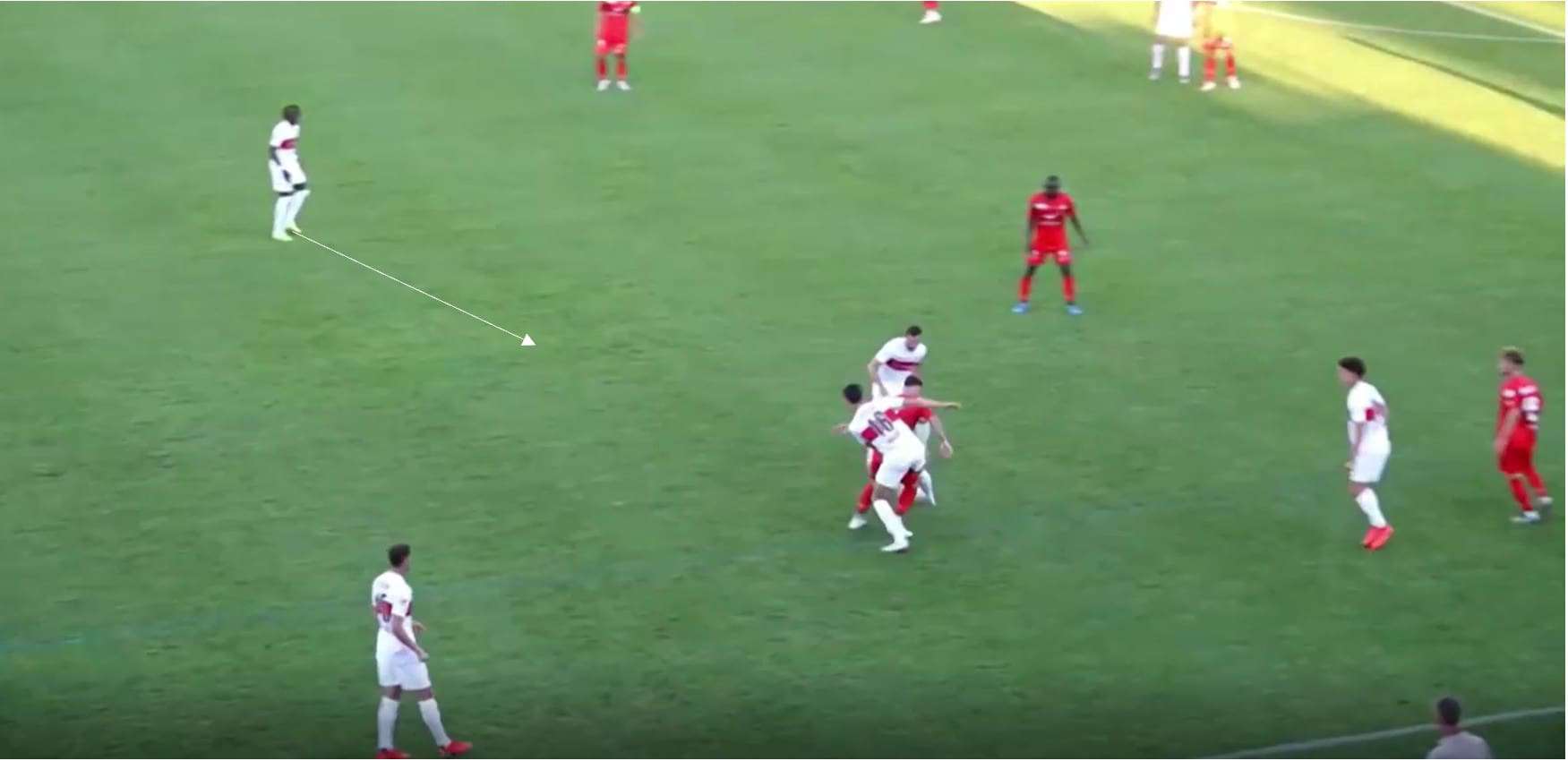
There are a few small teething problems on display in this situation below, which led to an opposition counter attack.
Firstly, the initial counter-press is not too bad in a positional sense.
Two players swarm an opposing player but fail to win the ball.
The problem comes from the lack of compactness in the counter press, where the central midfielder should tuck across to fill the large gap where the opposition transitions into.
Therefore, the opposition has space to launch a counterattack against a few Stuttgart players.
Personnel
Walter clearly took the job at Stuttgart as he believes they have a better chance of reaching the Bundesliga than former club Holstein Kiel.
This is largely down to the quality of the squad, and Stuttgart’s team is starting to take shape.
As mentioned earlier, the goalkeeper is often used in the build up play and so they have to be comfortable with the ball at their feet.
Kobel is good in this regard, with 88.7% of his passes being accurate last season in the Bundesliga.
Marc Oliver Kempf, whom I have mentioned several times in this analysis, appears to be improving in possession.
Only 76.1% of his forward passes were accurate last season in the Bundesliga, which when compared to one of Walter’s previous central defenders Hauke Wahl (81%) is poor.
It will be interesting to see what improvement is seen by Kempf in the upcoming season.
Stuttgart’s centre-backs will have to step up this year after both Pavard and Kabak left the club this summer.
The arrival of Atakan Karazor from Kiel also demonstrates what Walter wants from the side and fills the hole of a ball-playing defensive midfielder, which Walter must have thought was needed.
One dilemma Walter faces is how he fits Mario Gómez into the side’s tactics from an out-of-possession point of view.
Gómez is slow and not particularly mobile but could be very effective in possession for Stuttgart.
The key will be to not to force Gómez into pressing the ball aggressively, and instead allowing him to block passing lanes while others around him press.
For example here at Kiel, a man orientated press is seen with the opposition guided to the wide areas.
The wide players in this system have to do the most running, whereas the central players have to stay with their players and not allow the ball to be played into them.
Gómez’s experience, therefore, could make him an excellent part of the press if utilised correctly.

Conclusion
Holstein Kiel’s most significant problem last year was individual mistakes.
At Stuttgart, Walter should expect players with a better technical ability and will therefore hope for less individual mistakes from his new side.
A significant factor in Stuttgart’s season is how quickly they can adapt to Walter’s philosophy, which is essentially Tim Walter’s job.
It will be interesting to see if they can bounce straight back up despite losing some key players.

