Total Football Analysis
Once.Sport
  • Football Analysis
    • Data Analysis
    • Formations
      • 2-2-4 Formation
      • 2-3-5 Formation
      • 3-1-4-2 Formation
      • 3-2-2-3 Formation
      • 3-2-4-1 Formation
      • 3-1-6 Formation
      • 3-3-4 Formation
      • 3-4-1-2 Formation
      • 3-4-2-1 Formation
      • 3-4-3 Formation
      • 3-5-1-1 Formation
      • 3-5-2 Formation
      • 4-1-4-1 Formation
      • 4-2-2-2 Formation
      • 4-2-3-1 Formation
      • 4-2-4 Formation
      • 4-3-1-2 Formation
      • 4-3-3 Formation
      • 4-4-2 Formation
      • 4-5-1 Formation
      • 5-3-2 Formation
      • 5-4-1 Formation
      • 6-3-1 Formation
    • Head Coach Analysis
    • Match Analysis
    • Player Analysis
    • Recruitment Analysis
    • Set Piece Analysis
    • Tactical Theory
    • Tactical Preview
    • Team Analysis
    • Training Analysis
    • Tactical Analysis
    • Scouting Report
  • Competition
    • ALL Competitions
    • English Premier League
    • Champions League
    • La Liga
    • Bundesliga
    • Serie A
    • Ligue 1
    • Eredivisie
    • EFL Championship
    • FIFA World Cup 2022
    • WEURO 2022
    • Women’s Super League
    • NWSL
    • Belgian First Division A
    • A-League
    • Liga Profesional de Argentina
    • Austrian Bundesliga
    • Campeonato Brasileiro Série A
    • DFB Pokal
    • 1. HNL
    • Danish Superliga
    • EFL League One
    • EFL League Two
    • FA Cup
    • EFL Cup
    • Indian Super League
    • K-League
    • J1 League
    • Liga MX
    • Copa América 2021
    • Copa del Rey
    • MLS
    • Eliteserien
    • Euro 2020
    • Primeira Liga
    • Scottish Premiership
    • Allsvenskan
    • Europa League
    • UEFA Nations League
    • Liga AUF Uruguaya
  • Coaches
    • All Coaches
    • Alfred Schreuder
    • Ange Postecoglou
    • Antonio Conte
    • Arne Slot
    • Bo Svensson
    • Brendan Rodgers
    • Bruno Lage
    • Carlo Ancelotti
    • Christophe Galtier
    • Claude Puel
    • Claudio Ranieri
    • David Moyes
    • Dean Smith
    • Diego Simeone
    • Domenico Tedesco
    • Frank Lampard
    • Eddie Howe
    • Edin Terzić
    • Emma Hayes
    • Erik ten Hag
    • Ernesto Valverde
    • Gennaro Gattuso
    • Gerardo Seoane
    • Gian Piero Gasperini
    • Giovanni van Bronckhorst
    • Graham Potter
    • Igor Tudor
    • Imanol Alguacil
    • Jesse Marsch
    • Jonas Eidevall
    • Jorge Sampaoli
    • José Bordalás
    • José Mourinho
    • Julen Lopetegui
    • Julian Nagelsmann
    • Julien Stéphan
    • Jürgen Klopp
    • Luciano Spalletti
    • Lucien Favre
    • Manuel Pellegrini
    • Marcelo Bielsa
    • Marco Rose
    • Marco Silva
    • Massimiliano Allegri
    • Mauricio Pochettino
    • Maurizio Sarri
    • Mikel Arteta
    • Niko Kovač
    • Nuno Espírito Santo
    • Oliver Glasner
    • Patrick Vieira
    • Paulo Fonseca
    • Pep Guardiola
    • Peter Bosz
    • Rafa Benítez
    • Ralf Rangnick
    • Ralph Hasenhüttl
    • Roger Schmidt
    • Roy Hodgson
    • Sean Dyche
    • Sérgio Conceição
    • Simone Inzaghi
    • Sonia Bompastor
    • Stefano Pioli
    • Steffen Baumgart
    • Steven Gerrard
    • Thiago Motta
    • Thomas Frank
    • Thomas Tuchel
    • Unai Emery
    • Vincenzo Italiano
    • Xavi
  • Teams
    • ALL Teams
    • AC Milan
    • Ajax Amsterdam
    • Arsenal
    • AS Monaco FC
    • Atalanta
    • Atlético Madrid
    • FC Barcelona
    • FC Bayern Munich
    • Borussia Dortmund
    • Celtic FC
    • Chelsea FC
    • Everton F.C.
    • Inter Milan
    • Juventus F.C.
    • Leeds United F.C.
    • Liverpool FC
    • Manchester City
    • Manchester United FC
    • Paris Saint-Germain
    • Rangers FC
    • RB Leipzig
    • Real Madrid CF
    • Tottenham Hotspur
    • West Ham United
  • Players
    • ALL Players
    • Alisson Becker
    • Bukayo Saka
    • Erling Haaland
    • Harry Kane
    • Jack Grealish
    • John Stones
    • Julián Alvarez
    • Kalvin Phillips
    • Kevin De Bruyne
    • Kyle Walker
    • Kylian Mbappé
    • Lamine Yamal
    • Lionel Messi
    • Luis Díaz
    • Mohamed Salah
    • Phil Foden
    • Virgil Van Dijk
  • Contact
  • Write For TFA
No Result
View All Result
No Result
View All Result
Total Football Analysis
No Result
View All Result
Home Analysis

EURO 2020 Preview: Does England’s “no real drama” approach make them favourites against Denmark? – tactical analysis

Lorihanna Balabanova (née Shushkova) by Lorihanna Balabanova (née Shushkova)
July 6, 2021
in Analysis, Euro 2020, Tactical Preview
0
Euro 2020 Preview: England vs Denmark - tactical analysis tactics

Once he moved into a more advanced position he sent a through ball to Polusen, creating a goalscoring opportunity.

England are the big favourites against Denmark in their Euro 2020 semi-final battle, but they should not underestimate the inspired Danish team as we saw many of the big teams surprisingly withdrawal from the tournament in an unexpected turn of events.

The fact that England reached the semi-finals with “no real drama” as per the ex-Liverpool player Steve Nicol shows their confidence and trust in the process. Gareth Southgate hasn’t gone all out with his tactics, instead, he quietly planned his every move and adjusted to his opponents’ approaches while keeping the fundamentals of his strategy – a rather conservative style of play with no spectacular tactical twists.

Denmark on the other side have used their initial shock as an inspiration and have transformed their tactics to match up their strengths, aiming for a creative and attacking style of play which made them one of the most enjoyable teams to watch in the competition.

This preview in the form of a tactical analysis will examine both teams’ expected tactics and if the lack of drama so far will give England an advantage against Denmark.

Southgate should be flexible with England’s set-up

One of the biggest questions prior to the fixture is whether Southgate will opt for his 4-2-3-1 formation or will switch to a 3-4-3 similarly to their win over Germany. It is quite likely that he chooses the back three formation to match Denmark’s 3-4-3 but will this actually help the team nullify the opposition’s efforts? It might not.

The Three Lions will need to be quite flexible in their set-up due to Denmark’s movement in possession. Kasper Hjulmand’s side have successfully switched between the 3-4-3 and their previously used 4-3-3 in-game and have used this strategy to their advantage in their attacking actions.

The 3-4-3 scheme might be successful for England if they want more coverage in the wide areas and if they want to draw the opposition numerically as the Danes use their wing-backs quite actively. If the opposition decide to switch to a 4-3-3, though, it could be a whole another story, with Chelsea‘s Andreas Christensen moving up in more of a defensive midfield position and Pierre-Emile Højbjerg accepting a more advanced position.

Euro 2020 Preview: England vs Denmark - tactical analysis tactics
Christensen’s defensive midfield positioning.

With the full-backs/wing-backs then joining their teammates in the opposition half, this could give Denmark an advantage in attack. Højbjerg became their playmaker in the tournament and is their main creative source, delivering the ball to the advanced areas and creating chances for his teammates. His presence closer to the final third could be crucial for Denmark’s successful attacking actions.

Euro 2020 Preview: England vs Denmark - tactical analysis tactics
Højbjerg passed the ball out wide and immediately started his off the ball movement to the right half-space where he can support the attacking actions.
Euro 2020 Preview: England vs Denmark - tactical analysis tactics
Once he moved into a more advanced position he sent a through ball to Polusen, creating a goalscoring opportunity.

That’s why England need to increase their awareness for these tactical changes and be ready to adjust, especially defensively.

Dropping additional men who could tightly cover Højbjerg in the second line of defence might be key for England if they want to block their opponents’ build-up play. The Three Lions need to be very careful on a counter and always be aware of Højbjerg positioning since the team might use him to start counter-attacks with long balls over the top to the forwards or the

His 10.45 passes to the final third on average per 90 show his importance for Denmark’s ball progression and attacking actions. He has averaged 2.57 through balls in the tournament and is one of the main players to supply the front three with quality balls.

England’s frugal “no drama” approach – will it be successful again?

As mentioned, Southgate hasn’t gone out with never-seen tactical decisions and has relied on a more conservative approach which balanced the team and gave them confidence both defensively and in attack.

Despite the individual quality his side have in attack, the manager has considered the pros and cons of focusing on the attacking actions and constantly staying high up in the opposition half. Instead, he relied on a rather compact shape and retaining possession at the back while they see an opportunity to attack using a lot of positional changes.

That allows the team to stay solid defensively but also take advantage of the opposition’s mistakes and exploit any gaps that have occurred. Of course, that doesn’t mean that the team stay passive and give away the initiative, but it means that they don’t overcommit to the attacking actions and delivering the ball to the forwards at the cost of increasing their defensive vulnerability.

This strategy was really tested out against Germany, who are a very distinguished attacking team. Southgate didn’t change his principles massively but instead, did minor changes to their approach by switching to a back-three. This was done with the aim to have better defensive coverage with the wing-backs dropping during transitions and stopping Germany’s attacks through the flanks and with the hope that they will also bring more edge when in possession by playing with width and exploiting Germany’s weaknesses with crossing.

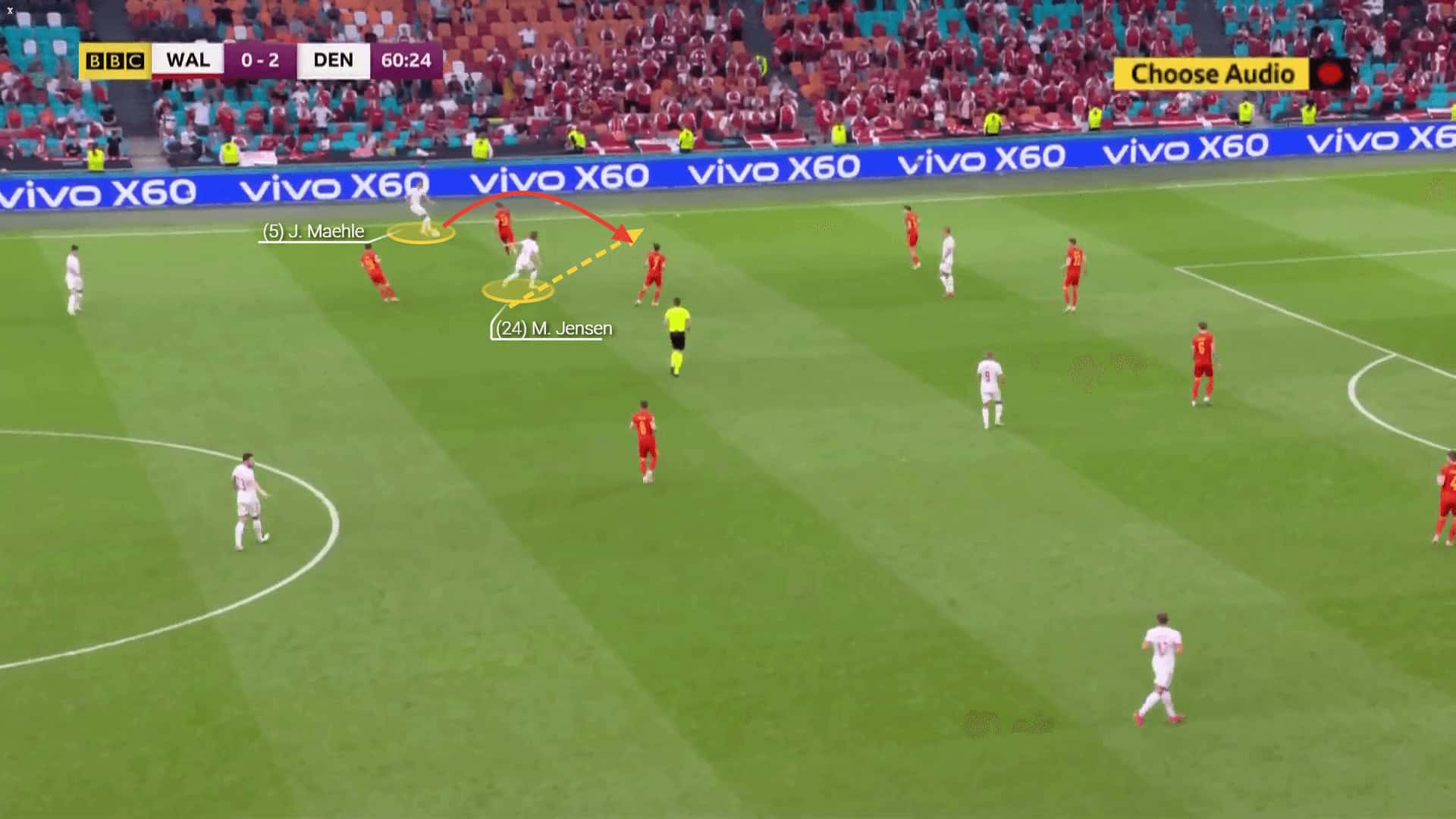
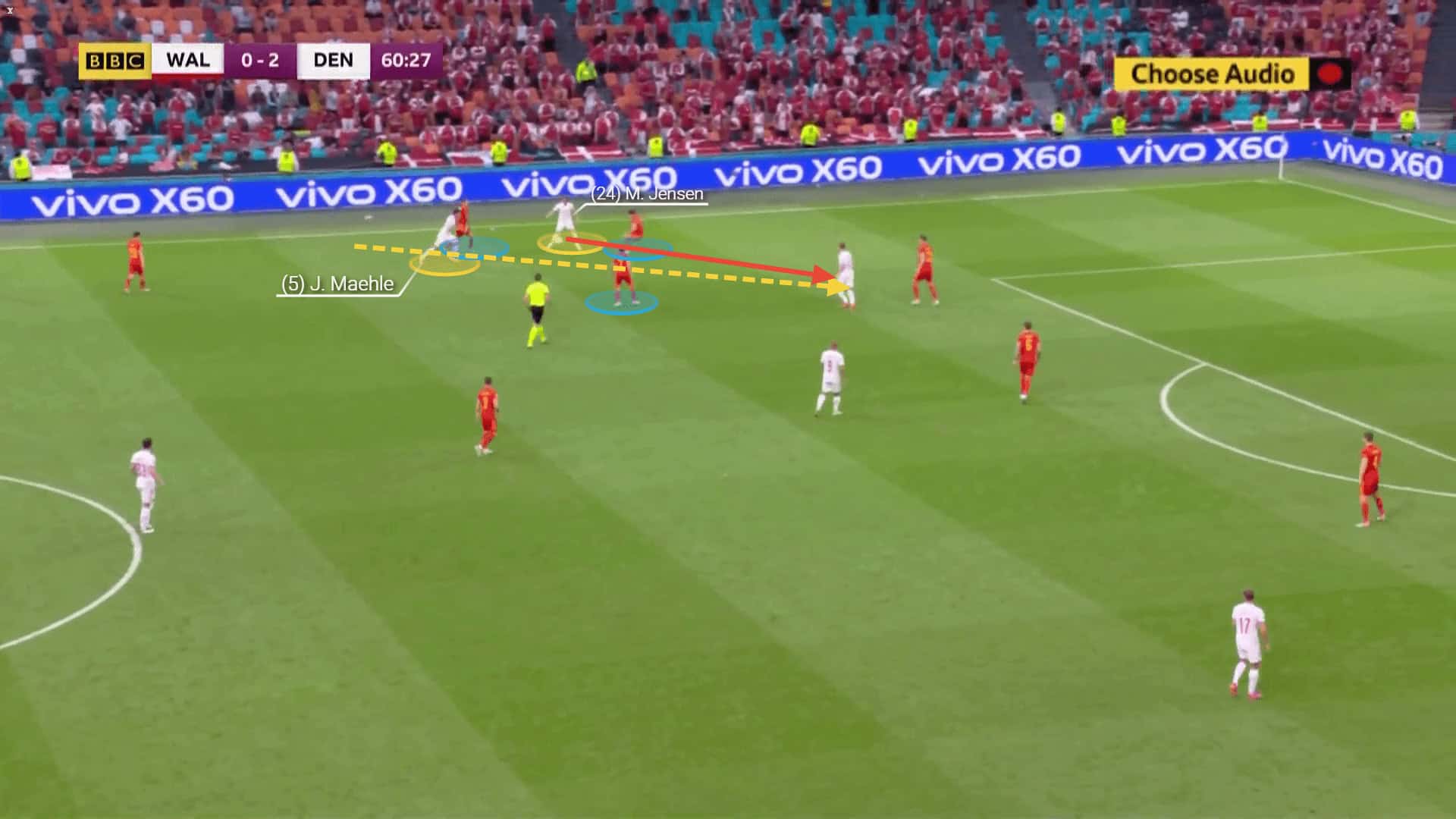
The 3-4-3 formation could be successful against Denmark too, in terms of blocking their attacking efforts on the flanks. The right wing-back Jens Stryger Larsen has been crucial for the team’s attacking actions, mainly occupying the areas between the central line and the final third. When it comes to Joakim Mæhle on the other side, the Three Lions need to consider his right-footedness and his tendency to take part in passing combinations with his teammates centrally as well as to cut inside. England’s central midfielders need to have increased awareness and support for the defensive actions to avoid any unwanted movement.
Euro 2020 Preview: England vs Denmark - tactical analysis tactics
Mæhle created a short pass combination with his teammate.
Euro 2020 Preview: England vs Denmark - tactical analysis tactics
He then immediately cut inside to provide additional option around the box.

It seems like England don’t need to make any out-of-the-ordinary tactical changes to have a better chance to qualify to the final. Southgate has succeeded by slightly adjusting to the oppositions’ approach without changing the main principles of their game and at first

Denmark’s counter-attacking threat

It is very likely that Denmark give away the initiative and allow the play in their own half, relying on their solid central defence and on the support provided by the wing-backs and Borussia Dortmund‘s Thomas Delaney and Højbjerg’s support.

This will be done in efforts to expose England on a counter. The Danes have completed 3.6 counter-attacks on average per game so far in the tournament and have been quite successful in that matter with 55.6% of them ending with shots.

There are a couple of reasons for that – good positioning in their own half leading to quality passes and very strong aerial performance. Denmark rely on their height and force the opposition into these situations so they can win aerial duels and attack. They are always on the front foot and do recover the ball quite often. With 79.6 recoveries per 90, they are often in good positions for turnovers.
Euro 2020 Preview: England vs Denmark - tactical analysis tactics
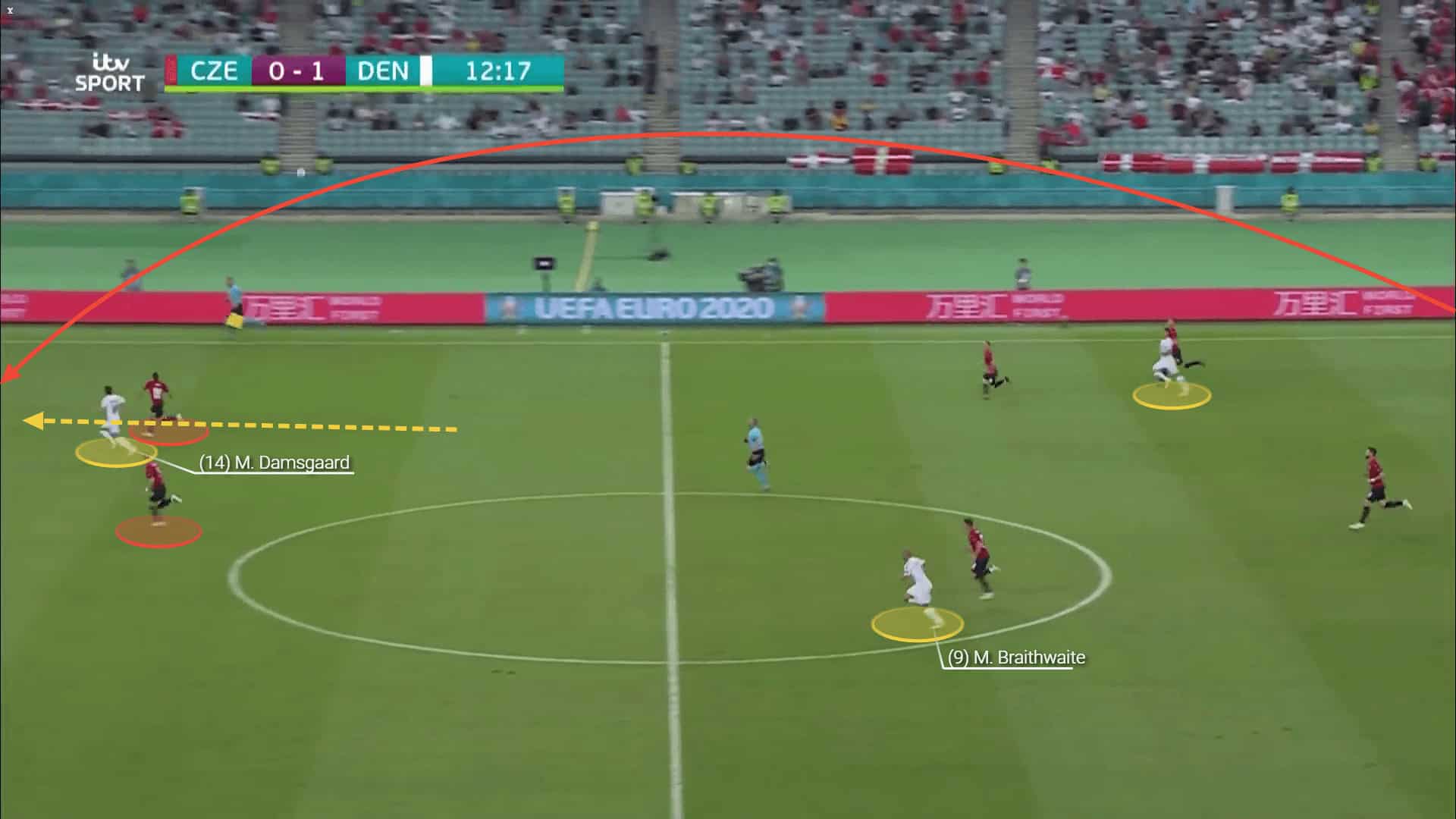
Højbjerg initiated a counter-attack with a long ball over the top to Damsgaard who used his speed to outrun the opposition and shoot.

They are successful thanks to Kasper Dolberg’s movement and Mikkel Damsgaard’s speed but they wouldn’t only rely on them in the final stages of the counter-attacks as the wing-backs are also often providing options both on the flanks and by cutting inside.

Their counter-attacking efforts add to their already impressive actions in front of the goal. The Danes have one of the highest shot frequencies on Euro 2020 with 15.8 attempts per 90.

Final thoughts

England are considered to be the favourites against Denmark, thanks to their actions on and off the ball. They have achieved balance both in defence and attack that gives them confidence in each phase leading to measured actions. The Danes, though, do have their strengths and will definitely try their best to expose England’s defence and having in mind their performance so far in the competition, they are capable of scoring the first goal in Jordan Pickford’s goal.

Previous Post

Colombian cannonball: The midfielder who pocketed Neymar in line for a huge transfer – Copa America scout report

Next Post

EURO 2020: Our best XI from the quarter-finals – analysis

Next Post
EURO 2020: Our best XI from quarter-finals matches - analysis

EURO 2020: Our best XI from the quarter-finals - analysis

  • About Total Football Analysis
  • Contact Total Football Analysis
  • Write For Total Football Analysis
  • Advertise
  • Privacy Policy
  • Cancellation / Refund Policy
  • Resources
  • Terms Of Service

© 2026 Total Football Analysis

No Result
View All Result
  • Football Analysis
    • Data Analysis
    • Formations
      • 2-2-4 Formation
      • 2-3-5 Formation
      • 3-1-4-2 Formation
      • 3-2-2-3 Formation
      • 3-2-4-1 Formation
      • 3-1-6 Formation
      • 3-3-4 Formation
      • 3-4-1-2 Formation
      • 3-4-2-1 Formation
      • 3-4-3 Formation
      • 3-5-1-1 Formation
      • 3-5-2 Formation
      • 4-1-4-1 Formation
      • 4-2-2-2 Formation
      • 4-2-3-1 Formation
      • 4-2-4 Formation
      • 4-3-1-2 Formation
      • 4-3-3 Formation
      • 4-4-2 Formation
      • 4-5-1 Formation
      • 5-3-2 Formation
      • 5-4-1 Formation
      • 6-3-1 Formation
    • Head Coach Analysis
    • Match Analysis
    • Player Analysis
    • Recruitment Analysis
    • Set Piece Analysis
    • Tactical Theory
    • Tactical Preview
    • Team Analysis
    • Training Analysis
    • Tactical Analysis
    • Scouting Report
  • Competition
    • ALL Competitions
    • English Premier League
    • Champions League
    • La Liga
    • Bundesliga
    • Serie A
    • Ligue 1
    • Eredivisie
    • EFL Championship
    • FIFA World Cup 2022
    • WEURO 2022
    • Women’s Super League
    • NWSL
    • Belgian First Division A
    • A-League
    • Liga Profesional de Argentina
    • Austrian Bundesliga
    • Campeonato Brasileiro Série A
    • DFB Pokal
    • 1. HNL
    • Danish Superliga
    • EFL League One
    • EFL League Two
    • FA Cup
    • EFL Cup
    • Indian Super League
    • K-League
    • J1 League
    • Liga MX
    • Copa América 2021
    • Copa del Rey
    • MLS
    • Eliteserien
    • Euro 2020
    • Primeira Liga
    • Scottish Premiership
    • Allsvenskan
    • Europa League
    • UEFA Nations League
    • Liga AUF Uruguaya
  • Coaches
    • All Coaches
    • Alfred Schreuder
    • Ange Postecoglou
    • Antonio Conte
    • Arne Slot
    • Bo Svensson
    • Brendan Rodgers
    • Bruno Lage
    • Carlo Ancelotti
    • Christophe Galtier
    • Claude Puel
    • Claudio Ranieri
    • David Moyes
    • Dean Smith
    • Diego Simeone
    • Domenico Tedesco
    • Frank Lampard
    • Eddie Howe
    • Edin Terzić
    • Emma Hayes
    • Erik ten Hag
    • Ernesto Valverde
    • Gennaro Gattuso
    • Gerardo Seoane
    • Gian Piero Gasperini
    • Giovanni van Bronckhorst
    • Graham Potter
    • Igor Tudor
    • Imanol Alguacil
    • Jesse Marsch
    • Jonas Eidevall
    • Jorge Sampaoli
    • José Bordalás
    • José Mourinho
    • Julen Lopetegui
    • Julian Nagelsmann
    • Julien Stéphan
    • Jürgen Klopp
    • Luciano Spalletti
    • Lucien Favre
    • Manuel Pellegrini
    • Marcelo Bielsa
    • Marco Rose
    • Marco Silva
    • Massimiliano Allegri
    • Mauricio Pochettino
    • Maurizio Sarri
    • Mikel Arteta
    • Niko Kovač
    • Nuno Espírito Santo
    • Oliver Glasner
    • Patrick Vieira
    • Paulo Fonseca
    • Pep Guardiola
    • Peter Bosz
    • Rafa Benítez
    • Ralf Rangnick
    • Ralph Hasenhüttl
    • Roger Schmidt
    • Roy Hodgson
    • Sean Dyche
    • Sérgio Conceição
    • Simone Inzaghi
    • Sonia Bompastor
    • Stefano Pioli
    • Steffen Baumgart
    • Steven Gerrard
    • Thiago Motta
    • Thomas Frank
    • Thomas Tuchel
    • Unai Emery
    • Vincenzo Italiano
    • Xavi
  • Teams
    • ALL Teams
    • AC Milan
    • Ajax Amsterdam
    • Arsenal
    • AS Monaco FC
    • Atalanta
    • Atlético Madrid
    • FC Barcelona
    • FC Bayern Munich
    • Borussia Dortmund
    • Celtic FC
    • Chelsea FC
    • Everton F.C.
    • Inter Milan
    • Juventus F.C.
    • Leeds United F.C.
    • Liverpool FC
    • Manchester City
    • Manchester United FC
    • Paris Saint-Germain
    • Rangers FC
    • RB Leipzig
    • Real Madrid CF
    • Tottenham Hotspur
    • West Ham United
  • Players
    • ALL Players
    • Alisson Becker
    • Bukayo Saka
    • Erling Haaland
    • Harry Kane
    • Jack Grealish
    • John Stones
    • Julián Alvarez
    • Kalvin Phillips
    • Kevin De Bruyne
    • Kyle Walker
    • Kylian Mbappé
    • Lamine Yamal
    • Lionel Messi
    • Luis Díaz
    • Mohamed Salah
    • Phil Foden
    • Virgil Van Dijk
  • Contact
  • Write For TFA
  • Login

© 2026 Total Football Analysis