


The quarter-finals of the 2020-21 Champions League have begun and we have already seen some interesting clashes in the first leg. The game between Bayern Munich and PSG was the most awaited given the superstars present in each team. The first leg lived up to the neutral expectation with PSG winning the clash 3-2 and almost in pole position to qualify for the semi-finals. The tie is not done yet given Bayern Munich’s domination in the first leg did not reflect in the scoreline and they would be looking to go all guns blazing in the second one.
This tactical preview will discuss how both teams line up in the build-up to the clash and also look into the interesting tactics that might make headlines during the match.
Predicted Lineups
Pochettino would be expecting to field the same lineup but given the injury, to Marquinhos he might have to shift Danilo to the centre-back position like in the first leg. Ander Herrera would be the obvious choice to come in and also given that Paredes is available, he might be drafted in for Draxler for a 3rd midfielder. It would also be interesting to see whether PSG go with a 3 man defence but given the lack of an obvious centre-back Pochettino might have to settle with 4 defenders.

Bayern, on the other hand, might be tempted to retain the same lineup which is probably their strongest on the paper. But they were dreadfully exposed on transitions and given the circumstances they will again go into the match looking to dominate possession and territory. A shift to a 3-man backline could be on the cards about which we will discuss in detail in this analysis. Probably a 3-4-3 or a 3-4-1-2.
PSG: Keylor Navas, Colin Dagba, Danilo Pereira, Presnel Kimpembe, Abdou Diallo, Ander Herrera, Gana Gueye, Leonardo Paredes, Kylian Mbappe, Neymar, Angel Di Maria
Bayern Munich: Manuel Neuer, Benjamin Pavard, Jerome Boateng, David Alaba, Lucas Hernandez, Alphonse Davies, Joshua Kimmich, Leon Goretzka, Thomas Muller, Choupo-Moting, Kingsley Coman
PSG forwards against Bayern’s backline
The main talking point coming out of the first leg was how the PSG forwards were able to get behind the Bayern defence and counter-attack with intent. Bayern left a lot of space behind while committing men forward and Pochetiino unleashed his star forwards to take advantage of that. Ever since Flick took charge of Bayern, they have been deploying a very high line against every opposition. Their key principle is to stop the attack at its earliest stage and not let the opposition get past the middle third. The line is so thin between successfully preventing the attack and getting exposed as playing this high. If the execution does not go right then it will always be difficult against any attack let alone this PSG attack.
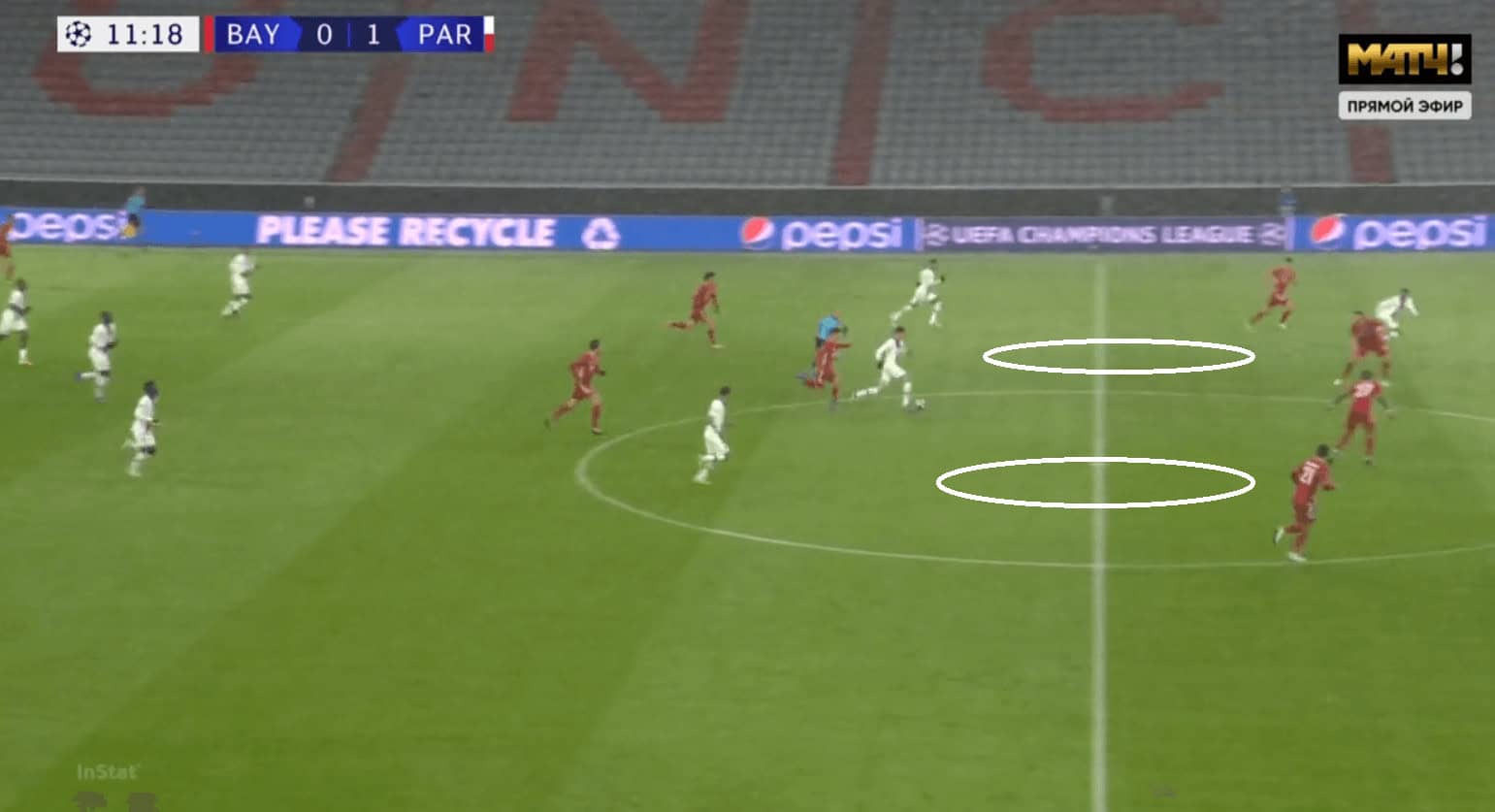
When Bayern did not want to commit their men forward much they did that only to their defensive line. This opened up spaces in between the midfield and defensive line as the midfield line pushed very high. The idea behind this is to delay the attack but then again the quality of the players in between the lines of PSG meant that this was not going to be feasible. We can see that in the above image where Bayern concede space in between the lines and look to delay the attack. Bayern had to substitute Sule, who was getting outpaced and extremely exposed against Mbappe.
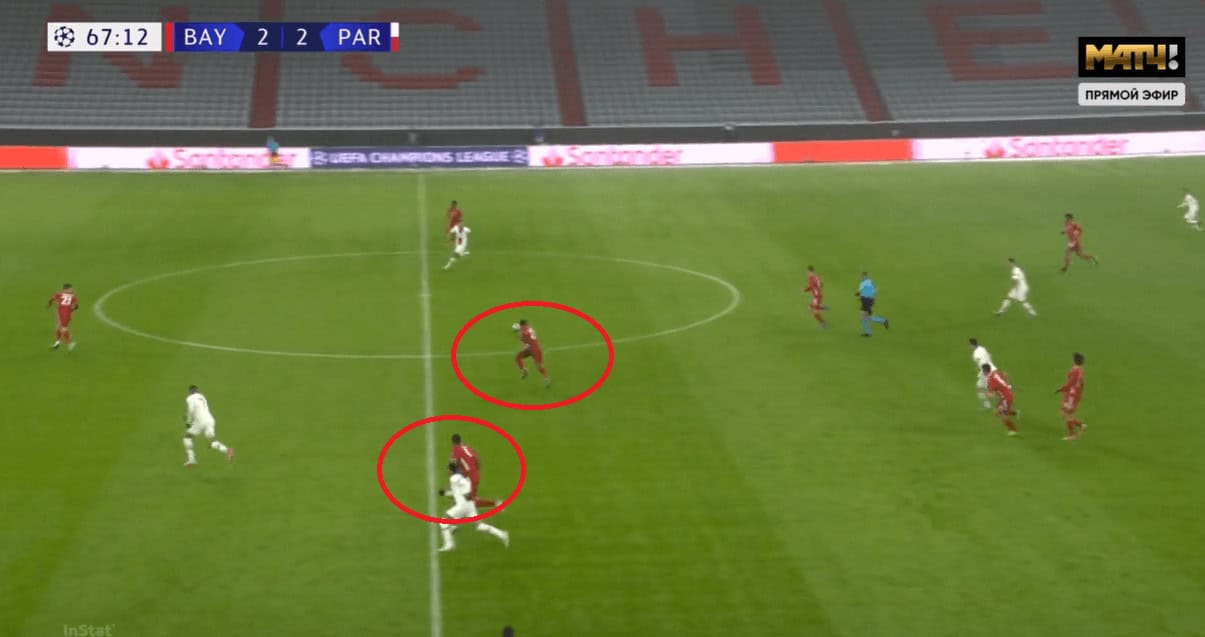
Another thing that was lacklustre from Bayern’s perspective was their counter-pressing. The need to commit men forward to score goals meant that they gave less importance to a rest-defence which is very important to a counter-press. When PSG won the ball, Bayern players committed themselves forward to press without any direction and principles that eventually saw passing lanes open. The primary objective of counter-press is to block access to players and when that itself was compromised, the whole structure collapsed. We can see that in the example below where PSG were looking to win the ball and also waiting for Bayern to commit high to press high. Baiting them lead to the opening of spaces which PSG exploited brilliantly.
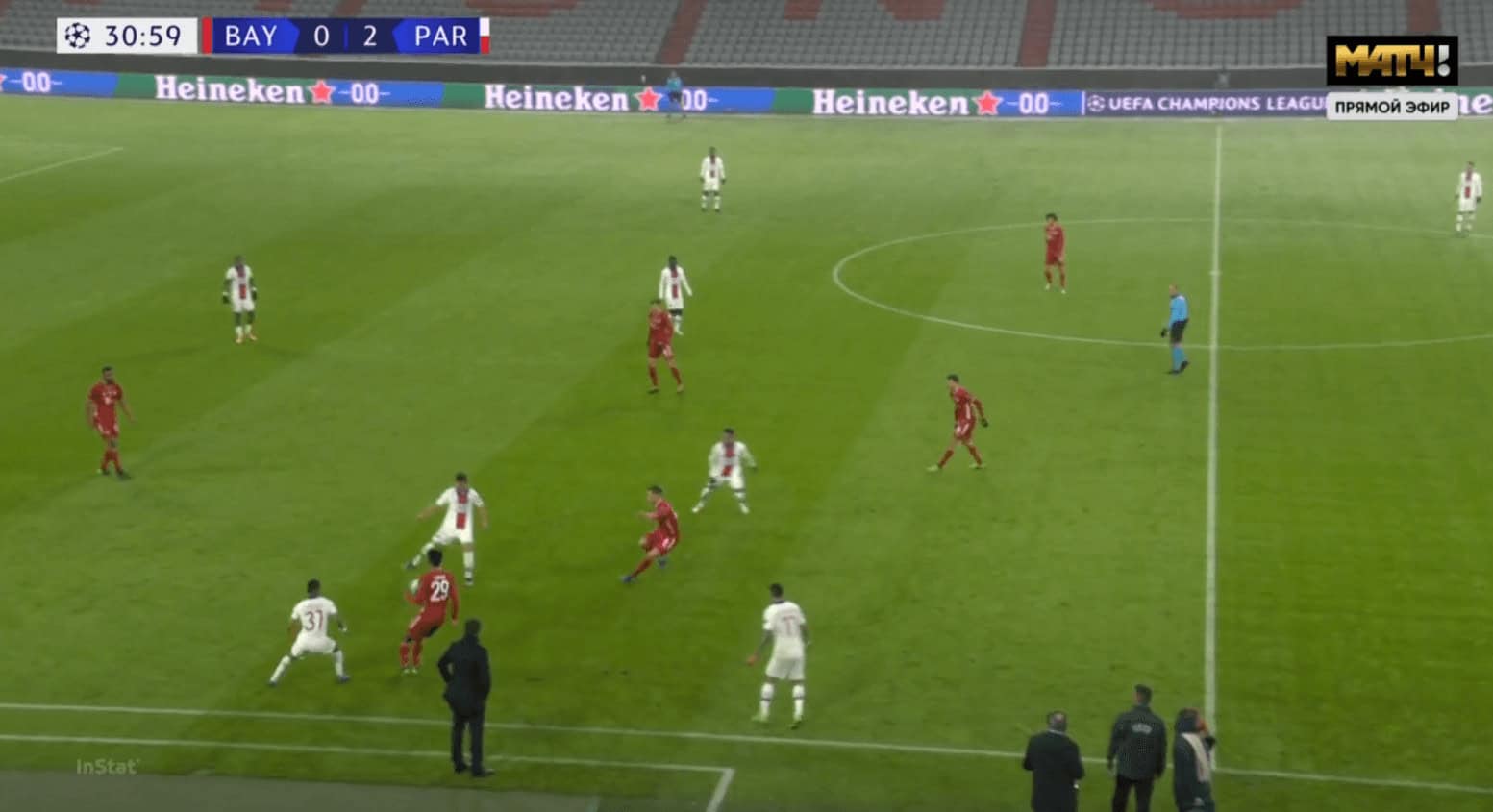
PSG also constantly used wide overloads by inviting Bayern to pressurize them on the wide areas. This press from Bayern was also haphazard and was not fully secure. Most of Navas’ pass was out wide to the full-backs as PSG would look to use these areas. We can see how PSG have created a 4v2 overload in the wide areas and with Mbappe staying in between the centre-back and full-back, Hernandez cannot go forward to the wing and help his team. Bayern easily got outnumbered allowing PSG to progress the ball.
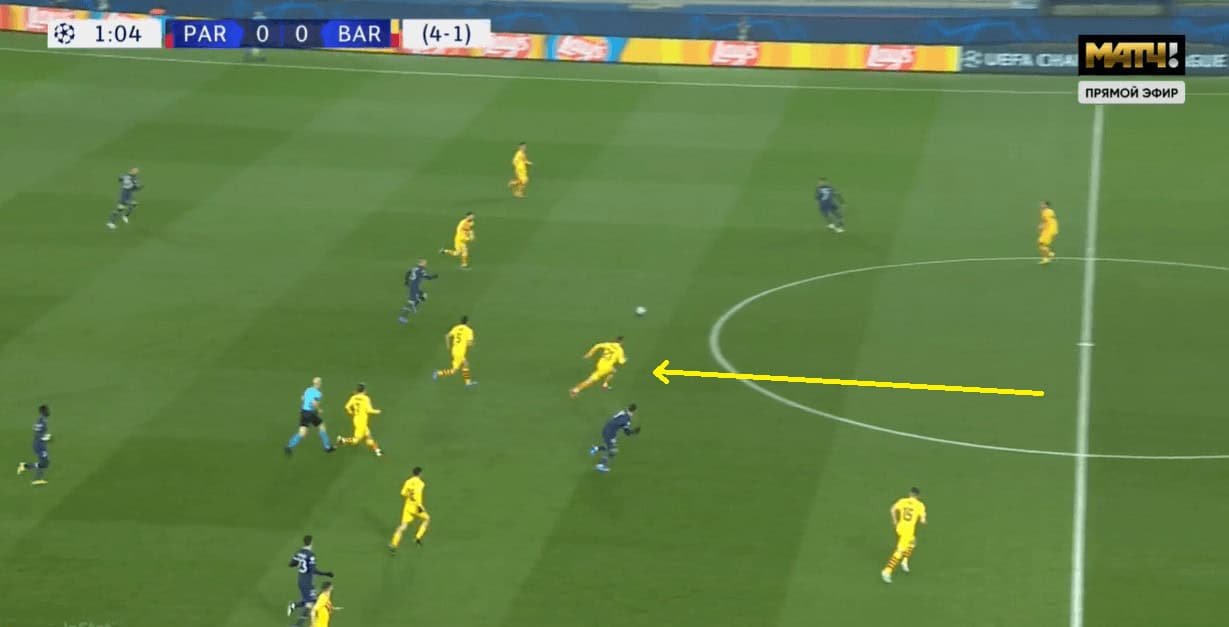
Bayern are in a similar position to how Barcelona was a month back when they took the battering against PSG. Barcelona went on to approach games with a 3-man backline ever since and Bayern could also deploy a similar approach to add a layer of security to the backline. The 3 man defence was extremely effective in containing the PSG forwards that night since now one of the centre-backs can now push forward with 2 of them providing them with the security. We can see De Jong stepping out to press Icardi while Barcelona still have 2 men for protection.
The other method to contain this PSG side and have a proper rest defence is going with a 4-2-3-1 formation but with a slight shift in tactics. Bayern have always favoured a 2-3-5 system in the attacking phase. It’s time for Flick to go with a 3-2-5 system that acts similar to the 3-4-3 or 3-5-2 in the final phase while maintaining the same structure in the initial phase. Hernandez can act as the third centre-back while Sane and Coman’s positions can be shifted as they can provide width from the flank.
PSG’s Low-block without Marquinhos
The other talking point coming out of the first leg was the early substitution of Marquinhos. Marquinhos contribution to the scoreline was well known when he netted PSG’s second goal but his presence on the other side of the pitch will be deeply missed by Pochettino. He kept organizing the low-block and was instrumental in so many shots being blocked in the first half. Before he left, he blocked 5 shots or else that would have required additional effort by Keylor Navas to stop them from being a goal. Bayern immediately scored after his substitution and the PSG backline struggled to organize themselves once he left. The primary ability of an old-school low block centre-back is to block shots. We can see PSG’s low block here as they have around 8 people inside the box. Bayern themselves have 6 people in it with an additional 3 of them outside. Goretzka takes a shot here but his shot is blocked by Marquinhos and goes out for a corner.
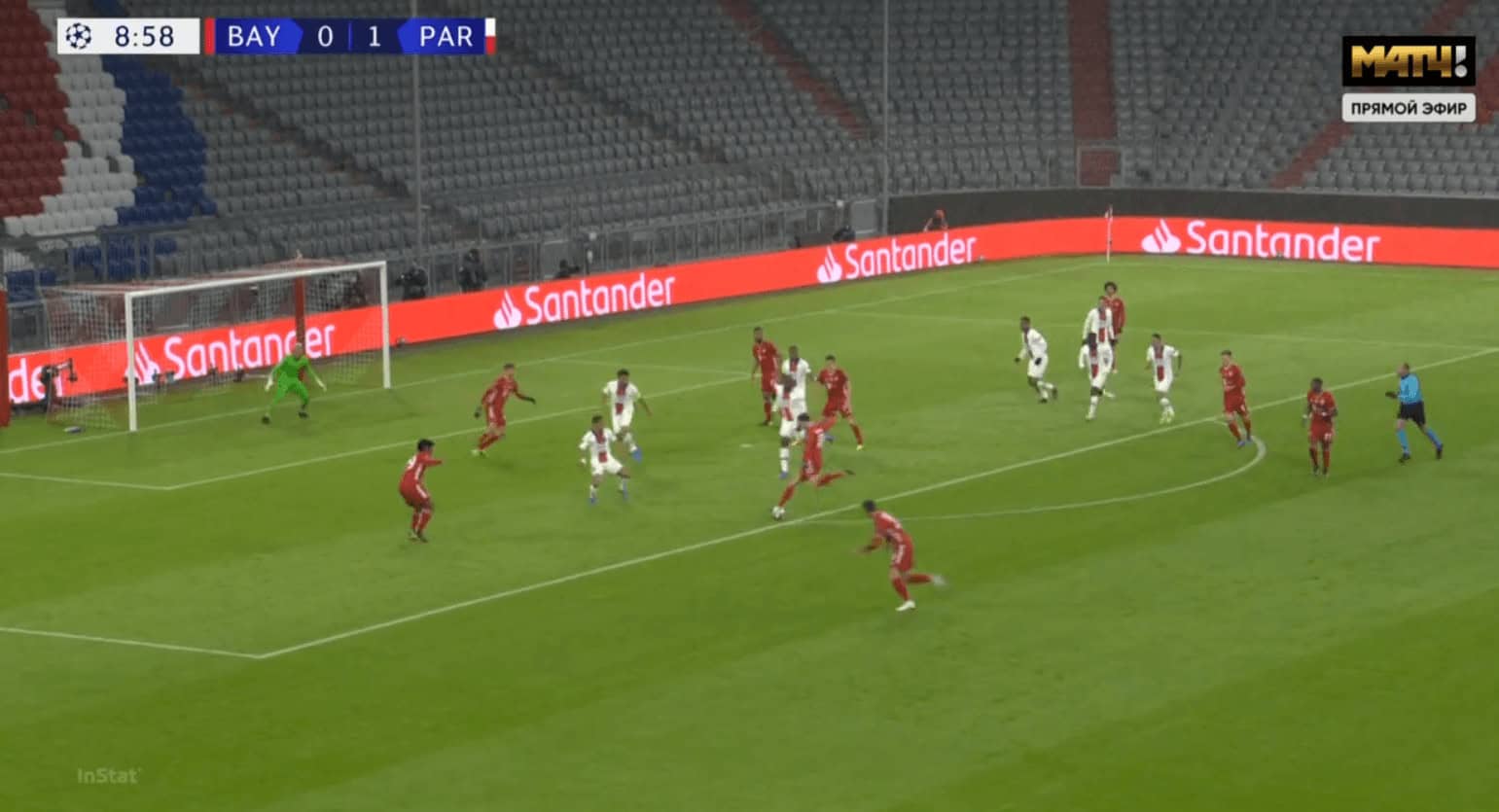
They had a settled shape with two banks of 4 players staying compact and covering the central areas. These two lines were maintained and managed extremely well throughout the game but even better when Marquinhos was there. We can see their positioning with even spacing between the players and very good coverage that enables them to shift towards either side of the pitch quickly. Also, the space in between the lines is very less and the likes of Muller cannot find the space to operate.
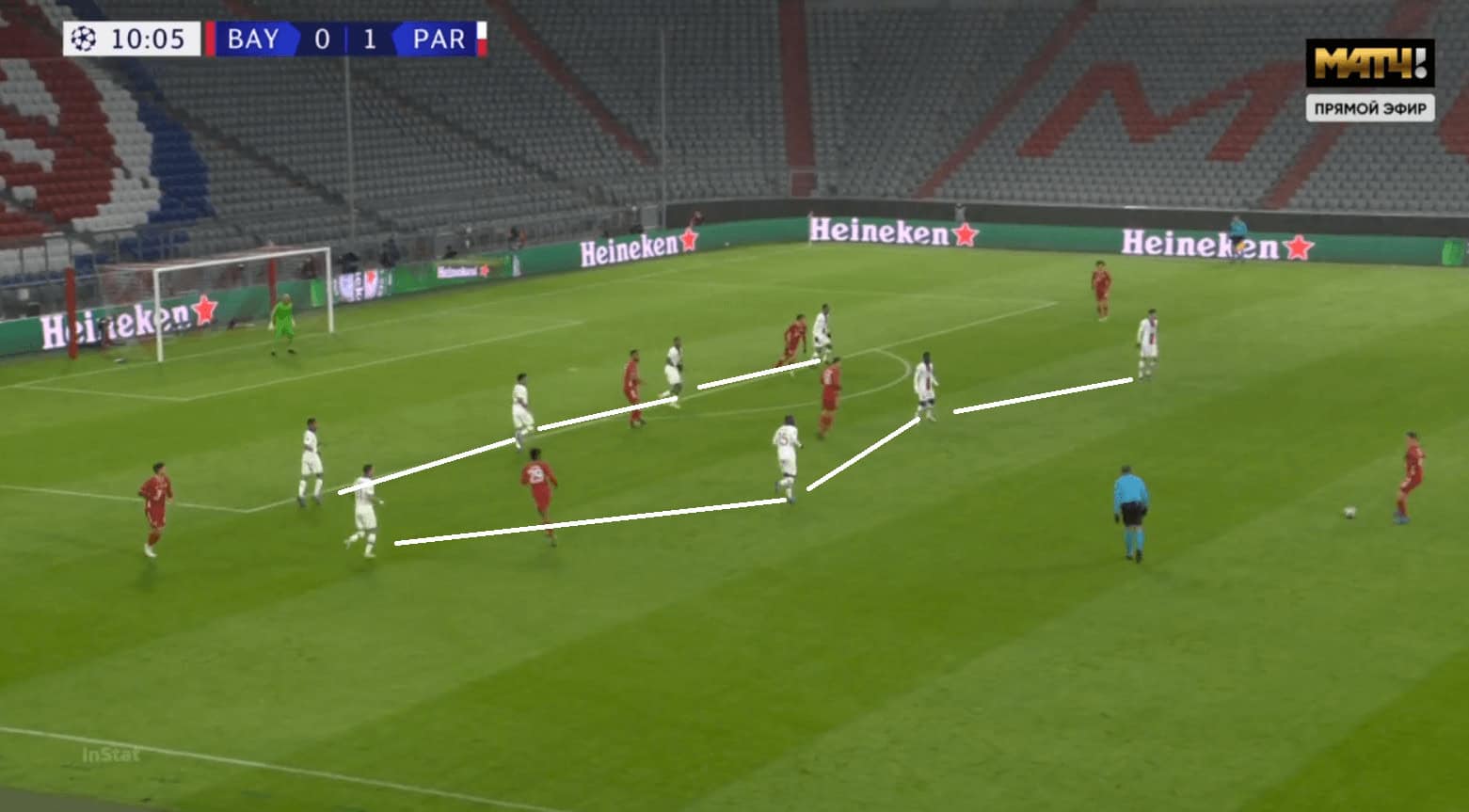
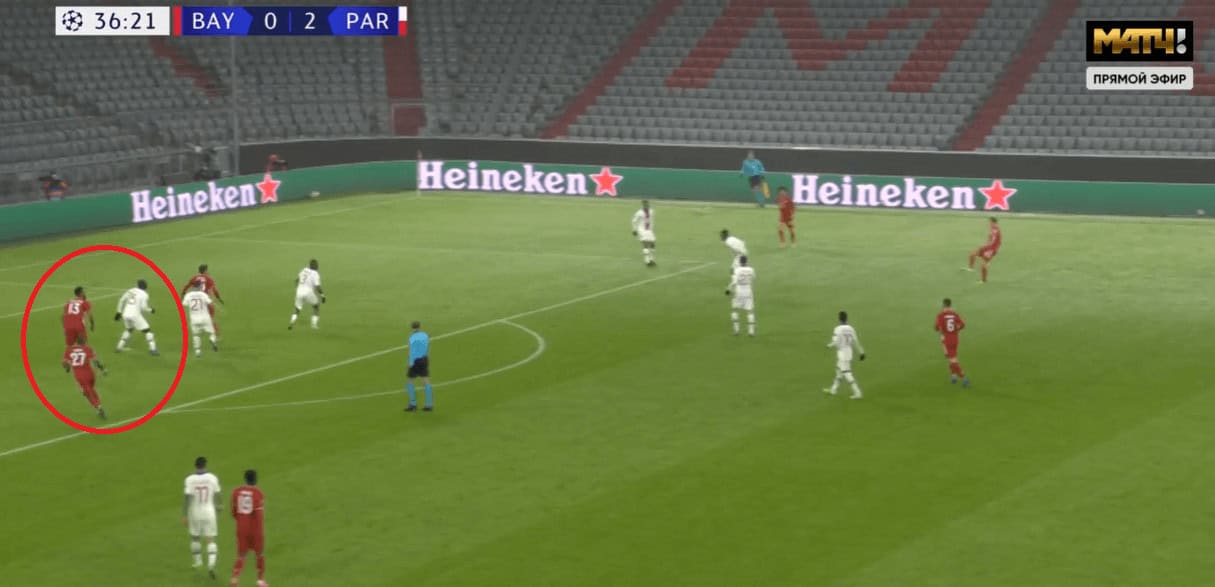
Even for Bayern’s first goal, we could see why PSG missed his presence in the backline. Danilo pushed back with Ander Herrera coming in to take his place in the pivot. Defending crosses is one of the key things associated with teams having low-block and for that, the positioning of the defenders are very important so that they meet the ball first when it is delivered. We see Danilo letting Choupo-Moting slide behind him and Herrera and himself are marking Muller. This lack of communication and awareness means that Bayern have 2v1 on the situation behind him with Alaba too running into the box.
Bayern to continue with Rotations and switches
The key aspect in breaking a low block is to find the possible ways to stretch their defence and one of the ways to do this is to switch the ball to the opposite flank constantly and try to unrest the low block. Bayern kept doing this in the game against PSG and it is one of the few things that they are extremely good at since Flick came. They kept switching the ball to the opposite flank constantly to find wingers. PSG made it clear that they would not press very high against the Bayern backline. While only Mbappe pressed centre-backs, Neymar was used to mark Kimmich. This gave spaces for the Bayern centre-backs to carry the ball forward and also time and space to pass the ball. The Bayern centre-backs Sule and Alaba made a total of 7 long passes in the game while Boateng himself attempted another 5. We can see an example of Alaba stepping out of his position and switching the ball to Sane in the opposite flank. We can see how focused PSG are on the ball near the flank as they shift as a block to maintain a compact shape.

These switches tend to disorganize any defence and if the actions post the switch are swift and decisive it can easily result into goals. We can expect more of these from Bayern in the second leg but they need to improve their post-switch executions well to make these viable. This also another reason to have a traditional winger in either flank as these switches help the wingers to immediately play an outswinging cross when the players are arriving into the box (players arriving into the box prefer outswinging cross as it comes outside to them whereas inswinging ones go away from them and towards the keeper which is difficult to reach). So whenever Sane received the ball from the other flank he had to wait for Parvard to put in an outswinging cross, whereas Sane can himself deliver the first time crosses from the left-wing.
With PSG not offering them central spaces, Bayern had to use these wide areas and they were comfortable in doing it too. On many occasions, they used overloads in the wings and were able to progress the ball. We saw how PSG struggled against Lille’s tactics when they constantly tried to create overloads. We can see in the image below where to maintain central coverage, the PSG midfielders do commit themselves wide. This means that there is a 3v2 situation against them when one of Lille’s centre-forwards pin the full-backs and not forcing him to go wide.
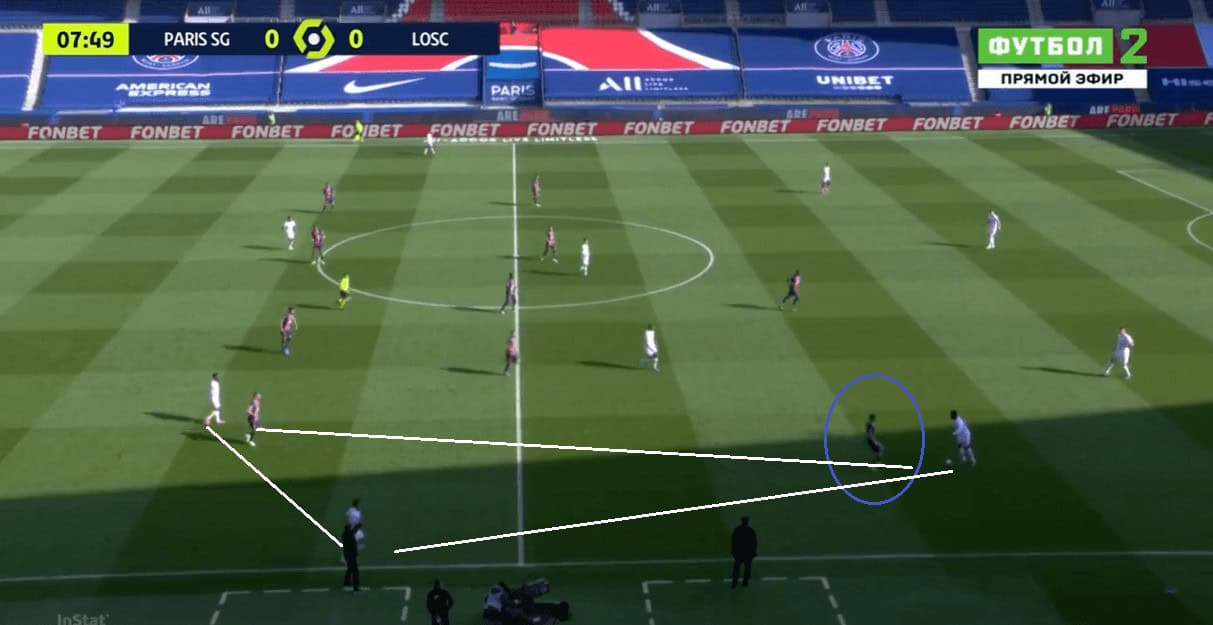
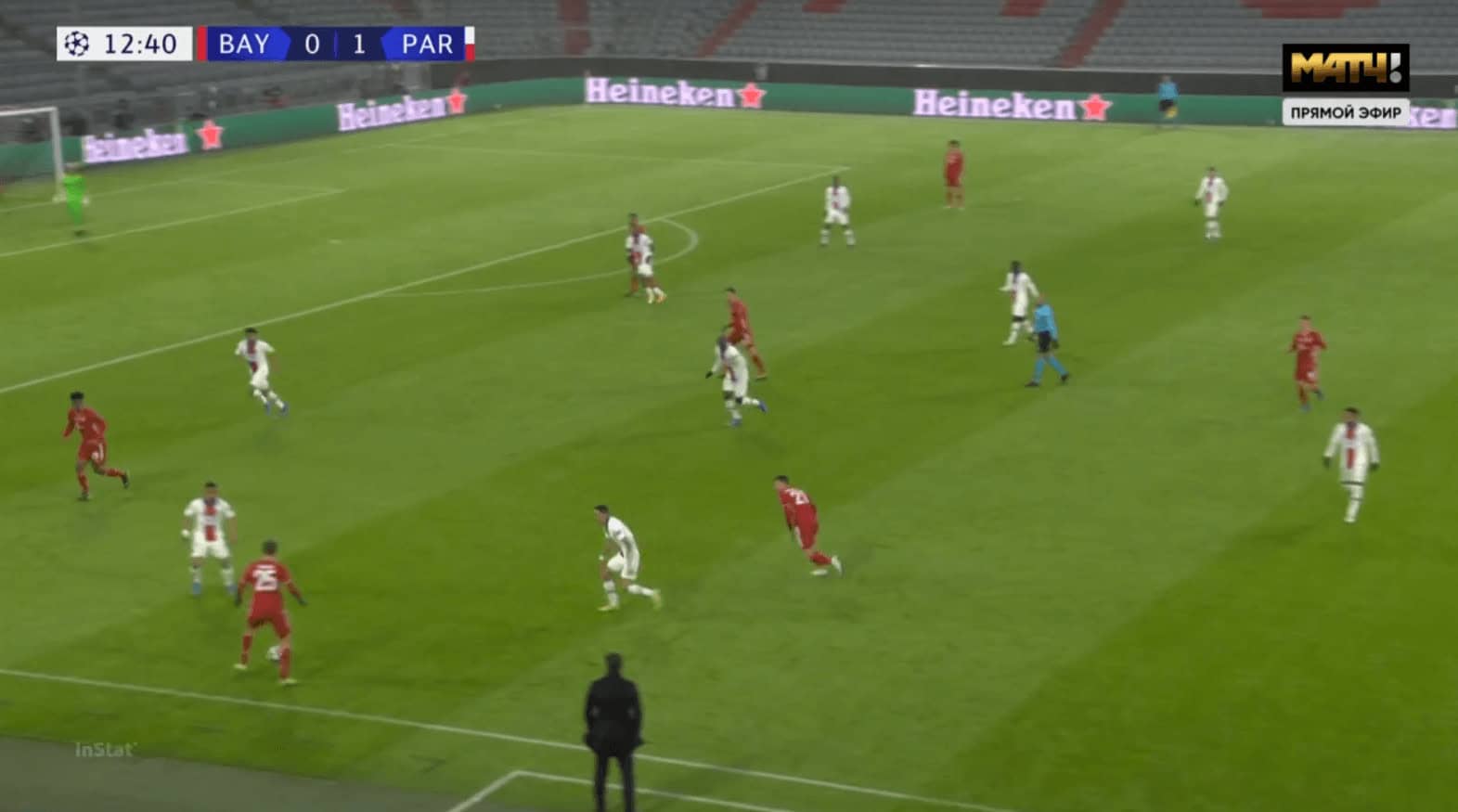
The following image shows Bayern using the same overload with Muller going to the wings and dragging PSG players. While Coman’s presence drags Marquinhos with him. This gives an opportunity for Hernandez to underlap near the half-space.
Set-piece Threat from Bayern
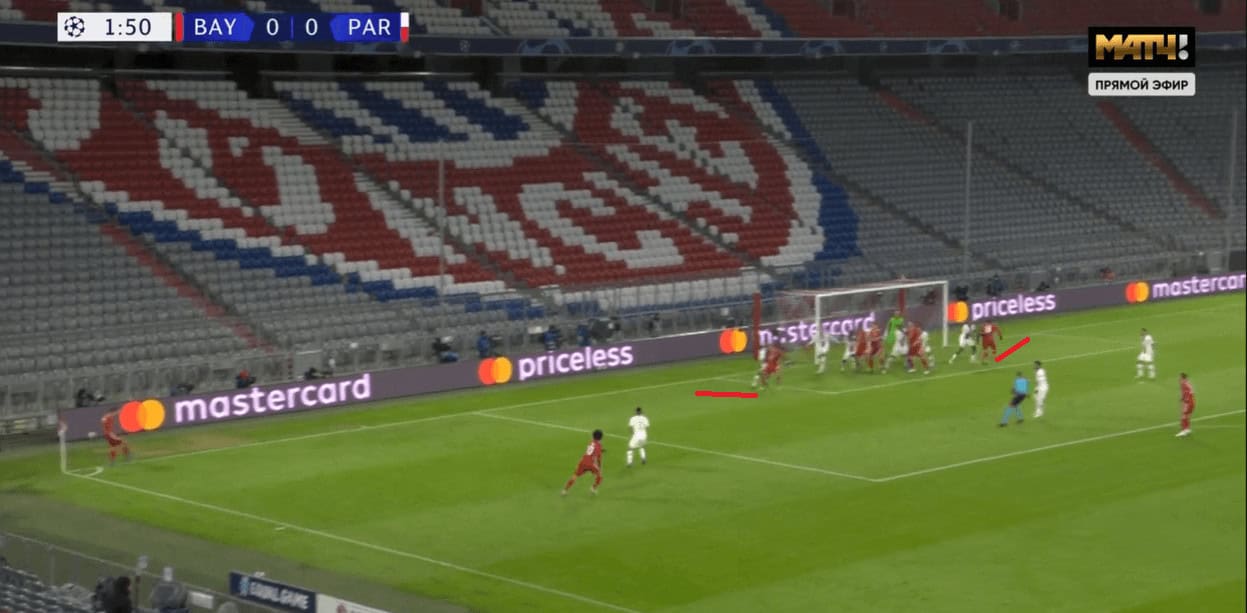
Bayern had an xG of 4.28 in the first leg and breaking it further down we see 2.05 of them being generated from set-piece situations. Their second goal came from a set piece and it was executed brilliantly by Bayern who had their goal scorer, Muller, positioned very deep and immediately making a run to meet Kimmich’s cross. They also used quite a few interesting patterns during corners. In the example below, they crowd the 6-yard box and we see two Bayern players diverging (one towards the near post and one towards the far post). This drags PSG players to the respective ends while also freeing up men in the centre.
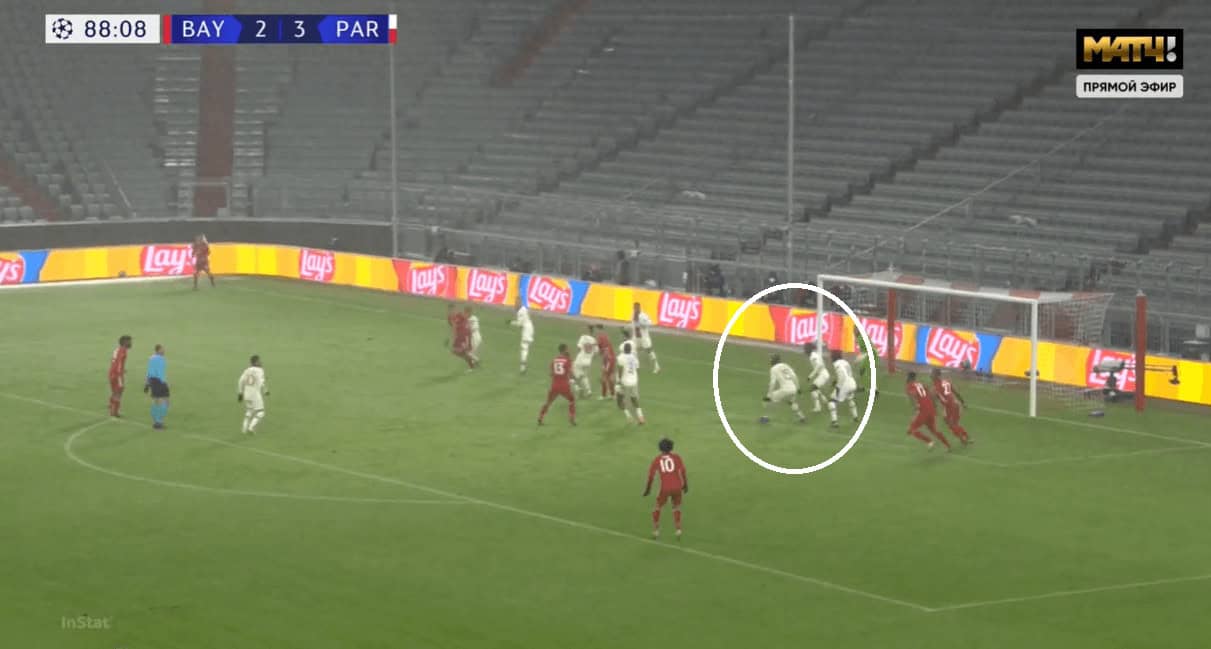
PSG’s lack of effective zonal coverage in the box leads to a couple of issues where they either leave free men at the far post or in front of the 6-yard box. We can see two Bayern players have already positioned themselves in the far post while 3 PSG players do not mark anyone while also being redundant on the zone in front of Navas.
These are situations in which Bayern would be targeting much more in the second leg given that they do not have a proper goalscorer in the absence of Lewandowski.
Conclusion
It’s going to be Flick’s biggest test in his short but successful managerial career at Bayern Munich. Having faced his first defeat in the Champions League last week, he has some work to do in order to script a comeback against a resilient PSG. PSG would be hoping to defend their lead as they did against Barcelona only that this time it’s quite slender.

