Total Football Analysis
Once.Sport
  • Football Analysis
    • Data Analysis
    • Formations
      • 2-2-4 Formation
      • 2-3-5 Formation
      • 3-1-4-2 Formation
      • 3-2-2-3 Formation
      • 3-2-4-1 Formation
      • 3-1-6 Formation
      • 3-3-4 Formation
      • 3-4-1-2 Formation
      • 3-4-2-1 Formation
      • 3-4-3 Formation
      • 3-5-1-1 Formation
      • 3-5-2 Formation
      • 4-1-4-1 Formation
      • 4-2-2-2 Formation
      • 4-2-3-1 Formation
      • 4-2-4 Formation
      • 4-3-1-2 Formation
      • 4-3-3 Formation
      • 4-4-2 Formation
      • 4-5-1 Formation
      • 5-3-2 Formation
      • 5-4-1 Formation
      • 6-3-1 Formation
    • Head Coach Analysis
    • Match Analysis
    • Player Analysis
    • Recruitment Analysis
    • Set Piece Analysis
    • Tactical Theory
    • Tactical Preview
    • Team Analysis
    • Training Analysis
    • Tactical Analysis
    • Scouting Report
  • Competition
    • ALL Competitions
    • English Premier League
    • Champions League
    • La Liga
    • Bundesliga
    • Serie A
    • Ligue 1
    • Eredivisie
    • EFL Championship
    • FIFA World Cup 2022
    • WEURO 2022
    • Women’s Super League
    • NWSL
    • Belgian First Division A
    • A-League
    • Liga Profesional de Argentina
    • Austrian Bundesliga
    • Campeonato Brasileiro Série A
    • DFB Pokal
    • 1. HNL
    • Danish Superliga
    • EFL League One
    • EFL League Two
    • FA Cup
    • EFL Cup
    • Indian Super League
    • K-League
    • J1 League
    • Liga MX
    • Copa América 2021
    • Copa del Rey
    • MLS
    • Eliteserien
    • Euro 2020
    • Primeira Liga
    • Scottish Premiership
    • Allsvenskan
    • Europa League
    • UEFA Nations League
    • Liga AUF Uruguaya
  • Coaches
    • All Coaches
    • Alfred Schreuder
    • Ange Postecoglou
    • Antonio Conte
    • Arne Slot
    • Bo Svensson
    • Brendan Rodgers
    • Bruno Lage
    • Carlo Ancelotti
    • Christophe Galtier
    • Claude Puel
    • Claudio Ranieri
    • David Moyes
    • Dean Smith
    • Diego Simeone
    • Domenico Tedesco
    • Frank Lampard
    • Eddie Howe
    • Edin Terzić
    • Emma Hayes
    • Erik ten Hag
    • Ernesto Valverde
    • Gennaro Gattuso
    • Gerardo Seoane
    • Gian Piero Gasperini
    • Giovanni van Bronckhorst
    • Graham Potter
    • Igor Tudor
    • Imanol Alguacil
    • Jesse Marsch
    • Jonas Eidevall
    • Jorge Sampaoli
    • José Bordalás
    • José Mourinho
    • Julen Lopetegui
    • Julian Nagelsmann
    • Julien Stéphan
    • Jürgen Klopp
    • Luciano Spalletti
    • Lucien Favre
    • Manuel Pellegrini
    • Marcelo Bielsa
    • Marco Rose
    • Marco Silva
    • Massimiliano Allegri
    • Mauricio Pochettino
    • Maurizio Sarri
    • Mikel Arteta
    • Niko Kovač
    • Nuno Espírito Santo
    • Oliver Glasner
    • Patrick Vieira
    • Paulo Fonseca
    • Pep Guardiola
    • Peter Bosz
    • Rafa Benítez
    • Ralf Rangnick
    • Ralph Hasenhüttl
    • Roger Schmidt
    • Roy Hodgson
    • Sean Dyche
    • Sérgio Conceição
    • Simone Inzaghi
    • Sonia Bompastor
    • Stefano Pioli
    • Steffen Baumgart
    • Steven Gerrard
    • Thiago Motta
    • Thomas Frank
    • Thomas Tuchel
    • Unai Emery
    • Vincenzo Italiano
    • Xavi
  • Teams
    • ALL Teams
    • AC Milan
    • Ajax Amsterdam
    • Arsenal
    • AS Monaco FC
    • Atalanta
    • Atlético Madrid
    • FC Barcelona
    • FC Bayern Munich
    • Borussia Dortmund
    • Celtic FC
    • Chelsea FC
    • Everton F.C.
    • Inter Milan
    • Juventus F.C.
    • Leeds United F.C.
    • Liverpool FC
    • Manchester City
    • Manchester United FC
    • Paris Saint-Germain
    • Rangers FC
    • RB Leipzig
    • Real Madrid CF
    • Tottenham Hotspur
    • West Ham United
  • Players
    • ALL Players
    • Alisson Becker
    • Bukayo Saka
    • Erling Haaland
    • Harry Kane
    • Jack Grealish
    • John Stones
    • Julián Alvarez
    • Kalvin Phillips
    • Kevin De Bruyne
    • Kyle Walker
    • Kylian Mbappé
    • Lamine Yamal
    • Lionel Messi
    • Luis Díaz
    • Mohamed Salah
    • Phil Foden
    • Virgil Van Dijk
  • Contact
  • Write For TFA
No Result
View All Result
No Result
View All Result
Total Football Analysis
No Result
View All Result
Home Competitions Bundesliga

Bundesliga 2018/19: Werder Bremen vs Hoffenheim

Kostadinov by Kostadinov
December 22, 2018
in Bundesliga, Match Analysis
0
Werder-Bremen-Hoffenheim-Bundesliga-Tactical-Analysis-Analysis

Artwork by @chapulana.

Only two points separated both teams from each other in the Bundesliga table. The European Cup places are within reach for both of them which promised an exciting game.

Not only the table situation suggested an exciting match but also the duel of two of the most promising young German coaches, Florian Kohfeldt and Julian Nagelsmann.

In this analysis, I will look at how Kohfeldt and Nagelsmann set up their teams, especially from a tactical point of view.

Line ups

Werder Bremen lined up in a 4-3-1-2/4-4-2 diamond. Maximilian Eggestein often joined the back-line in defensive phases in order to support the centre-backs and avoid 1v1 situations against Hoffenheim’s strikers Adam Szalai and Joelinton. The second reason was that Hoffenheim’s strikers often dropped, Bremen’s centre-backs tracked them so Eggestein covered the gap they left.

Hoffenheim’s formation was fluid, especially in midfield. That was due to Kramaric’s role. His positioning changed depending on the situation. In build-up phases, he often joined Kerem Demirbay and Leonardo Bittencourt in central midfield. In more advanced phases he was active as an offensive midfielder.

Pressing approach

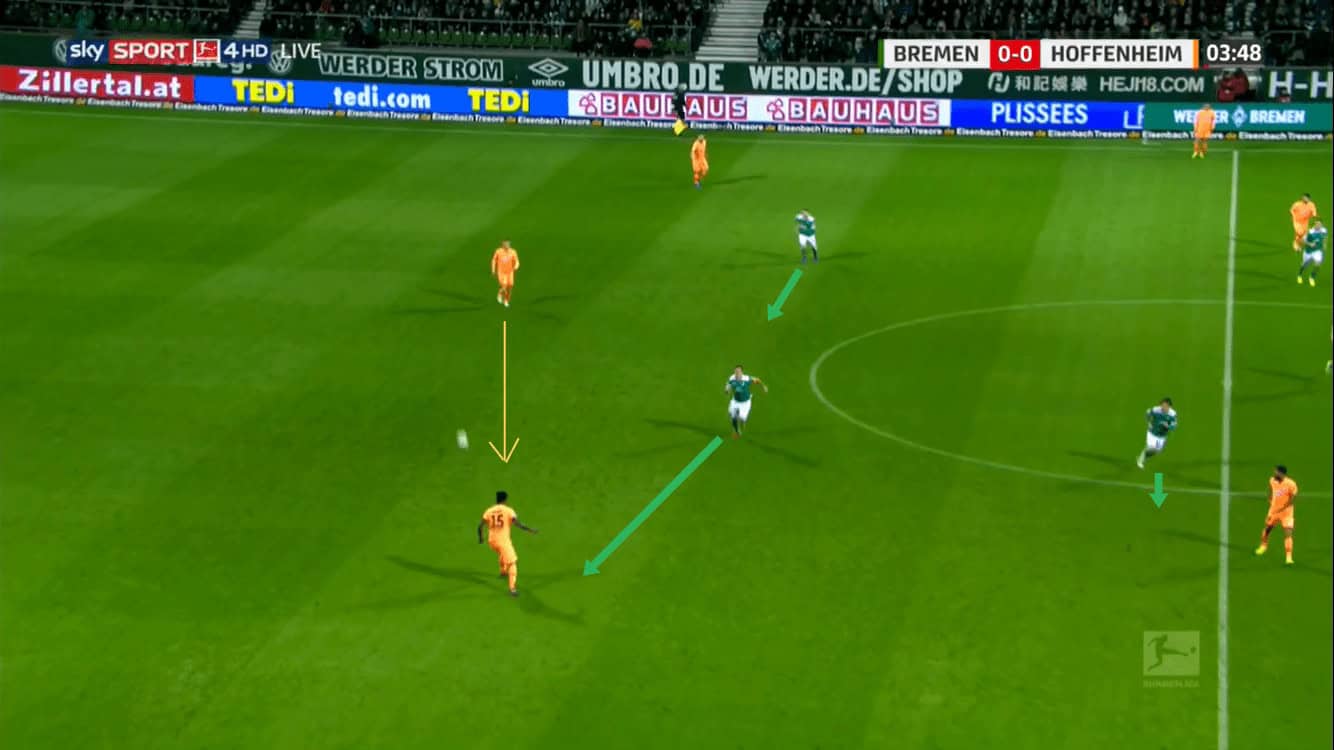
Bremen varied their pressing line in the first half. They mostly began pressing when Hoffenheim reached the centre circle but they also pressed very high up the pitch occasionally. The pressing-trigger was most often a pass from the central defender Stefan Posch to one of the half-backs (P1). Posch was forced to play these passes often because Hoffenheim’s playmaker Demirbay was man-marked or the passing lane was closed by Yuya Osako. This took the possibility from the guests to find him in the centre and control the flow of their possession therefrom.
Bundesliga 2018/19: Werder Bremen vs Hoffenheim Tactical Analysis Statistics
P1: Pressing-trigger

Due to the diamond-midfield, Bremen had a strong presence in midfield and especially in the halfspaces where Klaassen and Möhwald were positioned. This made it very difficult for Nagelsmann’s side to find Bittencourt or Kramaric there. Often Hoffenheim had to pass to their wing-backs who were immediately pressed by Bremen’s full-backs.

Hoffenheim’s struggle for solutions

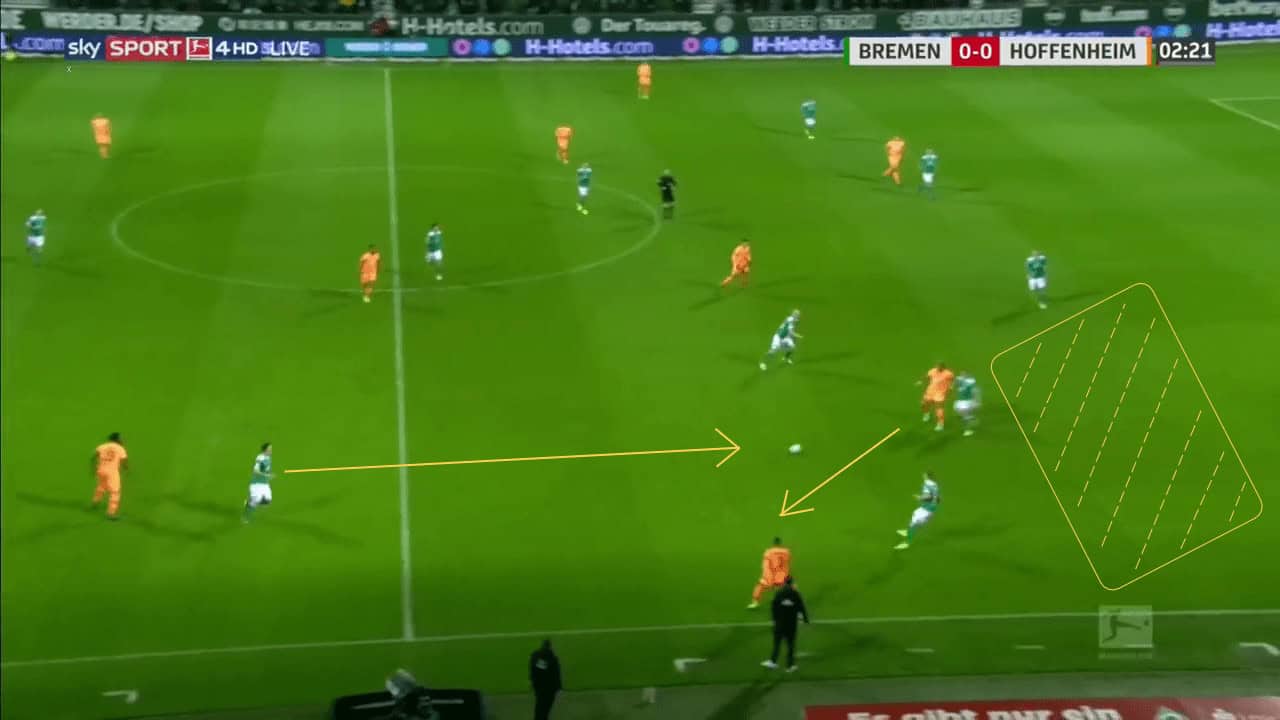
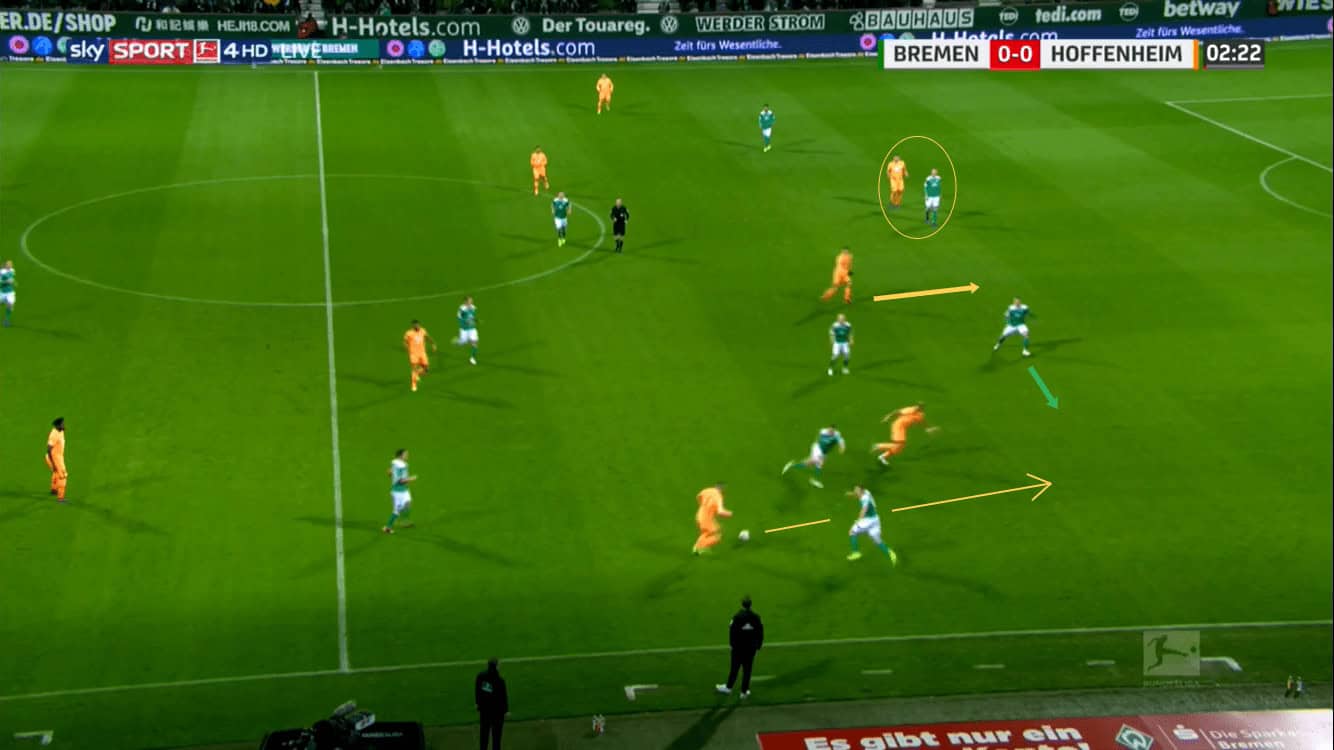
The mentioned points gave Hoffenheim little time to spend in the halfspaces in the opponent’s half or even reach them. Therefore, the strikers dropped often in order to receive vertical passes from the half-backs. Then, mostly they played lay-off passes to the wing-backs. Bremen’s centre-backs tracked the dropping strikers which created space behind them. After the lay-off pass, the dropping striker attacked the created space with an aggressive vertical run (P2.1 & P2.2).
Bundesliga 2018/19: Werder Bremen vs Hoffenheim Tactical Analysis Statistics
P2.1: Joelinton drops to provide an option for Adams and plays a lay-off pass
Bundesliga 2018/19: Werder Bremen vs Hoffenheim Tactical Analysis Statistics
P2.2: Joelinton immediately attacks the created space

Though, after few times it became too predictable for the opponent’s defenders. The centre-backs marked the strikers even tighter and teammates anticipated the passes.

Possible solutions

Bringing more variety in their attacking game would have caused more threats for the opponent. In the picture below, you can see that Posch decides to pass the ball to the half-back. As I already mentioned, this was a pressing-trigger for Kohfeldt’s side and almost all of Posch’s passes were played to a half-back. But Werder’s strikers didn’t press Posch at all most of the time. As a starting point for the following two possible solutions, I will take P3.

Bundesliga 2018/19: Werder Bremen vs Hoffenheim Tactical Analysis Statistics
P3

As a possible solution in order to bring in more variety, Hoffenheim’s central defender could have disorganized Werder’s patterns with continuing to dribble towards the opponent’s half. At some point, someone would have had to press him which would have opened space for another player. If Osako would have pressed him for example, it would have created space for Demirbay to receive the ball in the centre.

Another opportunity could have been an adapting of the central midfielders’ positioning in such situations. In P3, you can see that Bittencourt (orange player next to the referee) is positioned in the halfspace but very close to the centre which is already condensed. This makes it even better for the opponent’s central midfielder to stay in the halfspace which blocks vertical passes from Posch to the strikers. If Bittencourt would position himself wider, closer to the touch-line, the opponent’s midfielder would have to make a decision: either staying where he is or staying closer to Bittencourt which would draw him out of the halfspace.

Outcome

No matter which decision Hoffenheim’s midfielder makes, they would benefit from it. In the first case, Bittencourt would lose his marker and give Posch the option to play a diagonal pass to him. Bittencourt would have the opportunity to receive the ball with more space and his body directed towards the centre which allows him to get a view of a bigger and in this case more relevant part of the pitch. Receiving a vertical pass with his body directed to Posch wouldn’t give him that opportunity. In order to create even more space for Bittencourt, the left wing-back Nico Schulz could position himself higher up the pitch to pin the opponent’s fullback who then wouldn’t be able to press Bittencourt.

In the second case, Bremen’s central midfielder’s movement would open up a passing lane for Posch to play a vertical pass to a dropping striker.

Hoffenheim’s pressing

Nagelsmann’s side is well-known for their brave pressing. They put their opponents under high pressure very early in the build-up phase and force them to play many long balls. This helps them to win possession.

Against Bremen, Hoffenheim often used to leave the centre-backs free for a pass. While the ball is on the way to the centre-back, the strikers begin to press them coming from the centre. That takes the possibility away from the pass receiver to pass the ball to the other centre-back. In this way, they push them to the touch-line. Then, they mark all options around the ball. Finally, the opponent is forced to play a long ball which is easy to defend (P4).

Bundesliga 2018/19: Werder Bremen vs Hoffenheim Tactical Analysis Statistics
P4: Hoffenheim’s pressing

This approach led to the result that Werder couldn’t build up properly and often lost possession by playing a long ball.

Schulz’s contribution

The German national player Nico Schulz was very active down the left wing, especially in the first half. He played the most crosses of his team (8) and attempted the second most dribbles*. He also assisted Bittencourt’s goal with a cross after attacking down the left wing.

Kohfeldt adapts

In the second half, Bremen permanently pressed Hoffenheim’s build-up play. This factor added to Hoffenheim’s drop of courage to take risks in their build-up and the drop of concentration led to many long balls and consequently losing possession quickly.

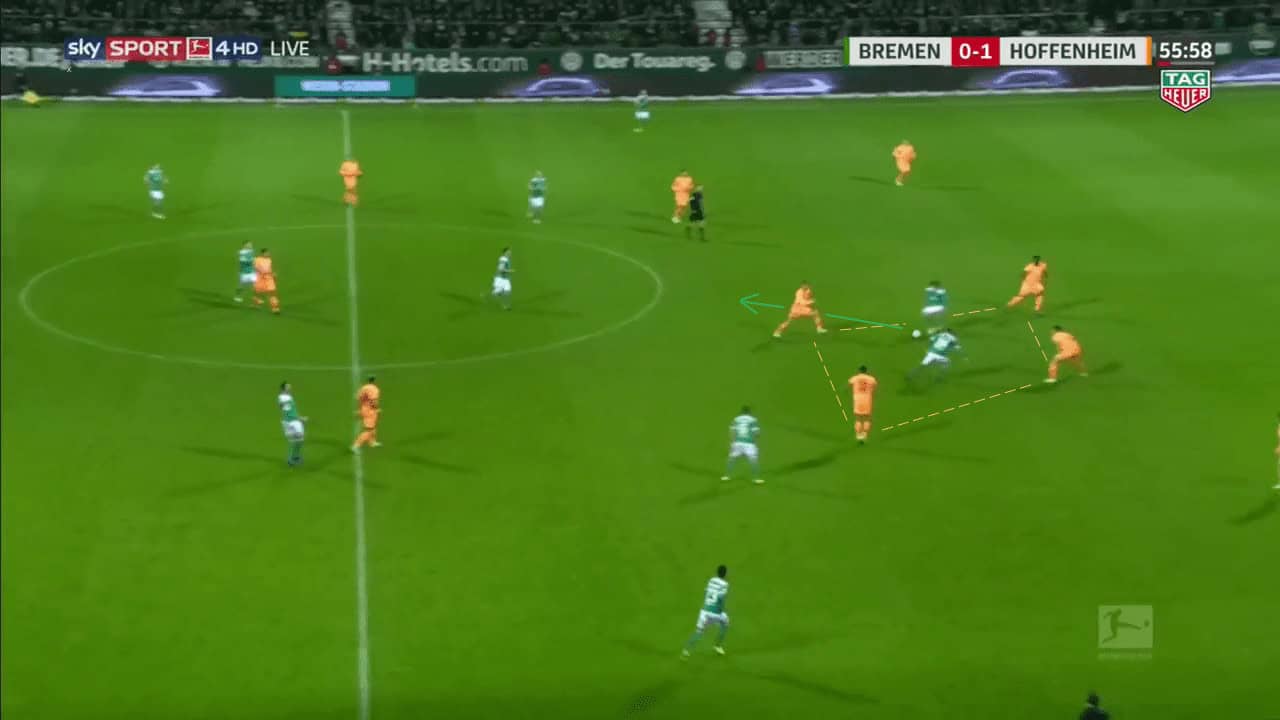
In the 57th minute, Bremen managed to equalize after Gebre Selassie’s header. It was a beautiful goal after a well-executed build-up play, direct passes in midfield, attracting opponents and finding the free man on the wing (P5.1 & P5.2).

Bundesliga 2018/19: Werder Bremen vs Hoffenheim Tactical Analysis Statistics
P5.1: Langkamp plays a vertical pass which attracts for defenders
Bundesliga 2018/19: Werder Bremen vs Hoffenheim Tactical Analysis Statistics
P5.2: Langkamp’s pass attracted the defenders. Pay attention to how the distances between the defenders got smaller compared to P5.1 and its effect on the rest of the space.

Bremen was the better team in the second half where Hoffenheim’s players weren’t able to maintain the intensity until the end of the match. In the last minutes of the match, both teams lacked discipline, left the midfield free and faced only few defenders. Though, both teams didn’t score. Especially, Bremen’s Rashica had many chances after he came in for Davy Klaassen.

Conclusion

The first half showed some interesting aspects from a tactical point of view. Both teams struggled to dominate the match but they managed to neutralize the opponent’s strengths mostly.

In the second half, Bremen had many opportunities to win all three points but Rashica failed to convert his chances. Especially in the last minutes, there wasn’t tactical discipline at all. This led to situations which are untypical for both sides.


If you love tactical analysis, then you’ll love the digital magazines from totalfootballanalysis.com – a guaranteed 100+ pages of pure tactical analysis covering topics from the Premier League, Serie A, La Liga, Bundesliga and many, many more. Get your copy of the FIRST of two December issues for just £4.99 here or preorder the SECOND of the December issues with an annual membership right here.

Previous Post

Bundesliga 2018/2019 – Bayern Munich vs RB Leipzig

Next Post

Oliver Batista Meier: The next big Bayern player?

Next Post
Oliver-Batista-Meier-Bayern-Munich-Tactical-Analysis-Analysis-Statistics

Oliver Batista Meier: The next big Bayern player?

  • About Total Football Analysis
  • Contact Total Football Analysis
  • Write For Total Football Analysis
  • Advertise
  • Privacy Policy
  • Cancellation / Refund Policy
  • Resources
  • Terms Of Service

© 2026 Total Football Analysis

No Result
View All Result
  • Football Analysis
    • Data Analysis
    • Formations
      • 2-2-4 Formation
      • 2-3-5 Formation
      • 3-1-4-2 Formation
      • 3-2-2-3 Formation
      • 3-2-4-1 Formation
      • 3-1-6 Formation
      • 3-3-4 Formation
      • 3-4-1-2 Formation
      • 3-4-2-1 Formation
      • 3-4-3 Formation
      • 3-5-1-1 Formation
      • 3-5-2 Formation
      • 4-1-4-1 Formation
      • 4-2-2-2 Formation
      • 4-2-3-1 Formation
      • 4-2-4 Formation
      • 4-3-1-2 Formation
      • 4-3-3 Formation
      • 4-4-2 Formation
      • 4-5-1 Formation
      • 5-3-2 Formation
      • 5-4-1 Formation
      • 6-3-1 Formation
    • Head Coach Analysis
    • Match Analysis
    • Player Analysis
    • Recruitment Analysis
    • Set Piece Analysis
    • Tactical Theory
    • Tactical Preview
    • Team Analysis
    • Training Analysis
    • Tactical Analysis
    • Scouting Report
  • Competition
    • ALL Competitions
    • English Premier League
    • Champions League
    • La Liga
    • Bundesliga
    • Serie A
    • Ligue 1
    • Eredivisie
    • EFL Championship
    • FIFA World Cup 2022
    • WEURO 2022
    • Women’s Super League
    • NWSL
    • Belgian First Division A
    • A-League
    • Liga Profesional de Argentina
    • Austrian Bundesliga
    • Campeonato Brasileiro Série A
    • DFB Pokal
    • 1. HNL
    • Danish Superliga
    • EFL League One
    • EFL League Two
    • FA Cup
    • EFL Cup
    • Indian Super League
    • K-League
    • J1 League
    • Liga MX
    • Copa América 2021
    • Copa del Rey
    • MLS
    • Eliteserien
    • Euro 2020
    • Primeira Liga
    • Scottish Premiership
    • Allsvenskan
    • Europa League
    • UEFA Nations League
    • Liga AUF Uruguaya
  • Coaches
    • All Coaches
    • Alfred Schreuder
    • Ange Postecoglou
    • Antonio Conte
    • Arne Slot
    • Bo Svensson
    • Brendan Rodgers
    • Bruno Lage
    • Carlo Ancelotti
    • Christophe Galtier
    • Claude Puel
    • Claudio Ranieri
    • David Moyes
    • Dean Smith
    • Diego Simeone
    • Domenico Tedesco
    • Frank Lampard
    • Eddie Howe
    • Edin Terzić
    • Emma Hayes
    • Erik ten Hag
    • Ernesto Valverde
    • Gennaro Gattuso
    • Gerardo Seoane
    • Gian Piero Gasperini
    • Giovanni van Bronckhorst
    • Graham Potter
    • Igor Tudor
    • Imanol Alguacil
    • Jesse Marsch
    • Jonas Eidevall
    • Jorge Sampaoli
    • José Bordalás
    • José Mourinho
    • Julen Lopetegui
    • Julian Nagelsmann
    • Julien Stéphan
    • Jürgen Klopp
    • Luciano Spalletti
    • Lucien Favre
    • Manuel Pellegrini
    • Marcelo Bielsa
    • Marco Rose
    • Marco Silva
    • Massimiliano Allegri
    • Mauricio Pochettino
    • Maurizio Sarri
    • Mikel Arteta
    • Niko Kovač
    • Nuno Espírito Santo
    • Oliver Glasner
    • Patrick Vieira
    • Paulo Fonseca
    • Pep Guardiola
    • Peter Bosz
    • Rafa Benítez
    • Ralf Rangnick
    • Ralph Hasenhüttl
    • Roger Schmidt
    • Roy Hodgson
    • Sean Dyche
    • Sérgio Conceição
    • Simone Inzaghi
    • Sonia Bompastor
    • Stefano Pioli
    • Steffen Baumgart
    • Steven Gerrard
    • Thiago Motta
    • Thomas Frank
    • Thomas Tuchel
    • Unai Emery
    • Vincenzo Italiano
    • Xavi
  • Teams
    • ALL Teams
    • AC Milan
    • Ajax Amsterdam
    • Arsenal
    • AS Monaco FC
    • Atalanta
    • Atlético Madrid
    • FC Barcelona
    • FC Bayern Munich
    • Borussia Dortmund
    • Celtic FC
    • Chelsea FC
    • Everton F.C.
    • Inter Milan
    • Juventus F.C.
    • Leeds United F.C.
    • Liverpool FC
    • Manchester City
    • Manchester United FC
    • Paris Saint-Germain
    • Rangers FC
    • RB Leipzig
    • Real Madrid CF
    • Tottenham Hotspur
    • West Ham United
  • Players
    • ALL Players
    • Alisson Becker
    • Bukayo Saka
    • Erling Haaland
    • Harry Kane
    • Jack Grealish
    • John Stones
    • Julián Alvarez
    • Kalvin Phillips
    • Kevin De Bruyne
    • Kyle Walker
    • Kylian Mbappé
    • Lamine Yamal
    • Lionel Messi
    • Luis Díaz
    • Mohamed Salah
    • Phil Foden
    • Virgil Van Dijk
  • Contact
  • Write For TFA
  • Login

© 2026 Total Football Analysis