
Chelsea Women missed out on Champions League qualification by coming third in the FAWSL, five points behind Manchester City Women. Even though they narrowly missed out on European football, Chelsea have shown an incredible turnaround of form that sees them hovering near the top playing some exceptional football. Having let go of a number of players this summer, the need for reinforcements was necessary. The only major summer addition saw the arrival of Norwegian winger Guro Reiten.
But the most pressing issue at Chelsea was integrating their star players in the same line- up to get them firing on all cylinders. Getting Fran Kirby, Ji So-Yun, and Bethany England
to operate in the same line-up seemed to be a conundrum Emma Hayes was unable to solve last season. Adding Reiten into the mix made the task all the more difficult. However, this season Hayes seems to have masterminded a way of integrating them and producing some stellar performances. Adjusting Kirby’s position and role on the pitch has been key and has allowed England to play much more effectively.
This report will aim to understand the tactical changes Hayes made to create a more effective and efficient team at Chelsea.
Fran Kirby – England’s Best Playmaker?
Kirby is a natural ‘number 10’ who takes up the role of a playmaker for both club and country. Kirby has the ability to play in a range of positions from central midfield to centre- forward – incredibly versatile. For Chelsea she plays as a striker whilst for England she has been shoe-horned into the ‘number 8’ role. Armed with vision and ability to receive and pass under pressure, Kirby is considered one of the best playmaking forwards in Europe. With an eye for goal, Kirby is one of the few players that have an incredible ability to score and create goals. Her incredible work ethic is a hallmark of her play and contributes towards her play style.
Bethany England – Underrated Striking Weapon
England plays primarily as a striker and can be classified as a poacher. She has an eye for goal after scoring 22 goals in all competitions last season. Combined with her incredible movement and positioning to create space in the final third, England is able to manoeuvre defenders in the 18-yard area and score goals. England hasn’t always played up front, however, with her versatility perhaps being her undoing during her tenure at Chelsea; she featured in midfield and filled in at wing- back since her move in 2016.
Ji-So Yun – South Korean Livewire
Ji So-yun is a dynamic attacking midfielder. Primarily played as a ‘number 10’, she is equally comfortable playing deeper as a central midfielder. The South Korean midfielder is most proficient on the ball and prefers to drive into the opposition half, playing in her attacking teammates. Equipped with incredible vision, Ji is usually at the heart of Chelsea’s midfield, simultaneously pulling strings in order to keep the side ticking and being an attacking force herself.
The Issues in 2018
To have a better understanding of the changes we will need to dissect and break down the team’s tactics and player roles from the 2018/19 season. Chelsea primarily used a 4-2-3-1 (37%) and 4-3-3 (19%) formation. Kirby was tasked with leading the line often playing as the lone striker starting 20 games out of 22 matches in that position last season. But has she been effective in these formations?
Kirby has been a prolific goal scorer for the most part: her 11 goals in the 2018/19 season being her highest tally in the FAWSL, although her assists haven’t been up to par with just
six coming in the past five seasons prior to this one. Even then those six came in the 2017/18 season where she also scored 18 goals in all competition with just eight coming in the league. For a player that is renowned for her playmaking skills she does not manage to register that many assists. Statistically speaking, Kirby does exceptionally well in other competitions but struggles to influence in the league compared to other forwards. For example, Vivanne Miedema excels as the focal point with 22 goals and 10 assists to her name last season. England had a similar tally last season with 12 goals and one assist but was in and out of the team.
Kirby’s skillset is reminiscent of a playmaker rather than goal scorer. She often drops deep to collect possession and looks to either dribble or find a penetrative pass. These movements ultimately create space for the likes of England, Reiten, and Ji. Kirby’s biggest strength is her ability to receive possession in tight areas relieving pressure. But the problem has been a mixture of very few midfield runners going beyond Kirby and a clash of similar players being played around her.
Ji usually plays in the ‘number 10’ role and her play style is more about getting on the ball than her movement off-the-ball. That preference
of running with the ball between Ji and Kirby made it difficult for the team to progress into the penalty area more effectively.
The 4-2-3-1 sees Ji play behind Kirby. The Japanese attacker is a lively presence; however, the issue Chelsea faced was both Kirby and Ji both prefer carrying the ball using their incredible creativity to play in their teammates. They play one-two passes with her teammates with no midfield runners going in beyond the opposition back four. If Kirby played up front and Ji as the number 10, then their similar play styles would collide.
Ji would usually be the recipient of Kirby’s interchanging passes in a similar position without someone being able to take advantage in the penalty area. The full-backs do push up but passes into the wide areas aren’t effective if there isn’t a natural centre-forward in the box to collect crosses. This is where England’s inclusion becomes vital.

out wide because it would give them time to reorganise themselves at the back. Both England and Reiten bring pace in abundance and could help to relieve this issue. Another probing issue was the man-marking systems. Many of the underdog teams would utilise a five-man backline and employ a man-marking system that would assign one player to push up, forcing Chelsea back and give them time to assemble their shape once again.


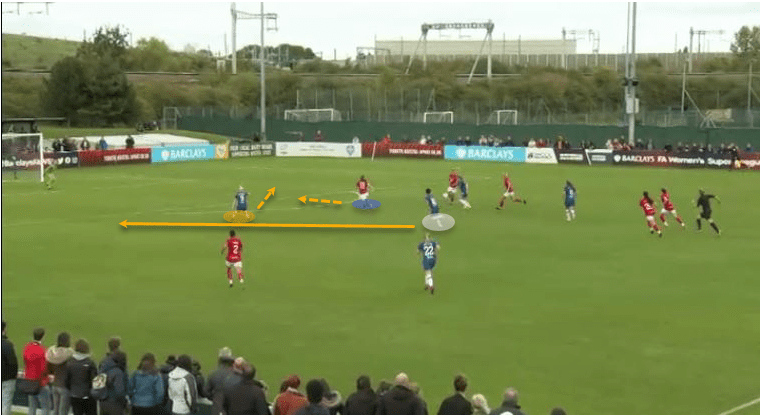
in behind. However, as we explained earlier, Ji’s (red) instinct is to drop deep than to run
in the opposite direction. What she has done well is distract left-back Selma Bacha, giving Bachmann (grey) space to drive into the wide, unoccupied area. However, this allows Lyon to regroup and block any crosses that eventually come their way. One of Renard’s biggest weaknesses is her lack of pace and exploiting that could have helped Chelsea penetrate a tight backline with the low number of chances on offer.
Hayes has an effective striker waiting in the wings in England. England made 18 appearances scoring 12 goals from 12 starts in the FAWSL last season and is a natural goal scorer. The Chelsea coach needed to find a way to combine the complementary skill sets of all three players. Last season Kirby and England started four games together scoring a total of six goals, so the potential is there.
Is 4-4-2 the Solution?
The current season has seen a complete shift away from the 4-2-3-1 formation with Chelsea now adopting a more native 4-4-2 system. The biggest, most obvious change has been the switch to a two-striker system. This has seen both England and Kirby start alongside each other in what could be the start of a dangerous partnership. Ji would
be permanently moved to a central midfield position. Chelsea gain many advantages
by moving to the 4-4-2 which has made a comeback with Diego Simeone’s Atlético Madrid as the biggest beneficiaries of the system in recent years.
The two banks of four allow for better pitch coverage and defensive solidarity along with more coordinated pressing from the front consisting of a genuine striker and shadow striker. The shadow striker allows teams to have a link player between the lines and carry the ball out wide to find the other striker. In this case, Kirby would take up the shadow striker role utilising her excellent playmaking skillset to connect play between Ji and Ingle to England. The space vacated by Kirby could be taken up by the inverted movement of Reiten. England has notched up two goals and one assist in five matches while Kirby has three assists to her name. Both Reiten and Ji have two goals and one assist each to their names.
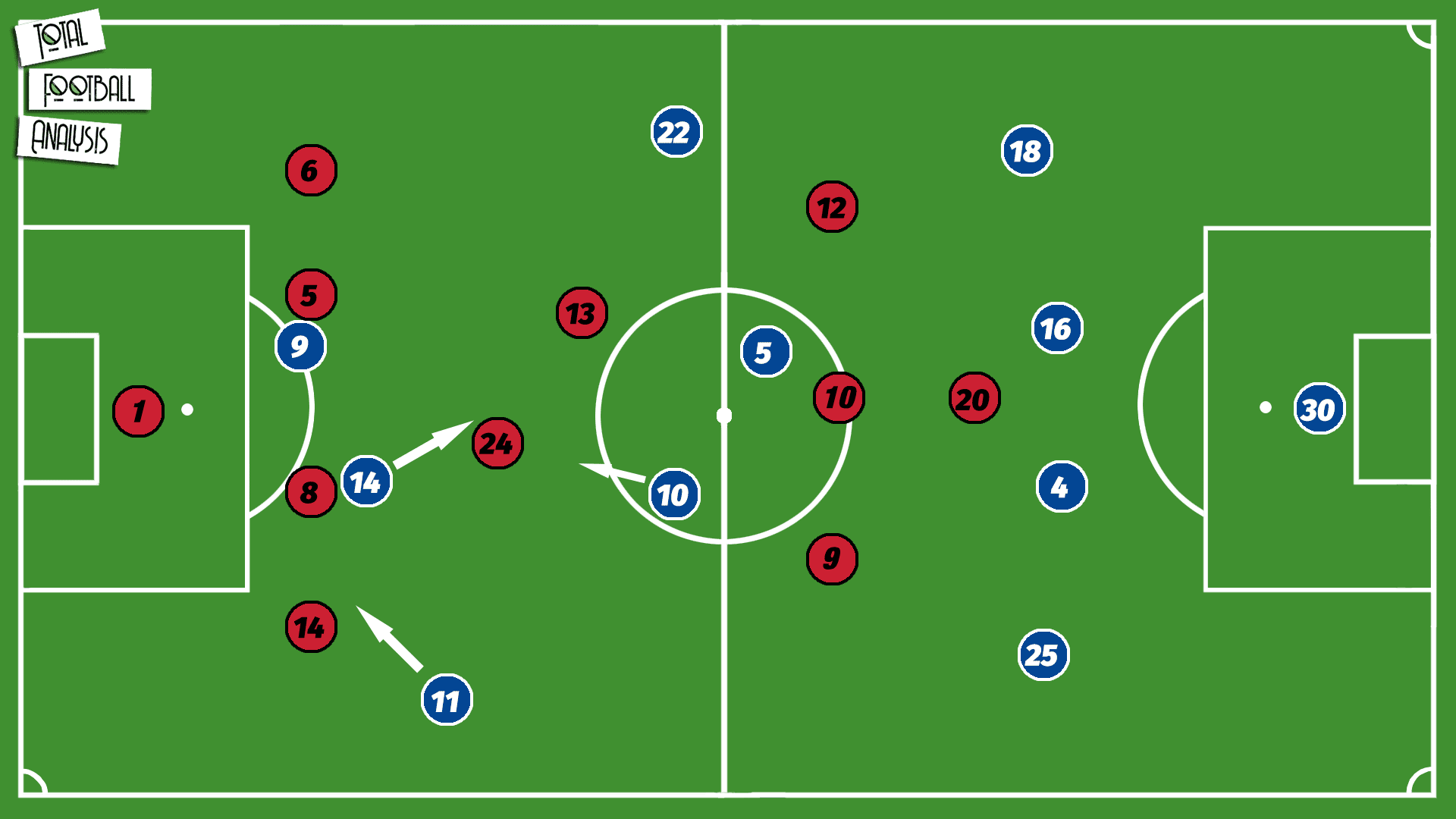
The positional fluidity and flexibility afforded by the system allows the wide players and shadow striker to interchange positions and attack from deep, confusing the opposition. This is where Reiten and England can thrive as one has the ability to cut inside and drift out wide while the other creates space through intelligent movement.
Statistically speaking the numbers illustrate Kirby’s improvement in her new position. Her number of passes has increased from 29.53 to 41.98 and long passes from 0.65 to 1.91 per 90. This could be a result of the space she has to roam and isn’t restricted by being isolated as a lone centre-forward. Her dribbles have increased from 4.05 to 5.72 per 90 which are in correlation to the space created by England and Ji.
The examples shown later in the report will highlight the way her teammates have mutually benefited from her play. Lastly, her attempts at intercepting possession has improved from 1.51 to 2.23 per 90, which means she’s been able to dispossess opponents from better positions and start more counter-attacks due to the defensive backing she has in midfield allowing her to play with more freedom and bring in her quicker teammates.
Indeed, England and Kirby complement each other due to their contrasting styles of play. England is a striker who possess pace, guile, and intelligence – a natural finisher. England has been lethal for Chelsea and acts as the perfect mould for Kirby in this new system. Kirby is now playing further forward but is able to effectively drop into midfield to influence play.


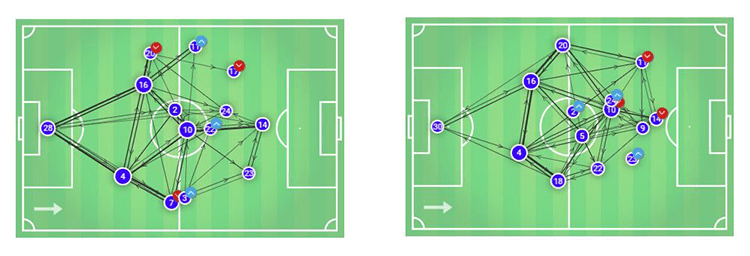
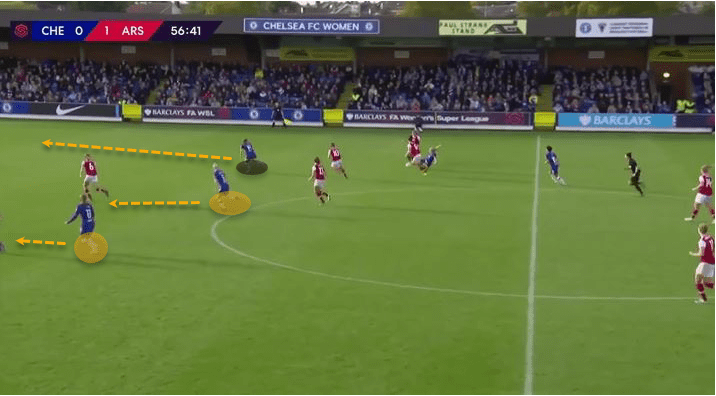
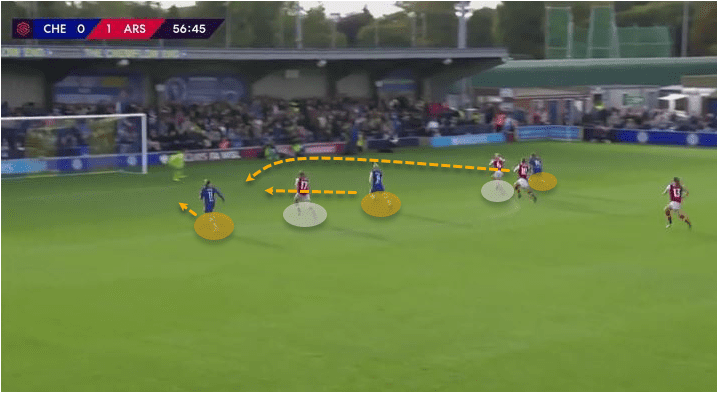
We can see how the 4-4-2 has allowed Kirby to flourish as an effective playmaking striker akin to Roberto Firmino at Liverpool. And just like the Liverpool striker, she has allowed her teammates to play with more freedom. The positive effect on the team has not only come from the tactical change but also in the role Kirby plays in this new setup.
The Kirby Effect
England, Ji and Reiten have hugely benefited from the change in formation. Kirby’s change in role has positively affected these three players. The Norwegian winger is able
to drift into central areas and act as a faux secondary striker when Kirby drops into midfield and helps to create overloads in the box. With a lethal left foot, the winger looks
to play an inside-forward role coming in off the right, driving into opposition defenders and putting them on the back foot. While she is a proficient dribbler, Reiten’s ability to find pockets of space makes her an asset in the final third. With Kirby’s ingenuity, she should
be able to capitalise on an extra player in the forward areas alongside England. The earlier example showing Kirby’s assist against Arsenal had Reiten in the 18-yard box too.
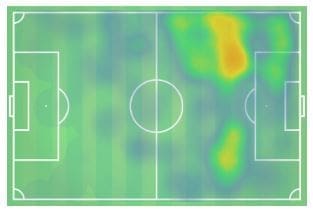
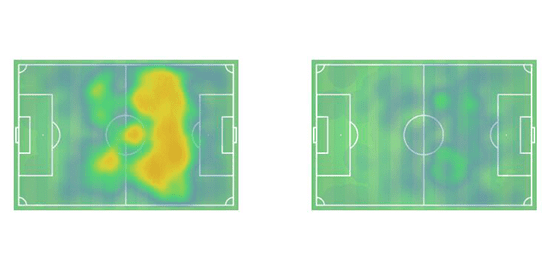
England seems to be most affected by the changes. While last season she started 12 games and scored 12 goals, she was constantly in and out of the side. The change in system has seen England play much more consistently and is now able to expect service from both Ji and Kirby. One of her biggest strengths is her movement in and around the penalty area with the ability to create space for herself. Now she is free to roam across
the forward areas while Kirby can easily slip away to find her in the final third. Her assist for the goal against Arsenal epitomised their relationship.

Additional Firepower
In November Chelsea announced the signing of Sam Kerr who will link up with the squad in January and will only add to Chelsea’s stacked attacking options. We’ve analysed and seen the impact the current players have had on the teams’ 4-4-2 system and Kerr’s arrival will further enhance the tactical choices Hayes will have at her disposal. Kerr is a complete forward and is characterised by her exceptional lethality and positioning. The Australian excels in finding space around the opposition’s defensive line creating one v one situations. Although she is a traditional number nine, Kerr’s preference to drop deep into midfield and link up play creates space. She should sync up perfectly with Chelsea’s dynamic midfielders.
Title Challengers?
Certain strikers thrive on playing as the lone forward whilst others work better in pairs. Chelsea are lucky to have a pair of strikers that have meshed well as a pair. Kirby’s contribution is slowly becoming more apparent with the number of goals she scores and chances she creates. While she has been somewhat of a goal scorer, those numbers match those of a midfielder rather than a striker. Playing alongside England could increase her contribution to the team by having an intelligent centre-forward next to her. This new formation could bring the best out of Kirby, England, and Ji –and if it allows the rest of the team to thrive then it could be a very successful year for Hayes and Chelsea. With no Champions League football to contend with, as well as Kerr’s arrival, their chances of dethroning Arsenal to the FAWSL crown could become a very real possibility.
