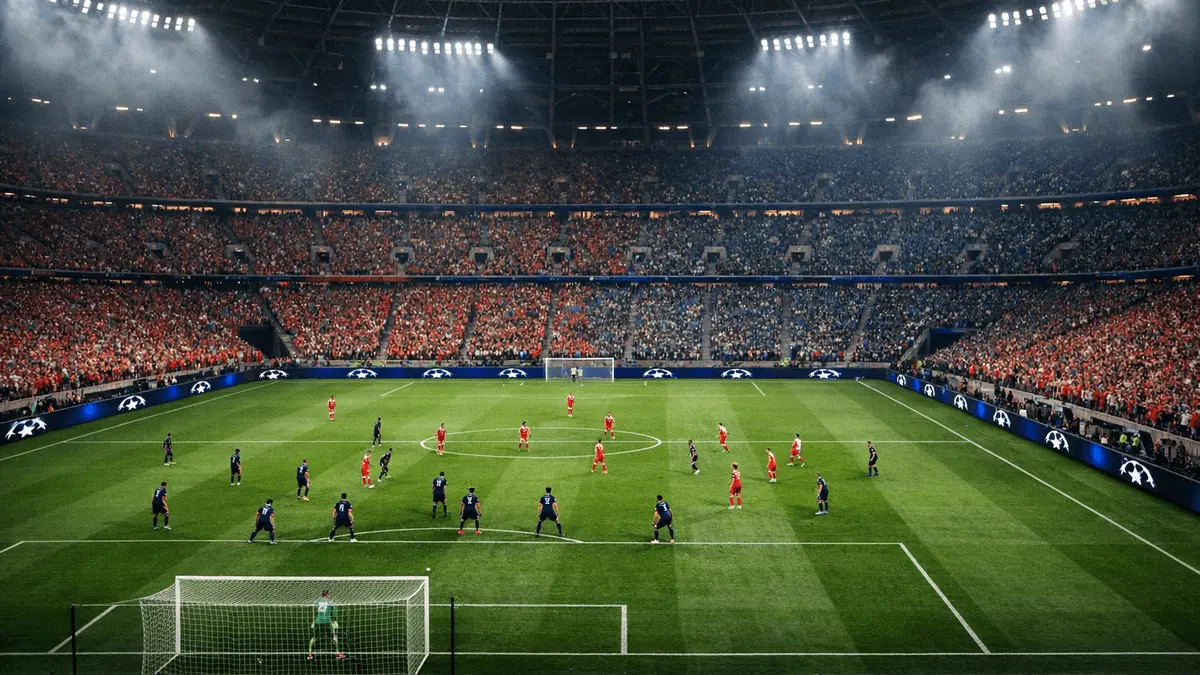
Paris Saint-Germain and Arsenal met at the Puskás Aréna in Budapest on 31 May 2026 for the Champions League final, a contest that pitched two of European football’s most structurally coherent sides against one another in the most consequential single game of the continental calendar – PSG defending the title they had claimed twelve months earlier and now pursuing back-to-back European Cups under Luis Enrique’s collective, positional-play model, Arsenal reaching their first European final since 2006 on the back of a Premier League-winning campaign built on elite defensive organisation, set-piece dominance, and a high-pressing identity refined to a level of structural consistency rarely seen outside the very summit of the club game. The final finished 1–1 after 120 minutes, with PSG prevailing 4–3 on penalties to become back-to-back Champions League winners, Kai Havertz’s sixth-minute header giving Arsenal an early lead before Ousmane Dembélé’s 65th-minute penalty restored parity. Structurally, the match was precisely the contest pre-match data models had projected: PSG’s possession-dominant, wide-overload attacking system pressed against the most defensively organised block in European football, with Arsenal’s set-piece threat and counter-pressing triggers providing the primary mechanisms through which Mikel Arteta’s side sought to disrupt PSG’s territorial control. In this tactical analysis, we will examine PSG’s kick-off pressing scheme and rest-defence architecture, their positional superiority in the wide channels, Arsenal’s structural difficulties in sustaining the low block under sustained positional pressure, the in-game evolution following Dembélé’s equaliser, and the structural conditions that shaped a penalty shootout ultimately decided by marginal technical details.
PSG vs Arsenal Lineups & Formations
Luis Enrique set PSG in their established 4-3-3, with Gianluigi Donnarumma in goal behind a back four of Achraf Hakimi (right back), Marquinhos (right centre-back), Willian Pacho (left centre-back), and Nuno Mendes (left back). The midfield three comprised Vitinha (pivot), João Neves (right interior), and Fabian Ruiz (left interior), with Ousmane Dembélé (right winger), Gonçalo Ramos (centre-forward), and Khvicha Kvaratskhelia (left winger) forming the attacking line.
Mikel Arteta responded with Arsenal’s familiar 4-3-3 defensive block, naming David Raya in goal, Ben White (right back), William Saliba (right centre-back), Gabriel Magalhães (left centre-back), and Kieran Tierney (left back) across the defensive line. Thomas Partey anchored the midfield pivot, flanked by Martin Ødegaard (right interior) and Declan Rice (left interior), with Bukayo Saka (right winger), Kai Havertz (centre-forward), and Leandro Trossard (left winger) ahead. The structural contrast was stark from the outset: PSG’s system was designed to generate positional superiority through wide rotations and interior arrivals, while Arsenal’s was explicitly configured to compress central space, absorb PSG’s possession phases, and exploit dead-ball situations and transition moments as their primary routes to goal.
PSG’s Kick-Off Press & Rest-Defence Architecture
PSG’s out-of-possession mechanism in this final operated from a coordinated kick-off pressing scheme that has become the structural signature of Luis Enrique’s European campaigns – a design in which the initial press is not conceived as a ball-winning action but as a territorial-conditioning tool that determines the starting position of the subsequent defensive organisation. The mechanism functioned as follows: PSG’s front three triggered the press immediately from kick-off, with Dembélé’s press angle angled to cover Arsenal’s right centre-back pass and invite the ball toward Tierney, concentrating the build-up into PSG’s right-side pressing corridor where Nuno Mendes and Fabian Ruiz could provide the second and third layers of the press.
What made the scheme structurally significant was its connection to PSG’s rest-defence architecture rather than its direct ball-recovery function. Vitinha’s positioning during press triggers was calibrated to maintain compactness between the lines, ensuring that even when Arsenal escaped the first press wave, PSG’s defensive block was already organised around a mid-block 4-1-4-1 shape rather than scrambling to recover from a fully committed press. This accepted a calculated risk – Arsenal’s direct passes into Havertz against Marquinhos and Pacho – in exchange for structural compactness that prevented the kind of progressive combinations through the lines that Arsenal had deployed so effectively in their knockout run, as demonstrated in Arsenal’s Champions League tactical encounters earlier in the tournament. The press recorded its primary structural dividend not in turnovers but in the progressive reduction of Arsenal’s build-up options across both halves of normal time.
PSG’s Positional Superiority & Wide Channel Dominance
The foundational principle of PSG’s in-possession system in this final was the deliberate avoidance of Arsenal’s most defensively organised zone – the central corridor between Partey and the two centre-backs – and the corresponding targeting of the wide channels where Hakimi and Nuno Mendes could generate two-versus-one situations against Arsenal’s wide midfielder-fullback pairings. The geometric logic was precise: Arsenal’s 4-3-3 defensive shape, when compacted into a low block, positioned the wingers (Saka and Trossard) in a dual defensive role that required them to track both PSG’s overlapping fullbacks and the interior runs of Neves and Fabian Ruiz. This created an irresolvable positional dilemma that PSG exploited with mechanical consistency throughout the first half and the early stages of extra time.
Hakimi’s partnership with Dembélé on PSG’s right side was the match’s most structurally productive pairing. Dembélé’s inverted movement off the right drew Tierney narrow, creating the overlap lane for Hakimi’s late runs, while simultaneously covering the half-space angle that prevented Partey from stepping out to challenge the overlapping run without abandoning his pivot responsibilities. The material consequence of this structural mechanism was territorial: PSG established 64% possession across the 120 minutes and generated their most dangerous attacking phases consistently through right-side combinations that forced Arsenal’s defensive block to shift its centre of gravity repeatedly.
Dembélé’s equalising penalty was the most direct structural output of this wide dominance – the foul that produced it arrived from a sequence in which Hakimi’s overlap had already drawn two Arsenal defenders toward the right channel, leaving Dembélé isolated against Gabriel on a sharp inside cut. The penalty was not an isolated incident but the culmination of a territorial mechanism PSG had been executing since the opening phase, as detailed in the complementary tactical examination of this final’s pressing and build-up structures.
Arsenal’s Structural Difficulties & The Limits Of The Low Block
Arsenal’s defensive structure entered the final as statistically the most accomplished block in the 2025/26 Champions League – nine clean sheets across the tournament, fewer goals conceded than any side in Europe’s top five leagues domestically – and Arteta’s 4-3-3 low block functioned as advertised for extended periods, denying PSG the central penetrations their positional system typically generates against less organised opponents. The structural ceiling, however, was inherent in the design itself: a block configured to eliminate central penetration will always concede territorial dominance in wide areas, and against a PSG side with the full-back quality of Hakimi and Mendes operating in combination with Dembélé and Kvaratskhelia’s inversions, that concession created recurring wide-overload situations that the block’s geometry could not resolve without compromising its central compactness.
The specific positional tension Arsenal could not solve was the relationship between Rice’s left interior positioning and Tierney’s fullback responsibilities on the left channel. When Kvaratskhelia inverted from the left, Tierney was required to hold his defensive line, creating a pocket of space in the left half-space that Fabian Ruiz repeatedly targeted with late arrivals. Rice’s cover responsibilities were split between tracking Ruiz’s runs and maintaining the block’s interior compactness – a two-option dilemma that, across 120 minutes of sustained PSG possession, generated enough uncertainty in Arsenal’s left-side coordination to produce the final’s most dangerous PSG phases in the second half of normal time.
In possession, Arsenal’s difficulties were equally structural. Their inability to build progressively under PSG’s kick-off press – the consequence of having constructed an identity primarily around defensive compactness, direct transition, and set-piece exploitation rather than positional build-up – meant that after Havertz’s early goal, Arsenal had no reliable mechanism to sustain territorial control and relieve pressure. The structural ceiling of the low block is precisely this: it demands elite defensive execution for extended periods, accepts limited possession phases, and creates pressure on set-piece moments to produce sufficient goal threats to convert a defensive plan into a winning one.
From Arsenal’s Early Lead To PSG’s Structural Response
Havertz’s sixth-minute goal arrived from exactly the structural mechanism Arsenal had designed their entire tournament around: a set-piece delivery from a deep left position, the near-post run pulling Marquinhos marginally away from his zone, and the secondary header arriving at the far post where Havertz generated the finish ahead of Pacho. The goal was the material output of Arsenal’s 25 set-piece goals across European and domestic competition – not a fortunate deflection but the precise execution of a designed dead-ball framework that Arteta’s staff had prepared for PSG’s zonal marking structure.
PSG’s structural response was to accelerate the wide-overload mechanisms that had always been their primary attacking instrument rather than adjust their shape reactively – a reflection of Luis Enrique’s consistent managerial logic, which treats in-game adjustments as intensity modifications rather than structural pivots. Enrique’s most significant personnel intervention came in the second half of extra time, introducing additional attacking width to stretch an Arsenal block that was visibly fatiguing under the sustained territorial demands, and it was this accumulated pressure – rather than a discrete tactical switch – that produced the structural conditions for Dembélé’s penalty.
The shootout itself carried its own structural dimension: Safonov’s replacement of Donnarumma for the penalties – a decision that reflected PSG’s specific preparation for this phase – proved consequential when he saved from Nuno Mendes on PSG’s side, though Eze’s opening miss and Gabriel Magalhães’ decisive kick over the bar meant Arsenal’s structural preparation for the shootout, whatever its detail, could not overcome the marginal execution failures that decided a contest otherwise managed with near-identical structural discipline by both sides across 120 minutes. The full structural examination of how these mechanisms connected across the entire match is available in the detailed phase-by-phase breakdown of PSG’s structural solutions against Arsenal’s defensive model.
Conclusion
PSG’s second consecutive Champions League title was achieved through structural design rather than individual brilliance, and the specific mechanisms that produced it deserve precise enumeration: the kick-off pressing scheme that conditioned Arsenal’s build-up from the first minute and established territorial dominance without requiring high-risk full-press commitment; the wide-overload system that paired Hakimi and Dembélé on the right channel to generate the geometric imbalances Arsenal’s block could not resolve without sacrificing central compactness; Vitinha’s rest-defence anchoring that maintained shape coherence during PSG’s attacking phases and prevented the transition moments Arsenal had identified as their primary route back into the game; and the accumulated territorial pressure across 120 minutes that produced the penalty foul and ultimately created the shootout conditions in which PSG’s superior conversion – four from five – proved decisive.
Arsenal’s structural achievement in this final deserves genuine analytical recognition rather than consolation: a side that conceded only 27 league goals and kept nine Champions League clean sheets reached a European final for the first time in twenty years, threatened a PSG side of genuine continental quality through a set-piece framework of the highest sophistication, and came within a single Gabriel Magalhães penalty of forcing European football’s most complete positional side to a fifth kick in a shootout they had better resources to win. The low block held. The set-piece system delivered. The structural ceiling was not the defensive model but the absence of a ball-retention mechanism capable of relieving the pressure that model inevitably accumulates across extended knockout football.
For PSG, the question now is whether back-to-back European titles permanently reframe their institutional identity and whether rival clubs – likely to study the wide-overload and kick-off pressing mechanisms with renewed urgency – can construct structurally detailed answers to a system that has now proven itself across two consecutive European campaigns at the highest level. For Arsenal, the structural task Arteta must address is unambiguous: their defensive compactness and set-piece dominance constitute a genuinely elite foundation, but converting structural coherence into a European title requires the development of a possession-retention mechanism under elite pressing pressure – the one phase of this final in which PSG’s superiority was not marginal but categorical.