
Arsenal’s unbeaten start to the Premier League title defence ended at the Amex Stadium, where Arsenal’s usually reliable control of possession counted for nothing against a Brighton side that pressed with total conviction. The champions had 59.9% of the ball and completed 425 passes, yet managed only two shots on target across ninety minutes. Brighton, by contrast, needed 258 passes, seventeen shots and three distinct methods of finishing to end Arsenal’s seven-game 100% record and move to within two points of top spot. What follows is an examination of the pressing mechanism that made that inversion possible, and why Arsenal’s territorial dominance became irrelevant the moment Fabian Hurzeler’s side committed to an aggressive, coordinated press against a team built to punish exactly that kind of risk.
Brighton’s High Press Against Arsenal’s Build-Up
The tone was set inside seven minutes, when Bruno Guimaraes – starting his first Premier League match – pressed with an intensity that signalled Brighton’s intent for the afternoon. From that point, Arsenal were denied the calm, patient build-up phases that have underpinned their control-based approach under Mikel Arteta.
Arsenal’s passing volume tells its own story of frustration rather than fluency. Completing 425 passes while generating only two shots on target is not a symptom of good possession football; it is evidence of a team being allowed the ball in areas that carried no threat, while being denied it in the ones that did. Brighton’s press did not need to win the ball high up the pitch on every occasion to be effective – it needed only to make Arsenal’s first and second lines of build-up uncomfortable enough that composed progression became sporadic rather than sustained.
That distinction matters in a match where Arsenal held the majority of the ball for the full ninety minutes. Territory and possession share are frequently treated as proxies for control, but Brighton’s pressing structure converted Arsenal’s numerical advantage in passes into a hollow statistic, stripping away the second and third-phase combinations that Arsenal rely on to work the ball into the final third with purpose.
Three Goals, Three Ways to Punish Arsenal
What separated this result from a standard pressing masterclass was the variety of Brighton’s punishment. Three goals arrived through three entirely different mechanisms, each exposing a different structural weakness rather than repeating the same pattern of exploitation.
The first, on 31 minutes, came from individual quality allowed to flourish through defensive passivity. Gabriel and Riccardo Calafiori gave Pascal Gross too much time and space on the edge of the box, and the German curled a 20-yard strike past David Raya at his near post. It was not a pressing trap sprung in a defined zone – it was simply space Brighton’s own risk-taking in midfield had created, and space Arsenal’s back line failed to close.
The second goal, scored by teenager Charalampos Kostoulas on the stroke of half-time, followed an almost identical pattern of defensive hesitancy. Declan Rice and Gabriel backed off rather than engaging, and Kostoulas was afforded space to beat Raya with a 25-yard strike. Two goals from outside the box in a single half is rarely coincidental; it reflects a back line that had been pulled out of its usual defensive rhythm by ninety minutes of being chased, harried and denied comfortable possession in deeper areas, leaving individual defenders reacting rather than dictating.
The third goal flipped the script entirely. Gross swung in a corner – a delivery Brighton had rehearsed and repeated throughout the first half – and Chema Andrés rose above Arsenal’s marking to head home. Set-piece efficiency is usually associated with Arsenal’s own attacking identity; here it was turned against them, closing out a period of second-half pressure with the kind of route-one ruthlessness Arteta’s side is normally credited with dispensing.
Arsenal’s Possession Without Penetration
The underlying numbers explain why Arsenal’s control never translated into meaningful chance creation. Brighton had seventeen shots to Arsenal’s eleven, five on target to Arsenal’s two, and struck the woodwork once for good measure. Arsenal’s individual shot totals underline the lack of individual spark to compensate for the structural failure: Bukayo Saka and Kai Havertz managed two shots apiece, Martin Odegaard one, and substitute Viktor Gyokeres, introduced with seventeen minutes remaining, did not register a single attempt.
Saka’s activity down the flank, an area Arsenal’s right-sided attacking structure is normally built to exploit through overlaps and combination play, produced nothing of note – a further indication that Brighton’s press disrupted not just central build-up but the wide progression Arsenal typically use to stretch settled defensive blocks.

The expected goals data captures the same imbalance in a different register. Arsenal’s 1.63 xG marginally exceeded Brighton’s 1.31, which on paper suggests a competitive chance-creation battle. But on expected goals on target – a metric that weighs shot quality by placement rather than just location – Brighton doubled Arsenal’s output, 2.04 to 1.08. Arsenal generated positions to shoot from; Brighton generated positions to score from. That gap between raw chance volume and shot quality is precisely what a well-executed high press is designed to produce: it forces the team in possession into lower-value actions while conserving its own moments for high-conviction strikes.
In-Game Adjustments
Arteta had no rotation excuse to lean on. He rested players in midweek and selected his strongest available side at the Amex, only to watch that XI finish second in every phase of the game. Four substitutions followed by the 81st minute – Martin Zubimendi and Mikel Merino introduced around the hour mark, Viktor Gyokeres and Eberechi Eze after that, and Ethan Nwaneri’s replacement Ryan Dowman for Saka late on – did nothing to alter the pattern established in the opening half-hour.
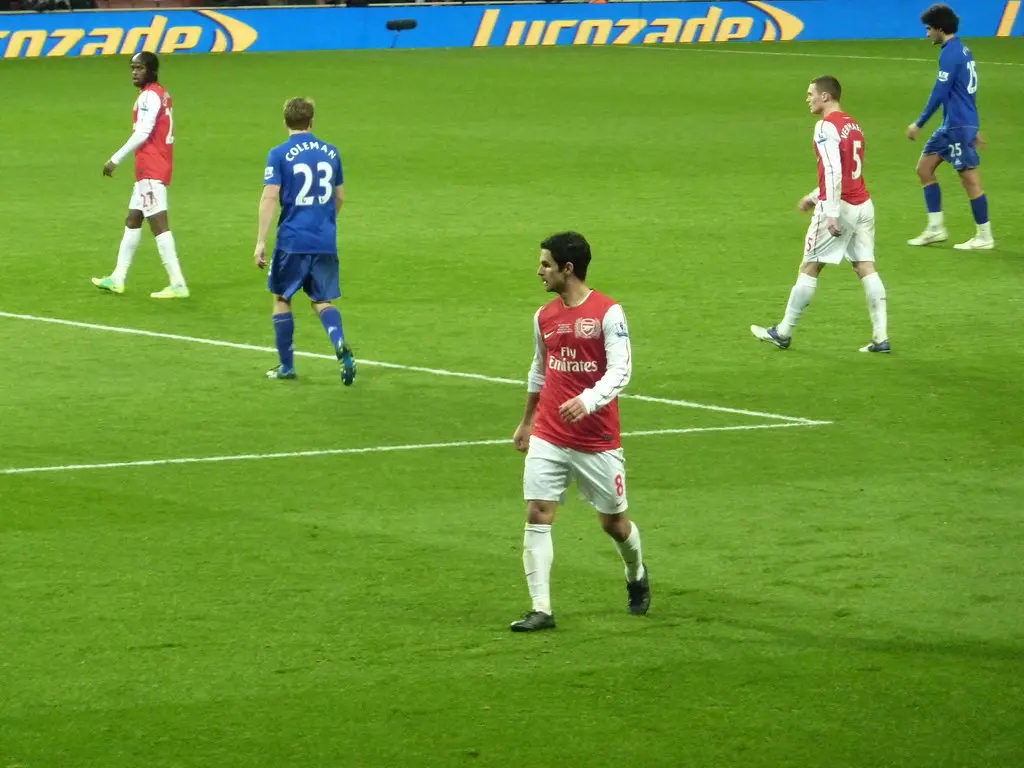
That the changes produced no discernible shift in territory, shot quality or defensive stability suggests the problem was structural rather than personnel-based. Swapping individual players inside a system that has already been pressed into disorder rarely restores control; Brighton’s approach had already dictated the terms of engagement long before Arteta reached for his bench.
Statistical Context
Taken together, the numbers describe a match won on efficiency rather than territory. Arsenal’s 59.9% possession and 425-to-258 passing advantage sit alongside a shot count of 11 to 17 in Brighton’s favour, and a shots-on-target reading of two to five. The expected-goals-on-target split – 1.08 for Arsenal against 2.04 for Brighton – is the clearest single indicator that Brighton’s press did not just limit Arsenal’s volume of attacking actions, it degraded the quality of the ones that got through, while Brighton’s own transitional and set-piece opportunities carried significantly higher conversion probability.
Conclusion
Brighton’s win ended a seven-match winning start and, with it, any chance of Arsenal matching the club’s 123-year record of eight straight victories to open a season. It was also Arsenal’s heaviest Premier League defeat in over three years – a scoreline built not on one repeated tactical trick but on a press that made Arsenal’s build-up uncomfortable for ninety minutes, three attacking routes that punished three separate defensive lapses, and a back line disciplined enough to win the long-ball battles that press invited. Brighton now sit two points off top spot having scored more goals than any side in the division, and Arsenal head into the international break needing to solve a problem that possession statistics alone will not fix.
