Total Football Analysis
  • Football Analysis
    • Data Analysis
    • Formations
      • 2-2-4 Formation
      • 2-3-5 Formation
      • 3-1-4-2 Formation
      • 3-2-2-3 Formation
      • 3-2-4-1 Formation
      • 3-1-6 Formation
      • 3-3-4 Formation
      • 3-4-1-2 Formation
      • 3-4-2-1 Formation
      • 3-4-3 Formation
      • 3-5-1-1 Formation
      • 3-5-2 Formation
      • 4-1-4-1 Formation
      • 4-2-2-2 Formation
      • 4-2-3-1 Formation
      • 4-2-4 Formation
      • 4-3-1-2 Formation
      • 4-3-3 Formation
      • 4-4-2 Formation
      • 4-5-1 Formation
      • 5-3-2 Formation
      • 5-4-1 Formation
      • 6-3-1 Formation
    • Head Coach Analysis
    • Match Analysis
    • Player Analysis
    • Recruitment Analysis
    • Set Piece Analysis
    • Tactical Theory
    • Tactical Preview
    • Team Analysis
    • Training Analysis
    • Tactical Analysis
    • Scouting Report
  • FIFA World Cup 2026
    • World Cup Betting Sites
    • World Cup Betting Promotions
    • World Cup Free Bets
    • World Cup Golden Glove Odds
    • World Cup Top Scorer Odds
    • World Cup Player of the Tournament Odds
  • Competitions
    • English Premier League
    • Champions League
    • La Liga
    • Bundesliga
    • Serie A
    • Ligue 1
    • Eredivisie
    • EFL Championship
    • Women’s Super League
    • NWSL
    • Belgian First Division A
    • A-League
    • Liga Profesional de Argentina
    • Austrian Bundesliga
    • Campeonato Brasileiro Série A
    • DFB Pokal
    • 1. HNL
    • Danish Superliga
    • EFL League One
    • EFL League Two
    • FA Cup
    • EFL Cup
    • Indian Super League
    • K-League
    • J1 League
    • Liga MX
    • Copa del Rey
    • MLS
    • Eliteserien
    • Allsvenskan
    • Primeira Liga
    • Scottish Premiership
    • Europa League
    • UEFA Nations League
    • Liga AUF Uruguaya
  • Coaches
    • All Coaches
    • Alfred Schreuder
    • Ange Postecoglou
    • Antonio Conte
    • Arne Slot
    • Bo Svensson
    • Brendan Rodgers
    • Bruno Lage
    • Carlo Ancelotti
    • Christophe Galtier
    • Claude Puel
    • Claudio Ranieri
    • David Moyes
    • Dean Smith
    • Diego Simeone
    • Domenico Tedesco
    • Frank Lampard
    • Eddie Howe
    • Edin Terzić
    • Emma Hayes
    • Erik ten Hag
    • Ernesto Valverde
    • Gennaro Gattuso
    • Gerardo Seoane
    • Gian Piero Gasperini
    • Giovanni van Bronckhorst
    • Graham Potter
    • Igor Tudor
    • Imanol Alguacil
    • Jesse Marsch
    • Jonas Eidevall
    • Jorge Sampaoli
    • José Bordalás
    • José Mourinho
    • Julien Stéphan
    • Julen Lopetegui
    • Julian Nagelsmann
    • Jürgen Klopp
    • Luciano Spalletti
    • Lucien Favre
    • Manuel Pellegrini
    • Marcelo Bielsa
    • Marco Rose
    • Marco Silva
    • Massimiliano Allegri
    • Mauricio Pochettino
    • Maurizio Sarri
    • Mikel Arteta
    • Niko Kovač
    • Nuno Espírito Santo
    • Oliver Glasner
    • Patrick Vieira
    • Paulo Fonseca
    • Pep Guardiola
    • Peter Bosz
    • Rafa Benítez
    • Ralf Rangnick
    • Ralph Hasenhüttl
    • Roger Schmidt
    • Roy Hodgson
    • Sean Dyche
    • Sérgio Conceição
    • Simone Inzaghi
    • Sonia Bompastor
    • Stefano Pioli
    • Steffen Baumgart
    • Steven Gerrard
    • Thiago Motta
    • Thomas Frank
    • Thomas Tuchel
    • Unai Emery
    • Vincenzo Italiano
    • Xavi
  • Teams
    • ALL Teams
    • AC Milan
    • Ajax Amsterdam
    • Arsenal
    • AS Monaco FC
    • Atalanta
    • Atlético Madrid
    • FC Barcelona
    • FC Bayern Munich
    • Borussia Dortmund
    • Celtic FC
    • Chelsea FC
    • Everton F.C.
    • Inter Milan
    • Juventus F.C.
    • Leeds United F.C.
    • Liverpool FC
    • Manchester City
    • Manchester United FC
    • Paris Saint-Germain
    • Rangers FC
    • RB Leipzig
    • Real Madrid CF
    • Tottenham Hotspur
    • West Ham United
  • Players
    • ALL Players
    • Alisson Becker
    • Bukayo Saka
    • Erling Haaland
    • Harry Kane
    • Jack Grealish
    • John Stones
    • Kevin De Bruyne
    • Julián Alvarez
    • Kalvin Phillips
    • Kyle Walker
    • Kylian Mbappé
    • Luis Díaz
    • Lamine Yamal
    • Mohamed Salah
    • Lionel Messi
    • Virgil Van Dijk
    • Phil Foden
  • Guides
    • Betting Sites
      • Betting Apps
      • Betting Bonuses
      • Betting Exchanges
      • Betting Sites Not on GamStop
      • Cash Out Betting Sites
      • Crypto Betting Sites
      • European Bookmakers
      • Footbal Betting Sites
      • Free Bets
      • New Betting Sites
      • No KYC Betting Sites
      • Live Betting Sites
    • Online Casinos
      • Casino Apps
      • Credit Card Casinos
      • Crypto Casinos
      • Fast Payout Casinos
      • Non GamStop Casinos
      • Offshore Casinos
      • Slots Casinos
      • Irish Online Casinos
    • International
      • Betting Sites Ireland
  • Contact
No Result
View All Result
No Result
View All Result
Total Football Analysis
No Result
View All Result
Home Analysis

The Set-Piece Strategies That Undermined Liverpool In 2023/24

Karim El-Shesheiny by Karim El-Shesheiny
June 4, 2024
in Analysis, Jürgen Klopp, Liverpool FC, Premier League, Set Piece Analysis, Trent Alexander-Arnold, Virgil Van Dijk
0
decoding-liverpool-gaps-at-defending-corners-set-piece-analysis-tactics

Liverpool concluded their season in third place in the Premier League, amassing 82 points.

They trailed Arsenal in second place by seven points and Manchester City in first place by nine points.

Liverpool remained a strong contender for the title until the final stages, marking a significant improvement from their previous season, when they finished fifth with 67 points.

Offensively, Liverpool showed a marked improvement, scoring 86 goals this season compared to 75 goals in the previous season, an increase of 11 goals.

Defensively, they also exhibited slight progress, conceding 41 goals this season, down from 47 in the previous season.

However, there is an aspect of Liverpool’s current season that has worsened and is considered significant, and who knows — perhaps even one key reason Liverpool did not win the league despite their overall improvements — which is the goals conceded from corner kicks.

This season, they conceded seven goals from corners, whereas in the previous season, they did not concede any goals from corners, in case of considering Brentford’s goal as an own goal.

In this tactical analysis, we will discuss the general structure of Liverpool’s defence against corner kicks and then explain how some opponents have found tactics to counter this structure in the current season after struggling significantly in the previous season.

Liverpool defending system

Now, sit back, relax and start with Liverpool’s main defending system, which generally didn’t change.

As shown below, they use a hybrid defending system with six zonal defenders, two man markers with different rules than usual, and a short-option defender who starts more inside the box, closing the direct grounded pass toward the penalty spot in case there is no short-option attackers near the taker and a player standing on the edge of the box for the rebound and maybe counterattacks.
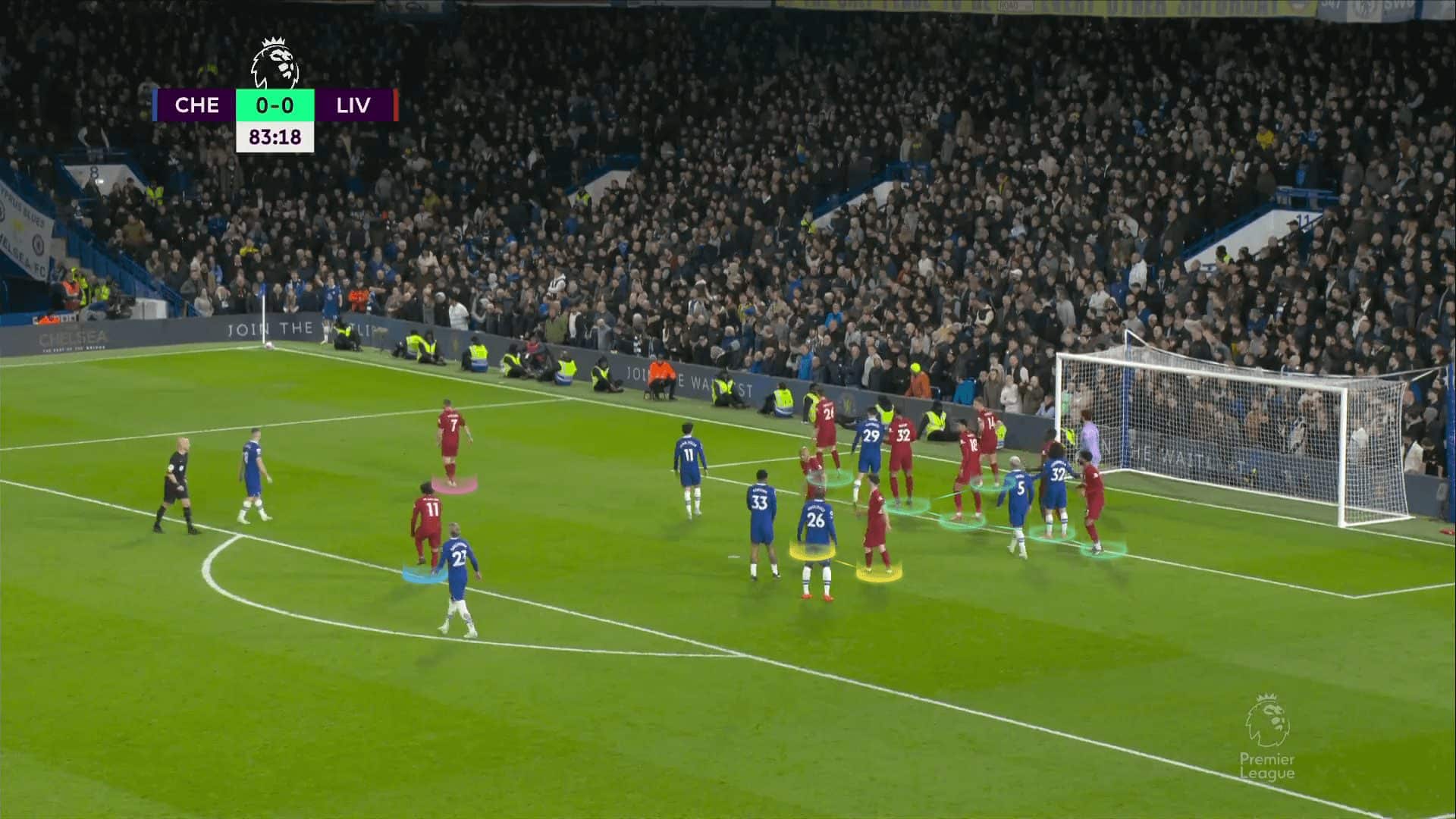
decoding-liverpool-gaps-at-defending-corners-set-piece-analysis-tactics

The same system is implemented in the case of out-swing crosses, but the zonal line stands more inclined to the outside because of the expected cross path, as shown below.

decoding-liverpool-gaps-at-defending-corners-set-piece-analysis-tactics

Coming to details, let’s start with the role of the first zonal defender, usually Andrew Robertson.

His role is to anticipate the cross while scanning around him, as in the photo below, to chase the ball getting the first touch, so you can see him standing in front of the rest five zonal defenders, always checking his shoulders to defend the area in front of the to get the first touch which could be a direct headed shot or a flick.
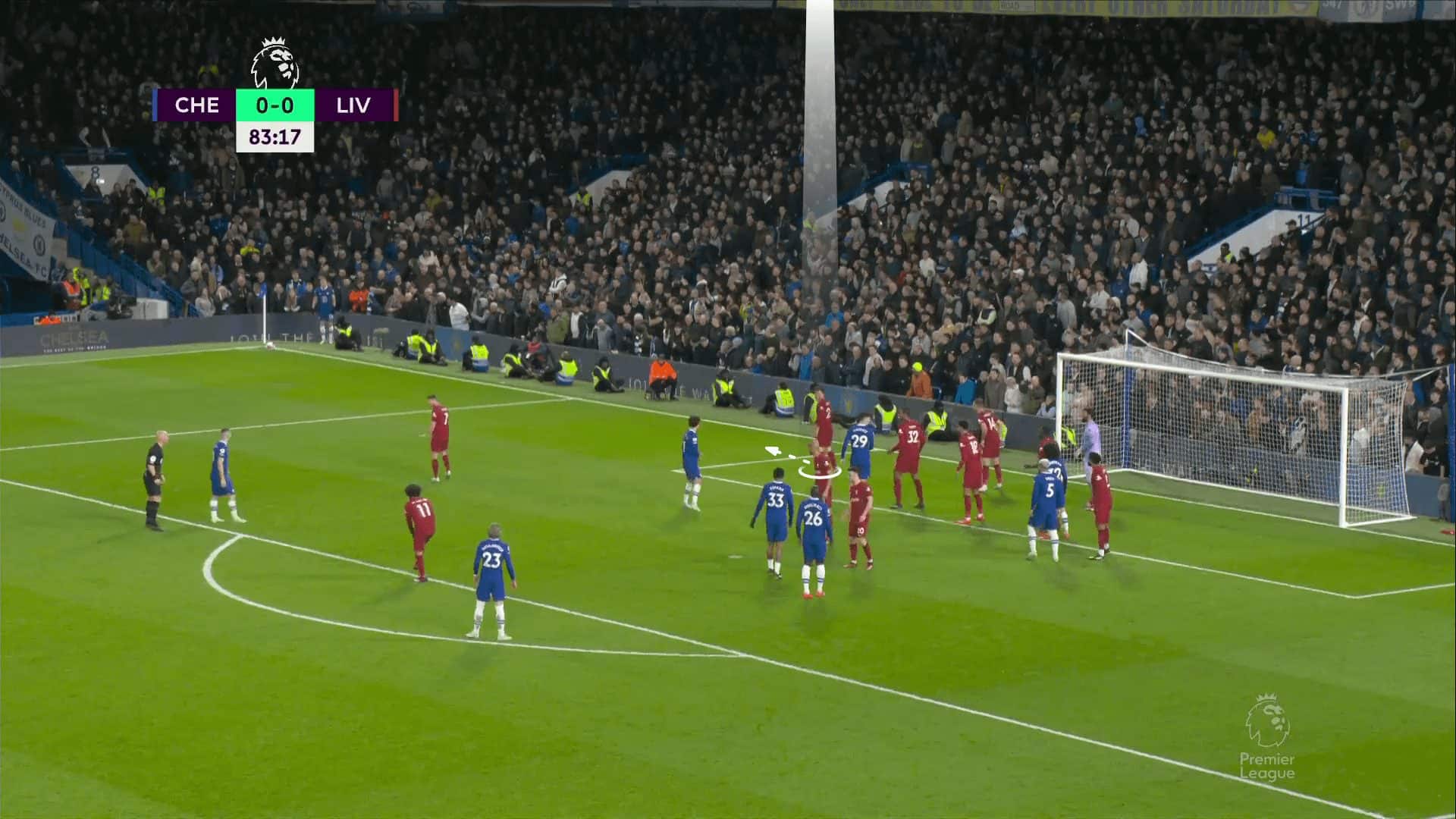
decoding-liverpool-gaps-at-defending-corners-set-piece-analysis-tactics

As shown below, he perfectly got the first touch with a good jump, scanning around him and, of course, measuring the point at which he could get the ball.

That is an important heading ability that fans may not know.
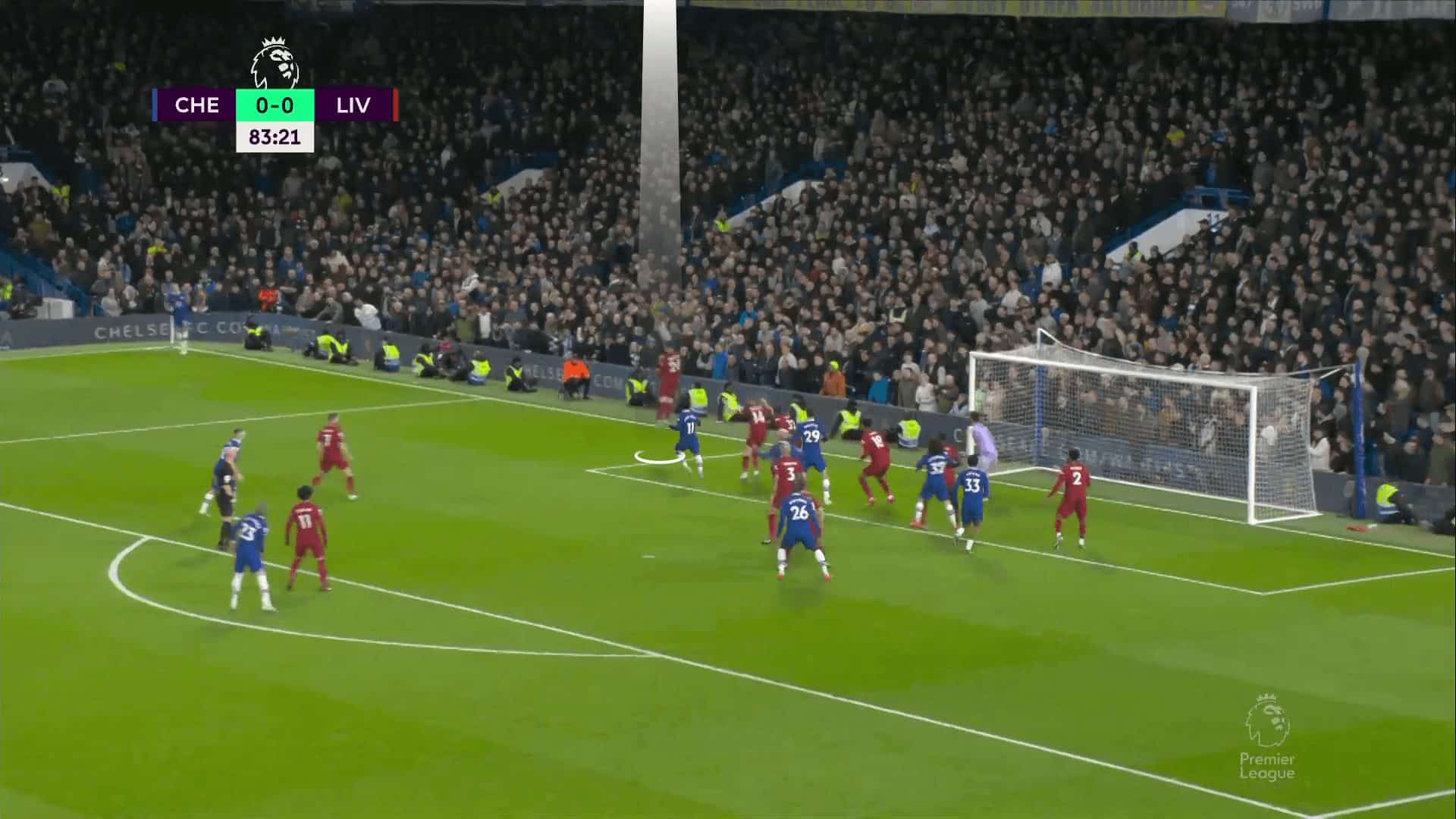
decoding-liverpool-gaps-at-defending-corners-set-piece-analysis-tactics

The strength of Liverpool is that they can anticipate any possible gap in their gaps, finding solutions for them before their opponents do, so you can find them having an answer to many difficult questions.

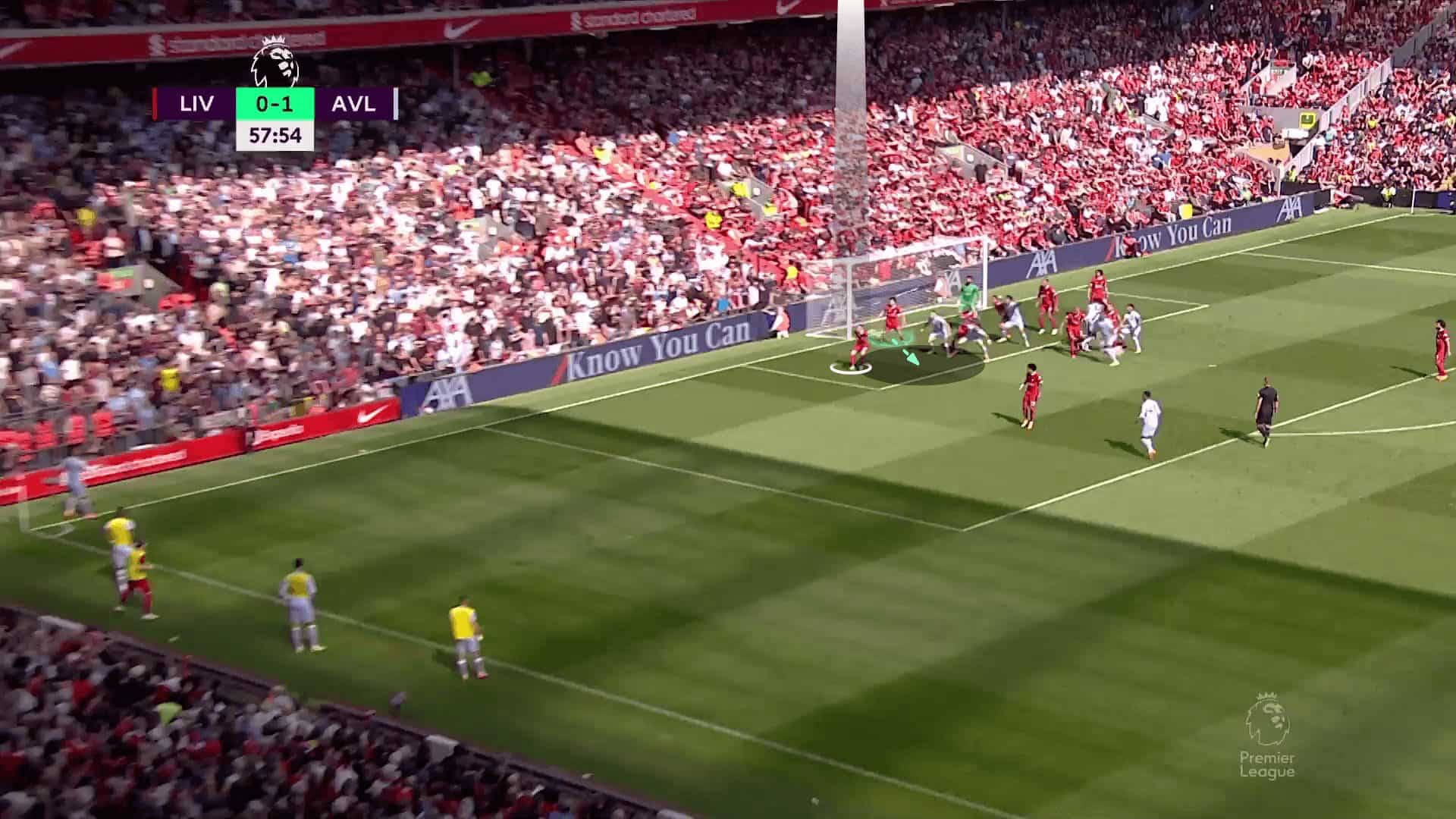
The first one is who will cover behind the first zonal defender when he goes forward to chase the first touch, filling the gap between him and the remaining five zonal defenders? That one is the zonal defender who stands initially on the near post.

He will start as usual to defend the direct shot or cross towards this dangerous area on the near post, but after that, he will cover behind the first zonal defender when he sees the ball path.
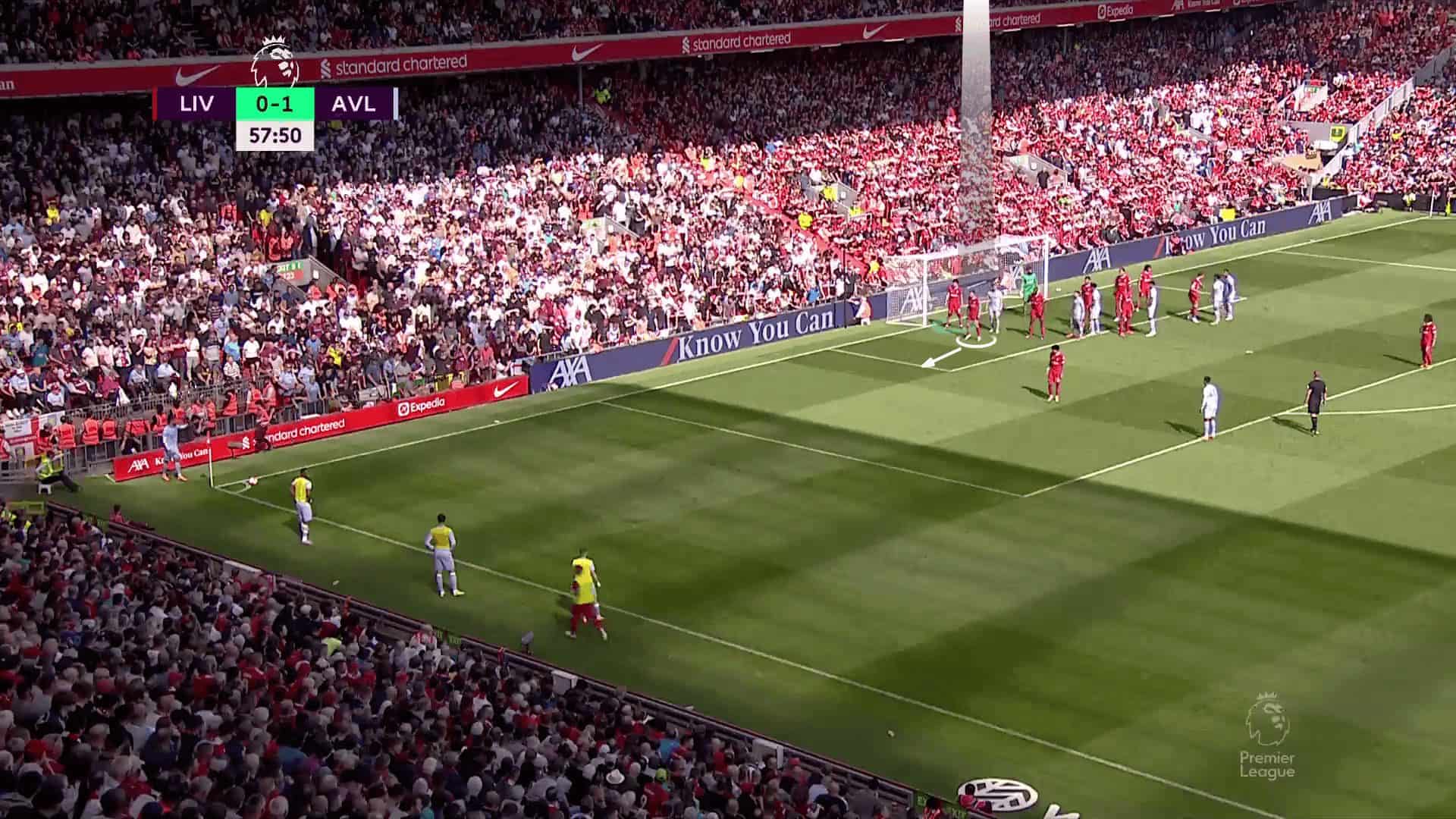
decoding-liverpool-gaps-at-defending-corners-set-piece-analysis-tactics

Below, you can see Aston Villa intending to target this area by a player blocking the zonal defender and the other to get the ball, but Liverpool don’t give him this chance, as shown in the second photo below, in which you can find the six-player zonal line is organised with no gaps.
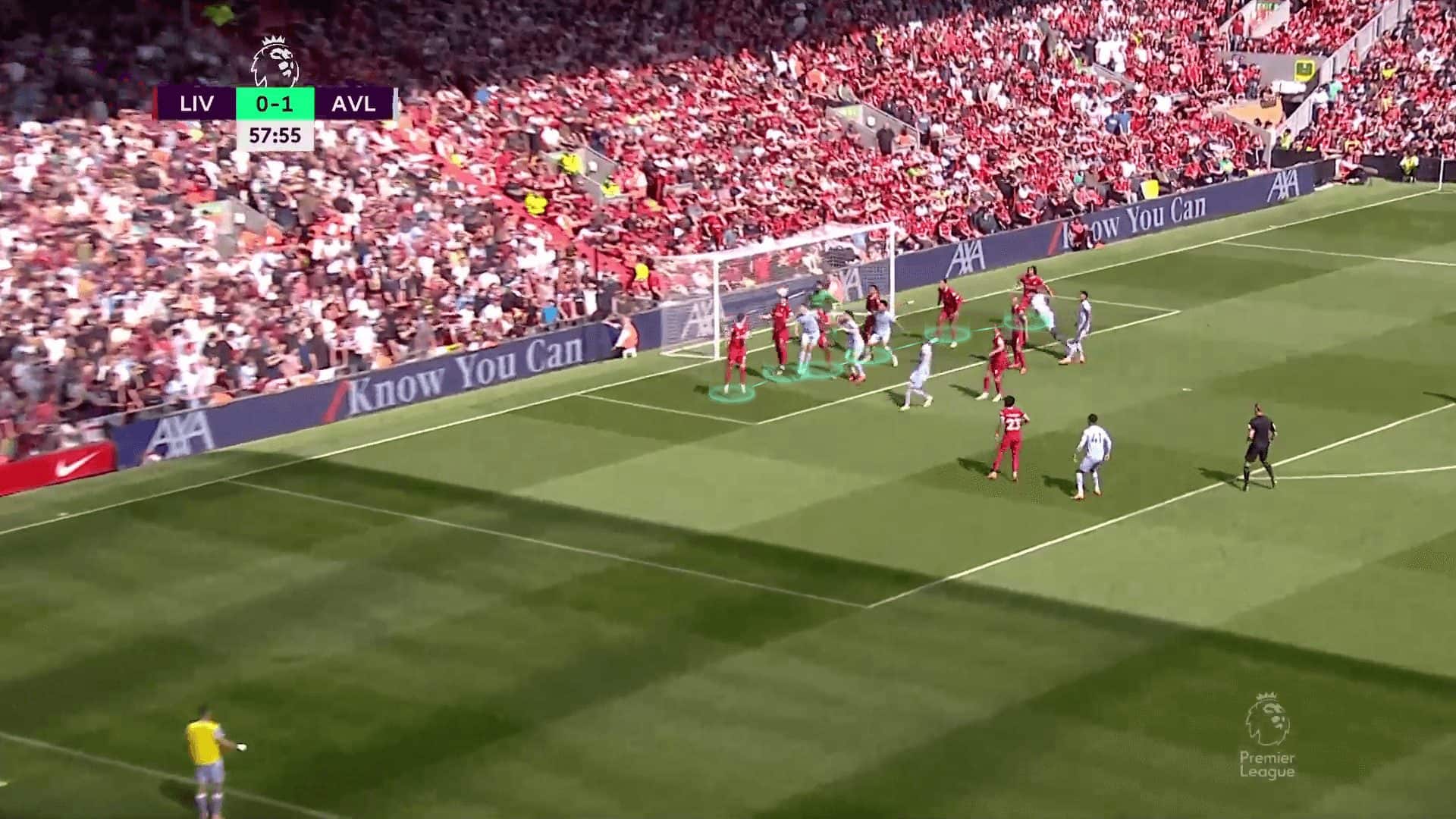
decoding-liverpool-gaps-at-defending-corners-set-piece-analysis-tactics


decoding-liverpool-gaps-at-defending-corners-set-piece-analysis-tactics

Going to the individual abilities, Liverpool exploit their best towers at aerial duels as zonal defenders around the six-yard line, so you can imagine how tough for opponents to target these areas, but when you find that Trent Alexander-Arnold is the sixth, last, zonal defender, you may predict that it is an easy area to target.

However, remember what we have just mentioned about Liverpool’s prediction of their possible gaps, so Liverpool put Virgil van Dijk as the fifth zonal defender with an intention of trying to chase the ball before getting to Arnold with his incredible power and anticipating the cross trajectory, as shown in the first three photos below.

Having the super Alisson Becker, they have an additional safety factor to go to claim the ball before reaching the far post, as shown in the fourth photo below.
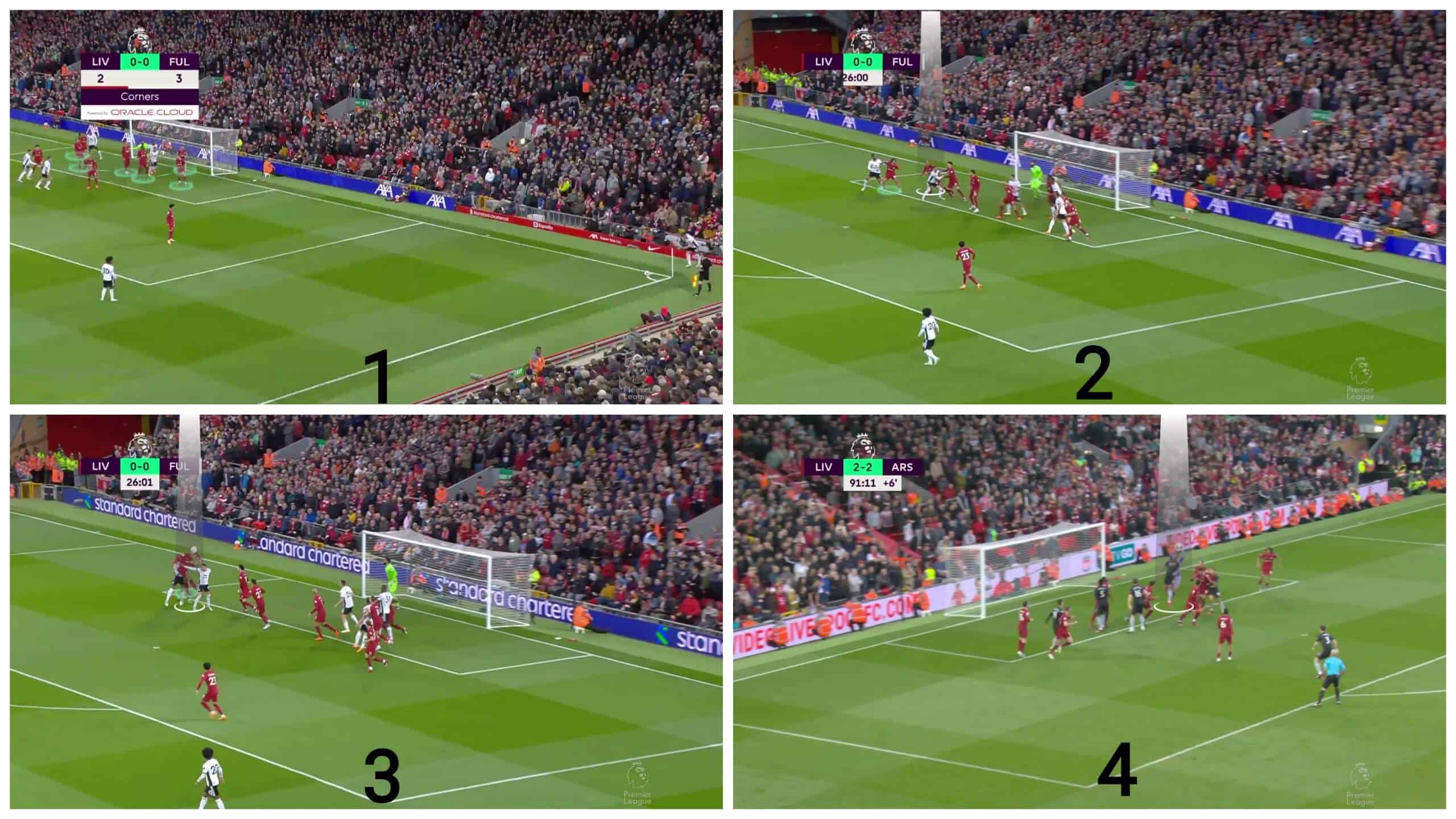
decoding-liverpool-gaps-at-defending-corners-set-piece-analysis-tactics

Going to another strength, their two man markers usually have a different role than the usual man markers, so you can find the man markers below waiting in front of the zonal defenders, having a clear role to prevent the possible dynamic mismatch from the best two runners who start in front of them to prevent them from reaching the zonal line running with all of their momentum.

With no caring, they let any attacker start behind them to the zonal line because the attackers then don’t have time and space to run before jumping, so they become in an equivalent situation in which they trust their amazing zonal defenders.

To be more specific, in the first photo below, a man marker marks an attacker, but he lets him when he moves towards the zonal line, as shown in the second photo, in which he starts to look for a new runner to mark, as he has done in the third photo.

The two man markers don’t have to be good at aerial duels because all of their roles is to annoy coming runners to reach the zonal line without dynamic mismatch, and that’s why you can find the man markers don’t follow the attackers very deep many times, as shown in the fourth photo in which a man marker let the attacker when he gets the zonal line.

This general way changes against some teams with some important players that should be marked from the beginning.

Other times, they prefer to wait for runners who run to specific areas depending on the opponent’s usual targeted area.
decoding-liverpool-gaps-at-defending-corners-set-piece-analysis-tactics

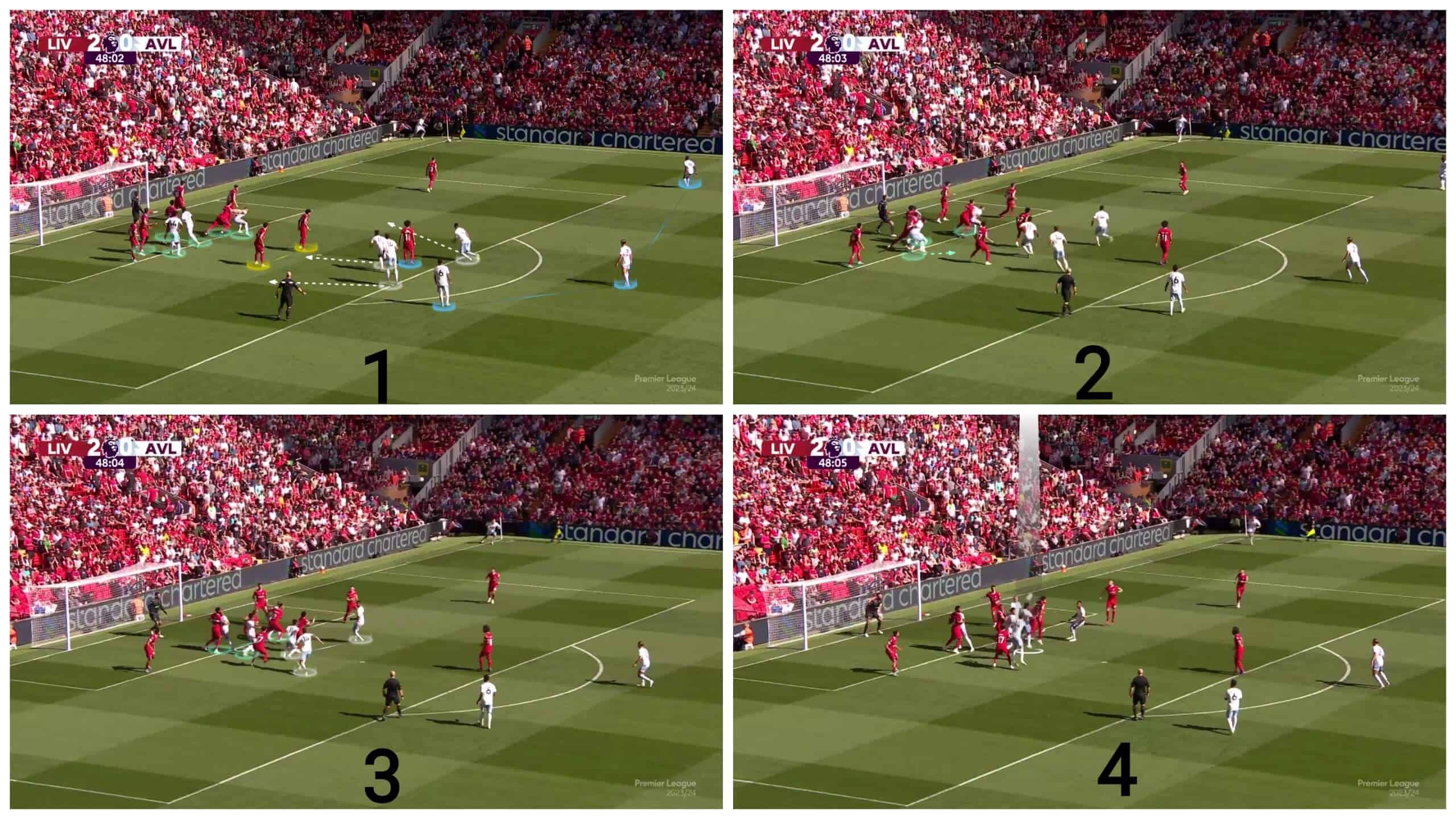
After all of that, you can imagine how tough you can attack them centrally even if you attack with three late runners dragging the man markers more steps forward with a free predicted attacker due to the 3-v-2 situation, as Aston Villa try in the first photo below with three players in the short and rebound area to make sure that the rebound defender won’t mark or annoy one of the three runners.

They try to block the three central zonal defenders in green to make the space empty for the free-coming one in the middle, but it is so difficult to keep blocking all of these three giant defenders all that time, as shown in the second and third photos.

In the end, the free attacker can’t control the ball well with the jam around him.

We should mention another failure reason: to be the free player, you should be the third-best runner at aerial duels to be unmarked.

At the same time, also we should mention that the two man markers adjust their focus due to match events and preferred targeted area by the opponent.
decoding-liverpool-gaps-at-defending-corners-set-piece-analysis-tactics

Blocking the zonal defender on the near post

In the previous season, Brentford found a good way to score a goal after some touches, and it was an inspiring idea despite the goal being considered an own goal.

In the two photos below, without going into many details, the key idea was to use two attackers.

One would move forward, dragging the first zonal line, while the other would block the zonal defender on the near post, preventing him from covering the area we talked about above.

Thus, the area would become empty and ready to be targeted using many different tactics.
decoding-liverpool-gaps-at-defending-corners-set-piece-analysis-tactics


decoding-liverpool-gaps-at-defending-corners-set-piece-analysis-tactics

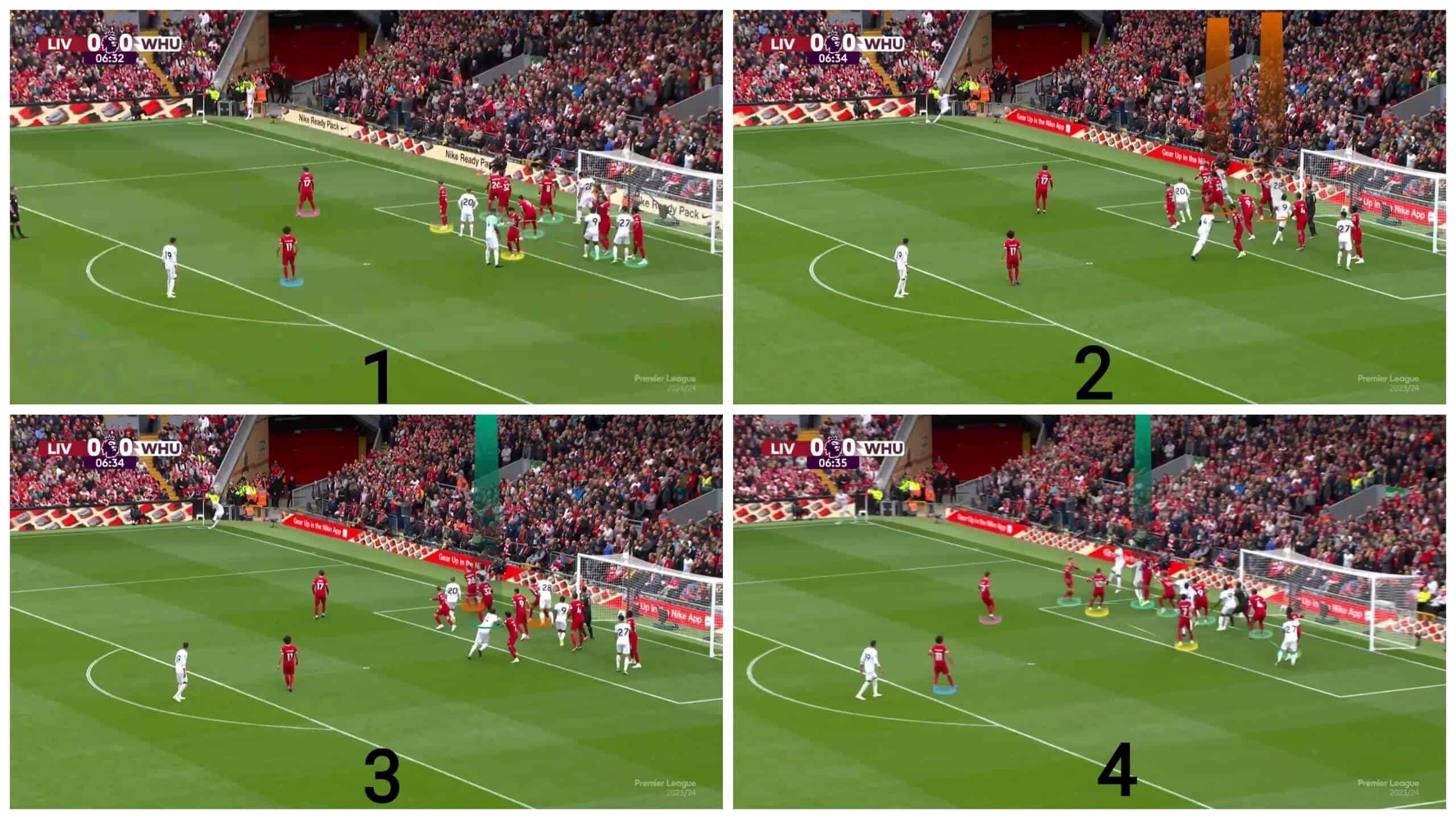
In this season, Liverpool tried to find a solution: shifting the line towards the near-post against teams who target the near post with many players, as shown in the first photo below.

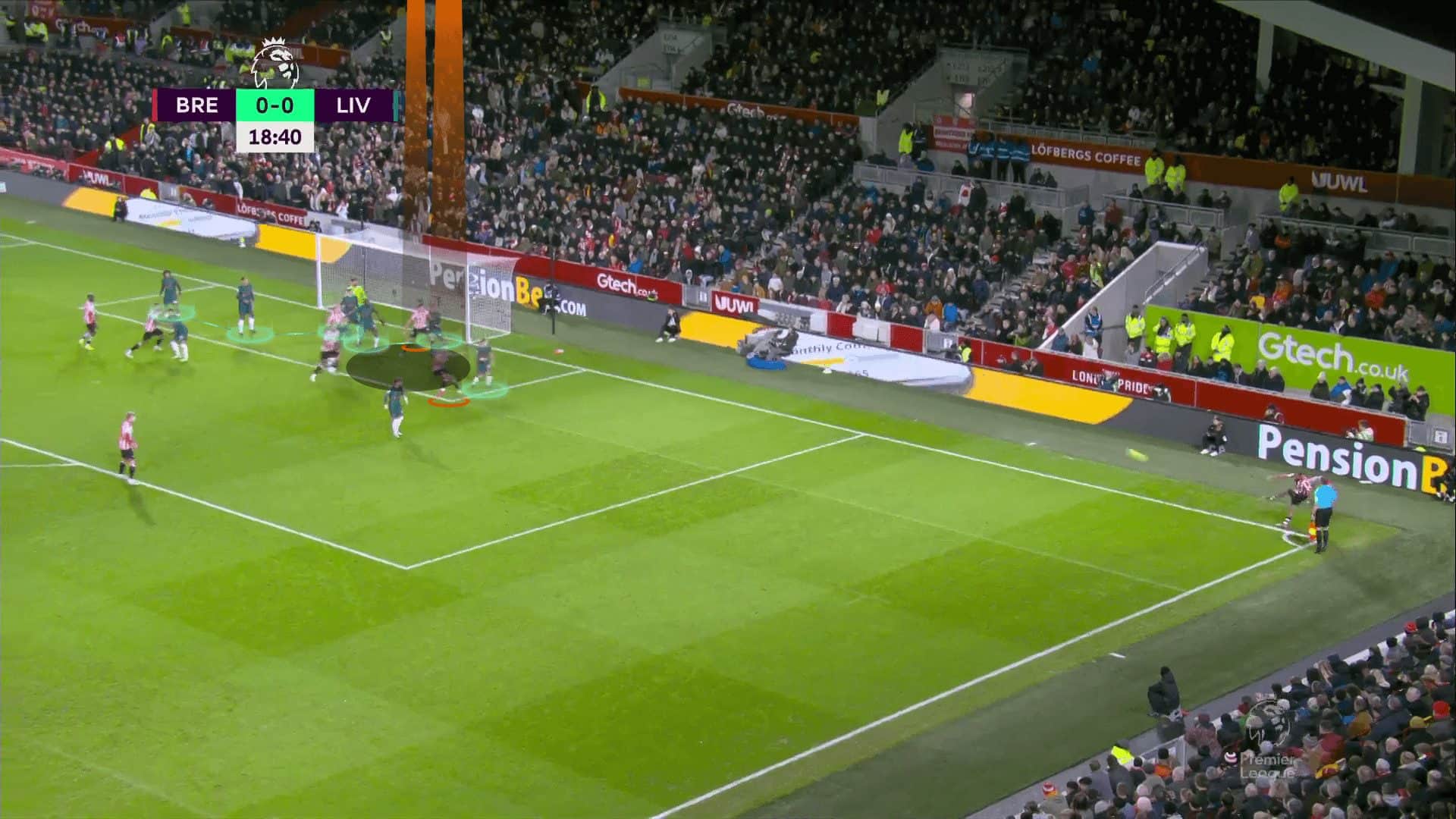
In the second photo, West Ham use two attackers to do the two jobs we have mentioned, but this shift makes the green zonal defender manage to make this sift and cover this area, as shown in the third and fourth photos.
decoding-liverpool-gaps-at-defending-corners-set-piece-analysis-tactics

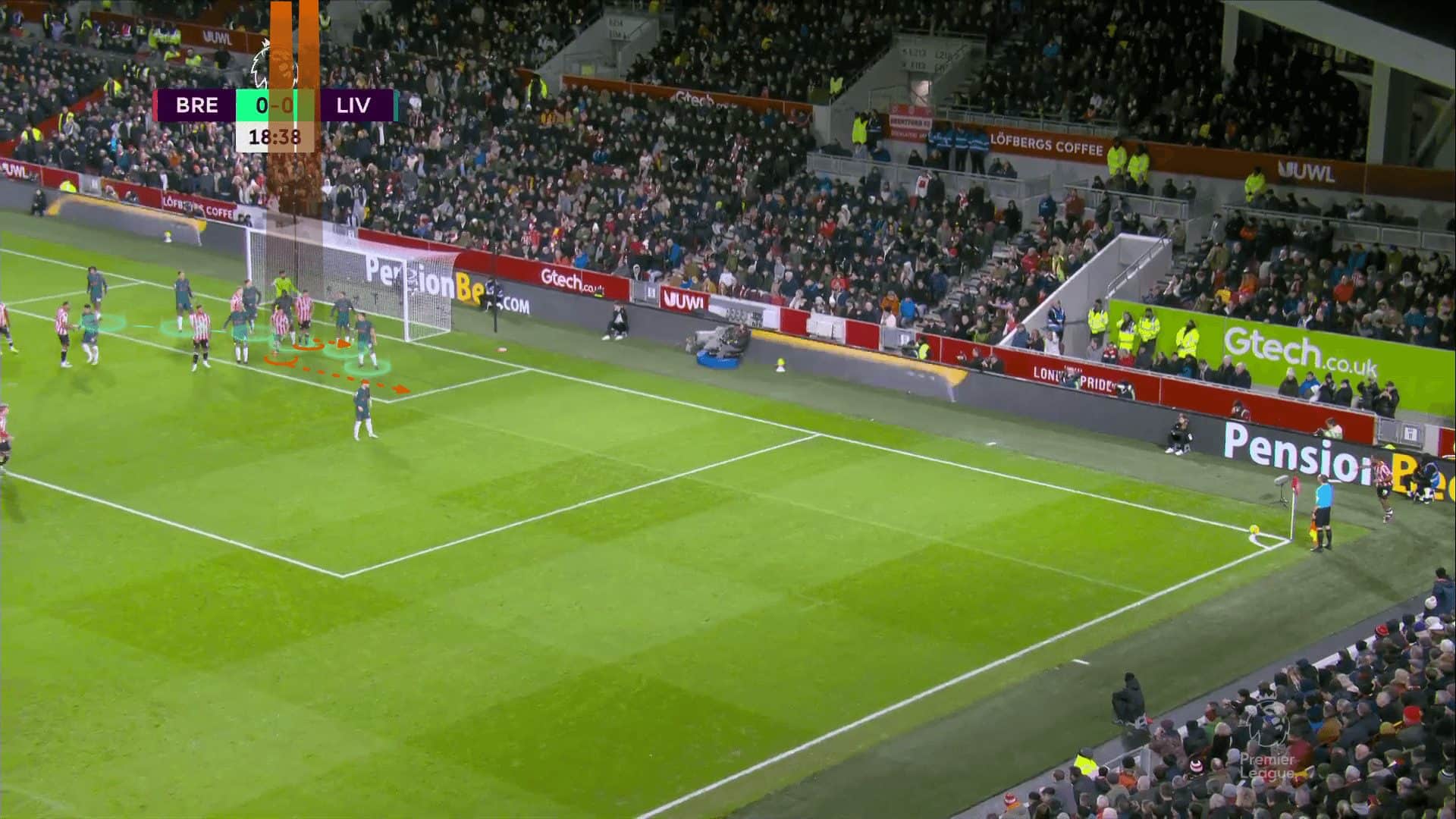
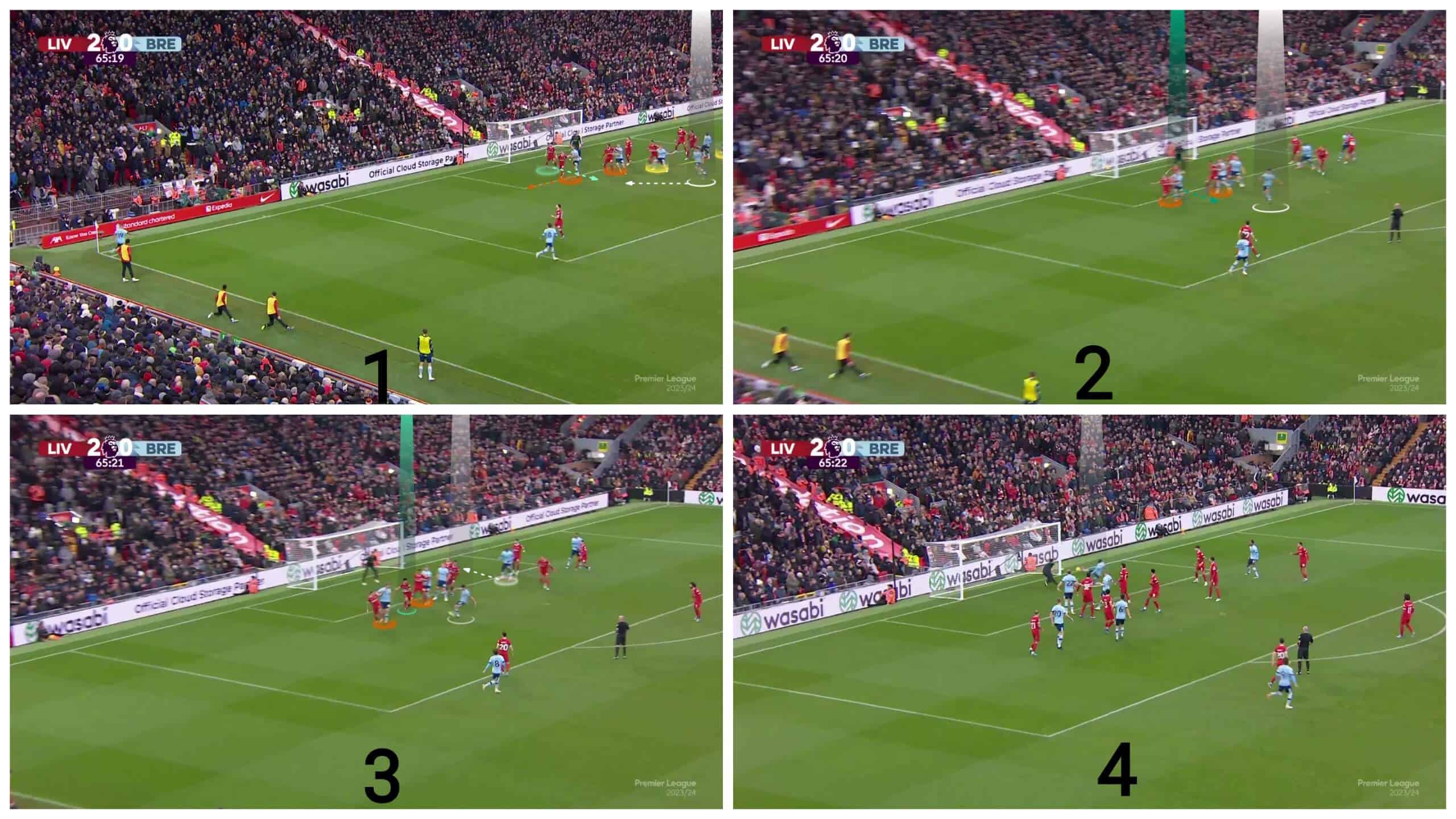
After that, Brentford met Liverpool this season, and they had a clever variation, which is leaving the zonal defender free, but they targeted a further area by an out-swing cross, which makes the distance further for him to go to cover.

In the first photo below, the two orange usual attackers are clear, but this time, one is to drag the first zonal defender and block them if he decides to go out to chase the ball while the other blocks the zonal defender behind him.

Regarding the white targeted player, he starts later until the yellow two man markers are assigned to the first two runners.

In the second photo, the targeted player gets closer the targeted area while the green post defender is still running.

The cross isn’t optimum, so the targeted player has nbo problem to use his feet while the second targeted player waits on the far post, but the ball passed him strangely, as shown in the third and fourth photos.
decoding-liverpool-gaps-at-defending-corners-set-piece-analysis-tactics

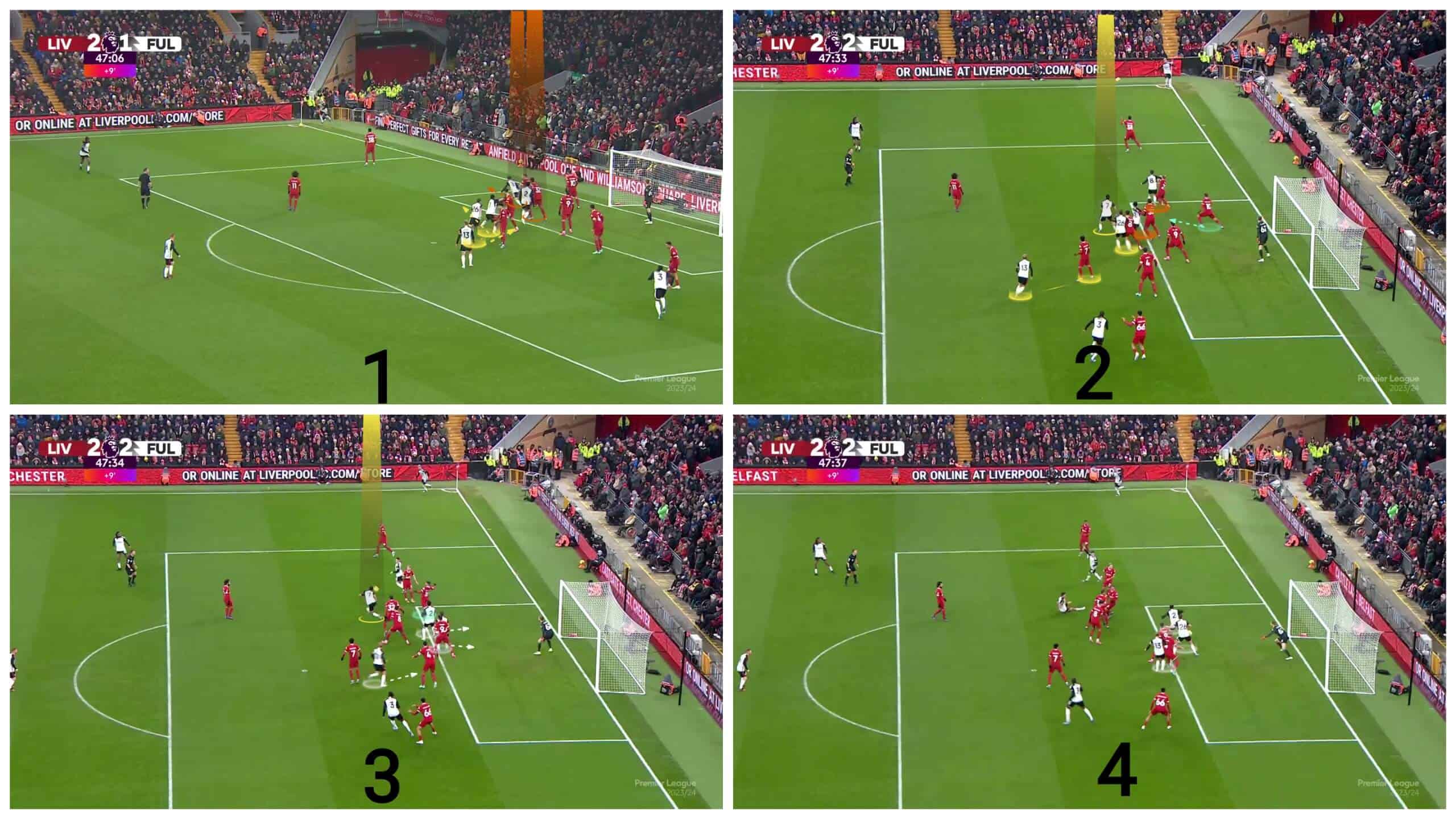
In the first photo below, Fulham implement a similar idea, but they use a right-footed player from the left side, which means that the predicted cross will be in-swing, which forces the zonal defender on the post to stand more towards the post, afraid of a direct shot or cross to such a dangerous area.

The surprise is that the taker crosses a straight cross to the same previous targeted area.

This trick, whether they meant that or not, makes the distance further for the post defender to go up.

Going into details, you can see the same roles of the two orange attackers.

At the same time, the first yellow runner will be the targeted player with the second runner’s screen, and a third runner goes forward to make sure that the first one will be free, especially since they know that Liverpool’s markers shouldn’t follow runners going toward the zonal line, but the intelligent attacker drifts wide then, as shown in the second and third photos.

One of the three white attackers waiting in the box got the ball and scored a goal!
decoding-liverpool-gaps-at-defending-corners-set-piece-analysis-tactics

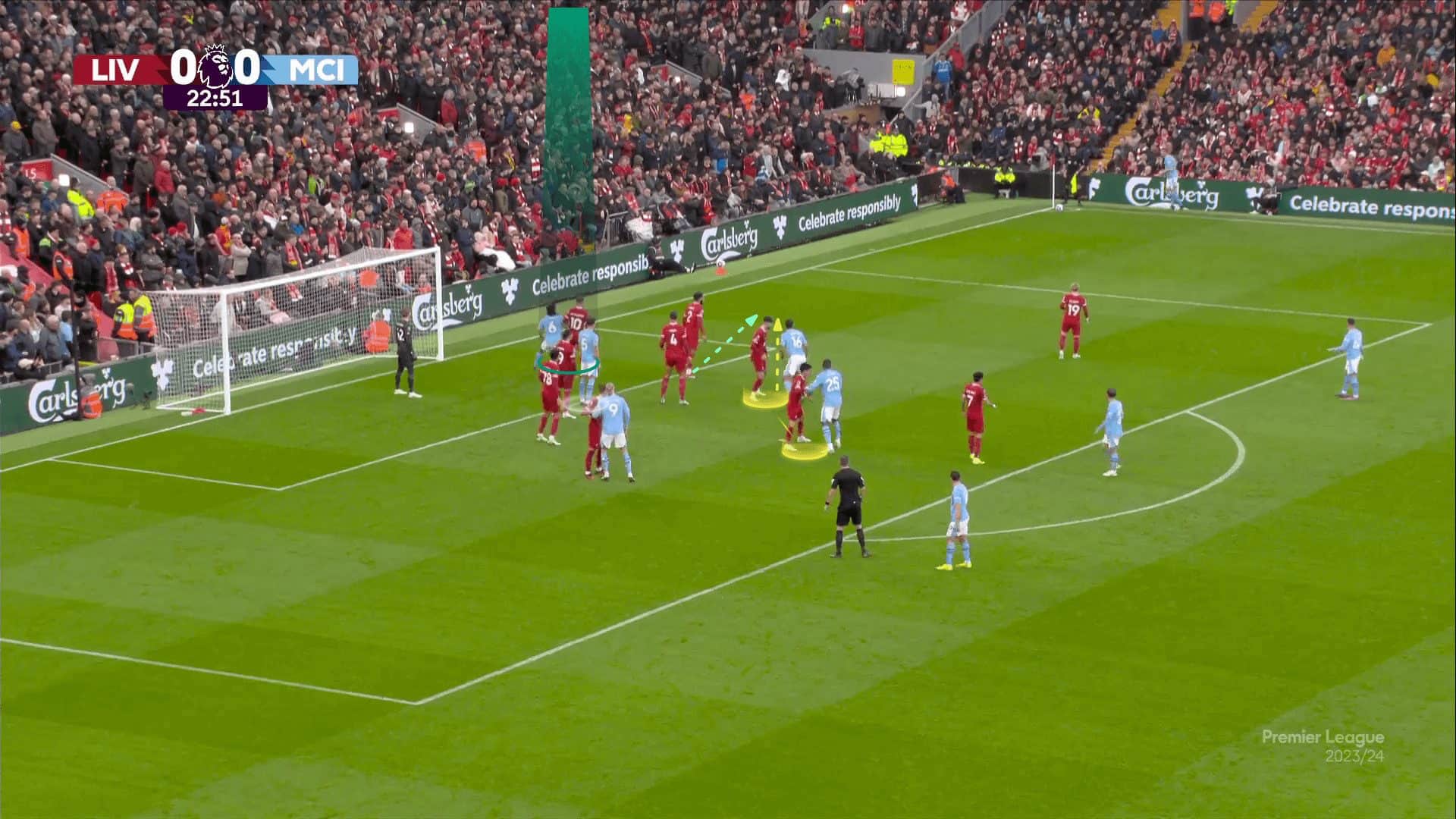
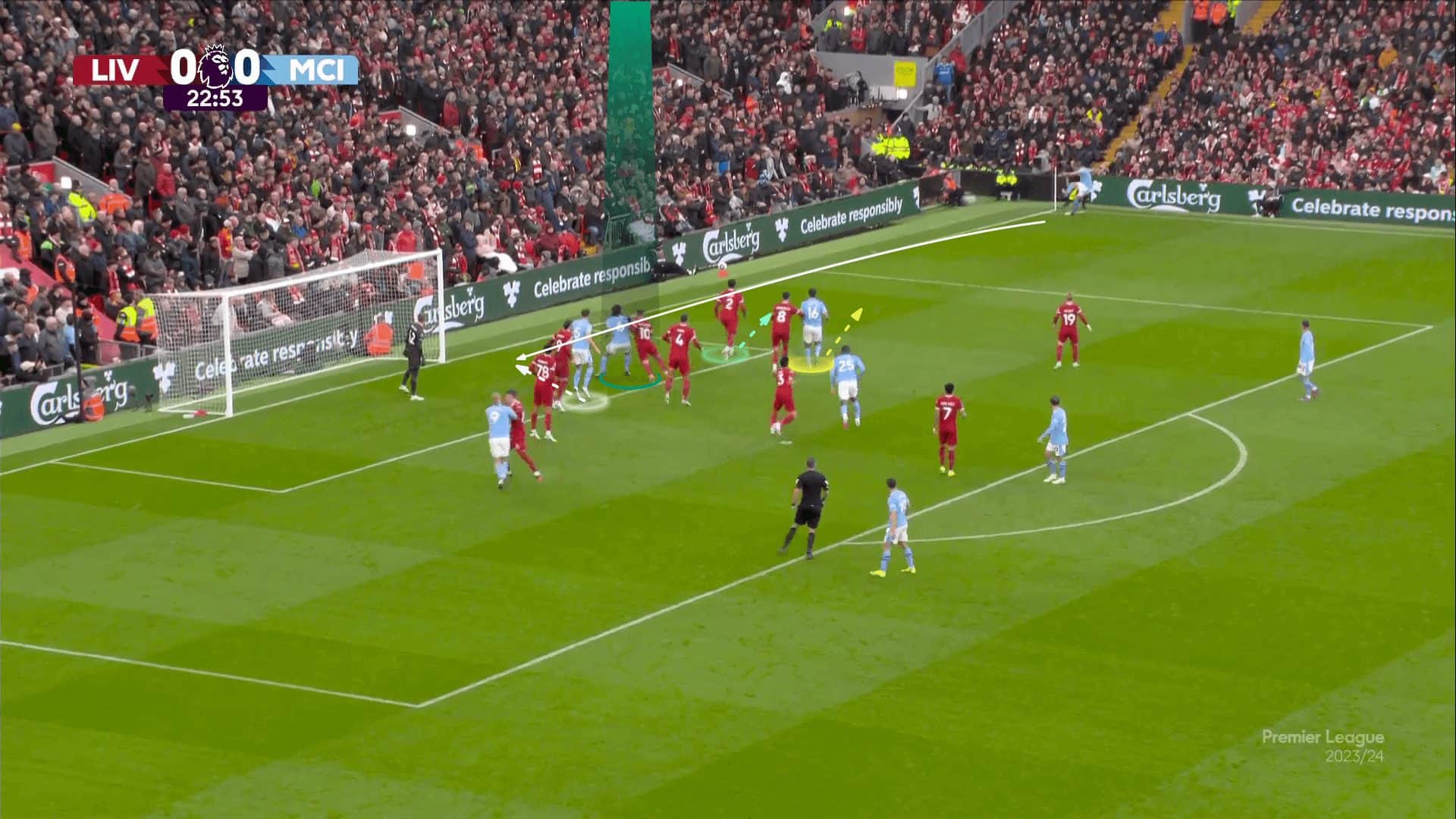
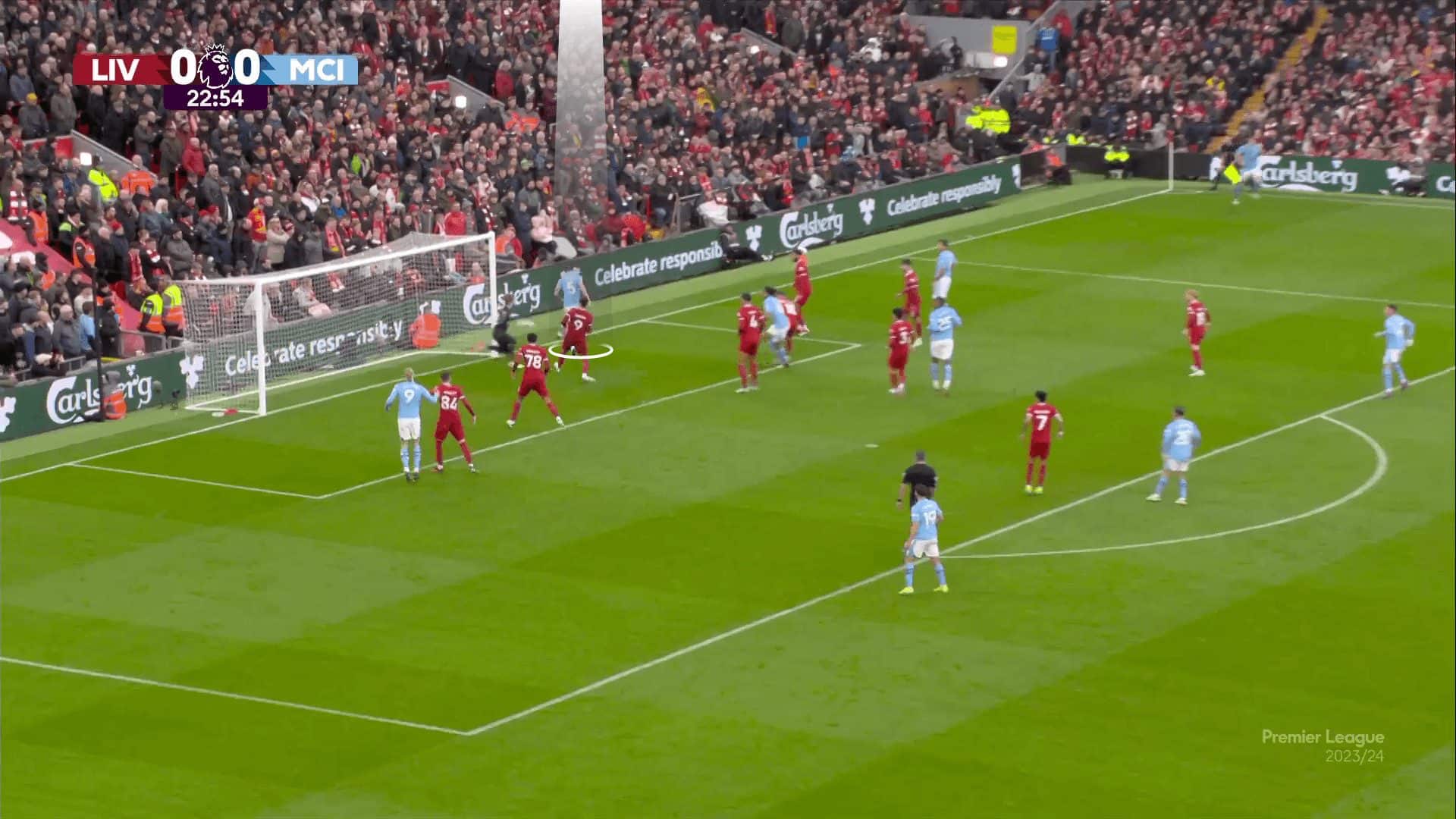
Man City had a brilliant idea to use the out-swing cross, but they exploited the fact that this defender wanted to push up quickly to cover and exploited the area behind him, not in front of him, with a green block from his back, as shown below.
decoding-liverpool-gaps-at-defending-corners-set-piece-analysis-tactics

In the photo below, Kevin De Bruyne’s perfect low cross targets John Stones, in white, who stands at first among the zonal defenders and the, goes suddenly to get the ball scoring an easy goal, as shown in the second photo below.
decoding-liverpool-gaps-at-defending-corners-set-piece-analysis-tactics


decoding-liverpool-gaps-at-defending-corners-set-piece-analysis-tactics

The area after the far post by a floated cross

This idea is simply to use a floated cross toward the area after the far post where no zonal defenders stand to be far from Van Dijk, who can’t help Arnold then while the cross is so high that Alisson can’t claim and takes so much time in the air that gives the marked attacker, the best one, the time to go to the targeted area with the marker annoyment.

This floated cross also makes it difficult for the marker to keep tracking the attacker raising his neck trying to track the ball and the attacker all that time.

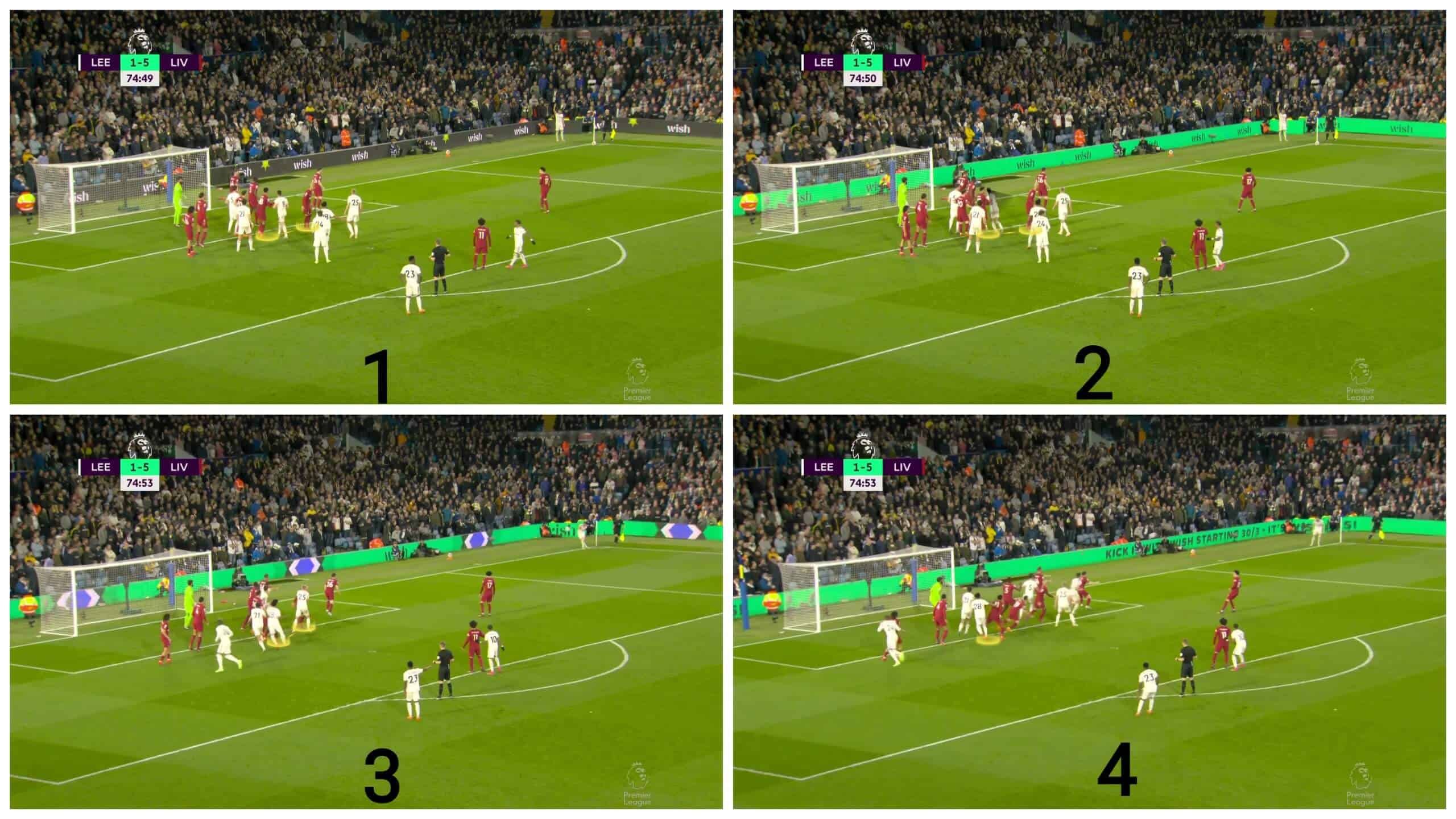
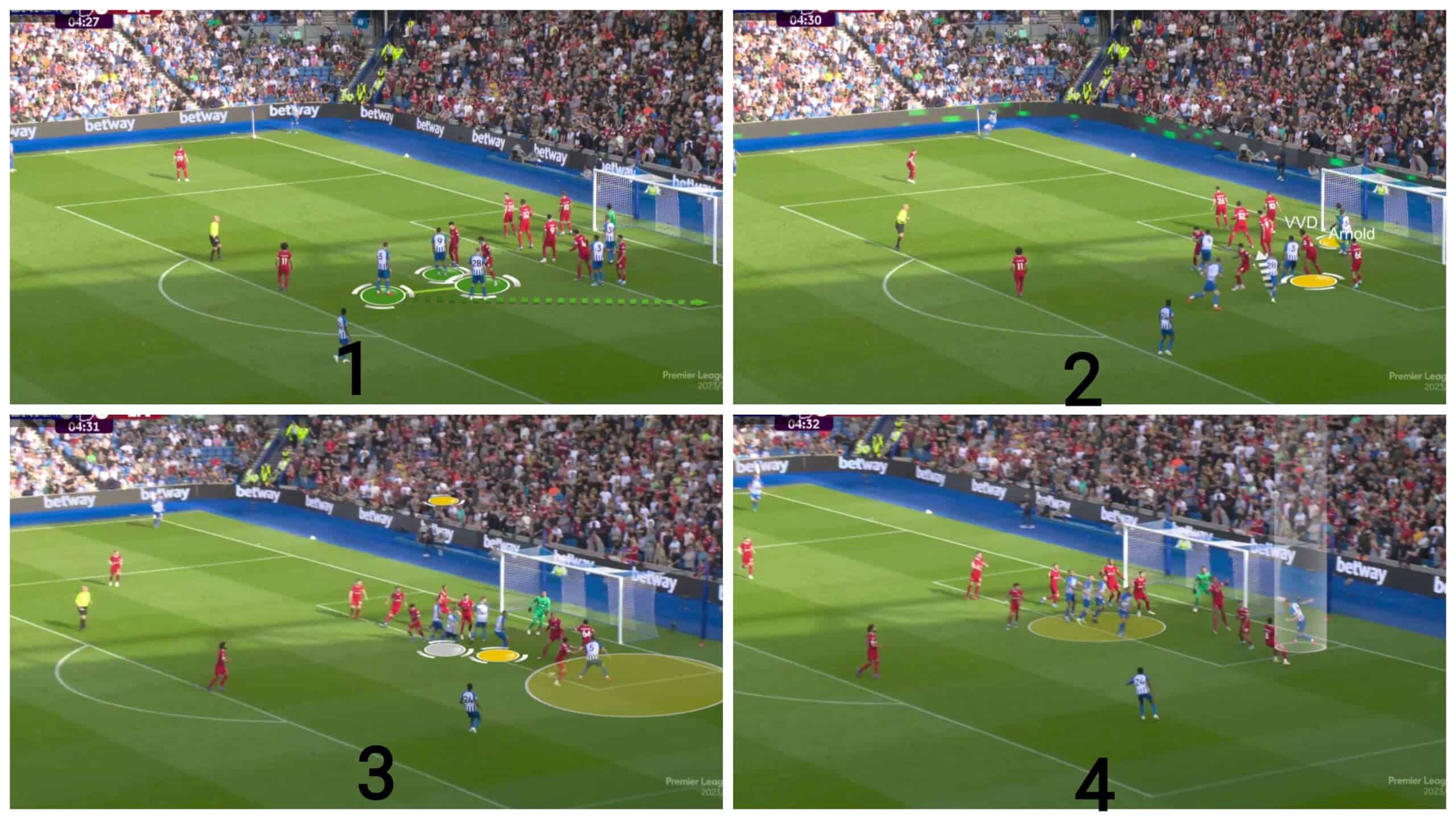
In the two photos below, we see three runners against Liverpool’s two man markers while Lewis Dunk goes to our targeted area where no zonal defender stands.

In the second photo below, there are two yellow blocks to Alisson and van Dijk while the third runner goes to be ready to receive the headed pass.

In the third photo, Dunk waits for the high ball in the air against his marker, who doesn’t see the ball and Trent Alexander-Arnold, the last zonal defender, who is not good at aerial duels depending on van Dijk and Alisson to cut the ball before getting to him, but this is a floated across and they are also blocked, so Dunk wins the aerial duel while four mates wait for the headed pass, as shown in the fourth photo below.
decoding-liverpool-gaps-at-defending-corners-set-piece-analysis-tactics

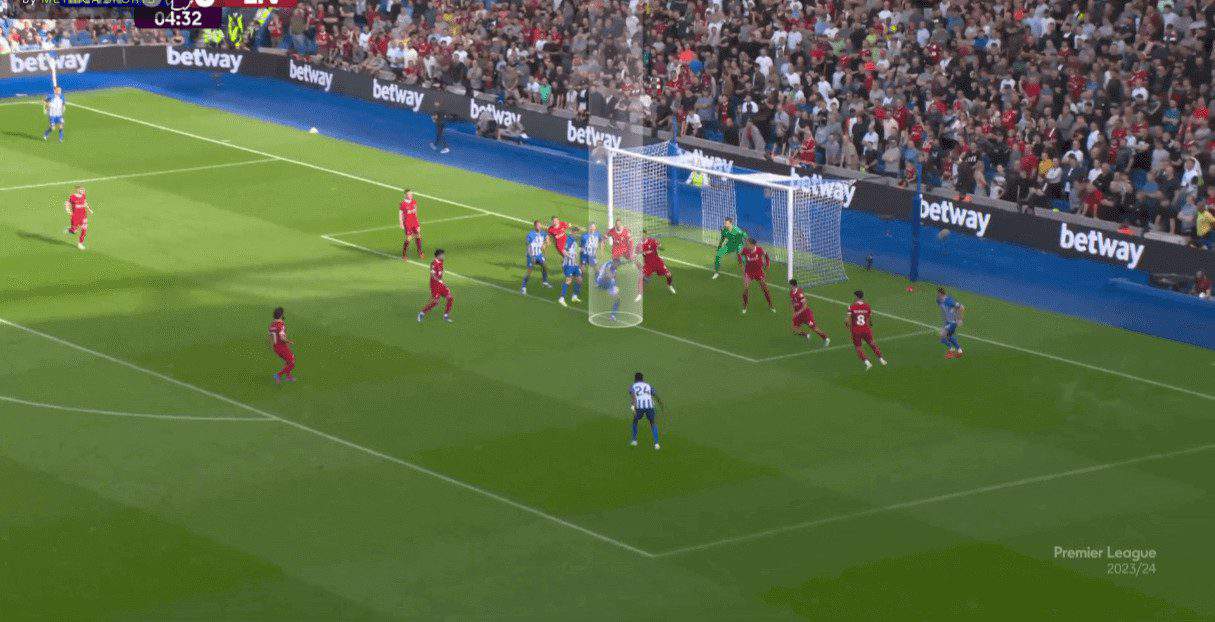
The plan works; a player gets the ball but can’t control it well, as shown below.
decoding-liverpool-gaps-at-defending-corners-set-piece-analysis-tactics

Everton also scored a goal against Liverpool using the same strategy in which they are so clever, as explained in this analysis.

The central area

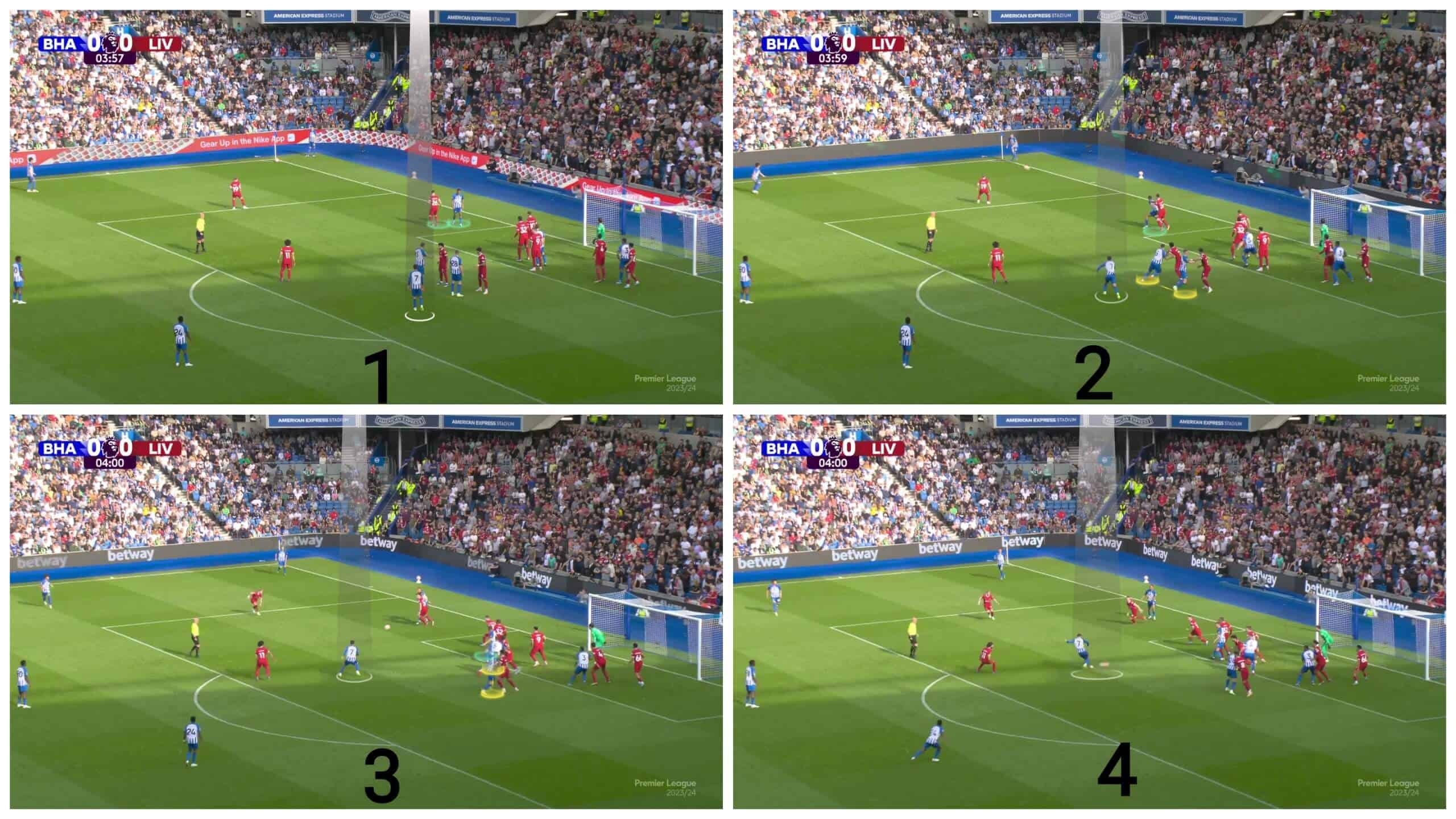
Overloading the central area didn’t help in many cases, as we explained at the beginning, but the idea below was good and tricky.

In the first photo below, the green attacker fakes that he is coming back and then turns around to receive a grounded pass and passes the ball to the free player near the penalty spot.

They are in a 3-v-2 situation, and man markers neglect him because Solly March isn’t so dangerous at aerial duels.

However, the shot isn’t optimum, as in the remaining photos.
decoding-liverpool-gaps-at-defending-corners-set-piece-analysis-tactics

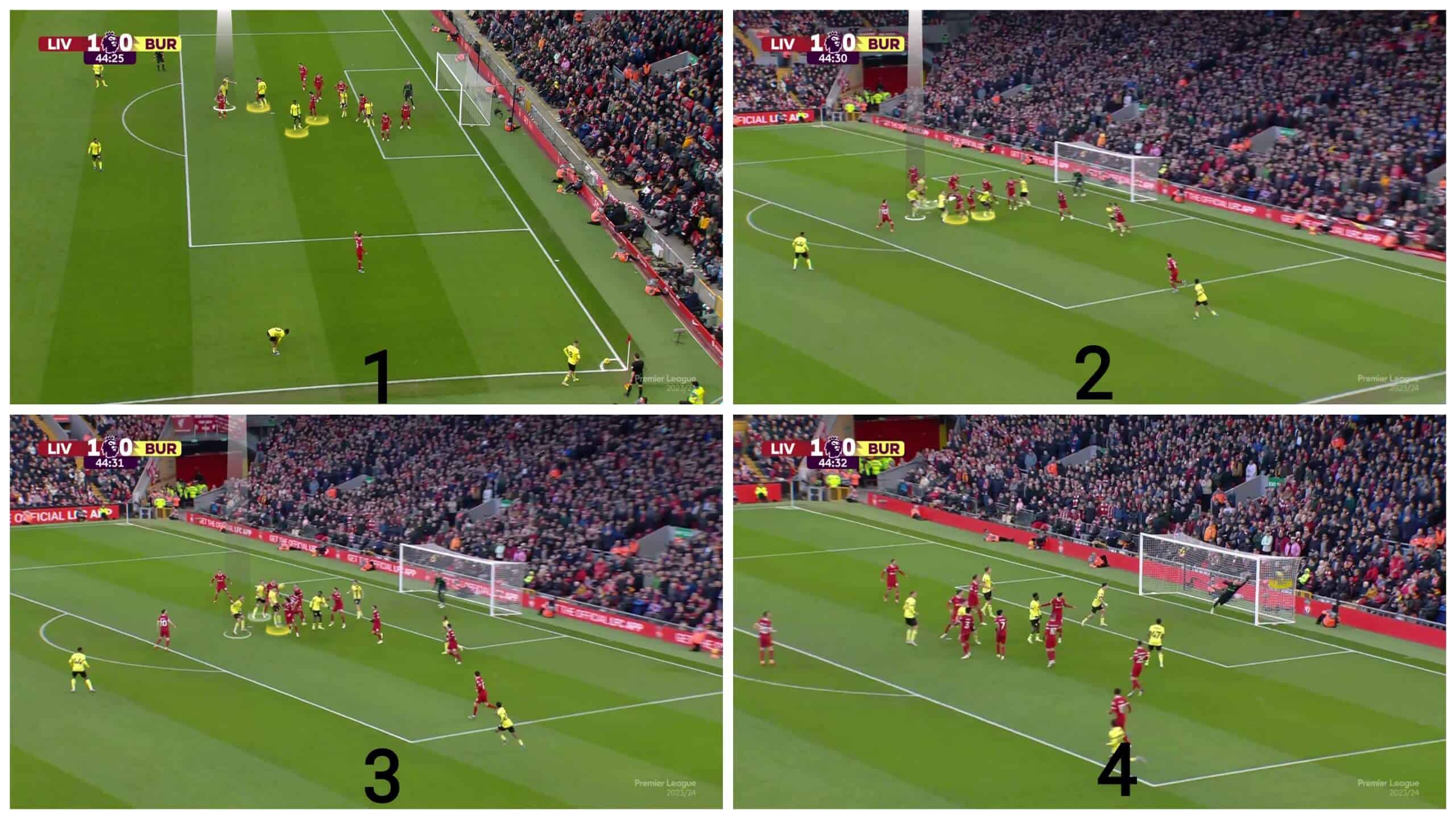
Burnley also scored a goal by overloading the penalty area with three attackers against two man markers by asking two attackers to block the man markers while the white one comes free from the back to be the targeted player, as shown in the first two photos.

In the third photo, the targeted player is free with another attacker blocking a zonal defender, preventing him from pushing forward to chase the ball.

The plan works, but the cross goes towards one of the marked attackers who didn’t have a problem overcoming the man marker and putting the ball directly on the net.
decoding-liverpool-gaps-at-defending-corners-set-piece-analysis-tactics

The problem with this strategy is that the distance from the goal is too long to score a direct goal in most of times.

Conclusion

In this analysis, we have discussed the strength of Liverpool’s defensive structure, which could once be described as invincible.

We then examined how opponents have managed to find solutions against this system, which remains strong but has become penetrable.

In this set-piece analysis, we have demonstrated how opponents have exploited three main weaknesses: blocking the zonal defender positioned on the near post, targeting the area after the far post, and exploiting the central zone beside the penalty spot.

Previous Post

Is Liverpool’s Kelleher Ready To Replace Alisson? – Data Analysis

Next Post

Soaring to the Suo-mmit: Why HJK Helsinki could be Kansallinen Liiga champions-in-waiting – scout report

Next Post
HJK Helsinki Naiset 2024: Their strong start to 2024 - scout report - tactical analysis tactics

Soaring to the Suo-mmit: Why HJK Helsinki could be Kansallinen Liiga champions-in-waiting - scout report

Match ball on centre spot of floodlit pitch at dusk, geometric shadows, stadium lighting, cool-blue and warm-gold atmospheric haze.

Germany vs Curaçao Prediction: World Cup 2026 Preview & Best Bets

June 11, 2026
Floodlit football pitch at dusk with match ball on penalty spot, dramatic stadium shadows, cool-warm colour grade.

Netherlands vs Japan Prediction: World Cup 2026 Preview & Best Bets

June 11, 2026
Overhead stadium view during evening kickoff: floodlit pitch, mixed-nation crowd colours, match ball on halfway line, dramatic shadows.

World Cup 2026 Group H Winner: Odds, Predictions & Best Bets

June 11, 2026
  • About Total Football Analysis
  • Contact Total Football Analysis
  • Advertise
  • Privacy Policy
  • Cancellation / Refund Policy
  • Resources
  • Terms Of Service

© 2026 Total Football Analysis

No Result
View All Result
  • Football Analysis
    • Data Analysis
    • Formations
      • 2-2-4 Formation
      • 2-3-5 Formation
      • 3-1-4-2 Formation
      • 3-2-2-3 Formation
      • 3-2-4-1 Formation
      • 3-1-6 Formation
      • 3-3-4 Formation
      • 3-4-1-2 Formation
      • 3-4-2-1 Formation
      • 3-4-3 Formation
      • 3-5-1-1 Formation
      • 3-5-2 Formation
      • 4-1-4-1 Formation
      • 4-2-2-2 Formation
      • 4-2-3-1 Formation
      • 4-2-4 Formation
      • 4-3-1-2 Formation
      • 4-3-3 Formation
      • 4-4-2 Formation
      • 4-5-1 Formation
      • 5-3-2 Formation
      • 5-4-1 Formation
      • 6-3-1 Formation
    • Head Coach Analysis
    • Match Analysis
    • Player Analysis
    • Recruitment Analysis
    • Set Piece Analysis
    • Tactical Theory
    • Tactical Preview
    • Team Analysis
    • Training Analysis
    • Tactical Analysis
    • Scouting Report
  • FIFA World Cup 2026
    • World Cup Betting Sites
    • World Cup Betting Promotions
    • World Cup Free Bets
    • World Cup Golden Glove Odds
    • World Cup Top Scorer Odds
    • World Cup Player of the Tournament Odds
  • Competitions
    • English Premier League
    • Champions League
    • La Liga
    • Bundesliga
    • Serie A
    • Ligue 1
    • Eredivisie
    • EFL Championship
    • Women’s Super League
    • NWSL
    • Belgian First Division A
    • A-League
    • Liga Profesional de Argentina
    • Austrian Bundesliga
    • Campeonato Brasileiro Série A
    • DFB Pokal
    • 1. HNL
    • Danish Superliga
    • EFL League One
    • EFL League Two
    • FA Cup
    • EFL Cup
    • Indian Super League
    • K-League
    • J1 League
    • Liga MX
    • Copa del Rey
    • MLS
    • Eliteserien
    • Allsvenskan
    • Primeira Liga
    • Scottish Premiership
    • Europa League
    • UEFA Nations League
    • Liga AUF Uruguaya
  • Coaches
    • All Coaches
    • Alfred Schreuder
    • Ange Postecoglou
    • Antonio Conte
    • Arne Slot
    • Bo Svensson
    • Brendan Rodgers
    • Bruno Lage
    • Carlo Ancelotti
    • Christophe Galtier
    • Claude Puel
    • Claudio Ranieri
    • David Moyes
    • Dean Smith
    • Diego Simeone
    • Domenico Tedesco
    • Frank Lampard
    • Eddie Howe
    • Edin Terzić
    • Emma Hayes
    • Erik ten Hag
    • Ernesto Valverde
    • Gennaro Gattuso
    • Gerardo Seoane
    • Gian Piero Gasperini
    • Giovanni van Bronckhorst
    • Graham Potter
    • Igor Tudor
    • Imanol Alguacil
    • Jesse Marsch
    • Jonas Eidevall
    • Jorge Sampaoli
    • José Bordalás
    • José Mourinho
    • Julien Stéphan
    • Julen Lopetegui
    • Julian Nagelsmann
    • Jürgen Klopp
    • Luciano Spalletti
    • Lucien Favre
    • Manuel Pellegrini
    • Marcelo Bielsa
    • Marco Rose
    • Marco Silva
    • Massimiliano Allegri
    • Mauricio Pochettino
    • Maurizio Sarri
    • Mikel Arteta
    • Niko Kovač
    • Nuno Espírito Santo
    • Oliver Glasner
    • Patrick Vieira
    • Paulo Fonseca
    • Pep Guardiola
    • Peter Bosz
    • Rafa Benítez
    • Ralf Rangnick
    • Ralph Hasenhüttl
    • Roger Schmidt
    • Roy Hodgson
    • Sean Dyche
    • Sérgio Conceição
    • Simone Inzaghi
    • Sonia Bompastor
    • Stefano Pioli
    • Steffen Baumgart
    • Steven Gerrard
    • Thiago Motta
    • Thomas Frank
    • Thomas Tuchel
    • Unai Emery
    • Vincenzo Italiano
    • Xavi
  • Teams
    • ALL Teams
    • AC Milan
    • Ajax Amsterdam
    • Arsenal
    • AS Monaco FC
    • Atalanta
    • Atlético Madrid
    • FC Barcelona
    • FC Bayern Munich
    • Borussia Dortmund
    • Celtic FC
    • Chelsea FC
    • Everton F.C.
    • Inter Milan
    • Juventus F.C.
    • Leeds United F.C.
    • Liverpool FC
    • Manchester City
    • Manchester United FC
    • Paris Saint-Germain
    • Rangers FC
    • RB Leipzig
    • Real Madrid CF
    • Tottenham Hotspur
    • West Ham United
  • Players
    • ALL Players
    • Alisson Becker
    • Bukayo Saka
    • Erling Haaland
    • Harry Kane
    • Jack Grealish
    • John Stones
    • Kevin De Bruyne
    • Julián Alvarez
    • Kalvin Phillips
    • Kyle Walker
    • Kylian Mbappé
    • Luis Díaz
    • Lamine Yamal
    • Mohamed Salah
    • Lionel Messi
    • Virgil Van Dijk
    • Phil Foden
  • Guides
    • Betting Sites
      • Betting Apps
      • Betting Bonuses
      • Betting Exchanges
      • Betting Sites Not on GamStop
      • Cash Out Betting Sites
      • Crypto Betting Sites
      • European Bookmakers
      • Footbal Betting Sites
      • Free Bets
      • New Betting Sites
      • No KYC Betting Sites
      • Live Betting Sites
    • Online Casinos
      • Casino Apps
      • Credit Card Casinos
      • Crypto Casinos
      • Fast Payout Casinos
      • Non GamStop Casinos
      • Offshore Casinos
      • Slots Casinos
      • Irish Online Casinos
    • International
      • Betting Sites Ireland
  • Contact
  • Login

© 2026 Total Football Analysis