
Grenoble Foot‘s Team currently occupies the sixth position in Ligue 2, amassing 40 points after 27 matches, trailing the league leaders, Auxerre, by a margin of 12 points, as they hold the top spot with 52 points.
On the defensive front, the team’s statistics appear reasonable, given the position they occupy. The sixth position is regarded as having the best defensive line in the league, having conceded 28 goals, a margin of five goals from the team with the best defensive record, Saint-Étienne, who have conceded 23 goals.
On the offensive front as well, their numbers are proportionate to their position, as they occupy the sixth position with the best-attacking line, having scored 35 goals. However, they trail the league-leading Auxerre by a margin of 16 goals, as they have scored 51 goals.
However, we encounter a pause on the offensive front as their significant reliance on set-pieces, especially offensive corner kicks, becomes apparent. They have scored seven goals from corner kicks, accounting for 20% of their total goals, indicating their impact. They are the league’s top-scoring team from corner kicks, tied with Rodez and Stade Laval, each with seven goals.
Upon closer examination of their offensive corner kicks, it becomes evident that they heavily rely on positioning their attackers initially in distant areas, sometimes extending beyond the box. What is remarkable is that this tactic proves effective across various defensive systems, whether man marking, zonal marking, or even hybrid systems. What’s influential is their incorporation of this strategy as part of their routine, with the purpose varying from one situation to another based on the evolving concept.
In this tactical analysis, we will discuss Grenoble Foot’s reliance on distant positions for their attackers initially and the various tactics they employ to implement this idea. Furthermore, we will explore how they capitalise on each of these routines against different defensive systems.
Far initial positions
Making some or all of the attackers start from far positions on the edge of the box or outside the box gives the runners many advantages if the markers go there or even if they wait inside the box.
If the markers go up, they will be forced to mark the attackers all of this distance, which causes many problems because it gives the attacker the time and space to escape from his marker because the marker can’t stick to him over all of this distance. This also gives one of the attacker’s teammate a huge opportunity to block his marker, which is called a screen.
The second problem is the difficulty for the marker to keep tracking the ball and the attacker simultaneously, which is called a problem of orientation. Let’s go into the details.
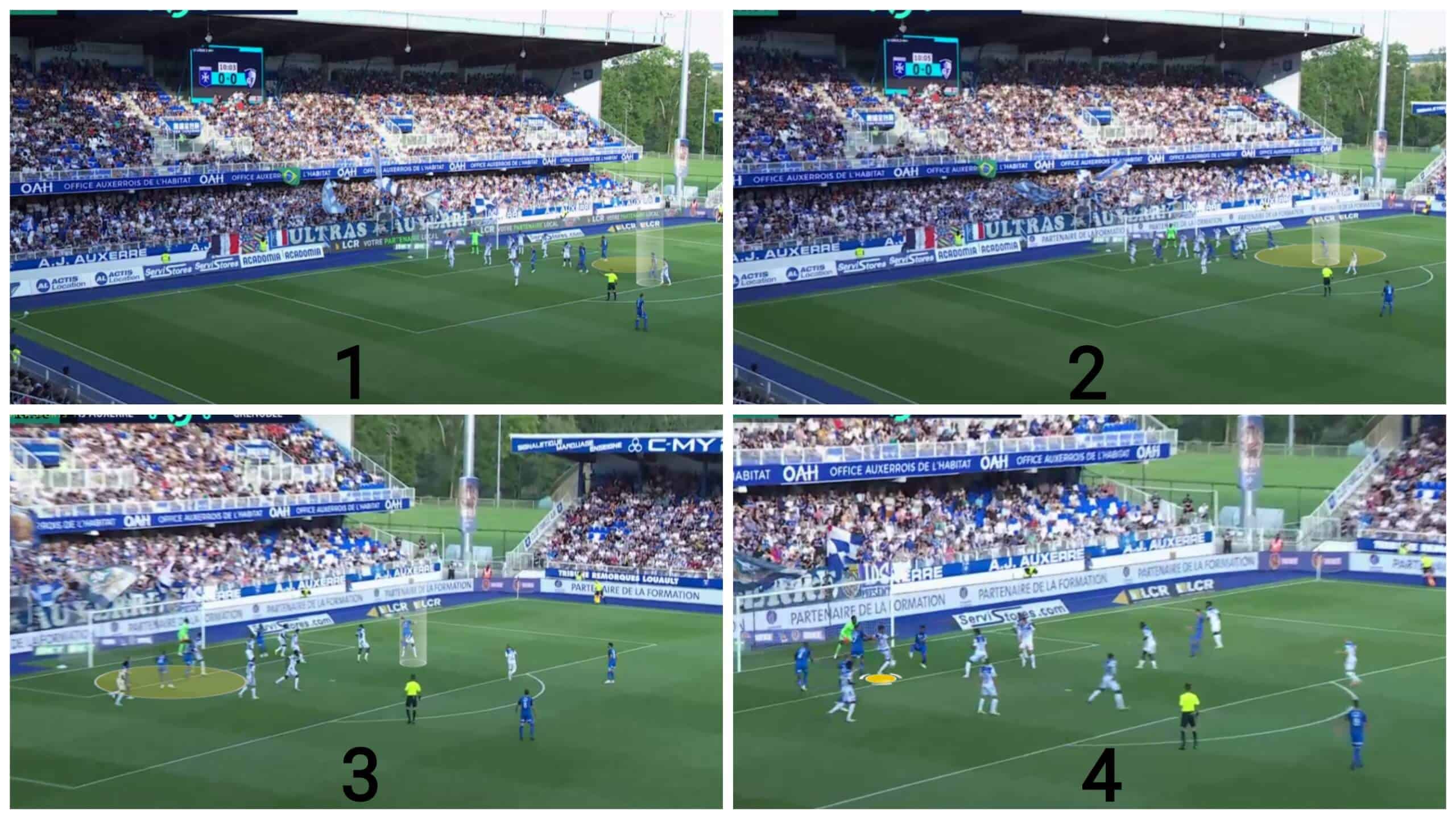
In the first photo below, the opponent defends with a man-marking defending system with only two zonal players while most of the attackers stand on the edge of the box, leaving only two attackers near the six-yard on the near post at the targeted area and then, they will leave it to empty the space for the white highlighted player outside the box.
In the second and third photos, the targeted player uses his teammate as a screen, turning around him to be away from his marker and avoiding any physical touch, as in the fourth photo.

The plan works because avoiding the physical touch allows the attacker to jump after movement, and the result is a goal, as shown in the two following photos.

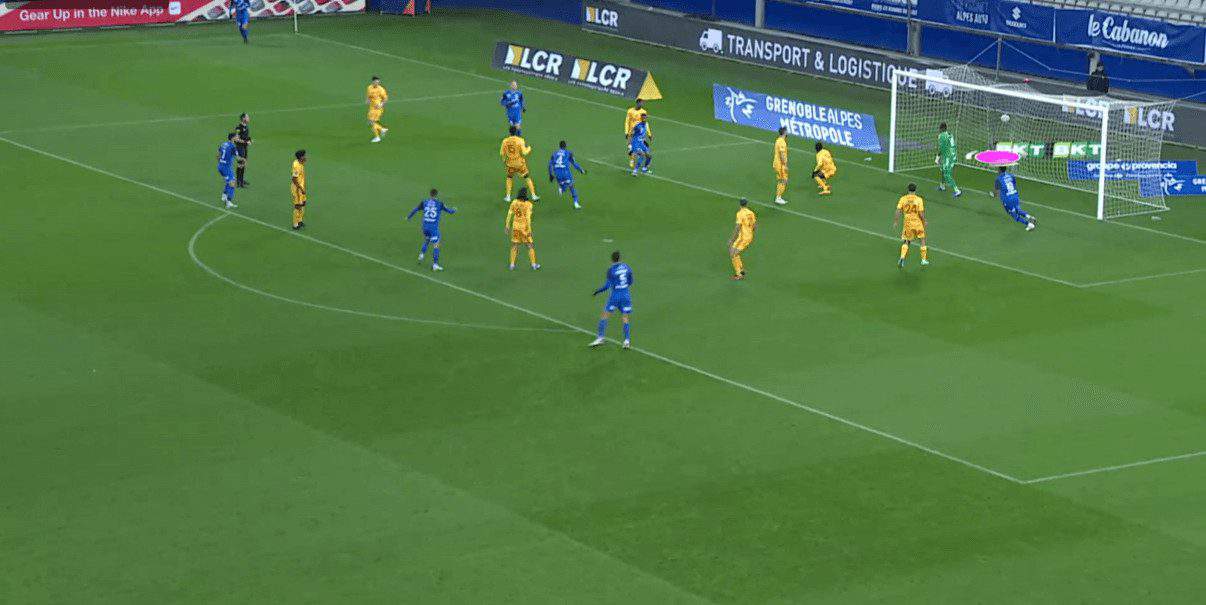
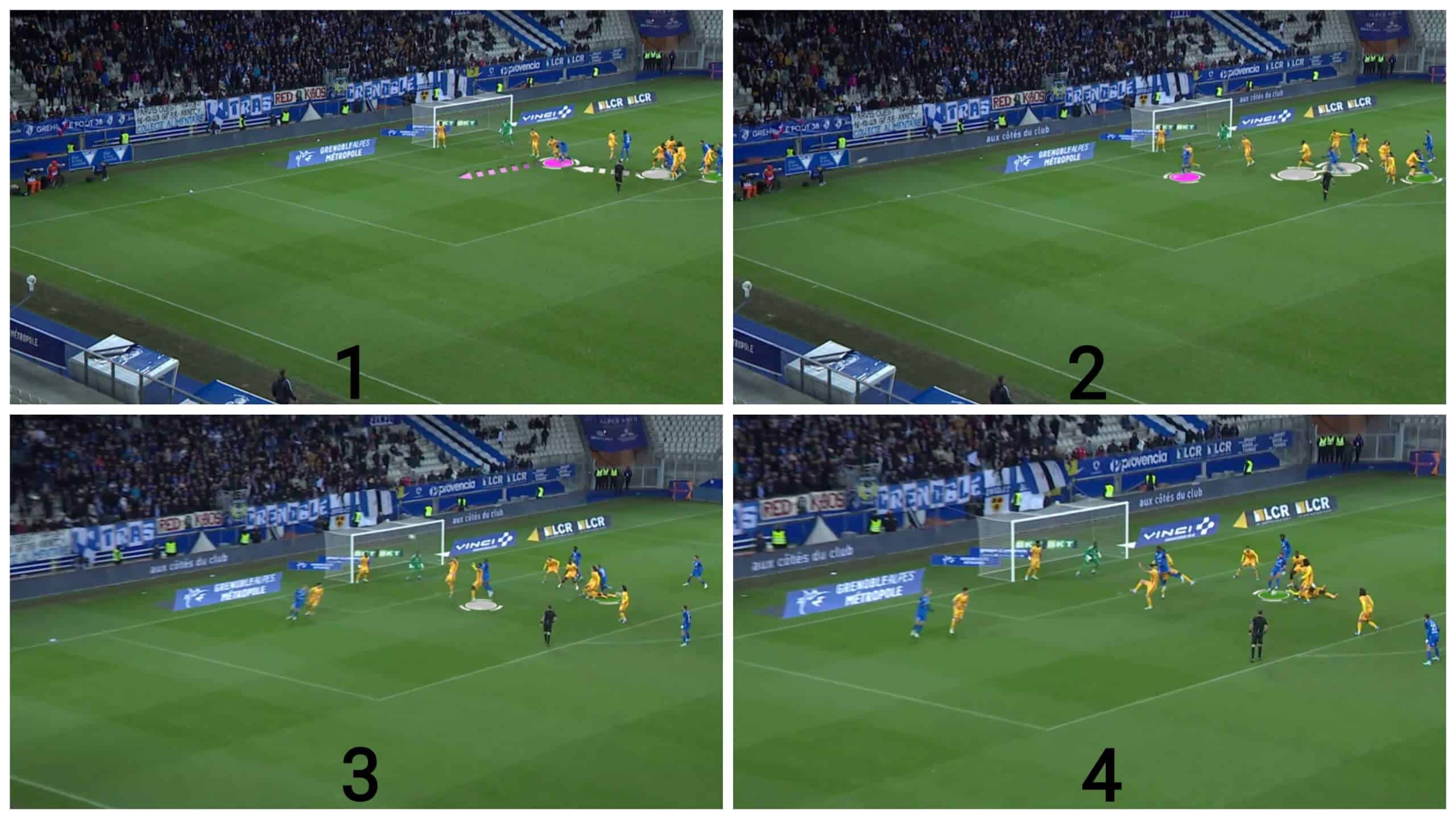
The second advantage of this far initial position is that it causes an orientation problem for the marker and makes it difficult for him to measure the landing point of the ball as a result, as will be explained in the case below.
In the first photo, the pink attacker moves from the targeted area to empty the space for the targeted area for the white far attacker, whose far initial position gives him an advantage over his marker who can’t keep tracking the ball and the attacker all this distance, especially against this out-swinging cross, so he loses communication with the attacker getting in front of him, as shown in the second photo.
You may say that it is effective against only a man-marking defending system because, in the zonal defending system, the zonal defender waits in the box so that they won’t suffer from most of the previous problems, but there is another problem defending teams may suffer from which is the dynamic mismatch because the attackers cut a long distance without annoyance jumping from movement.
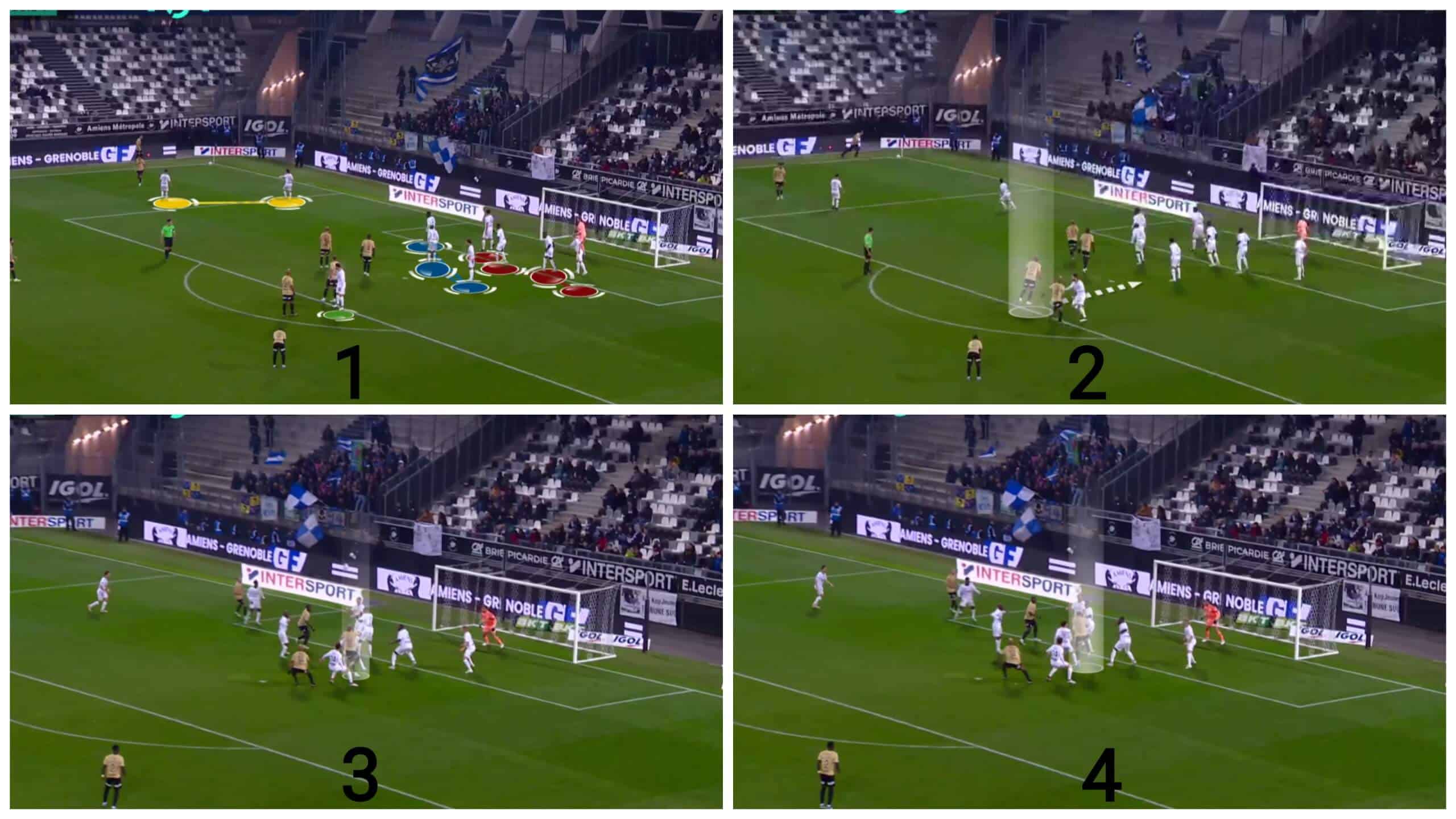
In the first photo below, the defending team defends with a zonal-defending system with four players in the first zonal line, three players in the second-zone line, two short-option defenders and a rebound defender.
In the second photo, the targeted player starts on the edge of the box, cutting all that way without annoyance or any physical touch, so when he reaches the ball, he overcomes the second-zone defender with a dynamic mismatch, as shown in the third and the fourth photos, and it ends with a goal.
This idea is also valid against hybrid systems but with a small extra help, which is using a teammate to do a screen, as explained in the case below.
In the first photo below, they start in a pack, overloading the man, marking in a 6-v-4 situation, so two attackers become free, highlighted in the second photo. As shown in the third photo, one of them is used as a screen to free the targeted player.
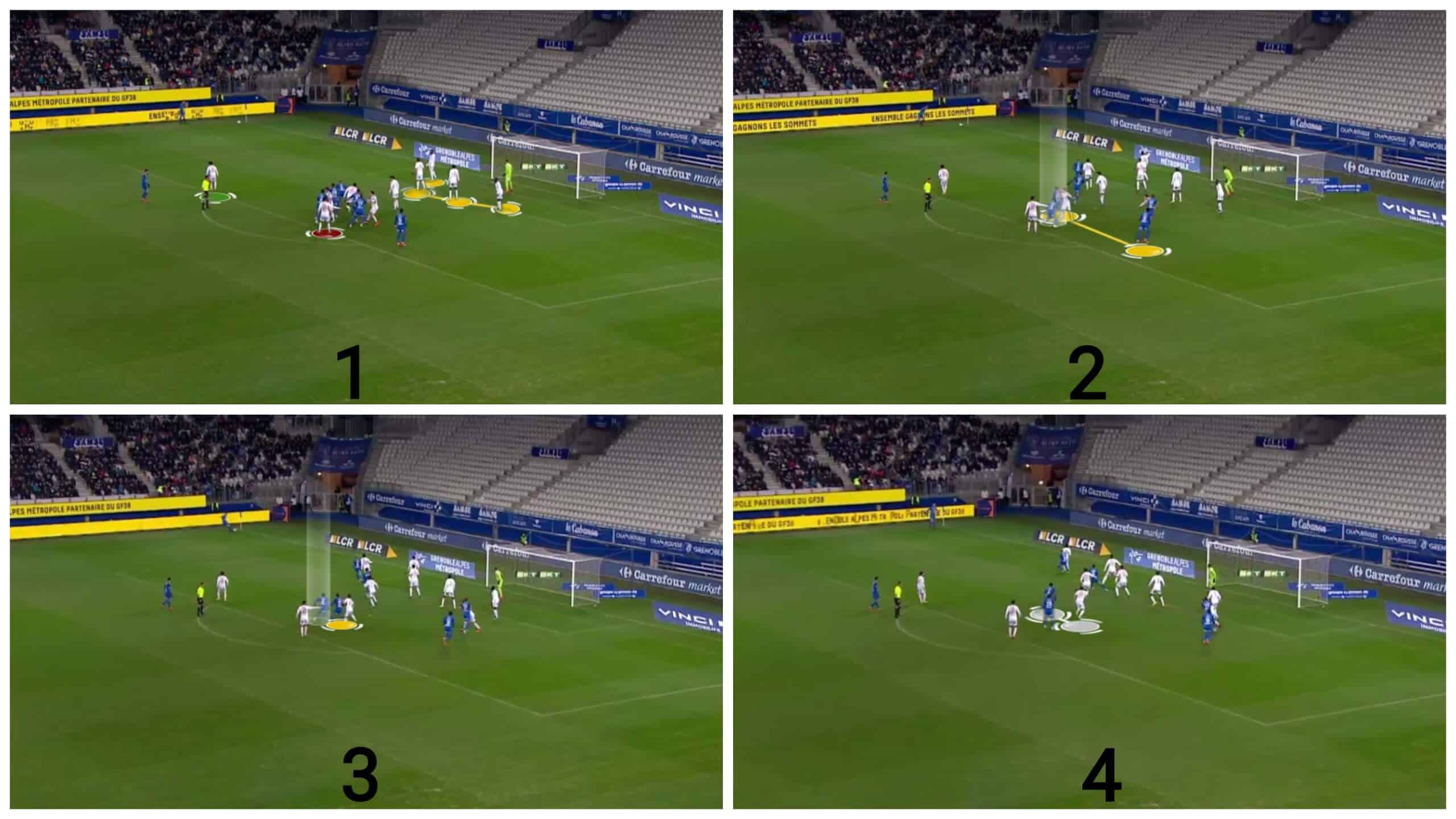
Then, the same previous story continues; the targeted player achieves a dynamic mismatch over the zonal line because he runs all this way without physical annoyance.
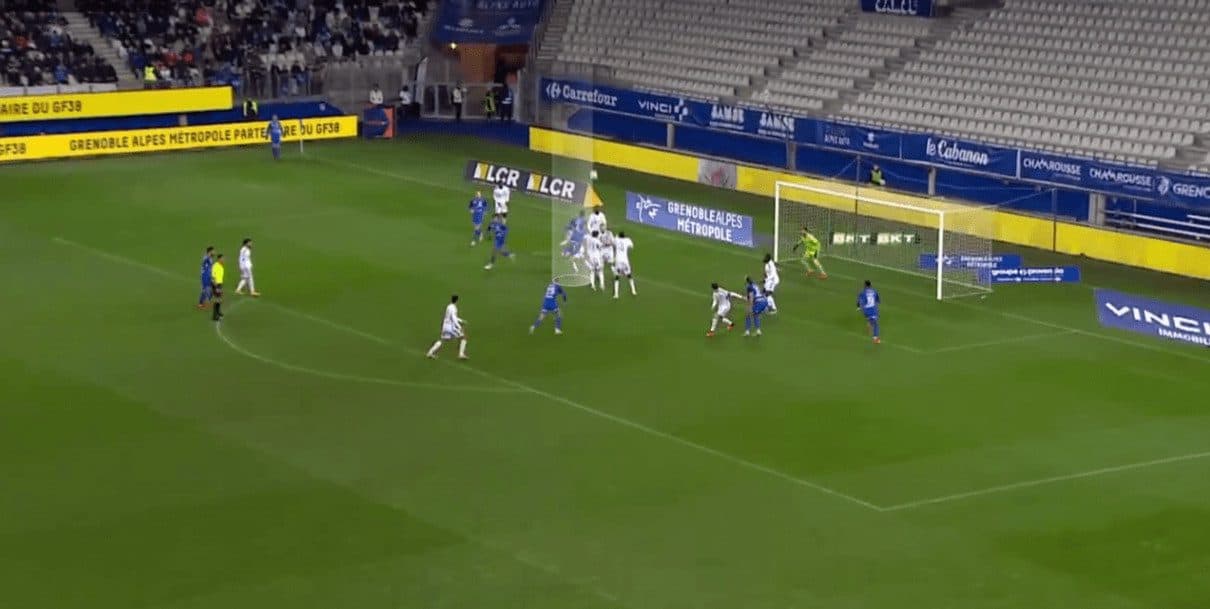
But the cross wasn’t optimum, so the ball passed him, as shown below.
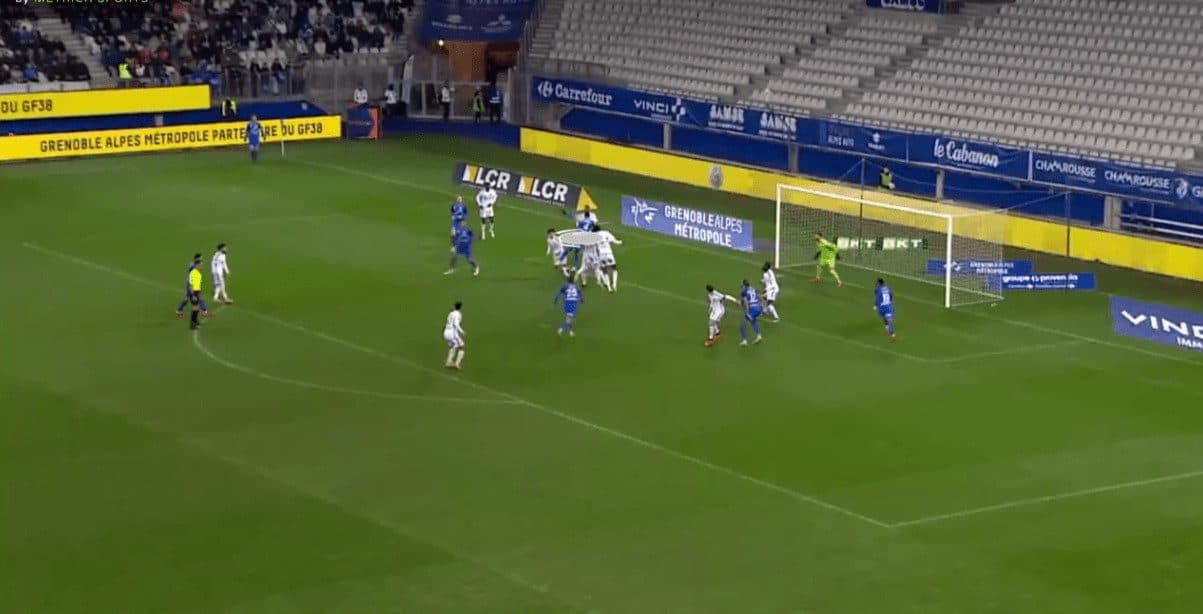
Flicks
As we mentioned above, they also use this idea as a part of too many routines to deal with different opponents and give them variety, making the opponent can’t expect this usual idea, so they use the same concept but with different shapes to surprise opponents. One of these routines is flicking the ball to the far post.
In the first photo below, the yellow attacker drags a marker with him to empty the space he left for the white far positions. At the same time, the second targeted player also waits in a far position, exploiting the defenders’ focus on the ball, as shown in the second photo.
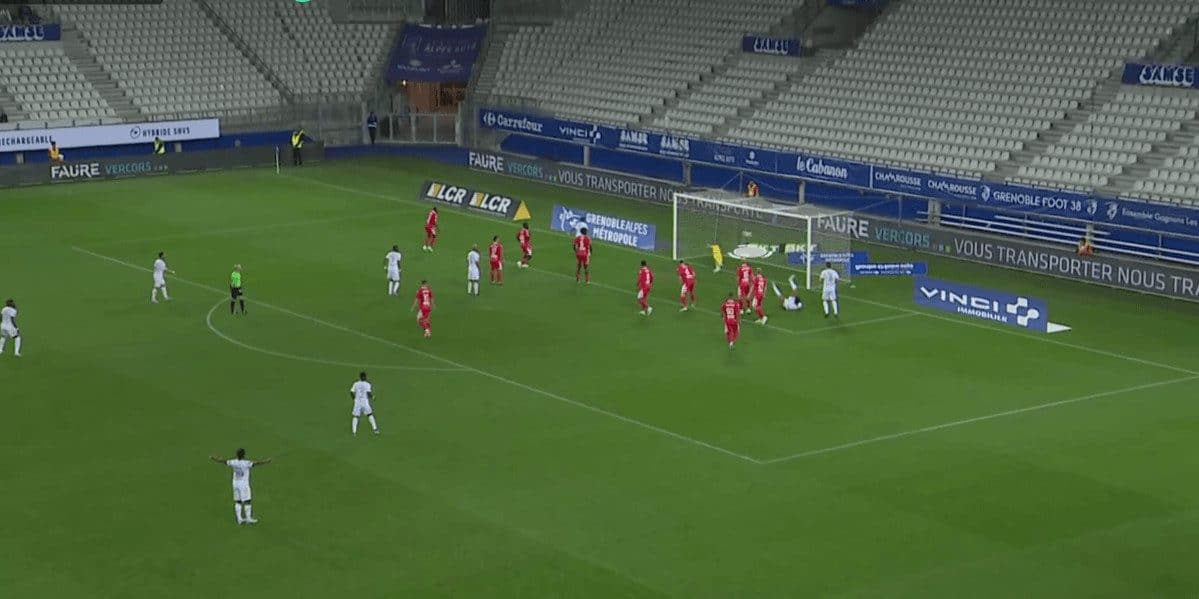
In the third photo below, the first targeted player can overcome the zonal defender with a dynamic mismatch. In contrast, the second targeted player goes to the far post out of the defenders’ sights, getting the flick, as shown in the fourth photo below.
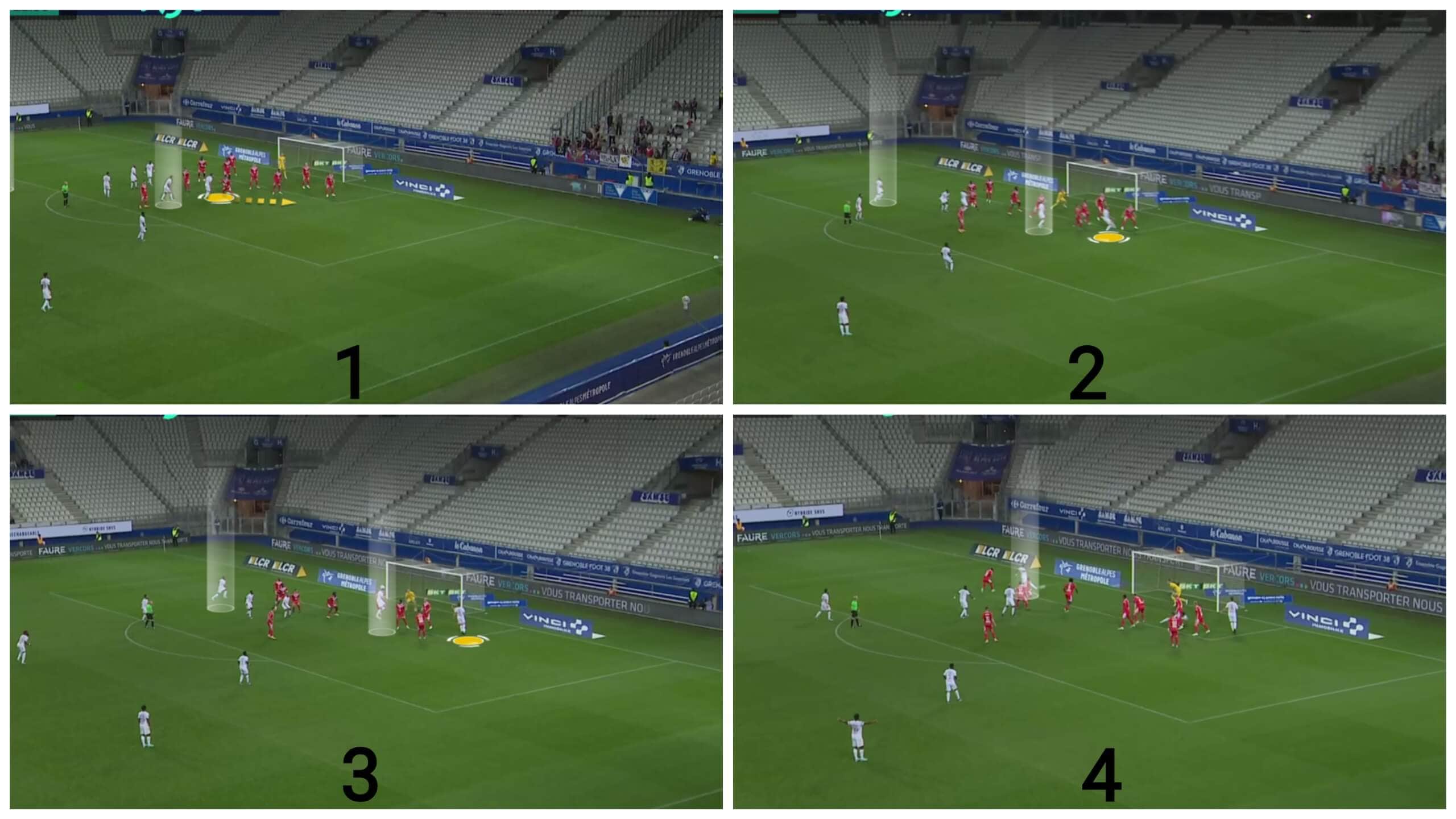
The plan works, and the result is a goal, as shown below.
Here, we should mention that the first targeted player may meant to target the goal directly. Still, some teams use this far-post attacker as a kind of framing the goal to increase the possibility of scoring goals if the first attacker can’t control the headed shot well.
Nods from the far to the near post
Grenoble Foot also use a counter idea of the previous one, which is targeting the area in front of the far post beside the penalty spot at first and then nodding the ball back to the near post with three players standing there waiting for the headed pass using the same far initial position for the first targeted player, but that time they used another trick to make the routine succeed. Let’s go into the details.
In the first photo below, the first targeted player starts on the edge of the box, highlighted in white, to target the yellow area. At the same time, the opponent defends with a zonal-defending system, so the targeted player needs to make sure that none of the second-zone-line defenders will go to the targeted area, and this is the role of the four attackers starting in the box.
In the second photo, these four attackers move toward the second-zone-line defenders to drag their attention to empty the space for the targeted player who comes late, away from their attention, so the targeted area is empty now.
In the third photo, the four attackers have another job: going to the six-yard line, prioritising the near post, having three players there, and waiting for the headed pass from the first targeted player. The plan works, but a defender intercepts the ball on the six-yard line, as shown in the fourth photo.
Conclusion
In this analysis, we have discussed the significant reliance of the team on delayed positions for the attackers initially, observing instances where they venture outside the box. This affects the ability of markers to continuously track the attackers over such distances, complicating their ability to anticipate and follow the ball in the air while simultaneously monitoring the opponent throughout this distance.
In this set-piece analysis, we have also elucidated that marking becomes even more challenging by utilising a single block or a screen, thereby presenting effectiveness against various defensive systems. Additionally, we have outlined their diverse ideas concerning this tactic to render it effective against different opponents.
