
This season’s CONCACAF Gold Cup has seen some interesting encounters already, such as Brazil’s 1-0 victory over Columbia; however, undoubtedly, the most surprising of them all is Mexico’s 2-0 victory over pre-tournament favourites USA.
The USWNT came into this game off the back of two wins and were on an 80-game home-soil unbeaten run against CONCACAF opponents.
On the other side, Mexico had come off the back of two mixed results against Argentina and the Dominican Republic, putting them on four points and needing a win to guarantee them progression to the next round.
In this tactical analysis, we provide an analysis of the key tactics that enabled Mexico to get an unlikely victory over the US.
Lineups
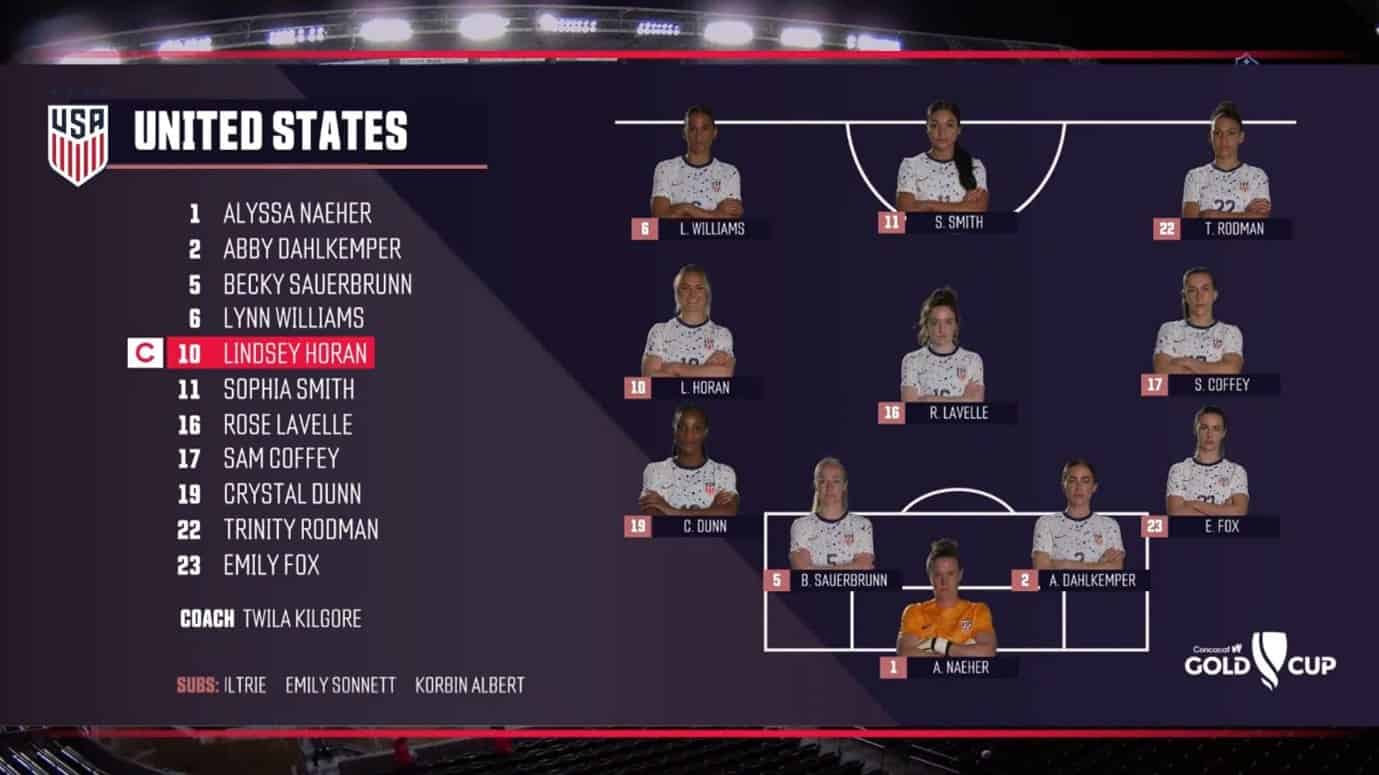
Coming into the three group stage games, Twila Kilgore has rotated the side considerably and played a few different formations. In their opening game against the Dominican Republic, they deployed a 4-4-2 formation.
However, in their second game against Argentina, they deployed a 4-2-3-1 shape, with the only player keeping their place from game one to game two being central midfielder Korbin Albert.
Then, in this final group game, with qualification to the next round already secured, they changed the team again, with this lineup being a combination of the two previous games. With the team lining up in a 4-3-3 shape with Alyssa Naeher starting in goal, in front of her was a backline from left to right of Crystal Dunn, Becca Sauerbrunn, Abby Dahlkemper, and Emily Fox. In midfield, they started with Sam Coffey as the single pivot and Lindsey Horan and Rose Lavelle playing as more advanced midfielders. Then, the front line was Lyn Williams on the left, Trinity Rodman on the right and Sophia Smith through the middle.
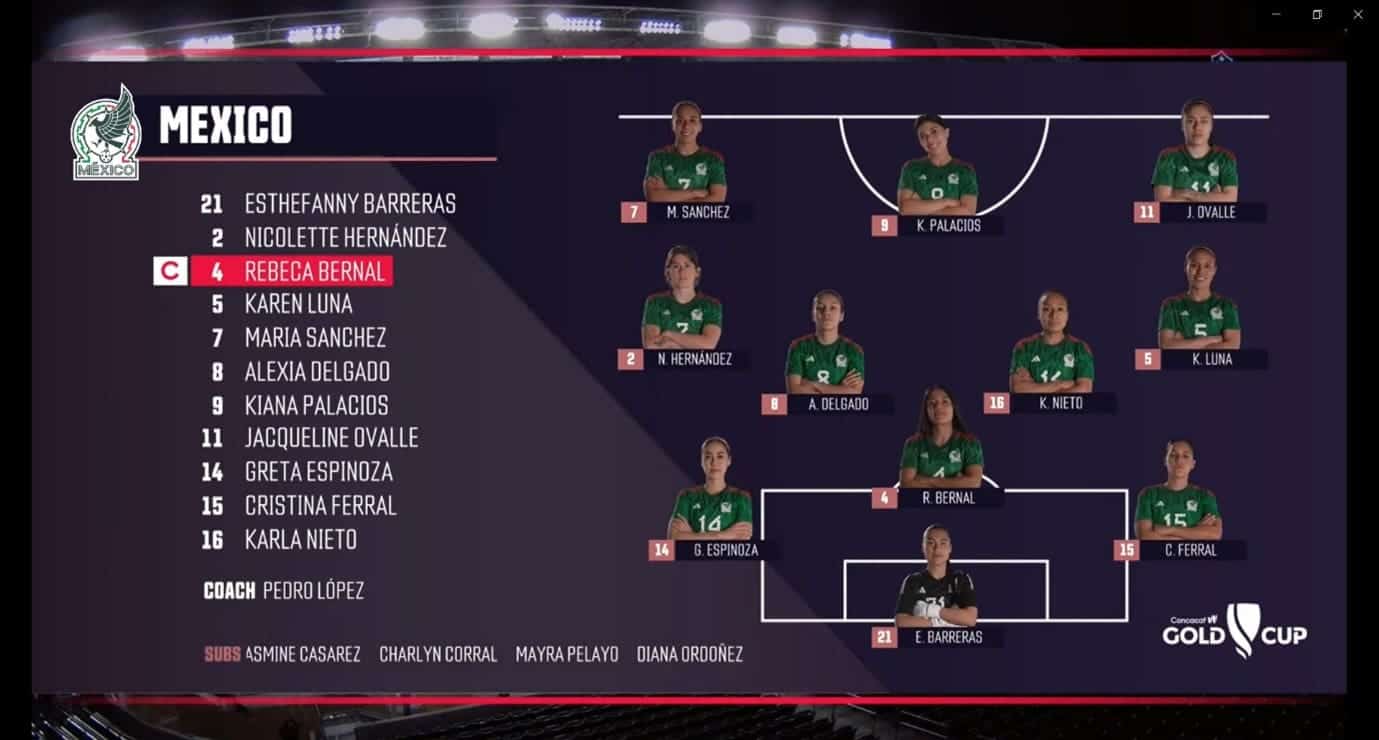
Coming off mixed results in their opening two games, a draw against Argentina and an 8-0 victory over the Dominican Republic, Mexico opted for a change of shape from their previous opening two games.
With Mexico having deployed a 4-2-3-1 in their opening game draw against Argentina, they made a slight adjustment to a 4-4-2 in game two against the Dominican Republic.
However, in this game, Pedro Lopez opted for a 3-4-3 shape with Rebeca Bernal, who started the first two games as captain of the side, playing through the middle; however, she was joined by Greta Espinoza and Cristina Ferral to make a back three. Then, in central midfield, Alexia Delgado and Karla Nieto both kept their places. At the same time, Nicollette Hernandez and Karen Luna, who played the previous game at full-back, were playing in a very similar role as wingbacks. Maria Sanchez, Kiana Palacios and Jacqueline Ovalle were in the front line, with Diana Ordonez making way for the extra defender at the back.
Mexico’s shape change pays dividends
The most obvious place would be the change of shape by Pedro Lopez coming into the game and looking at what impact this had on the side. What it enabled Mexico to do was be aggressive in the defensive shape and operate a zonal pressing system in rest defence.
With the US side operating a 2-3-5 shape in attack, this was an ideal match-up to a Mexico defensive shape that became a 5-3-2 or 5-4-1 shape with both wingers dropping back. Here, we will outline some examples of this in action.
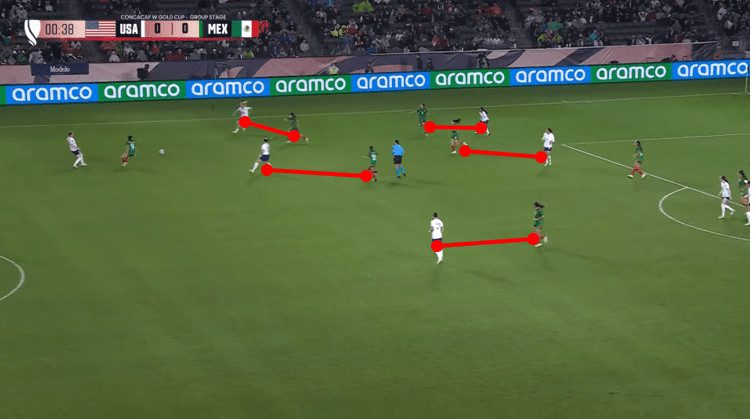
Here, you can clearly see how Mexico is playing a zonal marking system, with every player aware of their US opponent and either blocking a pass or ready to engage when poor passes and touches are made. In this situation above, a poor pass is played into Lindsey Horan, and Mexico is able to win the ball back with Ovalle and launch a counterattack.

In this situation, the US is trying to build up from behind. As soon as the ball is played to Rodman on the right side, this is the trigger for Sanchez to engage and put pressure on the ball. At the same time, Sanchez is pressing though all the other US passing options are closed off, with the only option being a pass to Fox, who has her back to the goal and is prevented from turning by Mexico’s left-back Hernandez.
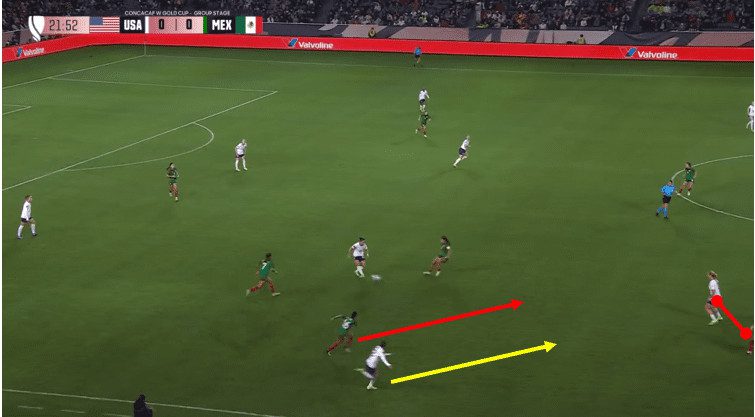
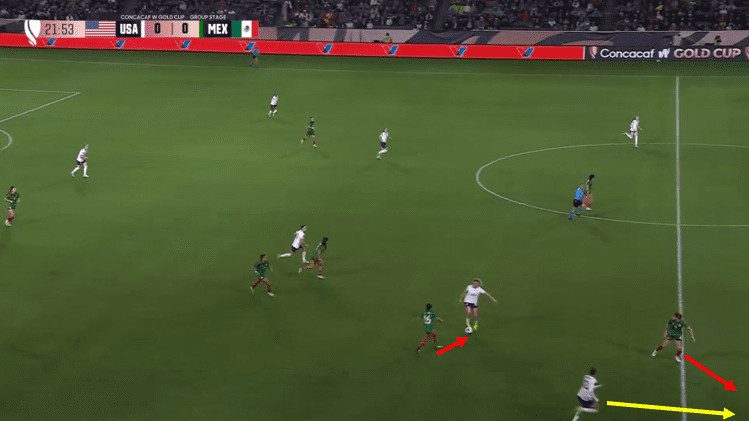
Now, one of the keys to this zonal pressing system is the ability to pass on opponents to each other when they exit one zone and enter another zone. Here is a good clear example of Mexico operating this effectively. Nieto initially tracks wide player Rodman as she begins to overlap, and defender Hernandez tracks Horan in the midfield. However, Rodman advances further and enters Hernandez’s zone. Both Nieto and Hernandez have the understanding to be able to switch roles and pass players off to each other, eventually resulting in the play breaking down and Mexico recovering the ball in the midfield.
Now, having looked at some strengths of this style of defending, let’s look at some weaknesses of this model that the US were able to exploit at times. The first of which is a look at how the US were able to use this passing-off zonal defending to create uncertainty in the defensive shape and, as a result, get the ball forward often through the midfield areas.
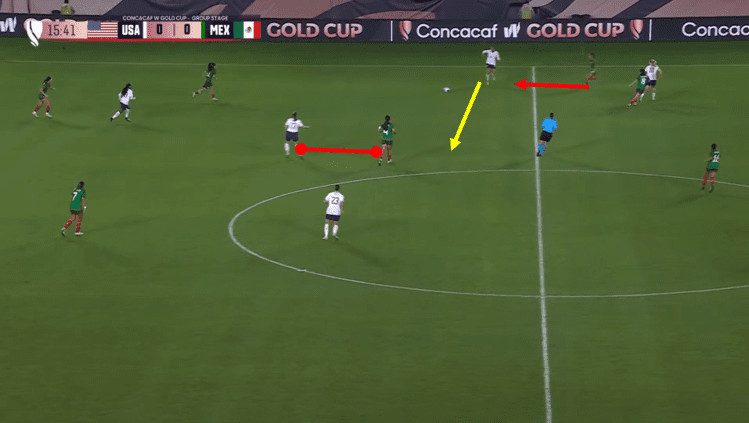

One way they could create this uncertainty was by moving laterally across zones. In this example above, Lynn Williams receives the ball in the wide channel and is being tracked by Luna; however, by moving laterally across the field, she draws the attention of Captain Bernal. This creates space in the midfield, people have to adjust, and Emily Fox is able to get free in space in the midfield and plays a through ball into Rodman, whose cross is blocked, and Mexico eventually get back into their deep defensive shape.
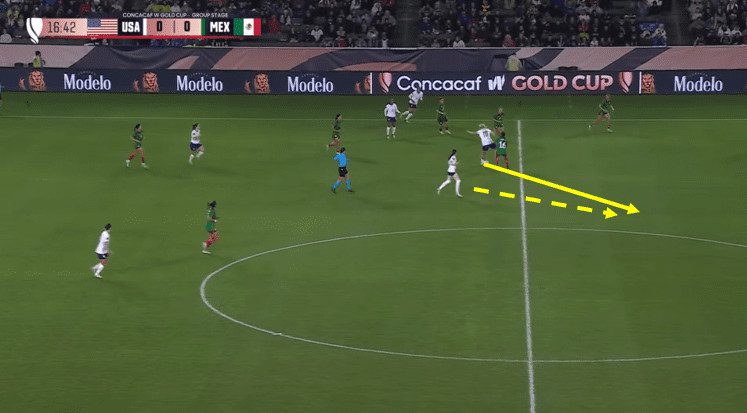
A further way that this uncertainty was caused was through the US quality and their ability to win one-on-one matches, which, as a result, will leave space on the field elsewhere no matter how disciplined you are. So, in this example here, Horan receives the ball back to the goal. However, she is able to roll her opponent’s turn and play a ball into teammate Lavelle in space.
US half-time adjustments and Mexico’s reply
At half time, to create even more uncertainty in the Mexico midfield, what the US did was bring on central midfielder Emily Sonnett for left winger Williams. They also brought off striker Smith for Alex Morgan in a more like-for-like transfer, however, with Morgan being able to link with teammates more adeptly.
What this did was mean that the US had changed their shape into a 3-4-3 with Sonnett and Coffey playing as double pivots. In contrast, Lavelle and Horan played as attacking midfielders, thus creating a box midfield with Rodman and Fox providing the width in front of back three of Dunn, Sauerbrunn and Dahlkemper.
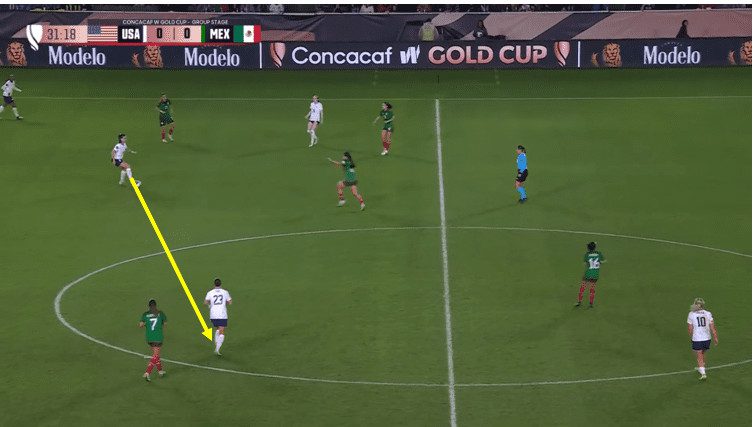
Now, the first example of this in action is actually towards the end of the first half, with Fox playing inverted to create that box midfield. Her being able to find space due to this midfield numerical supremacy enabled her to carry the ball relatively untouched through the midfield before playing the ball towards Williams out wide who wins a corner.
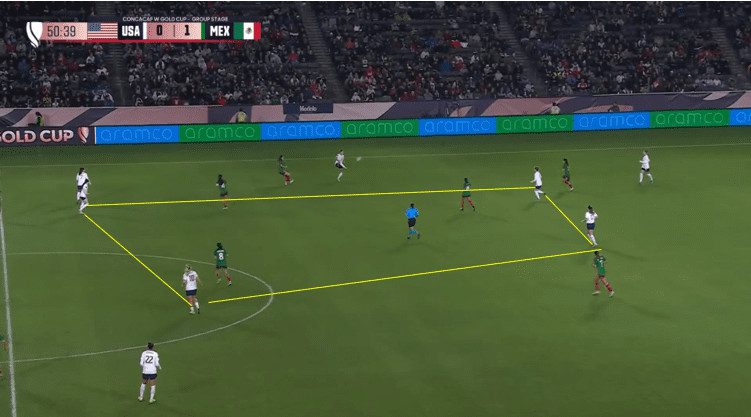
Here, you can see how it looks in the second half with the personnel change. What you can see is that uncertainty has been created for the Mexico wingers; in this case, Sanchez has the choice to either remain as the wide player and worry about Dunn down the left or focus on Coffey, who is in space centrally.
This uncertainty was able to create matchups in the final third, where Mexico defenders could be isolated two against one. In this case, Lavelle gets the ball with Horan outside her in space, and the US side is able to execute this overload and get a dangerous cross into the box, which results in a clearance by a defender off the line.
So, what did Mexico do to try and counteract this change of shape? The answer was to push Bernal forwards into the midfield and switch to a 4-3-3 defensive shape with the two deep midfielders being tracked by a winger and centre forward, Palacios. While the two US attacking midfielders played wide, they tried to create that disconnect in the Mexico shape. With the gap now being filled by Bernal, there was less space available, in particular for Morgan to receive the ball.

You can clearly see the 4-3-3 shape of Mexico, with the midfield now remaining connected and gaps no longer being present through the middle.
Then, for one last adjustment, Kilgore switched to a 3-5-2 with the addition of Purce to play down the middle alongside Morgan. This creates a front four in attack with a midfield three behind that. This was ultimately unsuccessful, as Mexico were able to play their zonal pressing scheme and match up with the US for numbers.
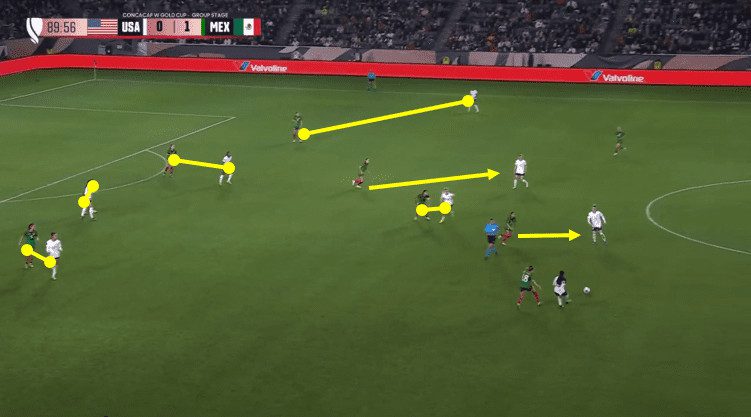
As you can see above, the USA’s midfield three are all being monitored and tracked by a Mexican player. At the same time, the same can be said for the US front line with this change of gameplan, with the US being entirely reliant on them being able to win one-on-one matchups across the field.
Mexico in transition
Now, although their defensive gameplan and adjustments throughout the game were a key component to them being able to get a vital victory in this game, they ultimately didn’t win the game, with goals being the critical component.
The key to this for Mexico was their ability to counterattack at high speed and efficiently to get shots on goal. This worked hand in hand with their defensive tactics as the process of putting pressure on the opposition led to mistakes and errors on the ball being made and Mexico winning the ball back where they had opportunities to then transition from defence to attack. The goal for Mexico is to get the ball forward quickly as opposed to possession retention.
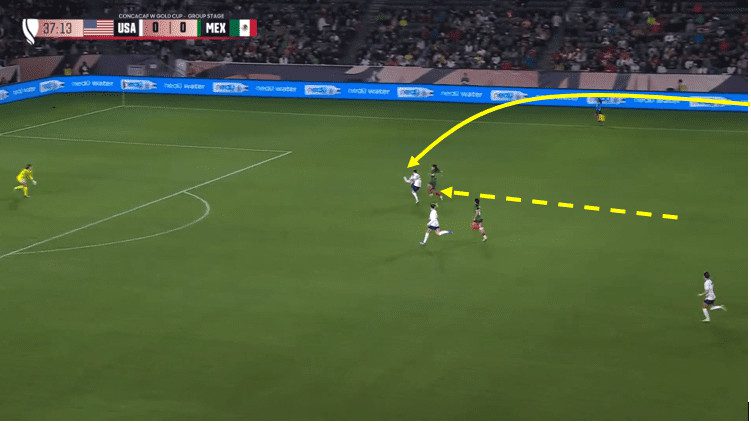
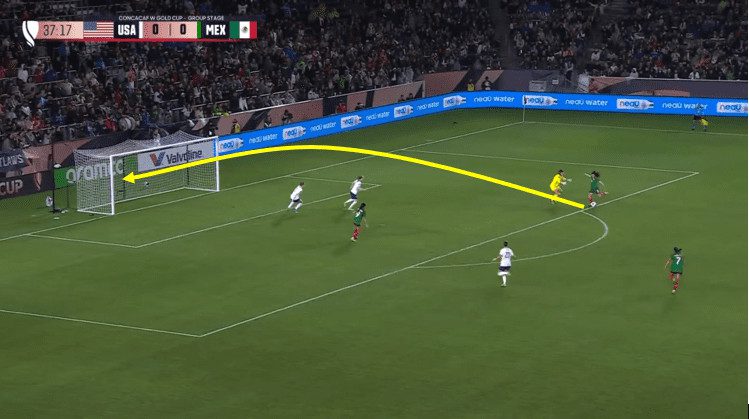
In this example here, you have a hopeful long ball played over the top of the defence by Nieto, with the aim being to control territory following a goal kick. However, Mexico’s principles of getting tight to opponents continue, and Ovalle puts pressure on experienced central defender Sauerbrunn, who makes the mistake and clears the ball into Ovalle, who is able to bring the ball down and have the composure to then chip the ball into the net under pressure from the goalkeeper.

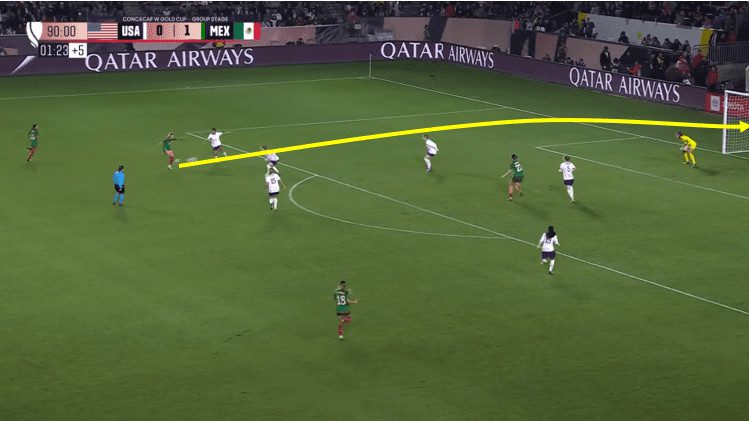
Then comes the game’s second goal, which ultimately finishes off the US side. A long ball is from the right side to the left wing towards substitute Mayro Pelayo-Bernal, who does exceptionally well to turn her defender inside out and finish from outside the box with a top finish.
Another notable difference between the two sides on the day was Mexico clearly had the intention to finish attacks with shots no matter the position on the field, hitting several long-range shots that nearly went in themselves, whereas, on the other hand, the US never had these opportunities to shoot with Mexico putting players behind the ball.

With the ball being won back by forward Palacios, she played the ball into Ovalle, who shoots from range and is able to rattle the crossbar.

However, on the other hand, with the US, Mexico have bodies packed behind the ball and two players converging on Fox as she tries to strike the ball from range.
Conclusion
As you can see from this tactical analysis of the pivotal final group stage game in group A. Mexico had a clear game plan of putting defensive pressure on the US side, and even though they had adjusted what that looked like in the game through their change in shape, the principles, attitude and energy remained the same throughout. They fully deserved their three points to put them top of the group and qualify for the quarter-finals.
On the other hand, the US still qualified for the quarter-final stage, but their first home loss in 80 games to a CONCACAF opponent can’t be forgotten. More worrying, perhaps, was the matter in which they were outsmarted by their opponents.
