


After three matchdays in the Belgian Pro League, KAA Gent were early to sack their manager Jess Thorup. This came as a surprise due to his good results leading to Champions League play-offs last season. This meant that a manager which had proven himself in the Belgian league was free to snatch up. Not much later Genk decided to part ways with Hannes Wolf. This resulted in hiring Genk signing Thorup as their head coach.
With this in mind, matchday seven in the Belgian Pro League promised to be an interesting one. Genk would take on Oostende. Oostende have had a rather steady start to the season under the management of former youth coach in the Bundesliga at RB Leipzig Alexandre Blessin.
The match finished in a 2-2 draw under interesting tactical circumstances. This tactical analysis will break the match down into various game moments to provide analysis and insights into the tactics utilised by the two sides.
Lineups and formations
In his first game ar Genk, Thorup decided to step away of his favoured four-diamond-two formation, which he often used when he was at Gent. This time he opted for a 4-2-3-1. Maarten Vandervoordt started in goal and the defence consisted of Jere Uronen, Lucumí Carlos, Cuesta Figueroa and Joakim Mæhle. The central midfield was occupied by Patrik Hrošovský, Bastien Toma and Kristian Thorstvedt. Whilst the offensive flanks consisted of Junya Ito and Luca Oyen. Ebere Onuachu led the line for Genk.
 The away side Oostende started in a 4-3-1-2 formation. In goal was Guillaume Hubert, with defender Jelle Bataille at left-back and Théo Ndicka Matam at right-back. Between them, Arthur Theate and Anton Tanghe were the centre-back partnership. The three-man midfield consisted of the experienced Kevin Vandendriessche, Andrew Hjulsager and Maxime D’Arpino, who was in the holding role. In front of them, in the No. 10 position was Cameron McGeehan. Makhtar Gueye and Fashion Sakala led the line.
Oostende’s pressing system exploited
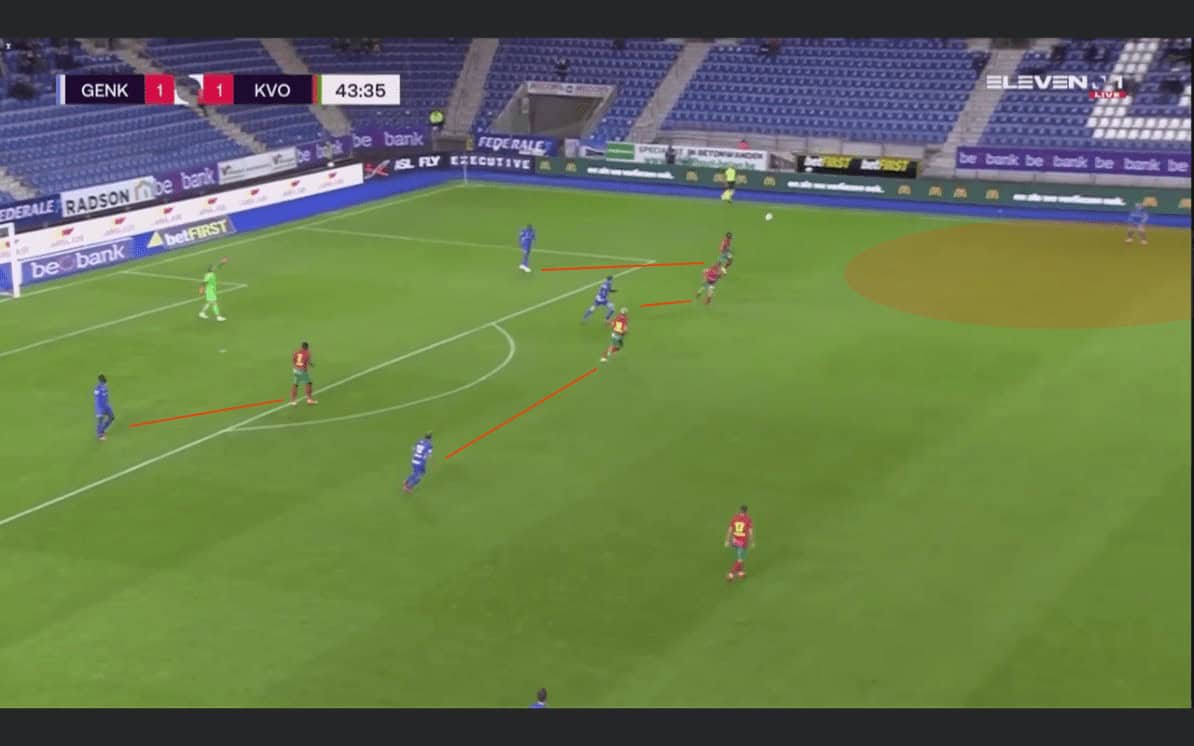
As Blessin has worked as a youth coach in one of the clubs most famous of their high pressing intensity, the German coach also applies this high pressing intensity at Oostende. Their overall PPDA rate during this game was at an impressive 5,3. This means Blessin’s men were constantly chasing down the ball once they lost it and more importantly not allowing Genk to play out of the back. Oostende’s pressing system did get exposed often, this allowed Genk progress through the thirds from the back. Some positional mistakes were the reason for this happening.

Subscribe To TFA To Unlock All Posts - Free 7 Day Trial
Try TFA Free For 7 Days
Gain access to all of TFA's premium contents.More than 12,000+ articles.

