Bradford City have long been one of the biggest ‘fallen giants’ in English football.
Last appearing in the Premier League in 2000/2001 when they finished bottom of the table, the Bantams spent the last six seasons in EFL League Two before finally managing to earn promotion to the third tier under Graham Alexander earlier this year, securing their place in EFL League One for the 2025/2026 campaign.
The Yorkshire club have got off to a flyer in the third tier, as well, going unbeaten in their first six games, winning four and drawing two, placing them sixth at the time of writing.
Bradford City had an average attendance of almost 18,000 in League Two last season, dwarfing the figure achieved by the next best Notts County, who boasted a figure of just over half Bradford’s attendance numbers.
This demonstrates the size of the club, the loyalty of its supporters, and the potential that exists to be tapped into should they continue their ascent up the English footballing pyramid.
After achieving promotion last term, Graham Alexander tactics have led the club to a successful start in 2025/2026; this Bradford City tactical analysis aims to outline the Graham Alexander tactics driving Bradford’s resurgence, focusing on their dominance in transition.
Graham Alexander Style Of Play
Graham Alexander sets his Bradford City side up in a 3-4-2-1 formation.
The Bantams have averaged just 40.9% possession in England’s third tier this season, yet they’ve generated the highest xG (10.45) of any side in their division six games into the 2025/2026 campaign, scoring 10 goals.
They average the third-most shots per 90 (11.75), third-fewest passes per 90 (263.59) and lowest pass accuracy (69.8%) of any side in League One this term.
All this data points to a side that has little interest in playing with patience in possession.
They also engage in a relatively high number of defensive duels and aerial duels per match.
Bradford’s game under Graham Alexander is all about quickly winning the ball back and driving towards goal with it.
Alexander’s players constantly press on the front foot and get their heads up with the ball, looking to progress.
This Bradford side is ultra-aggressive about putting the opposition’s backline under intense pressure in every way possible; that’s what their game is all about.
As we delve further into Graham Alexander’s tactical principles, we’ll explore the ins and outs of how his team achieves this ideal.
Graham Alexander Pressing Tactics
Calling Bradford City a ‘counterattacking’ side or one that thrives in transition may convey the idea that they like to sit deep, absorb pressure, and try to hit the opposition on the break by targeting space behind their backline.
However, Graham Alexander’s side is very comfortable pressing high, aiming to force turnovers on the edge of the opposition’s penalty area as well.
This can create golden opportunities to attack the opposition when they’re a little more open due to having just lost the ball while trying to build out from the back.
They’ll press in their 3-4-2-1 shape, with all players prepared to close the opposition down aggressively on the front foot, trusting a teammate will follow to cover the space behind them and deny the opposition a chance to just play the ball in behind the pressing player.
Thus, the central midfielders and centre-backs in the 3-4-2-1 shape play a key role in the effectiveness of Bradford’s pressing.
As the striker, wingers and wing-backs press high, the central midfielders and centre-backs must be prepared to jump from their settled position to protect the space behind those aggressive pressing players.
This ensures Bradford’s shape remains vertically compact, and it doesn’t invite the opposition to exploit the open space between the lines.
The central midfielders and centre-backs can also be pivotal in forcing high turnovers with their commitment to the press.

Here, the Peterborough United centre-back manages to thread the ball between Bradford’s pressing right-forward and centre-forward, finding a teammate in central midfield.
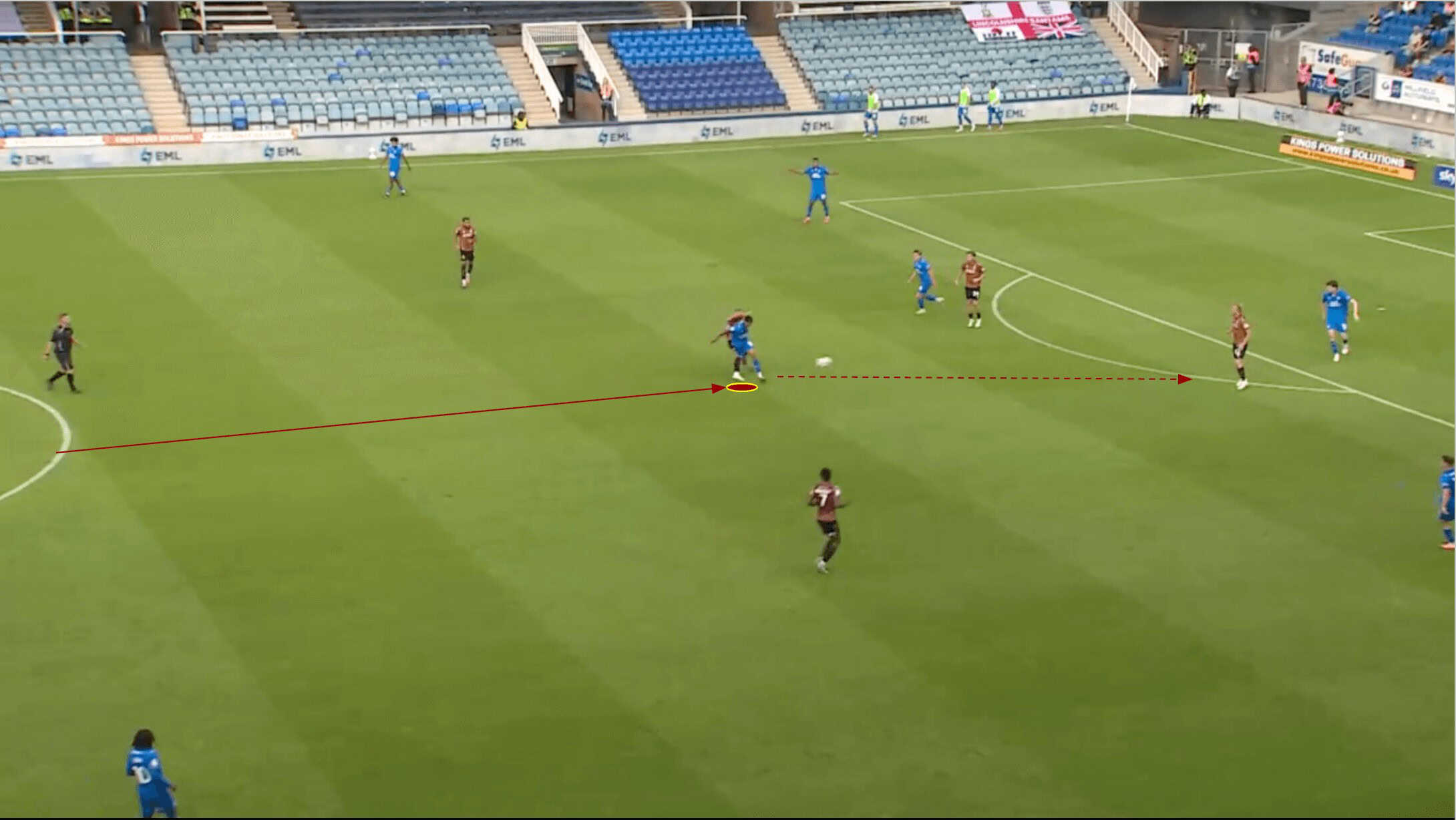
Before the receiver can turn and face forward, one of Bradford’s two central midfielders is on him, performing a successful tackle and turning this into an opportunity to create a goalscoring chance versus an unsettled defence inside the final third.


![Lazio Vs Napoli [0–2] – Serie A 2025/2026: Maurizio Sarri Zonal Marking Weaknesses And Unsuccessful Attacking Choices – Tactical Analysis](https://totalfootballanalysis.com/wp-content/uploads/2026/01/Lazio-Vs-Napoli-tactical-analysis--350x250.png "Lazio Vs Napoli [0–2] – Serie A 2025/2026: How Antonio Conte Tactics Exploited Structural Flaws – Tactical Analysis 6")