After lifting the 2024/2025 Premier League title, Liverpool entered the summer transfer window with an unmistakable sense of ambition.
Under new tactical leadership, the Reds were not merely content to defend their crown; they were intent on refining and reinforcing their squad to maintain both domestic and European dominance.
This intent was made clear through a proactive recruitment drive, shaped and steered by the club’s highly regarded data analysis department.
The departures of key figures Luis Díaz, Darwin Núñez, and Trent Alexander-Arnold, the latter making a high-profile move to Real Madrid, could have left sizeable gaps in the team’s structure.
Instead, Liverpool responded with precision signings designed not just to replace, but to upgrade.
Jeremie Frimpong was identified as the ideal modern right-back to fill Alexander-Arnold’s role, offering explosive pace, progressive carrying, and advanced attacking output.
On the opposite flank, Milos Kerkez arrived as a strategic left-back upgrade.
His energy, defensive discipline, and attacking versatility provided a fresh dynamic in a position where Andrew Robertson’s performances had dipped in consistency.
Up front, the additions of Hugo Ekitiké and Florian Wirtz signalled Liverpool’s commitment to evolving their attacking play.
Ekitiké brings youthful athleticism, pressing intensity, and a profile suited to breaking defensive lines, while Wirtz offers creative ingenuity, elite ball progression, and the versatility to operate across multiple attacking roles, qualities that directly elevate the squad following the losses of Díaz and Núñez.
In this data analysis, we will explore how and why Liverpool’s data team chose these four players, examining the statistical reasoning behind each acquisition and the tactical fit within Arne Slot’s evolving structure.
We will analyse their profiles against the outgoing players, assess their potential impact on Liverpool’s style of play, and consider how these moves position the Reds for sustained success in 2025/2026 and beyond.
Balancing The Flanks: Why Liverpool Chose Jeremie Frimpong & Milos Kerkez For Defensive & Attacking Balance
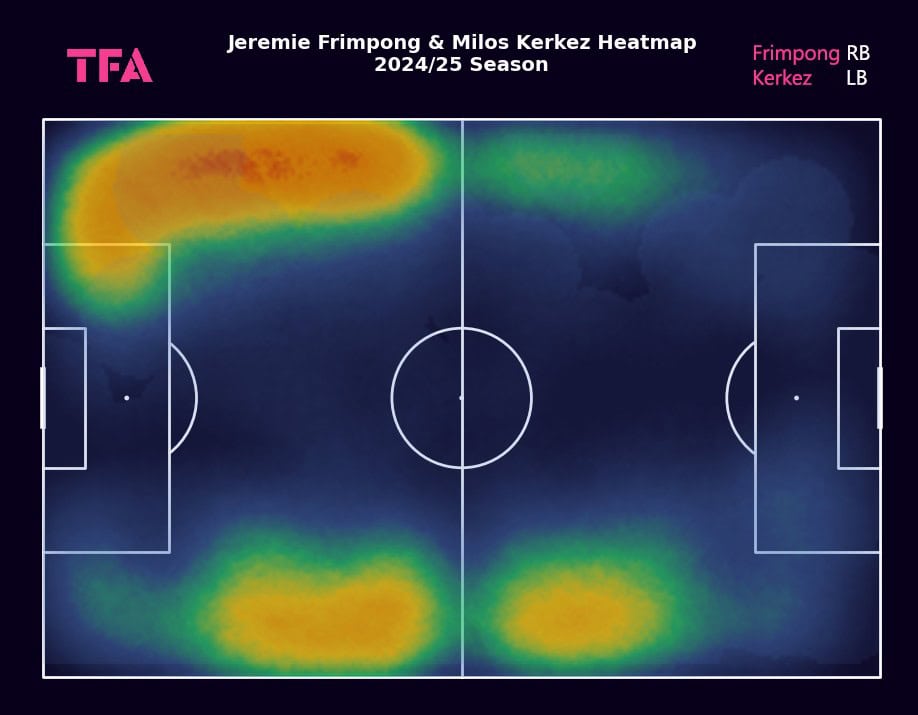
A glance at the combined heat map of Jeremie Frimpong and Milos Kerkez immediately reveals the contrasting tactical roles that informed Liverpool’s decision to recruit them.
Frimpong’s positioning is heavily skewed towards the opposition half, often overlapping into winger zones and providing width high up the pitch.
This advanced heat signature underlines his role as an aggressive, attack-minded full-back.
He frequently operates as an auxiliary winger to stretch defensive lines and create overloads on the right.
In contrast, Kerkez’s heat map shows a more balanced spread across defensive and middle thirds, reflecting the traits of a more traditional left-back who supports attacks without abandoning defensive structure and ensures solidity on the flank.
Jeremie Frimpong & Milos Kerkez 2024/2025 Heat Map
The data backs up this tactical distinction.
For Frimpong, his five goals and three assists from right-back underline his direct attacking output, while his 137 crosses show his intent to supply from advanced areas.


![Lazio Vs Napoli [0–2] – Serie A 2025/2026: Maurizio Sarri Zonal Marking Weaknesses And Unsuccessful Attacking Choices – Tactical Analysis](https://totalfootballanalysis.com/wp-content/uploads/2026/01/Lazio-Vs-Napoli-tactical-analysis--350x250.png "Lazio Vs Napoli [0–2] – Serie A 2025/2026: How Antonio Conte Tactics Exploited Structural Flaws – Tactical Analysis 6")