
France come into the 2023 FIFA Women’s World Cup after a turbulent few years for the national team. The Corinne Diacre era was mired by controversy throughout, with the 2017 SheBelieves Cup-winning coach being dismissed in March, paving the way for Hervé Renard to take the reins for the lead-up to this summer’s major tournament.
Renard arrives with an impressive pedigree in international football. He’s got two Men’s African Cup of Nations wins on his CV (2011/12 with Zambia and 2014/15 with the Ivory Coast), while he helped Morocco to qualify for their first FIFA Men’s World Cup since 1998 back in 2018 before guiding Saudi Arabia to a victory over Argentina while playing some quite impressive football in the 2022 Men’s World Cup.
Now, Renard has stepped back into European football but remained in his realm of international management as he’s taken charge of his native France. This is his first job in the women’s football world but with a heap of tournament football experience in his back pocket to rely upon, as well as the fact that, for some players, the sight of a coach who’s not Corrine Diacre will be bliss, the 54-year-old may be able to light a fire under this squad at just the right moment to deliver a 2023 World Cup performance for French football fans to be proud of.
This tactical analysis and team-focused scout report shares analysis of France’s strategy and tactics in attack, defence and transition. We’ll also have some sections focusing on the different players available to Renard separated into different areas of the pitch and some discussion around a player we’ve picked out as being crucial for this team’s success this summer.
Predicted starting XI
Our first section focuses on Renard’s 26-player preliminary squad, as announced on the sixth of June, which is the most up-to-date, confirmed selection of players for France that we have at the time of writing, as we wait for the final 23-player squad to be announced.

Figure 1 provides an age profile of the squad, with the prime age range of 24-30 highlighted. As we can see above, 16 of the 26 players fit into this prime age range, indicating that France have selected a team of players at the peak of their respective powers for the most part.
We also see a healthy mix of youth and experience in the preliminary squad selection; we expect players from both of these sections to contribute significantly during the tournament even though we anticipate the bulk of the starting XI to be made up of players in their prime years.
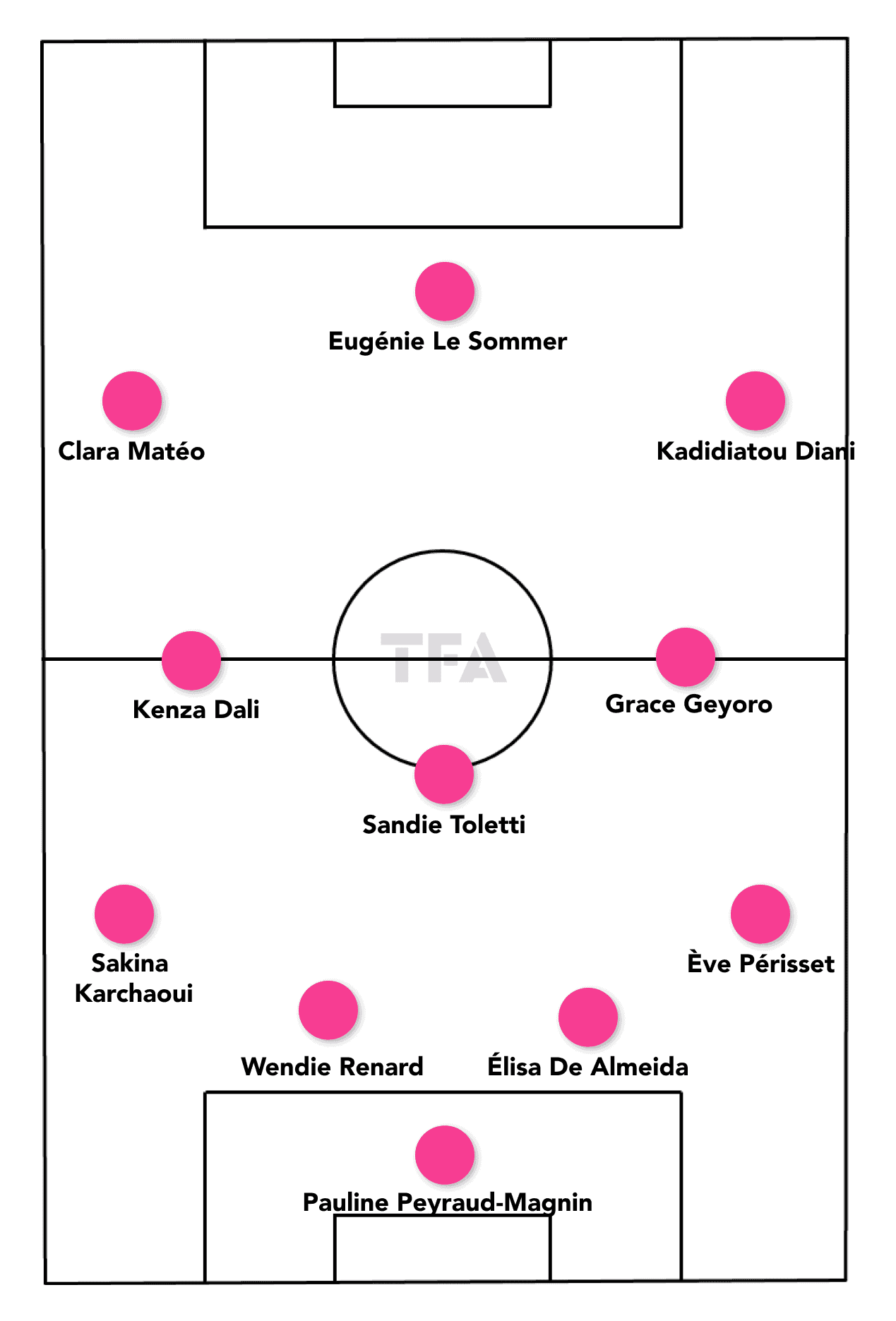
Here in figure 2, we have our predicted starting XI for the tournament. Of course, this could vary depending on specific opponents, form and injuries among a host of other factors that could alter France’s plans. If one or two names are different to this on the opening day versus Jamaica, don’t hold it against us! However, we feel that this starting lineup is one of the strongest that Renard could potentially field.
There’s an experienced spine consisting of Pauline Peyraud-Magnin (GK), the returning Wendie Renard (LCB), Kenza Dali (LCM) and Eugénie Le Sommer (CF) surrounded by peak-age players.
Joining Renard in the backline, we’ve got Sakina Karchaoui and Ève Périsset in the full-back positions, while we’ve got in-form Élisa De Almeida partnering the experienced defender at centre-back.
Real Madrid’s Sandie Toletti (DM) and PSG’s Grace Geyoro (RCM) partner Dali in the middle of the park for us, though this selection was one of the most difficult for us as there are a few conceivable combinations in the centre of the park to consider, all of which make sense, so some rotation may be inevitable in this part of the pitch.
Meanwhile, we’ve put Clara Matéo (LW) and Kadidiatou Diani (RW) up front on either side of Le Sommer to complete our starting XI. Emphasis on our — again, there are other attacking combinations that could just as easily trump this one for Renard.
We’ll discuss each section (defence, midfield and attack) in greater detail when the time comes for those relevant sections later on in the article to dive into the other possibilities we’ve touched on here but for us, this starting XI provides plenty of experience and ability which Renard can rely on for his maiden tournament as boss of this national team.
Attacking phase

Moving on, let’s start the tactical analysis by looking at France’s attacking phase. Firstly, in figure 3 we have a radar that highlights France’s percentile rank in several key areas relating to Les Bleues’ in-possession phases when compared with their World Cup opponents.
It’s clear that France are one of the more dominant teams participating in the tournament; they score plenty of goals, generate plenty of chances and keep a lot of the ball — something that Renard will only try to enhance if anything, as the typically possession-based coach puts his stamp on the team.
It’ll be nice for Renard to see the set-piece efficiency % ranking looking quite healthy as well and undoubtedly, the 54-year-old and his coaching team will try to put one or two routines in place to give this area of their game a boost heading into the World Cup, with the international football specialist fully aware of how set-pieces can make a major difference in the tournament format.
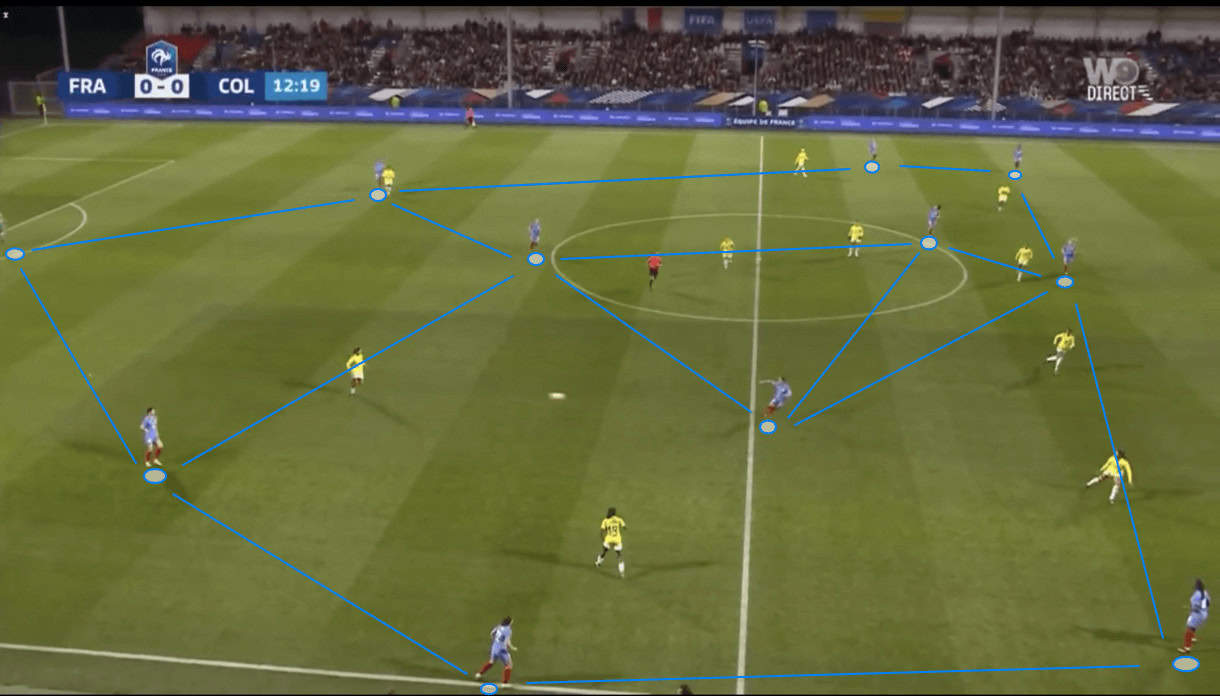
Our next image, figure 4, shows how this France team typically sets up in possession; this is how they’ve set up on the ball under Renard in their short time working with the 54-year-old so far and how we imagine they’ll continue to set up for the World Cup.
We’ve seen this national team line up in some alternative shapes at times over the past year, with the 3-4-3 having been tried out on occasion, and Renard has often utilised the 4-2-3-1 during his coaching career. However, with so little preparation time, we feel it makes the most sense to stick with this tried and tested setup for the World Cup, which suits plenty of the available personnel and could get the best out of key individuals.
Again, France are a heavily possession-based side, while Renard loves to see his teams keep the ball, putting together neat little passing combinations and carefully dissecting the opponent’s defensive block apart. We expect to see plenty of methodical possession play from Les Bleues in Australia and New Zealand. There’ll be long periods where the opposition need to concentrate and remain disciplined without the ball while France try to identify a route to goal.
From build-up, France’s centre-backs typically position themselves fairly wide, while the holding midfielder drops into the space ahead of them more centrally, creating something of a diamond between the goalkeeper, two centre-backs and holding midfielder.
In the middle of the park, each of the three central midfielders will position themselves on different specific vertical and horizontal lines to occupy different points of the pitch. This makes them more difficult for the opposition to mark while creating different varieties of angles for the deeper ball progressors.
Meanwhile, up front, the wingers will stay wide in this phase of play but we’d expect to see them look to make penetrative runs in behind as the ball moves more towards the final third. Le Sommer can provide an option for centre-backs and midfielders to aim for as they look to progress forward but she’ll really shine with her masterful off-the-ball movement inside the penalty box as she looks to occupy good goalscoring positions where she can be found before then efficiently putting the ball away.
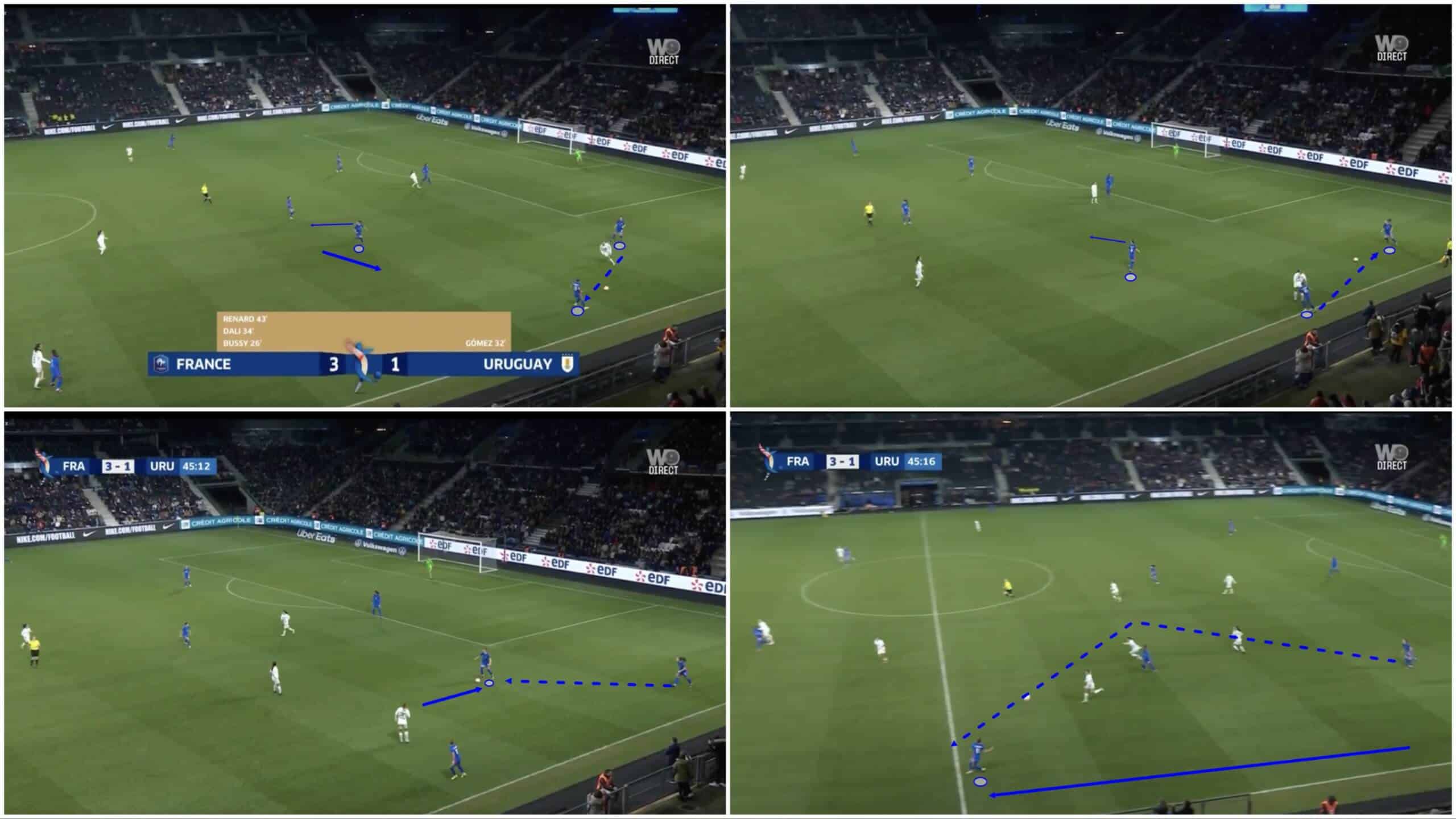
Toletti will likely play as the holding midfielder and her movement will be crucial in helping her team progress from build-up to ball progression while her passing quality will be vital in moving from progression to chance creation.
We see an example of her moving into space where a teammate can find her above as she continuously checks her shoulder at excellent times — with both images above showing her deciding to do so as the ball is in motion between two teammates, not in danger of drastically changing direction. This is the kind of intelligent play necessary for the holding midfielder often acting as the nucleus of the attack.
When she finally receives, she’s got time to turn, get her head up and pick out a nice lofted through ball for the left-back charging down the wing to help her team progress into a more threatening position and create a decent attacking opportunity.
I’d expect to see deep lofted balls from these kinds of positions playing an important role in France’s progression in this tournament and Renard’s women creating plenty of exciting attacking plays after the deep midfielder opts to flick the switch and send the team forward as the reliable Toletti did here.
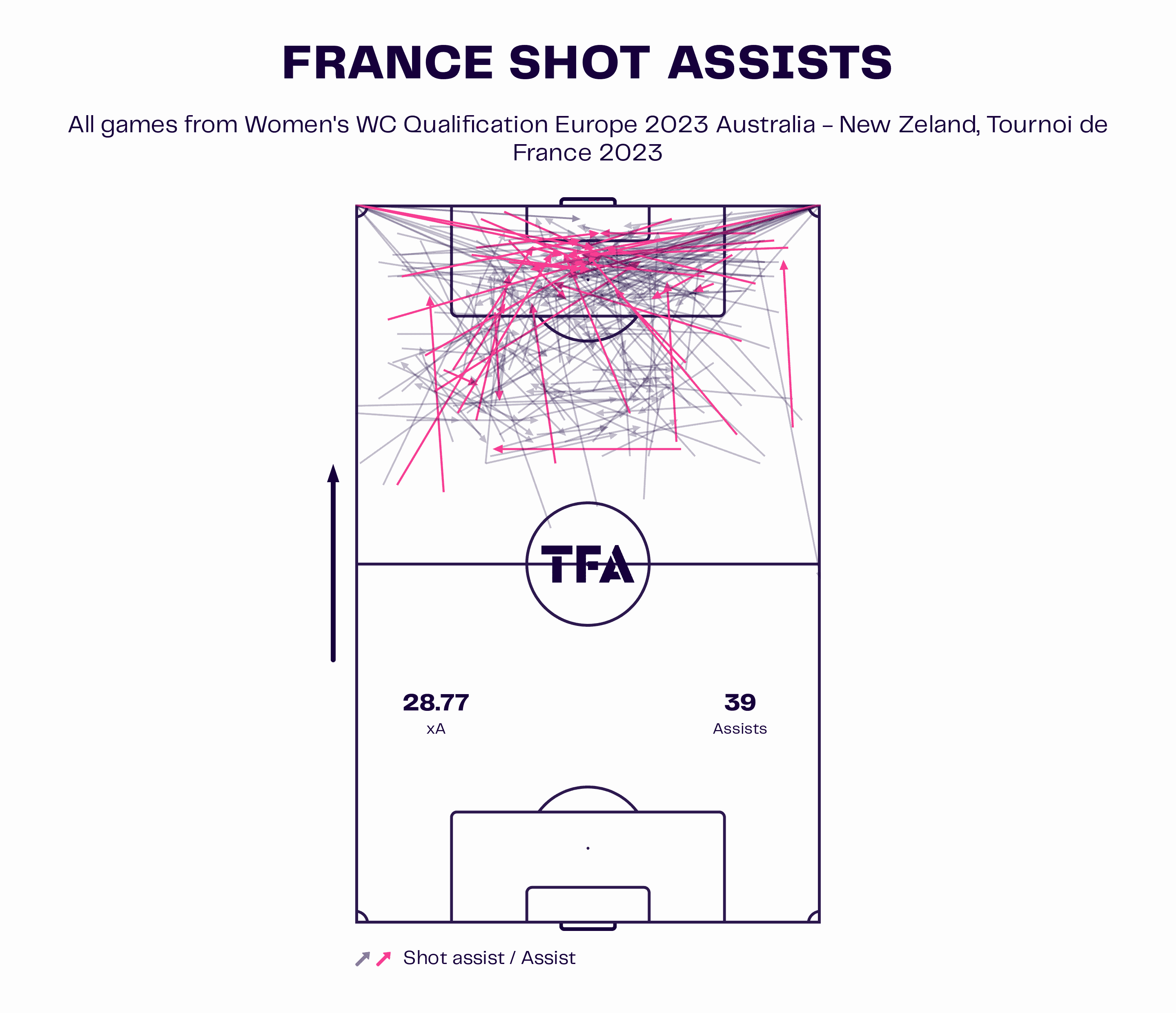
Inside the final third, France typically create their goalscoring chances via crosses from advanced positions or through balls from the half-spaces, which is displayed in figure 6. The wingers, full-backs and wide central midfielders can all perform important roles in this phase at different times.
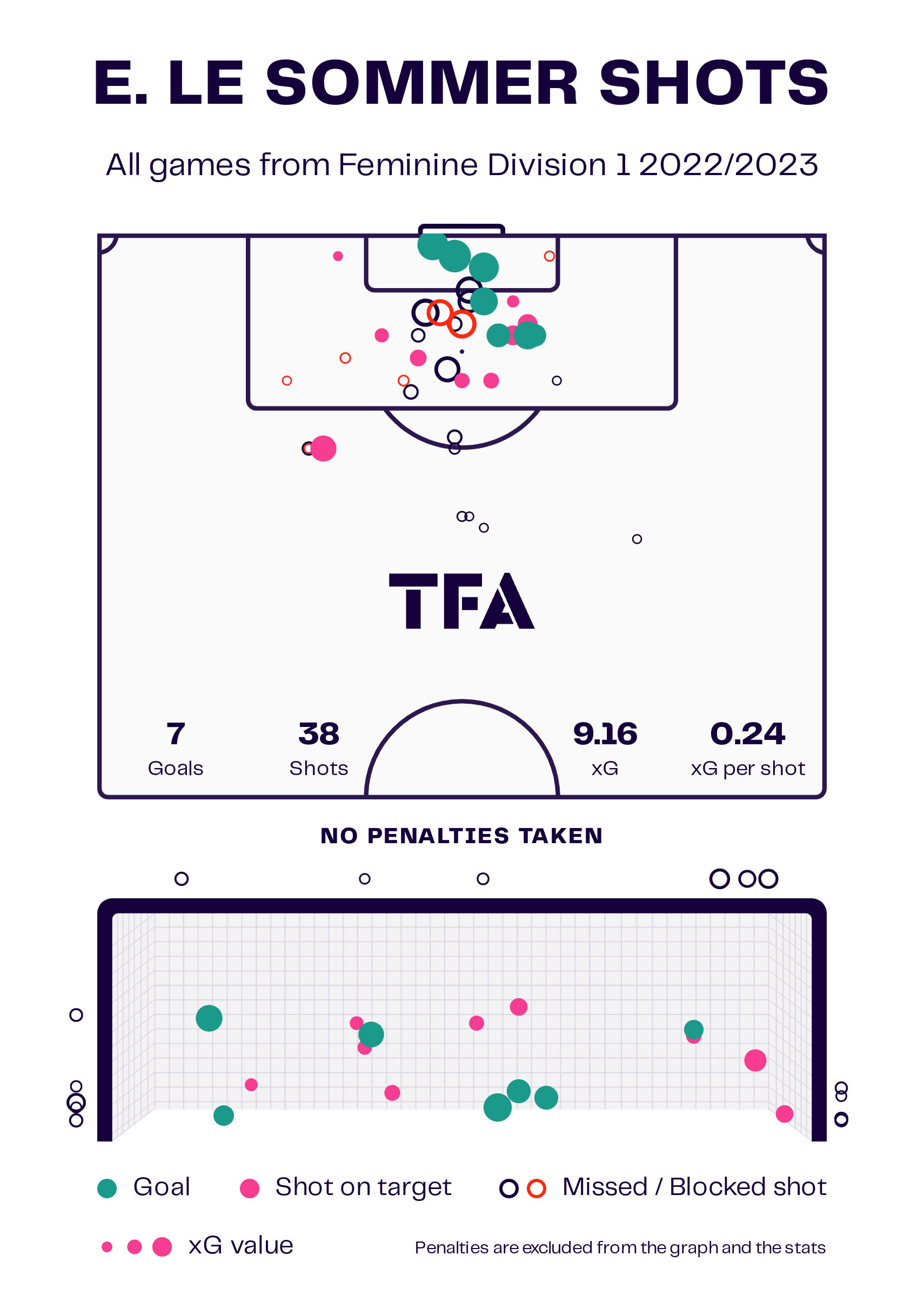
Now, figure 7 shows Le Sommer’s shot map from the 2022/23 Division 1 Féminine. Here, we can see a visual representation of the efficient shot-taking resulting from the masterful movement and positioning on display from the attacker that we mentioned previously.
An xG per shot of 0.24 is quite high and indicates that in Le Sommer, Renard possesses a centre-forward who knows where she needs to be in order to give herself the best chance of scoring from a given shot, as well as very good decision-making. If her teammates can consistently find her, that means they’re putting the ball into good areas and this will only be a good thing for France’s World Cup hopes.
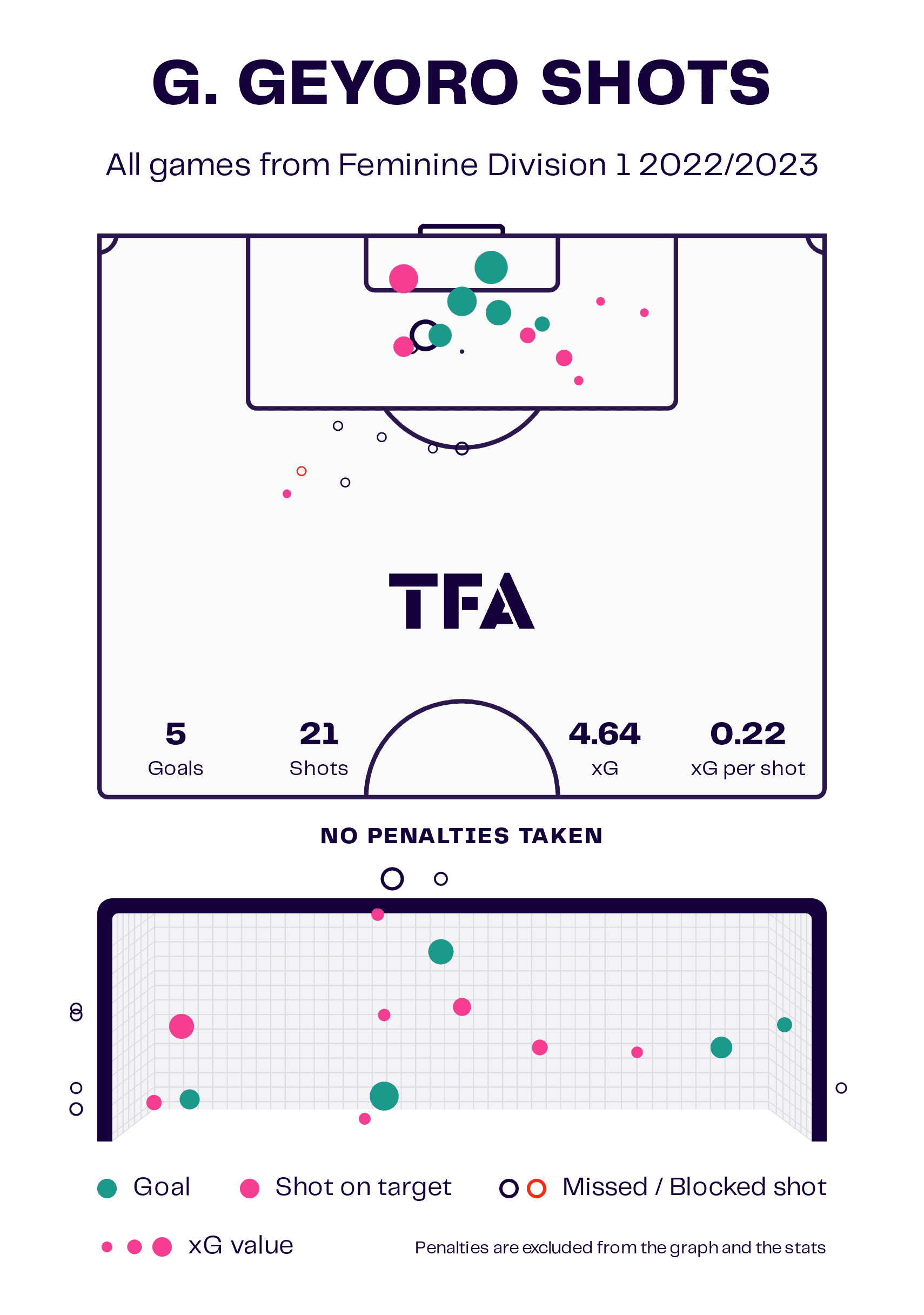
Expect Grace Geyoro, who we’ve positioned at right central midfield in our predicted starting XI, to get forward and potentially contribute a couple of goals for her side as well in this tournament. Over the last calendar year, she’s generated the highest xG (8.36) of any capped French midfielder and again, her attacking contribution isn’t longshots and speculative efforts, she’s making runs from deep and arriving in the box in good positions, hence her impressive 0.22 xG per shot.
Le Sommer should attract attention from opposition defenders as will the two wide attackers if they get into the box but this could create opportunities for Geyoro to exploit some space as she arrives late. Her attacking threat can’t be underestimated by opposing teams when she’s on the pitch.
Defensive phase
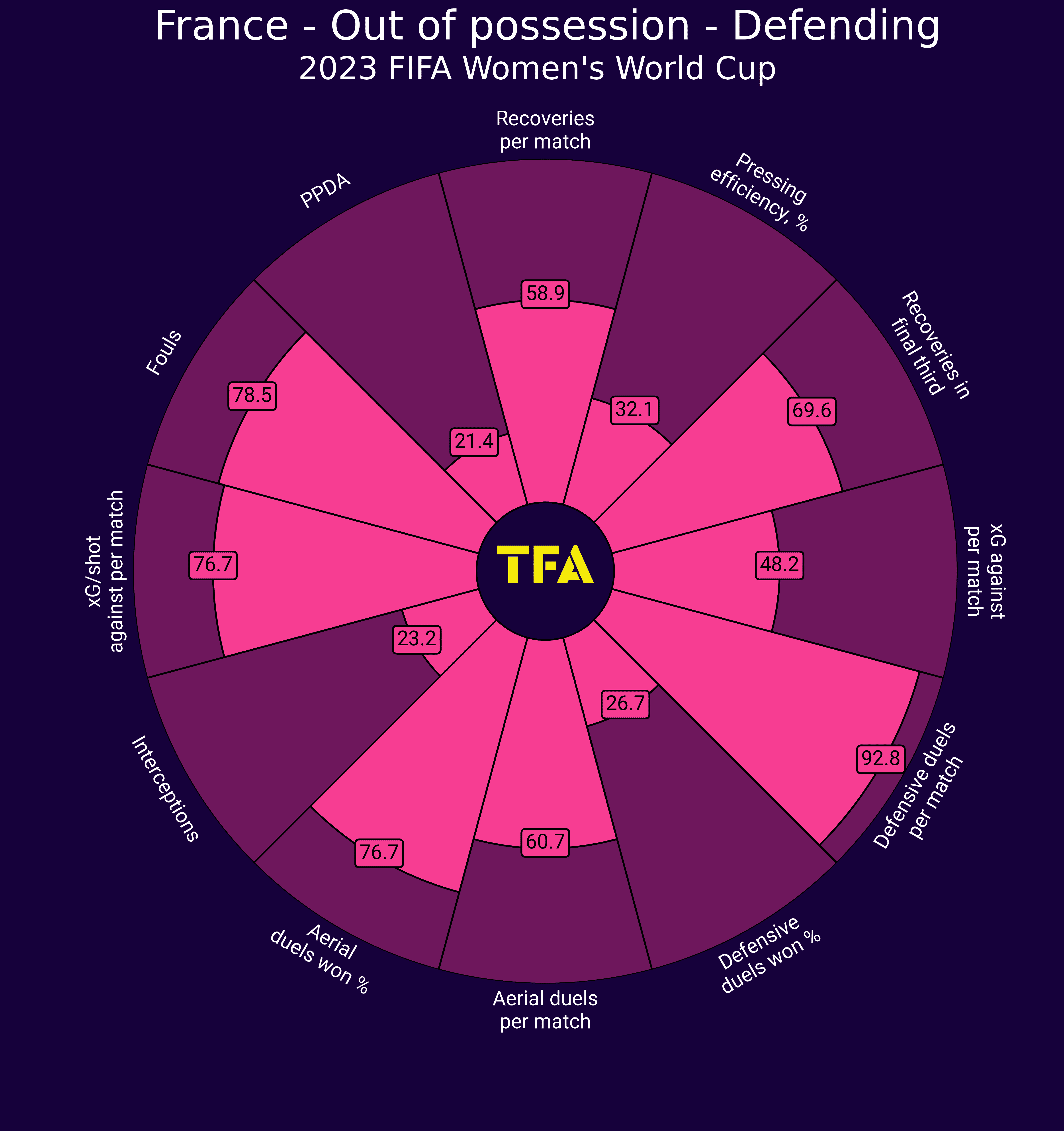
Off the ball, France defend quite aggressively, as their low PPDA percentile rank in figure 9 depicts. They make plenty of high recoveries but if they fail to win the ball when committing bodies high, that can leave them vulnerable at the back.
An area of strength for this side is their capacity to win aerial duels — again, something that can come in very handy in tournament football and give Renard’s women a boost at set-pieces. They may need this aerial ability at defensive set-pieces, given that France are more susceptible to committing fouls than most.
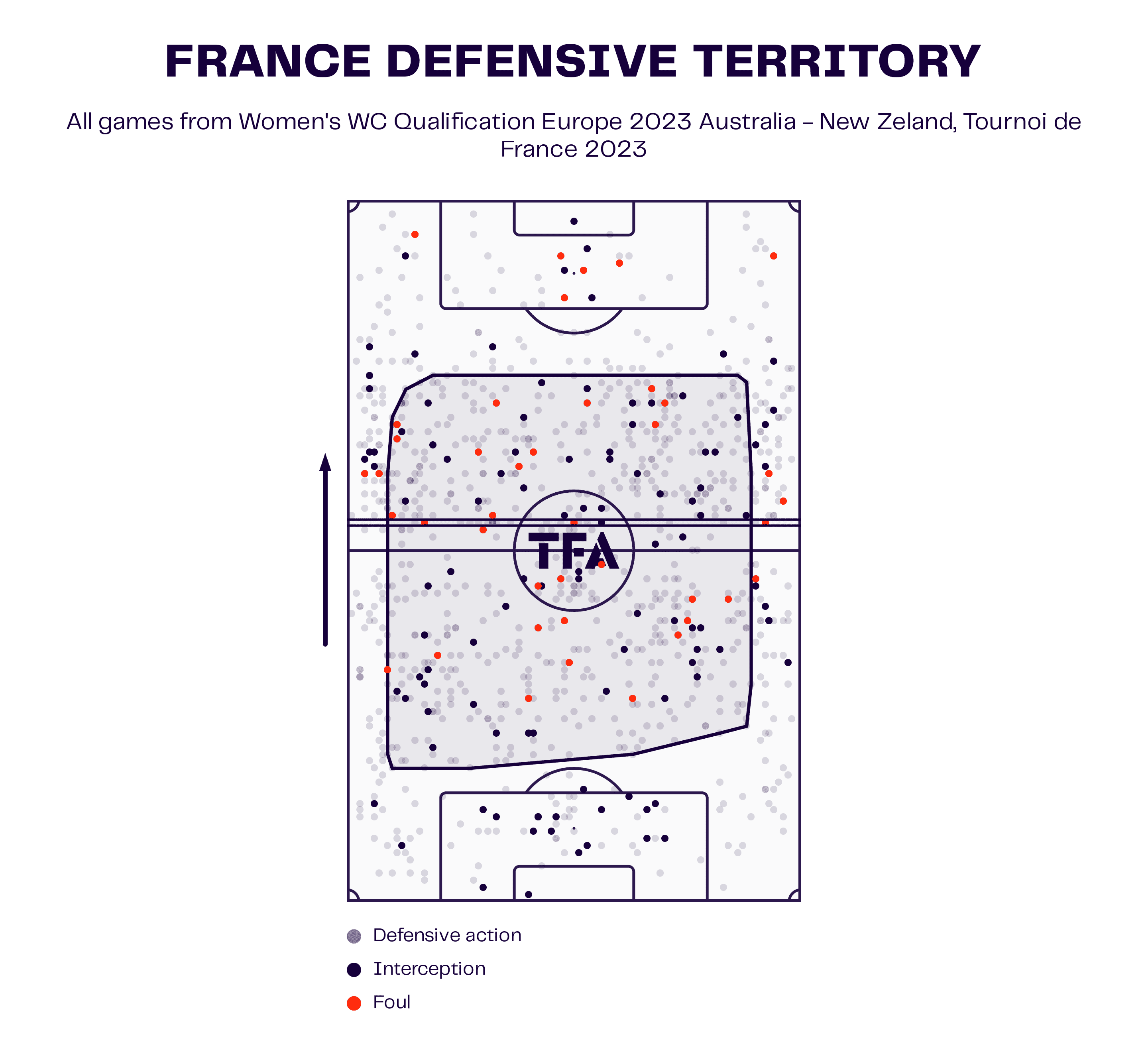
Renard has inherited a group of players who are super comfortable defending high, as the ultra-high average defensive line height from figure 10 indicates. They typically offer a lot of defensive energy and in games over the past year, have generally been very well-organised in how they press off the ball which is something Renard needs to ensure the continuity of — sometimes far easier said than done.

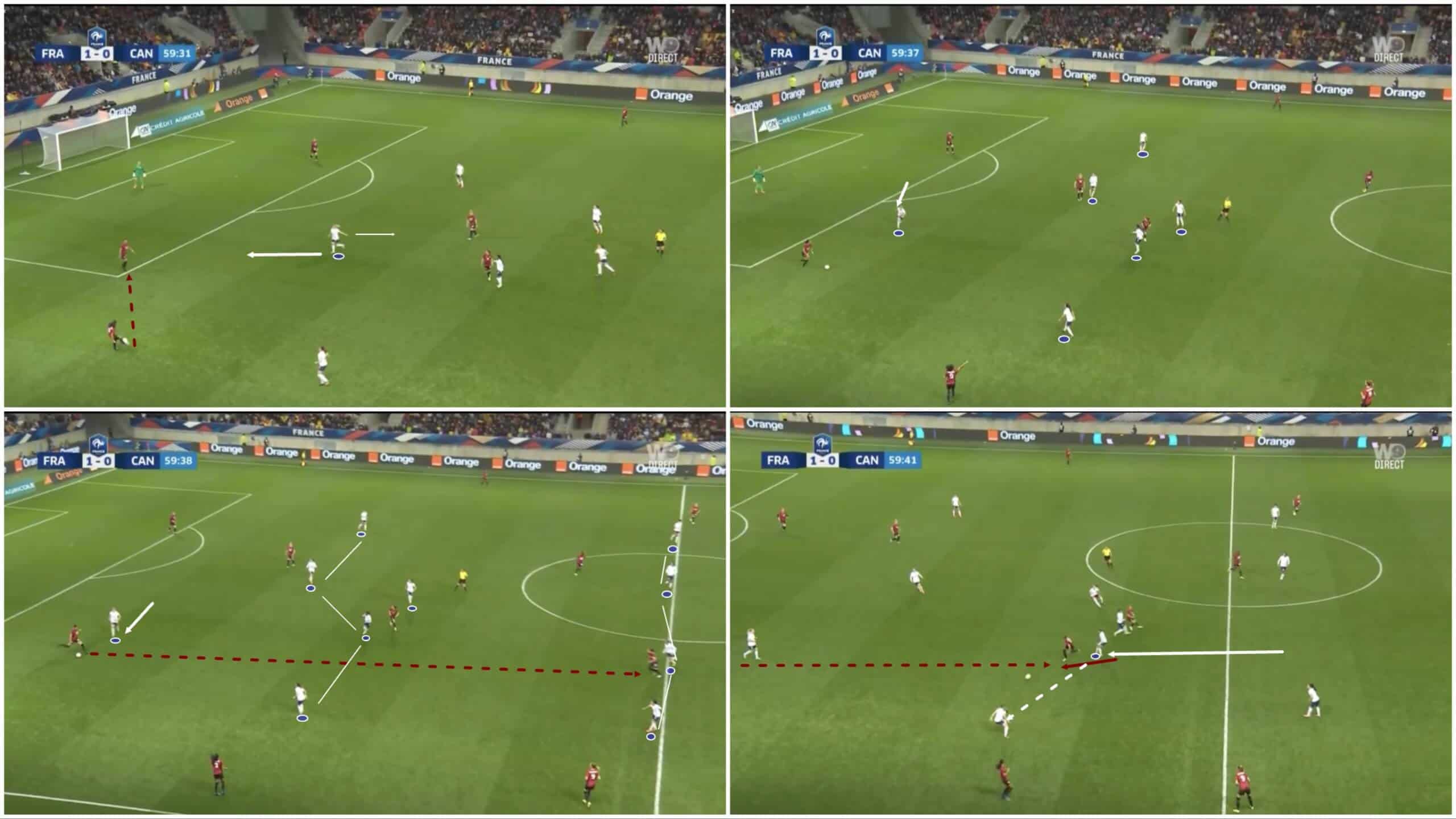
We see an example of how this France team looks when pressing in figure 11, taken from a recent clash with Canada.
Firstly, in the top-left section of the image, we can see how the left-winger was drawn out towards the opposition’s right-back as the ball was played out to her. At the same time, the ball-far winger retained access to the ball-far centre-back, the centre-forward got ready to press the near centre-back or goalkeeper and the central midfielders got tight to their opposite numbers.
With no clear options for progression, Canada were forced all the way back to the ‘keeper. At this point, Le Sommer jumped from her more conservative position to close the stopper down, as the wide forwards reorganised themselves on either side of her retaining access to the centre-backs. The midfielders remained tight to their Canadian counterparts in the middle of the park.
The ball ultimately moved back out to the right centre-back, drawing the press from the left-winger as Le Sommer also closed the receiver down while keeping the pass across goal to the left centre-back in her cover shadow.
With the central midfielders still marked tightly and not providing adequate movement to lose their markers, the Canadian centre-back tried to go beyond them and into the feet of the dropping centre-forward. However, this player was closely followed by France’s left centre-back and was unable to affect play as much as she would’ve liked.
This passage of play shares a clear example of how France like to defend high up the pitch. Their forwards lead the press — Le Sommer won’t run around like the energiser bunny but will intelligently position herself and cut off important angels for the opposition. Meanwhile, the wingers will press from out to in, preventing the ball from moving forward through the wider channels.
At the same time, France’s midfield will get tight to the opposition’s midfield. Still, they defend zonally, but turn their attention to the relevant options at play.
All of this forces the opposition into a risky play, which we see in the bottom-right quarter of the image.
We see a similar defensive approach and similar result from the same game in figure 12. Again, here, Le Sommer does a great job of defending without having to exert a tonne of energy as she positions herself intelligently and essentially cuts the pitch in half for Canada, preventing the right centre-back from turning inside.
With the centre yet again blocked off and the passes out to the wings covered by France’s predatory wingers ready to pounce should Canada try it, the ball is once more sent from centre-back to centre-forward.
Again, the left centre-back steps out and applies enough pressure to force the Canadian attacker into a poor touch, resulting in a loss of possession and an opportunity for France to counterattack from a nice position.
Teams will need to come at France with a better plan in possession than Canada offered in this game if they’re to have a chance of troubling the French defence but again, if the opposition do get past France’s high block, they have a good chance of creating a goalscoring opportunity because they commit so many bodies high that they’re vulnerable behind should this area get breached.
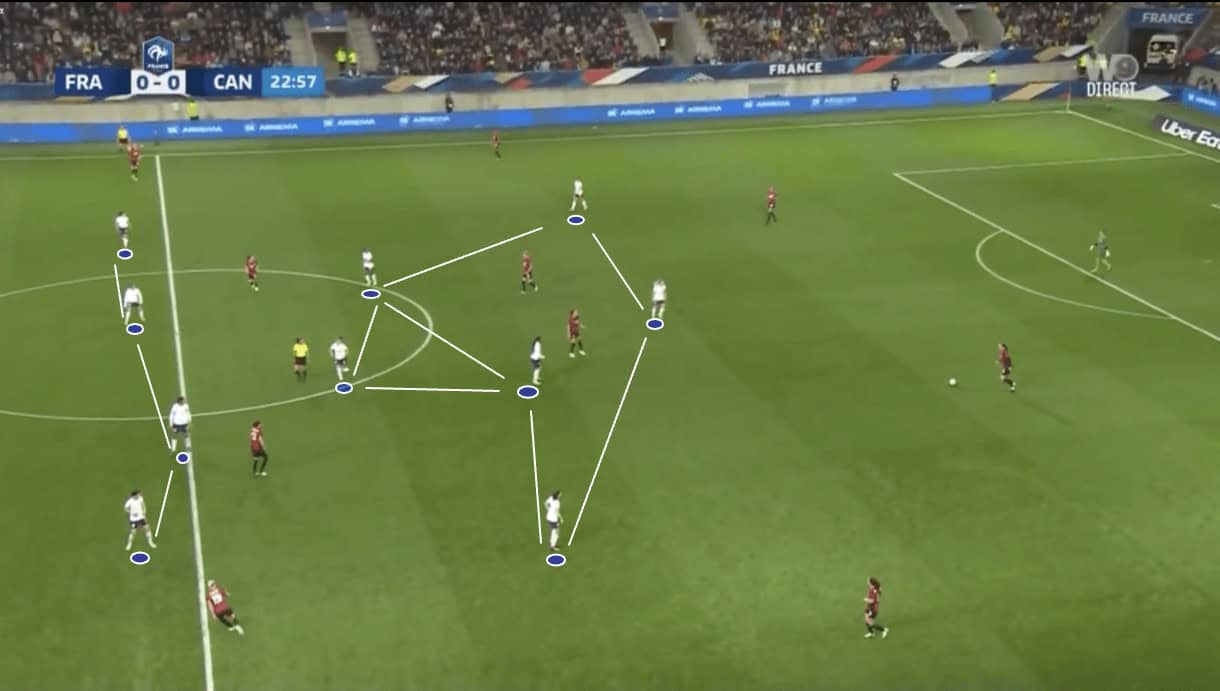
At times, the press will be slightly less aggressive — no team presses full-on for an entire 90-minute match — but even then, France’s backline will be right on the halfway line, looking to squeeze the opposition back into their own half and make the French goal look a million miles away.
In this block, France set up in a 4-1-4-1 with Le Sommer dropping to cut off passing angles into midfield while the marking system is zonal, with players picking up opposition passing options who enter their zone, similar to what we saw previously but in slightly slower motion. Still, the space is tight for Canada to try and play through France, with only the long balls over the top for the wingers to potentially run in behind diagonally looking on in this image. This pass is a decent idea against France, though, if you have the personnel to exploit the opportunity.
Transitions
As for transitional phases, beginning with transition to attack, we anticipate that France’s full-backs and central midfielders can be crucial in this phase with their ball-carrying ability potentially coming in clutch in certain situations to drive France out of their half, end a period of sustained pressure and break away to force the opposition back.
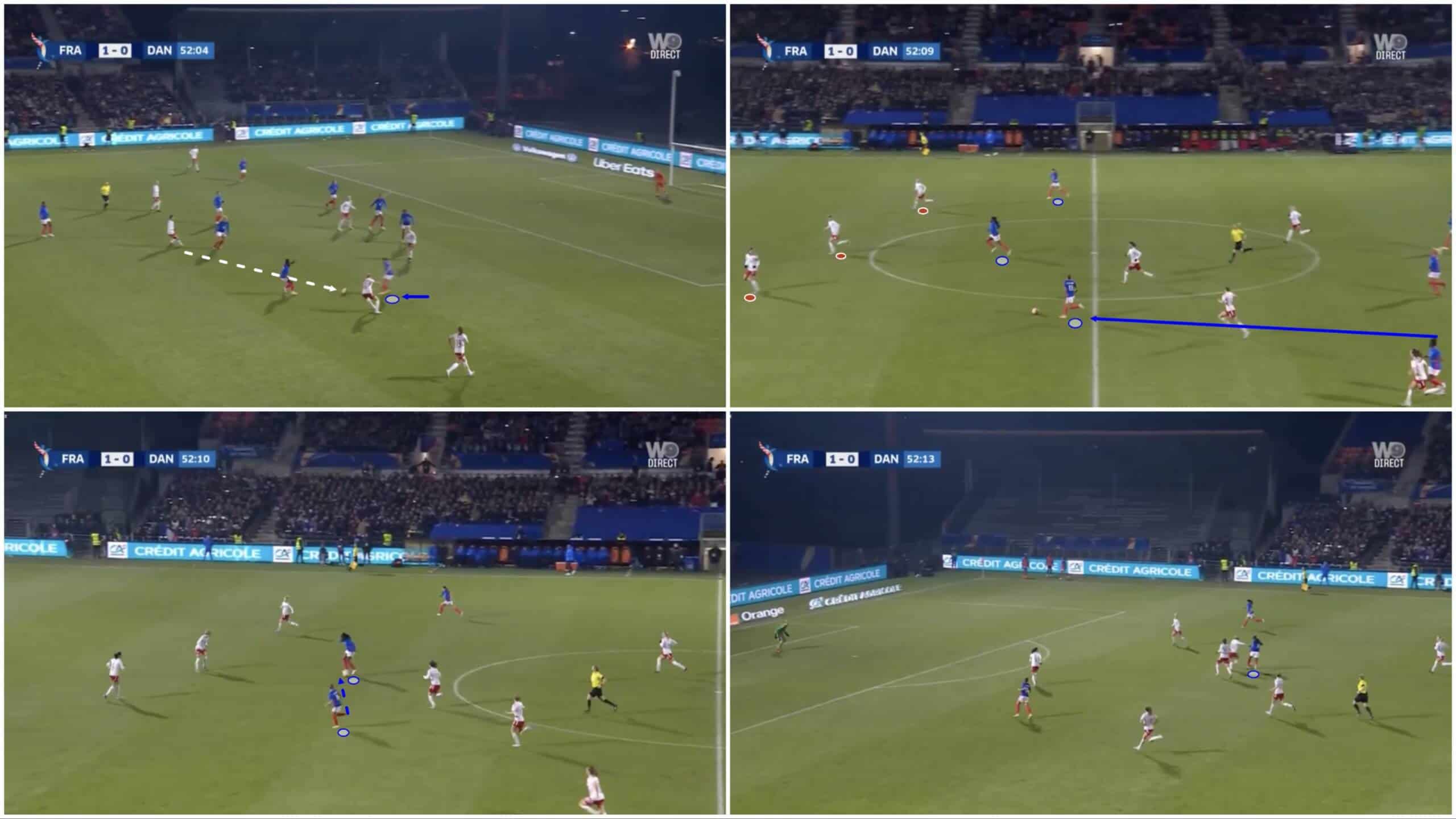
We see an example of one such situation in figure 14. Here, the left-back, Estelle Cascarino, has intercepted the ball deep before knocking it ahead and driving her team forward into the opposition’s half, quickly breaking the Danish midfield line apart with her dribble and almost immediately creating a 3v3 versus the opposition’s backline.
While her pass into Diani was played a little bit further behind the attacker than she’d likely have hoped, and this gave the Danish defence time to strengthen, the counterattack still wasn’t dead and this shows a great example of how France’s full-backs can play a key role in transition to attack, firstly through their ability to win the ball at one end and secondly by driving forward with it to create a goalscoring opportunity at the other end.
The central midfielders are equally capable of providing service in attack similar to this through their interceptions and ball-carrying, while they’re also capable of quickly finding some space in the middle of the park for defenders to pick them out before then carrying it forward in transition.
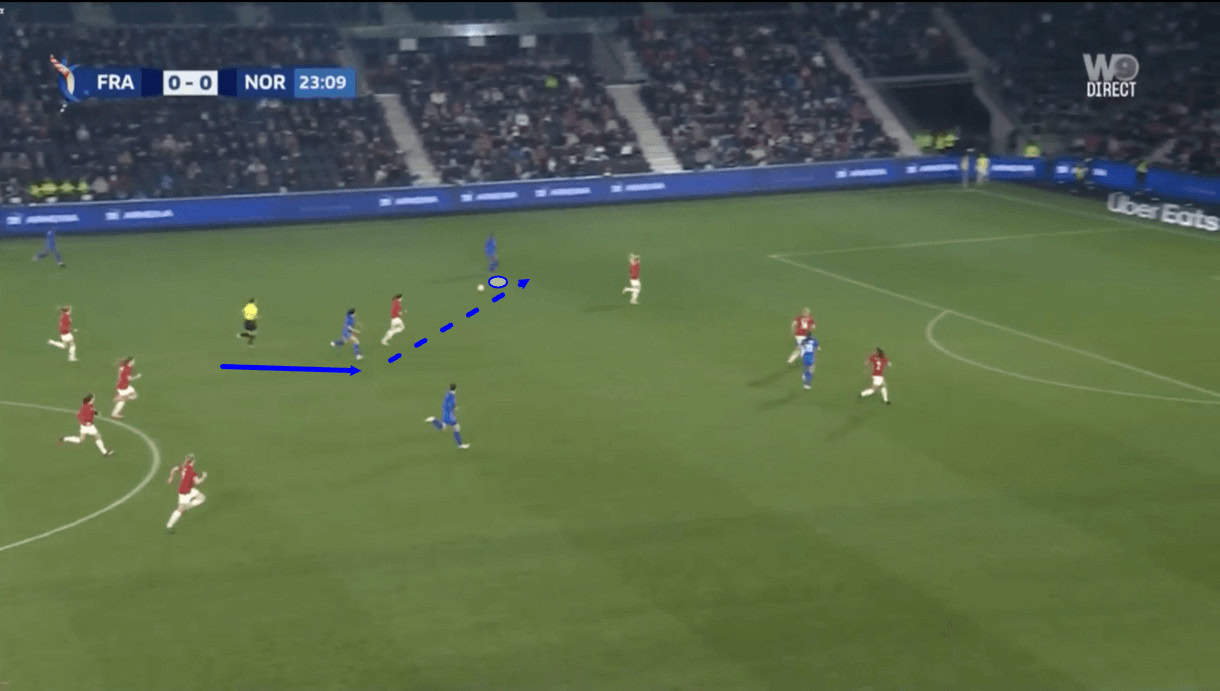
We just saw Diani receiving the ball in transition back in figure 14 and we have another example of this in figure 15. In this game, the 28-year-old attacker lined up at centre-forward — an option should Le Sommer be out of the squad for one reason or another — but she drifted out wide in transition to occupy some space where she could be found on the ball.
This shows one way in which she’s different from Le Sommer, you can expect Diani to seek the ball a bit earlier and in positions where she’s more likely to be a provider than the goalscorer. If she plays at right-wing, she’ll start in these wider positions where she’s also comfortable. She can carry the ball inside and link up with the other attackers from there.
In this case, after the central midfielder carried it forward for her team, she played it out to Diani who could take on the Norwegian defender 1v1 to try and progress France into the opposition’s box when their defence was weakened. Expect to see Diani targeted in these kinds of positions as France counterattack during this summer’s tournament.
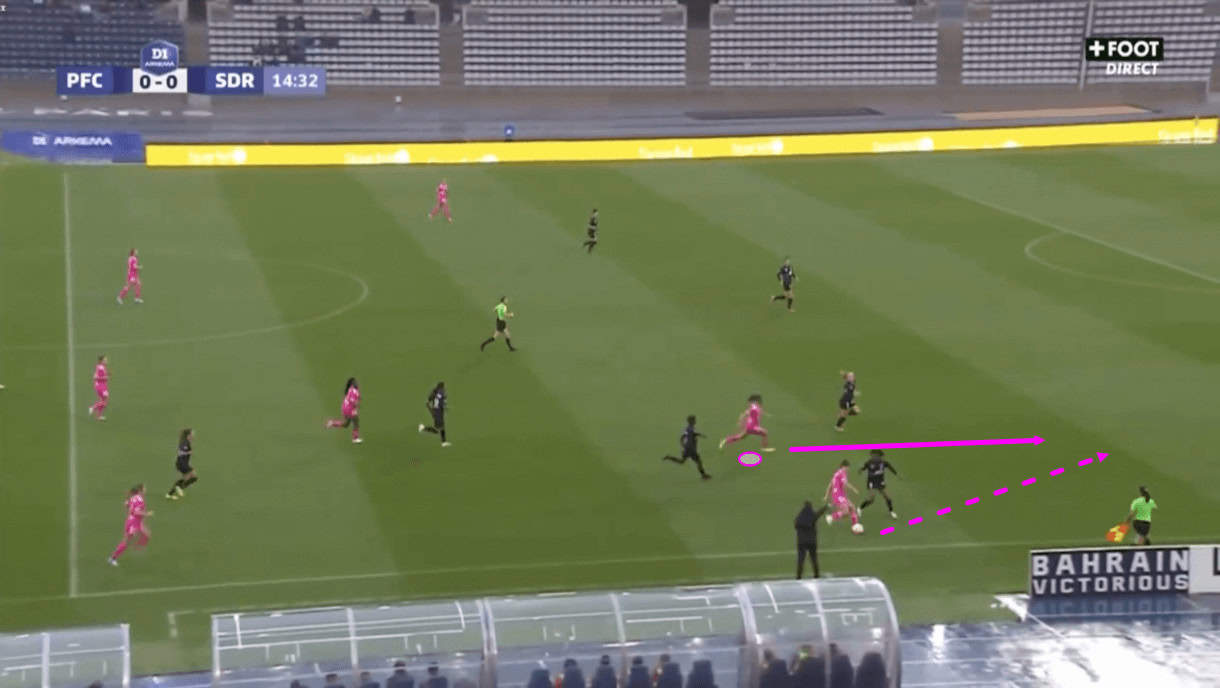
Clara Matéo, who we’ve got starting at left-wing in our predicted XI, is also capable of providing a threat on the counter as figure 16-17 show. Firstly, in figure 16, we find Matéo driving forward off the ball, trying to get up in support of the wide ball carrier on the right.
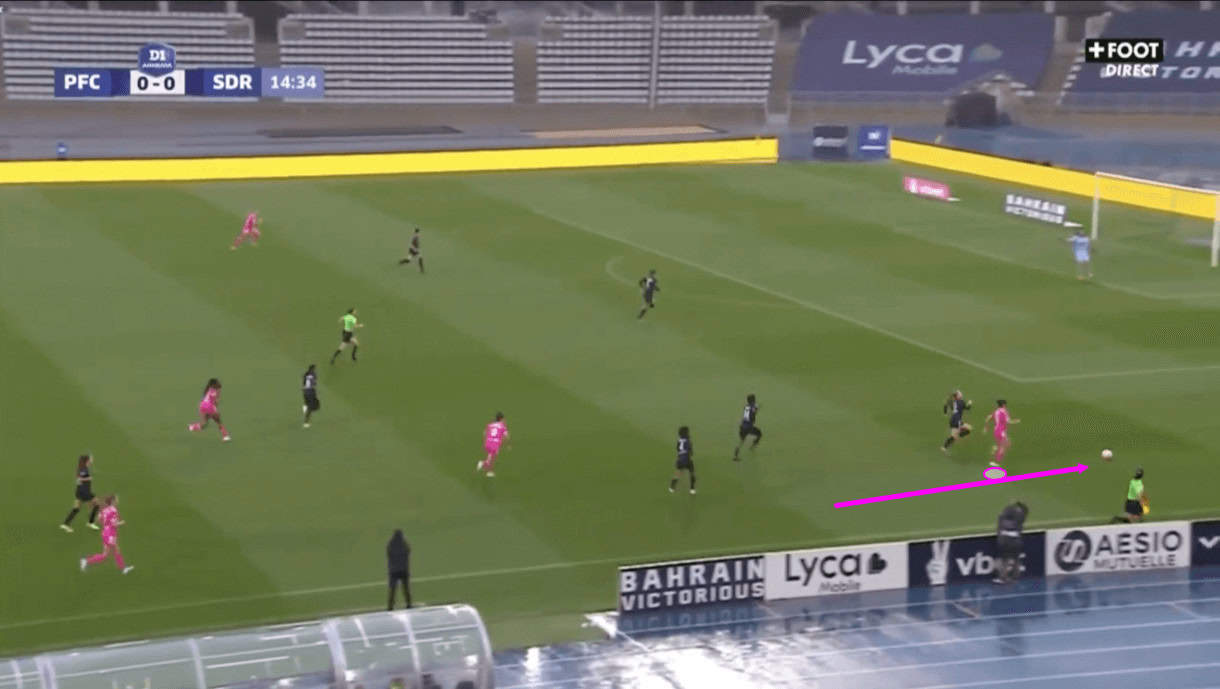
The 25-year-old Paris FC attacker busts a gut to get up in support and actually ends up sprinting beyond the opposition defender to reach the through ball played into the final third for her.
From here, the wide attacker can dribble at the weakened defence and create a decent crossing opportunity where she can pull the ball back for a teammate inside the box and try to generate something.
It’s fairly natural for the wide attackers to be useful options in transition and that’s no different with this France side. These players will be given space to target and attack in transition, and we expect them to pose a significant threat to the opposition on the counter.
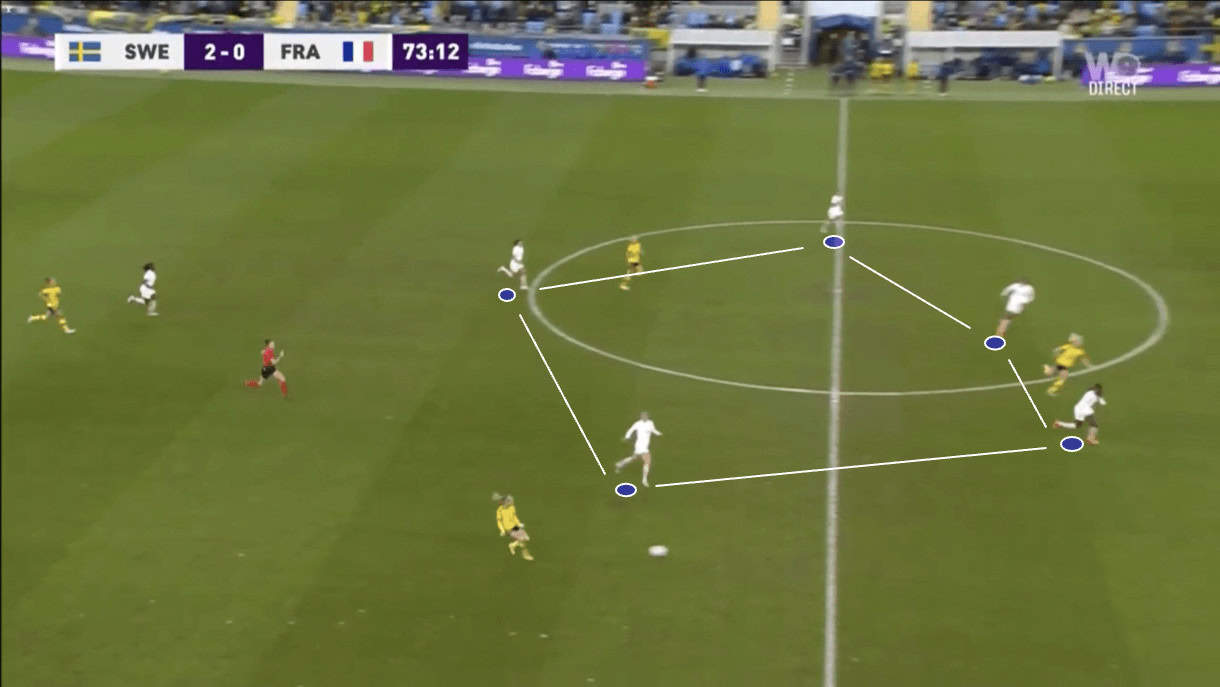
Moving on to defensive transitions, figure 18 shows France’s ideal rest defence setup. When in their controlled periods of possession parked inside the opposition’s half, they’ll normally try to keep around five players in deeper positions as we see here with two midfielders and three defenders having been sitting back as one full-back and one midfielder joined the three attackers up front.
When advancing through the thirds patiently, France should have time to create this pentagonal shape as a safety net against counterattacks. If they do, they stand a decent chance of defending against the counter as they control the centre and force the opposition into wider areas.
Of course, it’s possible the opposition try to play behind the French shape, as Sweden did here, in which case anticipation, positioning and pace is important for the defenders.
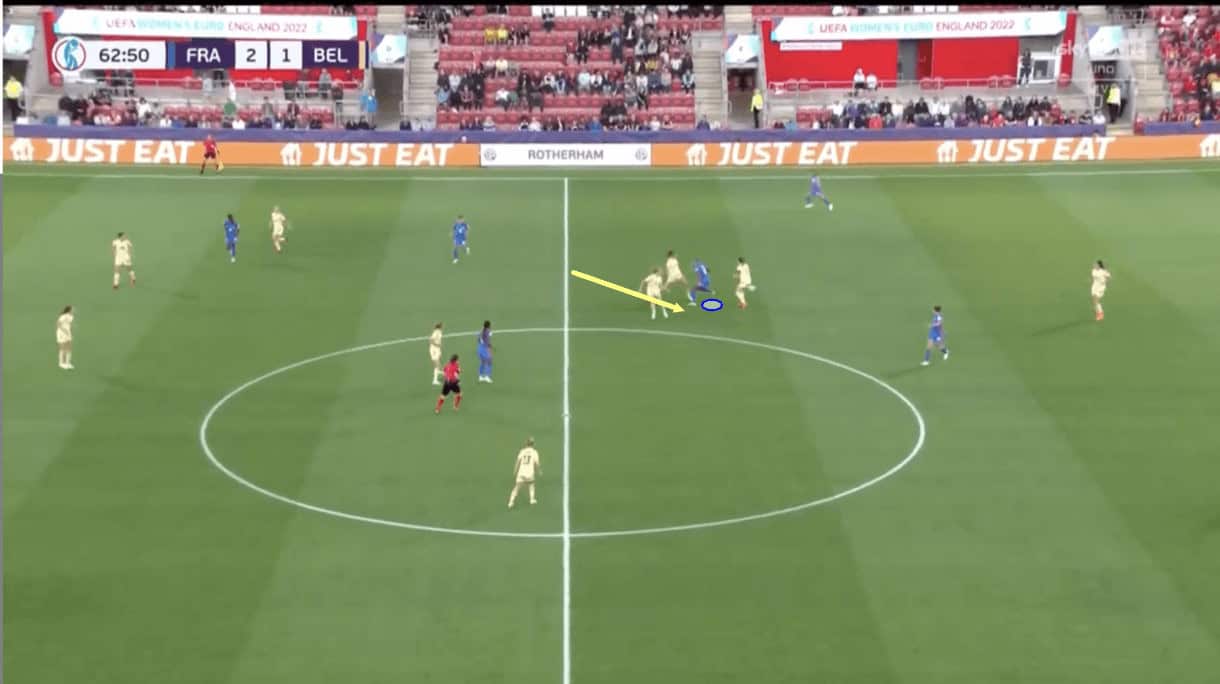
Where France really struggle in transition to defence, however, is when they lose the ball prematurely, which happened in figure 19 above as they were trying to build out from the back and enter the opposition’s half.
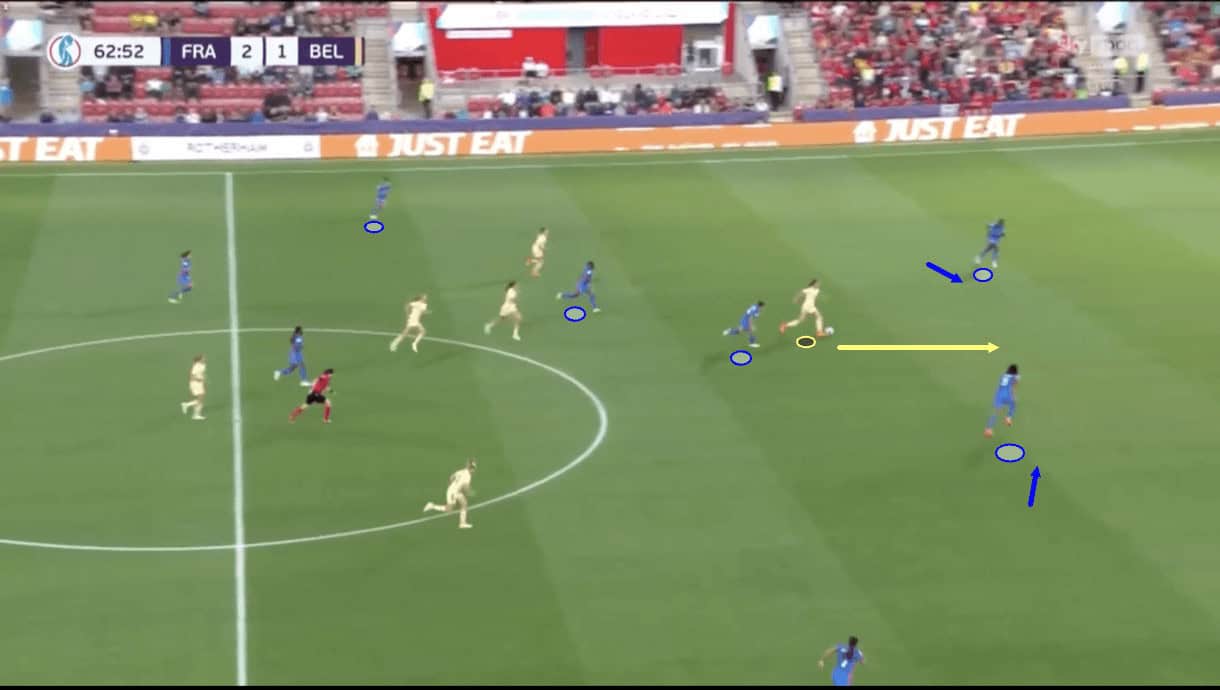
Earlier, we discussed how France’s centre-backs split quite wide in possession and here, we see how when Les Bleues lose the ball early before they can settle into a safe rest defence shape, their backline is very exposed and this is one major way in which teams can look to hurt Renard’s team this summer — force early mistakes in possession and quickly hit them on the counter.
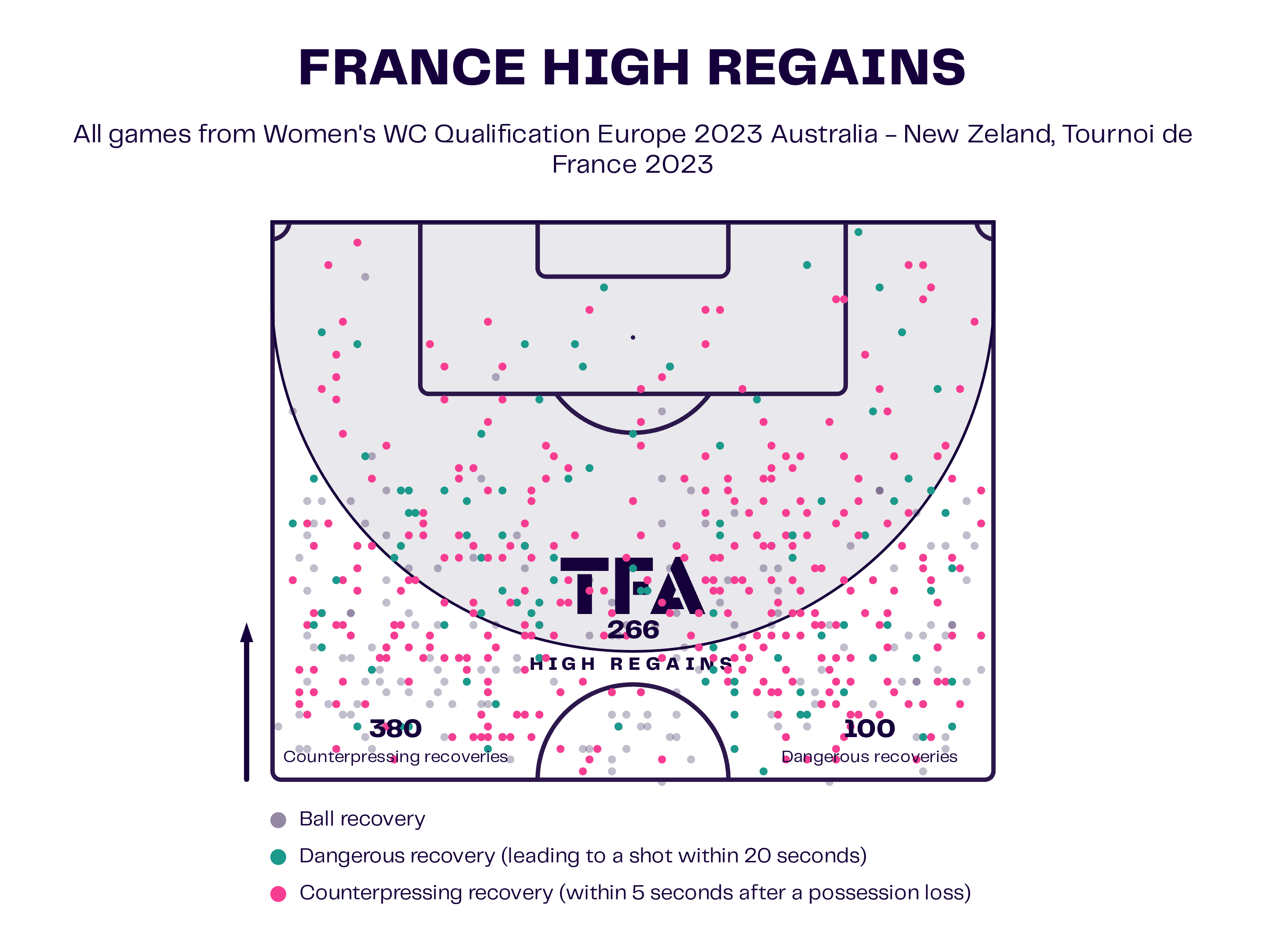
With 380 counterpressing recoveries in their World Cup qualification campaign and the recent Tournoi de France, counterpressing is an integral part of this team’s game plan. They keep players close together and put together intricate passing plays in one part to try and delicately progress upfield but also because this keeps their players close together should they lose the ball, meaning they have plenty of bodies nearby to immediately apply pressure to the opposition player who’s taken it from them.
Les Bleues have been very good at recovering possession quickly after losing it in recent times and we’d expect Renard to try and maintain this weapon as he settles in as the new national team boss.
Attackers
In attack, while we’ve already discussed Le Sommer, Diani and Matéo in some detail, there are at least three other players we haven’t discussed who can fit under this umbrella and challenge for a place in Renard’s team this summer. Two of those players fall into the youth age range: 21-year-old Naomie Feller and 19-year-old Vicki Bècho, the latter of whom is yet to receive her international debut, with the former having made just three international appearances thus far in her young career.
Both players are versatile attackers capable of contributing across the forward line, making them useful assets to have in a tournament. Feller would more likely play as the left-winger with Bècho perhaps providing cover on the right.
Feller, in particular, is an exciting talent with immense dribbling capability who could be an excellent impact substitute for either Diani or, more likely, Matéo later on in games when an injection of energy could prove crucial.
The other attacker we haven’t mentioned is West Ham United’s Viviane Asseyi, who’s no stranger to the national team setup having made 61 appearances and scored 14 goals for France.
Asseyi is, again, capable of providing cover across the forward line. She has normally played either centrally or to the right of late but has plenty of experience playing as a left-sided attacker as well.
Asseyi’s goalscoring experience will be useful for Renard to have on the bench as reassurance if the starting options aren’t working in a given game and something different is needed. She’s very good at ghosting into good positions and finishing from close range, especially with her head.
Midfielders
There are five midfielders we’re yet to really touch on, one of whom could have a very important role to play in the tournament: the returning Amandine Henry who hasn’t featured for France since 2020 — her omission from the 2022 Euros squad was one of many high-profile incidents to have occurred under the regime preceding Renard’s.
Now, Henry is back and the midfielder could have a key role to play for France either in the deepest midfield position perhaps with a couple of solid central midfielders alongside her or on the right. Perhaps she could even feature alongside Toletti if Renard wants to go for a 4-2-3-1 at times. Henry can pull off the types of creative passes from deep we discussed as being important for this team when looking at their ball progression earlier and we believe she can be important for Renard in this tournament.
Lyon’s Amel Majri is a creative midfielder who will likely show her face on the left at times in place of Dali or perhaps in the team with her, as either she or Dali are capable of playing as part of the front three, also on the left, from where they’d likely want to drift inside with the ball into the half-space and link-up with each other or the centre-forward, giving the left-back room to advance as well. I’d expect her to play an important part for France this summer even if she’s not part of our predicted starting XI — we can only pick 11!
The 31-year-old Léa Le Garrec is coming into this tournament off the back of an immense campaign for Fleury. While the deep-lying midfielder has got just five caps to her name so far, we feel she could challenge Toletti or at the very least provide a very capable backup for the Real Madrid women in the holding midfield position.
She can offer composure and immense technical quality that would allow her side to advance into dangerous positions through her in a similar manner to Toletti as observed earlier. I’d like to see Le Garrec get some minutes as she’s one of France’s real in-form players coming into the tournament, having run the game for her club at times this season from the base of midfield.
Two younger midfield options made the cut for Renard’s 26-person preliminary squad, in the form of 21-year-old Oriane Jean-François and 19-year-old Laurina Fazer, both from PSG.
Jean-François is another who’s comfortable playing deeper but perhaps provides more defensive solidity than other midfield options while still possessing impressive technical quality. She could be an excellent option in games when France need extra defensive might in midfield, a particular marking job done or to see out games as a guard against counterattacks.
As for Fazer, she’d likely contribute more at the other end of the pitch, helping her team break down the opposition. Fazer’s greatest quality may be her ball-carrying ability, as she’s good at finding space to receive before then picking up the ball and taking on a defender 1v1. The teenager is not a household name yet but she’s earned her call-up after a promising campaign at club level and could provide something different to other French midfielders via her profile, so is an interesting one to keep an eye on heading into the tournament.
Defenders
As for the defenders in Renard’s 26-person squad who we haven’t mentioned yet, we have two more players who’ll likely be vying for the left-back position — Selma Bacha and Estelle Cascarino. In addition to Sakina Karchaoui from our predicted starting XI, it’s likely that one of these players will drop out for the final 23-person squad.
Both players offer a lot going forward, with Bacha, in particular, contributing on the attacking front. However, Cascarino is slightly more defensively capable while still being a useful creative force on the left-wing which could nudge Renard towards her. Ultimately, the manager will have time to observe both players first-hand before making his decision if, indeed, either of them are going to be dismissed from the 23-person squad.
Aïssatou Tounkara could well end up starting the first game of the tournament, either in place of De Almeida or alongside her, perhaps with De Almeida moving to right-back. We went with De Almeida in our predicted XI because of current form and the fact she’s coming into this tournament off the back of a great campaign in which she showed a lot of qualities Renard will likely want from his centre-backs. However, Tounkara is more experienced at international level and she could well force her way into the starting XI with good performances in front of Renard in the pre-tournament training camp.
Lastly, Maëlle Lakrar, who has made just two career appearances for her national team, is the final defender in the 26-person squad. She is versatile enough to provide cover at right centre-back or right-back, which could make her a useful part of the squad and make a case for her being part of the final 23-person selection. With France playing a high line, Lakrar’s pace and anticipation ability can come in very useful in defensive transitions, so don’t be surprised to see her make the final squad even though she’s not very experienced at international level.
As for the goalkeepers, while all four in the preliminary squad have featured for their national team before, Juventus’ Peyraud-Magnin is by far the most experienced in the preliminary squad. Having said that, PSG’s Constance Picaud featured in Les Bleues’ most recent game versus Canada. Nevertheless, we’ll likely see Peyraud-Magnin continue as France’s number one in Australia and New Zealand. Solène Durand of Guingamp and Mylène Chavas of Bordeaux are the other two ‘keepers selected for the 26-person squad, though we’ll likely see one of the latter duo drop out for the final 23-person squad.
Key player
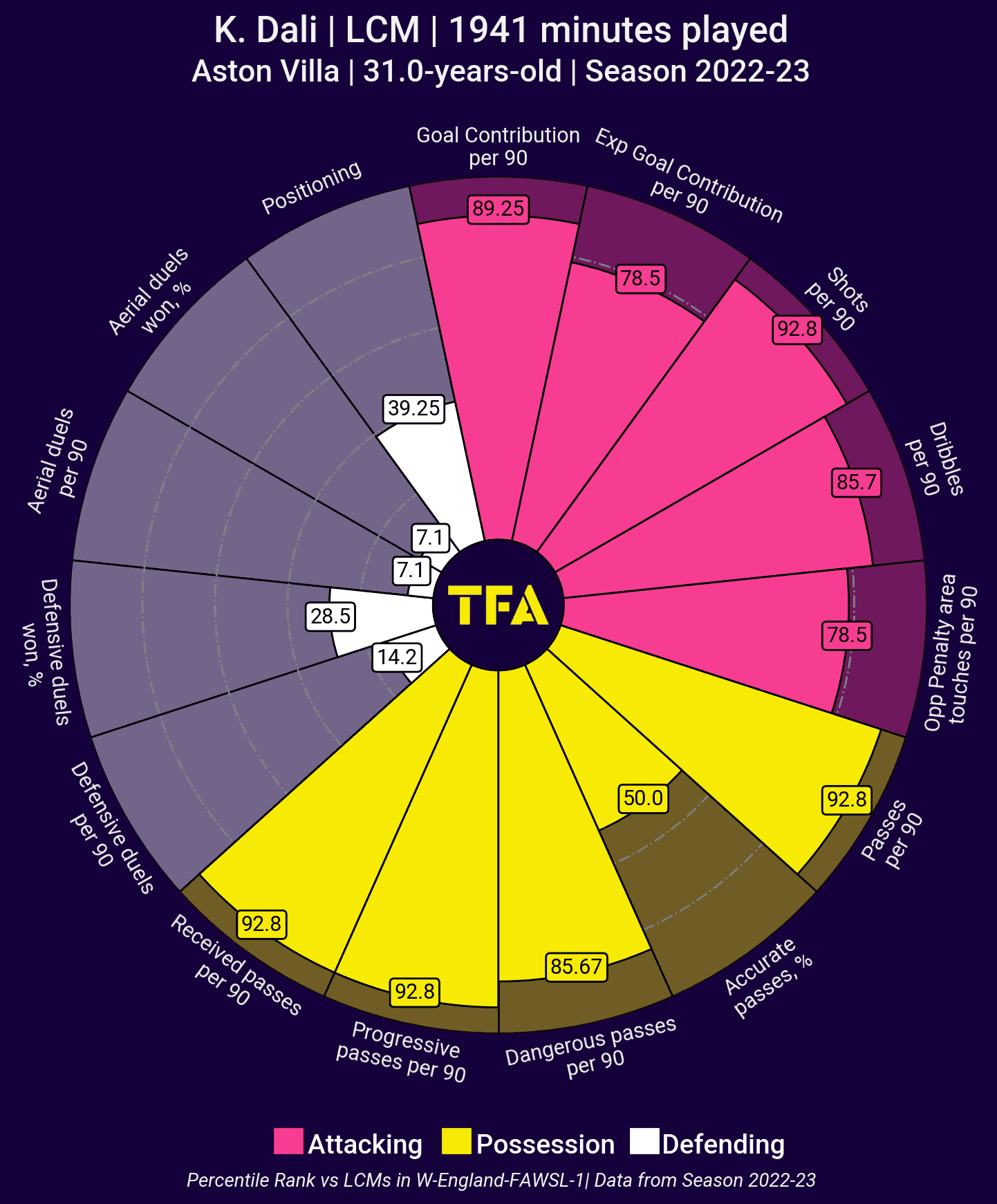
We’ve selected 31-year-old Kenza Dali as France’s key player for this piece, though there are, of course, plenty of top-quality assets in this team who could make a case for being selected as the key player.
As the player radar in figure 22 indicates, we’ve selected Dali more for what she offers in possession than her out-of-possession qualities. The Aston Villa midfielder ranks incredibly well among other FAWSL midfielders in passing metrics and attacking metrics. She’s a creative threat on the edge of the final third while she’s also capable of getting her name on the scoresheet herself and isn’t shy about trying to do so, as her 92.8 percentile rank for shots per 90 would suggest.
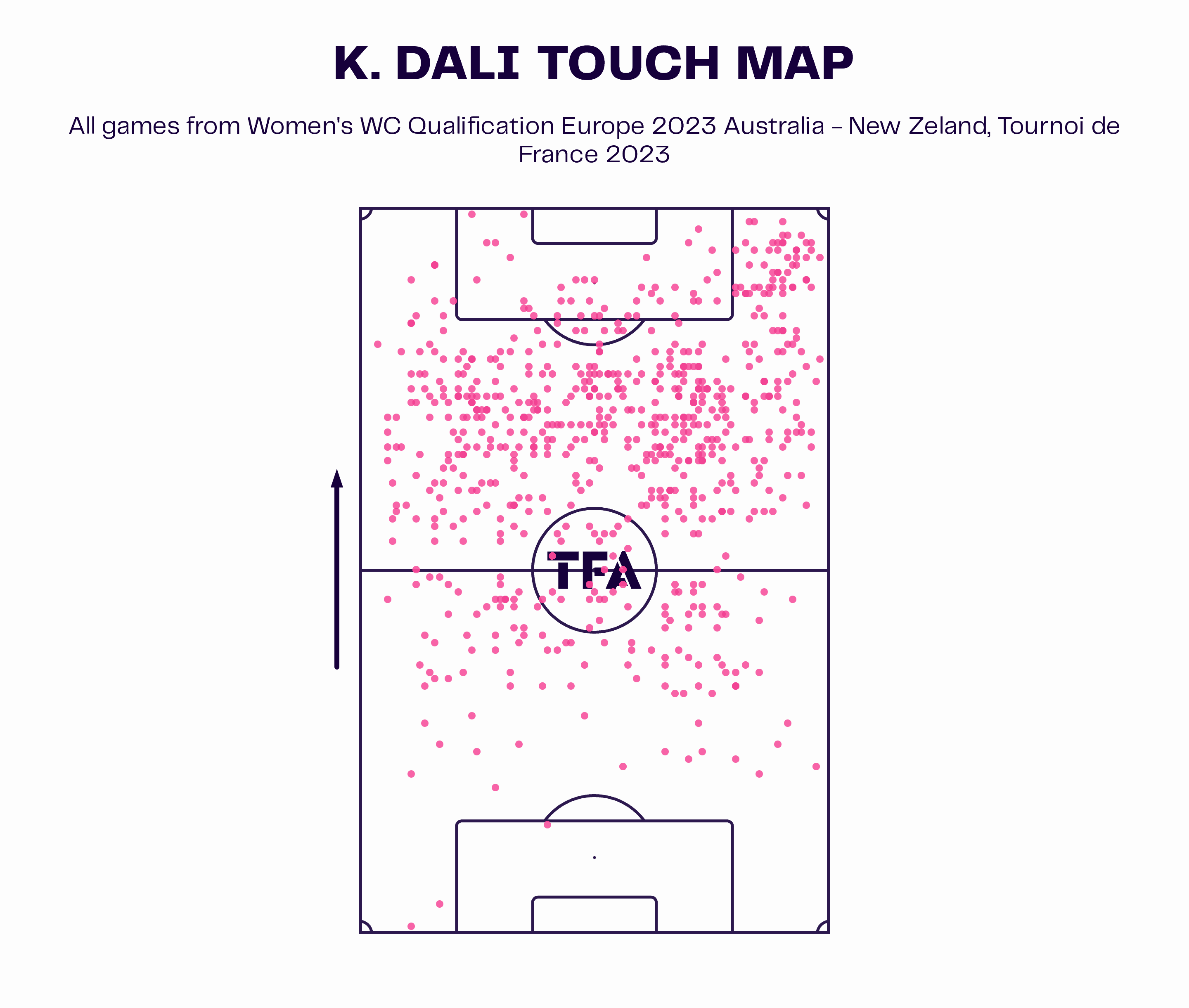
Dali is primarily involved in her team’s games centrally and on the edge of the final third, as her touch map from the World Cup qualifiers and recent Tournoi de France indicates. She sometimes manages to find space in zone 14 from where she can be very dangerous but also often finds herself getting involved via the half-spaces where she’s more likely to get away from opposition markers yet still enjoys the fruitful passing angles of such a central position.
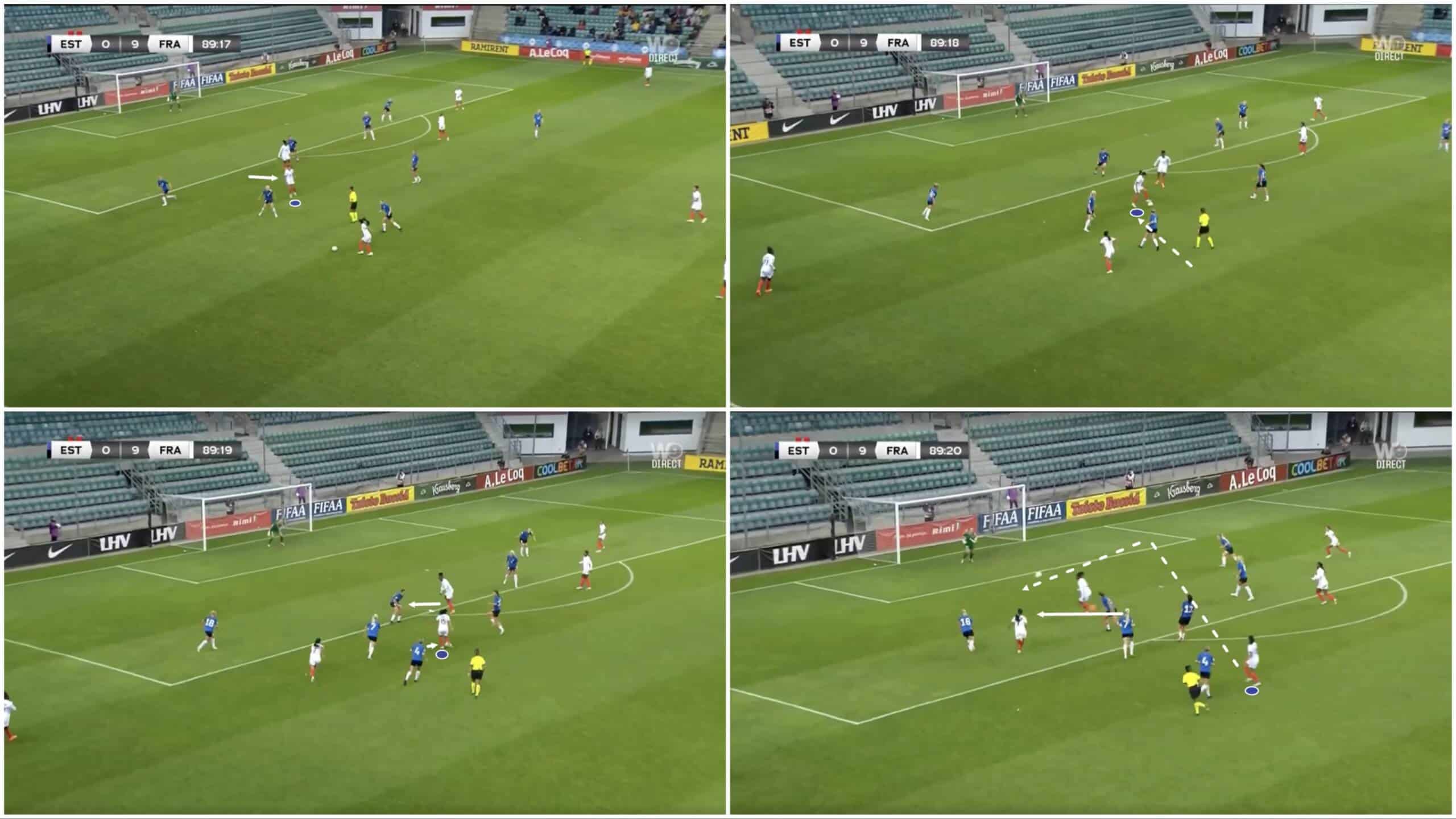
Figure 24 shows an instance of Dali finding some room in between opposition players in the left half-space where she was able to receive on the half-turn before knocking the ball just slightly towards the centre, helping her to get the ball out of her feet and buying herself a second to get her head up and scan for the movement ahead of her.
It was then that she spotted her attacking teammate’s diagonal run in behind the opposition centre-back which she found with a neatly lofted defence-splitting ball in behind for the striker to chase down.
This specific attack didn’t result in a France goal but it’s the type of attack that Dali is so useful for generating via her movement, positioning, vision and technical passing quality. If her deeper teammates can link up with her via her intelligent movement and space occupation in and around the final third, then that’ll be a big positive for France’s chance creation.
Tournament prediction
On one hand, France haven’t had long under Renard to really give the new manager time to get to know his players as well as opposition coaches will know theirs and likewise, the players haven’t had much of a chance to become acquainted with their new boss or even each other, with some player rotation evident in the team as discussed.
However, at the same time, Diacre obviously didn’t have a lot of supporters among the playing squad and her departure could be a breath of fresh air for some in the squad and the conversation around it, with less of a media circus likely to be surrounding the camp this time around.
While he’s an international tournament specialist, we think Renard will need more time to work with his squad before being able to work his magic but his appointment is a positive one for France. If we had to make a prediction for the tournament, we’d say semi-finals may be the ceiling for France this time around with quarter-finals perhaps being more realistic still, but we’re feeling positive for the future of Les Bleues.
