
As much fun as it is to watch possession-dominant teams pick their opponents apart, one of the most impressive and educational elements of their game is the response in defensive transitions.
Sure, the likes of Manchester City, Bayern Munich and Barcelona are all highly entertaining teams with an aesthetically pleasing style of play, but the ability to play that style requires protection. The threat is a robust opposition counterattack. To nullify the threat, these possession-dominant teams have to show their teeth in defensive transitions, quickly closing space and working at full defensive intensity for a quick recovery.
Recovering the ball is the most obvious objective of the counterpress, but there’s more to it than simply regaining possession. In this tactical analysis, we’ll look at those other principles, specifically rest defence and denying progression. In fact, this tactical theory piece will put together a few exercises with some coaching points to help your team become more effective in defensive transitions.
Rest defence
Any conversation on improving defensive transitions has to start with attacking structure. A team’s rest defence directly impacts their ability to transition to defence quickly. The less connected the attacking shape or the more unbalanced the structure, the more difficult it is for a team to limit the opposition in transition.
This is where the conversation turns towards the playing philosophy, system objectives, and personnel. Having a clear picture of the team’s identity and the strengths and weaknesses the players bring to the fold is the starting point. Understanding where your roster stands relative to the strength of direct competition is also pivotal. Realistic tactics are an acknowledgement of what your team can pull off against the opponents on the schedule.
For a team like Manchester City, this is pretty straightforward. They’ll be the possession-dominant side, dictate the flow of play and relentlessly press the opposition. With the quality in their squad, they have the capacity to set the match initiative throughout.
But that doesn’t mean a qualitative advantage guarantees a team can impose themselves on the opponent. Structure safeguards the team as a whole and puts individuals in positions that best suit their skill sets.
Take City for example. Their 3-2-5 attacking shape allows them to connect higher up the pitch, create overloads to unbalance the opponent and progress into the opposition’s box with numbers. From a defensive standpoint, their back three allows them to cover the width of the pitch if the opponent plays long, plus the two holding midfielders protect the backline while also stifling central counterattacking opportunities. Put the lines together, and you have a well-connected team that can quickly apply pressure on the ball after a loss and regain their defensive shape within seconds.
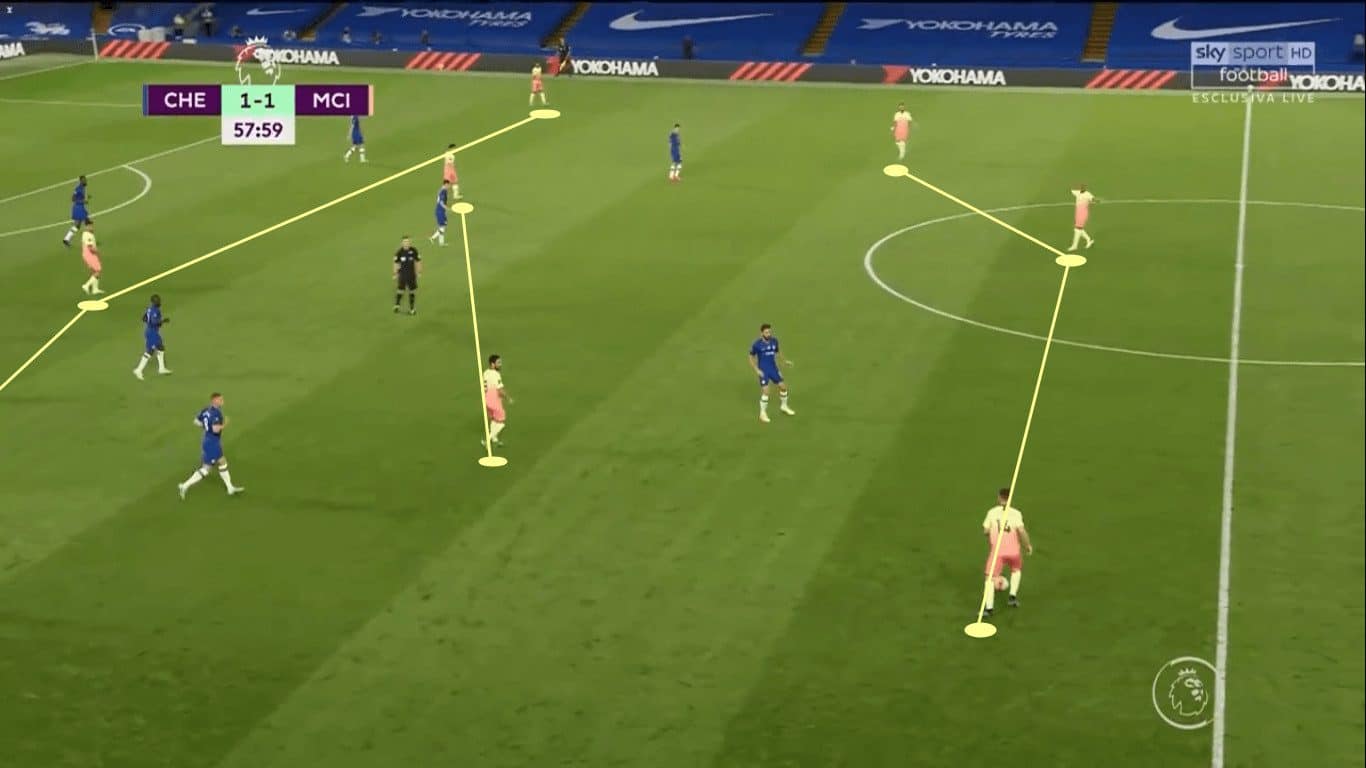
Whether 3-2, 2-3 or some other set-up at the back, attacking structure must help the team carry out their attacking objectives while also offering protection against counterattacks. Back in the Zinedine Zidane days, Real Madrid used a central square with Sergio Ramos and Rafael Varane at the base and Casemiro and Toni Kroos in front.
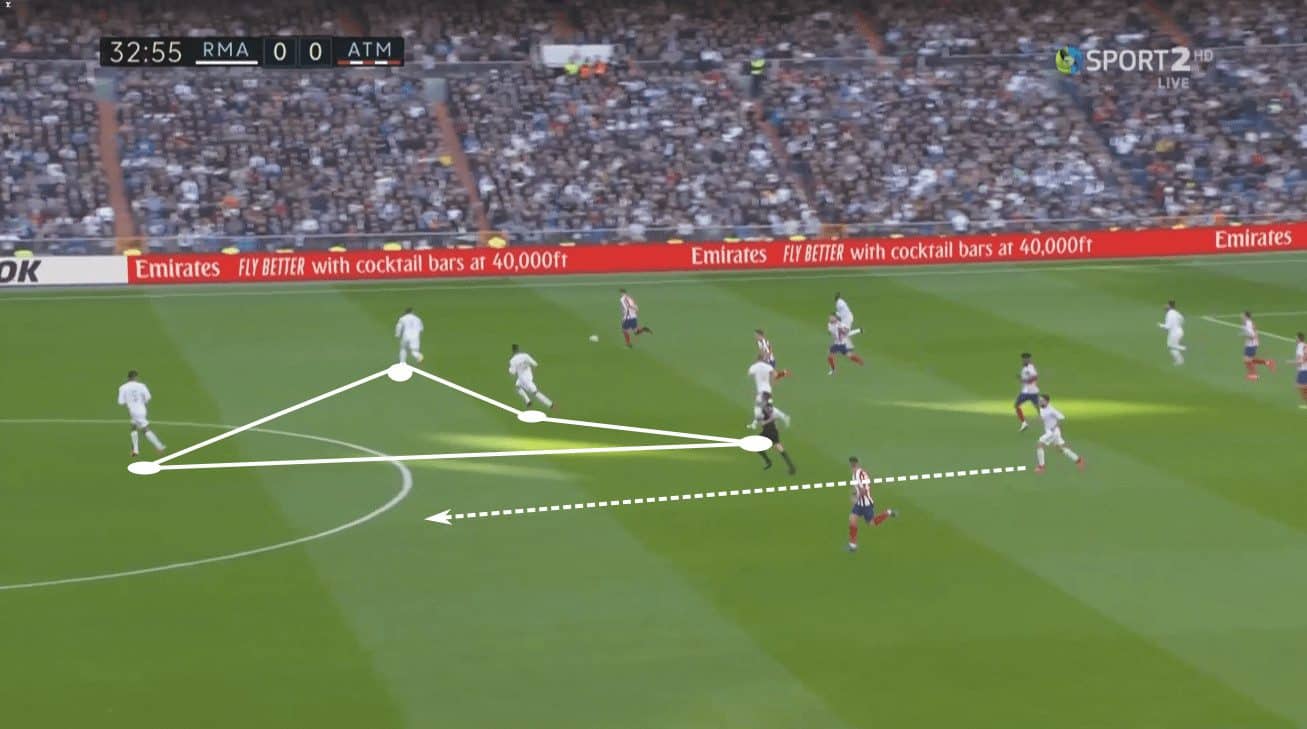
While opponents had space to counter through the wings, Real Madrid saw that as a worthwhile risk. Getting six players forward gave them a more prolific attack, plus the opponent’s taking the ball into the wings bought time for Real Madrid to recover numbers behind the ball. The added benefit is that they forced a more difficult movement and delivery sequence by forcing opponents wide before coming back inside against an organised defensive front, even a partial one.
To train rest defence, we’re going to give the attacking team (our focus group) an opportunity to play 11v8 at the start. The opponent will have a goalkeeper, back four and three in midfield. Our playing area is the full width by 70 m. If space or numbers fall short of these marks, scale back to fit your restraints.
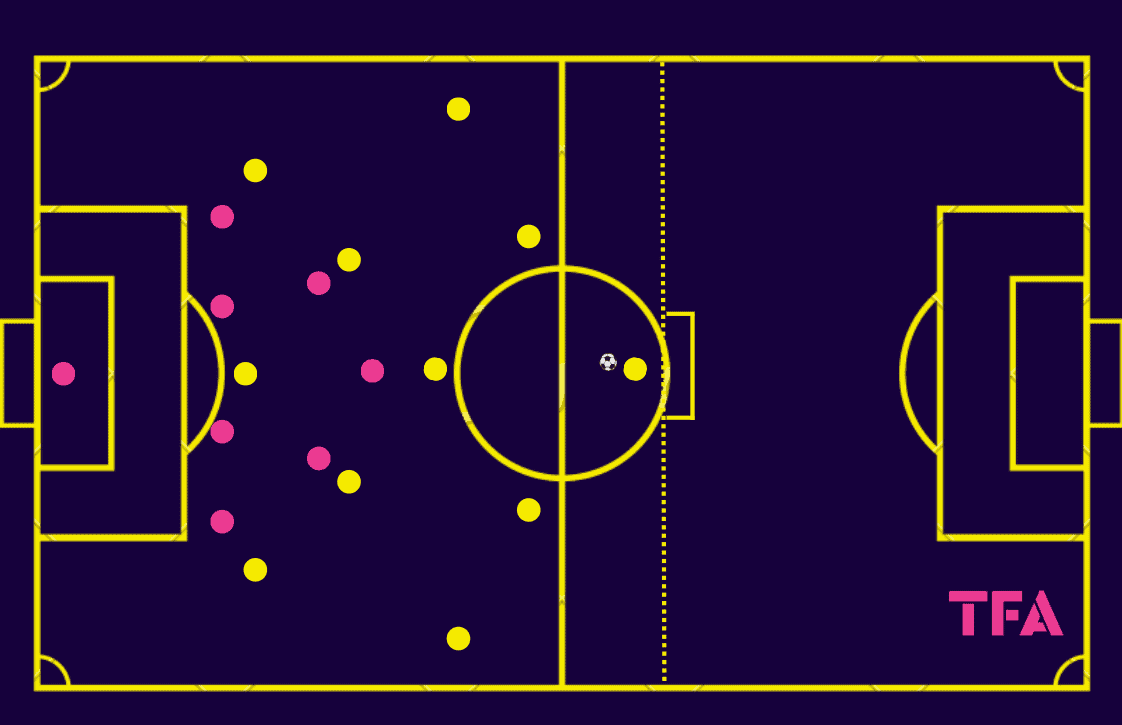
Since the opponent (team of eight) has limited numbers, the focus group should dictate the flow of play. Focus on the positioning and movements of the team, connecting the parts to the whole. If, like Real Madrid, the outside-backs take up high and wide positions, show the players how that impacts the positioning of the wide forwards in our 4-3-3. Pinch them inside, but show the importance of staying connected with the outside-backs, attacking midfielders and #9.
From the midfield’s perspective, determine how you plan to use them to protect the centre of the pitch and backline. Do you keep one or two holding? If one pushes higher, is there a corresponding move needed from another player, such as an outside-back pinching inside or a #10 dropping deeper?
These are considerations to work through prior to hitting the training ground. Ultimately, the question to ask is, “What do I want my team’s shape to look like the moment we lose the ball?” No adaptation. No cheating movements of the magnets on the tactics board. Think about the worst-case scenario and base the team’s shape on that preference.
Deny progression
With a developed idea of the team’s attacking shape, we’re now prepared to make quick transitions to defence. When transitioning to defence, there are two clear objectives: 1) deny progression and 2) win it back. Let’s talk about the first objective.
As teams move from a structured attack to a defensive transition, they’re moving from a more expansive attacking shape to a vertically and horizontally compact structure. Regardless of the system or in-possession objectives, there’s ground that needs covering.
Our first step in transition is training the players near the ball to quickly close space and eliminate forward passing options. Rest defence plays a critical role. Due to the team’s attacking shape, at least one player should be near enough to apply pressure on the ball while supporting teammates’ close forward passing lanes. The key sub-principles in denying progression are applying pressure on the first attacker and eliminating passing options to second attackers in front of him.
Let’s revisit Zidane’s Madrid. This sequence against Barcelona is a personal favourite. It’s a perfect example of counterpressing to deny progression, forcing a string of negative passes and moving into the high press on the back of a successful defensive transition.
To set the scene, Kroos played the rare incomplete pass, leading to a counterattacking opportunity for Barcelona. Kroos is the highest of that central square, and there are six players on the wrong side of the ball. This is a time for quick, decisive action. Dani Carvajal is the first to respond, sprinting to the first attacker, while Fede Valverde joins the recovery.
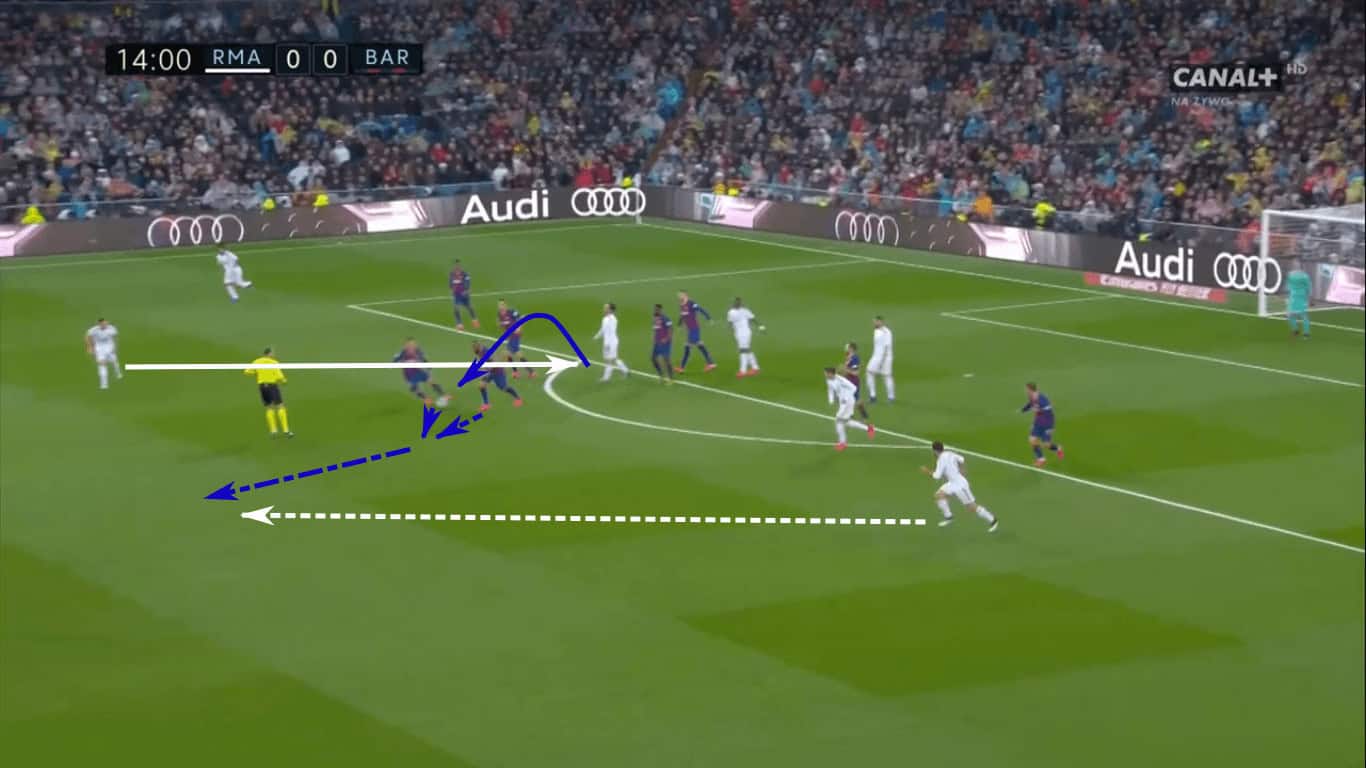
Kroos does well to take away the passing lane from Messi. Carvajal applies pressure on Arturo Vidal, forcing him to release the pass. While Vidal does make some progress up the pitch and plays into Antoine Griezmann, a forward pass, Casemiro is well-positioned to step to the Frenchman and force him backwards. That negative action allows Real Madrid to get numbers behind the ball.

But they’re not satisfied with one negative pass. Knowing Barcelona has no forward options, Los Blancos continue the counterpress. They want to drive Barcelona further back. Real Madrid used those first seven seconds of the counterpress to settle into their defensive shape. Now that they’re organised, each negative pass is seen as a pressing trigger. They’ve successfully transitioned from a counterpress to a high press. Now they can chase those pressing triggers, such as negative passes, poor body orientation and passes into players with limited passing options.
Real Madrid forces Barcelona to play back to Samuel Umtiti, whom Karim Benzema immediately pressures. He swings the ball to Marc Andre ter Stegen, who feels the weight of Benzema’s pressure. Unwilling to take on additional risk, the German attempts to reach an intermediate target.
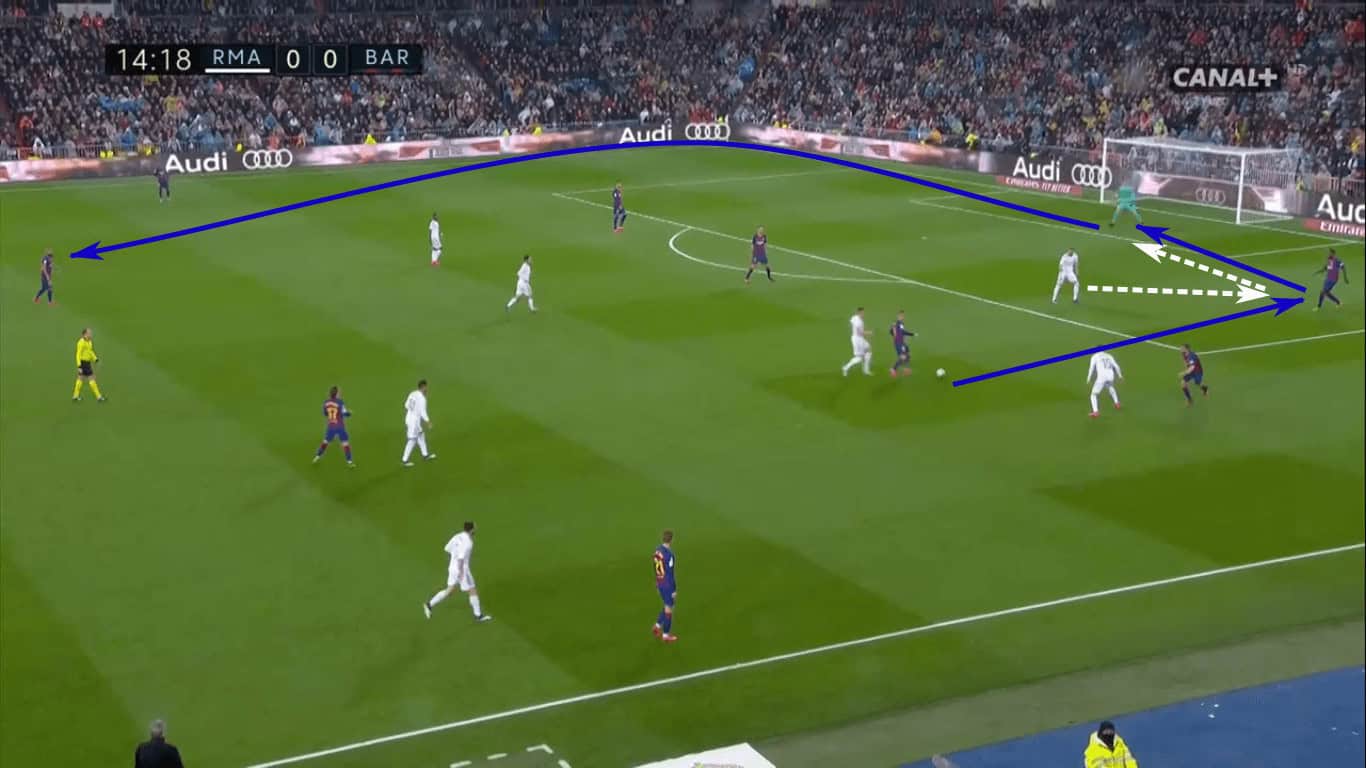
As the ball travels, so does the press. The aerial pass is contested and lost. Marcelo picks up the ball, and a Barcelona counterattack opportunity quickly becomes Real Madrid’s own chance.
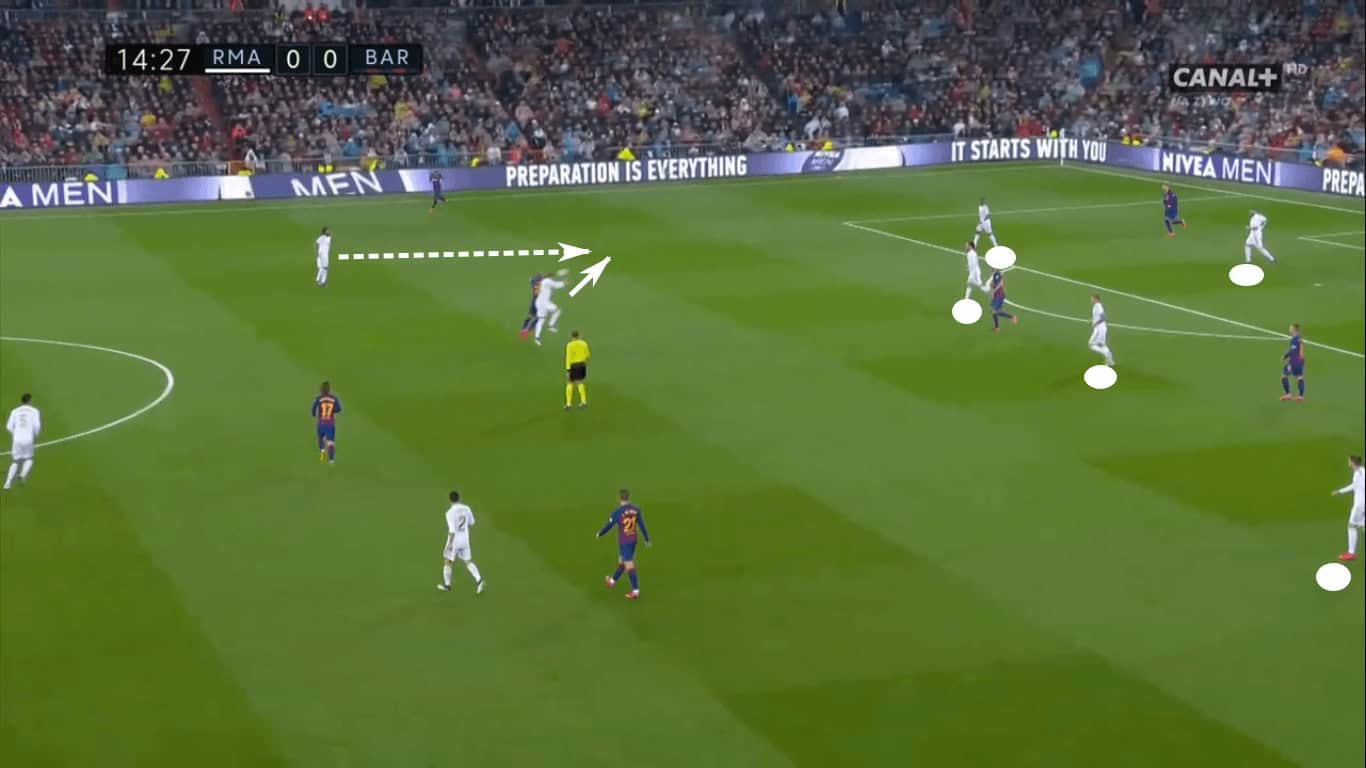
The lesson here is to use the counterpress as a tool for limiting or fully taking away the opponent’s path forward. In doing so, the counterpress allows for the transition from an expansive attacking shape to a compact defensive shape. The quicker the shape is recovered, the sooner the team can press. Ultimately, we want to press from a position of strength. We’re organised and compact. Space is limited, and we’re giving them limited actions, making play predictable. Dictating when and where the opponent can play is the goal. We can defend against that.
But let’s scale back. Let’s train the team to deny, or at least limit, progression. Ideally, we’re forcing the opponent backwards into recovering defenders, who can either apply pressure on the ball or get back into our defensive shape.
Not all counterpresses can achieve that goal. At the very least, teach the players to decrease the threat. Funnelling into the wings is one way. Delaying the attack to get more numbers behind the ball is another. Forcing square or negative passes is another. Bend, don’t break. If it’s impossible to deny progression, at least slow it.
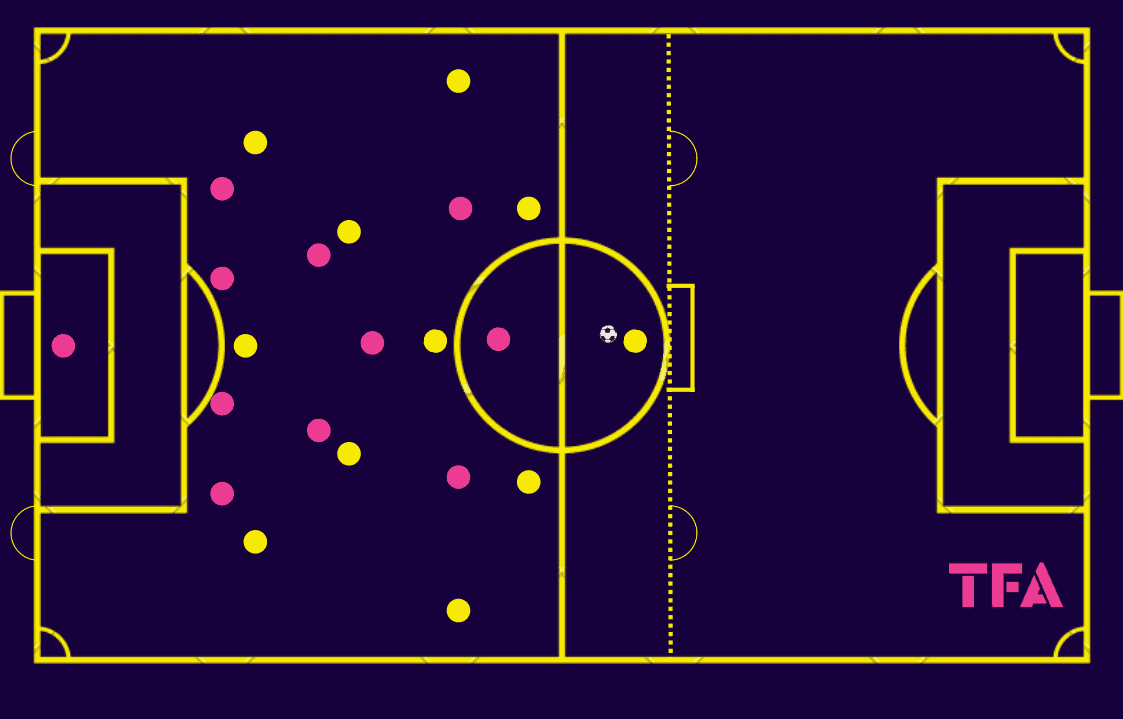
In this game, we’re going to overload the players with pressure to get pressure on the ball and keep the opponent from playing forward. This six-goal game has each team attacking three goals. The full-sized goal in the centre is worth three points. We want to protect the central channel, so incentivising those attacks will generate the situations we want to learn to defend against.
We want more than just numbers behind the ball. We want to put pressure on the first attacker and force passes backwards or square. In order to do so, we need numbers near the ball and a defensive tempo that prevents opponents from picking their heads up and finding forward options.
The small goals out wide are worth one point. If the defending team doesn’t counterpress quickly, they’ll leave those goals exposed. On a short field like this one, those goals represent forward-passing opportunities. We want to prevent the opposition from getting behind our lines, even in the wings. Press or get beat behind the lines.
Those small goals are also replaceable with endzones. That’s a way to train in defending against runners in wide spaces.
Win the ball and keep it
It’s time to turn to the most obvious objective of the counterpress: to win the ball. We’ll go even further. In defensive transitions, we want to win the ball and keep it. For some teams, that may mean winning possession and playing out of the counterpress in order to reestablish an organised attack. For others, playing the first past forward or into the highest line may be a top priority. In doing so, they turn the defensive transition into an attacking transition.
What your team does once they’ve won the ball is up to you, but this tactical analysis will help create a framework for winning the ball and playing out of the opposition’s counterpress. It all starts with quickly condensing space to limit the opposition’s short and intermediate options. Take away the easy passes, and your team will slow the opponent’s decision-making. Any time added to their decision-making and actions allows the defending team to increase pressure on the first attacker and take away more options.
Designing a counterpressing exercise must correspond with your team’s tactics. If you’re a side that plays with minimal or limited width, then the exercise should incorporate enough space for the opponent to play out of your counterpress if pressure is poor.
But let’s say your team has a more expansive shape when attacking. When designing an exercise, the playing area should accommodate the attacking principles, which will give more realistic reps in defensive transitions. Since the team typically covers more significant surface area when attacking, they must be prepared to recover into a more compact defensive shape to limit the opponent’s progression moments after a recovery. First-defender pressure and coverage from the second defenders is critical. They have to keep the opponent from playing forward and then increase pressure on the first attacker to take the ball off of him.
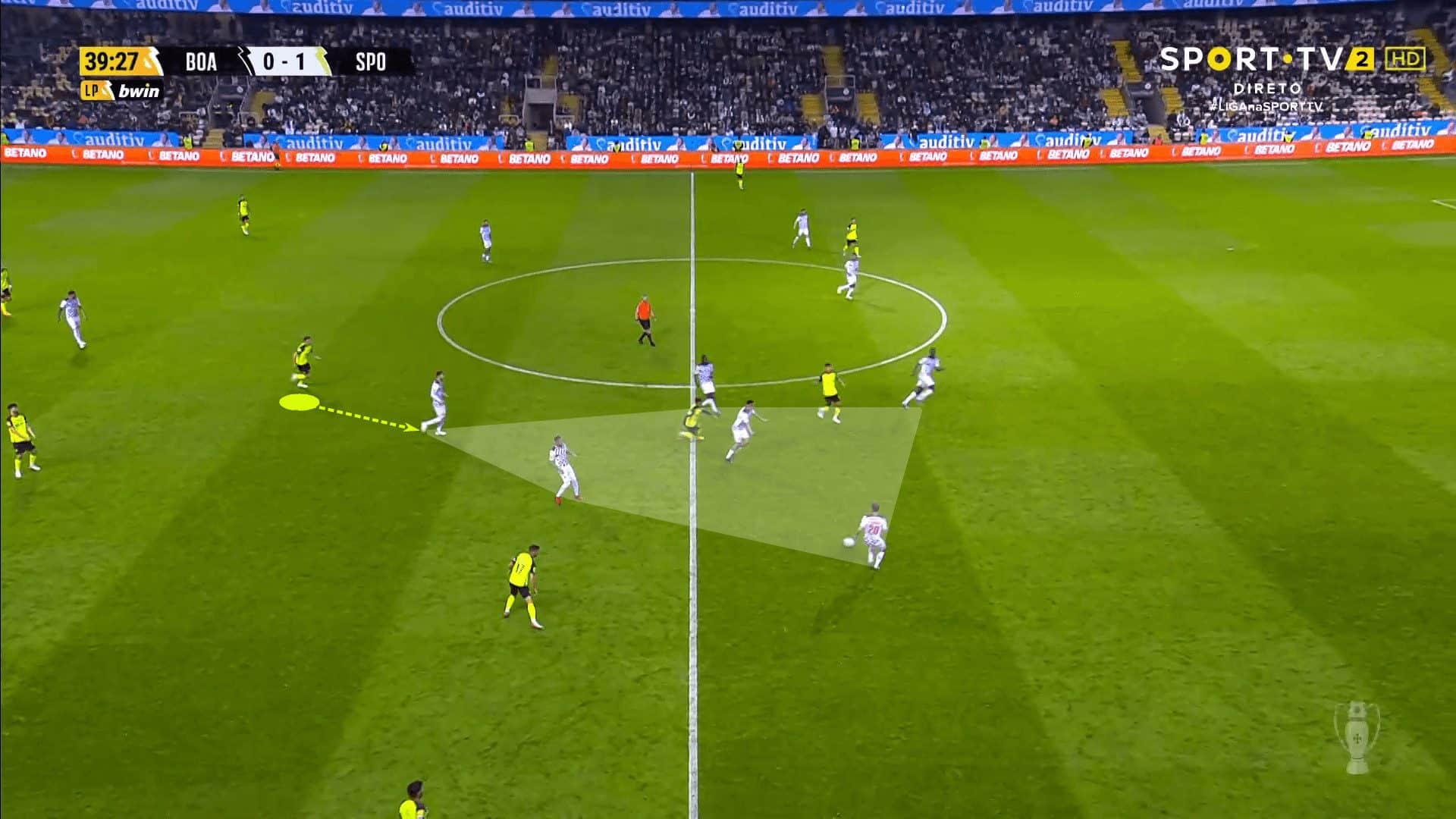
Sporting CP offers an excellent example of these tactics. Immediately upon losing the ball, one player quickly steps into the first defender role to apply pressure on the ball, step into passing lanes and limit passing options. Good first-defender pressure helps the second defender read much more effortlessly. As we see in this example, since Boa Vista is still in their compact defensive shape, the run of the first defender leaves two field players and the goalkeeper as realistic passing options. Seeing what the first defender has taken away, the three supporting defenders can adapt their movements to condense space near the two field players. This is where the counterpressing team wants to win the ball. If the opponent plays short, we want numbers near the ball to take it off of them.
Minimising the risk of forward press-breaking passes is vital. If the only available option is to play back, as Huesca does during an aggressive Atletico Madrid counterpress, players should continue to apply pressure on the ball. In the example below, the decision is to play safe and clear the ball up the pitch. It’s not a final third recovery, but Atleti still managed to win the ball.

The final scenario is more typically associated with low-risk, high-reward tactics. Another valuable counterpressing idea to train is taking a chance playing over the opposition’s press to target a hopeful killer pass. If the pass works out, great, get to goal. If it doesn’t, the forwards must show immediate awareness to transition to the counterpress.
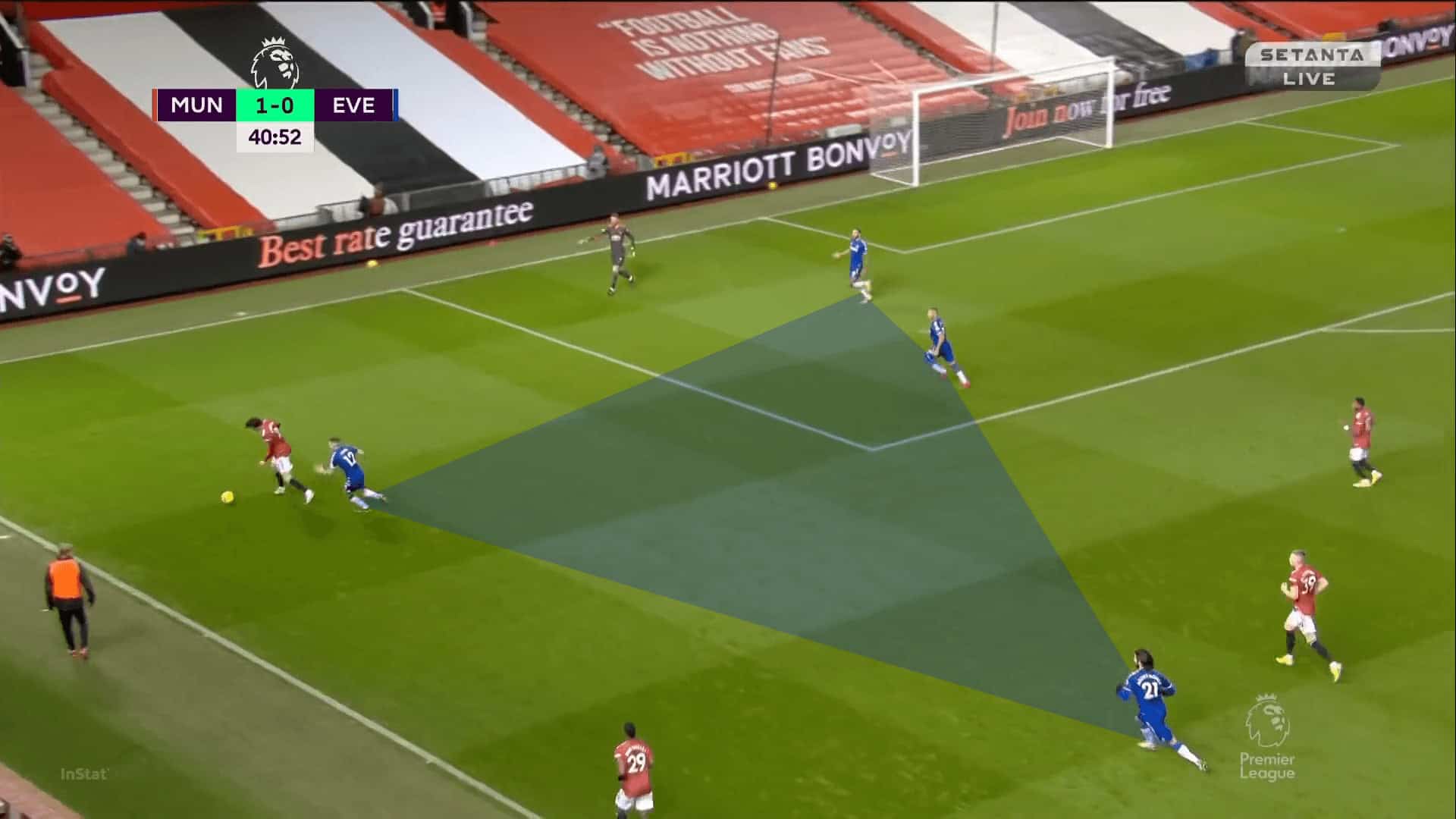
Just as Everton did, the team must get numbers high up the pitch to apply pressure on the first attacker, who is likely facing his own goal. If he’s being pressed away from the central channel, taking away the goalkeeper will further limit his options out of pressure. In all likelihood, the first attacker will try to cut the ball wide and send it long down the line, limiting risk out of the back.
In order to create this counterpressing situation and position the squad for a high recovery, the first step is to miss long with the ball behind the back line. The pass must get behind them and force a recovery towards goal. Next, there must be enough players high up the pitch to put pressure on the first attacker and limit his short and intermediate passing options. Given that his momentum is moving towards his own goal, he should have very few options to play into, making the marking responsibilities easier for the supporting players.
Whatever your team’s tactics, the goal of the exercise is to create counterpressing situations and help your team understand how to compress space quickly and create opportunities for recoveries.
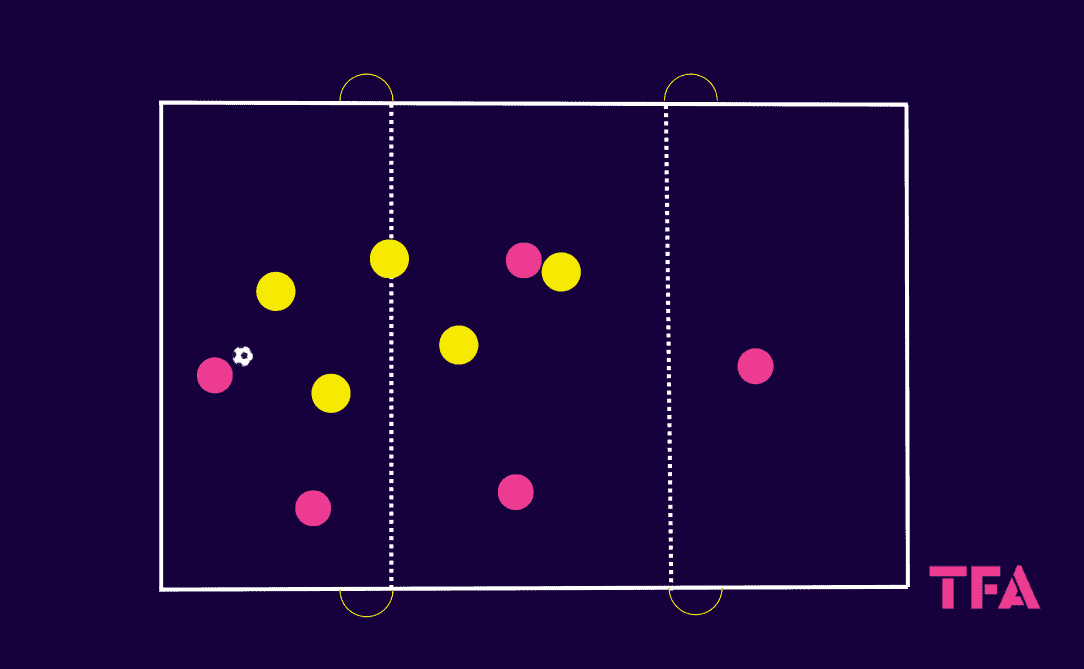
To train the players to quickly condense the playing area and make defensive engagements more frequent, we’ll play a small-sided game with each team attacking two small goals. The field is split into three channels. When attacking, the team in possession can occupy all three zones if they would like. The defending team, meanwhile, can only occupy two out of the three. As soon as there is a change in possession, the team transitioning to defence must quickly recover their shape. They want to get pressure on the first attacker while also eliminating shooting lanes to goal.
The goals are in the two wings, but the inside post sits on the channel line. The goal placement will naturally encourage the teams to offset their attacks into the wings, allowing the defending teams to occupy two out of the three zones.
Quick responses in transition are key. Ensure the first defender is quick to apply pressure on the first attacker and that cover arrives quickly. If the first defender can win the ball himself, fantastic. Just build in the understanding that if he gets beat when there is no cover, his early engagement has likely hurt the team. As the defending team settles into their defensive shape, they build an understanding of their movement objectives. Take away the lanes to goals, eliminate short and intermediate passing options and look to seal the attacking team into a small area of the pitch. Once the defending team has their structure, this is when they can increase their defending tempo and intensity.
Conclusion
Given the speed of play in the contemporary game and the reliance on counterattacking as a response to facing teams with an extraordinary ability to retain possession of the ball, excellence in defensive transitions has become a vital component of the game.
Defensive transitions aren’t as simple as making the playing area as small as possible. These transitional moments are inherently tied to the way teams attack. Positioning and movement in possession directly impact a team’s ability to transition into a more compact shape, apply pressure on the first attacker and deny progression. Structured attacks and defensive transitions are tied together. Improve one, and you’ll likely improve the other.
