German football has always had a distinct feel; you simply knew what kind of football and what kind of quality to expect from the Bundesliga.
The same can be said about the second tier of Bundesliga, too.
Just like its big brother, the 2. Bundesliga is home to many talented players and coaches alike waiting for their turn under the sun.
Holstein Kiel’s Marcel Rapp is one of such coaches.
Boasting highly attacking tactics and an intriguing football mind, the 44-year-old German is among the names slowly but surely orbiting the public eye.
And for good reason, too; Kiel are a very Bundesliga-type team but also one that can surprise you in many ways.
While there are no concrete links to the likes of Premier League, La Liga or even Bundesliga clubs (yet), Rapp is steadily building a project bound to give him the recognition he so desperately deserves.
In this tactical analysis, we’ll look at the tactics of Holstein Kiel under Rapp’s coaching style, do a thorough analysis of his philosophy and try to project his 2024 based on both the eye test and the statistics.
So then, who is Marcel Rapp, and what does his future hold?
Marcel Rapp coaching overview
Marcel Rapp is a 44-year-old Holstein Kiel coach, currently guiding his team in the 2. Bundesliga.
At the moment, Rapp has a total of 1.64 years of experience in coaching.
Hence, he’s relatively new to the scene, and Holstein Kiel are his first extensive tenure, following an ‘upbringing’ at TSG Hoffenheim, mainly in youth categories or as an assistant coach.
So far, he’s managed a total of 80 matches at Holstein Kiel, boasting a record of 34 wins, 19 draws and 27 losses.
This amounts to an average of 1.51 points per match, with an average record of 1.75 goals scored vs. 1.70 goals conceded.
As a whole, this is very reflective of his tactical approach of highly attacking and open football, but it’s in the current 2023/24 season that Rapp has started to come to his own.
In the current season and at the time of writing, Holstein Kiel has played a total of 19 games, securing 12 wins, two draws, and five losses.
This has bumped the average point per match to an impressive 2.00.
With 41 goals scored in those 19 games, Holstein Kiel rattles the inside of the opposition’s net an average of 2.1 times per game, while their 30 conceded goals mean they allow the opponent an average of 1.5 goals per game as well.
Again, this is very reflective of the overall tactical philosophy.
Rapp’s contract is valid until 2026, so we can assume he still has time to build his project in the 2. Bundesliga.
However, with the team currently topping the table and playing great football, it feels like only a matter of time before other teams come knocking on his door.
But what tactics is Rapp deploying to make Holstein Kiel such a force to be reckoned with in Germany?
Marcel Rapp tactics In possession
Holstein Kiel’s most impressive and undoubtedly intriguing tactics come in their possession phase.
Rapp already has a reputation for being a highly flexible coach with an ever-changing and ever-adapting philosophy.
Still, nothing truly encapsulates it better than what his team does in the first two phases of play.
The data already confirms this.

If we look at the formations Holstein Kiel has used so far this season, we get at least three different shapes Rapp often uses in his in-possession structures.
Intriguingly, all three of the most prevalent ones include some form of a three-at-the-back variation, and at least two have been used almost equally throughout the 2023/24 campaign.
But Rapp likes to be flexible, and Holstein Kiel doesn’t have a problem using a more traditional four-at-the-back system with two fullbacks and two centrebacks down the middle either.
According to the numbers, however, this seems to be far less regular and more situational than anything else.
That said, the three-at-the-back is not always what Holstein Kiel starts with on paper but rather what they transform into once the game starts.
But even then, these build-up tactics are all about flexibility and, even more notably, rotation.
It does seem that Rapp’s philosophy is fluid, adapting to the opposition as much as it wants to stay true to its foundation.
For instance, the following example shows Holstein Kiel’s initial shape in possession and subsequent rotation to optimise their progression chances.

They start in a standard three-at-the-back, using three centre-backs and two wingbacks (or wide midfielders, as is often the case) but then rotate towards the right, pushing the right centre-back into a higher position and dropping the left midfielder/left wingback into the left centre-back position.
The purpose of this rotation is simple: dismarking.
As their first and second lines rotate, the opposition is put into difficult situations where they have to decide whether to follow and risk getting dragged out of position or retain their positions but then allow Holstein Kiel in the first line to have easier superiority.
It’s an arguably standard decisional crisis situation that seriously tests the foundational quality of the defending team.
Holstein Kiel uses it well precisely to create superiority and capitalise on either the opposition’s indecisiveness or their inability to counter the rotation in the first place.
At his core, Rapp is still a highly positional coach despite his ‘heavy metal’ tendencies, as we will see further on in the tactical analysis.
Speaking of that positional nature, this principle is, again, best seen in the first two phases of play.
Rapp does, however, marry this positional principle with a highly aggressive and direct one to create a hybrid that works very well, at least so far in the 2. Bundesliga.

Holstein Kiel are very patient in certain phases and specific zones of the pitch.
This is largely true when they’re baiting the press and using those rotations mentioned above to gain an advantage or when they’ve settled in the opposition’s half.
However, once the superiority has been established and there is a clear path to progress, Kiel will take it.
And they will take it fast.
The build-up example we see here shows precisely that.
Rapp’s men successfully create the 4v3 situation in the first phase and patiently outplay the opposition to progress the ball onto the flanks.
But once the pass reaches the free man or has the opportunity to access runners or players between the lines, the play speeds up immediately.
Holstein Kiel, on average, had more possession and passes in 2023/24 than their opposition, but they were very proactive in using this advantage.
This means that there isn’t necessarily a lot of recycling or dallying on the ball; rather, once the opportunity has been identified, it’s all go from the start.
The data analysis suggests the same, as can be seen in the following chart.
Holstein Kiel Ball Progression Chart
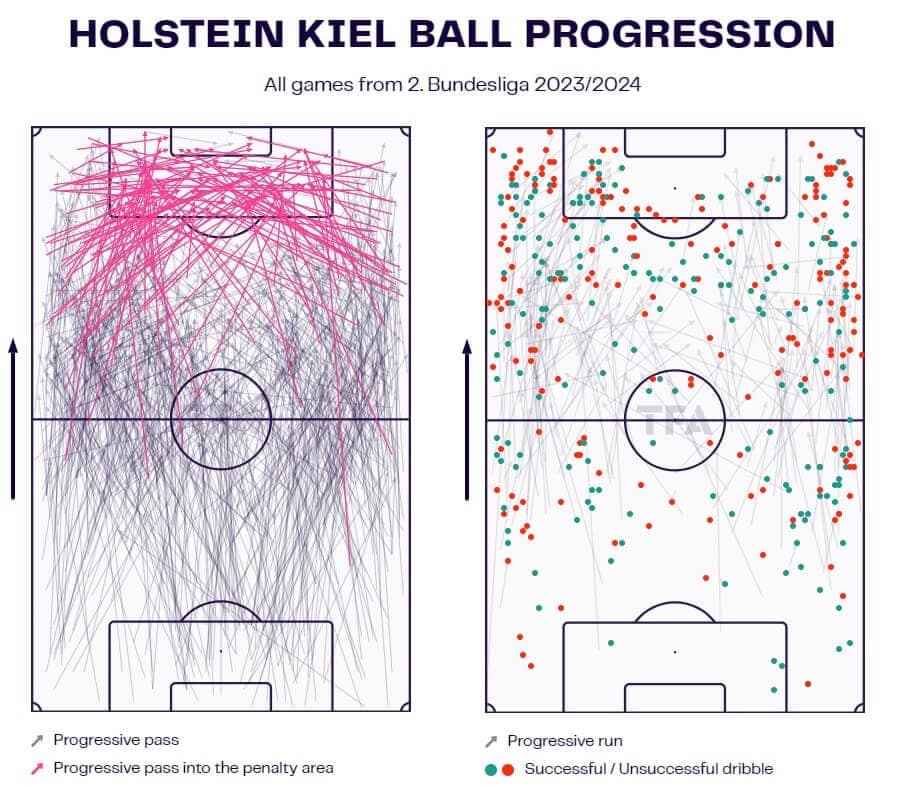
If we analyse Holstein Kiel’s progression, we can see specific clusters appear around the halfway pitch; this is where they generally tend to camp and attempt to pin the opposition down in the final third.
However, when we go deeper down, aspects of that direct approach come into play.
Holstein Kiel isn’t afraid to skip phases if the option presents itself, so there are either many long and direct passes from the back or deep dribbles that start a long carry into advanced areas of the pitch.
Both of these aspects speed up play a lot and contribute to a fast match tempo, which we often associate with German football.
Similarly, the fact there are almost no dribble attempts in the middle of the pitch is more proof of the same concept: this phase.
At the same time, this is important when holding possession against a low block, but it is often skipped in favour of the faster and direct route down the flanks or in behind into open space.
That doesn’t mean Holstein Kiel doesn’t recycle possessions; on the contrary, they are still a team that can retain really well.
They are also not afraid to speed up when necessary and sacrifice safer recycling in favour of the arguably riskier exploitation of space quickly.
Let’s take a look at another example of the marriage between these two tactical aspects.

Once again, Holstein Kiel are very good at securing the numerical superiority in the first line to access the free man.
But once that happens, the rest of the attack unfolds in a total of three or four moves at most.
This isn’t a coincidence either; it’s a pattern.
Identify the free man and access him; identify the space and exploit it.
It sounds simple, but it requires a lot of practice and very good coaching to implement successfully.
Combined with a plethora of rotations, Rapp’s tactics are difficult to counter as they are so fluid and ever-adapting.
However, One thing to note is that despite the insistence on a double pivot on paper, Holstein Kiel mostly plays with a single-holding midfielder.
In contrast, his double pivot partner pushes up the pitch to support the attack, often in the forward line itself.
Similarly, the forwards, often the striker himself, will drop into the half-space to support the attack and initiate an overload.
For example, in the following sequence, Holstein Kiel overloaded the left, which seems to be their preferred side for positional combinations, and switched the play quickly to the underloaded side, where they once again established numerical superiority to progress the ball.

Once possession has been shifted, they immediately step on the gas pedal and attack the space.
The same is true for their final third combinations — and ‘combinations’ truly is the right word to use for this part of our tactical analysis.
Third-man runs, switching of positions, supporting runs, disembarking—all of that is standard in a highly fluid attacking line that has enough retention and runners to constantly threaten the opposition.
The numbers support the thesis of direct play as well.
Looking at the following two graphs, we can see many of Holstein Kiel’s shot assists actually come from deeper areas but also end up in highly threatening zones close to either zone 14 or deeper into the penalty box.
That’s a good sign and also aligns with their expected goals and values.
Holstein Kiel Shots & Shot Assists Map

Looking at their actual goals scored, they often come from high xG situations.
While there are quite several low xG outside-the-box attempts, those still don’t form the majority of shots taken.
All of that being said.
However, it’s difficult to escape the fact Holstein Kiel are not efficient from range this season, and that could be part of the reason why they often resort to direct play; it nullifies the need for sustained pressure and unlocking deep blocks, which can often be breached with attempts from a distance.
Fortunately, their off-the-ball phase can contribute to chance creation too.
Marcel Rapp Tactics Out of possession
Holstein Kiel’s out-of-possession tactics are as you’d expect them to be and, at the very least, much less complex than their on-the-ball aspects.
True to the German way of playing the sport, Rapp’s defensive philosophy remains aggressive, quick and effective.
However, once again, he’s not fully playing into the stereotype, for better or worse.
Statistically, they still press higher and with more intensity than their opposition.
In fact, they rank as the team with the second-highest challenge intensity (rate of defensive actions) and fourth-lowest passes allowed per defensive action (PPDA).
A big part of that comes in the form of pressing, which we will shortly touch upon in this part of our tactical analysis.
However, generally, Rapp likes to deploy his team in a solid mid-block rather than have them press their opposition into oblivion.
Holstein Kiel’s defensive territory confirms that thesis, as can be seen in the following graph.

However, we have to note a couple of things from it.
Firstly, the height of the press.
As alluded to, Holstein Kiel would rather maintain a middle block than chase the ball into the opposition’s first third.
Secondly, the biggest cluster of fouls is located around the entrance to the pitch’s centre, indicating that they usually collapse, engage or even attempt tactical fouls to prevent quick progression and transitional play.
Thirdly, the vast majority of their interceptions come deep in their own penalty area.
This is where turnovers of play are combined with Holstein Kiel’s quick and direct attacks.
And that’s another interesting aspect of Rapp’s tactics; Holstein Kiel are pretty aggressive, primarily upon losing possession, but don’t necessarily turn these quick recoveries to attacks higher up the pitch.
Instead, we see them defend deeper near their penalty area and then immediately eject their runners into space.
The following sequence happens immediately following a deep recovery.
The most important thing to note is how quickly they get up the pitch and into a threatening situation.

This move is essentially done in four passes, but everything is played out in a matter of seconds.
That’s their greatest weapon in attack, either when it comes to turnovers or simply starting a deep build-up phase and then speeding up the game once the opportunity arises, as we already discussed earlier in this tactical analysis.
But data suggests Holstein Kiel are also good at recovering possession in dangerous situations higher up the pitch, too.
In fact, this season alone, they’ve recorded 167 high regains and produced 60 dangerous recoveries (leading to a shot within 20 seconds) and 244 counter-pressing (or gegenpressing) recoveries (within five seconds after a possession loss).
This suggests, as strange as it may sound, that they are a team that often creates through their defending, too.
A couple of key elements make up a sound counter-pressing system.
One would be compactness and the other intensity.
Fortunately for Holstein Kiel, Rapp has coached both of these things.

If the team stays compact in all phases, executing counter-pressing becomes much more manageable.
And Holstein Kiel does it quite well for the most part.
We say for the most part because, despite their good defensive numbers and clear intent, intensity and discipline, they are still a team that will aim to outscore rather than contain, for better or worse.
The numbers suggest the same.
With 236 shots against in 2023/24 (12.44 per 90 minutes), they still concede more than the league average of 11.85.
Fortunately, they no longer concede that many goals and are pretty successful at minimising the damage.
At the moment of writing, they have conceded 23 goals from 26.76 xGA and are allowing 0.113 xGA per shot, among the league’s lowest values.
That said, however, they are the team with the most goals conceded outside the penalty area (9), so even though they minimise the opponents’ expected goals per shot value, they still concede goals from low-value attempts, which is worrying.

If we look at the shots blocked and faced by the goalkeeper, we can see how effective they are at minimising their opposition’s chances in the first place.
Blocks and saves combined have saved them just over six goals, which is good.
However, notice the shots that the opponents have converted: they either come from very high xG value attempts or were taken in and around zone 14.
As good as they can be out of possession, Holstein Kiel still concede goals from golden zones that absolutely need to be adequately defended.
As the numbers confirm, even lower-value shots can be threatening when taken from favourable positions, and currently, that is a blindspot in Rapp’s otherwise stellar philosophy.
Conclusion
Marcel Rapp is a newbie coach by all standards; he doesn’t have an exhaustive or overly impressive CV but is building one as we speak.
At the moment of writing, his Holstein Kiel are currently top of 2 Bundesliga while playing excellent football with intriguing concepts and solid foundations.
By all accounts, 2024 could be a massive year for the still-green gaffer.
Whatever happens, however, following his journey should be exciting.

![Burnley Vs Manchester United [2–2] – Premier League 2025/2026: The Red Devils New Ideas And Potential Tactical Changes – Tactical Analysis](https://totalfootballanalysis.com/wp-content/uploads/2026/01/Burnley-2-2-Manchester-United-tactical-analysis-350x250.png "Burnley Vs Manchester United [2–2] – Premier League 2025/2026: The First Steps Of The Post-Rúben Amorim Era – Tactical Analysis 15")