
An eight-year wait for the World Cup will finally be coming to an end for the Colombian national team, with a return on the horizon after missing out on the 2019 edition of the tournament. In 2015, Colombia were knocked out in their first playoff game after making it out of the groups, in an unlucky matchup, they went on to face eventual winners USA.
25th-ranked Colombia have been placed in a group with second-ranked Germany, 72nd Morocco and 17th-placed South Korea. This will definitely be a closely contested group, with Colombia likely set to battle South Korea for the second spot.
Colombia have the potential to be involved in many high-scoring matches due to their high-energy style of football. They will look to win the ball back as quickly as possible, whilst also trying to get it into the back of the net without giving opposition teams a chance to catch a breather.
In this tactical analysis, Colombia’s tactics will be thoroughly investigated to understand how they will try to cause upsets at the World Cup with their electric front line. Furthermore, we will conduct an analysis of their principles in and out of possession, as well as give a brief scout report on the key players and what is required from key roles in Nelson Abadia’s system.
Predicted Starting XI

Colombia have lined up in a 4-2-3-1 in every match of current manager Nelson Abadia’s reign at the time of writing. They will likely continue with the same system, although defeats and leaky performances against France and Italy, the only two teams ranked higher than Colombia who they’ve faced this season, may encourage Abadia to be slightly more cautious at the World Cup.
Monica Ramos will likely start at right-back, having done so in multiple games for her national team in recent months, although she is versatile and capable of playing on the right wing as she has done at club level. Daniela Arias and Jorelyn Carabalí have formed a partnership in central defence in recent games whilst Manuela Vanegas of Real Sociedad has been the preferred option at left-back.
Lorena Bodeya and Daniela Montoya will likely remain the double-pivot at the base of midfield, with Catalina Usme slightly ahead in attacking midfield. Real Madrid’s 18-year-old Linda Caicedo, has been a consistent performer on one wing, whilst the other wing for Colombia has been occupied by a number of different players, with the selection changing from game to game. We predict Ivonne Chacon to start on the right wing, with Mayra Ramírez starting at centre-forward.
The graphic below illustrates the age profile of the provisional squad ahead of the World Cup. The majority of the starting XI are currently in the prime age of their careers, with a couple of older experienced heads helping lead the nation at the tournament. There are a number of teenagers in the squad, with the majority receiving their first call-ups to the provisional squad, to get the opportunity to experience the occasion.

Attacking Phase

As can be gathered from the stats above, Colombia are one of the more direct and fast-paced teams at the World Cup. Their main chance creation method involves minimal passes, aiming to penetrate the space behind opposition defences as quickly as possible before they can get back into position. They rank in the upper half in terms of teams who score the most goals, meaning that although they don’t see much off the ball, their attacks are often effective and still lead to a steady run of chances per game.
Their possession stats are a result of two main factors; poor technical quality in the build-up, and poor movement to progress the ball. During the build-up, Colombia struggle to retain possession and often give away chances to opponents swiftly after losing the ball.
In the image below, we can see the holding midfielder receiving the ball from the central defender. The structure of the team has allowed for the right-back to have easy access to him from the midfielders, although the poorly played pass by the midfielder results in Colombia nearly conceding the ball in their own box. The midfielders lack the quality to put the correct weight of pass for their teammates, causing Colombia to really struggle to retain any possession.
Furthermore, as can be seen in the image below, Colombia do not have any player dropping deeper between the lines to collect the ball from their teammates. The instructions were designed to have multiple players as close to the opposition goal as possible, hampering their ability to progress the ball through the thirds as a team.
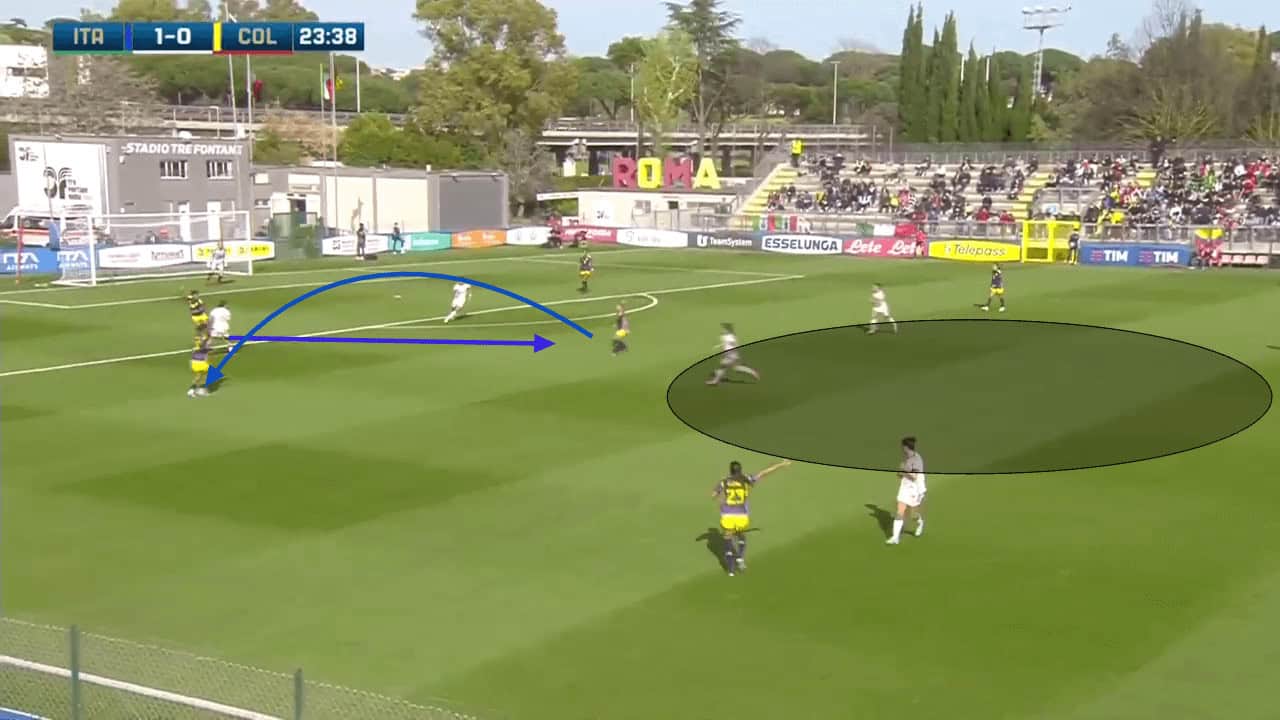
Colombia’s most frequent and reliable method of progressing the ball is by utilising the physical strengths of their centre forward, Ramírez. Ramírez is a strong bull-like powerful runner; defenders bounce off her when competing for the same ball. When there is lots of space in behind, Ramírez thrives in footraces with defenders, with the safety of being the favourite to win 50/50 duels because of her size and strength.
In the example below, we can see the winger dropping into space to drag a full back away from the last line, in order to create the space for Ramírez to run through.
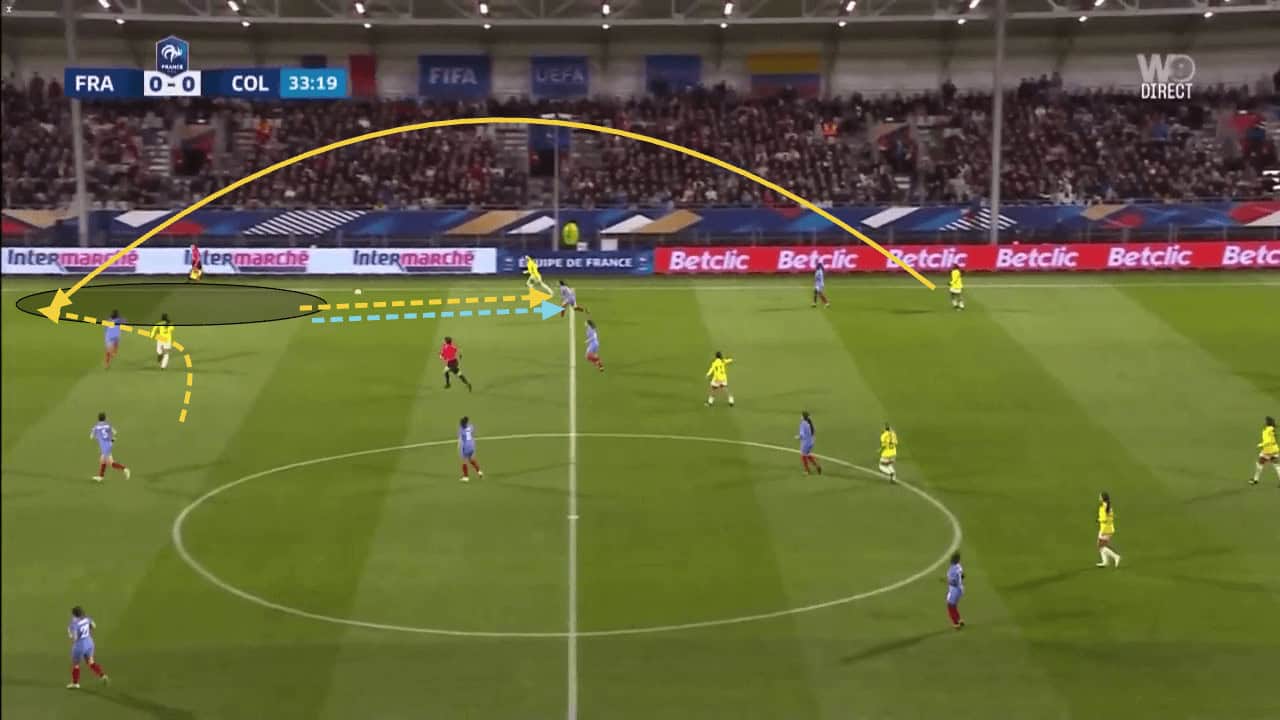
When it is not possible to play a pass into space, Colombia attempt to find Ramírez’s feet directly, allowing her to hold the ball up and give time for teammates to get in close proximity to receive the ball in a higher position. Even with two people surrounding her, Ramírez has exceptional core strength to hold the defenders off before laying the ball off and attacking the box.
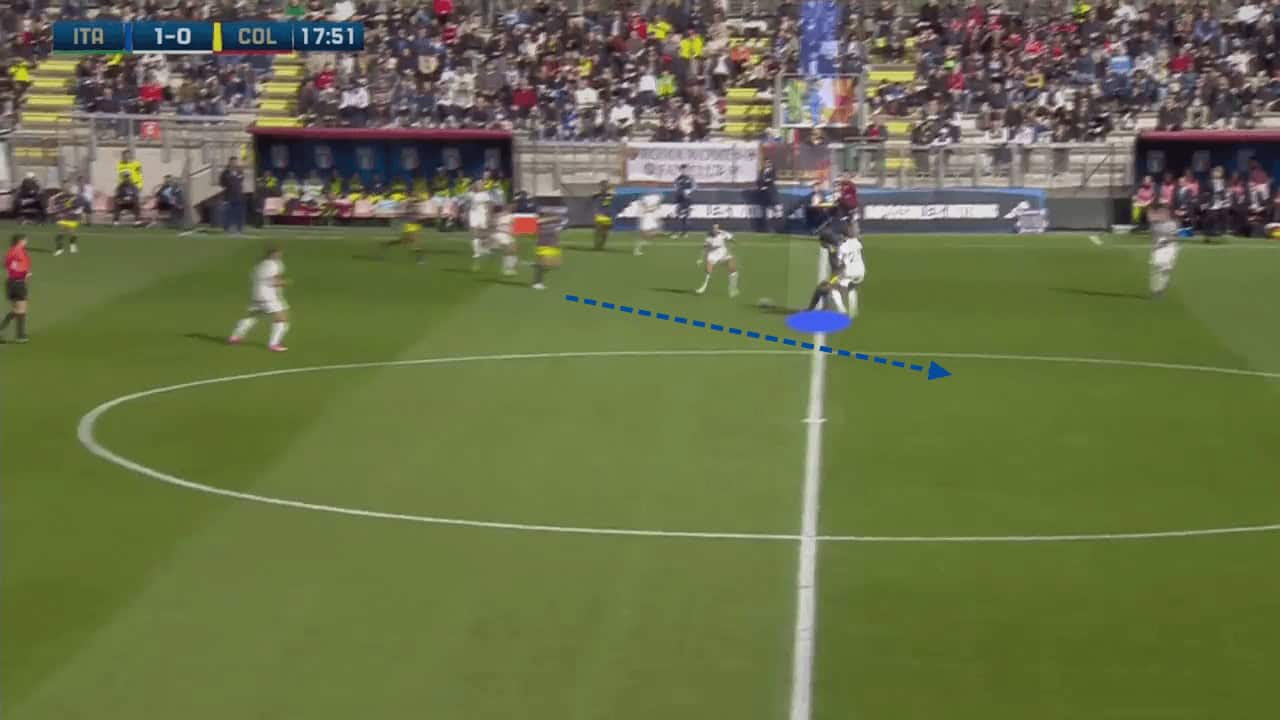
The picture below shows the next events following Ramírez’s hold-up play, where the delay in the attack was crucial in allowing Colombia to attack the box with more than the one or two they were having to utilise the whole game. With such a direct nature in their team, Ramírez has to be the calming presence once in a while to prevent the game from becoming like basketball.
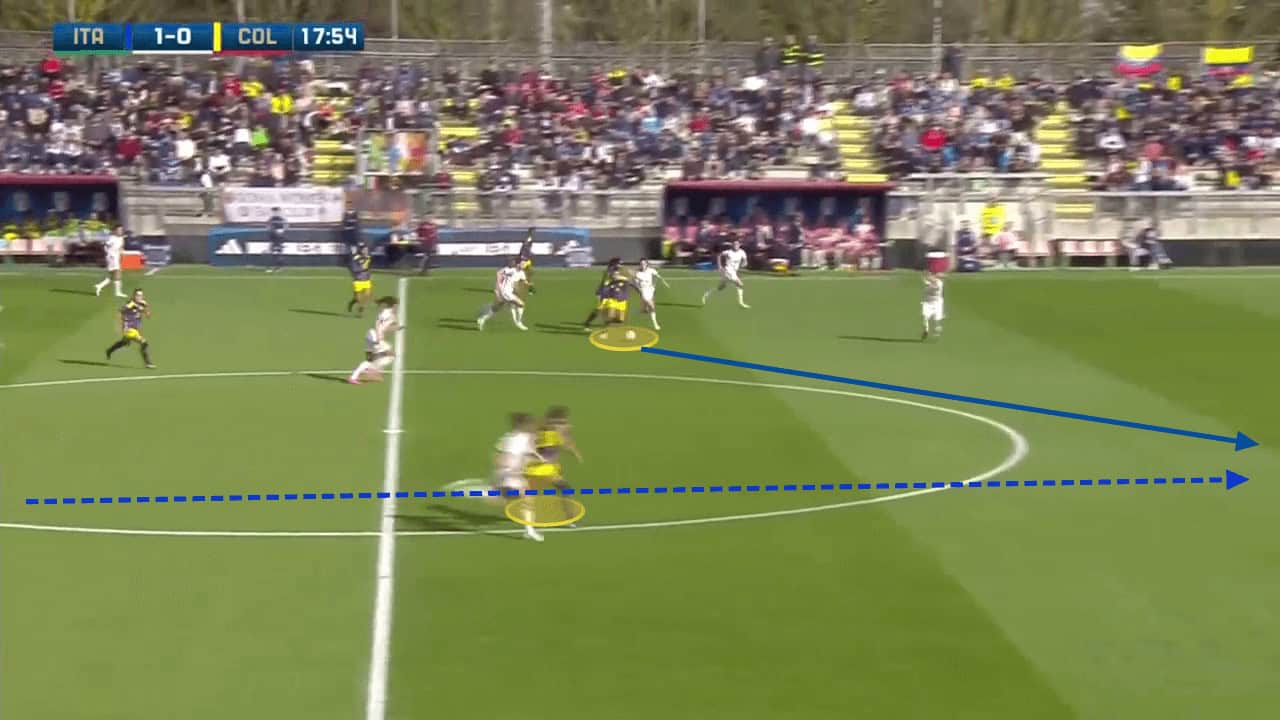
On the occasions that Colombia manage to retain the ball in the opposition third and come up against teams that are happy to sit back, Catalina Usme is key in breaking down the deep blocks through her incredible passing. She is an intelligent player, always on the move after playing a pass to force opposition defenders to either follow her or give her the time she likes to score a goal.
Using multiple runners from deep, like in the example below, also helps cause extra uncertainty to opposition defenders, which then provides Usme with more space to aim her killer passes into. Defenders have to be wary of the pass behind them and the potential of the ball carrier coming towards them, which would cause them to hold their position. Defenders must make a choice, and Usme makes her decision based on her judgement.
Defensive Phase

The stats above display Colombia’s stats without the ball. The thing that stands out instantly, is their extremely low pressing efficiency. Colombia attempt to press the ball high on most occasions; however, there seems to be a lack of thought to the structure behind the intense pressure. As a result, the press is incredibly inefficient, and the stats above also show that they face a high-quality xG chance per game, due to their open nature without the ball.
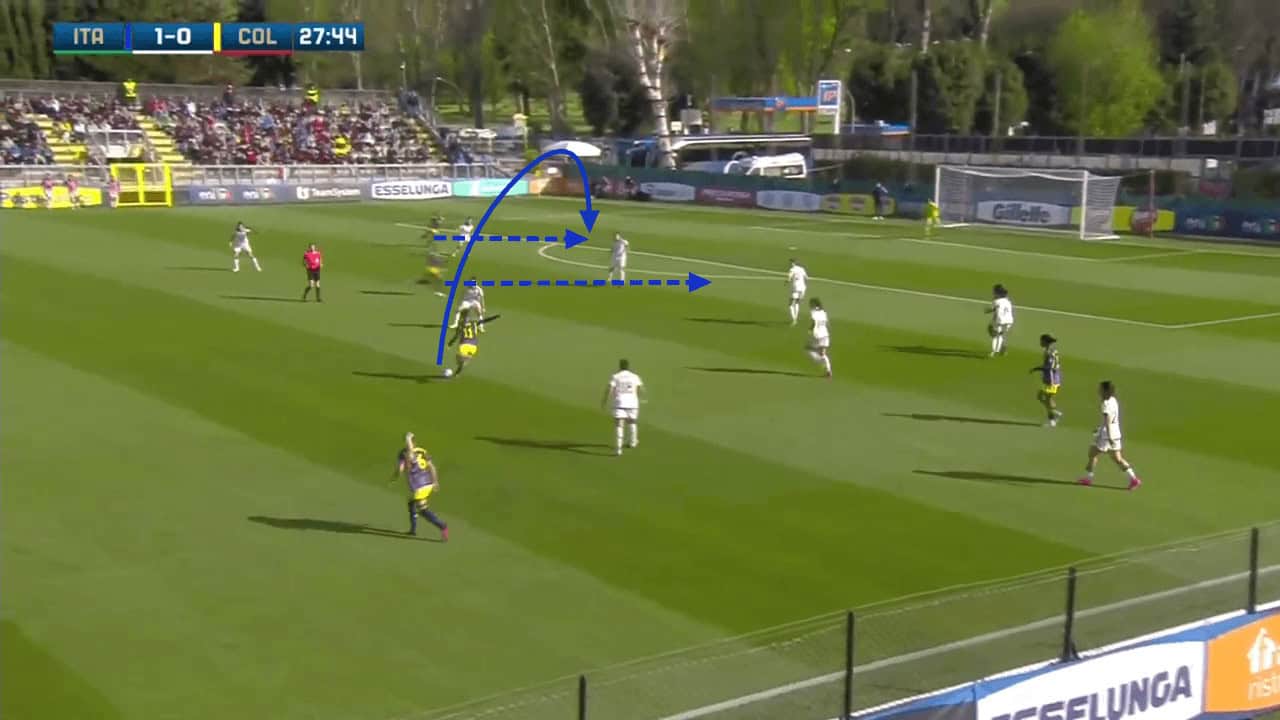
Below we can see an example of the weak pressing structure on show by Colombia. Each player in the front four presses an opposition defender in the backline which in turn leaves them extremely exposed in other areas of the pitch. When the press is so wide in the first phase, the two-player midfield often gets overloaded in the centre of the pitch. As a result, they cannot defend both the space and the men in the central lanes of the pitch, meaning that an opposition midfield player is more open than usual.
We can see the holding midfielder in lots of space in the middle of the pitch, which makes it easy for him to receive the ball from the back four without being at risk of losing the ball. This in turn leads to a 6v6 for opposition teams with two-thirds of the pitch left to play with.
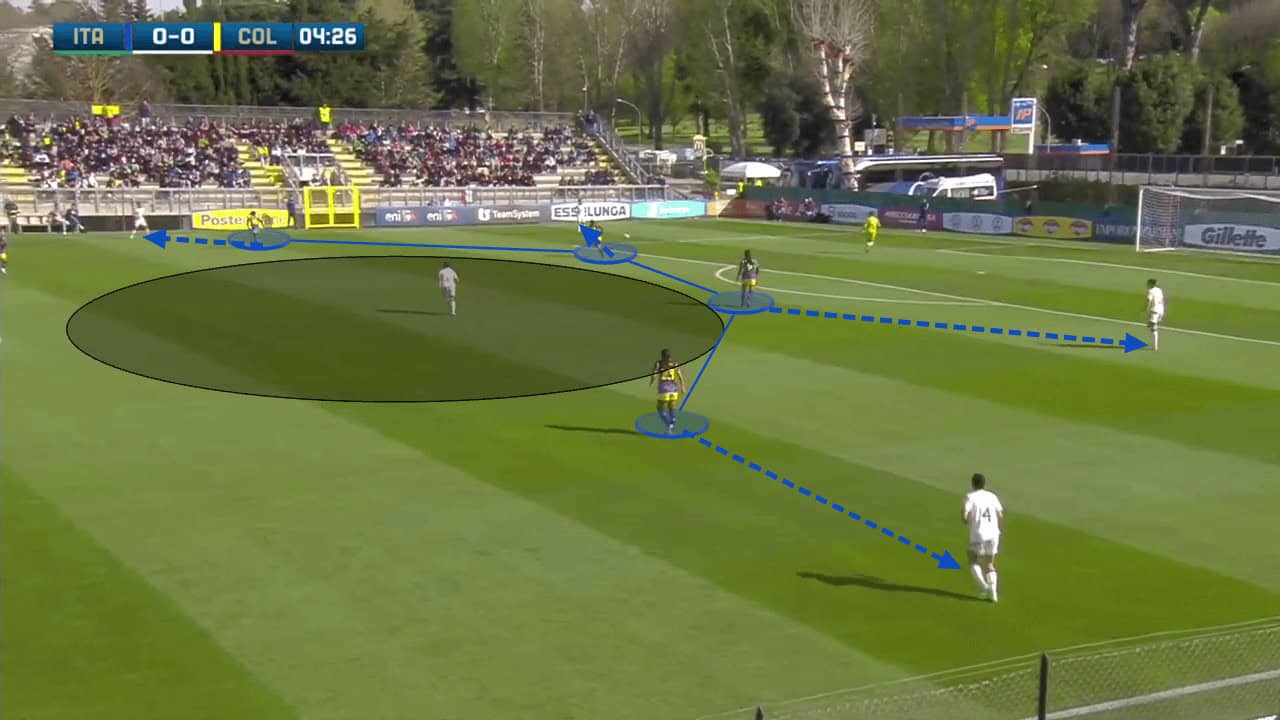
The lack of compactness in Colombia’s off-the-ball structure causes problems throughout the thirds. With the midfield underloaded yet again, this time the midfielders step up to man mark the short passing option. The image below shows the defensive midfielder stepping up to man mark, which then leaves a massive space between the midfield and defensive lines. The big spaces are then found by other attackers waiting for the ball who drop deep to find space, and Colombia lack the cover for their defensive players to allow them to freely step up and mark their opponents closely.
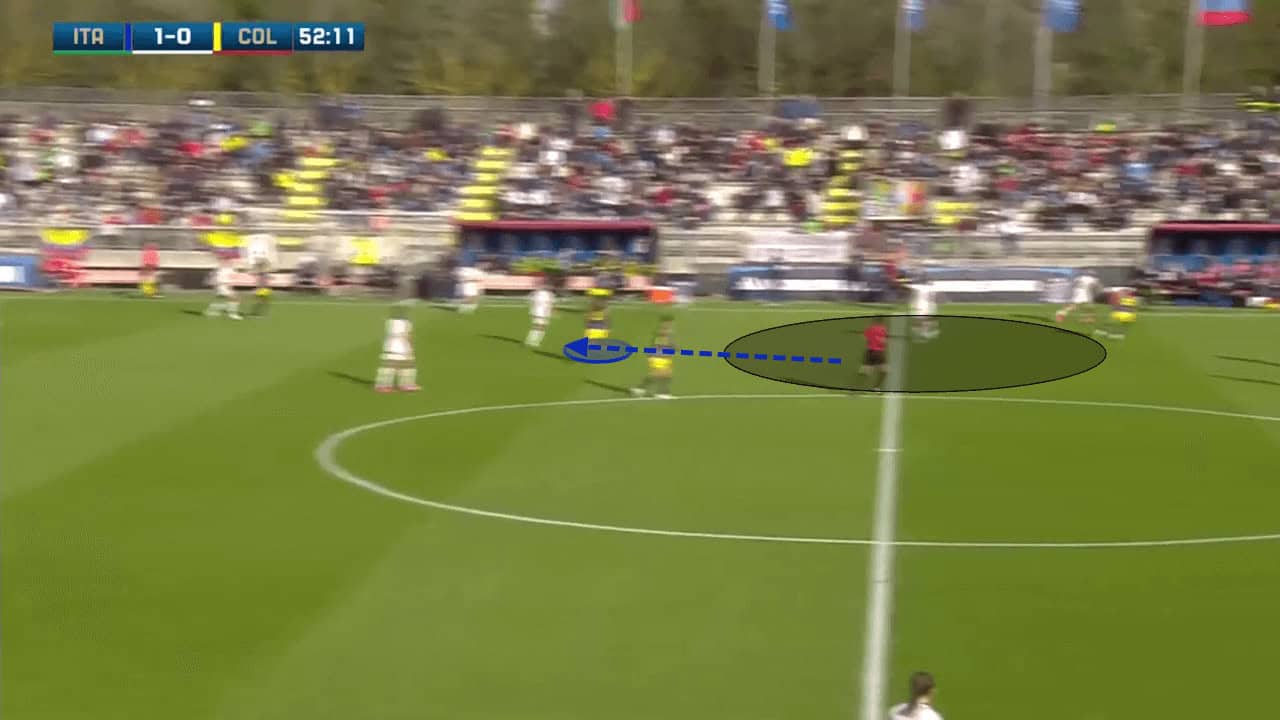
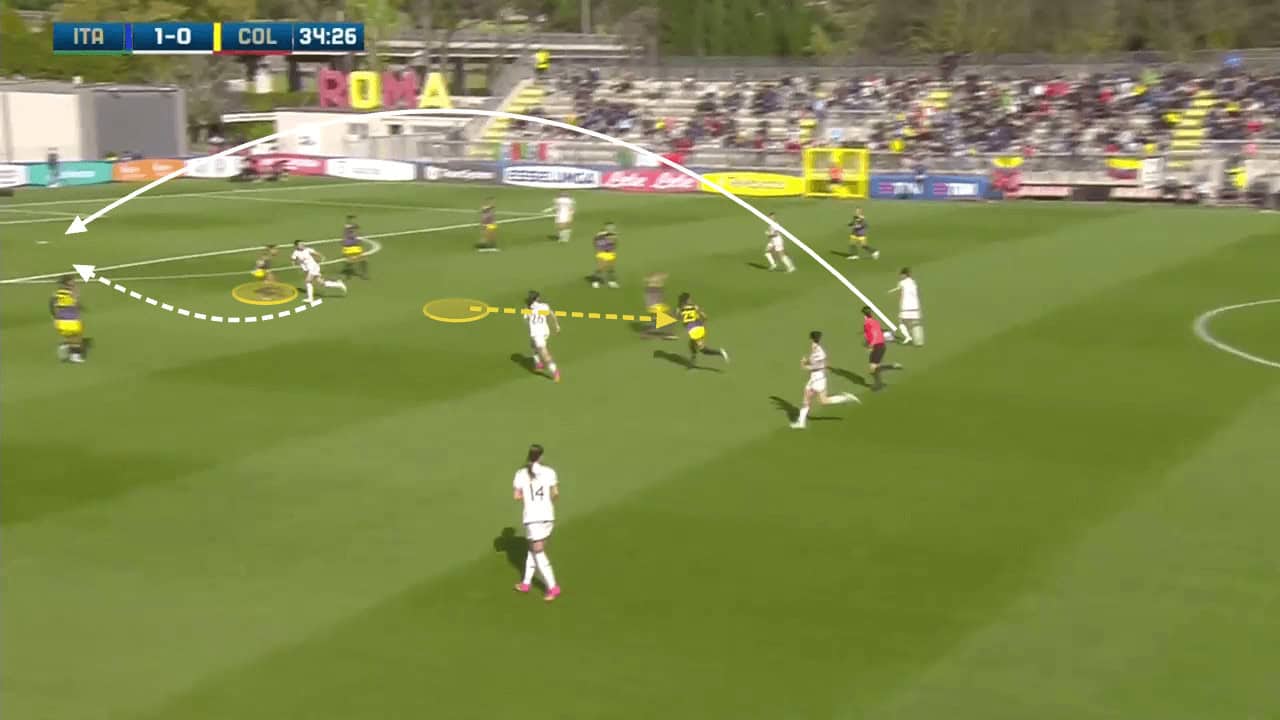
In other instances, when the midfield vacates their positions to mark the opposition midfield, the Colombia defenders can tend to get too aggressive and stay too close to their markers. The defenders struggle to strike the balance with when to step out of the backline and when not to because of their aggressive nature, so gaps are often found when they think they can intercept a pass being played between the lines but can’t get there in time. The image below displays the example of the right-back being too aggressive, which Italy expect and have a third woman attacking that space instantly after the first pass which lures the defender out of position.
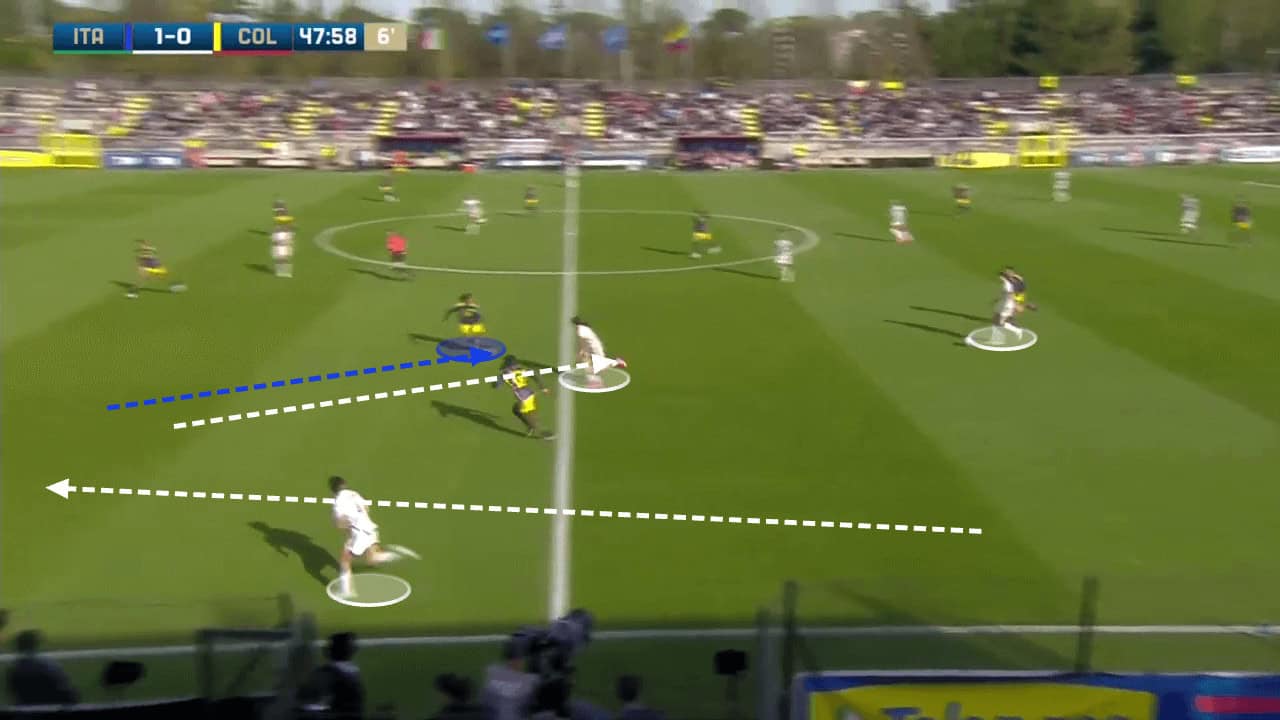
Colombia still suffer from similar issues in their own third outside the box. We can see the centre-back is still extremely eager to intercept the pass by stepping out to block the pass. However, the central defender pays no attention to the run being made or the pass attempted, so while he runs in one direction, the attacker attacks the space the defender has just vacated by stepping out.
Transitions
As mentioned earlier, Colombia love to be direct with their attacks, and the incentive is even higher during transitions, where the space behind the back line is even more plentiful than usual. During these sorts of situations, Mayra Ramírez uses her strong build to pin the centre-backs.
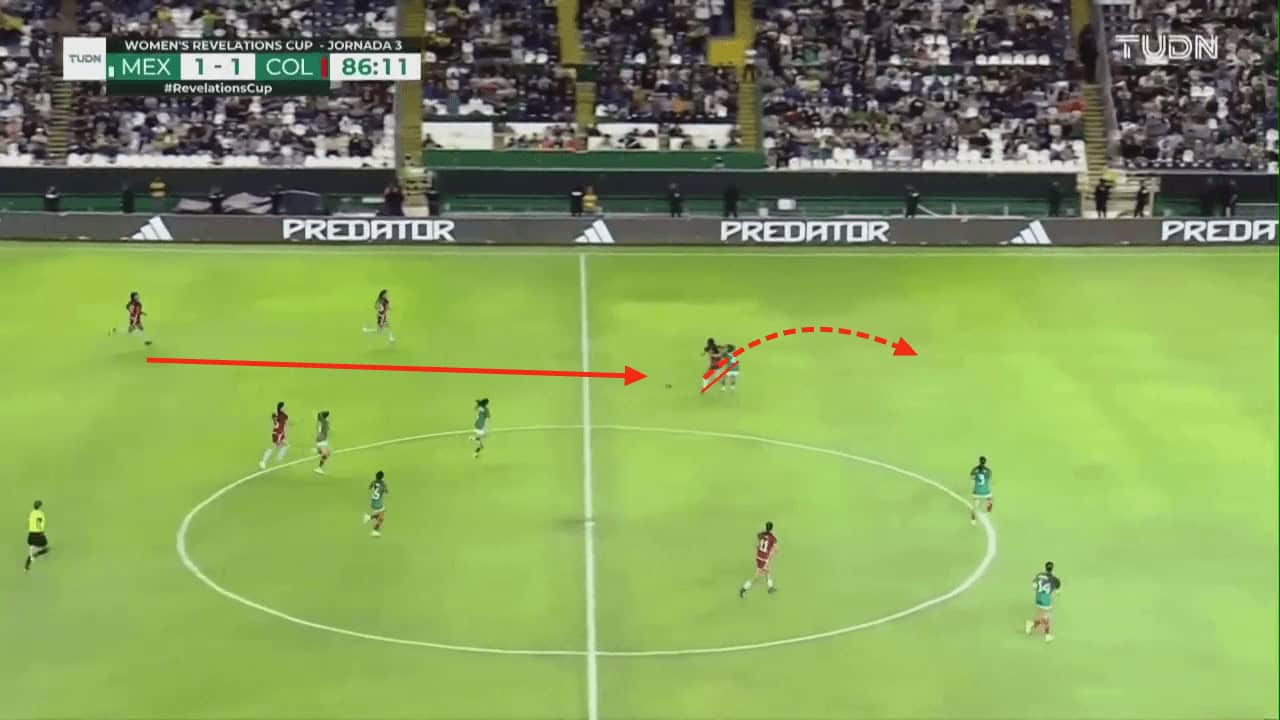
The image below shows Ramírez holding off a defender by the halfway line. Purposely pinning a centre-back allows Ramírez to dictate what happens with the pass that is coming in. If a defender overcommits and lunges for the ball, Ramírez can roll her and attack the massive space left behind them. If the defender continues to back off the attacker, they will give the attacker a potential opportunity to turn with the ball and run directly at the back line or to lay the ball off to a forward-facing player who’ll be able to find someone in a better position.
Colombia haven’t had and won’t have defensive transitions to worry about too often. In the instances that they have lost the ball and been counterattacked, they have already had a good number of players deep to defend against the attacks, because the nature of their quick attacks means that Colombia rarely throw too many players into the box, as there is really no need or time.
Defenders
Carolina Arias of Junior FC and Daniela Caracas of Espanyol are both good depth options at right-back and in central defence for Colombia. In this provisional squad, two teenagers Ana María Guzmán and María Fernanda Viáfara are both set to be involved, although with minimal game time under their belt and unlikely to be given key roles at the World Cup.
Midfielders
34-year-old Diana Ospina can deputise in the midfield pivot, as can María Reyes and María Morales. In the attacking midfield role, Marcela Restrepo is the deputy for Catalina Usme, while Liced Serna is also another option.
Attackers
In the wide areas, Leicy Santos of Atlético Madrid and Lady Andrade provide depth, with Gabriela Uruena being able to cover both the flanks and centre-forward roles.
Key Player
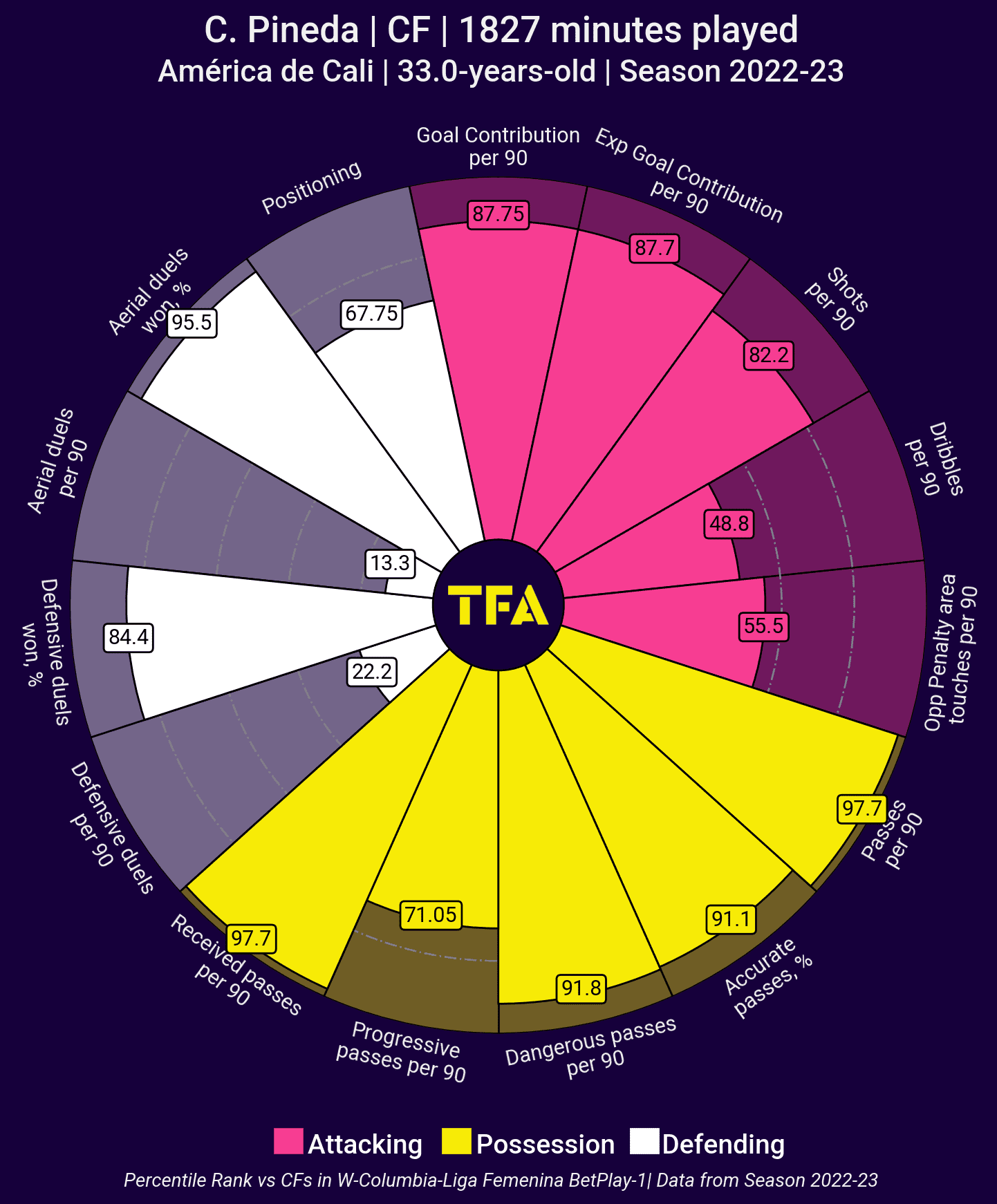
Catalina Usme has been an ever-present for the Colombian side since 2006, with 38 goals in 75 appearances in these past 17 years. She is the creative source of the team, often receiving the ball off the midfield pivot, from where she can find one of the front three. Her excellent passing range allows her to provide dangerous chances when facing high lines under pressure and low blocks equally effectively.
Usme is the heartbeat of the team and with the responsibility of every dead-ball situation, which is one of Colombia’s best methods of getting goals. She has the ball-striking ability to whip in free kicks and corners with pace whether it’s a shot or a cross, leading to lots of dangerous chances from both set plays and open play.
Tournament Prediction
Due to the individual quality in the Colombian front line, they can be expected to progress out of a group containing Germany, South Korea and Morocco. With the squad mostly in its prime and looking to build on some experiences gained in 2015, Colombia will attempt to make it into the knockout stages and make a good name for themselves.
Whilst they may provide entertaining results, their intense style will see them concede a fair few goals, which has the potential to see them go home early in the World Cup. An exit to a first-placed team from an opposing group in the first knockout game is a likely point where the journey ends.
