
The Slovenian Prva Liga is a growing football stage.
Even though their market remains largely under the radar and criminally untapped, the talent at hand is quite remarkable.
Following the conclusion of the World Cup in Qatar, which saw Paris Saint-Germain’s and Argentina’s Lionel Messi crowned champion, club football is set to restart.
And over in Slovenia, no one is as eager for that to happen as NK Olimpija Ljubljana and their newly appointed coach, Albert Riera.
The 40-year-old former Liverpool and Galatasaray player has taken over the club at the beginning of the 2022/23 season following a rather turbulent summer for the Slovenian powerhouse.
Riera replaced Robert Prosinečki in a rather dramatic fashion, with Green Dragons’ ultras storming his press conference in an attempt to stop Prosinečki from being sacked.
However, six months in, Riera is taking Ljubljana to new heights, placing a firm stranglehold on the league table and leaving the second-place FC Koper 14 points behind them.
In that period, they’ve secured 48 out of 60 points with 39 goals scored and only 16 conceded.
In this tactical analysis, we’ll provide a comprehensive overview of Riera’s tactics, including an examination of his attacking and defensive philosophies.
Albert Riera In Possession Tactics
Olimpija Ljubljana is one of, if not the most exciting, team in the entirety of Prva Liga.
A simple glance at the league table is enough to justify such a claim, but the fact that they’ve achieved it with a heavy positional system and a proactive, protagonistic style of play makes it that much more impressive.
This team has so far averaged 61% ball possession, up from 53% in the prior season, and 565 passes (86% accuracy), up from 490 (82%) in the previous season.
Additionally, their figures in key areas, including key passes, shots, goals, expected goals, chances created, and corners, have all increased, while their counter-attacks are among the few that have seen a slight decrease.
However, this tells us a lot about Albert Riera’s style of play.
When we say heavy positional system, we’re emphasising the importance Riera puts on creating and exploiting superiorities across the pitch.
This includes overloads, dragging, asymmetrical shapes and most importantly, adaptation.
When asked about his tactics, Riera was clear that there is no single approach he favours; what matters most is being flexible and unpredictable.
“In seven games, we only repeated the tactical setup once! I repeat, just once! Players get a lot of information and process it successfully. They adapt well to rivals. Let’s not forget that in football, a lot depends on the opponent. That’s why we prepare a different tactic every week. For every game,” he told Siol.net.
And it’s true; Olimpija is very difficult to read.
That being said, Riera’s philosophy is always to be the protagonist of any match.
Much like the footballing greats such as Pep Guardiola, he loves to dominate and control: “I like to have more possession, for my players to keep the ball, to be in control. I like to feel superior to my opponent. However, football is not played in just one way.”
Again, Riera emphasises the importance of being flexible.
When we take into account that he’s been exchanging ideas and talking with Mikel Arteta, who in turn has done the same with Guardiola, his philosophy doesn’t come as a surprise.
In fact, you can see shades of both coaches in the way Olimpija Ljubljana play.
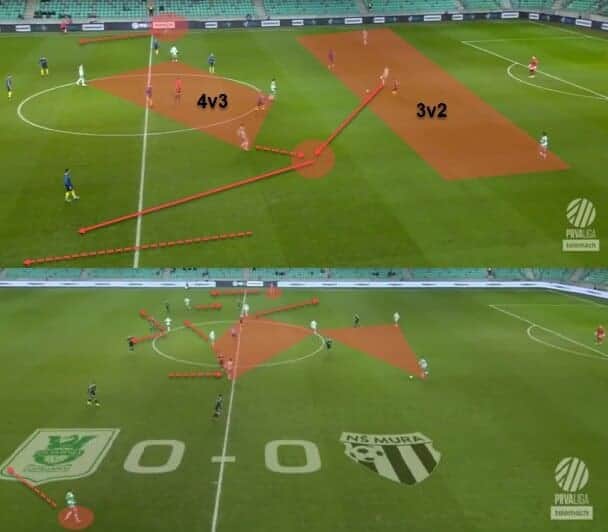
Here, we can see Olimpija Ljubljana’s basic structure in possession.
Riera likes to switch it up, that’s true.
So far in 2022/23, he has used the 4-1-4-1 formation 26% of the time, the 4-3-1-2 formation 21% of the time, and the 4-2-3-1 formation 10% of the time.
Going beyond that, his teams can and do adapt mid-game, confirming the coach’s earlier words.
However, specific patterns and mechanisms remain despite the formation changes.
For instance, looking at the first image, we can see positional play first-hand.
Olimpija are excellent at creating and exploiting superiorities across the pitch.
Riera demands this in every phase of the attack.
Notice how there’s an overload in the first line (3v2) and a diamond that ensures a 4v3 situation in midfield.
This guarantees Olimpija have a relatively easy progression path and a direct way to access their primary targets.
The first line is generally easily broken, and one of the midfielders will often drop deeper into their respective half-space to receive the ball directly from the defenders.
Note that the pivot is generally found either forming a triangle with the centre-backs or slotting between them to establish numerical superiority (or provide parity).
Either way, Ljubljana are exceptional at finding the free man between the lines and progressing play smoothly. Their full-backs are also a point of interest.
Usually, they will be width providers but can also assist in building up, inverting, and attacking space.
This is where Riera’s adaptability shines once more.
Depending on who plays, the structure may change entirely.
It’s not uncommon to see Ljubljana play in an asymmetrical shape, where one full-back is positioned deep and the other provides width.
Generally, however, they are used as an offensive tool.
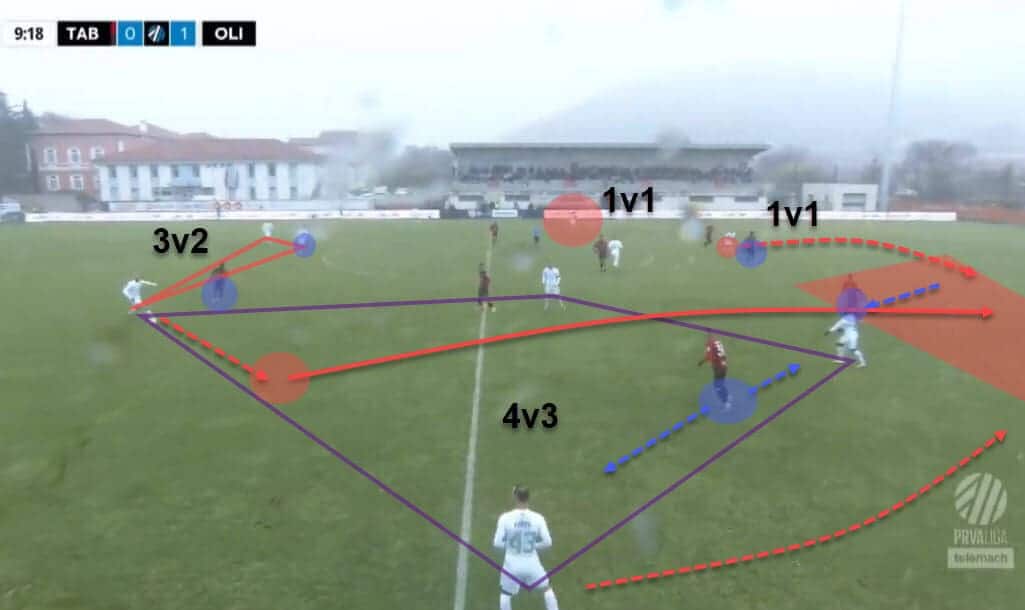
This next image is another representation of Olimpija Ljubljana’s build-up philosophy.
Again, notice how Riera’s team achieved numerical superiority in the first line and then overloaded the right flank while isolating the left one.
This is also where heavy rotations come into play.
The first line is easily broken due to the 3v2 situation, and the centre-back advances with the ball.
This is done so that Ljubljana can create the 4v3 diamond out wide, drag markers away, and ultimately create space.
This brings us to the role of the wingers.
Generally, they are inverted and tend to receive the ball to their feet while dropping via their respective half-spaces.
However, depending on the profile of the full-backs, the wingers can also be width providers.
In the previous example, we can see one of the wingers dropping, which alerts the opposing defender, who must commit to tracking him.
But that creates space for one of the forwards and the right-back to advance.
All of that culminates with an excellent lofted pass into the newly created pocket behind the opposition’s backline.
Just like that, Olimpija Ljubljana successfully penetrated the defensive block with shrewd movement and intelligent positional play.
If we examine the numbers, it becomes clear that they have been dominating the league.
The following graph displays Olimpija Ljubljana’s passing statistics, which provide insight into their performance on the ball.
Olimpija Ljubljana Passing Stats Map
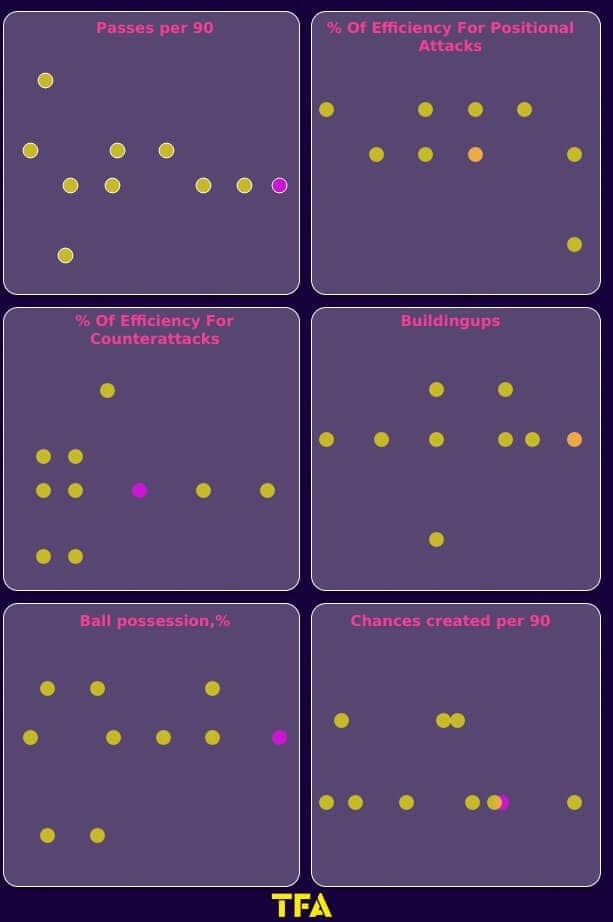
The data confirms that Olimpija dominates games and controls possession, while also excelling at creating chances.
Note that they’re represented by the purple and orange circles in the visuals — purple when their data doesn’t match another team’s, orange when two teams overlap in numbers.
It has to be said that despite their positional prowess, Olimpija are yet to optimise their chance creation through positional play.
They are good at retaining possession and carving out blocks with key passes, but their positional play efficiency needs further improvement.
What they do exceptionally well, however, is get the ball into the final third through movement, rotations, and manipulation, and then get on the end of cutbacks or crosses.
Olimpija Ljubljana lack a clear goalscoring no.9 in the team and, true to the Guardiola systems of old, often field a strikerless system or at the very least, a system with no traditional centre-forward.
This aids their positional play, as the structure is more fluid and interchanging, focusing on movement and adaptation, which Riera discussed at length.
Considering Olimpija Ljubljana’s style of play and performances so far, it can be said that this striker issue hasn’t affected them negatively yet.
In fact, examining their attacking output through a statistical lens, Olimpija Ljubljana are comfortably among the most threatening teams in the league.
Olimpija Ljubljana Attacking Stats Map
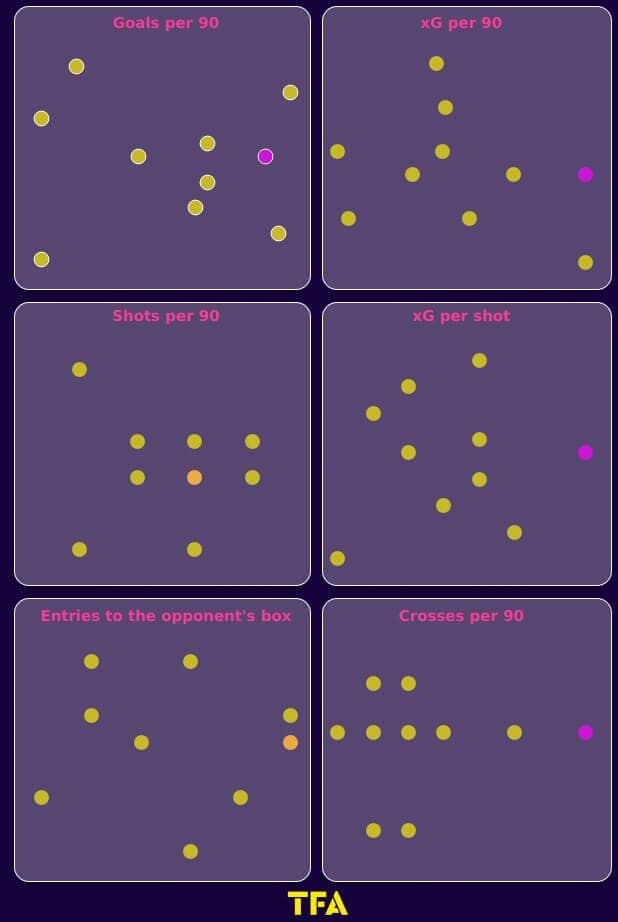
Whether it’s chance creation, goals scored, crosses, or even xG per shot, Riera’s team is comfortably among the best or at the very top.
So what are some of the mechanisms they use both to enter and upon entry to the final third?
Riera’s tactics higher up the pitch follow the same philosophy of overloads, movement, and manipulation.
However, another clear concept he has taken from the best modern positional coaches is midfielders’ off-the-ball movement through the half-space.
Interestingly, this is something Xavi’s Barcelona utilises a lot, and it helps break down stubborn defensive blocks.
Olimpija Ljubljana does it systematically, focusing on doing the basics of their philosophy well and then translating it to every phase of play while in possession of the ball.
As always, it starts deep, with the centre-backs and a pivot ensuring a smooth build-up from the first line.
The ball can then be progressed to the wings by either allowing the centre-back to run with it or by passing it to the dropping midfielder.
This creates the diamond and ensures superiority on the flank, in turn easing their advance into the ‘danger zones’ of the pitch.
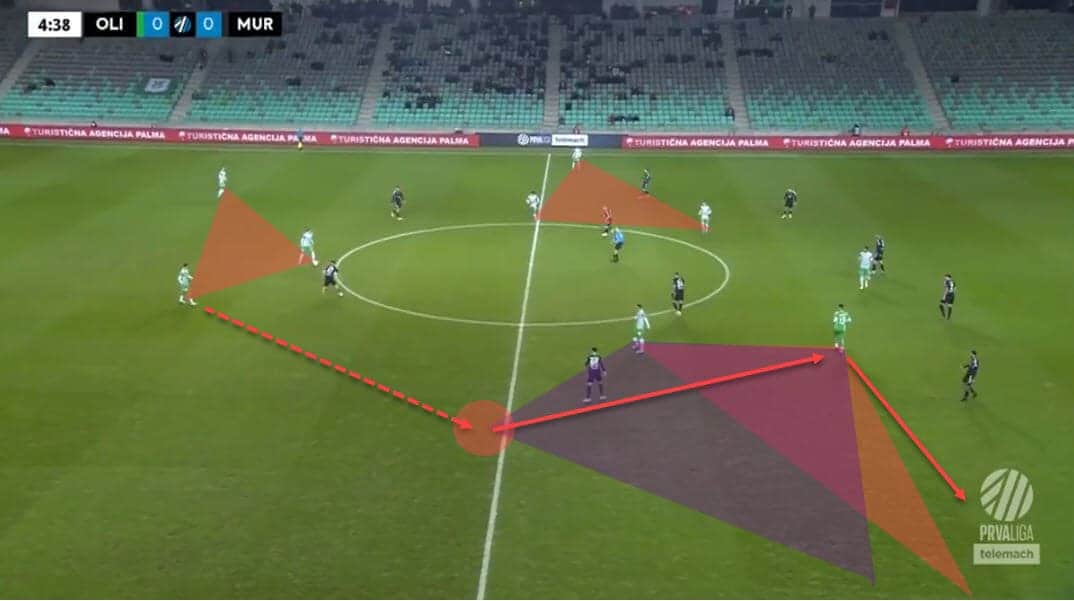
It’s important to note the ball is often then recycled out wide to the full-backs or the wingers, depending on whose role it is to occupy those areas.
As mentioned earlier in our tactical analysis, Olimpija Ljubljana often relies on cutbacks and early crosses, so wide players play a key part.
In this particular example, they use a quick lay-off to access the isolated full-back who can continue the attack.
It’s actually this trident, comprising the full-back, inverted winger, and midfielder, that does most of their attacking work.
And it’s also where the half-space penetrators from the middle come into play.
The winger will usually combine with the full-back and rotate to manipulate the opposition’s backline.
This can include the winger dropping to drag the centre-back deep or the winger drifting to drag the centre-back wide.
The full-back, in turn, has to adapt to his teammate’s movement, just like Riera instructs.
This can be the full-back overlapping or underlapping, depending on the position of the players in their immediate surroundings.
The midfielder, however, often has a particular role: attack space once a pocket has been created.
 Notice how these plays are almost identical.
The winger drifts, manipulating the defender’s movement and opening a channel that can be exploited.
The full-back reacts accordingly and can either combine with the winger or look for the advancing midfielder directly.
Either way, the ball is quickly moved into the penalty area and is ready for a cross or a quick cutback.
It’s also quite interesting to note how efficient they can be in transitional phases of the game, especially when attacking.
We’ll touch upon Olimpija Ljubljana’s pressing and counter-pressing in the following section of our tactical analysis.
Still, it’s important to note that they adhere to simple rules: make the pitch smaller upon losing possession and make it bigger as soon as possession has been regained.
This sounds simple because, ultimately, it is.
And that in itself is a big part of everything Riera does at his new club — doing the simple or basic things really well and efficiently is enough to get results.
This is true for their search for superiority and manipulation, as well as when it comes to transitioning.
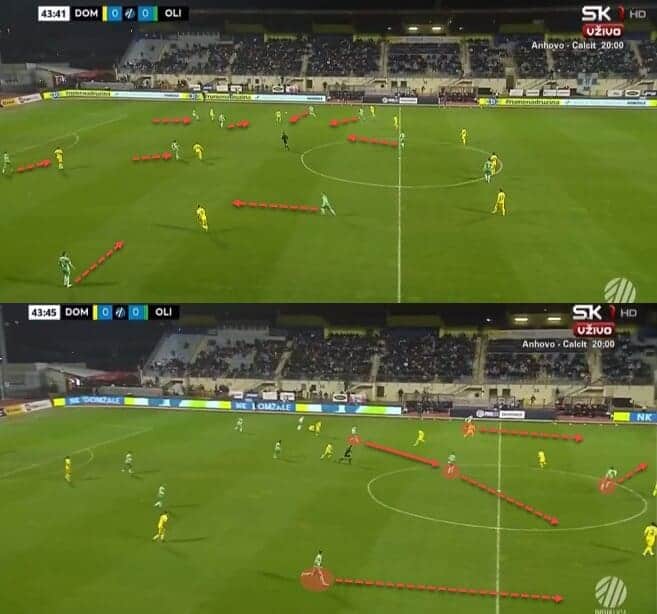 Here is a fairly basic sequence that effectively highlights these principles.
As soon as Olimpija Ljubljana lose the ball, they collapse quickly to regain possession.
If successful, their outlets immediately spread and stretch the pitch, attacking space with intent.
It helps that there are usually one or two players remaining high to serve as these outlets in the first place.
Generally, it will be the striker and one of the wingers.
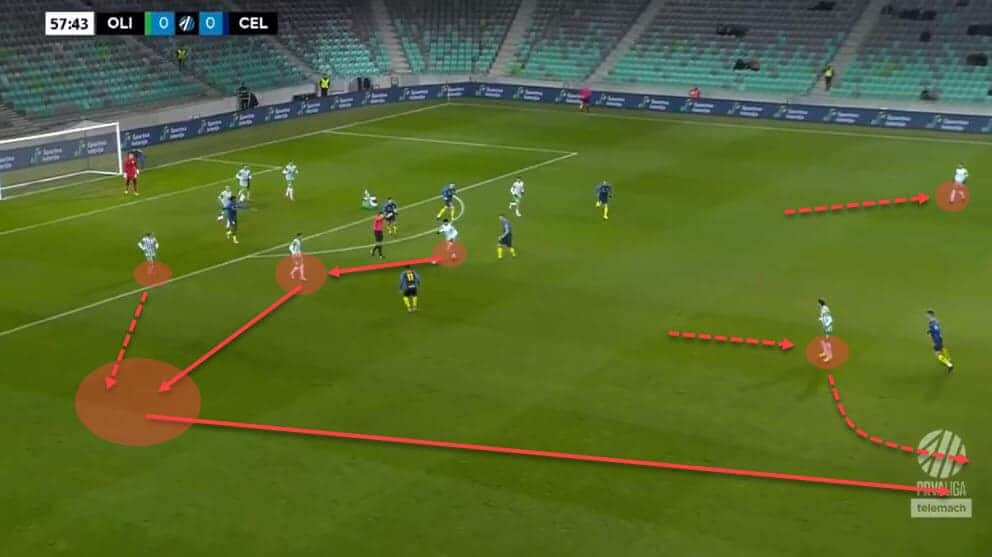
The following image shows this perfectly.
Notice the direction of movement of the striker and two wide players; they’re aiming to stretch the pitch and attack space quickly.
That’s the basic principle of a good counter-attack.
Data indicates that Olimpija Ljubljana counterattacks less under Albert Riera than they did last season, but they are more efficient at doing so.
This, too, is proof of the adaptability and flexibility of his teams.
Albert Riera Out Of Possession Tactics
Having only conceded 16 goals since the start of the season, it’s safe to say Riera has a good defensive record so far with Olimpija Ljubljana.
But while there is a certain solidity in their ranks, the Green Dragons owe a lot to their incredibly talented goalkeeper, Matevž Vidovšek.
The 23-year-old has been instrumental in their defensive record and continues to add to his reputation.
But what do we know about Ljubljana’s off-the-ball tactics?
Generally speaking, we will see Riera’s team press high quite aggressively, which is something the newly appointed coach has almost certainly adopted from Guardiola and Arteta’s philosophy.
Looking at the data we have on hand, we can see just how successful they are at it.
Olimpija Ljubljana Defensive Stats Map
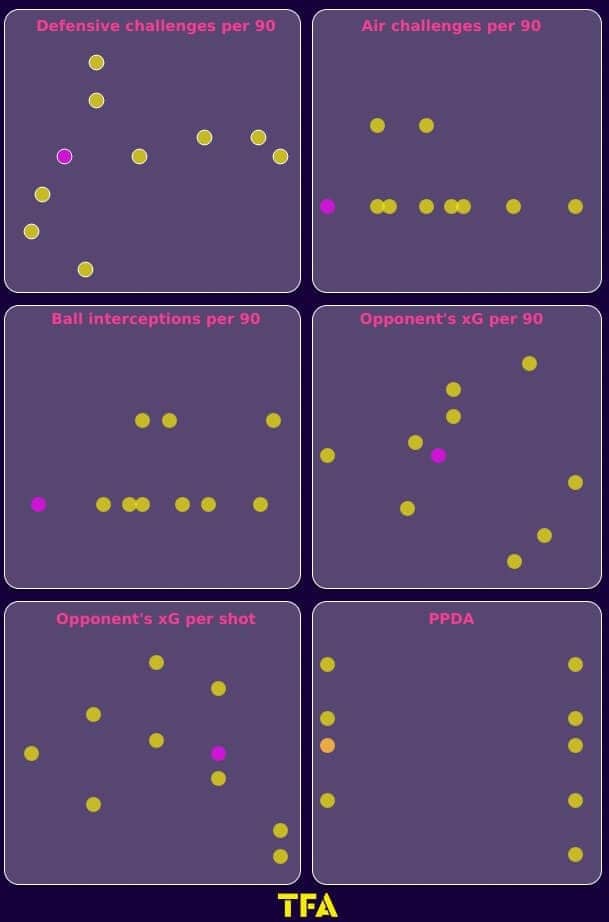
Interestingly, while their PPDA is joint-lowest with some other teams in the league, they are surprisingly inefficient in winning defensive duels, intercepting the ball, and even limiting the opposition’s expected goals values.
Of course, it has to be noted that by the nature of their philosophy, which is to dominate possession, they also engage in fewer duels in the first place.
We can take it one step further and use Total Football Analysis’ radars to directly compare Olimpija Ljubljana with the second-placed NK Koper.
Our next visualisation does precisely that.
This time, we can see the exact figures and how they compare to their closest rival so far.
In this image, their pressing inefficiency is clearly visible as we measure how many of their pressing sequences have been successful so far compared to Koper, who are an excellent pressing side themselves.
Olimpija Ljubljana Vs Koper – Defending Metrics Radar
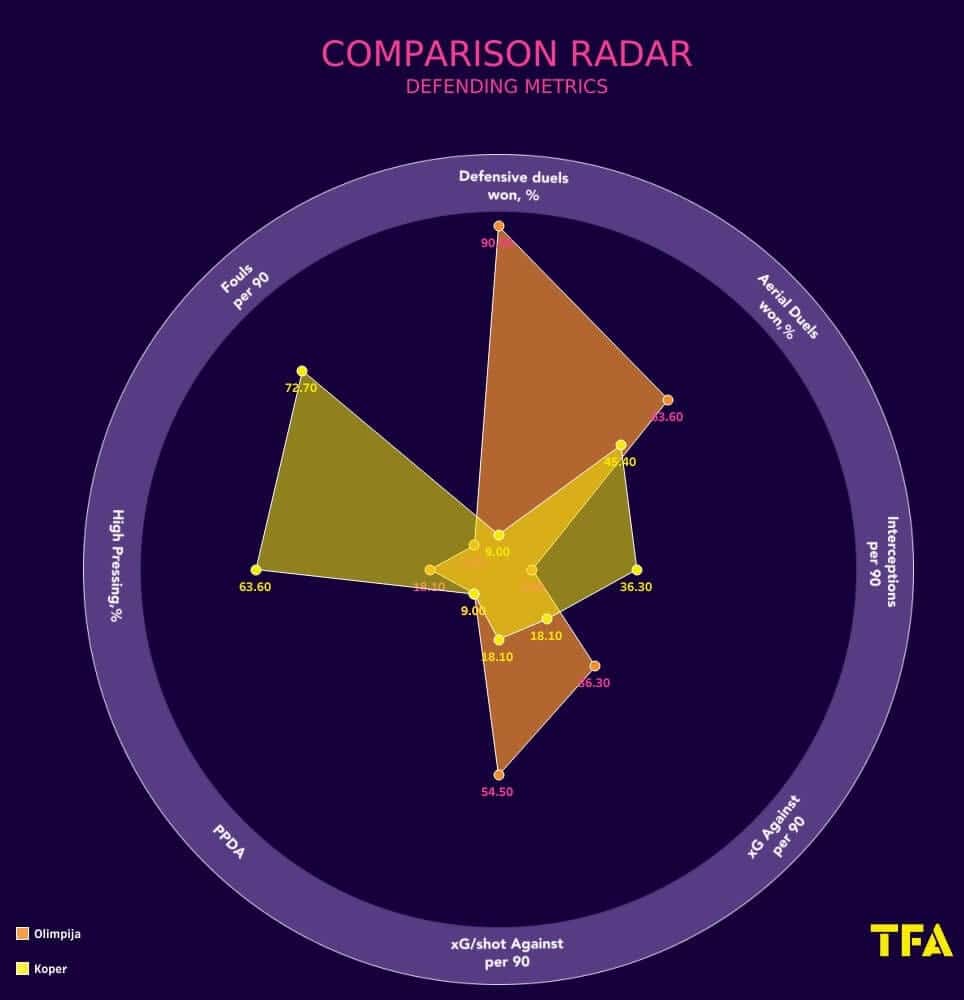
When it comes to philosophy and tactics behind their off-the-ball phases, they follow a clear philosophy of dosed aggression and selective pressing.
Their PPDA numbers are low (which indicates aggression), but this has more to do with their immediate counter-pressing than necessarily squeezing the possession out of the opposition.
We’ve already pointed this out in the previous section of our tactical analysis, but let’s reiterate.
Riera emphasises a quick collapse upon the loss of possession, trying to make the pitch small and close all and any passing lanes that could lead to an opposition transition.
In the stable phases of the opponent’s possession, they will press in a man-oriented manner, often trying to mimic the other team’s shape.
This is evident in the following images.

However, we also see some deficiencies in their approach.
Olimpija Ljubljana seems to be extremely susceptible to counter-attacks, especially when their collapse and/or high pressing don’t yield positive results.
This is due mainly to the lack of compactness in their lines.
Both examples here demonstrate that quite well; there’s a significant gap between the first and second lines of pressing, and while leaving the flanks open for the opposition can be used as a trap, again, Ljubljana aren’t marking well enough to execute it.
Generally, these issues can be addressed by ensuring the team is more cohesive and plays better as a unit, and through an improved defensive strategy.
Pushing players forward is normal for highly positional teams who have to face sturdy and deep defensive blocks, but the best of the best are highly compact and always extremely difficult to play through.
Olimpija Ljubljana simply aren’t.
Let’s look at a couple more examples here.
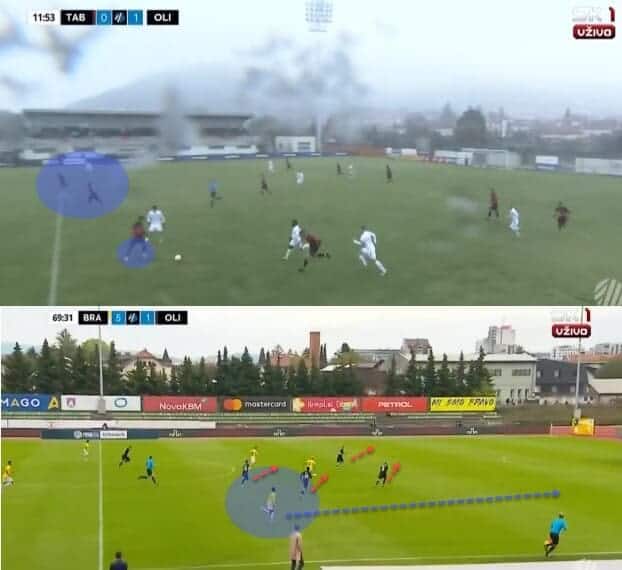
Both of these sequences demonstrate how teams can slice through their structure with a couple of passes if the initial press or counter-press is broken.
While this isn’t uncommon in football, top teams need to control such sequences more effectively if they are to maintain their dominance.
Riera’s team has obviously been dominant and sturdy so far, but perhaps more due to their individual quality and the lesser quality of their opposition than the impenetrable nature of their defensive block.
They’ve been able to limit the damage the opposition can inflict, but in the long term, this is something Riera should look to improve upon.
Conclusion
Albert Riera is at the very beginning of his coaching journey, but six months in, and he’s been absolutely sensational for Olimpija Ljubljana.
They are an exciting team with a lot to prove, but also a team that promises to improve with time.
Riera himself should only get better.
If he becomes only half as good as Pep Guardiola and Mikel Arteta, his mentors, he may have a glorious future ahead of him.
