After an irregular passage in South American football, the former legend, Hernán Crespo, became the coach of Al-Duhail of the Qatar Stars League in March 2022.
The Argentine, just 47 years old, had a fairly high peak in his career when he won the Copa Sudamericana with Defensa y Justicia, the Argentine club, in 2021.
However, his time there ended badly with poor results and few reinforcements for the squad.
Then, his stay at Sao Paulo could not have started better, with many victories in a row and a way of playing that he integrated quite well into the Brazilian team.
The first round of the league tournament was quite successful for the team, but later the bad results would come again and he would be replaced by Rogério Ceni, who would later lead them to the final of the Copa Sudamericana that they eventually lost to Independiente del Valle.
His football always stood out far above in the best moments of the team.
A positional idea, to which Crespo is adept, where the flexibility of the formations reigns, especially in some positions of the first line in the build-up, but beyond that, the roles of the players are very specific, and it is what has kept Al-Duhail competing strongly at the start of the league.
They are in second position in the Qatari championship, with 20 points, two points behind the league leaders.
They have won six games, two draws and only one loss in nine matches and have scored 19 goals and only conceded 8, some pretty solid numbers.
Let’s take a look at the tactics of Al-Duhail in this tactical analysis of Hernán Crespo, which will include a team scout report and an analysis of his ideas.
Hernán Crespo Width and build-up
In his time at Defensa y Justicia, as well as at Sao Paulo, Hernán Crespo showed quite positive things within his ideals to play the ball from behind.
With all of his lines very wide, rotating between a back-three or a back-four that would normally run within it in a 4-3-3 or 4-4-2.
The width was the key to his teams, seeking to stretch the rival block so that there were spaces to progress with their central defenders, both with ball-carrying and passing.
The full-backs remained extremely open and low, looking to attract the rival pressure to that point, in order to connect from their position, with one of the double-pivot midfielders who moved from side to side to progress through the said area.
The first idea in possession of the Crespo teams is that, with this width they look for, the ball has to move constantly from side to side until there are spaces within the rival block in order to progress.
In case of not finding near-passing options to keep moving the rival block, the central defenders look to activate players into space with long balls, as do the midfielders.

At Al-Duhail, Hernán Crespo has changed his formation to a more fixed 4-2-3-1 than the 4-3-3 or 4-4-2 where he used his #8 a lot in half-space back in Brazil and Argentina.
In Qatar, the former AC Milan player has sought to prioritise the wings, the double pivot, and a much freer #10 on the field, who seeks to be the connection in various channels before releasing the pass that places them in the last third.
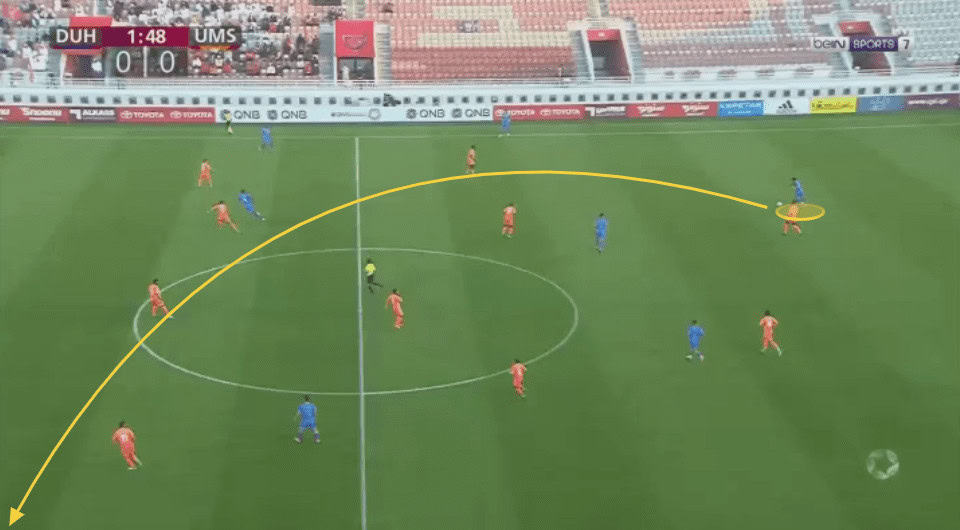
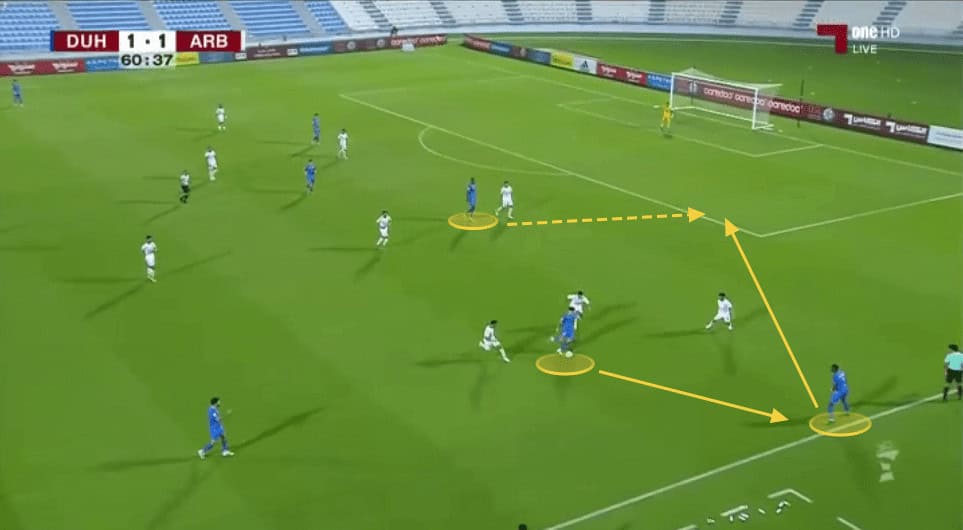
As we can see in the first photo above, the idea is quite clear and it remains the same on Crespo’s part with a lot of width in the first line, his centre-backs at quite a distance as well as his full-backs that are hugging the line.
Regarding the double pivot, given the distance from the centre-backs, it is possible for one of these midfielders to drop to their line and help at the base to generate superiority if required.
As well as to offer long passes from there thanks to their good and better technique to find players.
The idea and meaning of this are simple, the team opens up so much that the rival pressure cannot cover the entire field, therefore the ball circulates from side to side and the rival block leaves spaces in their pursuits that can be taken advantage by Al-Duhail, both with passes directly on the outside between full-back-to-winger, as well as inside with a centre-back-to-midfielder and a lot of variety in the first progressions as well to try and do it from full-back-to-midfielder.
Sometimes, one of the wingers, normally the right winger, can step more into the half-space in order to seek to be another option on the inner channel.
But the 3v2 on the wing is something highly sought after by Crespo’s teams to start progressing, even as well to finish plays, which because of this have the double-pivot so separated so that they can participate in these wide overloads.
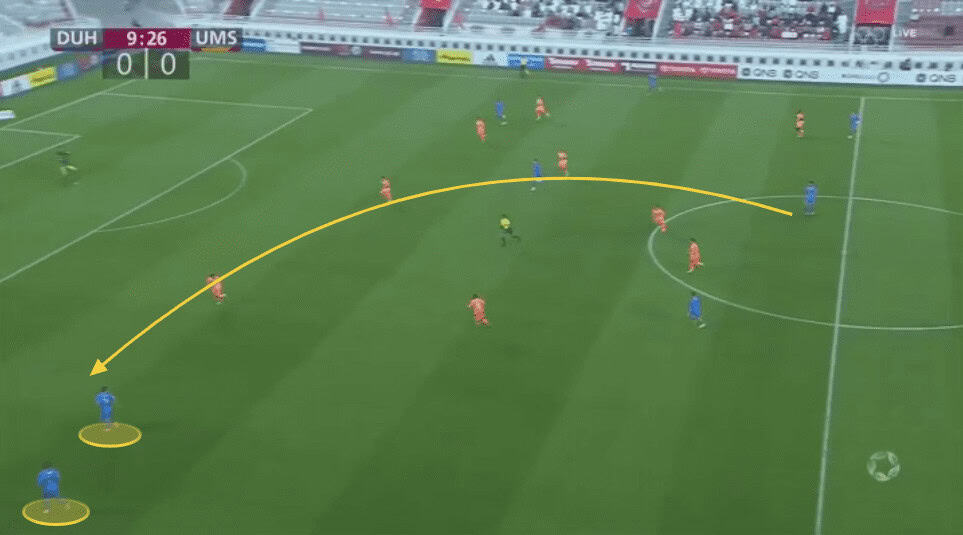
One of the clearest automatisms is the search for the long ball into space for one of the wingers, both commonly playing well on the outside.
All of this is achieved thanks to the attraction created by the number of passes from side to side to reach the rival block, as well as the use of the double pivot and the #10.
When the ball is on his strong side, let’s say the right side, for example, the attacking midfielder then positions himself on the weak side, looking to pin the rival full-back and for the winger near him to appear on the run and be free to occupy space.
That is why many of the progressions in Al-Duhail occur in this frequent manner, thanks to the off-the-ball role of several players, in addition to a patient search to draw the rival into later activating the opposite side of the pitch with long passes from central defenders and midfielders.
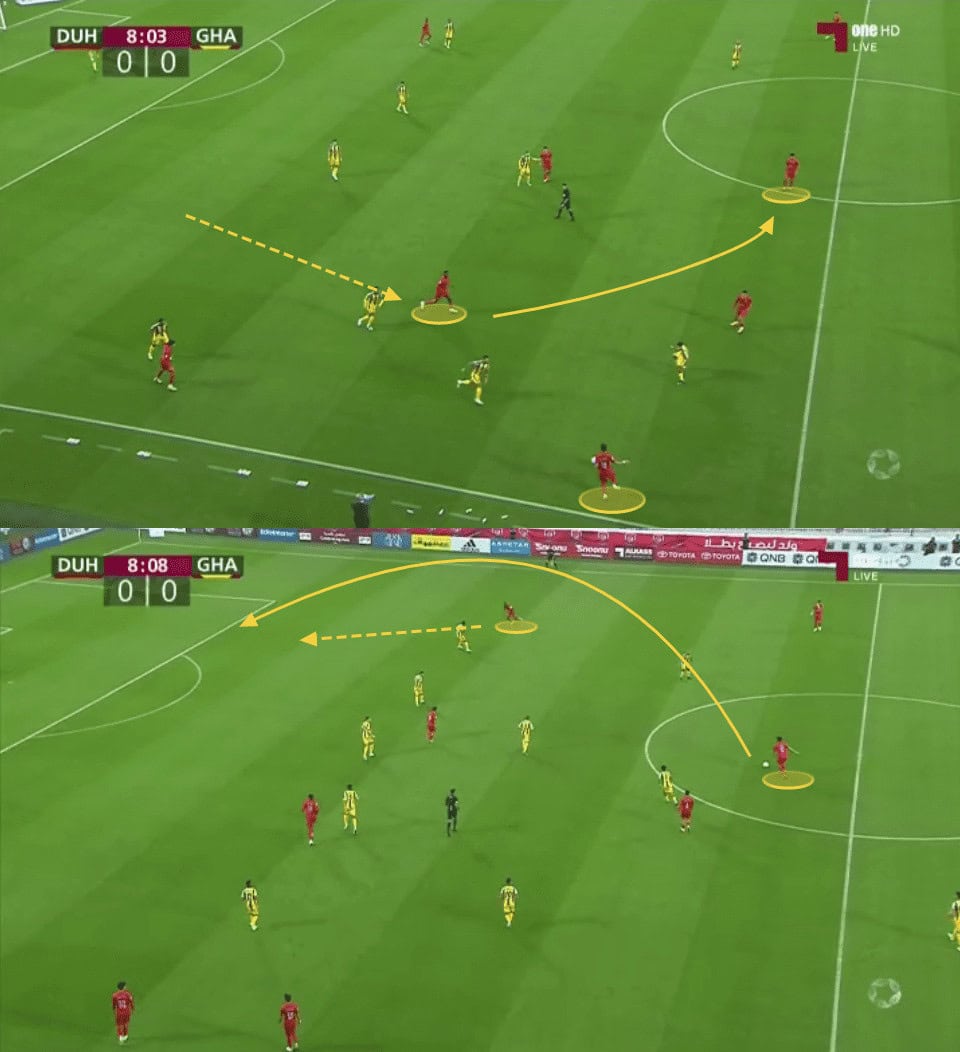
The figure we have above is the perfect example.
The left winger doesn’t even appear on the screen because of how isolated and close he is to the line.
The attacking midfielder from Crespo’s team has pinned the right full-back of the opposition side, so he then dragged him, and his teammate appeared alone in space all over the wing, typically with diagonal executions, looking to be unpredictable to avoid accumulating more in one zone and activating the weak side.
The utilisation of the full-backs is also very important for Crespo.
Unlike some coaches who love positional play, such as Pep Guardiola or Mikel Arteta, who look for these players to play more internalised rather than in the outside channels, the Argentine is very the opposite.
From beginning to end their role is to also give width and generate mostly overlapping runs in attack.
After the control of the ball by the winger, one of the full-backs always offered themselves as a pass option running behind him, in order to generate 2v1 situations in the last third and seek to score with crosses in the run or with 1-2 combinations that reach the penalty area.
The winger, who looks more to receive into space, has a role of going inside with his run and that is where the overlapping runs from both sides of the full-backs appear.
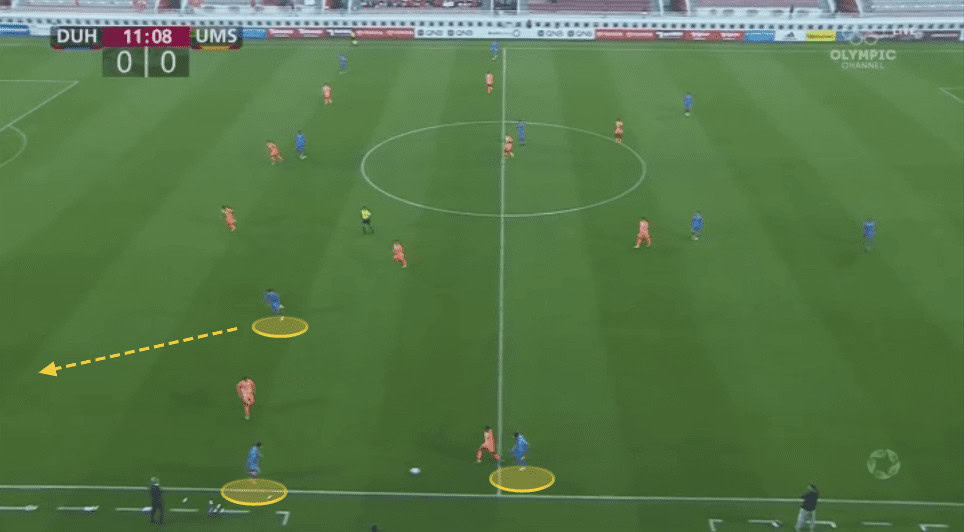
As in the picture we have above, the winger is awaiting the ball into space with a body posture that tells us he’s going to cut inside.
The full-back then arrives at great speed, to take his positioning to the attack, offering a lot of depth with overlapping and sometimes also underlapping runs if the winger wants to position himself more openly.
The idea will always be to have company from them to finish plays forward.
Third-man runs, overloading and changing to the weak-side
We have already recognised Hernán Crespo’s search to exploit the weak side of the game in his teams.
Now, we are going to see how they seek to accumulate on a side where not only the full-back or a midfielder can approach to create 3v2 or 4v3 situations, but also their attacking-midfielder or striker on several occasions, who play in a more central role for them but offer some support movements there as well.
First of all, it must be made clear that positional play allows few rotations between the players on the field.
Each one of them has indicated the areas for which they are responsible and the movements should not be so flexible.
On the other hand, the idea of many who practice this system is to finish attacks from the outside, so that their wingers or full-backs carry the greatest threat on the team.
However, it obviously all depends on the profile and quality of your players in those areas.
For you to try and play to activate the weak side, you must first do an excellent job of charging one side.
You need players with good retention of both the ball and the pressure, as well as good body postures to at some point get out of those areas with passes on their first touch and things like that.
However, movements into space as third-man-runs are also very important to do and Al-Duhail also looks to it if the change to the opposite side seems difficult to do.
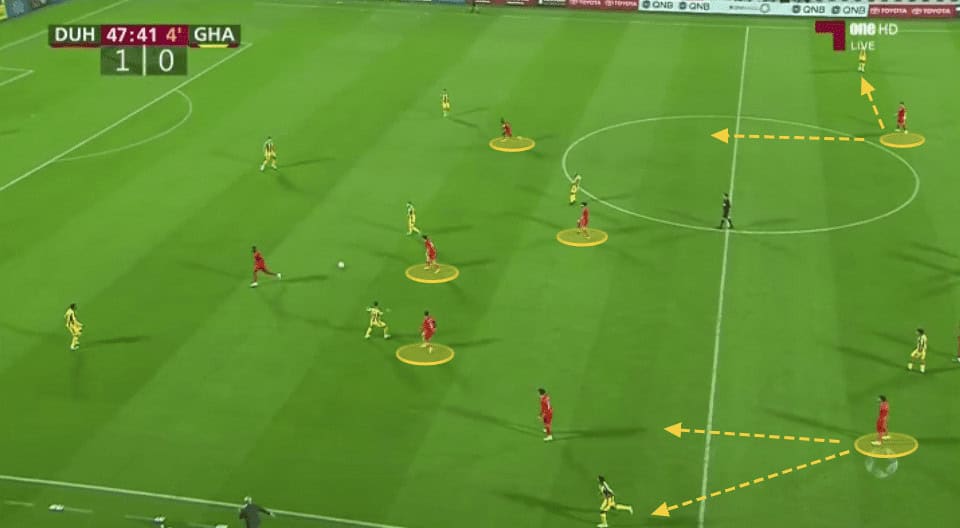
Just as we can see in this image below, where the winger and the full-back have joined in the wide area, both are accumulating that side to try to later switch it to the other.
However, a third-man-run was executed by the attacking midfielder who moved from half-space to the wide zone.
A run that will be triggered by the winger who continued to touch the ball down the line.
These types of plays are not only made in lower areas of the field in order to progress to the final third, but they also like to make them to reach the opponent’s box and score goals.
For example, we can see it in the image below.
Beyond the crosses, ball-carrying by the wingers towards the penalty box and cut-backs aimed at attacking and utilising the depth of the pitch, Al-Duhail also attempts to utilise the third-man-run forward, seeking to be more direct and connect with a striker or winger who may appear in the danger zone.
Here we can see how the midfielder appears to create this wide overload, who handles the ball and drives out to perform a link-up play with his partner who is the right full-back.
He has already seen the position of the striker who hopes to receive a quick pass both into space to the wing or inside to pick the ball and then turn out the defender with his back and use his hold-up-play.
The pass went that way and the striker was able to resolve in a great way with a body spin and enter the penalty area to finish with a goal.
However, the most classic idea of both this Al-Duhail and Crespo’s teams is to load and then switch the play.
That is why the wingers are among the most dangerous players because they are always receiving long balls behind the backs of the full-backs.
Nevertheless, not only the full-backs, but also some of the attacks are searching through the centre-back-full-back interval.
For example, we are going to take this play into account where, for the first time, we see their centre-forward offering support.
He has dropped his line to appear in the half-space low in the pitch.
There he becomes the third man to join and form the triangle that seeks to form the team in a wing.
The full-back, quite open and close to the line, draws the pressure and plays with the forward who, later, changes the game towards one of his midfielders.
All this with the purpose that one of these midfielders then ends up making the complete turn towards the weak side, where one winger already traced the run diagonally and he would recognise such a movement to send a long ball behind the rival defence.
Despite the fact that, in this play, no one has pinned the rival full-back, the winger seeks to do so only trusting in his rhythm and pace to win the race.
In possession, Hernán Crespo likes width, he likes to exploit isolated players on the weak side and also generate triangulations, which are mostly on the wings.
He also likes that his wingers carry the biggest threat and his players know they have responsibility for some areas of the pitch, one more than the other.
A fairly detailed style but when well-trained, it can result in great things.
Man-marking
Al-Duhail under the orders of Hernán Crespo seeks to be quite effective in marking the man, and depending on how the rival looks to play in possession, he will provide specific roles and responsibilities to his players to go marking in this way.
Normally, we can see up to four players trying to force the opponent to move the ball towards the area they are trying to, which is usually inside where they look to win the ball back quickly with their midfielders who have great recognition of pressing and when to pull the trigger to surprise and steal from behind.
The attacking midfielder tries to cover the build-up towards one of the first passes, which is to a midfielder in the majority of cases but can also jump towards one of the central defenders.
The striker is the first to force the ball to move to one side and finally, they look for the ball to go from outside to inside where the midfielders of Crespo’s box are very aggressive, marking tight.

Despite the fact that many teams like to man-mark in defence in a proactive stance to win the ball in the rival third, they throw the full-backs high enough to cover their own wide channel.
On the other hand, Hernán Crespo seeks to make his defence more compact and the inner channels of the field with these players quite close to the central defenders.
Their trigger is not like many other teams, to go take the ball to whoever appears on the outside, but rather to jump aggressively on the inside to one of these players who tries to receive in the half-space in front of them.
It is clear that if a player receives the ball from the outside and no one is marking them, they must also jump. However, the common observation is that they often win the ball in the central channels of the field.
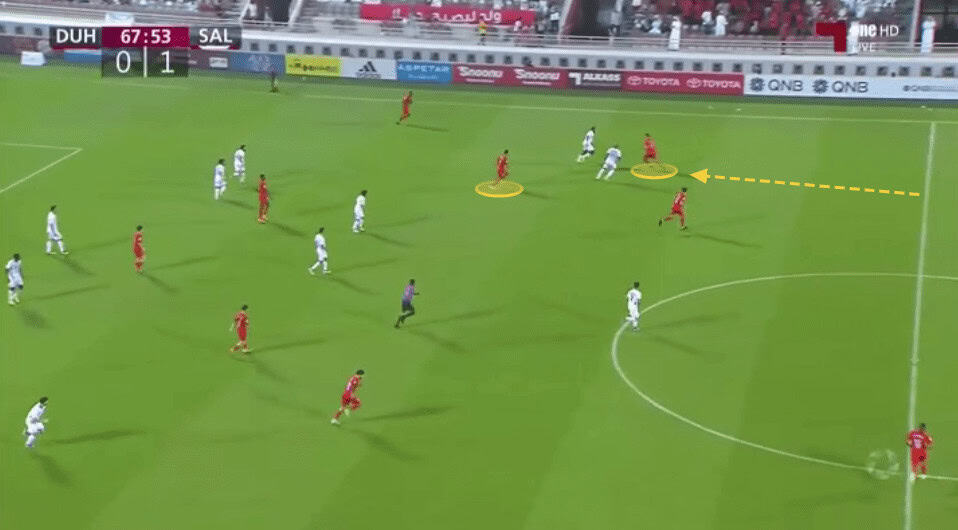
It is not the exact sequence of the play that we show above, but here we can see how one of the full-backs, in this case, the right-back, has taken the responsibility of aggressively going to cut a player in the half-space, without waiting for one of the midfielders to do the job in that zone.
The idea is that the ball moves towards the middle, so, therefore, the responsibility of going to defend intensely to the full-back is not so embedded in Al-Duhail’s defensive posture, but to let them try to execute a pass for one of the midfielders or more advanced players that are marked, so these players pull the trigger and will win the ball jumping off their zones.
Conclusion
Tactically, Hernán Crespo is a coach adept at positional play, an idea which needs a lot of time to integrate into a group, something he hasn’t achieved in his experiences as a manager.
His teams, despite some incidents and certain rumours of being unfriendly to players, staff, or the press, have played very nice and fun football, similar to Defensa y Justicia or the current Al-Duhail team.
His growth will be interesting to watch and see where he can move after completing this stage, considering whether an opportunity in Europe could arise.