


Since their relegation back in 2014, Stevenage have only qualified for a play-off spot once, the consecutive season after dropping down from League One to League Two. On that occasion, they finished sixth in the league table, with 72 points under Graham Westley, the manager who led them to promotion to League One. After the 2014/15 campaign, Stevenage weren’t able to pick a direct or play-off promotion place in England’s fourth tier.
Since Westley left the club, he returned twice, between 2013 and 2015, and 2019 and 2020. Seven managers have passed through the team in an effort to make a heroic attempt to get Stevenage to play good football and take some steps in the league.
However, this couldn’t happen, and the majority of head coaches could only avoid relegation and finish campaigns in mid-table. Even in Westley’s third period as Stevenage’s manager, he ended in the 23rd spot, which would mean relegation to the National League, if Bury weren’t expelled from League One.
With luck on their side, Stevenage started a new season with new objectives and a new manager as well; it was Alex Revell, who lived up to his expectations. Once again, they finished in mid-table, this time in 14th position.
The 2021/22 season kicked off with the sacking of Revell on the 15th of November, after the team had won only three games, drawn five, and lost eight in their first 16 matches.
Paul Tisdale was the next manager. He performed exceptionally well and even had an excellent spell during January, when the team went unbeaten in five games. After that, he went on without winning for two months, and this opened the door for former Leeds United manager Steve Evans, the actual man in charge of the team.
Evans saved Stevenage from relegation, after they recorded 16 points from 27 available, and escaped the bottom of the table with a nine-point difference between them and the 23rd-placed team, Oldham Athletic.
The new season started, and many players left the team. A revolution was starting within the team.
One of the biggest signings of the season arrived, as Jordan Roberts signed from Scottish Premiership side Motherwell, and Dan Sweeney also came in as a free transfer from Forest Green Rovers.
With new faces and a compact team, Evans kicked off the new campaign in a positive and competitive environment, having completely revitalized the entire squad upon his arrival in the final matches of the previous campaign.
Now, things have changed for good.
Steve Evans and his team are in second place in the table, fighting for promotion with direct football, as well as a range of interesting tactics and a high block that has made them the fourth team with the fewest goals conceded and the third with the most goals scored throughout the start of the season.
They have played 17 matches, winning 11, drawing three, and losing two, scoring 24 goals and conceding 15, registering 36 points, with a four-point lead over Northampton in third place.
Let’s take a look at the tactics deployed by Steve Evans.
This tactical analysis piece will be a team scout report of English League Two side Stevenage.
Functional roles and overloads over the flanks
One of the first Steve Evans changes inside the team was a shift in formation. Last season, as you can see, Stevenage used to play on a back-four, alternating between a 4-4-2 and a 4-3-3, which sums up to 63% of utilization in that 21/22 season. Even the 60-year-old head coach tends to use these two formations since he arrived in March.

Nonetheless, Evans has changed his team formations and has been rotating through a 3-4-1-2 and a 4-3-1-2, which normally depends on which opposition they’re facing. Stevenage appears to be chameleonic, trying different methods and positioning on the pitch to avoid being static and predictable to opponents in League Two.

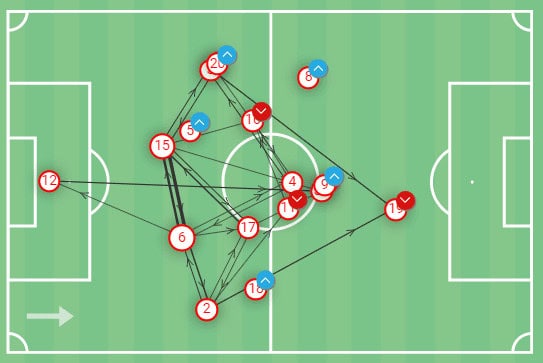
Stevenage has demonstrated different set-ups and automatisms when playing these formations; however, some principles remain consistent during these shifts. As you can see on the pass network below, it was from their last league game against Colchester United where they used a 3-4-1-2, with different positions and movements from their players that really generate chaos through different channels of the pitch. The left-wing-back was the one offering width in the first stages of build-up, with one of the centre-backs depending on where the ball was played being a bit higher on the pitch. Jordan Roberts, the number ‘11’, is one of the most functional and free-role players this team has, dropping deep on half-spaces, creating overloads as a winger or attacking the penalty area.

In a back-four, some things obviously change. The full-backs are a bit deep, forming a compact first defensive line, and each one of them is offering width. However, midfielders remain very separated as they’re vital in overloading their wings, as well as one of them getting higher to be close to Jordan Roberts, with the pair of strikers up, with one being freer and the other a bit more positional.
Stevenage ranks as one of the teams with fewer passes per 90, but very high on passes to the final third, key passes, through passes and progressive passes, this only means one thing: They have the ball, but they are really rapid and direct with it.
One of their principles is to overload the wide areas, especially the right one, where one of the midfielders starts the progression with another through the middle, to then release the ball to the outside, where the full-back normally receives and releases within their first touch on the ball, keeping the progression forward and direct. All of these build-ups are only possible thanks to the incredible coordinated off-the-ball movements Stevenage’s players have.
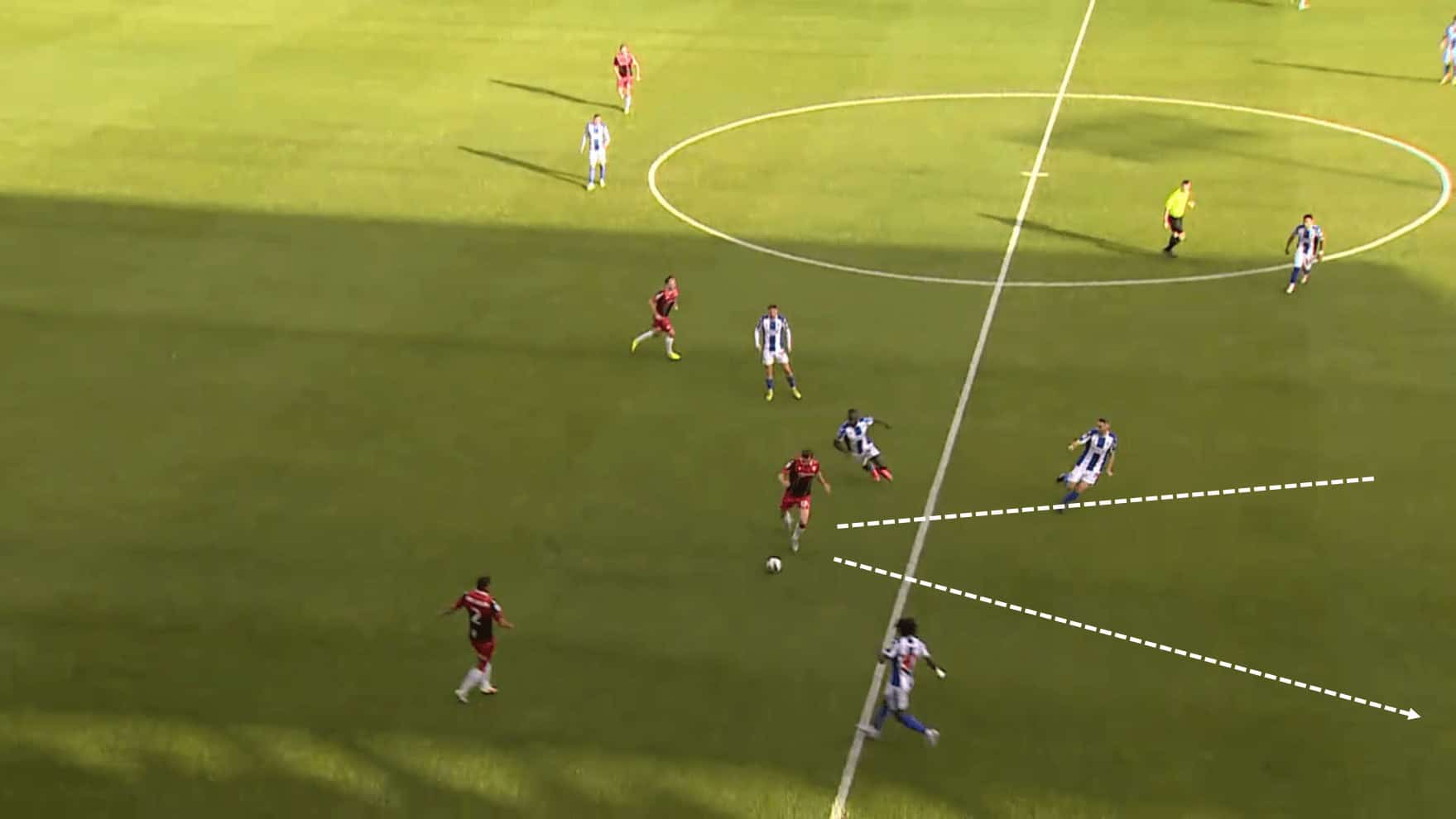
This is a brilliant example of how Stevenage places their high block and midfielders look to attract pressure through the middle, to release passes then and do movements wide. What we are seeing below us is the first stage of an overload over the right that Steve Evans’ team is going to execute. Their midfielders create a dynamic ball circuit. As one releases, the other receives and does a first-time pass to the supporting run of the other.

Almost every time, the next pass comes from the midfielder to the right-back; however, it will not be done in that way in this play. The midfielder has decided to progress through the pockets of space the full-back has created thanks to his positioning, pinning one of the markers there.
Alex Gilbey, the man on the ball, then decides to play the ball forward to the wide man, who, in that play, is going to be the number 9, Luke Norris. He once again makes a supporting run to create a one-two situation to find another teammate outside, Jordan Roberts, who normally displays his football through these zones.
 Again, we can see how they constantly repeat these kinds of movements down the flank.
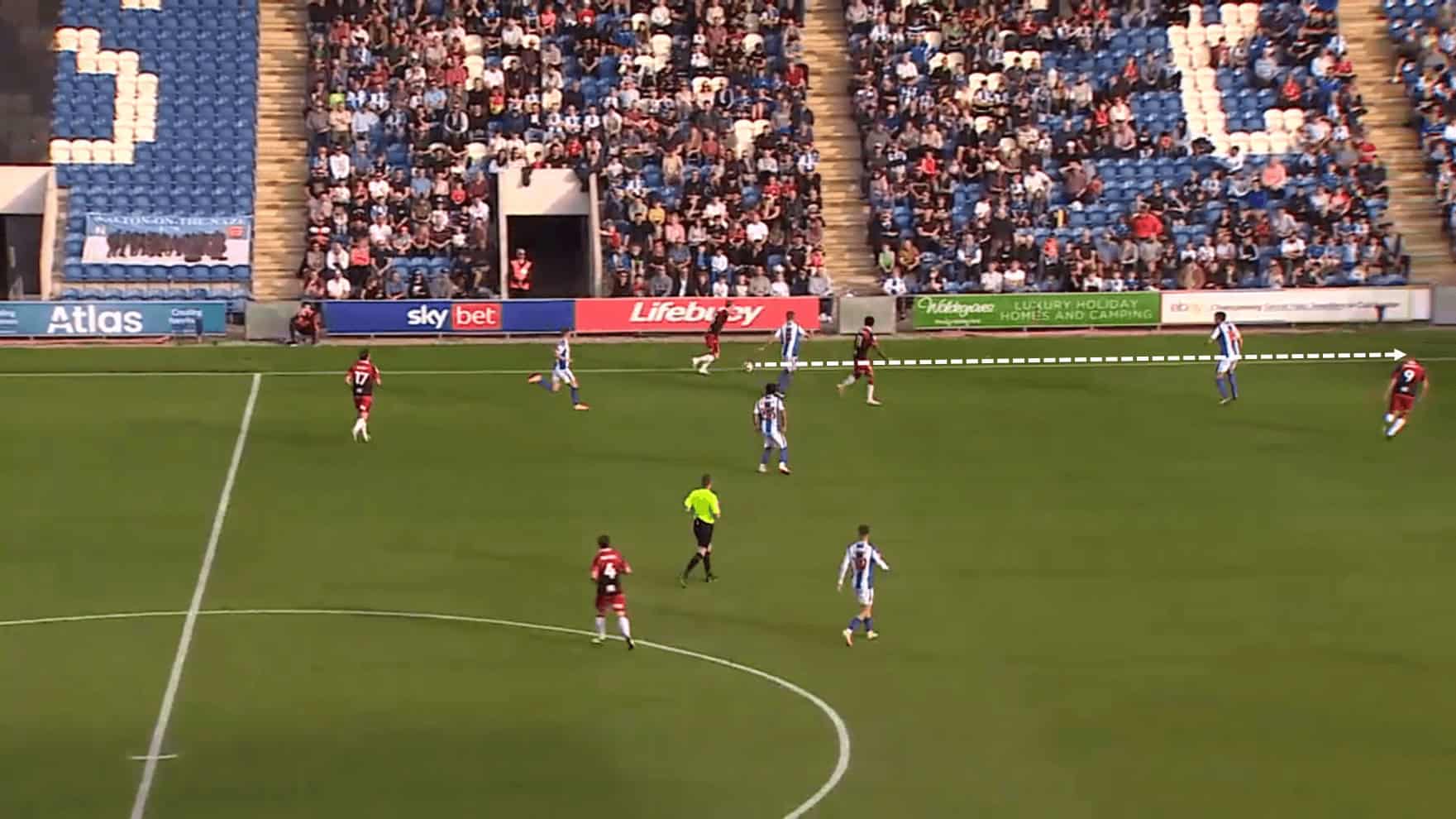
In this example, one of the midfielders, Jake Reeves, who normally plays deep but can perfectly exchange heights, releases a pass out wide to the full-back, who instantly, after receiving, returns a pass to Reeves, who follows with a first-time through-pass to Jordan Roberts, who was running behind the full-backs.

This run in behind the full-backs from the players pinning out wide is another frequent situation you see at Steve Evans’ Stevenage.
It can be executed in different ways, but the typical one is from in-to-out, with a pass from one of the players appearing at the half-space to the wing-back, who immediately throws a pass to a player running behind the opposition’s full-backs.
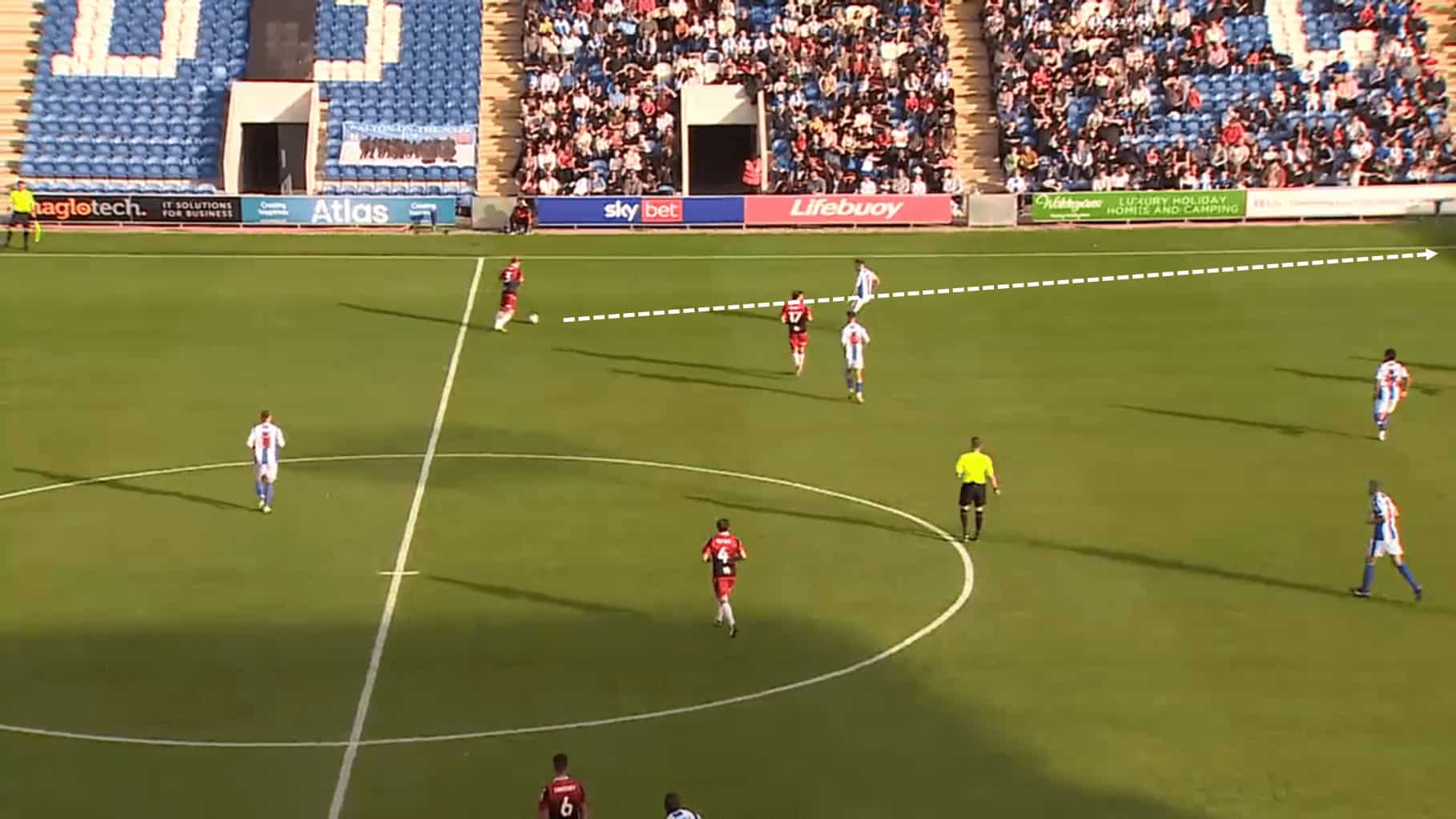
The figure below illustrates our point perfectly. The left wing-back offers complete width, before this situation was seen, the left-centre-back played a pass to Jordan Roberts who appeared between the lines, in the half-space, who as well performed a first-time ball to Max Clark, the man out wide, who chipped a brilliant ball through the same channel to the former Brentford player Luke Norris, who was already making the run.
Other utilised methods from Stevenage are long balls of different types, which can be diagonals or through-balls over the full-back to their wide player to run. These are usually taken by centre-backs who try to attract the most pressure, and midfielders look to pin players through the middle, leaving wide teammates with some space to run.
This resulted in a goal for Steve Evans’ side against Colchester. The ball was played from the midfielder to the centre-back, and as soon as he recognised there weren’t close players to play it down and fast, he made the decision to play a long ball to Jordan Roberts, who appeared with time and space in the box to pass it back to his striker.
Diagonal balls are also the usual decision centre-backs take to accelerate possessions.
They’re normally very well-taken and threatening to opponents as Stevenage allocates fast and intense players in the wide zones to look aggressively at this kind of balls.
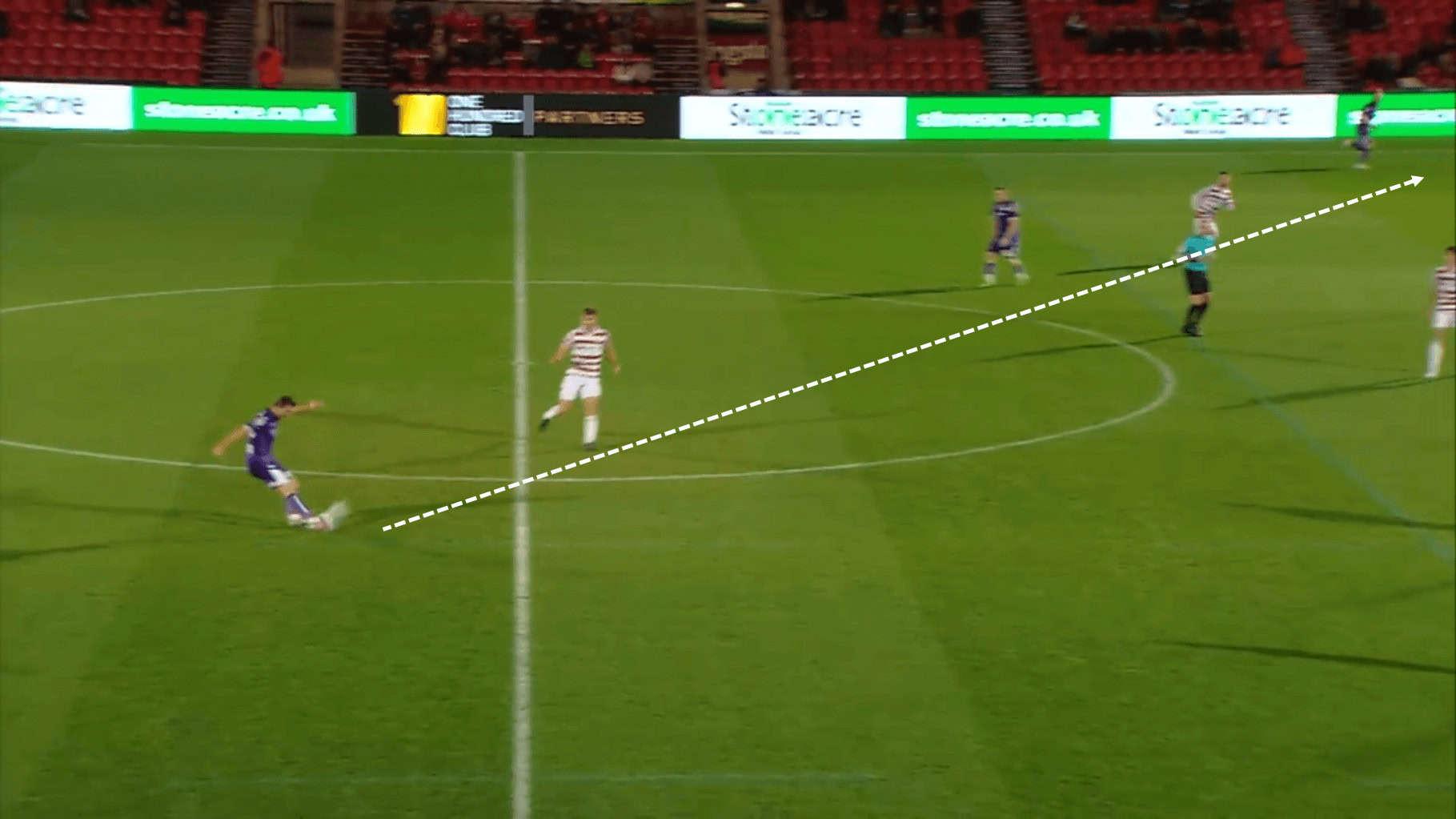
Moving higher into the attacking third, Stevenage looks once again to generate a threat from outside.
Typically, these kinds of plays shown above us are designed to activate one player in space, allowing them to take cut-backs or crosses from behind, which are also well-utilized inside Evans’ system.
Below, we can see how they find a wide player in space. Overloads continue to occur in a similar manner at different heights on the pitch; however, on this occasion, another player joins in, the more mobile striker, who plays a functional role by moving across the pitch. He tries to pin and drag one of the defenders to confuse defensive lines, and the full-back can run behind.

Stevenage also likes their midfielders to join the wide zones to accumulate players down the flank, and one of them to take crosses.
Normally, this kind of play starts between two teammates, and then the midfielder gets closer to receive and cross within seconds to the box.
This picture below shows Arthur Read, in this case, the left-midfielder, who came close to the flank to support the attack with a brilliant cross that was headed in by a teammate to put Stevenage one-nil up against Doncaster Rovers.
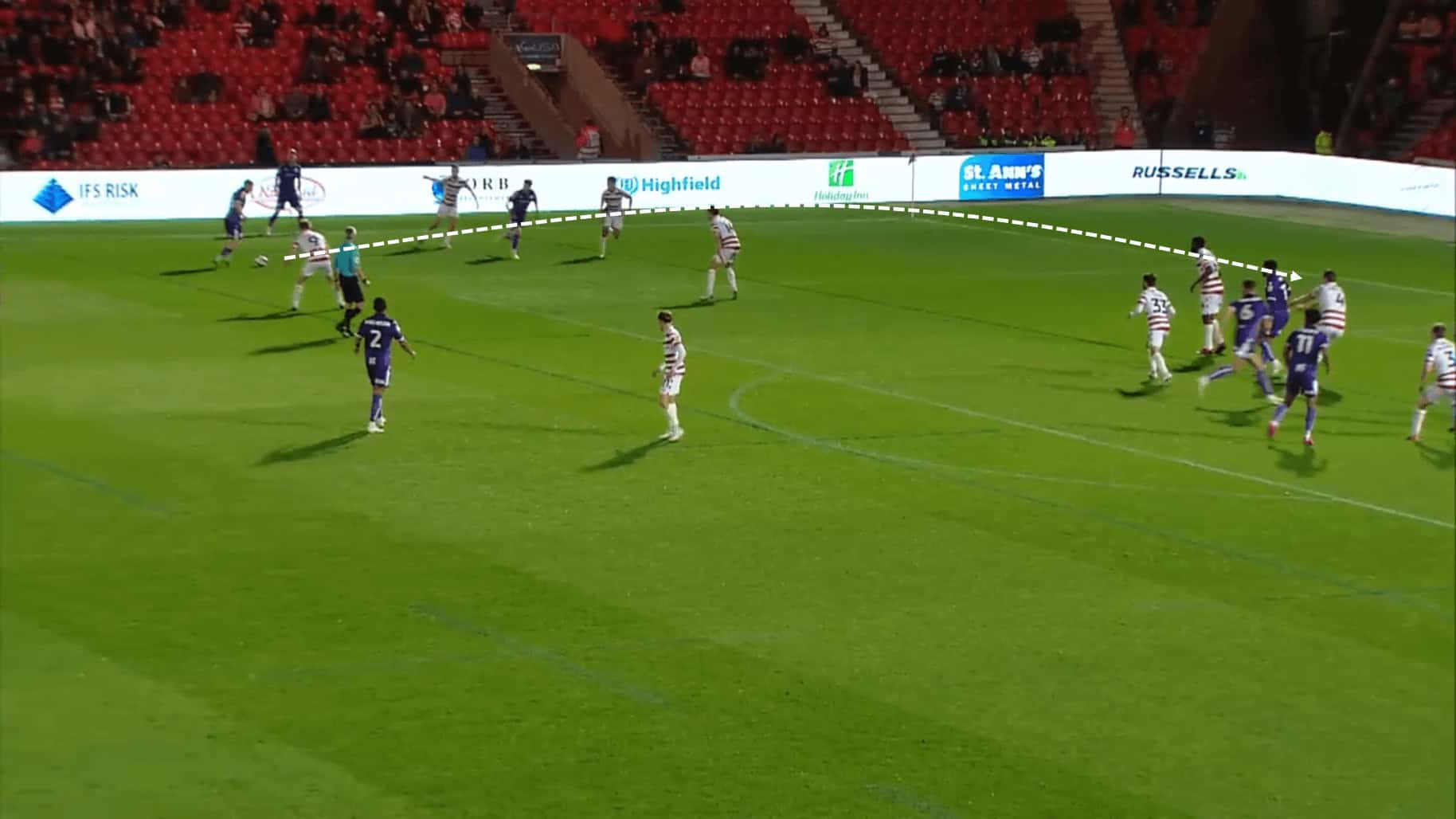
Crosses from behind are another important tool inside Steve Evans’ tactics. He doesn’t want his full-backs to run that deep. He prefers a surprise factor with two players accumulating the ball and one getting from behind or beside them to pin a curved ball to the box. As this picture shows, Max Clark gets behind and immediately sends a perfect ball to the rival’s box.

High-block and intensity
Arriving at the final words of this analysis, we found ourselves with Stevenage’s defensive phase, as some things have also changed thanks to the appointment of Steve Evans. In their last seasons in League Two, they have been among the teams with the highest PPDA percentages.
This only means they were passive, conceding too many goals with this low-block posture. One of the clear things Evans has changed is the intensity, aggression, and competitiveness in defending.
Stevenage are generally not forced into low-block situations, as they play a very high line that wins the ball back within seconds after their teammates lose possession in the attacking phase. Their restart is almost automatic, as three or two defenders stay back to offer coverage and a strong, physically imposing presence that keeps them in the final third.
This picture shows their high block shape with three defenders, one of whom is the right wing-back, who occasionally drops deep when his team attacks from the other side of the pitch.
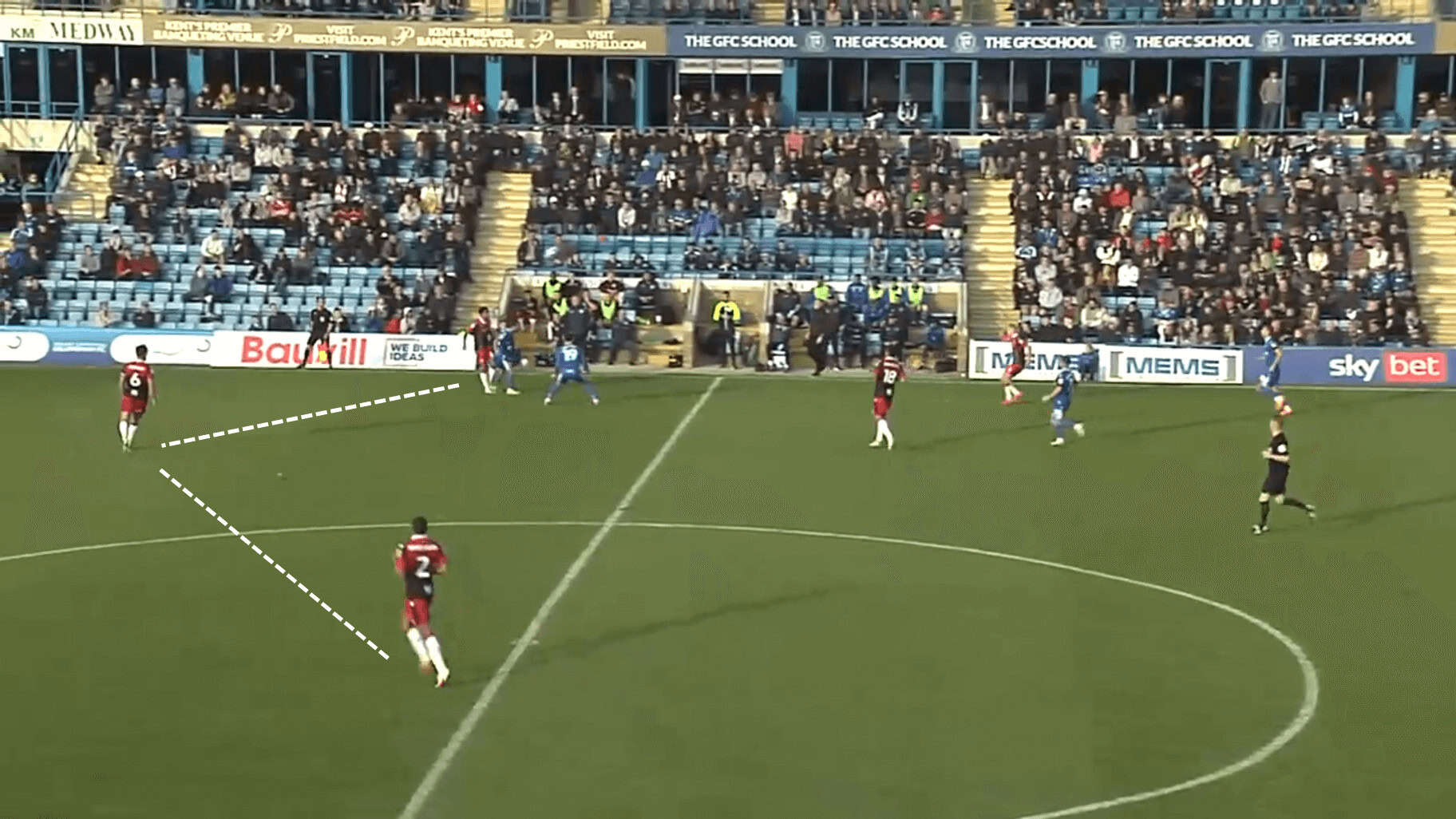
Nevertheless, Stevenage sometimes play with a back-four formation, which saw them displaying their high block intentions, but this time with two on the back, being the two centre-backs who have a big awareness and concentration to always anticipate the opposition’s forwards who try to run in-behind. They rely on their good timing.
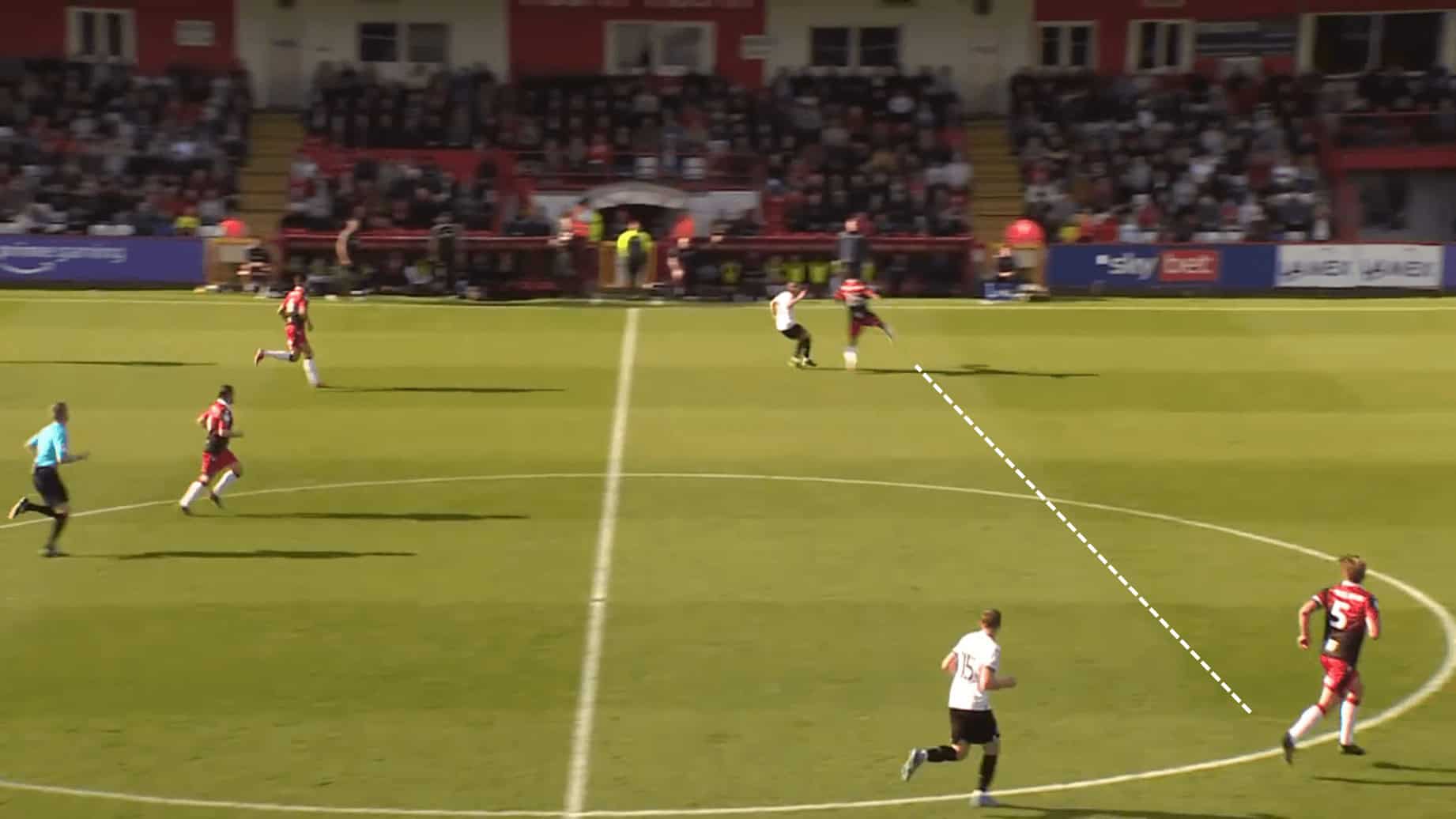
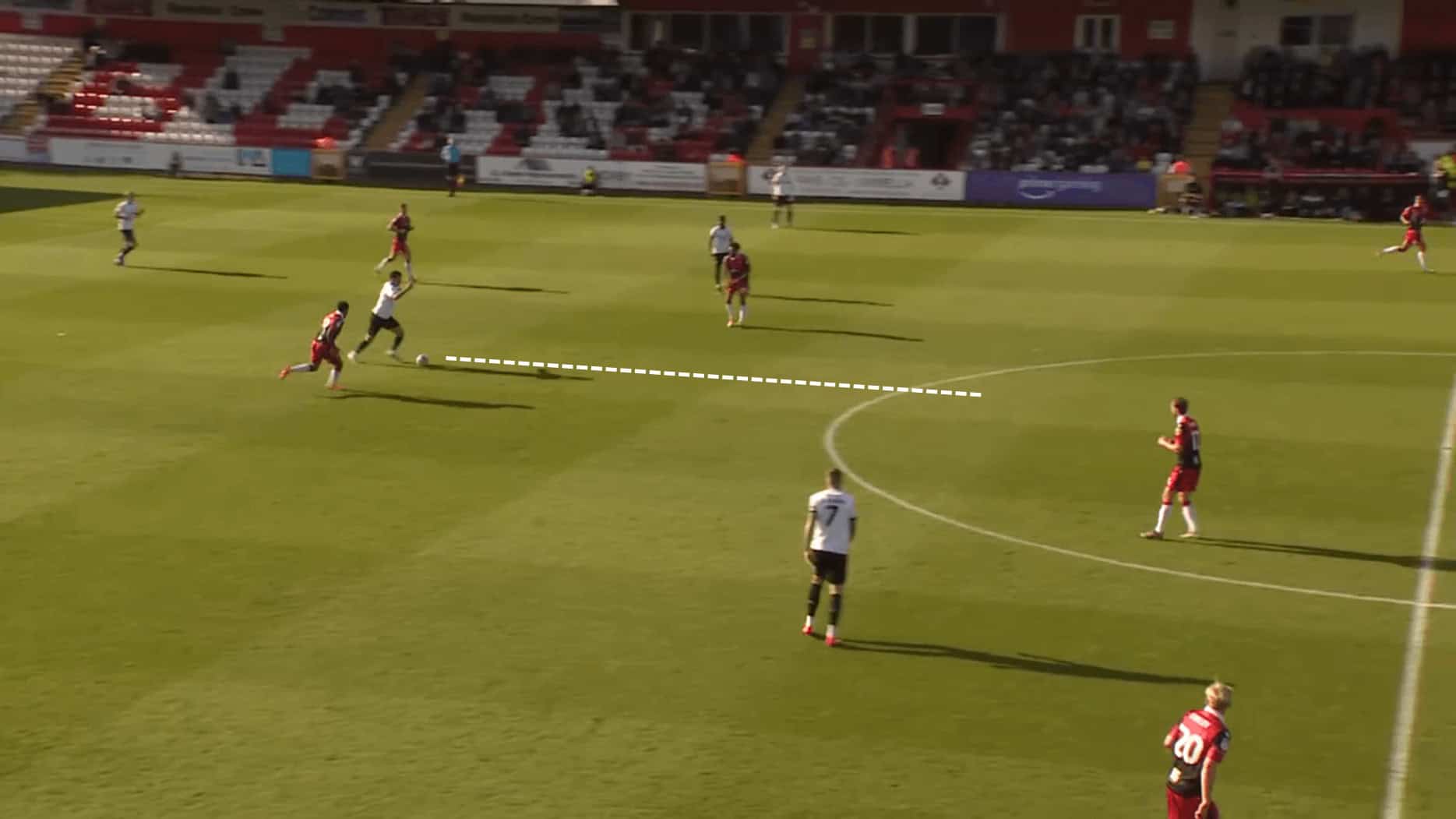
Stevenage looks to press a bit high when they’re not in possession of the ball, with two strikers and one attacking midfielder, which normally is Jordan Roberts. However, they aim to allow the rivals to progress through this three-man pressure, then lock the central areas and force them to restart or take long balls that are typically well-covered by their defensive line.
As we can see, the player looks to progress with a carry through the hole that he has left with three-man pressure. One of them is putting pressure on the ball-holder, and while he keeps moving and progressing, he looks up and doesn’t find any solutions or passing options as Steve Evans’ boys lock all the midfield and block all the spaces to run or appear.
When defending lower and closer to their box, they look to set up in a 5-2-1-2, with constant surveillance forcing opponents to move the ball side-to-side without causing damage, as they can’t find space between the lines.
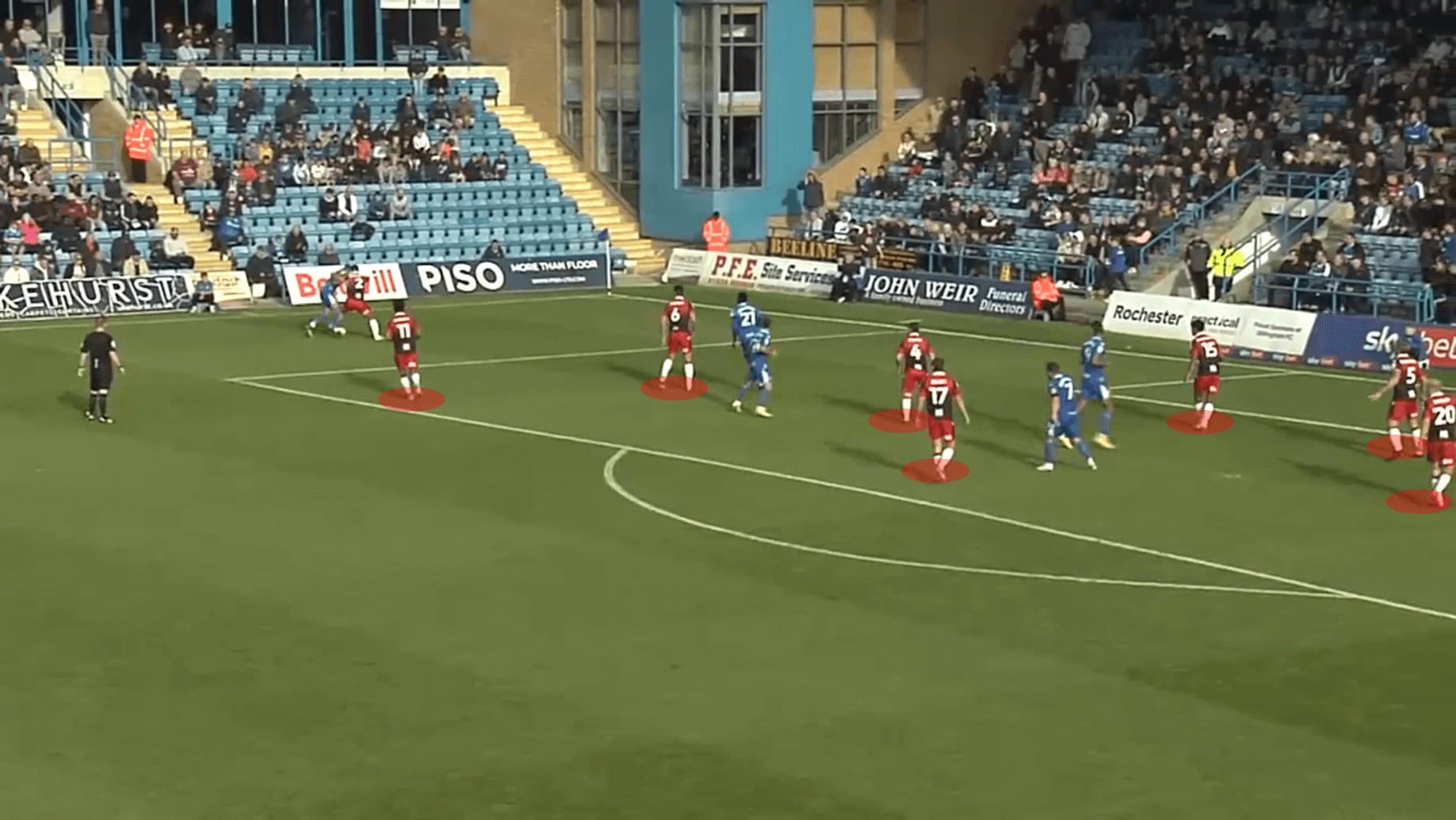
Once again, they change several shapes and structures when teams look to take crosses into the penalty area, attempting to overload it as much as possible, with two or three of their midfielders getting inside, adding up to seven players.
It is a risky setup because they leave the midfield free, but the cross is poorly executed, which is tightly marked by the wing-back outside.
Conclusion
Stevenage has completely changed his playing style and competitiveness within the squad.
Steve Evans has transformed a previously passive side that normally finished in mid-table into a totally renewed, proactive, intense, and attacking menace when they have the ball, as well as a modern, tough, and aggressive side when defending.
Recently, being second with 36 points is only the result of a well-trained, mentally strong team that has picked up 11 wins in 17 matches.

