Total Football Analysis
Once.Sport
  • Football Analysis
    • Data Analysis
    • Formations
      • 2-2-4 Formation
      • 2-3-5 Formation
      • 3-1-4-2 Formation
      • 3-2-2-3 Formation
      • 3-2-4-1 Formation
      • 3-1-6 Formation
      • 3-3-4 Formation
      • 3-4-1-2 Formation
      • 3-4-2-1 Formation
      • 3-4-3 Formation
      • 3-5-1-1 Formation
      • 3-5-2 Formation
      • 4-1-4-1 Formation
      • 4-2-2-2 Formation
      • 4-2-3-1 Formation
      • 4-2-4 Formation
      • 4-3-1-2 Formation
      • 4-3-3 Formation
      • 4-4-2 Formation
      • 4-5-1 Formation
      • 5-3-2 Formation
      • 5-4-1 Formation
      • 6-3-1 Formation
    • Head Coach Analysis
    • Match Analysis
    • Player Analysis
    • Recruitment Analysis
    • Set Piece Analysis
    • Tactical Theory
    • Tactical Preview
    • Team Analysis
    • Training Analysis
    • Tactical Analysis
    • Scouting Report
  • Competition
    • ALL Competitions
    • English Premier League
    • Champions League
    • La Liga
    • Bundesliga
    • Serie A
    • Ligue 1
    • Eredivisie
    • EFL Championship
    • FIFA World Cup 2022
    • WEURO 2022
    • Women’s Super League
    • NWSL
    • Belgian First Division A
    • A-League
    • Liga Profesional de Argentina
    • Austrian Bundesliga
    • Campeonato Brasileiro Série A
    • DFB Pokal
    • 1. HNL
    • Danish Superliga
    • EFL League One
    • EFL League Two
    • FA Cup
    • EFL Cup
    • Indian Super League
    • K-League
    • J1 League
    • Liga MX
    • Copa América 2021
    • Copa del Rey
    • MLS
    • Eliteserien
    • Euro 2020
    • Primeira Liga
    • Scottish Premiership
    • Allsvenskan
    • Europa League
    • UEFA Nations League
    • Liga AUF Uruguaya
  • Coaches
    • All Coaches
    • Alfred Schreuder
    • Ange Postecoglou
    • Antonio Conte
    • Arne Slot
    • Bo Svensson
    • Brendan Rodgers
    • Bruno Lage
    • Carlo Ancelotti
    • Christophe Galtier
    • Claude Puel
    • Claudio Ranieri
    • David Moyes
    • Dean Smith
    • Diego Simeone
    • Domenico Tedesco
    • Frank Lampard
    • Eddie Howe
    • Edin Terzić
    • Emma Hayes
    • Erik ten Hag
    • Ernesto Valverde
    • Gennaro Gattuso
    • Gerardo Seoane
    • Gian Piero Gasperini
    • Giovanni van Bronckhorst
    • Graham Potter
    • Igor Tudor
    • Imanol Alguacil
    • Jesse Marsch
    • Jonas Eidevall
    • Jorge Sampaoli
    • José Bordalás
    • José Mourinho
    • Julen Lopetegui
    • Julian Nagelsmann
    • Julien Stéphan
    • Jürgen Klopp
    • Luciano Spalletti
    • Lucien Favre
    • Manuel Pellegrini
    • Marcelo Bielsa
    • Marco Rose
    • Marco Silva
    • Massimiliano Allegri
    • Mauricio Pochettino
    • Maurizio Sarri
    • Mikel Arteta
    • Niko Kovač
    • Nuno Espírito Santo
    • Oliver Glasner
    • Patrick Vieira
    • Paulo Fonseca
    • Pep Guardiola
    • Peter Bosz
    • Rafa Benítez
    • Ralf Rangnick
    • Ralph Hasenhüttl
    • Roger Schmidt
    • Roy Hodgson
    • Sean Dyche
    • Sérgio Conceição
    • Simone Inzaghi
    • Sonia Bompastor
    • Stefano Pioli
    • Steffen Baumgart
    • Steven Gerrard
    • Thiago Motta
    • Thomas Frank
    • Thomas Tuchel
    • Unai Emery
    • Vincenzo Italiano
    • Xavi
  • Teams
    • ALL Teams
    • AC Milan
    • Ajax Amsterdam
    • Arsenal
    • AS Monaco FC
    • Atalanta
    • Atlético Madrid
    • FC Barcelona
    • FC Bayern Munich
    • Borussia Dortmund
    • Celtic FC
    • Chelsea FC
    • Everton F.C.
    • Inter Milan
    • Juventus F.C.
    • Leeds United F.C.
    • Liverpool FC
    • Manchester City
    • Manchester United FC
    • Paris Saint-Germain
    • Rangers FC
    • RB Leipzig
    • Real Madrid CF
    • Tottenham Hotspur
    • West Ham United
  • Players
    • ALL Players
    • Alisson Becker
    • Bukayo Saka
    • Erling Haaland
    • Harry Kane
    • Jack Grealish
    • John Stones
    • Julián Alvarez
    • Kalvin Phillips
    • Kevin De Bruyne
    • Kyle Walker
    • Kylian Mbappé
    • Lamine Yamal
    • Lionel Messi
    • Luis Díaz
    • Mohamed Salah
    • Phil Foden
    • Virgil Van Dijk
  • Contact
  • Write For TFA
No Result
View All Result
No Result
View All Result
Total Football Analysis
No Result
View All Result
Home Analysis Formations 3-4-2-1 Formation

Why Direct Balls To Tammy Abraham And Numerical Superiority Were Key In AS Roma’s Win Over Hellas Verona – Tactical Analysis

Marko Jovic by Marko Jovic
November 2, 2022
in 3-4-2-1 Formation, AS Roma, Hellas Verona, José Mourinho, Match Analysis, Salvatore Bocchetti, Serie A, Tammy Abraham
0
Serie A 2022/23: Verona vs Roma tactical analysis tactics

The picture above shows the setup Roma used, especially in the late moments of the game when they needed to move the ball into the box more quicker. The height of the line varied throughout the duel but the formation was more or less always the same. The main playmaker in those situations could easily become Smalling who went repeatedly up the pitch and positioned himself in higher sectors roleplaying as a midfielder.

After the weekend that brought some interesting results in Serie A, Monday night football in Italy was opened with the duel between Verona and Roma.

Sharing the last-place spot and gasping for air, the home team desperately needed a win against José Mourinho’s side and opened the game with a clear intention of controlling the actions happening all over the pitch.

Their organized tactics brought them a step closer to winning, but the red card that happened a bit after the half-hour mark changed the course of the match and gave the needed push to the Romans.

This tactical analysis will show you how the Roma took advantage of the numerical superiority they had against Verona, and what were the baselines on which they built up their tactics for this game.

Also, we’ll take a look at how the hosts have had the upper hand whilst being even in numbers.

Lineups

Serie A 2022/23: Verona vs Roma tactical analysis tactics

Salvatore Bocchetti set his team in a 3-4-2-1 formation with an interesting structure in the central area of the pitch.

The back three was formed by Federico Ceccherini, Koray Günter and Paweł Dawidowicz, who went on to finish the game early and leave his team with a man down because of the red card he got.

The constantly shifting diamond in the midfield depended mostly on the actions of Yayah Kallon and Adrien Tameze, with Miguel Veloso as a conductor and Thomas Henry as their main threat.

José Mourinho also went for a three-at-the-back solution, with Chris Smalling being the main man in front of Rui Patrício.

Bryan Cristante was the key to connecting the lines and Lorenzo Pellegrini and Mady Camara were roaming in front of him, whilst the wing-backs provided the team with the necessary width.

Tammy Abraham was the clear target man on top of the squad and he paired up with Nicolò Zaniolo who played next to him and had the freedom in motion.

The exploitation of Abraham

From the first moment of the game, a clear defensive focus for Verona was to neutralize Abraham as it was very obvious that he’ll be the main attacking asset for the visitors.

Roma went into the first half with a game plan that was highly striker-dependent.

They wanted to lure the opposition higher by playing a couple of short passes in the first third of the pitch and then sent the play-switching passes towards the former Chelsea man who played his role of a target man really well.

Their idea was to get their number nine to have more space around him once the ball was played to him and thus the initial short-passing in the first zone of the action.

When the ball was sent, the Roma players closest to Abraham provided him with second-ball support, and he commonly had more than two options for his next pass.
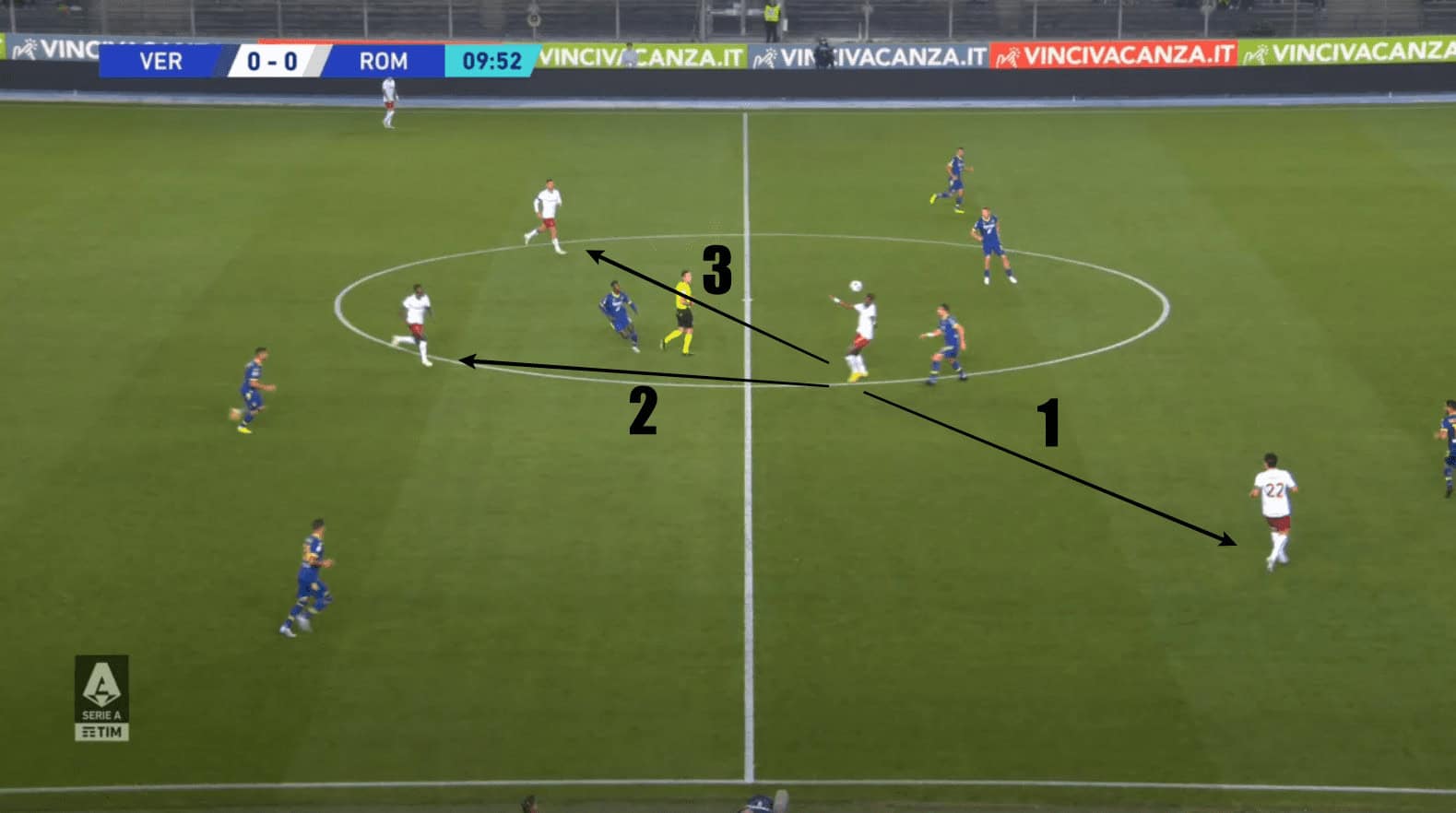
Serie A 2022/23: Verona vs Roma tactical analysis tactics
We can see how Abraham has three possibilities for his next solution which eases the context for him. The space on the right-hand side is quite big because of the initial idea of luring the opponent forward, and the most dangerous option for Roma (Zaniolo) is positioned on the easiest passing lane.

The striker didn’t always have three options around him, and the players weren’t supporting him constantly well in timing.

On occasions when it happened the danger they emitted went quickly from 0 to 60 because they had a lot of space and time in their hands, so they could utilise their individual qualities.

As the game became more fast-paced and direct in orientation, the spaces got wider, but the pressure on Roma’s striker kept on becoming more intense and the time for idea execution got shorter.

Abraham then didn’t have the necessary space-time context to keep the ball for a longer time and then play it but needed to embrace one-touch problem-solving, which could’ve been beneficial for his side only if the supportive players made their runs in his surroundings.
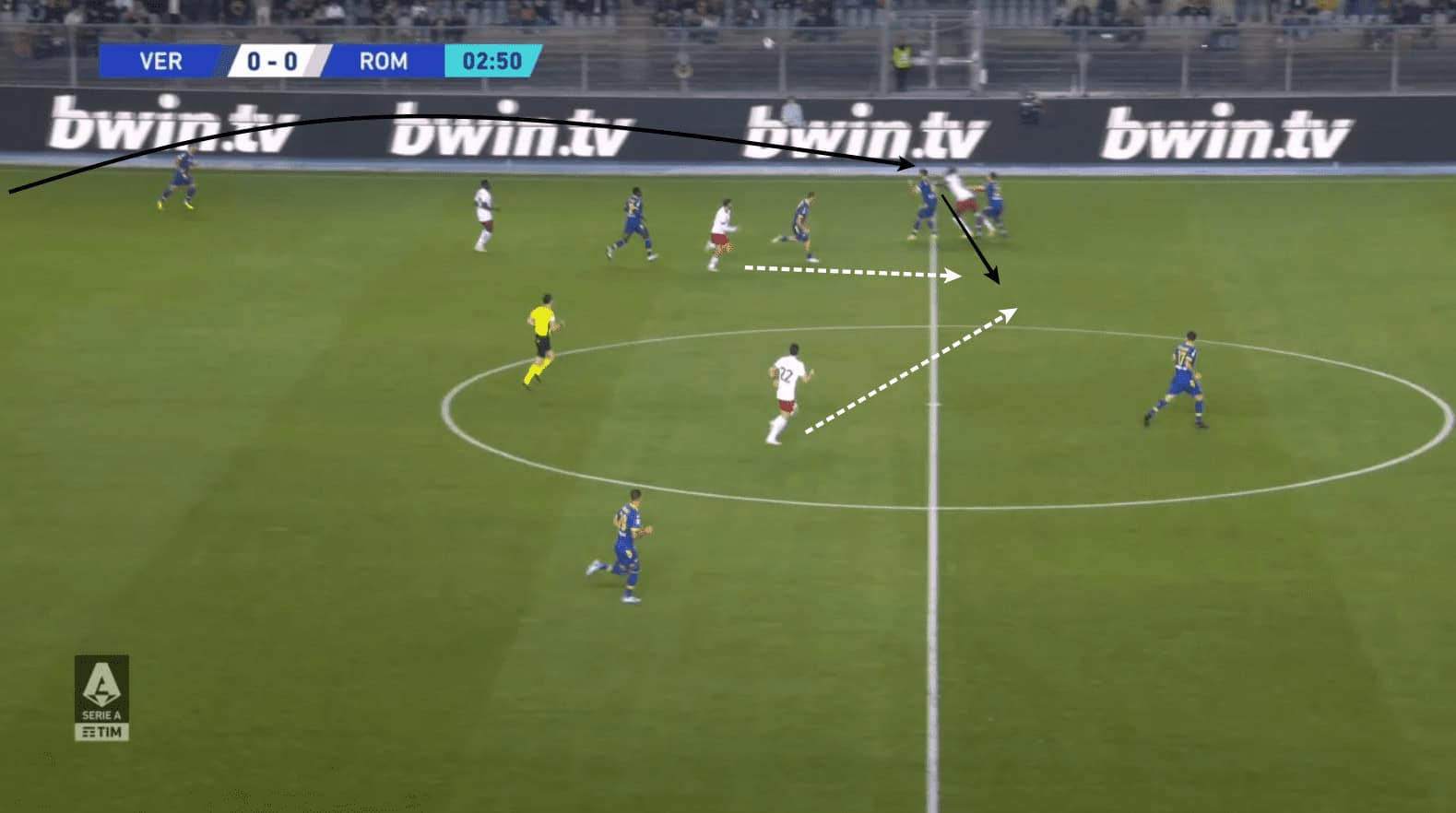
Serie A 2022/23: Verona vs Roma tactical analysis tactics
In the picture, we can see how the long ball was played to Abraham while he has two men on him. He was then left with one possible solution only which was a quick one-touch pass to players running in behind him/into the area of the second-ball drop.

Some moments after the long ball was played to Abraham, Pellegrini and Zaniolo went for their supportive runs or in-depth run-ins.

They commonly repeated counter-movements in relation to what their striker was doing so they could exploit the space that broke open once the opposition’s focus was on the Englishman.

The attention Abraham got throughout the match opened the possibility for Mourinho to use him as the bait and lock the defenders to him which would potentially open up the space for other players from the second line of the attack (midfielders, second striker, etc.).
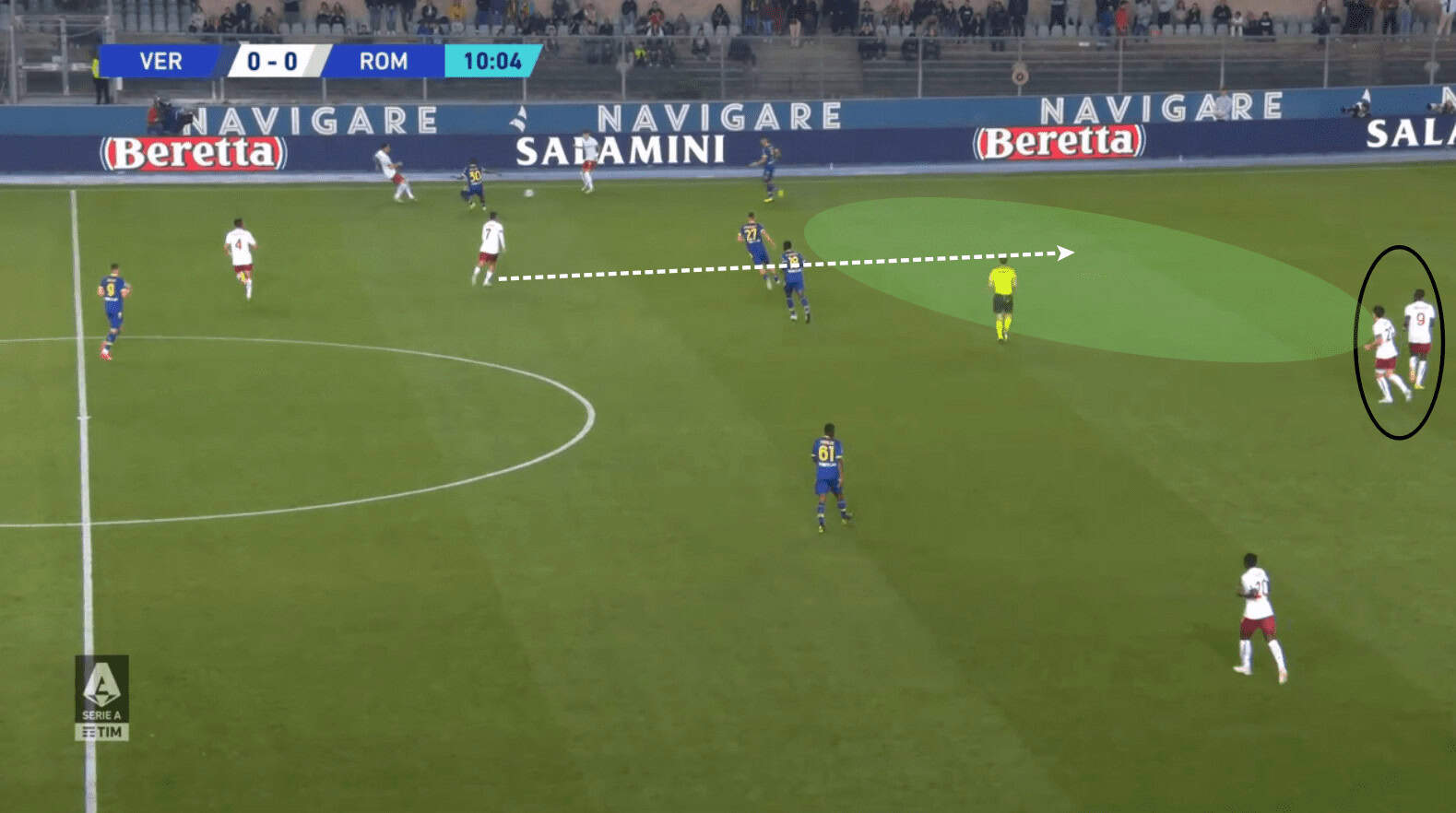
Serie A 2022/23: Verona vs Roma tactical analysis tactics
Even though we can’t clearly see Verona’s centre-backs in this picture, the close-positioning of Roma’s attacking duo drove attention away from the half-space and opened the room for Pellegrini to attempt a run-in.

Abraham and Zaniolo time and again went for a dummy positioning which lead them not to get the ball, but at the same time broadened the gaps for their teammates to operate.

Second-line run-ins happened on multiple occasions and were the key once Verona went a man down.

On the other hand, the fact that centre-backs were trying to lock Abraham by staying close to him opened a whole new topic for Roma so they went to take the best out of it, which is the next thing that will be explained in the analysis.

Pinning the defensive line and opening the space

The numerical deficit Verona had from the 36th minute changed the game a bit as they tended to become more narrow in their defensive block and tried to play a man-to-man defence against the opposition’s forwards.

Roma accepted that deal and went for it, pinning their players onto the defenders and making a constant 4v4/5v5 somewhere around the opponent’s box

Serie A 2022/23: Verona vs Roma tactical analysis tactics
The picture above shows the setup Roma used, especially in the late moments of the game when they needed to move the ball into the box more quicker. The height of the line varied throughout the duel but the formation was more or less always the same. The main playmaker in those situations could easily become Smalling who went repeatedly up the pitch and positioned himself in higher sectors roleplaying as a midfielder.

Verona’s newly-born back four had a clear idea of playing man-marking against the front four of Roma and that meant they focused their whole attention only on the player and not on the space.

Mourinho easily exploited that fact as he used Abraham, and more frequently Zaniolo as bait-players who’d lock the direct opponents onto themselves and lure them out of position, or make them stay deeper (in their position) in order to stretch the gap between the lines.
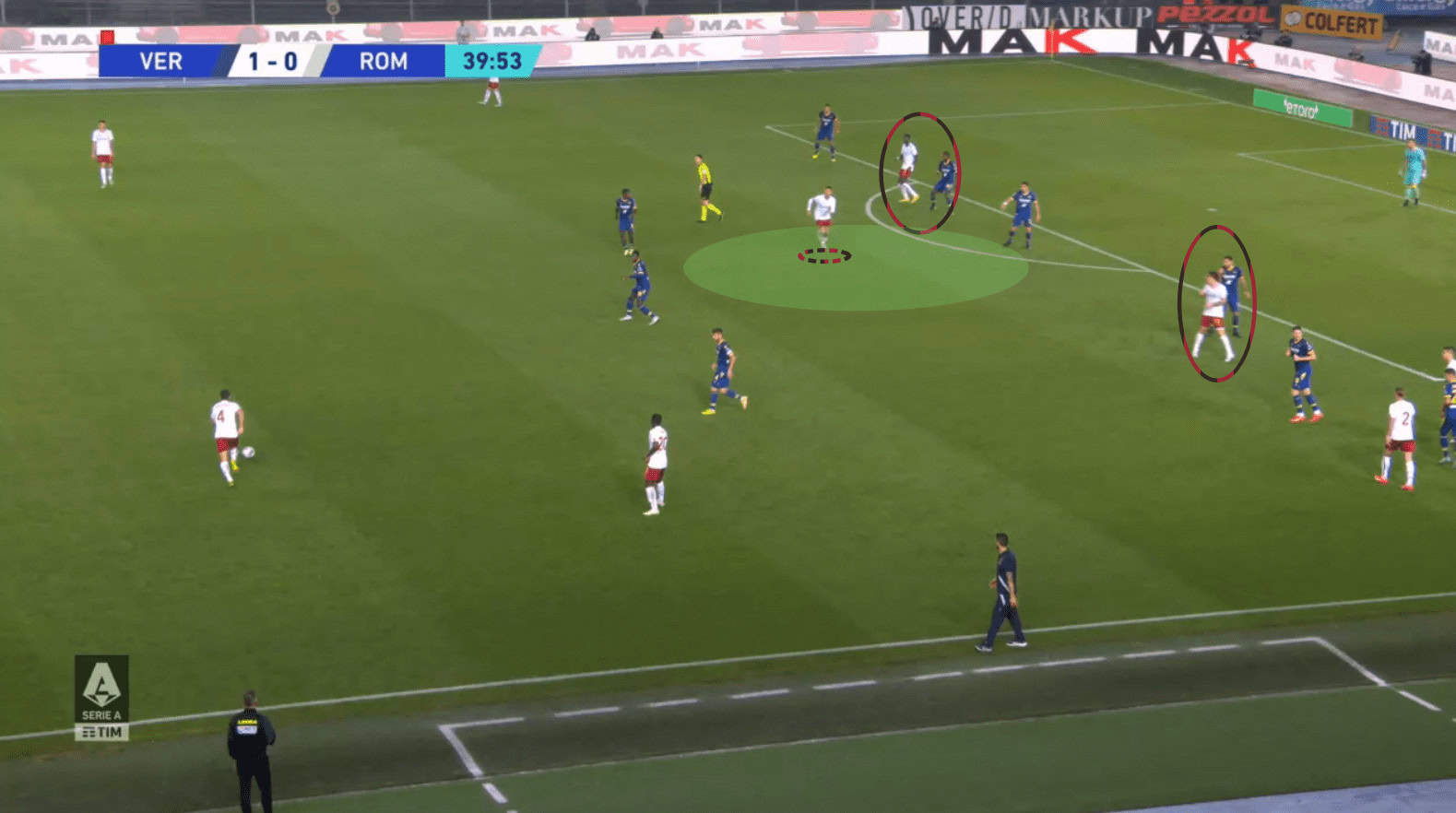
Serie A 2022/23: Verona vs Roma tactical analysis tactics
An example of the latter situation: Zaniolo and Abraham are static and positioned next to the two centre-backs enjoying the attention they got and not wanting to get the ball. Pellegrini then activated himself between the lines coming out of the blind side of the hosts’ midfielders and utilizing the free room in the gap.

Even though this was a proper option for the visitors, they mostly used the first-described solution and went for a ‘lure and exploit’ concept with Zaniolo being the man for the job.

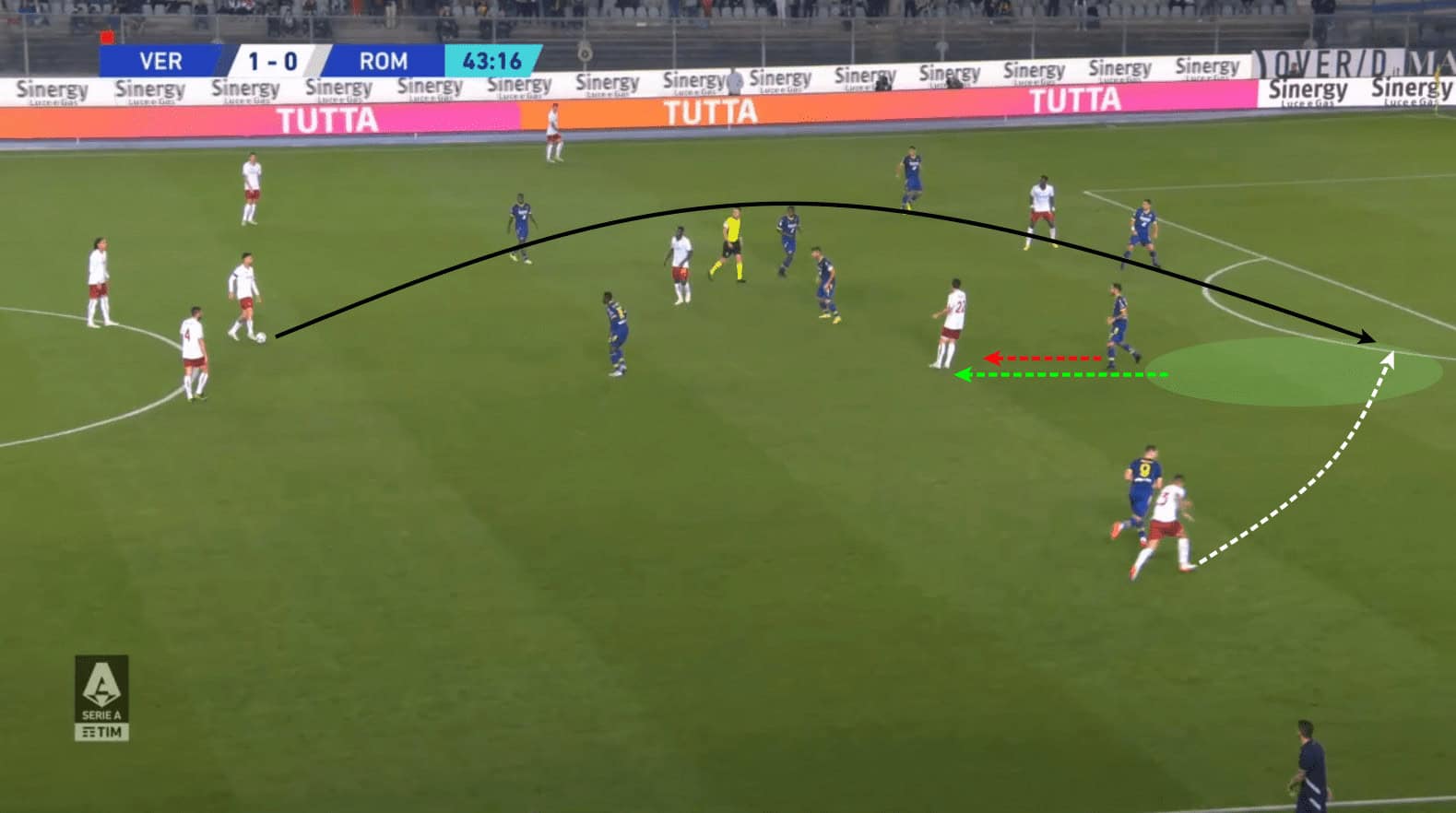
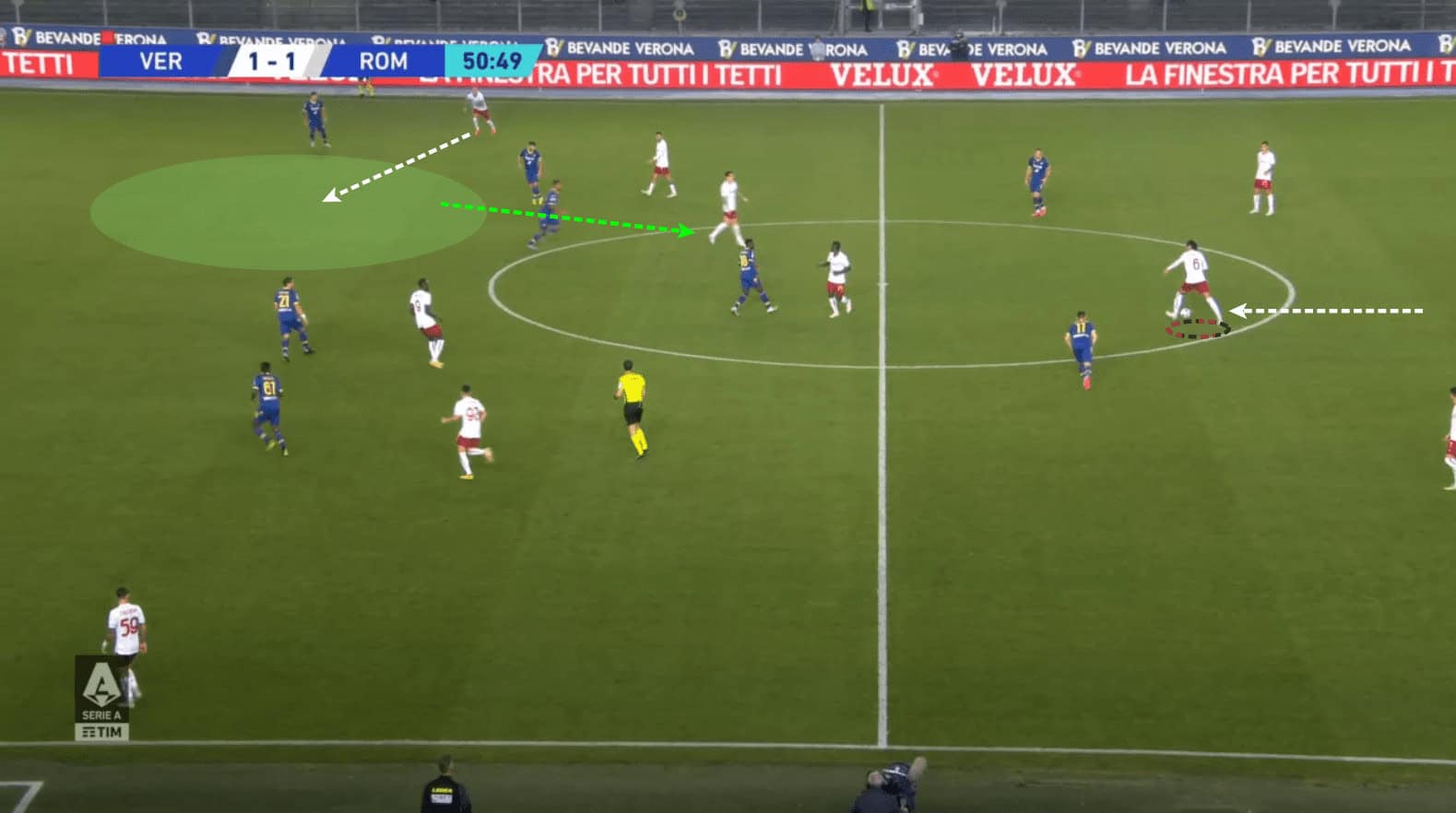
He easily locked centre-backs because he was portrayed as the main threat due to his constant roaming and used that fact to pull the defenders out of their position so that his teammates could attack the open areas.
Serie A 2022/23: Verona vs Roma tactical analysis tactics
Zaniolo drags the defender out of the back four which disrupts their horizontal compactness and opens the passing lane for a lower-positioned teammate to run in.
Serie A 2022/23: Verona vs Roma tactical analysis tactics
The Italian performed the same motion over and over again and the space behind him was filled in also by the players that are initially positioned wide on the flanks. You can once again see Smalling coming forward to play as a midfielder and get more included in the attack organization.

As you can see in the pictures above, the idea of the compactness disruption was beneficial for Roma as they got the needed space and open passing lanes which they could exploit.

They had two approaches to using these settings: taking advantage of the open room with the wide centre-backs running from the low zones or forcing the wing-backs to cut inside and enter the open spots.

These ideas were the baselines of their offensive tactics and they could’ve benefited even more from them if the execution/finishing was better.

Nonetheless, they had the tools and knew how to use them so they came out triumphantly on this tough night in Verona.

Verona’s offensive approach

Although they didn’t get the result they wanted, Bocchetti’s men had the upper hand initially and had good grounds on which they based their tactics.

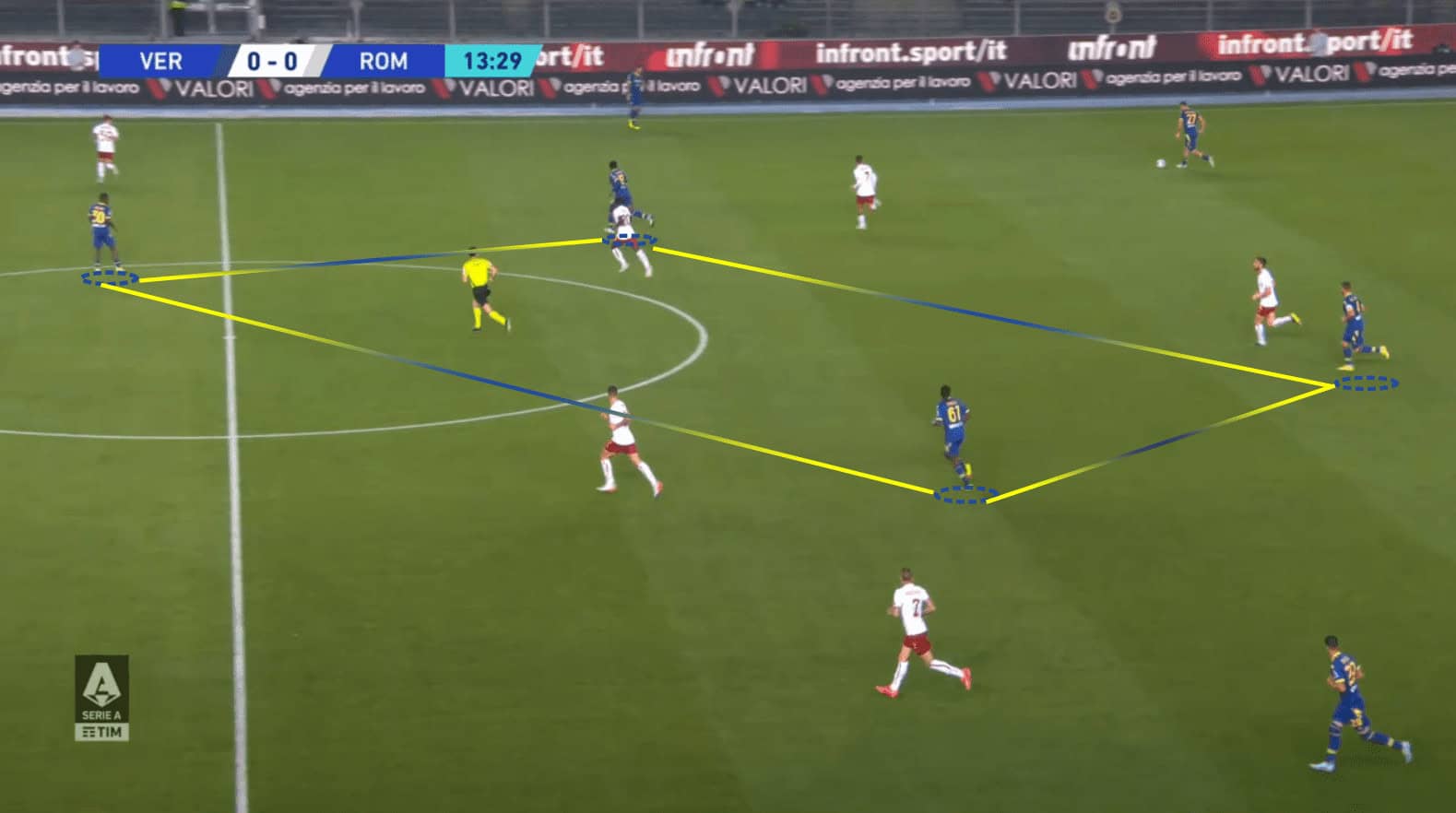
After a slower start in the first couple of minutes, Verona got in control of the game with their interesting attacking structure: they tended to have a constant diamond in the midfield which would quite compactly shift depending on the situation on the pitch.

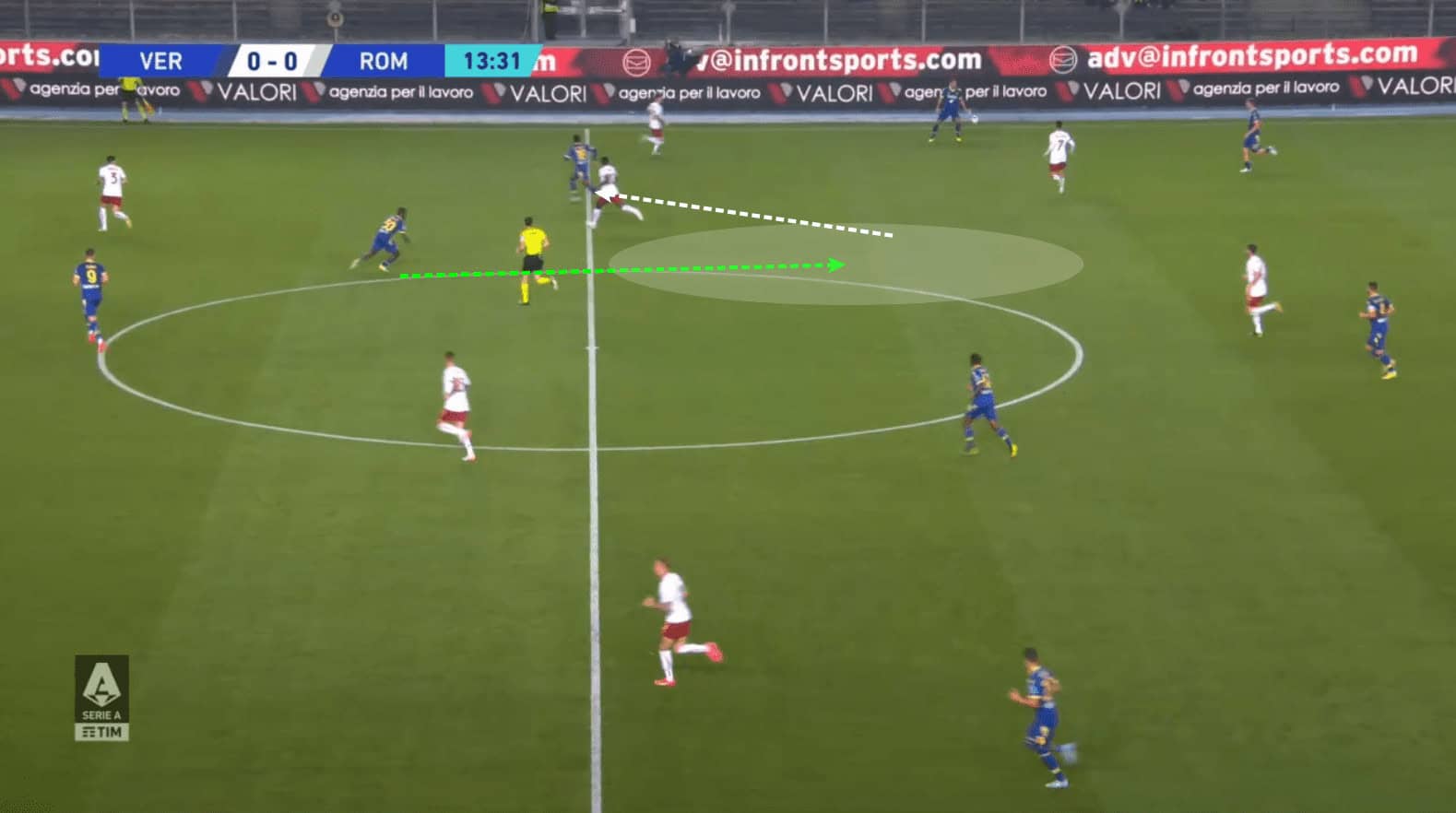
Once they created the so-called rhombus, the additional rotations came into play and the midfielders were free to switch places whilst keeping the structure relatively compact.

The rotating opened the pitch for them and made it possible for the host to progress through the lines and get closer to the opposition’s goal.
Serie A 2022/23: Verona vs Roma tactical analysis tactics
Here we can see the diamond-shaped midfield that was the basis of Verona’s offensive structure…
Serie A 2022/23: Verona vs Roma tactical analysis tactics
…and here’s what happened just moments after the first picture was snapshot: the midfielder in the low half-space went for a flank-oriented run, and the one that was initially positioned on top of the diamond dropped lower into the abandoned space which made it quite possible for him to get the ball.

These rotations happened often and the two players that were nominally the attacking midfielders were the main exploiters of the gaps.

When the game got moved forward, and onto the opponent’s half of the pitch, the diamond was shifted into the box with Kallon and Tameze operating in the half-spaces and being the key vertical solutions for their team.
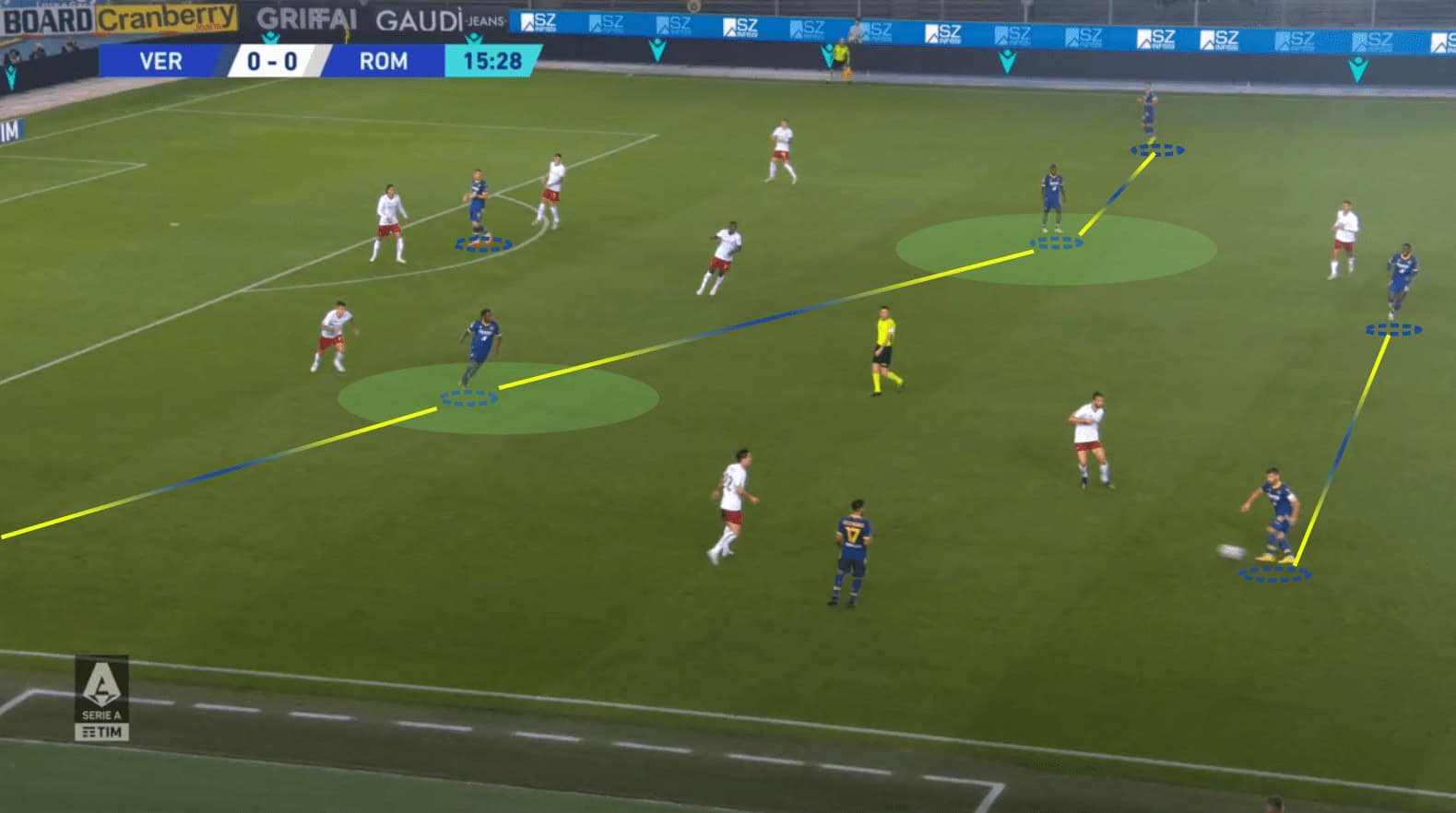
Serie A 2022/23: Verona vs Roma tactical analysis tactics
Verona’s offensive structure – wing-backs delivering width, Henry stretching the field, Veloso and Hongla being main playmakers and two attacking midfielders cleverly using the room in half-spaces.

Once the ball got delivered into the final third, the most interesting solution was brought to light.

As Verona’s progress was initially half-space oriented, meaning that the ball primarily goes down the inner corridor into the finishing sector of the pitch, from there they’d read the context and structure themselves into two triangles.

One of the two triangles was in charge of chance creation, while the other one was meant for the finishing of the action.

The chance creation happened on the flanks, and the home team wanted the players forming the finishing triangle to get themselves as quickly as possible into the box in order to be prepared for the potential crossing and also possibly open up the passing lane for cutback passes.
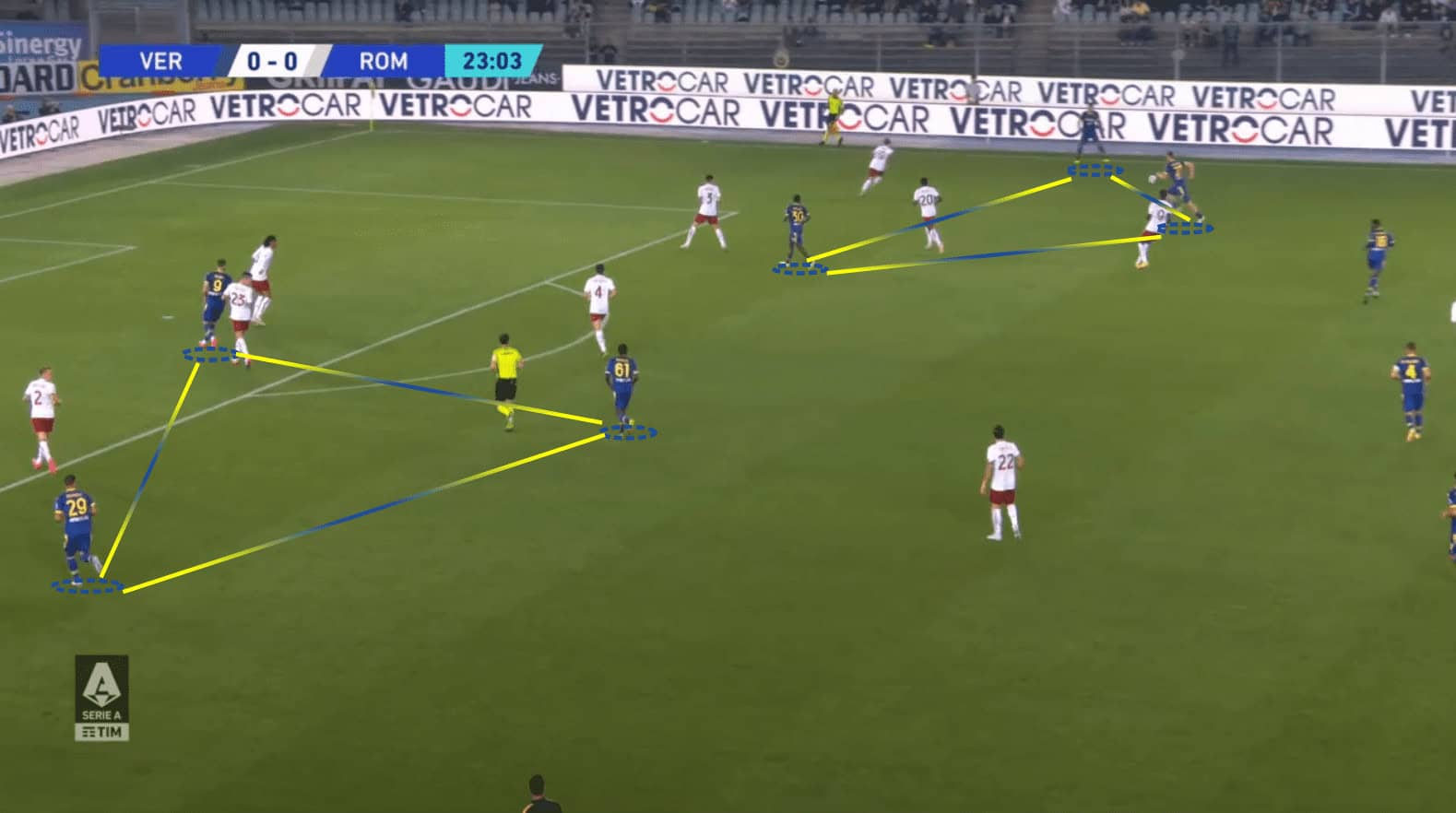
Serie A 2022/23: Verona vs Roma tactical analysis tactics
The idea of two triangles shown in real time – chance-creating triangle was free to combine and improvise, whilst the finishing one was only in charge of getting at the end of passes sent towards them.

Verona’s initiative was cut short because of the man-down situation and they were forced to play more conservatively and try to get the best out of the bad position they were in.

Anyways, their offensive structure was very interesting and effective and suggests that they have a good base for the upcoming games.

Conclusion

This tactical analysis has shown how Mourinho’s men took advantage of the numerical superiority that happened because Dawidowicz got sent off.

They utilized the attention their strikers had reserved for them and by locking them to have an opponent next to them constantly unlocked the attacking potential of their other players.

Verona’s ideas were good, but they lacked longevity because they needed to adapt to a new context that took place after the red card.

Their tactics were quite beneficial and it could’ve ended up differently if they were playing 11v11 for the whole 90 minutes.

Both teams had their moments and Roma got what they needed and is preparing for the next fixture from fourth place, whilst Verona will wait for their second win of the season sharing the bottom of the table with Cremonese.

Previous Post

“A team accustomed to winning”: Why Portland Thorns’ self-belief helped defeat Kansas City Current in the NWSL Championship – tactical analysis

Next Post

Women’s Super League 2022/23: Arsenal vs West Ham United – data viz, stats and insights

Next Post
UEFA Champions League 2022/23: Liverpool vs Napoli - tactical analysis tactics

How Nullifying Stanislav Lobotka Stifled Napoli And Helped Liverpool Claim Victory In The UCL - Tactical Analysis

  • About Total Football Analysis
  • Contact Total Football Analysis
  • Write For Total Football Analysis
  • Advertise
  • Privacy Policy
  • Cancellation / Refund Policy
  • Resources
  • Terms Of Service

© 2026 Total Football Analysis

No Result
View All Result
  • Football Analysis
    • Data Analysis
    • Formations
      • 2-2-4 Formation
      • 2-3-5 Formation
      • 3-1-4-2 Formation
      • 3-2-2-3 Formation
      • 3-2-4-1 Formation
      • 3-1-6 Formation
      • 3-3-4 Formation
      • 3-4-1-2 Formation
      • 3-4-2-1 Formation
      • 3-4-3 Formation
      • 3-5-1-1 Formation
      • 3-5-2 Formation
      • 4-1-4-1 Formation
      • 4-2-2-2 Formation
      • 4-2-3-1 Formation
      • 4-2-4 Formation
      • 4-3-1-2 Formation
      • 4-3-3 Formation
      • 4-4-2 Formation
      • 4-5-1 Formation
      • 5-3-2 Formation
      • 5-4-1 Formation
      • 6-3-1 Formation
    • Head Coach Analysis
    • Match Analysis
    • Player Analysis
    • Recruitment Analysis
    • Set Piece Analysis
    • Tactical Theory
    • Tactical Preview
    • Team Analysis
    • Training Analysis
    • Tactical Analysis
    • Scouting Report
  • Competition
    • ALL Competitions
    • English Premier League
    • Champions League
    • La Liga
    • Bundesliga
    • Serie A
    • Ligue 1
    • Eredivisie
    • EFL Championship
    • FIFA World Cup 2022
    • WEURO 2022
    • Women’s Super League
    • NWSL
    • Belgian First Division A
    • A-League
    • Liga Profesional de Argentina
    • Austrian Bundesliga
    • Campeonato Brasileiro Série A
    • DFB Pokal
    • 1. HNL
    • Danish Superliga
    • EFL League One
    • EFL League Two
    • FA Cup
    • EFL Cup
    • Indian Super League
    • K-League
    • J1 League
    • Liga MX
    • Copa América 2021
    • Copa del Rey
    • MLS
    • Eliteserien
    • Euro 2020
    • Primeira Liga
    • Scottish Premiership
    • Allsvenskan
    • Europa League
    • UEFA Nations League
    • Liga AUF Uruguaya
  • Coaches
    • All Coaches
    • Alfred Schreuder
    • Ange Postecoglou
    • Antonio Conte
    • Arne Slot
    • Bo Svensson
    • Brendan Rodgers
    • Bruno Lage
    • Carlo Ancelotti
    • Christophe Galtier
    • Claude Puel
    • Claudio Ranieri
    • David Moyes
    • Dean Smith
    • Diego Simeone
    • Domenico Tedesco
    • Frank Lampard
    • Eddie Howe
    • Edin Terzić
    • Emma Hayes
    • Erik ten Hag
    • Ernesto Valverde
    • Gennaro Gattuso
    • Gerardo Seoane
    • Gian Piero Gasperini
    • Giovanni van Bronckhorst
    • Graham Potter
    • Igor Tudor
    • Imanol Alguacil
    • Jesse Marsch
    • Jonas Eidevall
    • Jorge Sampaoli
    • José Bordalás
    • José Mourinho
    • Julen Lopetegui
    • Julian Nagelsmann
    • Julien Stéphan
    • Jürgen Klopp
    • Luciano Spalletti
    • Lucien Favre
    • Manuel Pellegrini
    • Marcelo Bielsa
    • Marco Rose
    • Marco Silva
    • Massimiliano Allegri
    • Mauricio Pochettino
    • Maurizio Sarri
    • Mikel Arteta
    • Niko Kovač
    • Nuno Espírito Santo
    • Oliver Glasner
    • Patrick Vieira
    • Paulo Fonseca
    • Pep Guardiola
    • Peter Bosz
    • Rafa Benítez
    • Ralf Rangnick
    • Ralph Hasenhüttl
    • Roger Schmidt
    • Roy Hodgson
    • Sean Dyche
    • Sérgio Conceição
    • Simone Inzaghi
    • Sonia Bompastor
    • Stefano Pioli
    • Steffen Baumgart
    • Steven Gerrard
    • Thiago Motta
    • Thomas Frank
    • Thomas Tuchel
    • Unai Emery
    • Vincenzo Italiano
    • Xavi
  • Teams
    • ALL Teams
    • AC Milan
    • Ajax Amsterdam
    • Arsenal
    • AS Monaco FC
    • Atalanta
    • Atlético Madrid
    • FC Barcelona
    • FC Bayern Munich
    • Borussia Dortmund
    • Celtic FC
    • Chelsea FC
    • Everton F.C.
    • Inter Milan
    • Juventus F.C.
    • Leeds United F.C.
    • Liverpool FC
    • Manchester City
    • Manchester United FC
    • Paris Saint-Germain
    • Rangers FC
    • RB Leipzig
    • Real Madrid CF
    • Tottenham Hotspur
    • West Ham United
  • Players
    • ALL Players
    • Alisson Becker
    • Bukayo Saka
    • Erling Haaland
    • Harry Kane
    • Jack Grealish
    • John Stones
    • Julián Alvarez
    • Kalvin Phillips
    • Kevin De Bruyne
    • Kyle Walker
    • Kylian Mbappé
    • Lamine Yamal
    • Lionel Messi
    • Luis Díaz
    • Mohamed Salah
    • Phil Foden
    • Virgil Van Dijk
  • Contact
  • Write For TFA
  • Login

© 2026 Total Football Analysis