


North American football has been growing in strength and popularity every year, with the MLS attracting many star names and the recent success of Canada’s qualification campaign showing that the continent is becoming much more competitive in world football. However, whilst John Herdman’s Maple Leaves will be appearing at only their second-ever World Cup finals, the United States have been one of the tournament’s regulars in living memory, having appeared at every edition of the competition between 1990 and 2014. They missed out on Russia 2018 after going out during the qualification stages, but have recovered and will return to the finals through their third-place finish in the third stage of CONCACAF qualifying.
The USA have been drawn in Group B in Qatar, which will see them face England, Wales and Iran for a place in the knockout stages, and they have a very real chance of making it that far. They also have previous experience of competing in the latter stages of the competition, having finished in the top two of their group in both 2010 and 2014, so know what it will take to be in the last 16.
This tactical analysis will look at their overall game in more detail, with the scout report identifying their key tactics, which players will carry the most importance for them and the statistics that show what their strengths and weaknesses are. The analysis will also pick out one member of their squad who will be central to everything they do during their time in Qatar, and why keeping that player fit will be essential to their chances of getting into the knockout rounds.
Predicted starting XI
Head coach Gregg Berhalter has tended to favour a 4-3-3 formation since taking charge of the national side in 2018, with it being used on 87% of occasions this year. The fact that their next most-used structure, a 4-2-3-1 setup, has only been seen in 4% of their matches highlights how much faith they have in the balance that comes from a 4-3-3 lineup.
In goal, they have several good options to choose from, with Middlesbrough’s on-loan Manchester City stopper Zack Steffen and Nottingham Forest’s Ethan Horvath, who is spending the 2022/2023 season at Championship side Luton Town, both good players to have in the squad. However, the player most likely to be given the nod between the posts is Matt Turner, with the Arsenal and former New England Revolution goalkeeper currently in firm possession of the No. 1 jersey and tending to start when he is fit.
In front of him, the USA look for a balance of defensive and attacking quality, enabling them to be hard to beat but also to play out from the back when they can. The full-backs are especially important to this, and they have tended to mix around in recent games due mostly to injuries but also to test different combinations out ahead of the World Cup.
However, the two that are most likely to start are DeAndre Yedlin and Antonee Robinson, who have both shown throughout their careers that they can support attacks and offer defensive support with equal ability. With those two players likely to get up the pitch, the USA need to have good defensive strength and awareness in the centre-back partnership, and Aaron Long and Walker Zimmerman fit those profiles perfectly.
The midfield trio is made up of one defensive-minded player and two who can both defend and attack, with the USA’s tactics centring around their transitional work and ensuring that they have players who are comfortable with the ball at their feet. Juventus’ Weston McKennie is not the most effective player to have in the final third, but he can be relied upon to make intelligent passes and provide those on either side of him — in this case, the Leeds United duo of Tyler Adams and Brenden Aaronson — with the ability to get forward and work closely with those ahead of them, which is where they are at their best.
The forward line is made up of two wide attackers and one striker, although in reality all three are expected to contribute goals and make the right movements at the right times. There is likely to be a good deal of competition for those positions, but it is likely to be the star duo of Borussia Dortmund’s Giovanni Reyna and Chelsea’s Christian Pulisic who are given the nod in the wide attacking roles, whilst Jesús Ferreira is likely to start between them.
Both Reyna and Pulisic have shown themselves to be capable of changing direction on the spot and of delivering accurate crosses into the middle, while DC United’s Ferreira has impressed when used in recent matches, most notably when the USA faced Grenada and he scored four times and constantly broke through their defensive line.

The full USA squad has yet to be announced, but this graphic indicates all of the players in with a chance of being included in Qatar and their age ranges, with them either categorised as youth, in their peak or experienced.
With the USA’s preferred style of play requiring good movement and intelligent passing, it is no surprise to see that the majority of those who could feature fall in either the youth or peak sections, and this will also help the USA to grow as a team when the tournament begins, with them getting used to each other’s strengths and developing partnerships around the field.
Attacking phase

The way to describe the United States’ style of play is patient at the back and then fast and decisive passing when they get the chance to move forwards, and the fact that they have a lower percentile rank for average shot distance reflects how they always wait for the right opportunity to open up before moving forwards and don’t take shots until they are closer towards the opposing goal, minimising the risk of it failing to find the target. They also prefer to move the ball through the thirds instead of playing long balls during transitions, which is why they have a low percentile ranking for long passes and sit around the middle percentile bands for touches in the penalty area and shots on target.
It is also worth mentioning that they don’t give up possession easily, which again comes down to the care that they take when they have the ball. As mentioned, everything they do is precise and shows good attention to detail, and this means that it will not be easy for England, Wales and Iran to win the ball back once they lose it, putting more pressure on them to not make mistakes.

That precision and attention to detail are indicated here, with the USA’s setup meaning that they have covered all bases and ensured that they have a way of progressing play regardless of what their opponents, in this case, Saudi Arabia, choose to do.
The key players to look at here are the two full-backs, as Yedlin has moved higher up the pitch whilst Barcelona’s Sergiño Dest has stayed closer to the two centre-backs. This presents a slightly unbalanced picture, but it gives the USA options on the ball, as they can now play a longer pass towards Yedlin, which would gain them a significant amount of territory, or they can be conservative and play a shorter pass in Dest’s direction, with him having more time than Yedlin to control the ball and to see if he can make any progress up the field.
This setup has been a common feature in the USA’s matches and is clearly something that head coach Berhalter has worked on with them, and it has had a very positive effect on the development of their pass-and-move tactics simply because of how it gives them different ways to move the ball around the pitch and to never take unnecessary risks.

When they do move the ball into advanced areas, the USA immediately increase the tempo of their play as they look for the best way to hurt their opponents. In this case, Grenada have caused their own problems, with their high back line inviting the USA to position players on the shoulder of the defenders and to send passes into the spaces behind, and the fact that they had Ferreira leading the line in this game was key to them making the most of the spaces that Grenada left open, with Ferreira’s Dallas teammate Paul Arriola weighting a perfect pass through and a goal coming from this attack.
Therefore, the key thing that the USA’s upcoming World Cup opponents will need to be aware of is that they cannot leave spaces open, because the fact that Ferreira scored four times in this match from similar situations demonstrates that any mistakes or gaps left open will be capitalised on.
Defensive phase

When out of possession, the USA look to make themselves as tough to score against as possible, with this graphic indicating how they rank highly in percentile terms for defensive duels, aerial duels and recoveries made per game. However, there is a clear difference between the number of aerial duels won and the number of defensive duels won, which suggests that the way for their opponents to beat them is to keep the ball on the ground, although the fact that they are in the middle band for shots against per match implies that not many teams do this.
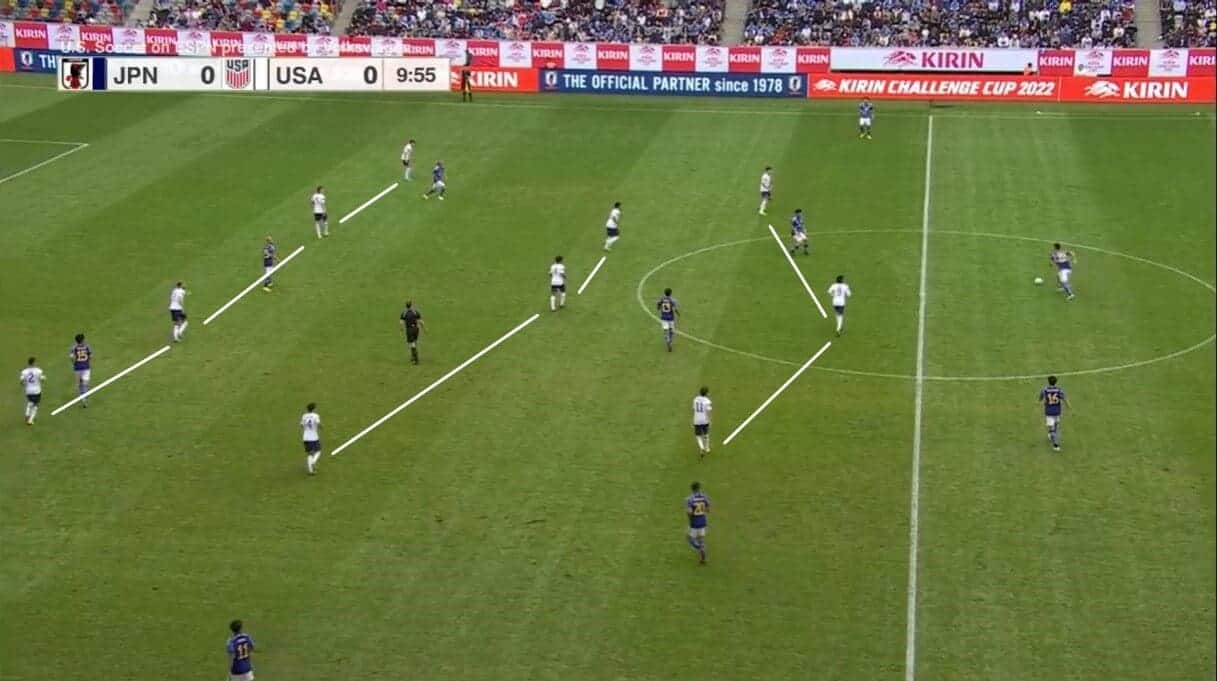
This situation illustrates their setup once they have lost the ball, with the lines indicating their 4-3-3 structure. By setting up this way, they have put a significant amount of ground between the ball and the goal, making it as difficult as possible for Japan in this case to advance up the pitch and create a goalscoring opportunity.
However, the key detail that makes this so effective is that their formation constantly changes, with individual players either moving forwards or dropping back, so this structure could at any time change into a 4-3-1-2 or a 4-4-2, and that makes the USA unpredictable and therefore harder to beat, with the chance of Japan making an error increased as they try to find a way through.
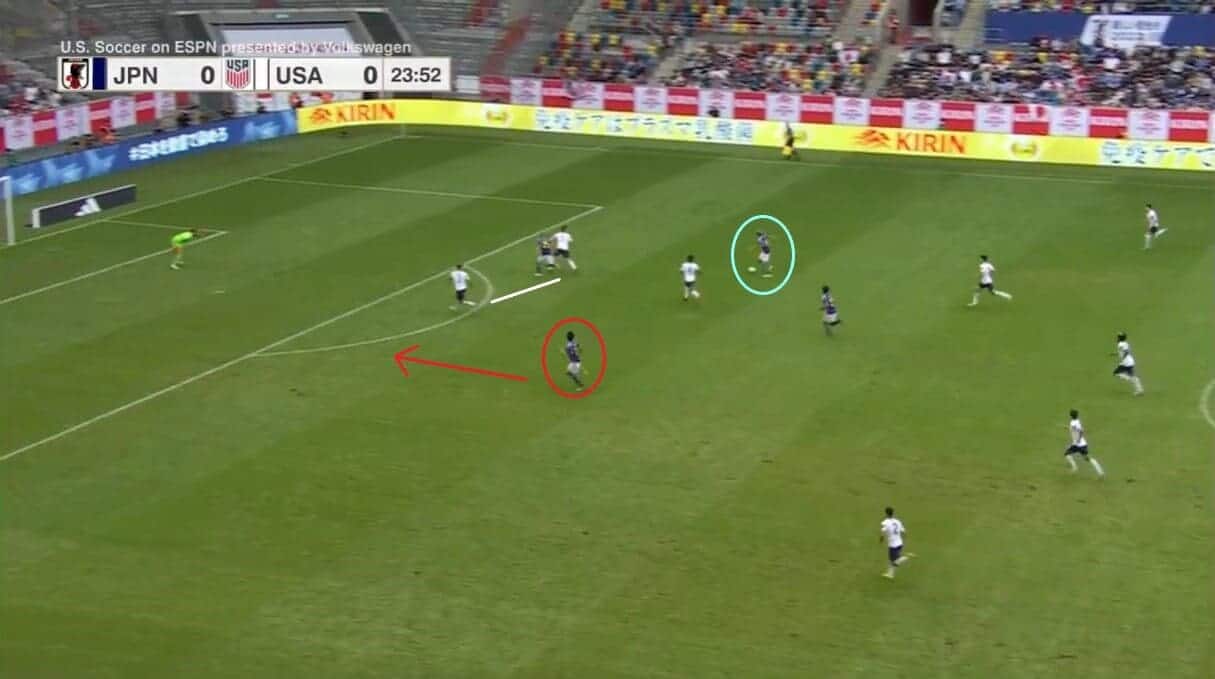
However, the thing about the USA’s defensive tactics is that they only work when their players have time to get back behind the ball, and this situation shows how they can be caught out when they lose possession and can’t get numbers back.
In this case, McKennie has made a poor pass in his own third which has invited Junya Ito to advance towards the USA’s goal area, and his combination play with Hidemasa Morita enables the ball to travel into the path of Eintracht Frankfurt forward Daichi Kamada, whose run is indicated by the red arrow. Once the ball reaches Kamada, he has time and space to pick his spot and find the bottom of the net, and the fact that he was alongside the two USA centre-backs when he took the shot meant that there was no way for either Zimmerman or Long to get across and close him down.
On this occasion, the USA were saved by the fact that Kamada was ruled offside when he took the shot at goal, but this is not the first time that they have found themselves in this type of situation, with it coming down to how much they push players up the field when committing to an attack. It is very much a “risk and reward” way of playing, with the positives obvious but the negatives indicated here, and it is something that their opponents will recognise and look to exploit once the World Cup gets underway.
Transitions

As mentioned, the United States on the whole play a measured style of football that sees them keep the ball and then strike when the right moment arrives, and that is helped in no small part by the movement that individual players make around the field. To explain, if players had one role and stayed in just one area of the pitch, then it would be easy for their opponents to mark them and prevent the ball from moving around. However, because the USA’s players keep moving and switching positions, they become less predictable and teams find it harder to close off all available passing options against them.
It is important to remember though that the USA don’t take risks when moving the ball around, and that is once again on show here with their players looking after it as their priority, and the fact that Aaronson’s first thought when he receives the ball from Adams here is to send it back towards his defensive line indicates that it is a case of “safety first” in everything that they do.
However, Adams is the player to look at here, because his run after sending the ball into Aaronson takes him into an area where he can provide a link between the two ends of the field, which Aaronson recognises as he gets up the pitch to offer a forward passing option. Therefore, Nashville defender Zimmerman can now pass forwards to Adams and know that the USA will be able to transfer the ball through the thirds and into a dangerous area of the pitch, with Aaronson not missing the target by much once the ball reaches him.

Once they lose possession, as mentioned, their focus immediately turns towards getting back and protecting their goal area, and this analysis has already shown how they set up in a shape that limits what their opponents can do. In the initial stages of that defensive effort, any player in the area at the time is expected to fill in, with Adams getting back here to act as an emergency left-back.
However, the key point to make here is that these four players are now only focused on protecting their goal, which means that none of them think about coming out to slow Morocco’s progress down. This on paper looks like a good decision, as it prevents gaps from opening up, but the problem is that it also invites pressure from opposing sides when they are counterattacking, and Morocco used the spaces well on this occasion to get Adel Taarabt into a good position, before he set up Angers’ Azzedine Ounahi, in the blue circle, to have a shot at goal.
On this occasion, Adams did come out at the last minute to meet Ounahi and deflect his effort, making it easier for Turner to save the shot, but the feeling among some might be that the USA could have done more earlier to prevent Morocco from getting so far up the pitch here, and this is another potential chink in the United States’ armour that their three group stage opponents could use against them.
Attackers
It has already been mentioned that the United States want their wingers to be capable of cutting inside and supporting the striker as much as possible, but that relies on the player in that central role having the right profile. Otherwise, the team will end up with players getting into the same spaces and rendering their attacking chances ineffective.
The two players most likely to play in the central role are Ferreira and Norwich City’s Josh Sargent, who has started the current Championship season in good form and has shown after a difficult Premier League campaign that he can score goals for the Canaries. He would be the ideal player for the USA to start if they were looking to play with those tactics, as he has fewer touches inside the penalty area per game on average (4.17, compared to Ferreira’s 5.31), which suggests that he is a more mobile option, and that makes sense when considering how he has worked with the likes of Teemu Pukki and often dropped back to enable the Finland international to get on the end of crosses and passes at Carrow Road this season.
Sargent also averages a higher number of aerial duels won, having been successful on 30.5% of occasions compared to 26.3% for Ferreira, so he would also be the better player to have if the USA wanted to be more direct, but the fact that he moves around more also has its downsides as it means that he might not be the best player to have on the pitch when the USA require a goal. Instead, that is where Ferreira will shine, with him showing in recent internationals that he likes to stay in a more fixed position and to run behind defences to convert opportunities, and that is why he is perhaps more likely to start as the USA try to take early control of their games.
Midfielders
When it comes to the central third, the main characteristics that Berhalter looks for are the ability to make accurate passes and to get shots on goal, with those who start in those positions expected to push forwards and contribute in the final third.
When it comes to passing the ball around, the player with the best accuracy out of those likely to be in these positions is Luca de la Torre, with 89.1% of his passes finding their intended target. However, the three players named in the predicted starting XI are not far behind him, with Adams’ passing accuracy standing at 88.2%, Aaronson’s at 85% and McKennie’s at 83%, so all four players can be relied upon to move the ball around the pitch with precision and to help create chances.
However, whilst de la Torre is clearly the best option to have when moving the ball around, he is let down when compared to the other three by the percentage of shots that he gets on target, with only 33.3% of his efforts being accurate, whilst Adams has the highest percentage for this statistic, with 54.5%, whilst Aaronson has 54.2% and McKennie 44.6%. This is why de la Torre was not included in the predicted starting XI, although he is likely to feature at the World Cup and will be a highly effective squad player and someone that can make an impact from the bench when needed.
Defenders
There are two things to consider when analysing the different options in the USA’s defensive line, because they need full-backs who are happy to play in advanced areas and who will help to move the ball up the pitch and they need centre-backs who are tough to beat and would be comfortable being left on their own when their side has possession, with that last point being something that they have struggled with, as previously analysed.
Focusing first on the full-backs, the player with the best accuracy when it comes to sending balls into the final third is Dest, with 84% of his passes into advanced areas finding their intended target.
The next best player is Yedlin, who has a 72.7% accuracy, whilst Reggie Cannon, who is likely to be one of the main deputies in the full-back areas, has a 72.2% accuracy and Fulham’s Robinson has 68%. However, the reason for this statistic being lower is likely to be due to him not getting as far forward as the others, meaning that his efforts have longer to travel, and the fact that he stays further back is why he fits into the USA’s tactics when considering the unbalanced setup that was identified earlier in the scout report.
As for the centre-backs, they need to be good at winning defensive duels and interceptions, ensuring that opponents have as few chances to shoot at their goal as possible. The player who wins the most defensive duels out of those likely to start in these positions is Long, with his experience also making him an important part of the team. Meanwhile, the other players in with a chance of starting have mixed values, with Celtic’s Cameron Carter-Vickers, Nashville’s Zimmerman and Club Bruges’ Mark McKenzie winning 67%, 73.6% and 76.5% of their 1-v-1 battles respectively, so it is clear that, from this statistic, Long has to be on the field if the USA are to be robust in their own third.
However, the perfect defensive partnership is made of two players who bring different things to the field, and the best way to compliment a player like Long who engages in duels is to have a player who reads the game well and anticipates play. With that in mind, the player from those four who has the highest average interceptions is McKenzie, with him averaging 6.43 per game, whilst Zimmerman makes 4.76, Long 4.28 and Carter-Vickers 3.98. Therefore, having McKenzie or Zimmerman alongside Long would be the best selection for the United States to make, but Zimmerman has more experience and has shown himself to be adept at passing out from the back (another key quality), which is why he was selected ahead of the others in the predicted starting XI.
Key player

What has become clear in this analysis when focusing on Adams is that the Leeds midfielder offers everything that the USA need from their players in the central third, including an ability to link up with those behind him, offer passing options and get up the field at speed when his team are in transition. Therefore, there is little doubt that the USA’s ability to make their tactics work against England, Wales and Iran will depend on him being in top form in every game.
With him being a mainly box-to-box player, his attacking metrics rank in the lower percentile bands, but this is not a disaster as his role is not to provide the final end product. However, what will encourage fans of the USA is that he does work hard in offensive duels, with him ranking in the second-highest percentile band for this area of the game and therefore giving his team a strong chance of scoring whenever he gets into advanced areas of the field.
His passing metrics are also hugely encouraging, with him ranking above the league median for forward passes, progressive passes and passes to the final third. Therefore, again, his attacking play contains a high degree of accuracy, which is why he will be essential in defence-to-attack transitions and in helping to transfer the ball into the forwards when chances to do so present themselves.
The fact that he ranks below the median for long passes and average pass length might worry some people, but they are nothing to be concerned about as those statistics simply show how the USA approach their games tactically, so are not a reflection of Adams’ abilities.
Being a box-to-box midfielder means that players need to be just as good at the back, with them needing to offer defensive protection when it is required, and this scout report has already shown that Adams is happy to play his part when his team need someone to drop back and cut spaces off. His defensive metrics support those findings, with him ranking highly for defensive duels and aerial duels won, so there is no doubt that, given what has been mentioned about him throughout this analysis, he is someone that his team will rely on as they look to keep clean sheets and have the best possible chance of progressing into the knockout rounds.
Tournament prediction
What has become clear throughout this tactical analysis is that the United States are a team with an abundance of quality and that cannot be underestimated, with England, Wales and Iran needing to be at their best when facing them once the tournament gets underway later in November. If they get every detail of their play right, including personnel, tactics and substitutions, then progression into the knockout rounds is very much within the USA’s grasp, and Berhalter will feel that his side has a strong chance of meeting that expectation with the squad options that he will have available to him in Qatar.
However, as has also been shown, there are areas where they can be hurt, with them needing to look after each other and not leave spaces as open because some of their recent friendlies will encourage their opponents that they can be broken down if possession is won back high up the field and they can isolate the two centre-backs. However, despite this, progression to the knockout rounds does look fairly secure for the USA, although anything could happen once the tournament finally begins.

