VPN-friendly casinos exist, but only a subset of online gambling sites genuinely tolerate encrypted connections without penalizing accounts or freezing withdrawals. Using a VPN at the wrong casino can get your funds locked before you ever cash out.
We’ve evaluated more than 30 VPN-friendly casino sites to produce this ranked list for 2026. The guide covers which offshore crypto casinos actually work with VPN connections, how the legality breaks down by jurisdiction, what the KYC overlap means for privacy-focused players, and which VPN products hold up best in a casino environment. You get picks across the best VPN casinos, a jurisdiction table, a VPN product comparison, and a seven-question FAQ block.
Top-Rated VPN-Friendly Casino Sites








































TL;DR: Key Takeaways for US Players
| Category | Summary |
|---|---|
| Top Overall Pick | JustCasino, no-wagering cashback, broad crypto stack, Curacao-licensed |
| Best for High Bonuses | CoinCasino – 200% up to $30,000 welcome offer, crypto-only, explicitly VPN-tolerant |
| Best No-KYC Option | Betpanda, purpose-built for anonymous play, VPN guidance published on-site |
| Top Recommended VPN | NordVPN, obfuscated servers, strict no-logs policy, fast enough for live dealer |
| US Legal Takeaway | VPNs are legal in the US. Using one to access offshore casinos is a grey area, not outright illegal for individual players, but carries no state regulatory protection. |
What Are VPN-Friendly Casinos and How Do They Actually Work?
A VPN-friendly casino is one that does not actively block VPN IP addresses, does not include explicit anti-VPN language in its terms of service, and does not penalize accounts detected using an encrypted tunnel. Most offshore crypto casinos fall into this category by default: their entire player base is international, so they have no structural reason to geo-police connections the way state-licensed US operators do.
The mechanism is straightforward. When you connect through a VPN, your real IP address is replaced by one assigned by the VPN server. The casino sees the server’s location, not yours. This changes your apparent jurisdiction, hides your ISP identity, and prevents session tracking tied to your home IP. What it does not do is make you invisible to KYC checks: if the casino requires identity documents at withdrawal, your VPN connection is irrelevant to that process. “VPN-friendly” means the platform tolerates your connection method; it does not mean the platform ignores account verification entirely. Setting that expectation early matters, because the two concepts are frequently conflated in guides that conflate technical access with full anonymity.
Best VPN-Friendly Casinos Compared 2026
The table below consolidates the headline numbers across the full list of online casinos that allow VPN connections reviewed for this guide. VPN policy ratings reflect T&C language, offshore licensing structure, and community-reported access reliability. Use this as a quick-reference scan before reading the mini-reviews and deeper sections below.
In-Depth Reviews of the Best VPN-Friendly Casinos
The four casinos below represent the strongest picks from the full list for US players specifically seeking VPN-compatible, crypto-native offshore access. Each review leads with the feature that earned its ranking position, covers the bonus structure and banking in detail, and names the trade-offs honestly.
1. Best Overall VPN Casino: JustCasino
- Welcome Bonus: 20% daily cashback on net losses up to $100 for 7 days, credited daily, with no wagering requirements
- Crypto Support: BTC, ETH, USDT, LTC, SOL, XRP, ADA, DOGE, BNB, TRX, USDC, TON, BCH, and more
- KYC Level: Low, crypto-first onboarding with no mandatory upfront verification
- License: Curacao | Payout Time: 24h
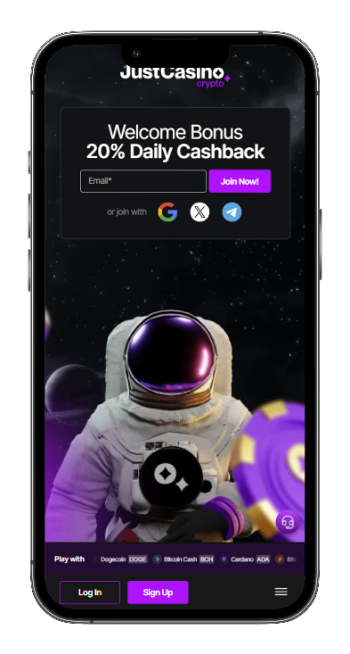
JustCasino earns the top spot on this list because its welcome offer is structured differently from every other casino here. Rather than a deposit match with a wagering hurdle, you get 20% of your net daily losses returned as cashback for seven consecutive days, with a $100 daily cap and zero wagering requirements on what you receive. For a player connecting via VPN and depositing crypto, that structure removes the two biggest friction points at once: no rollover to clear before withdrawing, and no fiat payment processor to flag your connection.
The platform operates under a Curacao license and accepts a wide range of major coins and stablecoins, with same-day withdrawal processing. The game lobby draws on 143 providers, covering slots, live dealer tables, crash games, and game shows. That depth is meaningfully above average for a crypto-licensed brand of this age. The mobile experience is fully browser-based, which suits the VPN-plus-mobile workflow well: no app store geo-check, no download required, and the responsive layout holds up cleanly on smaller screens.
The trade-off is that JustCasino launched in 2023, so its track record is still developing relative to older offshore brands. Some player reports flag inconsistency around complex withdrawal or verification queries. For routine crypto deposits and cashouts, the experience is consistently praised. For high-value or edge-case situations, approach with realistic expectations and keep your VPN server location consistent from registration through withdrawal.
Pros
- No-wagering daily cashback welcome offer is a genuine differentiator on this list
- Broad crypto payment stack with same-day withdrawals
- 143 game providers covering slots, live dealer, crash, and game shows
- Fully responsive browser-based mobile experience, no app download needed
Cons
- Launched in 2023, so the public track record is shorter than more established offshore brands
- Support consistency can vary on complex account queries
2. Best for High-Ceiling Bonuses: CoinCasino
- Welcome Bonus: 200% deposit match up to $30,000 plus 50 free spins on a minimum $10 deposit
- Crypto Support: BTC, ETH, USDT, SOL, XRP, ADA, AVAX, DOGE, LTC, TON, BONK, PEPE, SHIB, POL, and more
- KYC Level: Low, crypto-only infrastructure with automated payouts
- License: Anjouan | Payout Time: 0–24h
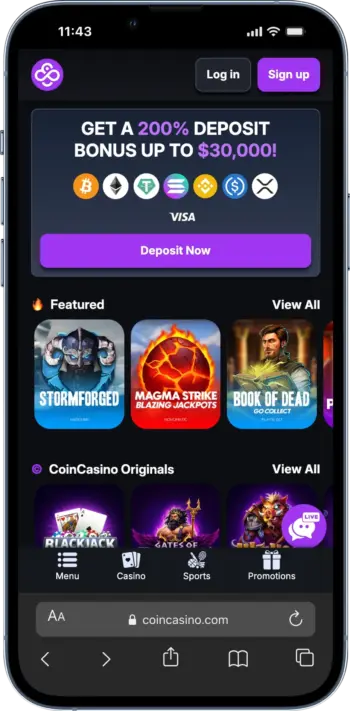
CoinCasino is positioned explicitly as a VPN-friendly platform by design, meaning its infrastructure is built to function normally under encrypted connections rather than treating VPN IPs as a fraud signal. That distinction matters: most offshore crypto casinos passively tolerate VPNs, but CoinCasino’s crypto-only architecture removes the fiat banking compliance layer that typically generates VPN-triggered payment flags. The result is a cleaner experience for players who route all traffic through a privacy tool.
The welcome offer tops out at $30,000 on a 200% match, which is one of the highest ceilings among the VPN-tolerant casinos on this list. The minimum deposit to trigger it is $10, keeping the entry point accessible. The platform has operated since 2017, giving it a longer track record than most crypto-native competitors. Its game library spans slots, live dealer, and table games sourced from 81 providers, complemented by a full sportsbook with live betting and cash-out functionality under a single crypto wallet.
The trade-off is a reputation that is uneven in practice. Editorial testers found live chat responsive, but user reviews describe inconsistent support quality around bonus disputes and withdrawal holds. High-rollers should treat the $30,000 bonus ceiling as aspirational and verify the current wagering terms before depositing at scale. The mobile experience is fully browser-based with a responsive dark-mode layout that navigates cleanly on smaller screens, well-suited to VPN users who tunnel all mobile traffic.
Pros
- Explicitly VPN-friendly by design, not just passively tolerant
- Crypto-only infrastructure with automated payouts and blockchain-verifiable transactions
- Integrated casino and sportsbook under one crypto wallet with live betting
- Established since 2017, giving it one of the longer track records among crypto-native offshore platforms
Cons
- Support quality is inconsistent, particularly around bonus disputes and withdrawal queries
- High-volume players should verify current wagering terms before depositing at scale
3. Best No-KYC VPN Casino: Betpanda
- Welcome Bonus: 100% deposit match up to 1 BTC with 80x wagering requirement over 7 days
- Crypto Support: BTC, ETH, USDT, LTC, SOL, XRP, DOGE, BNB, TRX, USDC, TON, SHIB, SAND, and more
- KYC Level: None upfront, no mandatory identity verification before play
- License: Costa Rica | Payout Time: 0–24h
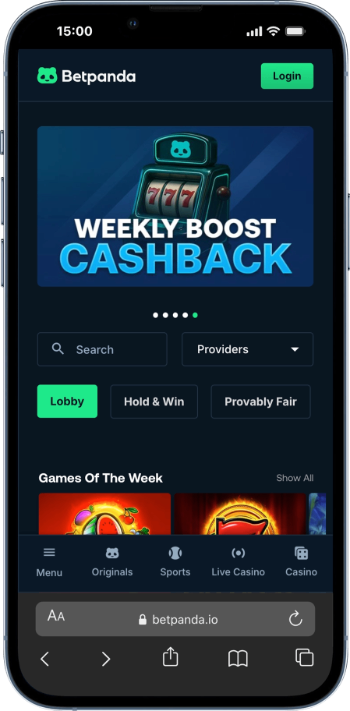
Betpanda is the most deliberately VPN-forward platform on this list. The site publishes explicit guidance on VPN use as a privacy and security enhancement, treating it as a feature rather than a policy violation. That transparency is unusual: most offshore casinos simply don’t mention VPNs in their terms, leaving players to test and hope. Betpanda removes that ambiguity, which is a meaningful differentiator for players who want certainty before depositing.
The no-KYC structure is the other reason this platform earns its ranking. There is no mandatory identity verification before you play or make initial withdrawals, which aligns directly with the privacy motivations that lead most players to use a VPN in the first place. The platform runs on an exclusively crypto-based payment stack covering a broad mix of major coins and stablecoins, enabling fast deposits and withdrawals without traditional banking intermediaries. The welcome offer is a 100% match up to 1 BTC, with an 80x wagering requirement that is on the higher side, so the bonus is best treated as extended play value rather than a quick-clear structure.
The trade-off is that Betpanda operates offshore without US regulatory oversight, and the United States is listed as a restricted jurisdiction. US-based play carries contractual risk and no local consumer-protection recourse if disputes arise. The mobile experience is responsive and navigates cleanly across casino, live tables, and sports sections. Support handles routine queries well, but player reports suggest quality drops in complex or high-value withdrawal situations.
Pros
- Publishes on-site VPN guidance, treating encrypted connections as a supported feature
- No upfront KYC required, the strongest privacy stack on this list
- Exclusively crypto-based payments with a broad coin selection and fast processing
- Integrated casino and sportsbook covering American football, basketball, soccer, and esports
Cons
- 80x wagering on the welcome bonus is on the higher end; treat it as play value rather than a fast-clear offer
- US is listed as a restricted jurisdiction, so US-based play carries contractual risk with no local recourse
4. Best for Crypto Depth: BC Game
- Welcome Bonus: 470% up to $4,000 plus 400 free spins across four deposits, 40x wagering within 30 days
- Crypto Support: 150+ coins including BTC, ETH, SOL, XMR, USDT, LTC, DOGE, and dozens of altcoins
- KYC Level: Low, flexible deposit thresholds, crypto-first onboarding
- License: Anjouan | Payout Time: 24h
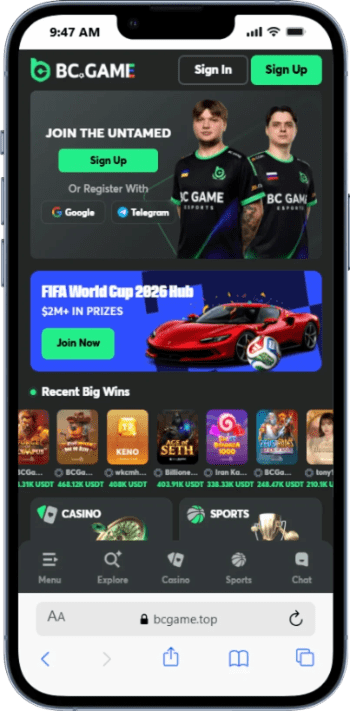
BC Game’s defining characteristic in a VPN-friendly casinos context is the sheer breadth of its crypto payment stack. With over 150 supported coins, including privacy-oriented options and a native token ecosystem with VIP and rakeback mechanics, it offers a depth of digital asset coverage that no other platform on this list approaches. For players who hold a diverse crypto portfolio and want to deposit directly without converting to BTC or USDT first, that flexibility is practically significant.
The VPN tolerance is widely reported in community accounts and support interactions: the platform does not actively police encrypted connections, placing it at the permissive end of the spectrum. The welcome package spans four deposits and delivers a 470% match up to $4,000 alongside 400 free spins, with a 40x wagering requirement and 30 days to complete it. That 30-day window is more generous than the 7-day structures common elsewhere on this list, giving you more time to clear the requirement without rushing your play.
The platform’s DeFi-style interface is polished and responsive across casino, in-house provably fair games, and a fully integrated sportsbook. The mobile experience is optimized across both major platforms. The trade-off is that the United States is formally listed as a restricted jurisdiction, meaning US-based play sits in a regulatory grey area with limited recourse if account disputes arise. Mixed community feedback around KYC checks and bonus confiscations is a real risk factor, particularly for players depositing at scale in restricted jurisdictions.
Pros
- 150+ supported cryptocurrencies, the deepest payment stack on this list
- Widely reported VPN tolerance with no active enforcement of encrypted connections
- Polished DeFi-style interface with provably fair in-house games alongside slots and sportsbook
- 30-day window to complete welcome bonus wagering, more generous than most competitors
Cons
- US is formally listed as a restricted jurisdiction, adding contractual risk for American players
- Community feedback includes reports of KYC checks and bonus confiscations at high-value withdrawal stages
Best VPN-Friendly Crypto Casinos: Where Crypto and Privacy Overlap
The overlap between VPN-tolerant casinos and cryptocurrency platforms is not coincidental. It reflects a structural difference in how these sites are built. Crypto-native offshore casinos have no fiat banking compliance layer, which means they have no reason to run the geo-IP checks that fiat payment processors require. A Visa or Mastercard transaction from a VPN IP that mismatches the cardholder’s billing country will often trigger a fraud flag. A Bitcoin deposit carries no such check: the transaction is pseudonymous, processes on-chain, and requires no bank intermediary to verify your location.
This is why VPN-friendly crypto casinos consistently appear in the same category. Operating under offshore licenses such as Curacao or Anjouan rather than US state frameworks, these platforms serve an inherently international player base. Their entire infrastructure is built for players connecting from multiple jurisdictions, which means VPN connections are structurally unremarkable rather than anomalous. The platforms on this list accept BTC, ETH, USDT, and LTC as standard, with many extending to SOL, XRP, ADA, and dozens of altcoins. BC Game’s 150+ coin support is the outlier at the top end; most platforms in this category cover 10–20 coins comfortably.
The combination of crypto payments and VPN access also intersects with KYC requirements. Because crypto deposits require no bank-level identity check, you can fund an account and begin playing without submitting documents. Most platforms on this list apply KYC only when withdrawal amounts cross certain thresholds or when unusual activity is flagged. That structure suits the VPN-friendly crypto casino use case directly: you get privacy at the payment layer and at the connection layer simultaneously, without needing to provide identity documents upfront.
Is Using a VPN to Gamble Online Legal? (US, UK, and Key Jurisdictions Explained)
The most important distinction in this entire article is the one between VPN legality and gambling legality. VPNs are legal tools in the US, UK, Canada, and Australia. Using one to browse the internet, protect your connection on public Wi-Fi, or access offshore casino apps is not a criminal act in any of these markets. The legal question is entirely separate: what is the legal status of the gambling activity itself, and does a VPN change that status? The answer to the second part is no. A VPN changes your apparent location; it does not change the underlying law that applies to you.
In the United States, online gambling law is primarily a state matter. A small number of states, including New Jersey, Pennsylvania, Michigan, West Virginia, Connecticut, and Delaware, have fully regulated online casino markets. In those states, the licensed operators use geolocation tools to enforce state borders. Using a VPN to access those platforms from outside the state violates the operator’s terms of service and potentially state gambling regulations. The situation is different for offshore platforms: these sites are not licensed by US regulators, operate under international licenses such as Curacao or Anjouan, and serve US players in a legal grey area. Individual players are rarely targeted for prosecution, but you lose access to state dispute resolution, guaranteed fund segregation, and formal self-exclusion programs when you play at unregulated offshore sites. Online gambling with VPN access to offshore platforms does not make the activity regulated or protected; it simply makes it technically accessible.
For readers outside the US, the picture varies by jurisdiction. The table below summarizes the key positions. This is not legal advice; consult a legal professional in your jurisdiction for specific guidance.
| Jurisdiction | Online Gambling Legal Status | VPN Use Legal | Offshore Casino Access via VPN | Risk Level |
|---|---|---|---|---|
| United States (federal) | Grey area; state-by-state regulation | Yes | Technically accessible; unregulated; individual prosecution rare | Medium |
| United States (regulated states: NJ, PA, MI, etc.) | Legal at licensed operators only | Yes | Violates licensed operator T&Cs; offshore access is unregulated | Medium-High |
| United Kingdom | Legal at UKGC-licensed operators | Yes | UKGC operators prohibit VPN/location masking in T&Cs; offshore access is unregulated | Medium |
| Canada | Province-regulated (Ontario has iGaming framework); offshore access common | Yes | Offshore access via VPN raises consumer-protection concerns; not explicitly criminalized for players | Low-Medium |
| Australia | Interactive Gambling Act 2001 restricts offshore operators from targeting Australians | Yes | VPN does not make offshore access legal under Australian law; enforcement against players is rare | Medium |
How to Check Whether a Casino Truly Allows VPNs Before You Sign Up
Knowing which casinos that allow VPN connections are genuinely tolerant versus which ones will lock your account after a large withdrawal is the practical question this section answers. The verification process takes about ten minutes and can save you from depositing into a platform that will freeze your funds the moment it detects an encrypted connection at payout time.
Start with the terms of service. Search the T&Cs for the words “proxy,” “VPN,” “IP masking,” “location spoofing,” and “virtual private network.” Red-flag language includes phrases like “use of proxy servers is prohibited,” “players must not mask their IP address,” or “accounts detected using location-spoofing tools will be suspended.” If any of these appear, treat the casino as VPN-hostile regardless of what affiliate sites claim. Offshore crypto casinos with Curacao, Anjouan, or Costa Rica licenses rarely include this language, because their business model does not depend on geo-compliance.
Next, understand how casinos detect VPN connections on their side. The most common methods are IP reputation databases (which flag known VPN server IP ranges), WebRTC leaks (which can expose your real IP even when a VPN is active in a browser), GPS versus IP mismatches on mobile devices, and browser fingerprinting that identifies VPN-associated patterns. A good VPN with DNS leak protection and a kill switch addresses the first two. Disabling device location services before connecting addresses the third. These are practical steps, not theoretical ones.
Finally, test before committing large funds. Make a small initial deposit, run a few sessions, and attempt a minor withdrawal before depositing at scale. If the platform processes that withdrawal without requesting additional verification or flagging your connection, you have a working baseline. Offshore crypto casinos are the safest category for this test because they structurally lack the geo-compliance obligations that make VPN detection worthwhile for state-licensed operators.
VPN-Friendly Casinos with Minimal KYC: The Privacy Stack
Players who use VPNs to access offshore casinos are frequently motivated by the same underlying concern that drives interest in low-KYC environments: privacy. The two needs overlap directly. A VPN masks your connection; crypto payments mask your financial identity; and a minimal-KYC casino reduces the point at which your real identity enters the picture. Together, these three elements form what privacy-focused players refer to as the privacy stack.
Full no-KYC is increasingly rare at offshore casinos. Most platforms that market themselves as “no KYC” mean no upfront KYC: you can register with an email address, deposit crypto, and play without submitting documents. The verification trigger typically comes at withdrawal, either at a specific threshold (often $2,000–$5,000 in accumulated withdrawals) or when the platform’s automated system flags unusual activity. Betpanda is the clearest example on this list: it publishes explicit no-KYC positioning and VPN guidance together, treating the combination as a deliberate product feature. BetGoat similarly markets instant access with no KYC as a core selling point. Zunabet also positions itself around no-KYC access with 20+ supported cryptocurrencies.
Crypto deposits are the mechanism that makes this stack work. Without a bank account or card in the transaction chain, there is no financial institution requiring identity verification at the payment layer. You can fund an account and begin playing using only a crypto wallet address. The practical implication: if you want both VPN tolerance and minimal identity friction, prioritize platforms that are crypto-only or crypto-primary, offshore-licensed, and explicit about their verification triggers. Platforms that accept fiat alongside crypto are more likely to apply KYC earlier, because the fiat payment processor requires it.
Bonuses at VPN-Friendly Casinos: What Changes When You Connect via VPN
The bonus structures at offshore VPN-tolerant casinos follow the same general categories as any online casino: welcome deposit matches, reload offers, cashback, and free spins. What changes when you connect via VPN is the risk profile around bonus eligibility and withdrawal. Understanding that risk before you claim is more valuable than any specific bonus figure.
Welcome Bonuses
The welcome offers across this list range from JustCasino’s no-wagering daily cashback structure to CoinCasino’s 200% match up to $30,000 and BC Game’s 470% spread across four deposits. The wagering requirements vary significantly: Telbet’s 15x on its 200% up to 1 BTC offer is one of the more manageable structures on this list, while Betpanda’s 80x on its 1 BTC match is on the higher end. When comparing welcome bonuses at VPN-friendly casinos, the wagering multiple matters more than the headline match percentage.
Reload Bonuses
Reload offers at offshore crypto casinos typically appear as weekly deposit matches or loyalty-tier bonuses. These are generally structured the same way as welcome offers and carry the same VPN-related risk: if the casino detects a VPN connection during bonus activation and its terms prohibit location masking, the bonus can be voided. At the platforms on this list, that risk is low by design, but it is not zero. Keep your VPN server location consistent from the moment you register, and do not switch server locations mid-session during an active bonus.
Cashback Offers
Cashback is the most VPN-safe bonus type because it is calculated on net losses rather than triggered by a deposit event. JustCasino’s 20% daily cashback with no wagering is the standout example: the return is credited automatically based on your play, with no geo-IP check required at the point of activation. Thrill and BetBolt both offer rakeback structures up to 70%, which function similarly. For players using VPNs, cashback and rakeback are the lowest-friction bonus types to claim.
VPN Casino Bonus Codes and Geo-IP Mismatch Risk
VPN-specific promo codes do not exist as a category. No casino on this list offers a code that unlocks a bonus specifically for VPN users. The “VPN casino code” search reflects a misunderstanding of how these bonuses are structured. What does exist is geo-IP mismatch risk: if a casino applies country-specific bonus terms (different wagering requirements or maximum win caps by jurisdiction) and detects a VPN IP that conflicts with your registered account details or KYC documents, it may apply the more restrictive terms or void the bonus entirely at withdrawal. The mitigation is straightforward: register, deposit, and claim bonuses while connected to the same VPN server location you plan to use throughout your account’s lifetime. Switching server locations after claiming a bonus is the most common trigger for geo-IP mismatch flags.
Which VPN Works Best for Online Casinos? Tested Options Compared
Most guides name-drop VPN products without a structured comparison. The table below evaluates the three most commonly recommended options against the specific requirements of casino use: obfuscated servers (to bypass VPN detection at the IP reputation layer), no-logs policy (for genuine privacy), connection speed (important for live dealer streams), and price. A fourth option, Proton VPN, is included because it is the most credible free option and its limitations for casino use are worth stating directly.
| VPN Product | Obfuscated Servers | No-Logs Policy | Speed Rating | Server Count | Best For | Monthly Price (approx.) |
|---|---|---|---|---|---|---|
| NordVPN | Yes (Obfuscated Servers feature) | Audited, no-logs | High | 6,000+ | Live dealer, consistent connections, general casino use | ~$3.99–$6.99 |
| ExpressVPN | Yes (Lightway protocol with obfuscation) | Audited, no-logs | Very High | 3,000+ | Speed-sensitive use cases, mobile casino play | ~$6.67–$12.95 |
| Surfshark | Yes (Camouflage Mode) | Audited, no-logs | High | 3,200+ | Budget-conscious players, unlimited device connections | ~$2.49–$3.99 |
| Proton VPN (Free) | No (paid plans only) | Audited, no-logs | Medium (free tier throttled) | Limited on free tier | Low-stakes testing before committing to a paid VPN | Free (limited) / ~$4–$10 paid |
For casino use specifically, NordVPN is the most practical all-around choice. Its obfuscated servers are designed to make VPN traffic appear as regular HTTPS traffic, which is the most effective approach against IP reputation databases used by casino platforms. The server count gives you flexibility in choosing a location that matches your registered account jurisdiction. ExpressVPN is faster on raw throughput, which matters if you play live dealer games with HD video streams and notice buffering under VPN latency. Surfshark’s Camouflage Mode performs comparably to NordVPN’s obfuscation at a lower price point, making it the strongest option if you want to connect multiple devices simultaneously.
Proton VPN’s free tier is worth mentioning honestly: the server selection is limited, speeds are throttled, and obfuscation is not available. It is adequate for testing whether a specific casino works with a VPN before you pay for a premium service. It is not adequate for sustained live dealer play or for bypassing more sophisticated VPN detection systems. For best server locations: choose a server in a jurisdiction where the casino operates and where your chosen payment method is valid. For most offshore crypto casinos on this list, a US server location is appropriate for US players. If you are testing access from a specific region, select a server in a country where the casino explicitly accepts players.
Risks of Using a VPN at Online Casinos and How to Minimize Them
Using a VPN at an online casino introduces specific failure modes that are worth understanding before you deposit. Here are the primary risks and the practical mitigation for each:
- Account suspension or permanent ban: If a casino detects a VPN connection post-deposit and its terms prohibit IP masking, it can suspend or permanently close the account. Mitigation: verify T&C language before registering; choose offshore crypto casinos that structurally tolerate VPN connections.
- Withdrawal delays or fund freezes: IP mismatch at payout time is the most common trigger for withdrawal holds. If the IP you used to deposit differs from the IP you use to withdraw, the platform’s fraud system may flag the discrepancy. Mitigation: use the same VPN server location consistently from registration through every withdrawal.
- Bonus voidance: Geo-IP flags during active bonus wagering can result in the bonus being voided and associated winnings confiscated. Mitigation: activate bonuses only after confirming the casino’s VPN tolerance; never switch server locations while a bonus is active.
- Payment method failures: Fiat payment methods (Visa, Mastercard, bank transfer) are particularly vulnerable to VPN-related failures. A billing address country that mismatches the VPN IP country can trigger payment processor fraud flags or chargebacks. Mitigation: use crypto for all deposits and withdrawals at VPN-friendly casinos; avoid fiat methods entirely in this context.
- WebRTC IP leaks: Some browsers expose your real IP address through WebRTC even when a VPN is active, which can undermine the connection masking entirely. Mitigation: use a VPN with built-in DNS leak protection and disable WebRTC in your browser settings, or use a browser that blocks WebRTC by default.
Games Available at VPN-Friendly Casinos
The game libraries at offshore VPN-tolerant casinos are generally broad. Slots dominate by volume: most platforms on this list source content from multiple providers, giving you access to titles from Pragmatic Play, Hacksaw Gaming, Evolution, and dozens of others under a single account. BC Game’s library spans slots, provably fair in-house titles, and a full sportsbook. JustCasino’s 143-provider roster covers slots, live dealer tables, crash games, and game shows, which is above average for a crypto-licensed brand.
Live dealer content is a meaningful differentiator at the top end of this list. Betfury carries over 1,100 live dealer tables, which is one of the largest live catalogs available at any offshore platform. MegaDice also emphasizes live dealer depth with over 170 immersive tables. For players who want the live casino experience through a VPN connection, these platforms are the practical choices, though live dealer streams require a stable, fast VPN connection to avoid buffering.
Crash games and crypto-native titles are a distinct category at offshore platforms that rarely appears at state-regulated casinos. Games like crash, plinko, and dice are standard at most crypto-native offshore sites on this list. These are provably fair by design: the outcome is determined by a hash-verified algorithm that players can independently verify, which adds a transparency layer that traditional RNG slots do not provide. Note that game provider availability can vary by IP region even at VPN-friendly casinos: some providers restrict their content by territory at the software level, which means a VPN server location change may affect which titles load in your lobby.
How to Use a VPN at an Online Casino: Step-by-Step
The process below applies to any of the offshore crypto casinos on this list. Follow it in order: skipping steps, particularly the cache-clearing and location-disabling steps, is the most common cause of VPN detection at the casino side.
- Step 1: Choose a VPN with obfuscated servers and a no-logs policy: Select NordVPN, ExpressVPN, or Surfshark based on your budget and device count. Enable the obfuscation or camouflage mode before connecting to ensure your VPN traffic appears as standard HTTPS traffic to the casino’s IP reputation system.
- Step 2: Select a server in an appropriate jurisdiction: Choose a server location that matches the jurisdiction where the casino accepts players and where your crypto wallet is based. For most US players using offshore platforms, a US server location is the most consistent choice. Do not use a server in a country where the casino explicitly restricts players.
- Step 3: Clear your browser cache and disable device location services: Clear cookies and cached data from any previous casino sessions before connecting. On mobile, disable GPS and device location services entirely. This prevents GPS-versus-IP mismatch detection, which is one of the more reliable casino-side VPN detection methods on mobile devices.
- Step 4: Register your account while connected to the VPN: Complete the registration process with the VPN active and connected to the server location you selected in Step 2. The IP address logged at registration becomes the baseline the casino uses for subsequent sessions. Registering without the VPN and then connecting it later creates an immediate mismatch.
- Step 5: Deposit using crypto: Fund your account using Bitcoin, Ethereum, USDT, or another supported cryptocurrency. Avoid fiat payment methods: card and bank transfer transactions carry billing address data that can mismatch your VPN IP and trigger payment processor fraud flags.
- Step 6: Maintain a consistent server location for all future sessions: Every login, deposit, bonus activation, and withdrawal should use the same VPN server location. Switching server locations mid-account is the single most common trigger for IP mismatch flags at withdrawal time. If your VPN app updates and reassigns your server, reconnect to the same location manually before opening the casino.
How We Selected These VPN-Friendly Casinos
Our editorial team evaluated more than 30 VPN-friendly casino sites to produce this ranked list. The methodology prioritized factors directly relevant to VPN and crypto use rather than generic casino quality metrics.
- VPN tolerance verification: We checked terms of service for explicit anti-VPN language, tested connections through encrypted tunnels, and cross-referenced community reports on specialist forums to identify platforms that actively block or penalize VPN connections.
- Crypto payment coverage and withdrawal speed: We evaluated the range of supported cryptocurrencies, the minimum deposit thresholds, and the quoted payout windows. Platforms with broader coin support and faster withdrawal processing ranked higher.
- Licensing and offshore structure: We verified license jurisdictions (Curaçao, Anjouan, Costa Rica, and similar offshore frameworks) and confirmed that the platform’s structure does not impose US state geo-compliance obligations that would make VPN detection worthwhile.
- Bonus fairness and geographic eligibility: We assessed wagering requirements, maximum win caps, and whether bonus terms include country-specific restrictions that could create geo-IP mismatch risk for VPN users.
- KYC requirement level: We identified at what point each platform triggers identity verification, distinguishing between no-upfront-KYC platforms and those that require documents before any withdrawal.
- Game library size and quality: We assessed provider counts, game category breadth (slots, live dealer, crash, provably fair titles), and whether live dealer content is available at a quality level compatible with VPN-added latency.
- Mobile experience: We evaluated whether the platform runs as a browser-based responsive site or requires a native app download, since app store geo-checks add a separate friction layer for VPN users.
Responsible Gambling
Gambling is entertainment, not a financial strategy. Set a budget before you play and treat losses as the cost of the experience. One specific point for VPN users: using a VPN to bypass self-exclusion programs or responsible gambling restrictions is harmful and is not a use case this guide endorses. If you have self-excluded from a platform and are considering using a VPN to regain access, that is a signal to seek support rather than a technical problem to solve.
If gambling is affecting your finances, relationships, or mental health, contact the National Council on Problem Gambling helpline at 1-800-522-4700 or text SUPPORT to 53342. International resources include GamCare and BeGambleAware. Regardless of your VPN status, use the responsible gambling tools available at your chosen platform.
- Set Deposit Limits: Decide your maximum weekly or monthly deposit before you open an account, and set it in the platform’s responsible gambling settings if available.
- Use Time Limits: Set a session timer. Most offshore platforms offer this in the account settings. If yours does not, use your device’s built-in screen time tools.
- Take Cooling-Off Periods: If you feel your play is becoming compulsive, use the platform’s cooling-off or time-out feature to pause your account for a defined period.
- Self-Exclusion: Most offshore platforms offer voluntary self-exclusion. Note that self-exclusion at an offshore casino does not link to state-regulated self-exclusion registers, so it covers only that specific platform.
- Never Chase Losses: Increasing your bet size to recover losses is the fastest route to significant financial harm. If you find yourself doing this, stop the session immediately.
Final Verdict
The category of VPN-friendly casinos is, in practice, the category of offshore crypto casinos. State-licensed US platforms use geolocation enforcement that makes VPN access a terms violation. Offshore platforms licensed under Curacao, Anjouan, or Costa Rica frameworks have no geo-compliance obligations and structurally tolerate VPN connections. The guide above maps out which of those offshore platforms are the most reliable choices for US players specifically, based on VPN tolerance, crypto depth, bonus structure, and KYC requirements.
JustCasino is our top pick for most US players: the no-wagering daily cashback structure removes the biggest friction point in the offshore bonus experience, and the broad crypto stack with same-day withdrawals is genuinely practical for players already operating in digital assets. CoinCasino is the strongest choice for players who want the highest possible welcome bonus ceiling and an explicitly VPN-tolerant infrastructure. Betpanda is the standout option for players who prioritize the privacy stack above all else, combining published VPN guidance with no upfront KYC and an exclusively crypto payment rail. BC Game suits experienced crypto players who hold a diverse portfolio and want the deepest coin support available at any offshore platform.
Open accounts at two or three platforms from this list rather than committing exclusively to one. Different platforms have different bonus cycles, game libraries, and withdrawal processing times. Spreading your play gives you flexibility and reduces the impact of any single platform’s support or payout delays.
FAQs
Is gambling using a VPN illegal?
VPN use is legal in the US, UK, Canada, and Australia. The legal question is not about the VPN; it is about the gambling activity itself. Using a VPN to access an offshore casino from the US does not make that activity regulated or protected, but individual US players are rarely prosecuted for accessing offshore sites. Using a VPN to access a state-licensed operator from outside that state violates the operator’s terms of service and potentially state gambling regulations. The VPN changes your technical access; it does not change the law that applies to you. This is not legal advice; consult a legal professional in your jurisdiction for specific guidance.
Which VPN is best for gambling?
NordVPN is the most practical all-around choice for online gambling with VPN access. Its obfuscated servers make VPN traffic appear as standard HTTPS traffic, which is the most effective approach against the IP reputation databases used by casino platforms. ExpressVPN is faster on raw throughput, which matters for live dealer streams. Surfshark offers comparable obfuscation at a lower price point and allows unlimited simultaneous device connections. All three have audited no-logs policies. Avoid free VPNs for sustained casino use: speed throttling makes live dealer play unreliable, and most free tiers do not include obfuscation.
Can a VPN allow you to gamble online?
Yes, technically. A VPN replaces your real IP address with one from the VPN server’s location, which can bypass geo-blocks that prevent access to specific casino sites. At offshore crypto casinos, which do not enforce geo-compliance, a VPN provides privacy and connection masking rather than access unlocking. At state-licensed US operators or UKGC-licensed platforms, VPN access may grant technical entry but violates the platform’s terms of service. The VPN gives you access; it does not give you legal permission to gamble in a prohibited jurisdiction.
What casinos allow VPN connections?
Offshore crypto casinos licensed under international frameworks such as Curacao, Anjouan, or Costa Rica are the casinos that allow VPN connections in practice. These platforms serve an international player base and have no structural reason to block encrypted connections. The full comparison table in this guide lists 38 such platforms with their VPN policy ratings. Betpanda is the most explicit, publishing on-site VPN guidance. CoinCasino is explicitly VPN-friendly by design. BC Game and JustCasino are widely reported as tolerant based on community accounts and T&C review.
What is the best VPN server location for online gambling?
For US players using offshore crypto casinos, a US server location is generally the most consistent choice. It matches your registered account jurisdiction and avoids creating a geo-IP mismatch between your location data and your VPN IP. If you are accessing a platform that restricts US players, choose a server in a jurisdiction where the casino explicitly accepts players and where your crypto wallet is based. The key principle is consistency: use the same server location from registration through every subsequent session and withdrawal. Switching locations mid-account is the most common trigger for IP mismatch flags.
Do VPN-friendly casinos require KYC verification?
Most do, but not upfront. The typical structure at offshore crypto casinos is no-KYC at registration and deposit, with verification triggered at withdrawal, either at a specific threshold or when automated systems flag unusual activity. Betpanda and BetGoat are among the platforms on this list that explicitly market no upfront KYC as a feature. Zunabet similarly positions itself around minimal verification. Full permanent no-KYC is increasingly rare: even platforms that advertise anonymous gambling are subject to their license conditions and AML obligations, which typically require identity verification at some point. Treat “no KYC” as “no upfront KYC” rather than “never KYC.”
Can using a VPN get your casino account banned?
Yes, at casinos that explicitly prohibit VPN use in their terms of service. The platforms most likely to ban accounts for VPN use are state-licensed operators and UKGC-licensed platforms, which use geolocation enforcement as a regulatory requirement. At the offshore crypto casinos on this list, account bans for VPN use alone are uncommon, because these platforms have no geo-compliance obligations. The more realistic risk at offshore platforms is withdrawal delays or bonus voidance triggered by IP mismatch, particularly if you switch VPN server locations between deposit and withdrawal. Keeping your server location consistent eliminates most of this risk.