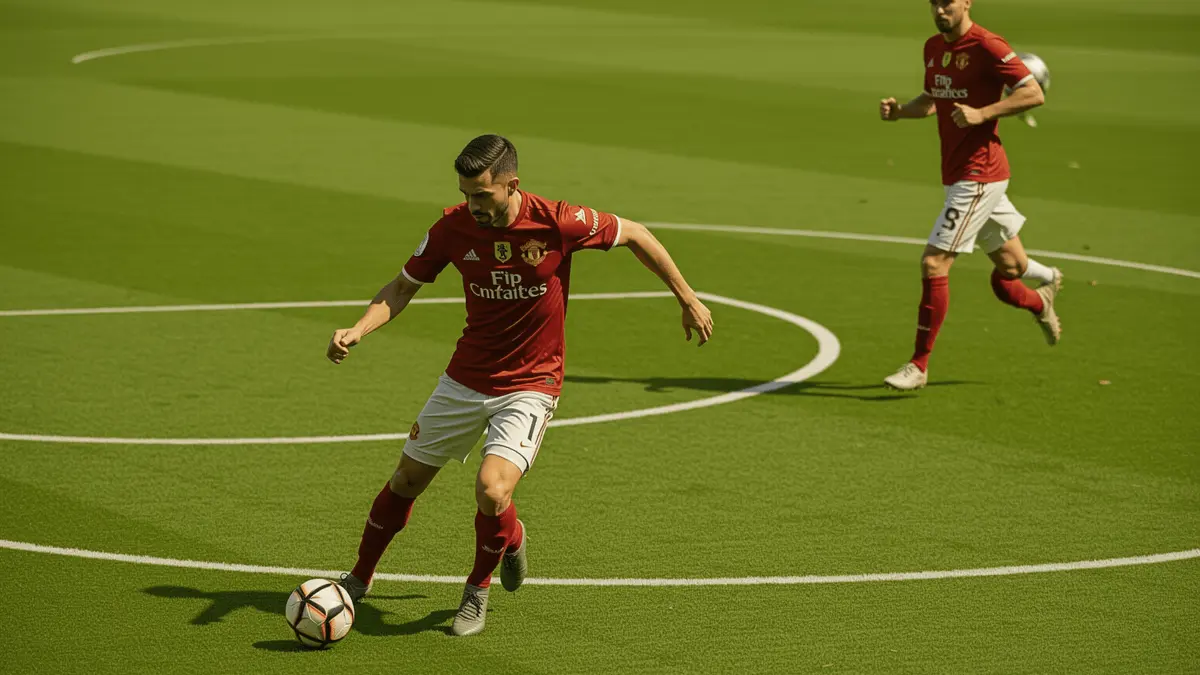
Manchester United have agreed a deal with Atalanta worth €45m – €40.5m fixed plus €4.5m in add-ons – to sign Brazilian midfielder Éderson, with the 26-year-old signing a four-year contract with the option of a fifth. The move is Michael Carrick’s first piece of summer business, and the positional logic is not subtle: United’s 4-2-3-1 has been structurally sound since Carrick took over in January but has operated with a midfield pivot that placed unsustainable demands on Kobbie Mainoo and pulled Bruno Fernandes too deep to be consistently dangerous. This analysis examines how Éderson’s specific profile resolves those structural tensions and what the partnership with Mainoo could produce.
The Vacancy Carrick’s System Created
When Carrick replaced Rúben Amorim in January 2026, his first decision was to abandon the 3-4-2-1 that had fractured the squad’s confidence and revert to a 4-2-3-1 the players could execute on instinct. The results were immediate: 11 wins from 16 league games, enough to secure Champions League football. But winning matches and controlling them are different problems, and the personnel in the double pivot only partly solved the control question.
With Casemiro and Mainoo as the pivot, United had a defensive screen and a ball-carrier, but the distribution of labour was lopsided. Mainoo was effectively running the build-up phase alone – receiving in tight spaces, carrying into midfield, covering the zones Casemiro could no longer reach at 33. Fernandes, rather than operating as a high roaming No.10 between the opposition’s midfield and defensive lines, was consistently dropping 35 to 40 yards to collect the ball and initiate attacks. That is not where his assists and shots originate.
Manuel Ugarte, expected to depart this summer, offered a different version of the same problem: good defensive positioning, limited carrying threat, and a passing range that recycled possession rather than advancing it. Carrick’s staggered pivot – one midfielder holding, one stepping higher – requires the deeper operator to do both jobs under pressure. Neither Casemiro nor Ugarte could sustain that across a full Premier League season.
Éderson’s Profile and Why It Maps onto the Role
Éderson developed under Gian Piero Gasperini at Atalanta, which contextualises his defensive output more than a raw numbers summary can. Gasperini’s system demanded that midfielders press in coordinated waves, recover second balls in transition, and operate as the engine of a counter-pressing structure rather than a passive defensive screen. The fact that Éderson continued to produce in later Atalanta sides, after Gasperini’s methods were diluted under successor coaches, suggests the qualities are his rather than purely systemic.
His career Serie A averages of approximately 2.5 tackles and 1.5 interceptions per 90 are the surface metric. More telling is his pressing volume – consistently registering double-digit pressures per game with a strong duel success rate – and his on-ball numbers in the progressive phases. Data from his last two Serie A seasons shows him averaging roughly 4–5 progressive carries and 3–4 passes into the final third per 90, figures that reflect a midfielder who advances possession by carrying into space rather than distributing it sideways.
At six feet and with exceptional stamina, Éderson also wins the physical duels that the Premier League’s tempo multiplies. He is not a Casemiro replacement in profile – he is younger, more mobile, and more capable of driving out of a press rather than simply absorbing it. The combination of defensive coverage and forward carrying is precisely what the staggered pivot Carrick prefers demands from its anchoring midfielder.
A detailed tactical breakdown of his positional role and how it integrates with Carrick’s system is available via Total Football Analysis, which maps his movement patterns against the specific spatial requirements of United’s build-up structure.
The Mainoo Partnership and the Staggered Pivot
Carrick’s preferred pivot is not a symmetric one. At Middlesbrough, he deployed Jonny Howson and Hayden Hackney with a clear functional split: one player anchored the defensive structure, the other stepped into the half-spaces to support the attack or receive under pressure. The same logic governs his United system, where the pivot is staggered depending on whether United are in build-up or pressing phases.
Mainoo’s natural game is best expressed as the more dynamic half of that pairing – pressing aggressively, carrying into the right half-space, and arriving late into the box on second-phase attacks. He is most dangerous when he does not have to constantly make decisions under pressure at the base of the midfield. The problem without Éderson is that someone has to make those decisions, and Mainoo was the one making them by default.
With Éderson as the anchoring midfielder, the division of labour becomes coherent. Éderson receives between the lines under pressure, carries forward to advance United’s shape, and covers the zones that Mainoo vacates when stepping higher. Mainoo is released to operate further up the pitch, where his driving runs and late arrivals are more dangerous. The two roles are complementary rather than overlapping, which is the structural pre-condition for a productive double pivot.
What Fernandes Gets Back
The clearest beneficiary of this arrangement is Fernandes himself. A pivot that can progress the ball without requiring him to collect it deep means Fernandes can position himself in the space between the opposition’s midfield and back four – the area from which his through-balls and shots are generated, not the area 40 yards from goal where he has been forced to operate as a ball-retriever.
Italian analysts who tracked Éderson through the 2024-25 Serie A season noted consistently that he functions as a midfielder who elevates the creative No.10 above him – not by chance, but because his carrying and line-breaking draw opposition midfielders out of shape, opening passing lanes for the player operating in behind. Fernandes living closer to Benjamin Šeško, Bryan Mbeumo, and Matheus Cunha also compresses the distance between United’s No.10 and their forwards, giving the attack a more connected shape in the final third.
Šeško in particular stands to benefit. The Slovenian striker’s hold-up play and movement off the shoulder are best exploited when the supply is early and controlled rather than long and contested. A pivot that recycles possession at speed and carries into the final third with purpose creates the conditions for a central striker to feed off a coherent platform rather than isolated set-pieces and transitions.
The Pressing Geometry and Defensive Transition
Carrick’s United under his first half-season pressed higher and more compactly than the passive mid-block Amorim had employed. The full-backs narrowed into supporting roles rather than bombing forward indiscriminately, and the pivot was asked to cover the distances created by Fernandes’s forward runs. That structure places significant spatial responsibility on the deeper midfielder, who must read when to step and when to hold.
Éderson’s pressing intelligence – developed across multiple Atalanta seasons in a system that used coordinated pressing triggers rather than reactive chasing – suits this precisely. He steps into passing lanes early rather than reacting to the pass, which is the difference between a pressing midfielder who contributes to the structure and one who disrupts it by leaving gaps. His positioning on defensive transition, covering the zones Fernandes vacates when the attack breaks down, is the least visible but most structurally important part of what he provides.
Carrick is also likely to experiment with asymmetric full-back positioning – one tucking narrower to support the pivot, one overlapping in the wide channel – which would give Éderson defined carrying lanes centrally rather than forcing him to navigate a congested central block. Pre-season friendlies will clarify whether he operates on the left or right side of the pivot and how that positioning interacts with Mainoo’s movement.
The Honest Caveats
Atalanta’s last two seasons were structurally less demanding than the peak Gasperini years, and some of Éderson’s output reflects a side that conceded more midfield territory than it once dominated. United are partly buying a projection of the player he was at his best rather than a guaranteed continuation of it. The Premier League’s tempo, particularly the pace of pressing from opposition midfielders and the physical intensity across a 38-game season, is a meaningful step up from where Atalanta spent much of 2024-25.
There is also the passing ceiling question. Éderson is a strong progressive carrier and a competent distributor, but the profile that most demands elite distribution from the deepest midfielder – a Rodri-style controller who dictates rhythm through the passing range rather than the carrying range – remains unfilled. United may find that Éderson and Mainoo together still lack a composed deep distributor for the moments when carrying is not an option. That is a solvable problem but not yet solved.
The weight of the shirt deserves mention. United have signed midfielders who mapped cleanly onto the system on paper and then found Old Trafford a different proposition entirely. Éderson’s temperament – composed in high-pressure Atalanta environments, experienced in European knockout football – gives reasonable grounds for confidence. It does not make the risk disappear.
Verdict
At £38m for a 26-year-old who enters his prime having produced consistently in one of Serie A’s most demanding pressing structures, the fee is proportionate to the functional gap being filled. This is not a marquee transfer designed to generate headlines; it is a structural signing designed to make the existing parts of Carrick’s system work as intended. The benchmark for success is not goals or assists but whether Fernandes plays 20 metres higher up the pitch by February and whether Mainoo’s half-space arriving becomes a consistent attacking weapon rather than an occasional one.
United’s front line – Šeško, Mbeumo, Cunha – is expensive and purposeful. The engine room was the bottleneck. Éderson, if he settles at the tempo the Premier League demands, removes that bottleneck. The coherence of the deal, relative to a decade of midfield recruitment that prioritised name recognition over systemic fit, is the clearest indicator that Carrick and the recruitment operation are aligned on what the team actually needs.